How big is a septic tank? Sizes, capacities, and what you need
By the SepticMind Editorial Team
TL;DR
- Most residential septic tanks hold 1,000 to 1,500 gallons.
- A 1,000-gallon tank is the typical minimum for a 1-3 bedroom home in most states, while 4-bedroom homes usually require 1,200-1,500 gallons.
- The right size depends on your bedroom count, local code, daily water use, and how often you want to pump.
- Undersizing is the single most common cause of early septic failure.
What is a typical septic tank size for a house?
For most single-family homes, it's a 1,000-gallon tank on the smaller end and a 1,250 or 1,500-gallon tank on the larger end. That range covers roughly 80% of the residential installs you'll ever see. Anything under 750 gallons reads as undersized under nearly every state code written in the last 30 years, and anything over 2,500 gallons on a residential lot is unusual enough that your installer will ask why.
The EPA's SepticSmart program puts it plainly: the standard design assumption for wastewater is 50 to 100 gallons per person per day, and most engineers work off 75 [1]. Take a 3-bedroom home, assume 2 people per bedroom, and you're designing for 450 gallons of flow a day. A 1,000-gallon tank gives you a bit more than 2 days of retention time, which is the window solids need to settle before liquid moves on to the drain field [2].
Here's the clean version to remember. A residential septic tank holds 1,000 to 1,500 gallons, and that answer is right most of the time.
How is septic tank size determined by bedrooms?
Bedroom count is the sizing proxy almost every state code uses. The logic runs in a straight line: bedrooms predict maximum occupancy, occupancy predicts water use, water use drives tank volume. Engineers don't size to your actual family. They size to the most people who could legally sleep in the house.
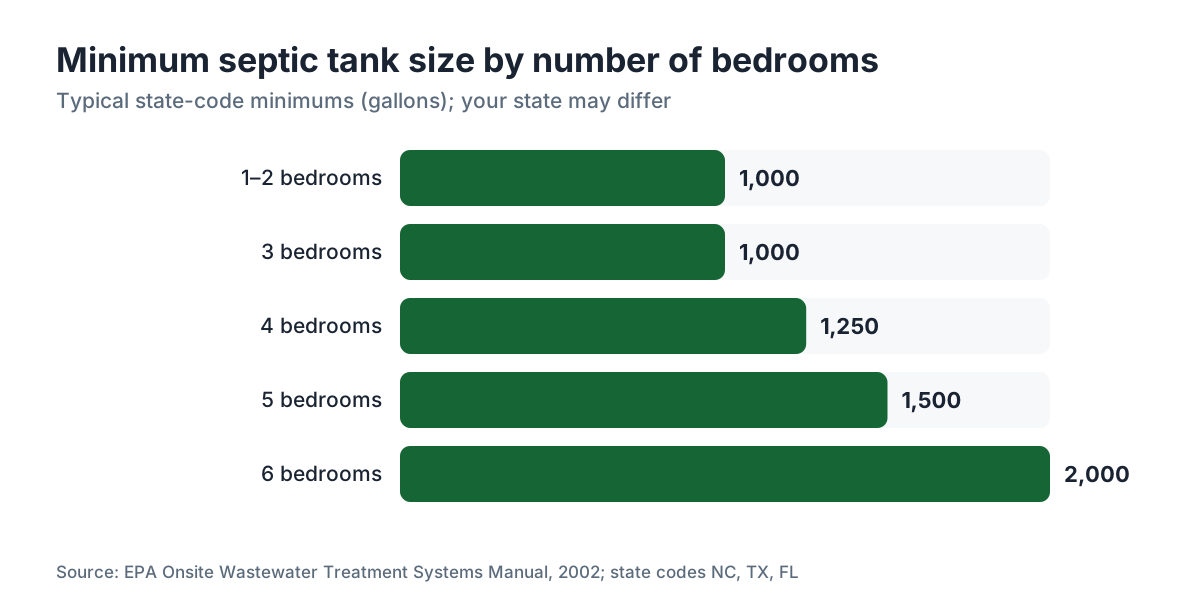
Here's how the numbers land across commonly referenced state guidelines and the EPA design manual [1][3]:
| Bedrooms | Typical minimum tank size | Daily design flow (at 75 gal/person) |
|---|---|---|
| 1 to 2 | 750 to 1,000 gal | 150 to 225 gal/day |
| 3 | 1,000 gal | 225 to 300 gal/day |
| 4 | 1,200 to 1,500 gal | 300 to 375 gal/day |
| 5 | 1,500 to 2,000 gal | 375 to 450 gal/day |
| 6 | 2,000 to 2,500 gal | 450 to 525 gal/day |
Some states set a flat 1,000-gallon floor for any residential installation, regardless of bedroom count. North Carolina requires a minimum of 1,000 gallons for up to three bedrooms [4]. Pennsylvania uses a similar floor. Check your state's onsite wastewater code directly, because the table above reflects common practice, not a universal law.
One thing that catches people off guard. Add a bedroom, and you may legally trigger a tank replacement or a second tank in series. Your county health department treats a bedroom addition as a permit event for exactly this reason.
What are the physical dimensions of a standard septic tank?
Gallons are what the code cares about. Dimensions are what you care about when you're locating a tank, digging around it, or trying to figure out why the lid sits 4 feet down.
Most precast concrete tanks in the 1,000-gallon range run about 8 to 9 feet long, 5 feet wide, and 5 to 6 feet deep [5]. A 1,500-gallon tank is usually 10 to 11 feet long with similar width and depth. None of this is fixed. Precast manufacturers vary, and plastic or fiberglass tanks often carry different proportions (taller and narrower, so they fit through access gates or tight yards).
| Tank capacity | Approx. length | Approx. width | Approx. depth |
|---|---|---|---|
| 750 gal | 6.5 ft | 4.5 ft | 4.5 ft |
| 1,000 gal | 8.5 ft | 5 ft | 5.5 ft |
| 1,250 gal | 10 ft | 5 ft | 5.5 ft |
| 1,500 gal | 10.5 ft | 5.5 ft | 5.5 ft |
| 2,000 gal | 12 ft | 6 ft | 6 ft |
Depth from the ground surface to the top of the tank depends on burial depth, usually 12 to 36 inches of soil cover in most climates. That's why one homeowner has a lid 18 inches down and another is digging past 4 feet. In a cold climate, deeper burial protects against freeze damage. Warmer climates often set tanks shallower so pumping stays easy.
Fiberglass and polyethylene tanks weigh a lot less, which makes them easier to install by hand or with a small machine. The catch is strict backfill requirements. Fill around a plastic tank with the wrong material, or skip filling it with water before backfilling, and the tank can float or deform. Concrete tanks don't do that, which is why they still dominate residential installs despite the weight.
Does tank size affect how often you need to pump?
Yes, directly. The EPA recommends pumping every 3 to 5 years for a typical household, but that number assumes your tank is sized right for the people actually living there [1]. An undersized tank packs on sludge and scum faster, and that shortens the interval between pumpings.
The math is simple. A 1,000-gallon tank serving 2 people fills with solids far slower than the same tank serving 6. Most industry references use a rule of thumb of about 0.5 to 0.7 cubic feet of sludge per person per year, though the EPA's design manual notes it swings with diet, garbage disposal use, and antibacterial products that suppress the bacteria doing the breakdown [2].
Run a garbage disposal daily and you should cut your pump interval by at least a year. Disposals dump ground food solids into the tank faster than the bacteria can work through them, no matter how big the tank is.
To keep pump intervals and system records straight, operators and homeowners increasingly lean on tools like SepticMind to flag when a tank is due based on household size and last service date. That's useful precisely because the 3-to-5-year rule is a range, not a schedule.
More on timing lives in our guide on how often to pump a septic tank.
What size septic tank do I need for a commercial or high-use property?
Residential sizing rules fall apart on commercial properties, rentals packed with occupants, and high-water-use operations. A restaurant generates 25 to 50 gallons per seat per day before you count kitchen prep, dishwashing, and grease [3]. A campground or RV park runs on a flow pattern that looks nothing like a house.
Commercial and institutional systems get sized off actual flow calculations, usually written into a design report stamped by a licensed engineer. Many states require engineered design for any commercial system, and some require it for residential systems above 1,500 gallons per day of design flow.
For small rentals (a duplex, a mother-in-law unit, a small office), the practical question is whether one shared tank serves both units or each unit gets its own. Most local codes want separate systems for separate dwellings, but some allow a shared tank if it's sized for the combined bedroom count. Ask your county health department, not your installer, because permit approval drives the answer.
Getting this wrong costs real money. An undersized commercial tank can fail a septic inspection and force an emergency replacement. See our breakdown of the cost to put in a septic tank if you're planning an install.
Does a bigger tank always mean better performance?
No. A bigger tank does buy you more retention time, so solids settle more thoroughly before effluent reaches the drain field. That part is genuinely good for your leach field. But oversizing carries drawbacks nobody talks about enough.
When your daily flow runs far below what the tank was built for, the bacterial population inside doesn't stay as active. A low-flow household on a 2,500-gallon tank gets longer retention times but weaker anaerobic digestion. Effluent quality can actually drop, because the microbes that break down solids need steady feeding to hold their numbers.
Oversizing also costs more upfront. A 2,000-gallon concrete tank typically runs $1,200 to $2,000 for the tank alone, before excavation, delivery, and labor [6]. A 1,000-gallon tank might be $700 to $1,100. Installation cost is roughly the same either way, so you're paying a real premium for capacity you may never touch.
My honest advice: size the tank for your bedroom count per code, bump up one tier if you run a garbage disposal or push heavy water use, and stop. The drain field design matters at least as much as tank volume for how the system holds up over decades.
What are the different materials septic tanks are made from, and does it affect size?
Concrete dominates in the U.S. and it's what most codes default to. Precast concrete tanks come in nearly every size from 500 gallons to 10,000 and up, and installers have been setting them long enough to do it in their sleep. They're heavy (a 1,000-gallon concrete tank weighs around 8,500 pounds) and they can crack over decades, but they sit stable, they don't float, and they hold up under vehicle traffic when designed for it [5].
Fiberglass tanks weigh a fraction of that (typically 400 to 600 pounds for a 1,000-gallon unit), shrug off corrosion, and don't crack. They show up a lot in coastal areas where soil conditions make concrete delivery a headache. The tradeoff is cost (usually 10 to 20% more than concrete) and the need for careful installation.
Polyethylene tanks are the lightest option, easy to haul into tight spaces, and cheaper than fiberglass. They're common out west and anywhere getting a concrete truck in is impractical. They need water inside before backfilling or they'll float.
Material rarely changes the gallon capacity you need. Size comes from code and household load, not from what the tank is made of. What material changes is installation method, longevity, and site access. If your yard has a narrow gate or soft soil, your installer will probably push fiberglass or poly even when concrete is on the table.
How do I find out what size tank I already have?
Start with your property records. When a septic system gets permitted, the county or state health department files an as-built diagram showing tank location, size, and sometimes material. It's a public record in most states. Call your county health department and ask for the septic permit records for your address. Plenty of states now put these online.
If records are missing or you want to confirm, a licensed inspector can measure the tank directly during a septic tank inspection. They pop the access risers, probe the depth, and estimate volume from the interior dimensions. Some older tanks predate permit records entirely, especially anything installed before the 1970s.
You can also read the lid layout. Single-compartment concrete tanks from the 1960s and 70s often have one center lid. Modern two-compartment tanks (required by most codes since the 1980s) have two lids, one over each compartment. Measure the internal length and width through an open lid, multiply length times width times depth in feet, then multiply by 7.48 to turn cubic feet into gallons.
Knowing your real tank size matters for scheduling your septic tank pump out right. An oversized tank may go longer than the 3-to-5-year default. An undersized one may need it every 1 to 2 years.
What size tank does my state require? A look at actual codes
Every state writes its own onsite wastewater rules, and the gaps between them matter. Here's what a few big states actually require, pulled from their published codes [4][7][8]:
| State | Minimum residential tank size | Sizing method |
|---|---|---|
| North Carolina | 1,000 gal (up to 3 BR) | Bedrooms |
| Texas | 750 gal (1 BR), 1,000 gal (2-3 BR) | Bedrooms |
| Florida | 900 gal minimum | Bedrooms + daily flow |
| California | 1,000 gal minimum | Bedrooms + flow |
| Pennsylvania | 900 gal (up to 2 BR), 1,000 gal (3 BR) | Bedrooms |
| New York | 1,000 gal minimum | Bedrooms |
These are minimums. Your county may be stricter, and if your soil percolation rate is poor, your engineer may size up to make up for it. Many states rewrote their codes in the 1990s and 2000s. A tank installed in 1975 might have met the code of 1975 and still fall short of today's standard.
The EPA sets no federal tank size requirement for residential systems. Under the Clean Water Act, onsite wastewater regulation is delegated to states [9]. So guidance from the EPA's SepticSmart program is exactly that: guidance, not law. Your state code is the binding document.
Planning a new install? Pull the current edition of your state's onsite wastewater rules straight from your state environmental or health agency. Don't run on what the neighbor says his installer told him in 2003.
How does tank size connect to drain field size?
People fixate on the tank, but the drain field (also called a leach field or absorption area) is where most septic failures actually start. Tank size and drain field size are related but not proportional. The field is sized off your soil's ability to absorb effluent, not off your tank volume [2].
The soil percolation test (perc test) measures how fast water moves through your ground. Sandy soils drink effluent quickly and need smaller fields. Clay soils absorb slowly and need much larger ones, sometimes two to three times the square footage. In some soils, a conventional field simply won't work and you're into a mound system or drip irrigation instead.
Here's where tank size does connect to field health. A properly sized tank protects the field by catching solids before they reach the distribution pipes. An undersized tank that fills with solids fast can push those solids through to the field and clog the soil. That's the failure that costs $10,000 to $30,000 to fix, because you're replacing the field, more than the tank [6].
For how the field itself works, our leach field guide covers sizing and failure signs. If you're already fighting problems, septic system repair walks through what the fixes actually look like.
Operators tracking multiple properties use SepticMind's system records to flag when a tank's pumping history points to field risk before it turns into an emergency call.
What does it cost to install a properly sized tank?
Tank cost moves with size, material, region, and labor rates, but here's a realistic picture from contractor pricing and state permit databases [6]:
A 1,000-gallon precast concrete tank runs about $700 to $1,200 for the tank itself. Add $500 to $1,500 for delivery and install labor, $200 to $600 for excavation, and $100 to $300 for permits. Installed cost for the tank alone (not the full system) lands roughly $1,500 to $3,000 across most of the country.
A full new septic system (tank, drain field, distribution box, piping) typically runs $10,000 to $25,000 depending on system type, soil, and local labor. Mound systems, aerobic systems, or installs in difficult soil can push past $30,000.
Replacing a failed or undersized tank costs less than a complete new system, but the work still needs excavation, a permit, and inspection. A tank replacement alone often runs $3,000 to $8,000 installed. See the full breakdown in our septic tank installation and cost to install a septic system guides.
One surprise for a lot of people. The material cost gap between a 1,000-gallon and a 1,500-gallon tank is often only $300 to $500. Excavation and labor barely change. So if you're on the fence about sizing up, the extra cost of the bigger tank is usually small against the total job.
Frequently asked questions
How big is a septic tank for a 3-bedroom house?
A 1,000-gallon tank is the standard minimum for a 3-bedroom home in most states. Some states set higher minimums, and if your household has heavy water use or a garbage disposal, many engineers recommend stepping up to 1,250 gallons. Check your state's onsite wastewater code for the binding requirement in your area, since minimums vary.
How big is a septic tank for a 4-bedroom house?
Most state codes require 1,200 to 1,500 gallons for a 4-bedroom home. The jump from 3 to 4 bedrooms often triggers a mandatory size increase because the design occupancy crosses a threshold in most flow-based sizing tables. Confirm with your county health department before purchasing any tank.
What is the smallest legal septic tank size?
The smallest you'll see permitted in most U.S. states today is 750 gallons, and that's typically only for a 1-bedroom dwelling. Many states have moved their floor up to 1,000 gallons for any residential installation. Anything under 500 gallons is effectively obsolete and won't pass inspection in any jurisdiction I'm aware of.
How do I know what size septic tank I have?
Start with your county health department's permit records, which should include an as-built drawing with tank size listed. If records are missing, a licensed septic inspector can open the access lids, measure interior dimensions, and calculate volume. You can also estimate it yourself: measure length x width x depth inside the tank in feet, then multiply by 7.48 to convert to gallons.
How long does a properly sized septic tank last?
A concrete tank that's correctly sized and pumped on schedule lasts 40-50 years in most conditions. Fiberglass and polyethylene tanks can last 30-40 years. What shortens tank life is corrosion from hydrogen sulfide gas (common in concrete tanks), tree root intrusion, vehicle weight over the tank, and infrequent pumping that lets sludge corrode the inlet baffle.
Can a septic tank be too big for a small household?
Yes, technically. An oversized tank means lower wastewater temperatures and a less active bacterial population, which can reduce treatment efficiency. In practice, going one size tier above the code minimum is rarely a problem and often helps on resale. Going two or three sizes too large for a very small household can produce weaker effluent quality, but this scenario is uncommon in residential installs.
How big is a septic tank in a mobile or manufactured home?
Manufactured homes are sized by the same bedroom-count rules as site-built homes. A 3-bedroom manufactured home on its own lot needs the same minimum tank size as a 3-bedroom stick-built house under your state code. The difference is that park-model units in RV or mobile home parks may share a community system rather than having individual tanks.
Does tank size affect how much it costs to pump?
Yes, but not dramatically. Most pumping contractors price by the truckload, and a standard vacuum truck holds 2,000-3,000 gallons. Pumping a 1,000-gallon tank and a 1,500-gallon tank often costs the same ($250-$500 for most markets) because it's still one truck visit. Very large tanks (2,500+ gallons) may require multiple loads or a larger truck, which increases cost.
What happens if a septic tank is undersized for the house?
An undersized tank fills with solids faster, which shortens pump intervals and, more seriously, risks sending solids into the drain field. Once solids clog the soil absorption area, the field can fail permanently. Field replacement typically costs $10,000-$30,000. Catching undersizing early through regular inspections and pumping is far cheaper than replacing the field.
How big is a two-compartment septic tank compared to a single compartment?
The total volume is the same (a 1,000-gallon two-compartment tank holds 1,000 gallons), but the space is divided internally. Most modern designs split roughly 2/3 to 1/3, with the larger first compartment handling initial settling and the smaller second compartment providing additional clarification before effluent exits to the drain field. Two-compartment tanks have been the code standard since the 1980s in most states.
How big of a septic tank do I need for a guest house or ADU?
An accessory dwelling unit (ADU) or guest house usually requires its own separate system if it's a permanent dwelling, sized by its bedroom count under your local code. Some jurisdictions allow a shared tank if it's sized for the combined bedroom count of the main house and ADU. Always check with your county health department before building, because permit requirements vary widely.
Does installing a water softener affect what septic tank size I need?
Water softeners add salt brine and extra water volume during regeneration cycles, which can affect tank loading. The EPA's SepticSmart program notes that excessive salt from water softeners can disrupt the biological activity in the tank and add hydraulic load to the drain field. If you have a water softener, some engineers recommend adding one tank size tier above the code minimum as a buffer.
How big is a septic tank for a tiny house or cabin?
A studio or 1-bedroom tiny house typically gets a 500-750 gallon tank where local code allows, or a 1,000-gallon tank where that's the minimum. For seasonal cabins with very infrequent use, some states have reduced-flow provisions that allow smaller systems. Permanent year-round occupancy almost always triggers the standard residential sizing rules regardless of the home's square footage.
Is a 500-gallon septic tank big enough?
A 500-gallon tank is too small for most modern residential applications. Nearly every state code written after 1990 sets the minimum at 750-1,000 gallons. A 500-gallon tank might be permitted for a very small seasonal cabin with documented low use in certain jurisdictions, but for any full-time residence it would need to be replaced or augmented with a second tank in series.
Sources
- EPA, SepticSmart Program Overview: EPA recommends pumping every 3-5 years and uses 50-100 gallons per person per day as the design flow assumption for residential wastewater generation
- EPA, Onsite Wastewater Treatment Systems Manual (EPA/625/R-00/008): Hydraulic retention time of at least 24 hours is required for adequate solids settling before effluent reaches the drain field; drain field sizing is based on soil percolation rate, not tank volume
- EPA, Commercial Onsite Wastewater Design Guidance: Commercial properties including restaurants require flow-based sizing calculations rather than simple bedroom-count tables
- North Carolina Department of Health and Human Services, Onsite Water Protection Program (Laws and Rules for Sewage Treatment and Disposal, 15A NCAC 18E): North Carolina requires a minimum 1,000-gallon septic tank for up to three bedrooms under state onsite wastewater rules
- Penn State Extension, Septic Systems resources: Standard 1,000-gallon precast concrete tanks weigh approximately 8,500 pounds and typically measure 8-9 feet long by 5 feet wide by 5-6 feet deep
- HomeAdvisor / Angi, Septic Tank Installation Cost Data: A 1,000-gallon precast concrete tank costs approximately $700-$1,200; full residential septic system installation ranges $10,000-$25,000 depending on system type and conditions
- Texas Commission on Environmental Quality, On-Site Sewage Facilities Rules (30 TAC Chapter 285): Texas minimum tank size is 750 gallons for 1-bedroom and 1,000 gallons for 2-3 bedroom homes under 30 TAC Chapter 285
- Florida Department of Health, Onsite Sewage Treatment and Disposal Systems (Chapter 64E-6 FAC): Florida requires a minimum 900-gallon septic tank for residential installations under Chapter 64E-6 of the Florida Administrative Code
- U.S. EPA, Summary of the Clean Water Act: Under the Clean Water Act, regulation of onsite wastewater (septic) systems is delegated to individual states, not set by federal mandate
- University of Minnesota Extension, Septic Systems: Bedroom count is used as the standard proxy for maximum occupancy and therefore tank sizing because it predicts worst-case water use better than actual occupancy surveys
Last updated 2026-07-09