How deep are leaching fields, and why does it matter?
By the SepticMind Editorial Team
TL;DR
- Leach field trenches are usually 18 to 36 inches deep, with the perforated pipe sitting roughly 6 to 24 inches below grade.
- State code sets the minimum.
- Soil permeability, groundwater separation, and bedrock set the maximum.
- Most residential systems land between 2 and 3 feet of total trench depth.
- Alternative systems can go shallower or deeper depending on the site.
What is the standard depth of a leach field trench?
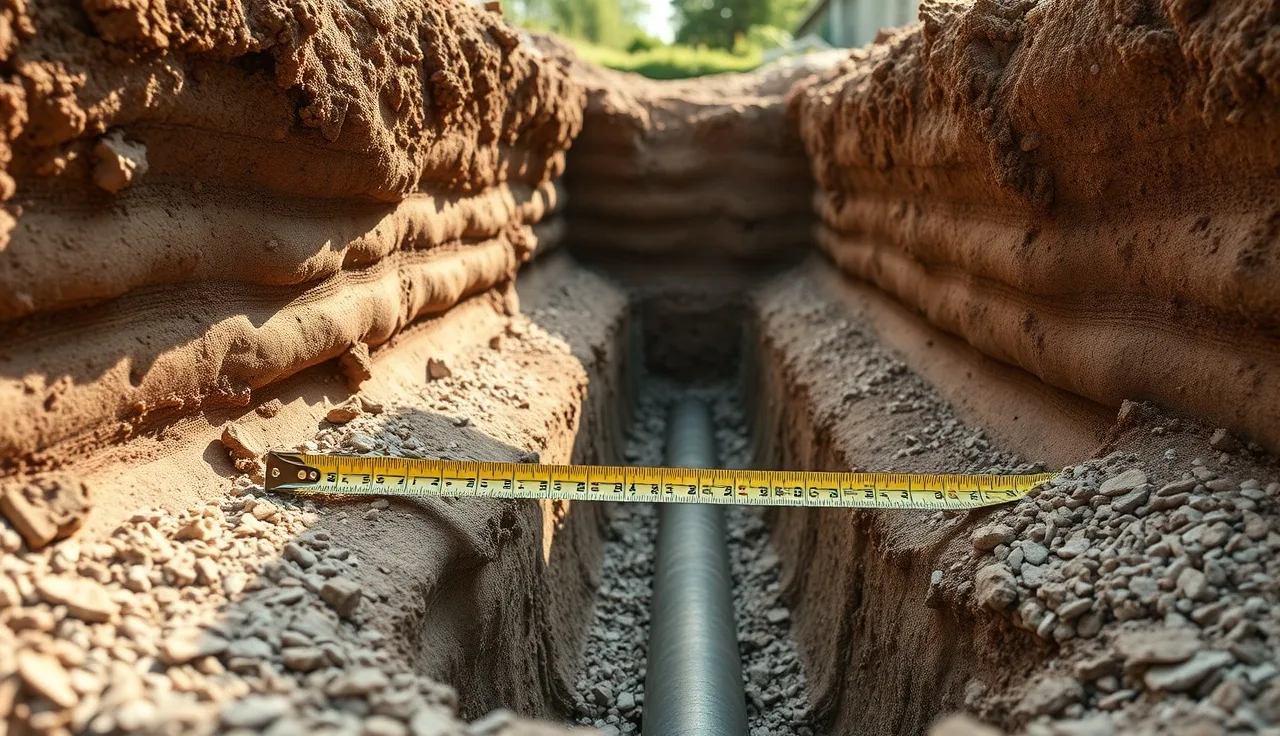
Most residential leach field trenches run 18 to 36 inches deep, measured from the ground surface down to the bottom of the gravel bed [1]. The perforated distribution pipe sits higher, somewhere between 6 and 24 inches below grade, resting on top of the stone with gravel and soil backfill above it.
That 18-to-36-inch window is not arbitrary. It gives the system enough native soil below the pipe to treat effluent through biological and physical filtration before the water reaches groundwater, while keeping the pipe shallow enough for gravity to move liquid through the field. Go too deep and you saturate soil that has no treatment capacity left before the water table.
Drip and chamber systems shift the numbers, but the principle holds: there has to be a minimum vertical distance between the bottom of the infiltrative surface and the seasonal high groundwater table. EPA guidance on onsite wastewater systems calls for at least 2 to 4 feet of unsaturated soil below the distribution medium, depending on soil type and local code [1].
The exact number for your property lives in your state's onsite wastewater regulations and your local health department's permit conditions. Many states publish design manuals with prescriptive trench depths by soil texture class. Check those before you assume the national rule of thumb applies to your lot.
What factors actually control how deep your leach field sits?
Depth is not a preference. Four physical and regulatory constraints drive it, and every one of them has to be satisfied at the same time.
Soil percolation rate is the biggest. Fast-draining sandy soil handles effluent quickly, so you need slightly less depth for treatment, but you also risk water moving through too fast to clean up. Clay or slow-perc soils often need shallower systems placed in the topsoil layer where biological activity peaks, a technique called pressure-dosed shallow placement [2]. The county or state engineer runs a percolation test and a soil morphology evaluation (reading soil color mottling) to figure out what your site can support.
Seasonal high groundwater is the hardest constraint to work around. Most state codes require 24 to 48 inches of vertical separation between the bottom of the gravel bed and the seasonally high water table [3]. If your water table is high, your trench bottom has to rise to stay above it. That is why coastal and lakefront properties so often end up with mounded systems instead of conventional in-ground trenches.
Bedrock works the same way. Plenty of Northeast and Upper Midwest lots sit on ledge only 18 to 30 inches down. The system cannot go below rock, so the designer installs a shallow system or brings in fill.
Frost depth matters in cold climates. Minnesota's code requires the distribution pipe be installed deep enough to prevent freezing, or that insulating blankets cover the trenches [4]. Northern-tier systems run at the deeper end of the range. Deep-South systems can run shallower because frost is not a concern.
The last one is grade. The elevation drop from the septic tank outlet to the field has to move liquid by gravity, which limits how shallow or deep you can place the pipe relative to the tank outlet.
How does depth differ between conventional and alternative leach field types?
Conventional gravel-and-pipe trenches are the baseline most people picture. Trench depth: 18 to 36 inches. Pipe depth: 6 to 24 inches. The 18-to-36-inch rule applies to this system directly [1].
Chamber systems (open-bottom plastic arches like Infiltrator's units) sit a bit shallower on average. The chambers replace the gravel bed, so you only need enough cover soil over the top for structural protection and plant uptake. Many chamber installs land at 12 to 24 inches of cover, with the chamber bottom at 18 to 30 inches below grade.
Mounded systems sit above grade on purpose, because the native soil is too wet, too shallow, or too slow to treat effluent. The distribution pipe is essentially at or just above original ground level, buried inside a constructed fill mound that rises 2 to 4 feet above the yard. Ask "how deep" for a mound and the honest answer is the pipe is nearly at the surface, while the treatment zone is the fill below and around it.
Pressure-dosed shallow drip and low-pressure pipe systems place the distribution lines at 6 to 18 inches, aiming at the biologically active upper soil. They need a pump, a dose timer, and tight dose sizing to work. They are a legitimate fix for poor-perc soils where a deep conventional trench would fail.
At-grade and gravelless systems sit in the middle. The infiltrative surface rests right at the original soil horizon, usually under a geotextile and minimal cover. You see them where soil is shallow over bedrock or a restrictive layer.
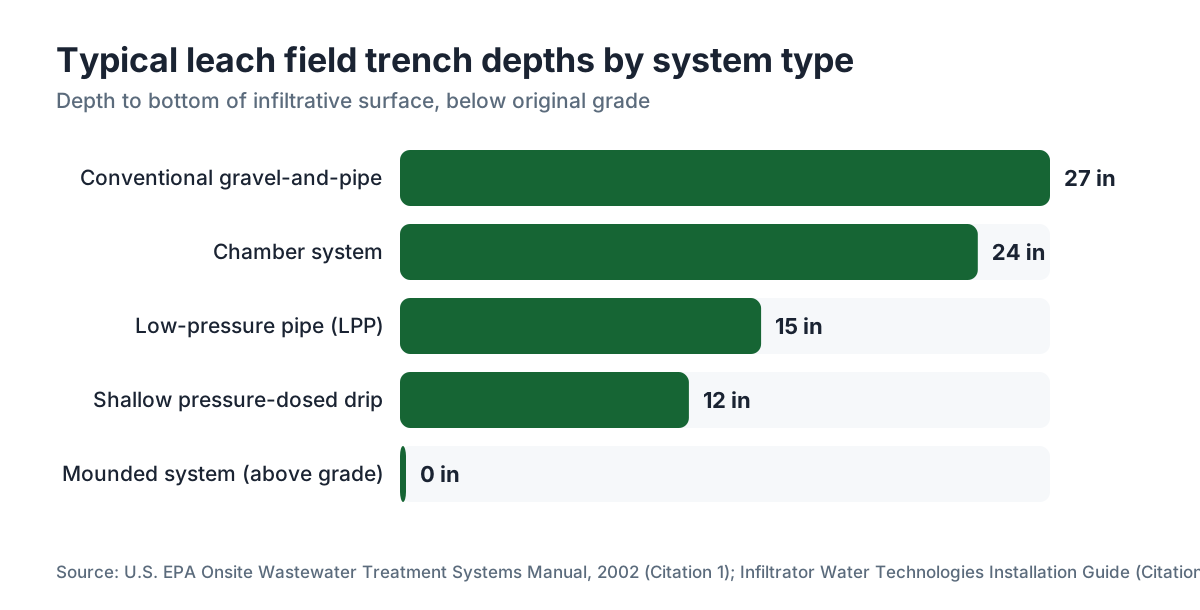
The table below sums up the typical depth ranges by system type.
| System type | Trench or bed depth (bottom of infiltrative surface) | Distribution pipe depth below grade |
|---|---|---|
| Conventional gravel-and-pipe | 18 to 36 in | 6 to 24 in |
| Chamber (gravelless arch) | 18 to 30 in | N/A (open bottom) |
| Pressure-dosed shallow drip | 12 to 18 in | 6 to 18 in |
| Low-pressure pipe (LPP) | 6 to 24 in | 6 to 18 in |
| Mounded system | At or above grade | At or slightly above grade |
| At-grade system | 0 to 6 in | 0 to 6 in |
What is the minimum depth required by code, and does it vary by state?
It varies a lot. There is no single federal code for leach field depth. The EPA sets general technical guidance through its onsite wastewater treatment systems manual, but implementation is entirely a state and local job [1].
Here is how the variation plays out. Florida requires the bottom of the drain field to be at least 24 inches above the estimated wet-season water table for conventional systems [5]. North Carolina requires naturally occurring soil between the trench bottom and any restrictive horizon, with minimum trench depths set by the site classification [6]. Minnesota specifies a 3-foot separation between the bottom of the system and the seasonal high groundwater, and requires designers to check January soil temperature data for freezing risk [4].
California has counties with their own standards layered on top of state rules, and regional water boards tighten requirements in groundwater-sensitive basins. Texas delegates almost everything to individual counties, so depth requirements in a rural Texas county can look nothing like a Dallas-area subdivision.
The short version: your local environmental health department or the engineer stamping your permit will give you the number that applies. You can usually find your state's standards by searching "[state] onsite wastewater regulations" or "[state] septic system design manual." Most states post these as PDFs on their environmental or health department sites [11].
Buying a home or checking an existing system? The single best source is the as-built permit on file with the county health department. It shows the actual design depth the installer followed.
How much soil must sit between the pipe and the water table?
This separation distance is the most safety-critical depth number in the whole system. Undertreated wastewater that reaches groundwater can contaminate drinking wells with pathogens and nitrogen. Everything else about depth is negotiable. This is not.
The EPA's 1980 design manual, still widely referenced, calls for 2 to 4 feet of unsaturated soil between the bottom of the distribution medium and the seasonal high water table, with the upper end applying to coarser, faster-draining soils [1]. Many state standards have since settled on 2 or 3 feet as a prescriptive minimum for conventional systems.
Florida's rule shows the real-world standard. Florida code requires that the bottom of the drainfield be no closer than 24 inches to the estimated wet-season water table [5]. North Carolina requires as little as 12 inches from the trench bottom to a seasonal high water table or rock for some system types, and 18 or 24 inches for others, depending on site classification [6].
Soil scientists find the seasonal high water table by reading soil color mottling. Iron and manganese minerals stain the soil gray, olive, or rust-orange at the depths where the ground saturates seasonally. A trained evaluator reads those color patterns and calls the seasonal high water table without waiting a full year for monitoring [10].
Say your soil evaluation shows mottling at 24 inches. A conventional 18-inch-deep trench with its gravel bottom at 18 inches leaves almost zero separation. That system fails code in most states. The designer would switch to a mound, import clean fill, or apply for a variance.
Does a deeper leach field work better, or can too deep cause problems?
Deeper is not automatically better. The intuition sounds right: more soil, more treatment. But below a certain depth the biological activity falls off a cliff, the aerobic zone disappears, and you are sending effluent into soil that can barely touch it.
The upper 12 to 24 inches of soil is where microbes do the most work. Plant roots, oxygen infiltration, freeze-thaw cycling, and organic matter all concentrate there [2]. Systems that place the infiltrative surface in that zone often beat deep conventional trenches on nitrogen and pathogen removal, which is the whole case for shallow pressure-dosed designs.
Go too shallow in a cold climate and the system freezes. A frozen distribution pipe stops lateral dispersal cold, and effluent backs up into the tank. That is a January emergency nobody wants.
Very deep trenches in low-permeability soil can hydraulically fail because water cannot move laterally fast enough. The trench fills, effluent backs up the pipe, and eventually backs up into the house. This is not theoretical. It is one of the more common failure modes in fine-textured soils, where a designer pushed depth to hit a separation requirement without checking whether the hydraulic loading rate still worked.
Correct depth is the depth that satisfies all four constraints at once: enough separation from groundwater and bedrock, enough soil biological activity, enough frost protection, and enough hydraulic gradient to move water. When those constraints fight each other, you need an alternative system, not a different trench depth.
How does depth affect leach field lifespan and failure risk?
Depth itself is not the main driver of leach field lifespan, but it is tied to the factors that are.
The leading cause of failure is biomat buildup, a layer of anaerobic bacteria and organic material that clogs the soil pores at the infiltrative surface [2]. Biomat gets worse in oversaturated, oxygen-poor conditions. Systems placed too deep in waterlogged soil, or hit with hydraulic overload because the trench is undersized for the household, grow biomat faster than a properly sized shallow system.
Groundwater encroachment is the other big one. A system installed right at the regulatory minimum separation may pass at permit time and still fail after a wet year raises the seasonal water table by 6 to 12 inches. The separation requirement is not a safety cushion on top of the minimum. It is the minimum. Building in extra separation when the site allows is just smart.
A well-designed, well-maintained leach field should last 25 to 30 years in most residential settings. The EPA's SepticSmart program points to poor maintenance and system overload as the main failure drivers, not depth [7]. That means pumping the tank on schedule, keeping non-degradable material out of the drains, and keeping vehicles and deep-rooted plants off the field.
For keeping the whole system healthy, the leach field guide covers maintenance in detail, and how often to pump your septic tank explains the tank-side schedule that directly protects field life.
What does a soil evaluation or perc test tell you about required depth?
Before any leach field gets a permit, the site goes through a soil evaluation. In most states that means two things: a percolation test and a soil morphology evaluation. Some states have dropped the perc test in favor of soil texture analysis alone.
The percolation test measures how fast water drops in a pre-soaked hole at the proposed trench depth. Results come back in minutes per inch (MPI). A slow rate over 60 MPI usually means conventional trenches will not work and the designer has to consider alternatives. A rate under 3 MPI (very fast) may need loading rate adjustments so untreated effluent does not race through coarse soil.
Soil morphology evaluation is done by a licensed soil scientist who digs test pits and describes what they find: texture, structure, color, mottling. Mottling depth tells them the seasonal high water table. Horizon depths tell them where restrictive layers like claypan, fragipan, or bedrock sit. All of it feeds the available depth for a system [10].
The evaluator's report drives the design depth directly. If the seasonal high water table shows up at 30 inches and the state requires 24 inches of separation, the trench bottom can go no lower than 6 inches below grade, which is basically impossible for a conventional system. The evaluator flags this, and the designer moves to an alternative.
Buying a home with an existing system? A septic tank inspection that includes the drain field gives you documentation of the actual condition, which beats guessing from a yard walk-around.
How deep should the gravel bed be inside the trench?
Inside the trench, the gravel bed has its own depth spec, separate from the overall trench depth.
Standard practice is 6 inches of clean stone below the pipe and 2 to 6 inches covering the pipe above [1]. That puts the aggregate bed at 8 to 12 inches thick in a typical trench. Above the stone sits geotextile fabric to keep soil out of the voids, then backfill soil to grade.
The stone has to be clean: no fines, no clay, no crushed limestone that dissolves and collapses the bed over time. Most specs call for 3/4-inch to 1.5-inch washed crushed stone or rounded river gravel. The void space in that stone stores effluent between dose events and spreads it to the soil below.
Chambered systems skip the stone entirely. The arch of the chamber creates the void space, and infiltration happens through the open bottom straight into native soil. Installation goes faster, and the systems perform on par with stone beds in most documented comparisons [9], which is why they now make up a large share of new residential installs.
Add it up for the total trench: 6 inches of gravel below the pipe, the pipe diameter (usually 4 inches), 2 to 6 inches of gravel above, and 2 to 4 inches of fabric and cover. That comes to roughly 18 to 24 inches just for the aggregate zone, which is why the total trench runs at least 18 inches even on a generous site.
How do you find out how deep your existing leach field actually is?
A few methods work. A few will cost you money for bad information.
Start with the as-built septic permit on file with your county health department or environmental health office. Most counties have kept these since the 1970s, and many have digitized their records. The as-built drawing shows the design depth, trench layout, and any special conditions. It will not confirm the system was built exactly to spec, but it is your baseline.
To verify the actual installation depth, a licensed septic inspector can probe with a metal rod to locate the distribution pipe and measure with a tape. Some inspectors run a camera through the distribution lines from the tank end. A standard septic tank inspection does not always include the field, so ask when you schedule.
For older properties where records are gone or the field has moved, ground-penetrating radar (GPR) can locate buried pipes and gravel beds with reasonable accuracy. It is a specialty service and not cheap, usually $300 to $800 depending on lot size and provider.
Do not dig random test holes looking for the pipe. You can tear the geotextile layer or collapse a trench sidewall. If you are chasing a suspected failure, let a licensed pro do any probing or excavation.
Worried about a home purchase or a possible failure? A full system inspection is the right move. The cost to install a septic system article gives context on what repairs or replacement might run if the evaluation turns up problems.
What happens when a leach field is installed at the wrong depth?
Too shallow in a cold climate and it freezes. Distribution pipes at 6 inches below grade with no insulation in Minnesota will ice over in a hard winter, backing effluent into the tank and the house. That is an emergency repair job.
Too shallow where groundwater is high and the trench gets submerged by the water table from below. Instead of treating downward, effluent pushes back up or sideways. Wet spots and sewage odors show up in the yard. Nearby drinking wells can be at risk.
Too deep in low-permeability soil and the system hydraulically overloads. Water ponds in the trenches, biomat forms on the sidewalls faster than normal, and the system saturates within a few years of installation. This is one reason clay-soil sites fail early so often, when the designer pushes depth to hit a separation requirement without cutting the hydraulic loading rate.
Insufficient separation from groundwater is the most serious outcome. The EPA has documented groundwater contamination from leach fields that failed to hold adequate vertical separation, especially for nitrate and fecal indicator bacteria [1]. Once a plume reaches a well, remediation is expensive and slow.
Bad installation depth usually stays invisible until the system fails. That is a big part of the case for as-built inspections when buying a property. If you ever see effluent surfacing over the field, standing water that lingers after dry weather, or sewage odors, call a licensed septic professional. Do not wait.
How does leach field depth relate to the cost of installation?
Deeper trenches cost more. That is physics and labor. Every extra foot of depth means more excavation, more aggregate, more pipe, and slower equipment cycles. On rocky or high-water-table sites that need engineered fill or a mound, costs can run 2 to 4 times a standard gravity trench install.
Nationwide, a conventional leach field installation runs roughly $3,000 to $15,000 depending on size, soil conditions, trench depth, and regional labor rates [8]. A mounded system that makes up for inadequate depth to groundwater typically adds $5,000 to $20,000 on top of the tank cost, because of the fill material, pump, and controls [8].
On sites flagged as shallow during the soil evaluation, the cost difference between a shallow pressure-dosed system and a conventional one is roughly neutral to slightly lower per linear foot. The added pump and controls close most of that gap, so overall system costs land close together.
The cost to put in a septic tank and cost to install a septic system articles break down the line items. For a failing field, knowing the depth requirements up front frames the conversation with your installer about what design is actually feasible on your lot.
Operators running multiple installs or service calls can use SepticMind's scheduling and job documentation tools to track site-specific depth data across properties. That saves real time when a repeat call comes in on a system you installed two years ago.
Frequently asked questions
How deep is the pipe in a leach field?
The perforated distribution pipe in a conventional leach field sits at roughly 6 to 24 inches below grade, resting on a 6-inch gravel bed inside the trench. Total trench depth is typically 18 to 36 inches. The exact pipe elevation depends on your state code, the hydraulic grade from the septic tank, and the minimum groundwater separation required on your specific lot.
How close to the surface can a leach field be?
Some states permit at-grade or very shallow systems as close as 6 to 12 inches to the surface, mostly for pressure-dosed systems in fine-textured soils where the biologically active topsoil is the treatment zone. Conventional gravity trenches are rarely permitted shallower than 12 to 18 inches, because you need structural cover over the pipe and aggregate. Frost, traffic loads, and groundwater separation set the practical lower limit.
What is the minimum separation between a leach field and groundwater?
Most state codes require 24 to 48 inches of unsaturated, naturally occurring soil between the bottom of the gravel bed and the seasonal high groundwater table. Florida requires 24 inches. Many Northern states require 36 inches. The EPA's guidance suggests 2 to 4 feet depending on soil type. Soil mottling during the site evaluation locates the seasonal water table and sets this constraint for the designer.
Can a leach field be too deep?
Yes. A trench placed too deep in fine-textured or low-permeability soil can saturate because water cannot drain fast enough, causing hydraulic failure and rapid biomat clogging. Very deep placement also puts effluent below the biologically active soil horizon where treatment is most effective. The ideal depth satisfies separation requirements while keeping the infiltrative surface in permeable, oxygen-rich soil.
How deep does a leach field need to be to avoid freezing?
In cold climates, distribution pipes usually need to be at least 18 to 24 inches below grade to avoid freezing, though the exact number depends on your region's frost depth. Minnesota requires designers to assess January soil temperature. Where burial depth alone is not enough, insulating foam boards or straw mulch go over the trenches. Regularly used systems also generate enough heat in the effluent to resist freezing.
How deep should a mound septic system be?
In a mounded system the distribution pipe sits at or just above the original ground surface, buried inside constructed fill that rises 2 to 4 feet above grade. The depth question inverts: you add elevation above ground rather than dig below it. The fill mound supplies the treatment volume that the native soil cannot, because the in-ground water table or a restrictive layer is too shallow for a conventional trench.
How deep are chamber leach field systems compared to gravel systems?
Chamber systems (plastic arch chambers like Infiltrator units) install at roughly the same overall trench depth as gravel systems, typically 18 to 30 inches to the trench bottom. The difference is that chambers replace the stone bed, so installation is faster and lighter per linear foot. The chamber bottom sits directly on native soil, and infiltration happens through that open base rather than through gravel.
Does bedrock affect how deep a leach field can be installed?
Yes, bedrock is a hard physical limit. Trenches cannot go below bedrock, and most codes require a minimum vertical separation from the bottom of the system to the rock surface. If bedrock is shallow, typically less than 18 to 24 inches down, a conventional in-ground system is usually not permitted. The site would need a mound, a shallow at-grade system, or imported engineered fill to meet separation requirements.
How do I find out the depth of my existing leach field?
Start with the as-built permit at your county health department. Most jurisdictions have kept these records since the 1970s, and they show the design depth and layout. A licensed septic inspector can physically probe the field to verify actual pipe depth. Ground-penetrating radar is an option for older properties with missing records. Do not dig random test holes yourself, since you can damage the geotextile layer and trench structure.
Does the depth of the leach field affect how often the septic tank needs pumping?
Not directly. Pumping frequency is driven by tank size, household size, and what goes down the drains, not by field depth. But a field failing from poor depth design often shows up as slow drains or backups that homeowners mistake for a full tank. If pumping gives only brief relief, the field itself is likely the problem. Most tanks need pumping every 3 to 5 years regardless of field depth.
Can I add fill on top of an existing leach field to change its depth?
Adding more than about 6 to 12 inches of fill over an existing leach field is generally not recommended and often not permitted without re-evaluation. Excess cover increases the depth to the pipe, can compress the trench, and may alter drainage patterns. If the field needs depth adjustment to fix a problem, the system usually needs redesign, not more dirt. Always check with your county health department before altering the grade over a drain field.
What is the depth of gravel below the pipe in a leach field?
Standard practice is 6 inches of clean washed stone beneath the distribution pipe, with an additional 2 to 6 inches of stone covering the pipe above. Total stone bed depth is usually 8 to 12 inches. The stone must be clean with no fines; 3/4-inch to 1.5-inch washed crushed stone or rounded gravel is typical. The void space in the stone distributes effluent laterally before it infiltrates into native soil below.
Does soil type change the required depth of a leach field?
Yes, significantly. Sandy, well-draining soils support deeper conventional trenches and faster loading rates. Slowly permeable clay soils often require shallower pressure-dosed systems placed in the biologically active topsoil, because a deep trench in clay hydraulically fails. Loam soils in the mid-range work well with standard 18- to 36-inch conventional trenches. A soil morphology evaluation and percolation test define which approach is feasible for a given site.
How deep is a leach field compared to the septic tank?
The septic tank is typically buried 1 to 4 feet below grade to the lid, with the tank bottom sitting considerably deeper. The outlet pipe from the tank to the field slopes downhill at a minimum fall of 1/8 to 1/4 inch per foot. The leach field distribution pipe is usually shallower than the tank outlet by the time the pipe reaches the field, because it travels downslope. The exact elevation difference depends on the distance between tank and field and the site grade.
Sources
- U.S. EPA, Onsite Wastewater Treatment Systems Manual (EPA/625/R-00/008): Standard trench depths of 18 to 36 inches, 6 inches of gravel below pipe, and 2 to 4 feet unsaturated soil separation to seasonal high groundwater are specified in this manual.
- University of Minnesota Extension, Septic System Owner's Guide: Biological activity is highest in the upper 12 to 24 inches of soil; shallow pressure-dosed systems exploit this zone for better treatment.
- U.S. EPA, SepticSmart Program Overview: Separation distance between the drain field bottom and seasonal high groundwater is a core EPA design requirement for protecting groundwater quality.
- Minnesota Pollution Control Agency, Minn. Rules Chapter 7080 (Individual Sewage Treatment Systems): Minnesota code requires 3-foot separation between the system bottom and seasonal high groundwater, and requires frost protection evaluation for distribution pipe placement.
- Florida Department of Health, Chapter 64E-6 F.A.C. Standards for Onsite Sewage Treatment and Disposal Systems: Florida requires the bottom of the drainfield to be no closer than 24 inches to the estimated wet-season water table for conventional systems.
- North Carolina Department of Environmental Quality, Onsite Wastewater Section (15A NCAC 18A .1900): North Carolina requires naturally occurring soil between the trench bottom and any restrictive horizon or seasonal high water table, with minimum depths set by system classification.
- U.S. EPA, SepticSmart: Information for Homeowners: EPA SepticSmart identifies poor maintenance and hydraulic overload as the primary drivers of septic system failure, and recommends routine pumping to protect the drain field.
- HomeAdvisor (Angi), Septic System Installation Cost Guide: Nationwide leach field installation costs range approximately $3,000 to $15,000 depending on size, soil conditions, depth, and regional labor rates; mounded systems add $5,000 to $20,000.
- Infiltrator Water Technologies, Chamber Product Installation Guide: Chamber systems are installed at trench depths comparable to gravel-and-pipe systems, with the open-bottom chamber replacing the stone bed; typical trench depths are 18 to 30 inches.
- University of Rhode Island Cooperative Extension, Onsite Wastewater Training Program: Soil mottling from iron and manganese oxidation is used by evaluators to identify seasonal high water table depth without year-round monitoring.
- U.S. EPA, Septic Systems Program (Decentralized Wastewater Management): EPA guidance establishes that state and local jurisdictions hold primary authority for setting onsite wastewater depth and separation requirements.
Last updated 2026-07-09