Mound septic system: how it works, costs, and how to keep it running
By the SepticMind Editorial Team
TL;DR
- A mound septic system treats wastewater by pumping it through a raised sand bed built above the natural soil surface.
- It's the design you use when shallow bedrock, a high water table, or bad soil kills a conventional drain field.
- Installed cost usually runs $10,000 to $30,000 depending on size and site.
- Pump the tank on schedule and it lasts 20 to 30 years.
What is a mound septic system and how does it work?
A mound septic system is an engineered drain field that sits above ground. Instead of burying distribution pipes in your native soil, the installer builds a raised bed of clean sand on top of the ground surface, and that sand bed does the treatment. Effluent from your septic tank gets pumped up into the mound in timed doses, filters down through the sand, then percolates into the native soil below, where the last stage of treatment happens before the water reaches groundwater.
The system has four parts. First is the septic tank, which works like any conventional tank: solids settle, scum floats, clarified effluent moves on. Second is a pump chamber (sometimes called a dosing chamber or lift station) downstream of the tank, with a submersible pump inside that delivers effluent in controlled doses instead of flooding the mound all at once. Third is the mound itself: a built bed of sand, usually 1.5 to 4 feet tall, capped with topsoil and grass. Fourth are the distribution pipes inside the mound that spread effluent evenly across the sand.
The dose timing matters more than people expect. Regulators set the pump to let the sand drain between cycles, which keeps the sand aerobic and the treatment working. Flood the sand continuously and it goes anaerobic, treatment collapses, and you send poorly treated effluent toward groundwater. The EPA's SepticSmart program puts the stakes plainly: a failing system "can contaminate nearby water bodies, wells and groundwater with harmful pathogens and excess nitrogen" [1].
The sand mound design came out of research at the University of Wisconsin in the 1970s, built specifically for sites that flunked a conventional perc test. Nearly every state with onsite wastewater rules now has a code section for mound construction, and many of them lean on the Wisconsin standards or something derived from them [2].
When is a mound system required instead of a conventional septic system?
Short version: when your soil can't do the job alone. A licensed soil evaluator or engineer tests the site before any permit gets issued. Three conditions almost always push you to a mound.
A high seasonal water table is the most common trigger. If the saturated zone rises within 18 to 24 inches of the surface for even part of the year (the exact threshold varies by state), a conventional trench risks dumping effluent straight into groundwater [3]. The mound lifts the treatment zone above that wet layer.
Soil that percs too slow or too fast causes the same failure from opposite directions. Clay-heavy soil that percs slower than roughly 120 minutes per inch in many state codes won't take effluent fast enough. Coarse sand or gravel that percs too fast shoves effluent through before it's treated. A controlled sand layer standardizes the rate.
Shallow bedrock leaves too little room for treatment. Most state codes want at least 4 feet of separation between the bottom of a drain field and bedrock or another limiting layer [3]. A mound builds that separation artificially.
Lot shape plays in too. If your usable area is tight, a mound concentrates the treatment zone instead of spreading trenches across a big field. Some jurisdictions allow mounds on slopes up to about 12 percent, which opens sites that would otherwise be unbuildable for septic.
If you're just working out what your site will support, read the cost to install septic system guide next to this one. You'll have a clearer budget before the soil evaluation comes back.
How is a mound septic system built? What does the installation involve?
Building a mound takes more work than a conventional system, and the cost shows it. Here's what happens on site.
First the crew scrapes off the existing topsoil across the footprint and sets it aside. Then they scarify (rough up) the native soil surface. This step is not optional: it stops a compacted seal from forming where the mound meets the ground, which would kill downward percolation entirely [2].
Next comes clean, coarse-washed sand, spread to the designed depth, usually 12 to 36 inches depending on the limiting conditions at your site. This is not contractor fill sand. State specs pin down the particle size distribution tightly because the sand is the treatment medium. Minnesota's rules, for one, require sand that meets ASTM C-33 gradation criteria [4].
Distribution pipes go in next, usually 1.25-inch to 1.5-inch perforated PVC in a pressurized network, bedded in gravel inside the sand layer. A pressure manifold ties back to the pump chamber. The whole sand-and-pipe assembly gets capped with topsoil and seeded with grass to hold it against erosion.
The pump chamber gets set in sequence with the tank, either as a second concrete or fiberglass tank or as a compartment inside a two-compartment tank. The pump, floats, and a control panel (with timer or demand-dose controls) go in before the chamber gets buried.
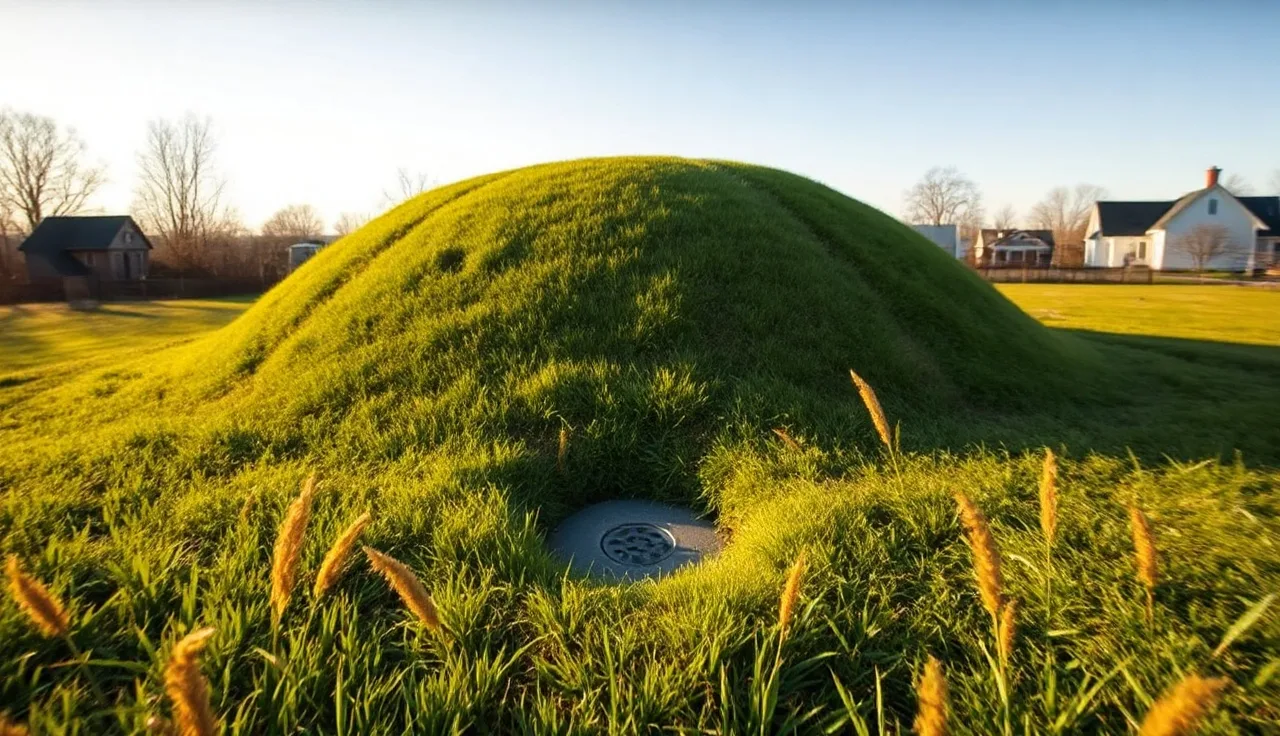
A licensed contractor does all of this. In most states the installer has to hold a specific onsite system license. The county or state agency inspects the mound at set stages before any cover goes on. Skip those inspections and you void the permit, and often the system warranty too. Once the grass takes, you can't see much from outside. What's left is a gently domed rise in the yard, anywhere from the size of a parking space to a small tennis court depending on household size.
How much does a mound septic system cost?
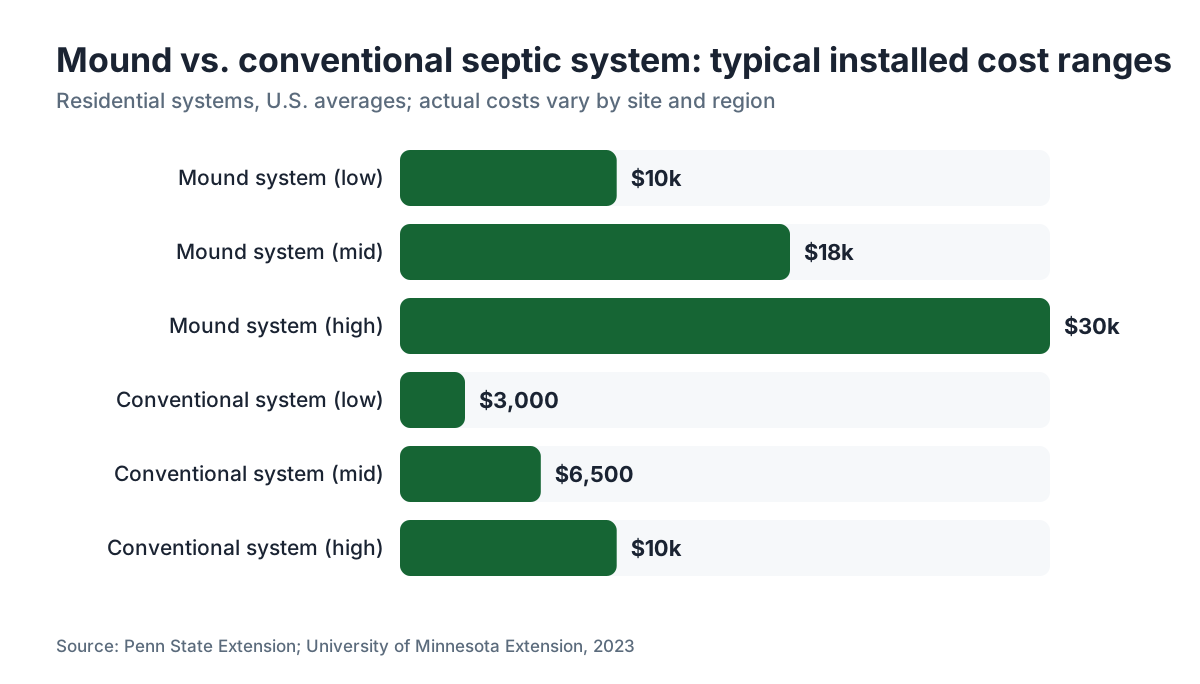
A mound system runs $10,000 to $30,000 installed for a typical home, and most people land in the $15,000 to $20,000 range [5]. That spread reflects real differences in site conditions, local labor, permit fees, and system size. Tough access, steep slopes, or expensive sand imports push you toward the top of the range or past it.
Compare that to a conventional gravity system on good soil, which often runs $3,000 to $10,000 all in [6]. With a mound you're paying extra for the engineered sand, the pump and control panel, and the labor to build and seed the mound.
Here's the typical breakdown:
| Component | Typical cost range |
|---|---|
| Septic tank (1,000 to 1,500 gal) | $700, $2,000 |
| Pump chamber + pump + controls | $1,500, $4,000 |
| Sand and gravel import | $1,000, $5,000 |
| Distribution piping and manifold | $800, $2,500 |
| Labor (excavation, build, seed) | $4,000, $10,000 |
| Permits, soil testing, engineering | $500, $3,000 |
| Total installed | $10,000, $30,000 |
Pump replacement costs $300 to $800 in parts and usually $200 to $500 in labor when the day comes, roughly every 7 to 15 years depending on the pump and its duty cycle [5].
Permit fees swing widely by state and county. Some rural counties charge under $200. States with stricter onsite programs can top $1,000. Your contractor can quote the local permit cost before you sign anything.
For the tank side of the budget in more detail, the cost to put in a septic tank guide covers it.
How long does a mound septic system last?
A well-maintained mound lasts 20 to 30 years, and some run longer. The part that gives out first is almost always the sand layer, not the pipes or the tank. Over time a biomat (a film of organic material) builds up at the infiltration surfaces. In moderate amounts that's normal and even helpful, because the biomat slows effluent and improves treatment. Let it thicken too far, though, and it seals the sand. Then the system backs up.
What speeds up biomat growth? An under-pumped tank is the main offender. When solids overflow into the pump chamber, they reach the mound and clog the pipes and sand fast. A leaking toilet or unusually heavy water use does the same by hydraulic overload. Some mound failures trace back to a failed pump float that lets the pump run nonstop.
Cold-climate systems can also take frost damage if the topsoil cover gets too thin, or if foot traffic and vehicle loads compact the cap. Most state codes call for a 6-to-12-inch topsoil cap for insulation [10].
With regular tank pumping and pump chamber inspection, 25-plus years out of a sand mound before any rehab is realistic. Rehab options exist. Some systems can be rested (bypassed to a temporary holding tank) to let the biomat die off, which can buy several more years [2]. Full sand replacement is possible too, but expensive, often $5,000 to $15,000 depending on site access.
How do you maintain a mound septic system?
Mound maintenance takes more attention than a standard system because you're watching two tanks and a pump instead of one tank. Here's the real schedule.
Pump the septic tank every 3 to 5 years for a typical household. That interval shrinks for big families or garbage-disposal users. Pump the tank and the pump chamber on the same visit. While the pumper is there, they check the pump, floats, and alarm. If your system has an effluent filter (a cartridge in the tank's outlet baffle), it gets cleaned at every pump-out too.
Inspect the pump and control panel once a year. Many pump chamber lids sit at grade and open without any digging. Lift the lid, confirm the alarm float triggers, and listen for the pump cycling. If the pump runs more often than the timer should allow, something's wrong. Hunt for a running toilet or a dripping fixture adding to the load. Septic tank riser lids make this annual check easy. If your chambers sit more than a foot down, risers pay for themselves.
Keep the mound surface healthy. Hold the grass cover to stop erosion. Never park on it. Divert roof drains and surface water away from the mound footprint, because soaking the soil around and under the mound is the second most common cause of failure after under-pumping. Most state codes want at least 10 feet of clearance between the mound and any drainage structure [3].
Don't plant trees or shrubs on or near the mound. Roots find distribution pipes and crack them. Grass is the right cover: it drinks up moisture, holds the soil, and keeps roots shallow.
What goes down the drain matters. The EPA's guidance is blunt about what wrecks a system: don't flush wipes, medications, grease, or harsh chemicals, all of which can disrupt the biological treatment or clog the pump [1]. For what a pump-out actually involves, the septic tank pumping guide covers it. And if you're not sure how often your tank needs service, how often to pump septic tank walks through the sizing math.
Operators running mound systems for a book of clients usually track service intervals in software rather than a paper calendar. SepticMind's operations tools handle that workload, keeping each system's pump-out history, alarm events, and service records in one place.
What are the signs that a mound septic system is failing?
Some failure signs are obvious. Others stay quiet until the system is already in real trouble.
The clearest one is wet, spongy, or foul-smelling ground on or near the mound. Effluent surfacing means the sand is fully saturated and can't take any more flow. That's a public health problem, more than a nuisance.
Slow drains all over the house, gurgling in the plumbing, and sewage odor indoors point to a backup from the receiving end. Check the pump chamber alarm first. A dead pump or a stuck float is often the immediate cause.
The alarm light or buzzer on the control panel exists for exactly this. Don't silence it and walk away. A triggered alarm means the liquid level in the pump chamber has climbed above normal, which happens when the pump fails, a float sticks, or inflow outruns what the system can handle.
Green, oddly lush grass growing in a line or a patch over one part of the distribution area (not the whole mound) can flag a concentrated discharge point. One stretch of pipe is getting overloaded while the rest fails to spread the flow.
Suspect a problem? Get a professional inspection before you dig anything up. A licensed inspector can camera the distribution pipes, check the pump, and measure liquid levels in both tanks. If it's just the pump or a failed float, that's a cheap fix. If the sand is clogged, you're looking at remediation or replacement.
For problems that are clearly tank-side rather than mound-side, septic tank repair and septic system repair cover those paths in more detail.
What regulations govern mound septic system design and installation?
States regulate mound systems, not one federal standard. Every state with onsite wastewater rules (which is all of them, in practice) has its own code setting setback distances, mound geometry, sand specs, and hydraulic loading rates. Some states adopted or closely followed the original University of Wisconsin mound design guidelines [2]. Others wrote their own.
The EPA's Office of Wastewater Management puts out general guidance through SepticSmart and the Onsite Wastewater Treatment Systems Manual, which lays out the technical design basis for mound systems [1][3]. These are guidance documents, not enforceable federal rules, but most state codes build on them.
At the local level, your county health department or environmental services office issues the permit. They can require specific designs, inspect during construction, and issue compliance notices for systems that fail or get altered without a permit. Modifying your mound (adding area, rerouting pipes, changing the pump size) without a permit is illegal in nearly every jurisdiction, and it can complicate your home's title when you sell.
Most state codes set minimum setbacks for mounds from wells, property lines, surface water, and buildings. Common minimums run 50 to 100 feet from a drinking water well, 10 to 25 feet from a property line, and 10 feet from any foundation [3][4]. Check your own state code before you assume these numbers fit your site.
To see how your state's rules read, EPA's septic pages link out to state wastewater programs [1].
How is a mound system different from a conventional drain field?
The core difference is elevation and active delivery. A conventional drain field uses gravity to move effluent from the tank into trenches cut into your native soil, and the soil does all the treatment. A mound builds the treatment zone above grade and uses a pump to deliver effluent in controlled doses.
A conventional system has no pump to fail, no pump chamber to service, and fewer moving parts overall. That's a real edge for simplicity and lifespan when the site allows it. But once the soil or water table fails a perc test, a conventional field is off the table.
Here's a direct comparison:
| Feature | Conventional drain field | Mound system |
|---|---|---|
| Treatment medium | Native soil | Imported sand |
| Delivery method | Gravity | Pressurized pump |
| Installation cost | $3,000, $10,000 | $10,000, $30,000 |
| Mechanical components | None beyond tank | Pump, floats, controls |
| Site requirements | Good soil, low water table | Works on marginal sites |
| Typical lifespan | 20 to 40 years | 20 to 30 years |
| Maintenance complexity | Lower | Higher |
For the drain field side, septic drain field covers how conventional infiltration works and what makes those systems fail.
One thing catches homeowners off guard: a mound's pump chamber needs inspection every year, while a conventional tank only needs pumping every 3 to 5 years. That extra service frequency is real, and worth budgeting for.
Can a mound septic system be repaired, or does it need full replacement?
Depends entirely on what failed. Pump and electrical failures are the cheapest fixes. A dead submersible pump costs $300 to $800 in parts, and a competent contractor can swap it in a few hours. Floats and control panels are similarly quick.
Distribution pipe failures (usually root intrusion or freeze-thaw cracking) get more involved. The contractor has to dig into the mound to reach the pipes, which disturbs the sand bed. If the disturbance stays limited, the repair is manageable. If the whole pipe network has collapsed or plugged with biomat, you're often better off rebuilding that part of the mound.
Resting is an option for biomat-clogged mounds if you have a reserve area. You take the mound offline, the biomat dries out and decomposes over several months to a year, and aerobic conditions bring back some permeability. Some extension resources say this can recover meaningful capacity, but results vary and nobody has good controlled data on how much recovery any given system will see [2].
Full sand replacement is the nuclear option: dig the mound down to the original soil surface, haul off the old sand, rebuild with fresh sand, and reinstall the pipe network. Expect $5,000 to $15,000. It essentially resets the system's lifespan.
If the native soil below the mound has failed (the limiting layer got too saturated, or site conditions changed), you may have to redesign and relocate the mound, which costs close to a new install.
Get a real diagnosis before you authorize any repair. A pump alarm does not mean the sand is dead. An inspection with a probe and a liquid-level check takes an hour and costs far less than pointless excavation. See septic system repair for how to diagnose system problems before you spend on fixes.
What should homeowners know before buying a house with a mound system?
A mound system is not a red flag. Plenty of them run fine after 20 or 25 years of decent care. But there are a few things to nail down before you close.
Get an inspection by a licensed septic professional, more than the general home inspector. Many home inspectors confirm the system flushes but never assess the mound, pump chamber, or distribution pipes in any detail. A dedicated septic inspection costs $300 to $600 and is money well spent. Ask specifically for pump operation verification and a probe of the mound to check for surfacing or saturation.
Pull the system's permit and as-built drawings from the county health department. They tell you the design flow rate the system was sized for, the sand spec used, and the install date. A 15-year-old mound has plenty of life left with good care. A 25-year-old one with no service records is a different conversation.
Ask when the tanks were last pumped. Sellers often don't know. If there's no record, budget for a pump-out and inspection right after purchase. A septic tank pump out at the time of sale is a reasonable contingency to write into the purchase agreement.
Understand the running costs. A mound uses electricity to run the pump, which adds roughly $20 to $60 a year to the electric bill at average U.S. rates, and the pump needs a professional inspection annually. Factor that against a conventional system's zero.
Check the reserve area. Most permits require a designated reserve for future expansion or replacement. If that reserve has been built on (a deck, a shed, a patio) since the permit issued, that's a problem: replacing or expanding the system may mean tearing those structures out. For operators doing pre-purchase due diligence across multiple properties, SepticMind pulls service history and permit data into one workflow, which speeds up exactly this kind of check.
Frequently asked questions
How often does a mound septic system need to be pumped?
Pump the septic tank every 3 to 5 years for a typical household of 3 to 4 people. Inspect the pump chamber at every pump-out and pump it when solids build up. With a garbage disposal or a bigger household, shorten that to every 2 to 3 years. Skipping pumping is the single most common cause of early mound failure, because solids overflow into the mound and clog the sand.
Can I put a garden or landscaping on top of a mound septic system?
Grass is the right cover. Shallow-rooted ground covers and wildflowers are usually fine if their roots stay under 12 inches. Skip trees, shrubs, and any deep-rooted plants entirely, because roots find distribution pipes and crack them. A vegetable garden is a bad idea, since you'd be growing food in soil irrigated with treated but not drinking-quality effluent. Never cap the mound with plastic sheeting or pavement.
What happens if a mound septic system freezes in winter?
Freezing is a real risk in cold climates if the topsoil cap is thin, compacted, or bare. A 12-inch topsoil cover with established grass insulates the system. Don't drive or walk on the mound in winter, since that compacts the insulating snow. If distribution pipes freeze, effluent backs up into the pump chamber and trips an alarm. A licensed contractor can thaw pipes with hot water injection, but preventing the freeze is far cheaper.
Does a mound septic system use more electricity than a conventional system?
Yes, because of the pump. A submersible effluent pump in a mound typically draws 300 to 500 watts while running, but it runs in short timed doses, not continuously. Annual electricity cost is roughly $20 to $60 at average U.S. residential rates, depending on water use and pump efficiency. That's a real ongoing cost against zero for a gravity system, but small next to total home energy use.
How big is a mound septic system? How much yard space does it take?
A typical mound for a 3-bedroom home with a design flow around 450 gallons per day covers roughly 1,000 to 3,000 square feet and stands 2 to 4 feet tall. Exact dimensions depend on the hydraulic loading rate from your soil evaluation and your state's design rules. Add buffer setbacks and a reserve area, and the mound's claim on your usable yard is real. Map it before you plan anything else on the lot.
Is a mound septic system more likely to fail than a conventional system?
Not inherently, but the failure modes differ. A properly installed and maintained mound lasts as long as a conventional one on a comparable site. The extra mechanical parts (pump, floats, controls) do add failure points a gravity system doesn't have. The upside: you can monitor those parts actively, while a conventional drain field failure often goes unnoticed until it's serious. Regular pump chamber checks catch problems early.
Can a mound septic system be installed on a slope?
Yes, within limits. Most state codes allow mounds on slopes up to 6 to 12 percent. Steeper than that makes it hard to build a stable mound and spread effluent evenly across the sand. On a gentle slope, the mound usually runs with its length along the contour, and the downslope side is the tallest part. An engineer or licensed designer should evaluate any sloped site before you assume a mound will work.
What is the difference between a mound system and a sand filter septic system?
Both use sand for treatment, but they're built differently. A mound puts the sand above grade with effluent dosed through pressurized pipes inside it. A sand filter (sometimes called an intermittent sand filter) is usually a buried or surface bed that polishes effluent before it reaches a separate drain field or discharge point. Sand filters can run in sequence with a mound or as a standalone advanced treatment step, and they're more common where higher effluent quality is required before discharge.
Do I need a permit to repair or modify my existing mound septic system?
Almost certainly yes. Any modification to a permitted septic system, including replacing distribution pipes, enlarging the mound, or changing the pump size, needs a permit in nearly every U.S. jurisdiction. A like-for-like pump swap with no structural changes is sometimes exempt, but confirm with your county health department. Unpermitted work becomes a serious problem at sale, since title companies and buyers' lenders often require septic compliance documentation at closing.
How do I know if my mound system is working correctly?
The clear signs: no alarm lights on the control panel, no wet or odorous spots on or around the mound, normal drain speed indoors, and a pump chamber level that drops predictably after each dose cycle. A professional inspection every 1 to 3 years, on top of routine pump-outs, can verify pump performance, float settings, and that nothing is surfacing. Many states require a licensed inspector to certify mound systems periodically; check your local code.
How does a sand mound septic system handle heavy rain or flooding?
Heavy rain that saturates the native soil around the mound cuts its ability to accept percolating effluent from the bottom of the sand bed. Extended wet spells can cause temporary stress or even surfacing. Diverting roof runoff and surface water away from the mound footprint is your main defense. After sustained flooding, have the system inspected before you resume normal use. Floodwater in the pump chamber can damage the pump and introduce sediment.
What effluent quality does a mound septic system produce?
A properly functioning mound with an adequate sand bed produces effluent comparable to secondary treatment: BOD and TSS removal is high, and fecal coliform counts drop sharply as effluent moves through the sand into native soil. Nitrate and some emerging contaminants still pass through. A mound is not tertiary treatment. It fits sites where treated effluent percolates to groundwater rather than discharging to surface water, where higher standards apply.
Can a failing mound be rested to extend its life?
Sometimes. Resting means taking the mound offline for several months to a year while you use a temporary holding tank or alternate system. With no incoming effluent, the biomat in the sand dries out and decomposes, which can partly restore permeability. It works best on systems that still have some functioning area and haven't been fully saturated for long stretches. A licensed inspector should judge whether resting is worth trying before you pay for a bypass setup.
Are there any tax credits or financing programs for mound septic system installation?
Federal tax credits for septic installation are limited. The USDA Rural Development program (Section 504 loans and grants) can help low-income rural homeowners with wastewater system costs, mounds included [8]. Some states run their own revolving loan funds for onsite upgrades; examples include Minnesota's point-of-sale inspection programs and Massachusetts' Title 5 loan program. Check with your state environmental agency and county health department for programs currently taking applications.
Sources
- U.S. EPA, SepticSmart Program: EPA guidance that a failing system can contaminate water bodies, wells, and groundwater; maintenance guidance; and the recommendation against flushing wipes, medications, grease, or harsh chemicals.
- University of Wisconsin-Madison, Small Scale Waste Management Project (mound system design): University of Wisconsin origin of mound system design standards in the 1970s and guidance on resting as a rehabilitation option.
- U.S. EPA, Onsite Wastewater Treatment Systems Manual (EPA/625/R-00/008): Design criteria for mound systems including minimum 4-foot separation from limiting layers, setback requirements, and hydraulic loading rates.
- Minnesota Pollution Control Agency: Minnesota requirement for ASTM C-33 sand specification and setback distances for mound systems.
- Penn State Extension: Installed cost range of $10,000 to $30,000 for mound systems and pump replacement cost estimates.
- University of Minnesota Extension: Conventional septic system installed cost range of $3,000 to $10,000 for comparison with mound system costs.
- U.S. EPA, Office of Wastewater Management: EPA Office of Wastewater Management guidance documents and directory of state wastewater programs for onsite system regulations.
- USDA Rural Development, Single Family Housing Repair Loans and Grants (Section 504): USDA Rural Development Section 504 loans and grants available for low-income rural homeowners with wastewater system costs.
- Wisconsin Department of Safety and Professional Services (private onsite wastewater treatment systems): Wisconsin state mound design standards that informed national adoption of mound system codes.
- NC State Extension: Frost depth recommendations, minimum topsoil cover of 6 to 12 inches, and maintenance schedule guidance for mound systems.
Last updated 2026-07-09