Septic tank riser: what it is, what it costs, and whether you need one
By the SepticMind Editorial Team
TL;DR
- A septic tank riser is a vertical pipe extension, usually 8 to 24 inches tall, that brings your tank's access lid up to or just below ground level.
- It ends the digging before every pump-out.
- Riser kits run $50, $300 in materials; professional installation adds $150, $600 depending on burial depth.
- Most homeowners recoup the cost in two to three pump cycles.
What is a septic tank riser and what does it actually do?
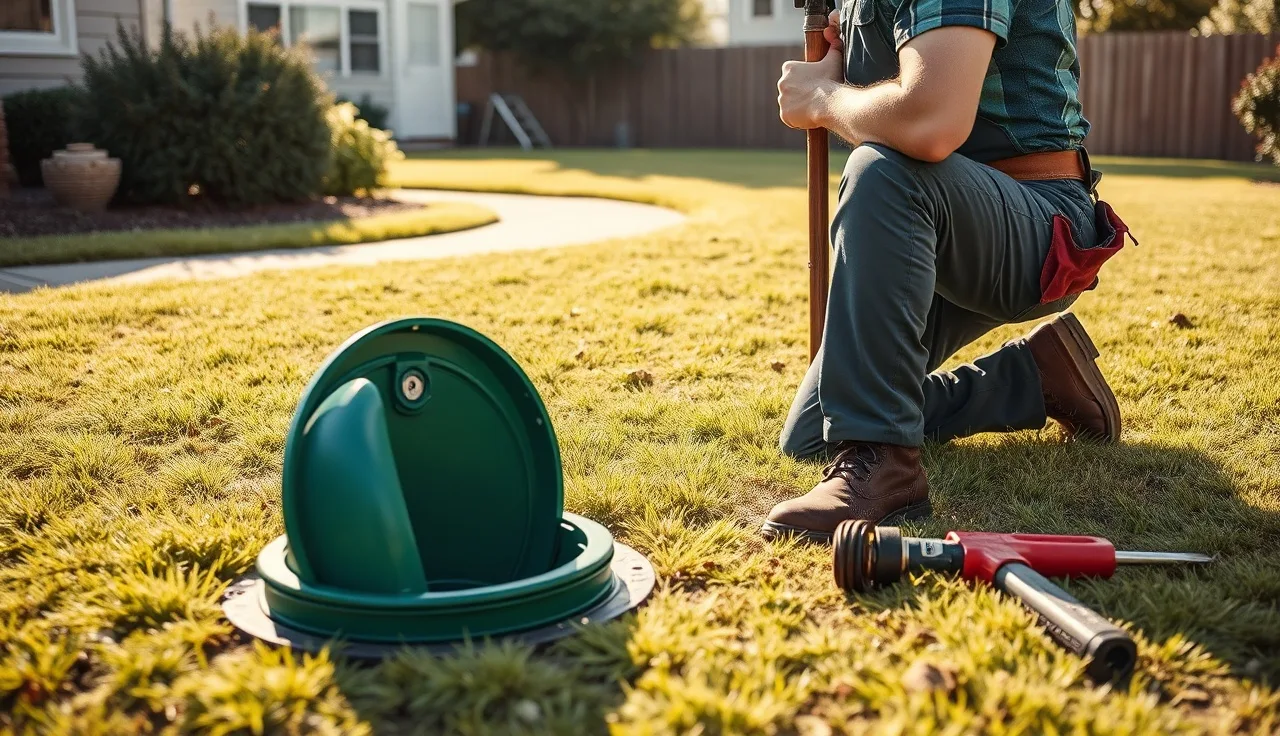
A septic tank riser is a cylindrical extension that sits on top of your tank's access opening and rises to ground level (or just below it, covered by a flush-fitting lid). Without one, your tank lid is buried under 12, 18, sometimes 30 inches of soil. Every time a pumper shows up, someone has to find the lid and dig it out. That takes 30 to 60 minutes and the pumper almost always charges you for it.
Risers end that. The pumper walks up, lifts the lid, and is done in minutes. The tank itself stays put underground. Only the access path changes.
Most residential tanks have two or three openings: an inlet access near where the house line enters, an outlet access near the baffle that leads to the drain field, and sometimes a center inspection port on larger tanks. You can riser one opening or all of them. If you're doing a full septic tank pump out, the pumper typically needs at least the large center or inlet lid open; risering all openings costs more upfront but gives you the most flexibility.
Risers also make septic tank cleaning and inspections far easier. An inspector can check baffles, measure scum and sludge layers, and probe the outlet tee without asking you to stand around while someone digs for 45 minutes first.
What materials are septic tank risers made from?
Three materials dominate the market: polyethylene (PE), PVC, and concrete.
Polyethylene risers are the most popular choice right now. They're light, they won't crack from freeze-thaw cycles, and the threaded or gasketed connections resist root intrusion and groundwater infiltration better than older designs. A 20-inch diameter PE riser section runs about $30, $60 per foot of height at a plumbing supply house.
PVC risers are stiffer and slightly easier to cut to exact height in the field. They cost roughly the same as PE but can turn brittle in extreme cold over time. In mild climates they work fine.
Concrete risers are old-school. Many tanks built before the 1990s already have a short concrete collar as part of the original pour. They're heavy, they need a crew to install, and the mortar joints can crack and let groundwater into the tank. If you have an older concrete riser and it's in good shape, leaving it alone is reasonable. If it's cracked or letting in roots, switching to a PE replacement kit makes sense.
The lid matters as much as the riser body. A good lid is rated for at least 1,500 pounds of static load (so a lawn mower can pass over it), locks or bolts down, and has a child-resistant latch. The EPA SepticSmart program specifically recommends secure, locked lids to prevent accidents and odor problems [1].
| Material | Typical cost per foot (materials only) | Lifespan | Best for |
|---|---|---|---|
| Polyethylene | $30, $60 | 30+ years | Most residential installs |
| PVC | $25, $55 | 20 to 30 years | Warmer climates, DIY cuts |
| Concrete | $40, $80 (labor-heavy) | 20 to 50 years | Replacement of existing concrete collar |
How much does a septic tank riser cost?
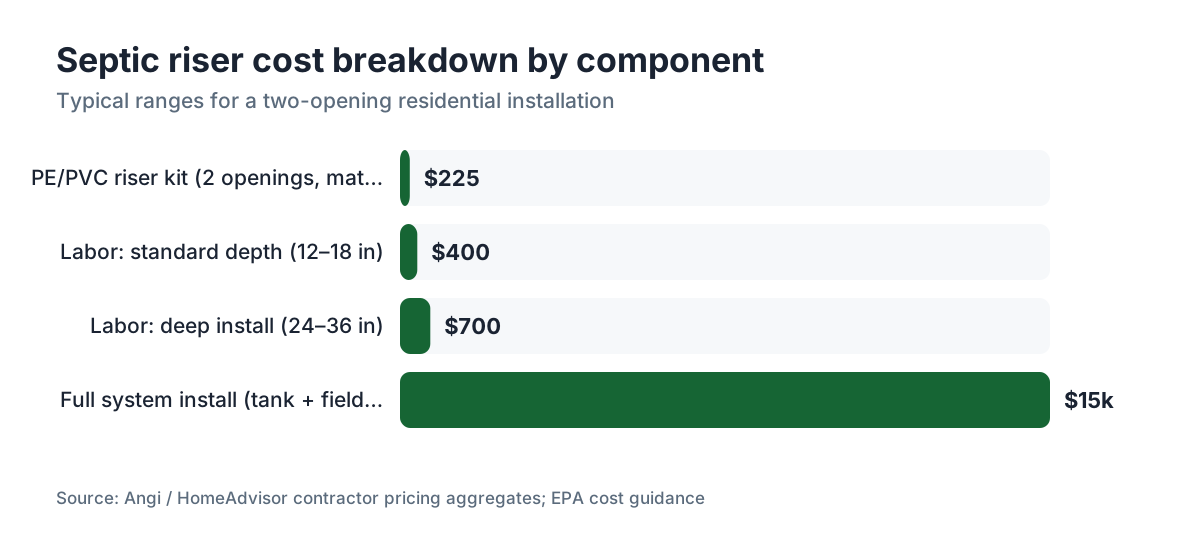
Materials for a single riser run $50, $200 for a PE or PVC kit that includes one riser section, adapter ring, and lid. A full septic tank riser kit covering both the inlet and outlet openings typically costs $150, $300 in parts.
Labor is where the range opens up. A septic contractor charges $150, $400 per riser for a straightforward install on a tank buried 12 to 18 inches deep. If your tank lid is 24 to 36 inches down, you're looking at more digging, possibly a second riser extension stacked on the first, and a higher labor bill. Some contractors quote the whole job (both openings, all backfill, and a new surface lid) at $400, $900.
The national average for riser installation on a single-family home, across all burial depths and configurations, is roughly $300, $600 all-in, based on contractor pricing data compiled by home improvement cost tracking services [2]. Your actual number depends on three things: how deep your lids are, how many openings you riser, and whether the contractor is coming out just for this job or tacking it onto a pump-out visit.
Schedule riser installation the same day as a pump-out and you nearly always get a better rate, because the pumper has to find and expose the lid anyway. The extra cost to set a riser while you're already there is low. That's the move I'd make.
For context, a full septic system installation on a new home costs $3,000, $15,000 or more depending on system type and local permitting. A riser is a small add-on against that number, and it protects the larger system by making routine maintenance easier to schedule and finish.
How much is a septic tank installation (and where does a riser fit into that)?
This comes up enough that it deserves a direct answer. A conventional septic tank installation for a new home typically costs $3,000, $7,000 for the tank itself (materials plus labor), and $10,000, $25,000 or more once you include the drain field, permits, and site work [3]. The cost to put in a septic tank depends heavily on tank size, local labor rates, soil conditions, and whether the site needs significant grading.
Risers are sometimes included in new construction installs at no extra cost, especially in states where local codes require them. A growing number of state onsite wastewater programs, including those in North Carolina [4] and Florida [5], require risers or equivalent surface access on all new tank installations. Check your county's onsite wastewater code before assuming your new tank will or won't have them.
When they're not part of the original install, adding risers later is straightforward. The tank is already in the ground, the lid locations are known, and the work is a few hours. The cost to install septic system pages we track show that homeowners who add risers at install time pay about $200, $400 extra, while those who add them after the fact pay $300, $600 because of the extra excavation.
If you're getting quotes on a new system or a full septic tank installation, ask flat out whether risers are included. If they're not, add them. You'll thank yourself every two or three years when the pumper arrives.
What is included in a septic tank riser kit?
A septic tank riser kit is a packaged set of parts sized to fit one access opening from adapter to lid. A standard kit includes:
An adapter ring or base adapter that bridges the tank's existing opening (usually 20, 24, or 30 inches in diameter) to the riser pipe's outer diameter. This is the piece that attaches to the tank lid flange or directly to the concrete tank top.
One or more riser pipe sections, typically in 6-inch, 12-inch, or 18-inch heights that stack until the top reaches grade. Most kits include one or two sections; you may need extras depending on burial depth.
A lid, either a flat snap-on type, a bolted safety lid, or a combo lid with a central inspection port. Quality kits include a gasket on the lid to keep surface water and insects out.
Hardware: screws, bolts, and in some kits, butyl sealant or EPDM gaskets for the joints.
Brand-name kit manufacturers like Tuf-Tite (one of the most common in the U.S. market) and Polylok sell kits at agricultural supply stores, plumbing wholesalers, and online. Prices run $60, $200 per opening depending on diameter and lid grade. For a two-opening system, budget $120, $400 in materials before labor.
Check one thing before you order: tank opening diameter. Many older tanks have 20-inch openings; newer tanks are often 24 inches. Measure yours or ask your last pumping company. Mismatched adapters are a common headache during DIY installs.
Can you install a septic tank riser yourself?
Technically yes, for most single-story PE or PVC riser kits. The basic steps: locate the lid, expose it by digging, clean the concrete surface around the opening, apply butyl sealant or the kit's recommended adhesive, set the adapter ring, stack riser sections to grade, backfill around the riser, and install the final lid. Most manufacturers include step-by-step instructions, and the physical work is light once the digging is done.
The part people underestimate is the digging. If your lid is 18 to 24 inches down, you're moving a lot of dirt and you have to do it carefully around the tank top to avoid cracking it.
There are also two reasons to pause on pure DIY. First, many states require a licensed installer or inspector to sign off on any work that opens or modifies the tank access, because a botched install can create a water infiltration path or a safety hazard. Check your state's onsite wastewater code before starting [4][5]. Second, if you've never located your tank and don't have records, finding it, finding the lids, and confirming the opening dimensions without damaging anything is genuinely hard. Having a pumper or septic contractor do the first installation and show you the layout is worth the cost.
For operators and service companies tracking dozens of installs, tools like SepticMind can log riser specs, opening diameters, and lid types by address so technicians arrive knowing exactly what they're looking at, no surprises.
If you do go DIY, buy a kit rated for traffic loads (H-10 or better) if there's any chance a vehicle will pass over the lid location. The cheap lids rated only for foot traffic fail fast under lawn equipment.
How is septic tank riser installation done by a professional?
A professional septic tank riser installation follows a set sequence that most contractors finish in two to four hours per tank.
First, they locate all access lids. On a tank with no prior riser and no accurate as-built diagram, this sometimes means probing the yard or using a metal detector. It helps enormously to know your tank's location beforehand; your county health department usually has permit records showing the tank's approximate footprint [4].
Once located, the contractor excavates around each opening down to the lid flange or tank top. The area around the opening needs to be clean and level for the adapter to seat properly.
The old concrete lid (or plastic lid, if present) comes off. The tank top and opening rim get inspected for cracks. If the opening is in poor shape, the contractor may need to do minor concrete repair before setting the adapter, which adds cost.
The adapter ring is set with a bead of butyl sealant or concrete adhesive. Many PE and PVC adapter kits are self-gasketing and bolt or screw down; concrete adapters use hydraulic cement. Riser sections stack and join with screws and sealant to bring the top to about 2 inches above finished grade. The final lid goes on with its locking hardware.
Backfill is tamped around the riser in layers to prevent settlement. A well-installed riser sits flush to slightly proud of the surrounding lawn, clearly visible but not a trip hazard.
The whole job, materials and labor, for a two-opening residential tank averages $400, $700 when done alongside a septic tank pumping visit [2].
How long do septic tank risers last and when do they need to be replaced?
PE risers installed with quality gaskets and proper sealant routinely last 30 years or more with no maintenance. PVC can hit 20 to 30 years in temperate climates. Concrete risers from older installs are more variable; some are fine at 40 years, others develop cracks at 15 from freeze-thaw or soil movement.
The signs a riser needs attention: the lid is cracked or no longer latches securely, water pools around the lid opening after rain (a sign the lid seal is failing), roots show inside the riser when the lid is lifted, or the riser has visibly shifted or heaved out of level.
A riser with a failing seal is a real problem. Surface water infiltrating the tank overloads the system, pushes partially treated effluent to the septic drain field before it's ready, and can speed up drain field failure. Drain field failure is expensive. Replacement can run $5,000, $20,000 depending on soil and system type [3]. A $40 replacement lid or $80 tube of butyl sealant is a straightforward trade.
For routine checks, lift the lid twice a year and look. If the gasket feels dry and cracked, replace it. If the riser tube itself is cracking, have a contractor decide whether a section swap or full replacement is warranted. Riser septic tank repair is almost always simpler and cheaper than letting a lid failure snowball into a bigger problem.
Do septic tank risers affect your drain field or system performance?
A properly installed riser has no effect on drain field performance or tank function. The tank's hydraulics, the inlet and outlet baffles, and the flow path to the field are all unchanged. The riser is purely an access modification.
There is one indirect benefit. Because pumping and septic tank emptying are so much easier with risers, homeowners tend to stick to their pumping schedule rather than skipping a cycle because it's expensive and inconvenient. Pumping on schedule (roughly every 3 to 5 years for a typical household, depending on tank size and use) is the single biggest factor in drain field longevity [7]. The EPA's SepticSmart program states that "a pumping schedule based on the number of people in the household and the size of the tank helps avoid costly repairs" [1].
Irregular pumping lets the sludge and scum layers build up until solids escape into the drain field, clog the distribution system, and kill the biomat. Once that happens, you're looking at septic system repair or a full field replacement, not a pump-out.
So the riser's real contribution to system health is behavioral. It takes the friction out of maintenance. That's worth more than it sounds.
For how often pumping should happen based on your household size, see our guide on how often to pump septic tank.
What do local codes say about septic tank risers?
Requirements vary a lot by state and county. At the federal level, the EPA does not mandate risers directly, but its SepticSmart guidance strongly recommends surface access as a best practice [1]. The main regulatory framework for onsite wastewater sits at the state level, run through departments of health or environmental quality.
North Carolina's onsite wastewater rules (15A NCAC 18A .1950 and related sections) require easily accessible inspection and pumping ports on permitted systems, which in practice means risers or equivalent access are expected on most new installations [4].
Florida's Department of Health (FAC 64E-6) requires that septic tank lids be accessible for inspection and pumping, and county health departments increasingly cite riser installation as the standard way to meet that requirement [5].
Several other states, including Virginia, Minnesota, and Oregon, have updated their onsite wastewater codes in the past decade to either require or strongly push riser installation on new systems and repairs [6].
The practical takeaway: if you're in a state with an active onsite wastewater permitting program and you're doing any permitted work on your system, expect your county health department to ask about lid access. Putting in risers during a repair visit is usually the fastest path to approval. Check your specific county's requirements before starting work; code lookups for most states are available through the state department of health's website.
Is a septic tank riser worth the money?
For the overwhelming majority of homeowners with buried lids, yes. The math is simple.
If your pumper charges $50, $100 to locate and dig out your lids on each visit, and you pump every 3 years, you pay $250, $500 extra over 15 years in digging fees alone. A riser installation ends that. The materials and labor pay for themselves in two to four pump cycles for most households.
Beyond the direct savings, there are softer benefits. Pumpers can assess the tank faster and more accurately when they're not rushing after a 45-minute dig. Inspectors can give you a real picture of the tank's condition. And you always know exactly where your lids are, which matters if you ever have an emergency or sell the house. Buyers and their home inspectors increasingly look for risers as evidence that a system was maintained properly.
The one scenario where I'd hesitate: if you plan to sell within 12 months and your pumper never charges for digging because you already know the lid location, the payback math tightens. Most homeowners don't fall into that narrow exception.
If you're managing multiple properties or running a septic service route, tools like SepticMind let you track riser status, lid types, and service history by address so every technician arrives informed. That kind of operational visibility compounds the value of good access hardware in the first place.
Bottom line: a septic tank riser kit costs $50, $300 in materials and $150, $600 installed. Pumping your tank costs $250, $600 per visit on average [6]. This is not a hard decision.
Frequently asked questions
How much does it cost to add risers to an existing septic tank?
Expect $200, $900 for a professional installation covering both the inlet and outlet openings on a typical residential tank. Materials (a PE or PVC riser kit) run $50, $200 per opening. Labor ranges from $150, $400 per opening depending on how deep the lid is buried. Scheduling it alongside a pump-out almost always gets you a lower combined price since the pumper is already digging out the lid.
How much is a septic tank installation from scratch?
A conventional septic tank alone costs $1,200, $4,000 installed; a complete system with the tank, distribution system, and drain field runs $10,000, $25,000 or more for a new home. Costs vary by tank size, soil type, local permit fees, and labor rates. Risers are sometimes included in new installs, especially in states that require accessible lids by code. See our full guide on cost to install a septic system for a detailed breakdown.
How deep can a septic tank riser be?
Riser sections stack, so there's no hard depth limit. In practice, tanks buried more than 36 inches need multiple stacked sections and a lot more excavation, which raises installation cost. Most PE and PVC kits are designed for lids 6 to 24 inches below grade. For lids deeper than 30 inches, a contractor may recommend a two-piece extension or a custom-cut section.
Do I need a permit to install a septic tank riser?
In many states, yes. Onsite wastewater rules often require a permit for any modification to an existing septic system, including access lids. Some counties treat riser installation as routine maintenance and allow it without a permit; others require a licensed contractor and inspection sign-off. Check your county health department's website or call the onsite wastewater program directly before starting. Fines for unpermitted work can exceed the installation cost itself.
What diameter septic riser do I need?
The most common residential tank openings are 20 and 24 inches in diameter. Older cast-in-place concrete tanks often have 20-inch openings; tanks made after the mid-1990s commonly use 24 inches. Measure your existing lid opening before ordering a kit. Riser kits are labeled by opening diameter; ordering the wrong size means the adapter ring won't seat and you'll have infiltration gaps around the joint.
Can a septic tank riser let water into the tank?
A poorly installed riser can, yes. If the adapter ring gasket fails, if sealant was skipped, or if the lid doesn't seal properly, surface water during heavy rain can infiltrate the tank. That overloads the system and can push solids into the drain field. The fix is a quality gasket on every joint, a bead of butyl sealant at the adapter-to-tank interface, and a lid with an EPDM gasket. Inspect the seal every one to two years.
How long does septic tank riser installation take?
For a single opening on a tank buried 12 to 18 inches, a professional install takes roughly one to two hours including excavation, seating the adapter, stacking sections, backfilling, and cleanup. A two-opening job takes two to four hours. If the tank is buried deeper or the concrete top needs repair, add another hour per opening. DIY on a known, shallowly buried lid can be done in an afternoon.
Do septic tank risers require any maintenance?
Very little. Lift the lid twice a year and inspect the gasket for cracking or compression set; replace it if it looks dry or cracked. Check that the lid latches or bolts securely. Look for root intrusion inside the riser. If the riser has shifted or the ground has settled around it, have a contractor re-level it to prevent surface water infiltration. Beyond that, a quality PE or PVC riser runs for decades with no active maintenance.
Will a septic riser affect my lawn or landscaping?
A properly installed riser finishes slightly above grade (1 to 3 inches) so it stays visible and drains away from the opening. The lid is usually green or black and unobtrusive. You can place a decorative rock or planter ring around it, but don't seal over the lid entirely or bury it under mulch. It needs to stay accessible. Avoid heavy planters or hardscape directly on top that could crack the lid or seal access.
What's the difference between a septic riser and a cleanout?
A septic riser gives access to the tank itself for pumping and inspection. A cleanout is an access point in the house sewer line used for clearing pipe blockages; it doesn't reach the tank. They solve different problems, and you need both. If you have a blockage between the house and the tank, a cleanout is what the plumber uses. If the tank is full or backing up, the pumper uses the riser.
Can risers be added to any type of septic tank?
Yes, with the right adapter. Concrete tanks (the most common type), fiberglass tanks, and polyethylene tanks all have compatible riser adapter rings on the market. The key variable is the opening diameter and the rim profile of the existing tank top. Some very old concrete tanks with irregular or damaged openings need minor patching before an adapter ring will seat properly. A contractor can assess this on-site in minutes.
How do I find my septic tank lid if I don't have risers yet?
Start with your county health department. Most jurisdictions keep permit records with a site plan showing approximate tank location. From there, follow the main sewer line from the house (usually in a straight line from the foundation, sloping downhill) and probe with a thin metal rod every foot or so. The lid is typically 8 to 24 inches underground. Once you find it, that's the right time to add a riser so you never have to search again.
Should I riser both the inlet and outlet, or just one?
Risering both the inlet and outlet openings is the better choice. It lets a pumper work from the outlet side to break up and pull the scum layer, and from the inlet side to remove sludge from the bottom, all without lifting the heavy concrete main lid. Many inspectors also check baffle condition from the outlet opening. The extra cost of doing both at once is much lower than paying for a second mobilization later.
Sources
- U.S. EPA SepticSmart Program: EPA SepticSmart recommends secure, locked septic lids to prevent accidents and odors, and a pumping schedule based on household size and tank volume to avoid costly repairs.
- Angi Cost Data: Septic Tank Riser Installation: National average for professional septic riser installation on a single-family home is roughly $300, $600 all-in based on contractor pricing aggregated by home improvement cost tracking services.
- U.S. EPA: Septic Systems Overview: Full septic system installation including tank and drain field can cost $10,000, $25,000 or more; drain field replacement alone can run $5,000, $20,000 depending on soil conditions and system type.
- North Carolina Department of Health and Human Services (Environmental Health): North Carolina onsite wastewater rules (15A NCAC 18A) require accessible inspection and pumping ports on permitted systems, effectively requiring risers or equivalent access on new installations.
- Florida Department of Health: Onsite Sewage Programs (FAC 64E-6): Florida's onsite sewage rules (FAC 64E-6) require septic tank lids to be accessible for inspection and pumping; riser installation is the standard compliance method used by county health departments.
- U.S. EPA: Septic System Maintenance Costs: EPA estimates average septic tank pump-out cost at $250, $600 per service visit for a typical residential system, and notes several states have updated onsite codes to require accessible lids.
- University of Minnesota Extension: Pumping septic tanks on a regular schedule (every 3 to 5 years for most households) is identified as the single most important factor in drain field longevity.
- Penn State Extension: Riser installation recommended for all tanks to facilitate regular inspection and pumping; access hardware described as a low-cost intervention with high maintenance compliance benefit.
- Virginia Department of Health: Virginia onsite sewage regulations updated to require accessible lid provisions on new and repaired systems, consistent with broader state trend toward mandatory riser installation.
- National Onsite Wastewater Recycling Association (NOWRA): NOWRA reports that polyethylene risers installed with gasketed adapters and quality lid hardware routinely achieve 30-plus year service life with minimal maintenance.
Last updated 2026-07-09