1000 gallon septic tank: sizes, costs, pumping schedule, and lifespan
By the SepticMind Editorial Team
TL;DR
- A 1000-gallon septic tank is the most common residential size in the U.S., usually sized for a 3-bedroom home with up to 6 occupants.
- The tank alone costs $700 to $2,000.
- Pump it every 3 to 5 years.
- It lasts 20 to 40+ years depending on material and care.
- Undersizing is a top cause of early drain field failure.
What is a 1000-gallon septic tank and what is it made of?
A 1000-gallon septic tank is a buried, watertight container that holds and partly treats household wastewater before it flows to the drain field. Solids sink to the bottom as sludge. Grease and lighter material float to the top as scum. The clarified liquid layer in the middle (effluent) exits through an outlet baffle toward the septic drain field.
Three materials own the market.
Concrete is the most common. A precast 1000-gallon concrete tank weighs roughly 8,500 to 9,000 lbs, which makes it resist flotation in high water tables. It's durable but can develop hairline cracks over decades, and older tanks may have steel baffles that corrode. Expect a 30 to 40-year lifespan with proper maintenance [1].
Fiberglass tanks weigh around 350 to 450 lbs empty. They resist corrosion and root intrusion better than concrete and go in easier on tough lots. The trade-off: they can shift or float if the soil around them saturates while the tank sits empty during a flood. Lifespan is 30 to 40 years too, sometimes longer.
Polyethylene (plastic) tanks are the lightest, often under 300 lbs. They're cheap and they don't crack. Many jurisdictions cap them at tanks under 1,500 gallons, and some states ban them outright for primary tanks, so check your local onsite wastewater code before ordering [2].
Steel tanks were common before the 1970s. If your property has one, it's past its design life and replacement planning is overdue.
What size house does a 1000-gallon septic tank fit?
Most state codes size residential septic tanks by bedroom count, not by occupants, because bedrooms are the best proxy for potential occupancy and occupant counts change over time. A 1000-gallon tank is the minimum or standard size for a 3-bedroom home in most U.S. states [3].
The table below shows common state sizing minimums. Yours may be higher.
| Bedrooms | Typical minimum tank size (gallons) |
|----------|-------------------------------------|
| 1 to 2 | 750 to 1,000 |
| 3 | 1,000 |
| 4 | 1,000 to 1,250 |
| 5 | 1,250 to 1,500 |
| 6 | 1,500 |
The EPA's SepticSmart guidance states that "the size of the tank depends on the size of the house and the number of people living in it," and it names undersizing as a driver of drain field failure [4]. A 1000-gallon tank serves a 3-bedroom home well when daily water use stays near the design assumption of roughly 150 gallons per bedroom per day.
Run a home business, keep a garbage disposal, have a water softener that backwashes to the system, or host guests often? A 1000-gallon tank may be undersized for your real load even when the bedroom count says otherwise. Some installers push you toward 1,250 or 1,500 gallons up front in those cases. That's honest advice, not an upsell.
For context, a 500 gallon septic tank fits a small one-bedroom cabin or seasonal place with very low daily flow. It's a poor primary system for a full-time home with modern water use.
How much does a 1000-gallon septic tank cost?
Costs split into two buckets: the tank itself and the installed price.
Tank only (no installation): A precast concrete 1000-gallon tank runs $700 to $1,200 delivered, depending on region and supplier. Fiberglass tanks range from $1,400 to $2,000. Polyethylene tanks are often $500 to $900 where allowed. These are supplier-to-site prices with no labor [5].
Full installed cost (tank plus labor, no drain field): Replacing or installing a 1000-gallon tank with excavation, backfill, and inspection runs $3,000 to $5,500 in most U.S. regions as of 2024 to 2025. In high-labor states like California, Massachusetts, or New York, the same job can hit $7,000 to $9,000.
Full new system (tank plus drain field): A complete new septic system with a 1000-gallon tank and conventional drain field costs $10,000 to $25,000 depending on soil, lot size, system complexity, and local permit fees. See our guide to cost to install a septic system for the full breakdown.
Permit fees swing widely. Many counties charge $200 to $800 for a new installation permit. Some require a perc test before approval, which adds $250 to $700.
Excavation is the biggest wildcard. Rocky soil, high water tables, or limited equipment access can double the labor estimate. Get at least three quotes and make each one spell out what's in excavation and backfill. Vague bids almost always grow.
How often does a 1000-gallon septic tank need to be pumped?
The EPA recommends pumping every 3 to 5 years for a typical household [4]. That range is real, not a hedge. The right interval for your 1000-gallon tank depends on how fast sludge and scum build up, and that depends on how many people live in the home and what goes down the drains.
A widely used rule of thumb: pump when sludge plus scum together fill more than one-third of the tank's working volume. For a 1000-gallon tank, that's roughly 330 gallons of accumulated material. A pumper measures this during a service call.
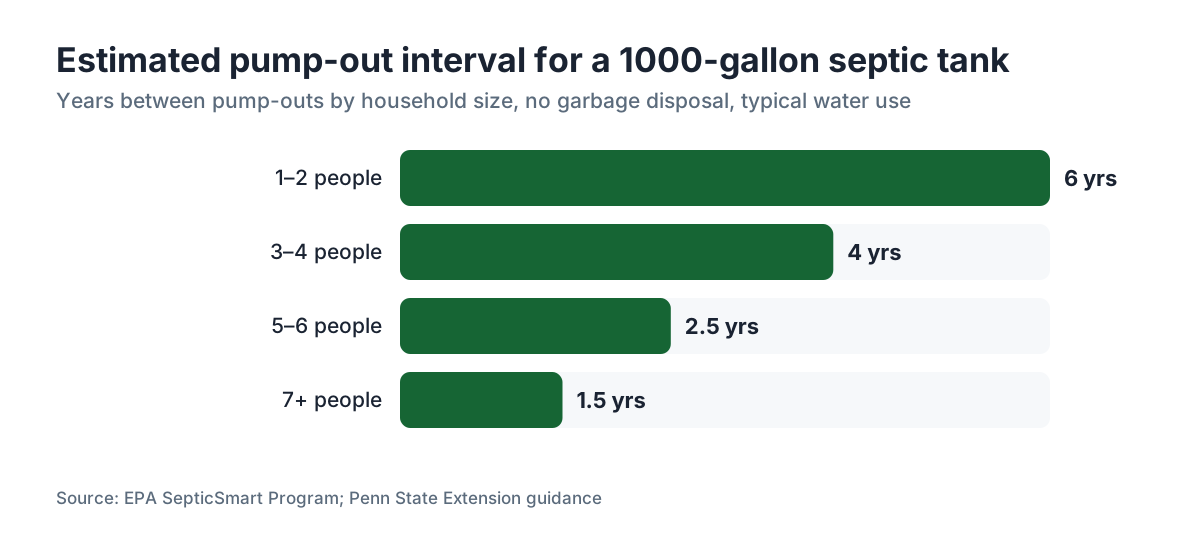
The table below shows estimated pump-out intervals by household size, assuming typical water use and no garbage disposal:
| Household size | Estimated pump interval |
|----------------|-------------------------|
| 1 to 2 people | 5 to 7 years |
| 3 to 4 people | 3 to 5 years |
| 5 to 6 people | 2 to 3 years |
| 7+ people | 1 to 2 years |
These are estimates. A garbage disposal cuts intervals nearly in half because ground food solids pile up fast. A water softener that discharges to the septic system adds sodium and extra water, both of which disrupt the bacterial digestion that slows sludge buildup.
Skipping pumping is the single most preventable cause of drain field failure. When a tank isn't pumped, sludge eventually spills past the outlet baffle and enters the drain field trenches. Once pipes and soil pores clog with solids, the field often needs full replacement, which costs $8,000 to $25,000+. A pump-out costs $300 to $600. The math is obvious.
See our full guide on how often to pump a septic tank for a deeper look at the variables.
What does a 1000-gallon septic tank pump-out cost and what's included?
A standard septic tank pump out for a 1000-gallon tank costs $300 to $600 in most U.S. markets as of 2025. The national average sits around $400 to $450 [6]. Prices run higher in dense metros and lower in rural areas, where labor and disposal costs differ.
A proper pump-out includes pumping all liquid and solids from the tank (more than the liquid layer), rinsing the interior walls with some of the pumped effluent, and a basic inspection of the inlet and outlet baffles and visible tank walls. What it doesn't automatically include: opening a buried lid (extra fee if there's no riser), replacing broken baffles (parts plus labor), or a formal written inspection report.
Adding a septic tank riser to bring the lid to grade is a one-time cost of $200 to $600, and it pays back quickly. Every pump-out that requires locating and digging up a buried lid adds $50 to $150 to the bill. No risers? Get them installed at the next pump-out.
Some operators quote a flat rate. Others charge by volume pumped or by time. Ask specifically whether the price covers opening the lid, whether it covers a baffle inspection, and what happens if they find a broken baffle while they're in there. Get that in writing.
How long does a 1000-gallon septic tank last?
Concrete tanks: 30 to 40 years is a fair range, with well-maintained tanks sometimes reaching 50. Older tanks (pre-1980s) may have steel inlet and outlet baffles that corrode and fail. Cracks form from settling, tree root intrusion, or heavy vehicle traffic over the tank. Concrete in acidic soil or under heavy hydrogen sulfide gas production degrades faster.
Fiberglass and polyethylene tanks can last 30 to 40+ years and sometimes longer because they don't corrode or crack the way concrete does. Their failure modes are different: physical damage during installation or from soil movement, and more vulnerability to flotation.
Two things kill tank lifespan faster than anything else, regardless of material:
- Neglected pumping. A tank that's never pumped lets solids overflow into the drain field. Once that happens, the field fails. The tank may be structurally fine, but the system as a whole is done.
- Driving over the tank. The buried lid and top of a concrete tank aren't rated for vehicle loads. One heavy pass from a truck or a loaded trailer can crack a lid or the tank body. Mark your tank location and keep vehicles off it.
Buying a home with an existing 1000-gallon tank? Get a full septic tank inspection before closing. An inspector probes the sludge layer, checks the baffles, looks for cracks, and measures effluent levels. That $200 to $400 inspection has saved buyers from $15,000 drain field replacements.
What are the dimensions of a 1000-gallon septic tank?
Dimensions vary by manufacturer and shape (rectangular vs. cylindrical), but a typical precast concrete 1000-gallon tank measures:
- Length: 8 to 9 feet
- Width: 4.5 to 5.5 feet
- Height/Depth: 4 to 5 feet
- Weight (empty): 8,500 to 9,000 lbs
Cylindrical concrete tanks and fiberglass tanks in the 1000-gallon range usually run 5 to 7 feet in diameter and 5 to 8 feet tall. Buried depth depends on local frost line rules and site conditions. In cold climates, the top of the tank may need to sit 12 to 24 inches below grade to keep it from freezing.
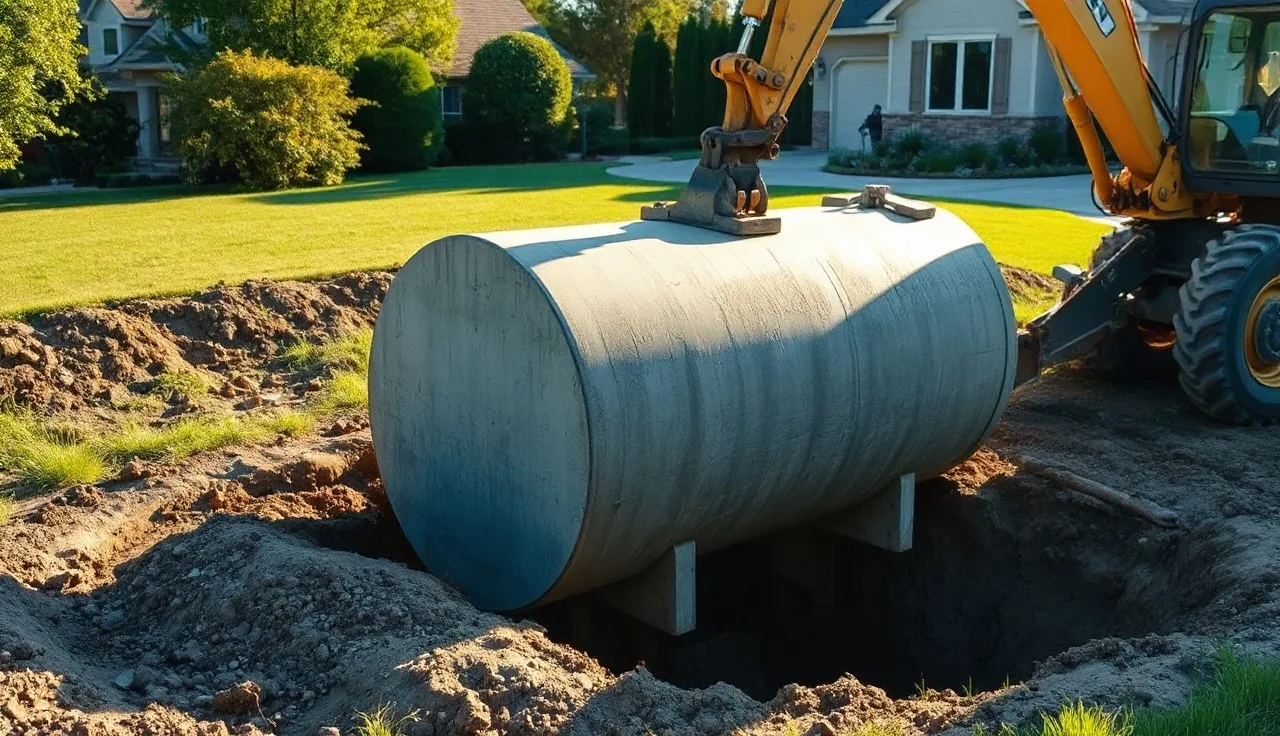
Installation access matters for dimensions. A 9-foot-long, 9,000-lb concrete tank needs either a crane or a large excavator with a lifting attachment to set it in place. On tight lots or properties with limited side yard access, fiberglass or polyethylene tanks get picked for their lower weight and easier maneuvering, not because they're inherently better.
Planning an installation or replacement? Confirm the delivery access path from the street to the site first. Tank delivery trucks are large, and a failed delivery attempt costs money.
Can you add a second tank to a 1000-gallon system?
Yes, and this option gets overlooked too often. If your household grew, you added bedrooms, or the system struggles to keep up with demand, adding a second tank in series before the drain field is a real upgrade short of full replacement.
A common setup: the existing 1000-gallon tank becomes Tank 1, and a new 1000-gallon (or 500-gallon) tank goes downstream in series. The second tank catches solids that slip past Tank 1 and gives more settling before effluent reaches the drain field. That extends drain field life by a lot.
This approach works well when:
- The existing tank is structurally sound and just undersized for current use
- The drain field still functions but shows early stress signs
- A full new system isn't in the budget right now
Permit requirements for adding a tank in series vary by state. Some states want a full permit and inspection. Others treat it as a repair with a simpler approval process. Check with your county health department before digging.
For system-wide problems, the septic system repair guide covers options from minor fixes to full replacement.
What can and can't go into a 1000-gallon septic tank?
The tank's biology depends on a healthy bacterial population breaking down organic waste. Several common household items kill that bacteria or clog the system.
Keep out of the drain and toilet:
- Flushable wipes (they don't break down; this is well-documented)
- Feminine hygiene products, cotton swabs, paper towels
- Cooking grease or fat in any quantity
- Bleach in large amounts, harsh drain cleaners
- Medications, paints, solvents, or any chemical classified as hazardous
- Excessive food waste through a garbage disposal
What's fine:
- Toilet paper (standard, not extra-thick quilted varieties)
- Normal household soaps and shampoos in ordinary amounts
- Dishwasher detergent used per manufacturer instructions
The EPA SepticSmart program puts it plainly: "The only things that should be flushed down the toilet are human waste and toilet paper" [4]. That's the right line.
Garbage disposals deserve extra mention. They sharply raise the solids load entering the tank. If you run one regularly, shorten your pump-out interval and think hard about whether your tank size fits the real load. Some states restrict garbage disposal use on septic systems for exactly this reason.
A high-efficiency washer running several loads a day also adds real water volume. Spread laundry over multiple days instead of one marathon session and you avoid hydraulic overload.
What are the signs a 1000-gallon septic tank is failing or full?
Catch problems early and you're usually fixing a tank or doing a pump-out. Miss them and you're replacing a drain field. The signs are distinctive.
Early warning signs:
- Slow drains throughout the house (more than one fixture, which usually points to a bigger problem than a single clog)
- Gurgling in drains or toilets
- Sewage odors inside the home or near the tank or drain field
More serious signs:
- Wet, spongy grass over the drain field that's greener than the surrounding lawn
- Standing water or pooling effluent over the field (a clear failure)
- Sewage backing up into the lowest drains in the home
- A tank lid that's visibly cracked or sunken
None of these resolve on their own. Additives sold as "tank restorers" have no reliable evidence behind them, and some may harm the bacterial balance you need. The EPA does not recommend septic tank additives [4].
Seeing wet spots over the field? Go easy on the system while you wait for an inspection. Every flush adds effluent to an already saturated field. Call a licensed pumper or inspector fast. Some repairs are cheap when caught early. The same problem ignored for another month often isn't.
The septic tank repair guide covers what's fixable and what's not.
Do you need a permit to install or replace a 1000-gallon septic tank?
Yes, in every U.S. state. Septic tank installation and replacement fall under state and county onsite wastewater treatment rules. Skip the permit and you can face fines, a forced removal of the unpermitted work, and title problems when you sell [2].
The typical permit process for a replacement tank:
- Apply to your county health department or environmental health office
- Submit a site plan and tank specifications
- Pay the permit fee ($200 to $800 in most jurisdictions)
- Schedule an inspection at time of installation
- Get written sign-off
For a new installation, most states also require a soil evaluation (perc test or a percolation and soil morphology assessment) to confirm the site suits a septic system and to size the drain field correctly [3].
For operators managing permit paperwork across many jobs, tracking permit status, inspection dates, and tank specs is the kind of workflow septic service software like SepticMind handles, so compliance records don't fall through the cracks.
Buying a property? Ask for copies of the original permit and any inspection records. Missing documentation is a red flag. Some county health departments keep digital records going back 20+ years. Others keep paper files only. Worth a phone call before closing.
How do you find and access a buried 1000-gallon septic tank?
Most 1000-gallon concrete tanks have two access ports: one over the inlet (near the house) and one over the outlet (toward the drain field). Some older tanks have only a single center port. Which configuration you have matters for pumping, because a proper pump-out needs access to both compartments, or at least both ends.
If the lids are buried, a pumper or inspector locates the tank by:
- Following the sewer line from the house (typically 4-inch pipe sloped 1/4 inch per foot)
- Using a soil probe to find the edges
- Running a metal detector over concrete tanks with steel hardware
- Reading the original permit drawing on file with the county
Once located, installing septic tank risers is the smartest $300 to $600 you'll spend on your system. Risers bring the access lids to grade so every future pump-out and inspection skips the locate-and-dig step. If your tank sits 18+ inches deep, the savings on a single future service call start paying back the riser cost within 2 to 3 pump cycles.
Keep a diagram of your tank and drain field locations. Your county permit file should hold an as-built diagram. Get a copy and keep it with your home records.
How does a 1000-gallon tank compare to smaller and larger sizes?
Size selection isn't only about hitting code minimums. Here's how a 1000-gallon tank stacks up:
| Tank size | Typical application | Pump interval (4 people) | Tank cost (concrete) |
|-----------|--------------------|--------------------------|-----------------------|
| 500 gal | 1-BR cabin, seasonal | 1 to 2 years | $400 to $700 |
| 750 gal | 1 to 2 BR small home | 2 to 3 years | $550 to $900 |
| 1,000 gal | 3 BR standard home | 3 to 5 years | $700 to $1,200 |
| 1,250 gal | 3 to 4 BR larger home | 4 to 6 years | $900 to $1,500 |
| 1,500 gal | 4 to 5 BR or high use | 5 to 7 years | $1,100 to $1,800 |
A 500 gallon septic tank makes sense for a small seasonal property with minimal use. For a full-time 3-bedroom home, it would need pumping so often that the annual service cost would swallow the savings on the smaller tank within a few years.
Going one size up from code minimum, say a 1,250-gallon tank where a 1,000-gallon is the floor, usually adds $200 to $400 to the tank cost. For a family that expects to grow or that runs appliances hard, that's a reasonable buy. Oversizing doesn't hurt the system. The bacteria work fine in bigger tanks.
For the full cost picture, see septic tank installation.
Frequently asked questions
Is a 1000-gallon septic tank big enough for a family of 4?
For most families of 4 in a 3-bedroom home, yes. A 1000-gallon tank is the standard size for that configuration in most state codes. The main caveat: heavy garbage disposal use, frequent laundry, or a high-water lifestyle pushes pump-out intervals closer to 3 years than 5. If you're planning for the long term, stepping up to a 1,250-gallon tank is reasonable.
How deep is a 1000-gallon septic tank buried?
Burial depth varies by climate and site, but the top of the tank usually sits 6 to 24 inches below grade. Cold climates need deeper burial against freezing. Warmer states run shallower. The bottom of a 1000-gallon tank usually sits 5 to 6 feet below grade once you add the tank's 4 to 5 foot height. Your installation permit drawing shows the exact depth for your property.
How much does it cost to replace a 1000-gallon concrete septic tank?
Replacing a 1000-gallon concrete tank including excavation, new tank, backfill, and inspection runs $3,000 to $5,500 in most U.S. markets. High-labor states can push it to $7,000 to $9,000. If the drain field also needs replacement, the full project usually runs $12,000 to $25,000. Get three itemized quotes; vague bids grow.
How many bedrooms can a 1000-gallon septic tank support?
In most states, a 1000-gallon tank is the minimum or standard size for up to 3 bedrooms. Some states extend it to 4. Bedroom count gets used because it proxies for potential occupancy, not actual daily use. Check your state's onsite wastewater rules, since minimums vary. Adding bedrooms to a home already on a 1000-gallon system usually requires a system evaluation and may require a tank upgrade.
What happens if you never pump a 1000-gallon septic tank?
Sludge builds until it overflows the outlet baffle and enters the drain field. Once solids reach the trenches, soil pores clog and effluent backs up or surfaces. Drain field replacement costs $8,000 to $25,000. The tank may be structurally intact, but the system fails. Skipping pumping is the leading cause of preventable septic failure. A pump-out costs $300 to $600.
Can a 1000-gallon septic tank be pumped more frequently than every 3 years?
Yes, and more frequent pumping never harms the system. If your household is large, you use a garbage disposal, or you've seen stress signs, annual or biennial pumping is reasonable. The only cost is the service fee. Some homeowners on smaller tanks or with big families pump every 12 to 18 months as preventive maintenance. There's no downside to pumping more often.
Can you use a 1000-gallon septic tank with a garbage disposal?
Technically yes, but ground food waste sharply raises the solids load. Many installers and extension service guides recommend against garbage disposals on septic systems, or suggest cutting pump intervals in half if you use one. Some states restrict or require disclosure of garbage disposal use in the system design. If you won't give up the disposal, pump more often and consider a larger tank.
How do I know if my 1000-gallon septic tank is full?
Signs include slow drains throughout the house, gurgling, sewage odors inside or near the tank, lush green grass over the drain field, or sewage backing up into low-lying fixtures. A pumper can also measure sludge and scum depth during a service call to gauge fill level objectively. If sludge and scum together top one-third of tank capacity, pump it regardless of when you last did.
What is the difference between a single-compartment and two-compartment 1000-gallon septic tank?
A two-compartment tank has an internal wall that creates a primary settling chamber (usually two-thirds of the volume) and a secondary chamber before the outlet. That design gives better effluent quality because solids from the first compartment have less chance of carrying over. Most modern codes require two-compartment tanks for new installations. Single-compartment tanks are common in older systems and still work fine if pumped on schedule.
How do I find out what size septic tank I have?
Start with your county health department. They should hold a permit with tank size and location. Your home inspection report from purchase may list tank size too. If neither exists, a pumper can often estimate capacity when they open the lid, and some companies probe to measure dimensions in the ground. Manufacturer markings are sometimes visible inside once the lid comes off.
Does a 1000-gallon septic tank need to be inspected when I sell my home?
Most states require or strongly recommend a septic inspection at point of sale, and many lenders require one for FHA or VA loans. A proper pre-sale inspection includes pumping, a baffle check, and an effluent level assessment. In some states the report must be filed with the county. Cost is typically $200 to $400 for the inspection plus $300 to $600 for pumping if needed. Skipping it creates liability.
Can tree roots damage a 1000-gallon concrete septic tank?
Yes. Roots from trees and large shrubs chase moisture and enter concrete tanks through hairline cracks or joints. Once inside, they break baffles, widen cracks, and block flow. Keep trees with aggressive roots (willows, silver maples, poplars, sweet gums) at least 30 to 50 feet from the tank and drain field. Slower-growing ornamental trees can sit closer, but avoid planting directly over any component.
Is a 1000-gallon fiberglass tank better than concrete?
Neither wins outright. Concrete is heavier, so it resists flotation in high water tables, and it's been the standard for decades. Fiberglass is lighter, easier to install on tight lots, and resists corrosion. Concrete can crack over time; fiberglass can float if emptied during a flood. In most cases the choice comes down to installer preference, local code, and site conditions. Both materials can last 30 to 40 years with proper care.
What septic tank additives work for a 1000-gallon tank?
None with reliable evidence. The EPA does not recommend septic tank additives, and no additive has been shown to reduce the need for pumping or repair in peer-reviewed research. The natural bacterial population in a healthy tank is self-sustaining. Biological additives are usually harmless but pointless. Chemical additives can disrupt bacterial balance or damage drain field soil. Save the money for your next pump-out.
Sources
- EPA SepticSmart homeowner guidance: Proper maintenance and the role of tank size in system longevity
- EPA Onsite Wastewater Treatment Systems Manual (EPA/625/R-00/008): Material types, permit requirements, and regulatory overview for onsite wastewater systems
- University of Minnesota Extension, Septic Systems: Tank sizing by bedroom count and state code requirements
- EPA SepticSmart Program guidance: EPA recommendation to pump every 3 to 5 years; guidance against septic additives; what to flush
- HomeAdvisor / Angi Septic Tank Installation Cost Guide: Concrete, fiberglass, and polyethylene tank cost ranges
- HomeAdvisor / Angi Septic Tank Pumping Cost Guide: National average pump-out cost of $400 to $450 for a standard tank
- NC State Extension, Onsite Wastewater and Septic Systems: Two-compartment tank design, lifespan, and maintenance guidance
- Virginia Department of Health, Environmental Health: State permit requirements and inspection processes for septic system installation and replacement
- Penn State Extension, Septic Systems: Sludge accumulation thresholds and pump interval guidance
- University of Florida IFAS Extension (EDIS): Tank material longevity, garbage disposal impacts on solids load, and household size considerations
- National Environmental Services Center (NESC), West Virginia University: Household occupancy, bedroom count, and daily flow design assumptions for tank sizing
- EPA Septic Systems (onsite wastewater) program: EPA position that additives do not reduce pumping need and are not recommended
Last updated 2026-07-09