How to locate your septic tank (7 reliable methods)
By the SepticMind Editorial Team

TL;DR
- Start with your county health department's as-built drawing, which shows the tank's exact spot relative to your house.
- If no record exists, trace the sewer line from the house cleanout with a soil probe or a plumber's snake fitted with a locating beacon.
- Most tanks sit 10 to 25 feet from the foundation, in line with the main drain pipe, buried 6 to 18 inches down.
Why locating your septic tank matters before you do anything else
You can't pump a tank you can't find. You can't inspect it, repair it, or safely dig near it. And if you're buying a home, an unknown tank location means an unknown risk sitting under your yard.
The EPA's SepticSmart program puts it plainly: homeowners should know where every part of their system is, including the tank, the distribution box, and the drain field. [1] That's not paperwork for its own sake. A buried lid gets driven over by a delivery truck and cracks. A drain field disappears under a new patio. A tank goes 15 years without a pumping because nobody knew where to dig. Those are the real costs of not knowing.
Finding the tank is the first step before any septic tank pumping, septic tank inspection, or repair work. A pump truck driver who's guessing where to dig burns your money on labor.
Here's the good news. In most cases you can find the tank yourself in an afternoon using free public records and a $12 soil probe. The methods below run roughly from easiest to most involved. Try them in order.
How do you locate a septic tank using county or health department records?
This is the single best first move. When a septic system goes in, the installer has to file an as-built drawing (sometimes called a permit card, record drawing, or site plan) with the local health department or county environmental agency in most states. [2] That drawing shows the tank's location, size, and setback distances from the house, property lines, and any wells.
Call or visit your county health department, sanitarian's office, or environmental health division. Bring your property address and parcel number. A lot of counties now post these records online through their GIS portal or permitting system. Search your county name plus "septic permit records" or "onsite wastewater permits."
What you'll usually get is a hand-drawn diagram with measurements like "tank inlet 14 ft from southeast corner of house, 6 ft from left foundation wall." Walk those dimensions off the house with a tape measure and you're standing within a foot or two of the lid in minutes.
Systems installed before roughly 1980 often have no records at all. Older tanks went in without formal permits, especially out in the country. If that's your situation, skip down to the tracing and probing methods.
How to locate a septic tank by tracing the sewer line from your house
Every drain in your house feeds one main sewer line that exits the foundation and runs to the tank. Find that exit point and you've got a bearing straight to the tank.
Start in the basement or crawlspace. Look for the biggest drain pipe, usually 3 or 4 inch diameter, either black ABS or gray PVC. Follow it to where it leaves through the foundation wall or floor. That exit tells you the direction the line runs.
Go outside and find where the pipe comes out. The line runs in a fairly straight shot from the house to the tank inlet. Tanks sit 10 to 25 feet from the foundation in most cases, though some are as close as 5 feet or as far as 50, depending on the lot and local setback rules. [3]
Once you know the heading, mark a line from the exit point and start probing. A soil probe (a thin steel rod about 3 to 5 feet long with a T-handle) lets you push into the soil every couple of feet and feel for the hard, slightly hollow resistance of a concrete or fiberglass lid. This takes practice. Rocks give similar resistance but feel denser and don't have the faint flex a fiberglass lid does.
Don't want to probe blind? Rent or hire out a plumber's snake with a locating beacon. Push the snake into a cleanout on the sewer line, feed it toward the tank, then track the beacon with the above-ground receiver. Where the receiver reads strongest under your feet, that's the snake head, which sits at the tank inlet. This is the method most plumbers reach for on a locate call.
How to locate my septic tank using visual clues in the yard
The yard itself often tells you where the tank is, once you know what to read.
Look for a slight depression or a low mound. A concrete tank that's been in the ground 20 years can settle the soil above it into a subtle dip. A poorly backfilled tank can leave a small raised patch instead.
Grass color is another tell. Soil directly over a tank runs a touch warmer and drains differently, so the grass above it can look off, greener in a dry spell or thin and patchy if the lid sits shallow.
Hunt for cleanout caps, inspection ports, or risers poking above grade. Plenty of older tanks have no above-ground access at all. Tanks installed or refurbished after roughly 2000 often carry plastic risers that run to the surface, which makes them far easier to find. Spot a green or black plastic cap in the yard and you've probably found a septic riser. [4]
Check for old fill or disturbed soil too. If a previous owner had the tank pumped, you might see a faint rectangular outline where the lawn was cut and replaced.
Then walk away from the house along the sewer line's heading and look for the drain field, usually a run of parallel trenches or a low mound. The tank always sits between the house and the drain field. More on the leach field here if you need to pin down that part of the system too.
What tools do professionals use to find a septic tank?
If the DIY routes come up empty, here's the gear a septic company or plumber brings out.
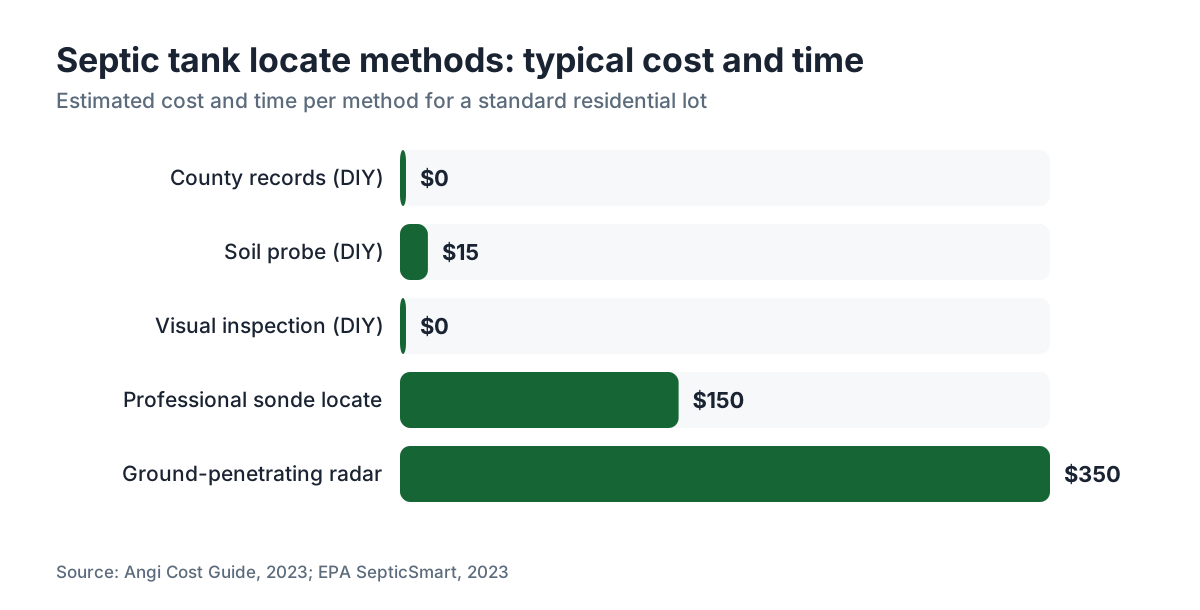
Electronic pipe locator / sonde: A small transmitter (the sonde) goes into the sewer line through a cleanout. Above ground, a receiver picks up its signal and walks the technician right to the tank inlet. Accurate to within inches. This is the most reliable non-destructive method, and most companies charge $75 to $200 for a locate call. [5]
Ground-penetrating radar (GPR): A GPR unit fires radar pulses into the soil and maps what's buried. It finds tanks, lids, and pipes with almost no digging, but it costs more, usually $200 to $500 for a scan, and the results need someone who can read them. GPR earns its keep on large properties or when you think the tank is buried deep. [9]
Metal detector: Works only on tanks with metal parts or cast-iron pipes. Steel tanks and old cast-iron lids show up well. Concrete and fiberglass tanks running PVC pipe give you nothing.
Drain camera with locator: Same idea as the sonde, but the transmitter rides on a camera head. You get to confirm you're in the right pipe and see the line's condition as you go.
For a standard residential locate, the sonde method is almost always enough and it's the cheapest of the pro options. Deep tank, big lot, or a system from before 1960? GPR is worth the extra money.
How deep is a septic tank, and how far from the house is it usually?
These numbers tell you how hard the digging will be once you've pinned the spot. Most residential tanks are buried with the top 6 to 18 inches below the surface. [3]
Some go deeper. Cold climates need extra cover against frost, and sloped lots often get a deeper tank so the inlet and outlet pipes hold the right grade. Tanks deeper than 30 inches are uncommon but not rare across the northern states.
Distance from the house varies more than depth. Most state codes set a minimum setback of 5 to 10 feet from the foundation. [2] The real-world install range lands at 10 to 25 feet. On a tight lot with setback conflicts (a neighbor's well, a property line, a wetland), the installer may push the tank off to one side instead of straight out the back.
A couple of practical reads on the ground. If the yard slopes away from the back of the house, the tank is probably in the lower ground, because gravity pulls the sewer line downhill. If the house has an addition or an attached garage on one side, the main sewer line likely exits a different wall than you'd expect. Find where the bathrooms and kitchen cluster and trace the drain stack out from there.
How to use a soil probe correctly without damaging the tank
A soil probe is a steel rod, usually 3/8 inch across and 3 to 5 feet long, with a T-handle or loop grip. You push it straight down and feel what's under the grass. Cheap, fast, and effective on tanks that aren't buried too deep.
Here's how to do it without cracking anything.
Know what you're feeling for. A tank lid is a flat or slightly domed surface, concrete, fiberglass, or polyethylene, usually round or rectangular, 18 to 24 inches across. When the probe hits it, you get a firm stop with a slightly hollow feel. Concrete reads very solid and dense. Fiberglass gives the faintest flex back.
Probe every 12 to 18 inches along your projected sewer line. Start 10 feet out from the pipe exit and work outward in a grid. Once you get a hit, probe around it to trace the edges. That maps the tank's size and which way it's turned.
Don't pound the probe. Push steadily with your body weight. Hit hard resistance and stop. You don't want to crack a fiberglass lid or punch through a concrete one that's rotted thin. Tap the probe sideways and if it sounds hollow, you're on the lid.
Tank deeper than your probe reaches? Rent a longer one or move to a sonde-based locate.
Can you locate a septic tank with a smartphone app or online map?
Somewhat, with real limits. Some county GIS portals bake septic permit data into their maps, and a handful of states run searchable statewide databases by address. The EPA keeps no national septic location database, so there's no single place to look. [1]
State-level examples:
- Minnesota's Pollution Control Agency runs a statewide subsurface sewage treatment program with permit records. [7]
- Washington State provides county-level septic records through its environmental health departments. [10]
- Florida's Department of Health offers an online septic permit lookup by address through many county health departments. [6]
For your state, search "[your state] onsite wastewater system permit lookup" or just call your county environmental health office.
Apps sold as "septic finders" mostly pull the same county GIS data you can get yourself for free. No magic in them. The data is only as good as what the county has on file, which for pre-1980 systems is often nothing.
SepticMind's operator platform gives service companies tools to record and manage location data on every system they work, handy for technicians hitting the same properties year after year. That won't help a homeowner finding a tank cold with no prior service record.
For most homeowners, the county records route is free and beats any app on speed.
What to do once you've found the tank
Mark the spot for good. Drive a stake, drop a GPS pin on your phone, or measure the exact distances from two fixed points on the house ("18 feet from the southeast corner, 4 feet left of the center of the back wall"). Sketch it and file it with your home records. Sell the house someday and this sketch saves the next owner days of digging around blind.
Check whether the tank has accessible lids or risers. If you had to dig to reach the lid, think about having a service company set a riser so the lid sits at or near grade next time. Riser installation runs $100 to $300 and pays for itself in reduced excavation labor at every pump-out. [5]
With the lid reachable, schedule a septic tank pump out if you don't know when it was last done. The EPA recommends pumping every 3 to 5 years for a typical household. [1] If the house changed hands with no records, assume it's overdue and get it done. A septic tank inspection at the same visit gives you a baseline on the system's condition.
Seeing wet spots or catching odors near the tank or drain field? Don't wait. That can mean a full tank or a failing system that needs more than a pumping. Our guides on septic system repair and septic tank repair walk through what those symptoms usually point to.
Just bought the place with no records at all? Get a full inspection before you assume the system is sound. An inspector can scope the line, check the tank, and read the drain field. That's the only honest way to know what's under your yard.
Step-by-step summary: how to locate your septic tank
The full process, in order of effort:
Step 1. Check county records first. Call or visit your county health department, or pull up their online permit database. Ask for the as-built drawing or permit card for your address. This alone solves it for most homeowners.
Step 2. Find the sewer line exit point. In the basement or crawlspace, find the main drain pipe (3 or 4 inch diameter) and trace it to where it leaves the foundation. Go outside and mark that point. That's your starting heading.
Step 3. Look for visual clues. Scan the yard for risers, cleanout caps, soil mounds or dips, or a stripe of greener grass along the path from the sewer exit.
Step 4. Probe the soil. With a soil probe, push down every 12 to 18 inches along the sewer line, starting 10 feet from the house. Work outward until you feel the firm, slightly hollow resistance of a lid.
Step 5. Use a sonde or electronic locator. If a thorough probing attempt comes up empty, hire a plumber or septic company to run a sonde through the sewer line and trace it above ground. This runs $75 to $200. [5]
Step 6. Mark and document. Record the exact location with measurements and GPS. Set a riser if the lid sits more than a few inches below grade.
Step 7. Schedule maintenance. No pump records? Arrange septic tank pumping and an inspection. A tank you've found but never serviced is still a risk sitting under your feet.
How often should you need to relocate your septic tank?
Ideally, once and never again. After you've found it, documented it, and set a riser if it needed one, the location is a solved problem for the life of the system.
The EPA recommends inspecting the system every 1 to 3 years and pumping every 3 to 5 years, depending on household size and use. [1] Every one of those service visits confirms the location again. A decent septic company logs the tank's spot in their records so future visits skip the re-locate.
Wondering how often to pump your septic tank? Short answer: a 1,000-gallon tank serving a family of four usually needs pumping every 3 to 5 years, but the interval depends on how much solid waste hits the tank and whether you run a garbage disposal. More solids, shorter interval.
For the bigger money picture, our guide on the cost to install a septic system covers what a full replacement runs, which matters if the locate turns up a tank that's failing.
Frequently asked questions
How do I find my septic tank if I have no records?
Trace the main sewer line from your basement to where it exits the foundation, then probe the soil in a straight line from that exit point, starting 10 feet out. Most tanks sit 10 to 25 feet from the house. If probing fails, hire a plumber or septic company to run an electronic sonde through the sewer line and track it above ground with a receiver, a service that runs $75 to $200.
Can I find my septic tank by looking in my yard?
Sometimes. Look for plastic riser caps or inspection port covers at grade, subtle soil dips or mounds, unusually lush grass, or disturbed soil in a roughly rectangular patch. These clues narrow the search area but rarely pinpoint the tank exactly. Pair them with a soil probe or county records for a reliable fix on the spot.
How deep underground is a septic tank?
Most residential tanks are buried with their tops 6 to 18 inches below the surface. In cold climates or on sloped lots, tanks can run 24 to 30 inches deep or more. Tanks deeper than 36 inches are less common but real. Depth matters because it sets how easy the lid is to reach and how much excavation a pump crew has to do.
How far from the house is a septic tank usually located?
Most state codes require at least 5 to 10 feet of setback from the foundation. In practice, tanks sit 10 to 25 feet from the house. Exact distance depends on lot size, where the bathroom and kitchen drain stacks are, and any site-specific setbacks for wells, wetlands, or property lines.
Will a metal detector find a septic tank?
Only if the tank or its pipes have metal parts. Steel tanks and old cast-iron inlet pipes register on a metal detector. Concrete tanks running PVC or ABS plastic pipe generally give no useful signal. A metal detector is worth a try if you suspect a steel tank or the home went up before the 1970s, when cast-iron pipe was standard.
What does a septic tank lid look like?
Most lids are round or rectangular, 18 to 24 inches across, made of concrete, fiberglass, or polyethylene. Older concrete lids may be stained or cracked. Newer plastic lids are usually green or black. With risers, the lid sits at or near ground level. Without risers, it can be several inches to a foot or more below the soil.
Can I use Google Maps or satellite images to find my septic tank?
Satellite images can sometimes show the drain field as an off-color patch of grass or a low mound, which helps you triangulate the tank (it sits between the house and the field). The tank itself is too small and too buried to show up directly. County GIS maps beat Google Maps here, since they tie permit records to a property address.
Is there a national database of septic tank locations?
No. The EPA keeps no national database of residential septic tank locations. Records live at the county or municipal level, usually with the health department or environmental health office. Some states run partial statewide databases, but coverage is uneven. Your best first stop is always the local county health or environmental office for your address.
What if my septic tank was installed without a permit?
Unpermitted systems are common in homes built before the 1970s or in rural areas with light oversight. With no county records, use the soil probe method along with tracing the sewer exit from the house. If the system is very old or undocumented, get a full inspection by a licensed septic pro once you find it, since the tank condition and drain field layout will also be unknowns.
How long does it take to locate a septic tank?
With county records in hand, you can confirm the location in 30 minutes with a tape measure. Probing from scratch on a property with no records takes 1 to 3 hours for a thorough attempt. A professional running an electronic sonde usually finds the tank in under an hour. Ground-penetrating radar scans take longer but map more ground.
What is a septic tank as-built drawing?
An as-built drawing is a site plan the installer files after the system goes in the ground. It shows the tank's location relative to the house with measured distances, the tank's size and type, the drain field layout, and setbacks from wells and property lines. Most states require these on file with the local health department. It's the single most reliable document for finding a tank fast.
Can I locate my septic tank myself, or do I need a professional?
Most homeowners can find their tank themselves with county records and a soil probe, especially if the tank is within 25 feet of the house and less than 18 inches deep. Bring in a professional if the tank is unusually deep, the lot is large, or the system is old with no records. Professional sonde locates cost $75 to $200 and take under an hour.
What should I do after I find my septic tank?
Record its exact location with measurements from two fixed points on the house and drop a GPS pin. If the lid is buried more than a few inches, consider setting a riser ($100 to $300) so future access skips the digging. Then schedule a pump-out and inspection if you have no record of recent service. A tank that's been found but neglected is still a failure risk.
Sources
- U.S. EPA, SepticSmart homeowner program: EPA recommends inspecting septic systems every 1-3 years and pumping every 3-5 years; homeowners should know the location of all system components
- U.S. EPA, Onsite Wastewater Treatment Systems Manual (EPA/625/R-00/008): As-built drawings are required at permit filing and show tank location and setback distances; minimum setbacks from foundations are typically 5-10 feet under state codes
- University of Minnesota Extension: Typical tank burial depth is 6-18 inches below surface; distance from house is usually 10-25 feet
- Penn State Extension: Tanks installed or refurbished after roughly 2000 often have plastic risers extending to or near the surface for easier access
- Angi, Septic Tank Cost Guide: Professional septic tank locate using electronic sonde costs $75-$200; riser installation typically costs $100-$300
- Florida Department of Health, Onsite Sewage Treatment and Disposal Systems: Florida maintains online septic permit lookup by address through county health departments
- Minnesota Pollution Control Agency: Minnesota runs a statewide subsurface sewage treatment program with permit records searchable through the agency and counties
- U.S. Census Bureau, American Housing Survey: Approximately 21 million U.S. homes rely on septic systems or other individual onsite wastewater systems
- North Carolina State Extension: Ground-penetrating radar can locate buried tanks and pipes with minimal digging; typical GPR scan costs $200-$500
- Washington State Department of Health: Washington State provides county-level septic permit records through environmental health departments
Last updated 2026-07-09