How often to empty your septic tank (and how much it costs)
By the SepticMind Editorial Team
TL;DR
- Most households should empty their septic tank every 3 to 5 years.
- The exact interval depends on tank size and the number of people in the home.
- A 1,000-gallon tank serving four people typically needs pumping every 3 to 4 years.
- A single person with a 1,500-gallon tank might go 7 to 10 years.
- Pumping costs $300 to $600 for a standard residential job.
What is the standard recommendation for how often to empty a septic tank?
The EPA's SepticSmart program recommends inspecting your septic system every 3 years and pumping it every 3 to 5 years for a conventional gravity system [1]. That range is a reasonable starting point for most households. But it is genuinely a range, not a fixed schedule. Your actual number could land anywhere from 2 years to well past 10 years depending on tank size, how many people live in the home, and what goes down the drains.
The 3-to-5-year figure comes from the rate at which solids build up. Wastewater separates inside the tank into three layers: a floating scum layer on top, a liquid middle layer (effluent), and a settled sludge layer at the bottom. You pump the tank when those combined layers eat up enough of the working volume to threaten overflow into your leach field. Once sludge and scum together take up more than about one-third of the tank's total liquid depth, pumping is overdue [2].
If you do nothing else, follow this rule: have a licensed pumper measure your sludge and scum depth at every service call. That single measurement tells you how fast solids build up in your specific tank with your specific household, and you can dial in a custom interval from there. The EPA itself says, "the size of the household, total wastewater generated, the volume of solids in wastewater, and septic tank size" all affect the pumping interval [1].
How does household size and tank volume affect the pumping schedule?
These two variables set your pumping interval more than anything else does. A bigger household makes more solids. A smaller tank fills faster. Stack those two against each other and your interval shrinks fast.
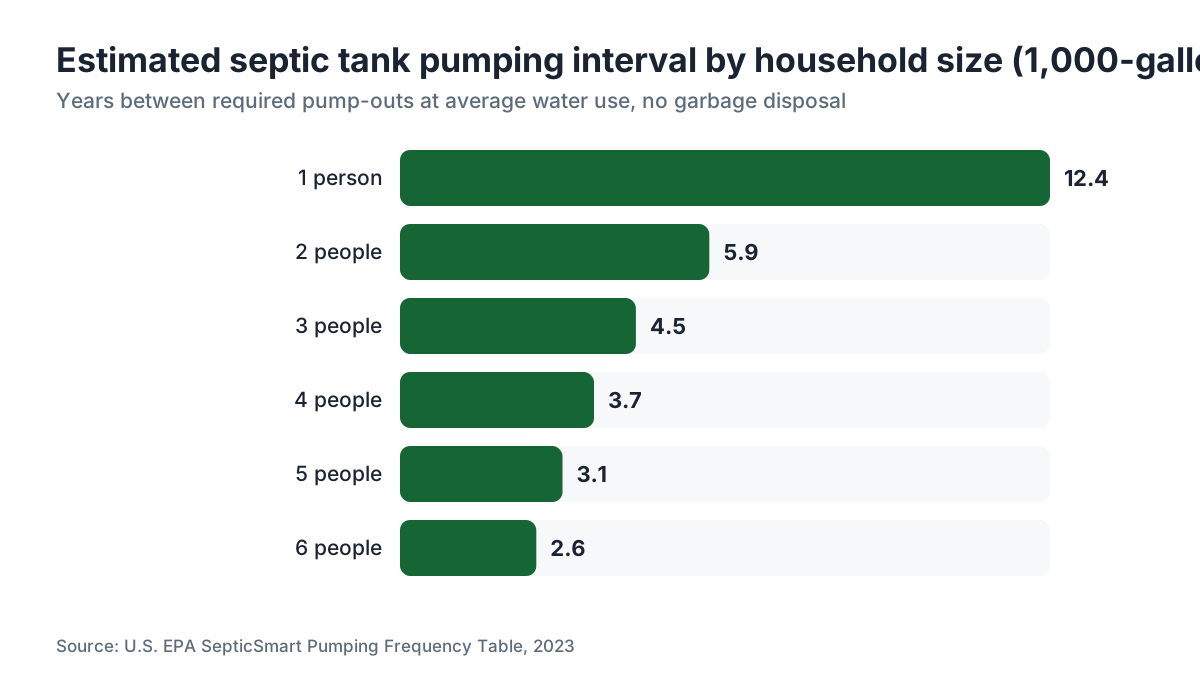
The table below shows estimated pumping intervals from the EPA's guidance for various household sizes and tank volumes [1]. These assume average water use and a household with no garbage disposal.
| Tank size (gallons) | 1 person | 2 people | 4 people | 6 people |
|---|---|---|---|---|
| 500 | 5.8 yrs | 2.6 yrs | 1.5 yrs | 1.0 yr |
| 750 | 9.1 yrs | 4.2 yrs | 2.6 yrs | 1.6 yrs |
| 1,000 | 12.4 yrs | 5.9 yrs | 3.7 yrs | 2.6 yrs |
| 1,250 | 15.6 yrs | 7.5 yrs | 4.8 yrs | 3.3 yrs |
| 1,500 | 18.9 yrs | 9.1 yrs | 5.9 yrs | 4.0 yrs |
A few things jump out. A family of four with a 1,000-gallon tank should pump roughly every 3 to 4 years, right in line with the common advice. That same 1,000-gallon tank serving six people needs pumping every 2.5 years. A single person with a 1,500-gallon tank could legitimately wait nearly 19 years, though most pros would still want a check-in around the 5- to 7-year mark just to confirm nothing odd is happening inside.
One caveat on the small end. 500-gallon tanks show up mostly in older construction or seasonal cabins. Most states now require at least 1,000 gallons for a new single-family install, and several require 1,250 gallons [3]. If your home went up before 1980, find out what you actually have before you assume the standard interval applies.
For a closer look at the mechanics behind these numbers, see our guide to how often to pump septic tank.
What other factors make you need to empty the tank more often?
Household size and tank volume are the headline factors. Several other things can cut your interval down hard.
Garbage disposals add a heavy load. The EPA specifically calls out garbage disposals as a factor that may require more frequent pumping, and some state guidelines suggest halving your normal interval if you use one regularly [1]. Ground-up food solids do not break down as fast as human waste, and they pile up in the sludge layer quickly.
Guests and long-term visitors raise your effective household size. A household of two that hosts family for two months of the year runs like a household of four or five during that stretch. If you run a home business with employees using your plumbing, count them too.
High water use speeds up the hydraulic load on the tank and can push solids into the drain field before they have settled. Washing machines are the usual culprit. Spreading laundry across the week instead of running eight loads on a Saturday is one of the single most effective things you can do to stretch tank life [9].
Antibacterial soaps, bleach, and certain medications taken in high doses can suppress the bacterial activity that breaks down solids in the tank. The effect is real, though the size of it depends heavily on how much you actually use. Nobody has good population-level data on this specific question, but university extension programs in several states flag it as a contributing factor [4].
If your system includes an in-tank pump (an effluent pump or a grinder pump), those components can hide early warning signs and push the system harder. Homes on pressure-dosed or drip irrigation systems should follow whatever pumping interval the installer specified, which may be shorter than the standard guidance.
How much does it cost to empty a septic tank?
A standard residential pump-out runs $300 to $600, with the national average around $400 to $450 [5]. That price covers the pumper truck visit, the labor to open the lid and vacuum the tank, and disposal of the waste at a licensed treatment facility.
Prices swing a lot by region. Rural areas with fewer providers and longer drive times run higher. Dense suburban markets with several competitors run lower. The Northeast and Pacific Coast generally price above the South and Midwest.
Tank size affects cost, but less than people expect. The jump from a 1,000-gallon tank to a 1,500-gallon tank might add $50 to $100. The bigger price drivers are these:
- Access. If the pumper has to locate buried lids, dig them up, or work around landscaping, expect a surcharge of $50 to $150.
- Depth. Tanks buried more than 18 to 24 inches often need extension risers to reach. Installing risers costs $200 to $500 but is a one-time job that makes every future pump-out faster and cheaper.
- Inspection add-ons. A basic visual inspection during pumping is often included or costs $50 to $100 extra. A camera inspection of the outlet baffle and the line to the drain field runs $100 to $250.
- Emergency or after-hours calls. If the tank is backing up on a Sunday, you pay a premium, often 50% to 100% above the standard rate.
For a full breakdown of what drives the price up or down, see our detailed guide on septic tank pump out costs.
One thing worth saying plainly. The cost of one pump-out every 3 to 4 years is trivial next to the cost of a drain field failure. A new leach field runs $5,000 to $20,000 or more depending on soil conditions and local rules [6]. Pumping is cheap insurance.
How much does a full septic tank cleaning cost, and is it different from pumping?
People use 'pumping' and 'cleaning' interchangeably, but there is a real difference. Pumping removes the liquid and most of the sludge. Cleaning, in the strict sense, means the pumper also backflushes the tank with water or uses a jetting hose to break loose sludge that has hardened on the walls and in the corners, then vacuums it all out. A full clean leaves the tank a lot emptier than a standard pump-out.
Full cleaning costs more. A standard pump-out runs $300 to $600. A full clean with backflushing can run $400 to $800, sometimes higher for large tanks or long-neglected systems [5].
For most households on a regular 3-to-5-year schedule, standard pumping is fine. The tank's bacterial activity breaks down residual sludge between visits. If you buy a home with no record of the last service, or if the system sat neglected for 8 to 10 years, a full clean earns the extra cost. Same story if the pumper pulls the lid and the sludge layer is abnormally thick.
For more detail on what a thorough service includes, see our guide on septic tank cleaning.
One important note. Some companies sell 'septic treatments' or enzyme additives as a substitute for pumping. They are not. The EPA's SepticSmart guidance does not endorse any additive as a replacement for regular pumping [1]. Save your money on the additives and spend it on the actual service.
What are the warning signs that your tank needs emptying now?
You should not wait for warning signs to pump. But knowing them helps you catch an overdue system before it becomes a failed system.
The most obvious sign is slow drains across the house, not in one fixture but in several. A single slow drain is usually a clog in that one line. Multiple slow drains at the same time point to a tank that is backing up. If toilets gurgle when you run a sink elsewhere in the house, take that pressure sign seriously.
Sewage odors outside near the tank or drain field are a red flag. Some odor during pumping or right after heavy rain is normal. Persistent odor in dry conditions is not.
Wet, soggy ground or unusually lush grass over the drain field, especially when the rest of the yard looks normal, means effluent is surfacing. That is a leach field problem, but an overfull tank is often the trigger.
Inside, a sewage smell that is strongest in the lowest level, near floor drains or basement toilets, often means the tank is at or near capacity. Trust your nose.
See any of these signs and call a pumper the same week. Do not run the system hard while you wait. Cut water use as much as you can until the truck comes. If you see sewage surfacing in the yard, stay out of that area and call your local health department. Surfacing sewage is a public health problem, not a plumbing inconvenience.
How do you find out when your tank was last emptied?
This is one of the most common problems new homeowners hit. The previous owner may have no records, and the tank itself tells you nothing.
Start with your local health department or county environmental office. Many counties keep records of septic pump-out receipts or annual inspection reports, especially in states with mandatory inspection programs. Your county's onsite wastewater program office is the right call.
If there is an inspection report from when you bought the home, that report should list the last known service date. Dig it out of your closing documents.
Call a few local pumping companies and give them the address. Larger operators keep service records going back years, and it costs nothing to ask. If the seller used the same local company for 15 years, that company probably has dates on file.
If you genuinely have no idea, the safest move is to pump the tank now and have the pumper measure the sludge depth before pulling everything out. Thin sludge layer, the system was probably serviced recently. Thick and consolidated, it has been a while. Either way, that measurement gives you a calibration point to set your next interval.
Some homeowners use a septic tank inspection as a starting point when they take over a new property. A camera inspection of the tank and outlet can tell you a lot about the system's current condition even with zero historical records.
Does the type of septic system change how often it needs to be emptied?
Yes, and generic advice tends to skip right past this.
A conventional gravity system (tank plus drain field, no pump) follows the standard 3-to-5-year guidance pretty closely. Most published pumping frequency tables assume this setup.
Mound systems and pressure-dosed systems often have smaller dose tanks that fill with solids faster, and some states require annual inspection of them. Follow the manufacturer's or installer's specified interval, which is often shorter than for gravity systems.
Aerobic treatment units (ATUs) use mechanical aeration to treat wastewater more aggressively before it reaches the drain field. They typically need maintenance visits every 6 to 12 months to check the aerator, chlorinator, and effluent quality. The solids-pumping interval on an ATU can actually be longer because the biological treatment is more complete, but the maintenance schedule is much tighter. Most states require ATU owners to hold a service contract with a licensed operator [7].
Chamber systems and drip irrigation systems have their own service requirements. The installer's documentation is the authority here.
If you have a holding tank rather than a septic system (no drain field, just a sealed tank that gets pumped out completely), your interval depends entirely on how fast the tank fills. A family of four can fill a 1,500-gallon holding tank in 3 to 6 weeks. Holding tanks are expensive to run and usually only go in where a conventional system will not fit.
For systems that need more than routine maintenance, see our guides on septic tank repair and septic system repair.
Are there any state laws about how often you must empty your septic tank?
Some states set mandatory pumping or inspection schedules. Most do not have a universal pumping frequency law, but they do have rules that add up to the same thing.
Massachusetts requires a Title 5 inspection when a property transfers or gets expanded, and the inspection typically triggers pumping if the tank has not been serviced recently [8]. Connecticut requires inspection of systems every 3 years in designated nitrogen-sensitive areas. Washington State requires annual maintenance contracts for ATU systems [7].
County and municipal rules add another layer. Many coastal counties and areas near lakes or sensitive watersheds run stricter inspection or pumping requirements than the state baseline.
Your local authority having jurisdiction (AHJ), usually the county health department or sanitarian, can tell you exactly what applies to your address. Look for your state's onsite wastewater program, usually housed under the department of environmental quality, department of health, or department of natural resources.
Even where there is no legal mandate, the EPA SepticSmart guidance works as the de facto standard in regulatory discussions. If your system fails and you have documentation of regular 3-to-5-year pumping, that record helps you when you talk to regulators about remediation options. It helps your home sale too. A system with no service records gets scrutinized much harder at inspection.
What happens if you wait too long to empty the septic tank?
When the tank does not get pumped on schedule, sludge and scum layers grow until there is not enough working volume for solids to settle before the effluent moves on to the drain field. At that point, raw or partially treated solids carry over into the leach field trenches.
The drain field soil relies on biological processes to treat effluent as it percolates through. When those pores clog with sludge, the soil becomes biologically overloaded and stops passing water. This is called biomat formation. Once a biomat fully clogs a drain field, the damage is often permanent. You need a new drain field.
A new drain field costs $5,000 to $20,000 for a conventional trench system. A mound replacement in tough soils can run $15,000 to $40,000 [6]. Those numbers make the $400 every 3 to 4 years look very different.
Short of full failure, an overloaded system can cause sewage backups inside the home (a health emergency and an expensive cleanup), surface discharge into the yard (a public health code violation in every state), and groundwater contamination that can reach a private well or a neighbor's well.
Some drain fields recover after you pump the tank and rest the system for a few weeks, but that is not reliable and not something to count on. The only guaranteed outcome is catching the problem before the solids reach the field. Pumping on schedule is the only tool that reliably does that.
If you are already seeing surfacing sewage or persistent backup, get a professional assessment before you decide between repair and replacement. Our guide on septic tank repair covers what options exist.
How can you track your septic pumping schedule and stay ahead of it?
The most common reason tanks go too long between pump-outs is that people simply forget. No bill arrives. No utility meter spins. No reminder is built into the system itself.
The simplest fix is a calendar reminder set the day you get the invoice from your pumping company. Set it to repeat at your target interval, and add a 6-month lead-up reminder so you can book ahead during slow season when companies are less backed up.
Some counties mail postcards to homeowners based on permit records. Do not count on that.
Managing a rental property or several properties makes these intervals harder to keep straight. This is where software built for the septic industry earns its keep. SepticMind is designed for septic service operators and includes tools for scheduling, service history tracking, and customer communication, which means the operator who services your tank can keep the records in a way that is actually retrievable next time.
For homeowners, your best documentation tool is a physical folder in the house with every service invoice. Date, company name, tank size, sludge depth before pumping, and any notes from the pumper. That paper trail is worth real money when you sell.
One more thing worth doing: get access lids installed if you do not have them. Concrete lids buried under a foot of soil cost you extra labor charges every pump-out. Plastic access risers brought to grade cost $200 to $500 installed once and save you money on every service call after. See our guide on septic tank pumping for what a typical service involves.
Frequently asked questions
How often should I clean my septic tank if I use a garbage disposal?
If you use a garbage disposal regularly, cut your standard pumping interval roughly in half. Instead of pumping every 3 to 5 years, plan for every 1.5 to 2.5 years. Garbage disposals add a heavy solid load that speeds up sludge buildup. The EPA's guidance notes that garbage disposal use is one of the factors that increases how often pumping is needed.
How much does it cost to empty a septic tank for an average home?
For a standard residential tank pump-out, most homeowners pay $300 to $600. The national average is around $400 to $450. Prices vary by region, tank size, and access difficulty. A tank that is hard to reach because the lid is buried deep may add $50 to $150 in labor. Emergency same-day calls can run 50% to 100% higher than normal rates.
How much is it to empty a septic tank for a large family home?
A large household with a big tank might pay $450 to $700 for a pump-out. Tank size affects cost, but less than people expect. The bigger cost driver is access. If the pumper needs to dig up a buried lid or work around a deck, that adds charges. A 1,500 or 2,000-gallon tank for a large home typically runs $100 to $150 more than a 1,000-gallon tank job.
Can I empty my septic tank myself?
No, not legally in most states. Removing and transporting septic waste requires a licensed waste hauler and disposal at an approved treatment facility. Trying to empty a tank yourself by digging it up and discharging waste on-site violates environmental regulations in virtually every jurisdiction. The fines for illegal dumping of septic waste are steep. Hire a licensed pumper.
How do I know if my septic tank is full right now?
Warning signs include multiple slow drains across the house (more than one fixture), gurgling when toilets flush or sinks drain, sewage odors near the tank or drain field, and soggy or unusually green patches of grass over the drain field. Inside, a sewage smell near floor drains or the basement is a common early warning. If you see any of these, schedule a pump-out promptly.
How often does a septic tank need to be emptied for a vacation or seasonal home?
For a home used only part of the year, the standard interval based on household size still applies, but the low annual usage means the tank may go many more calendar years between pump-outs. Use the EPA's household-size table and count only the people actually using the system and for how long. Many seasonal homeowners find they only need pumping every 7 to 10 years, but a check-in inspection every 5 years is still smart.
Does pumping a septic tank damage the good bacteria inside it?
Pumping removes most of the active bacterial population along with the sludge and liquid. The system reestablishes a healthy bacterial community within a few days to a few weeks through normal household wastewater. You do not need to add any commercial bacterial additive to restart the system after pumping. Normal waste from the household is enough to recolonize the tank.
How often should a 1,000-gallon septic tank be pumped?
For a family of four with a 1,000-gallon tank, the EPA's guidance suggests pumping every 3 to 4 years. For two people, that same tank can go roughly 6 years. For six people, you are looking at every 2.5 years. If you use a garbage disposal, shorten those intervals. Have your pumper measure sludge depth at each service to calibrate the interval for your specific household.
What happens if I never pump my septic tank?
Eventually the sludge and scum layers fill the tank and solids carry over into the drain field. Once the drain field clogs with solids, the soil loses its ability to treat and absorb effluent. This leads to sewage backing up into the house, surfacing in the yard, or contaminating groundwater. Drain field replacement costs $5,000 to $20,000 or more and is largely preventable with regular pumping.
How much does it cost to have a septic tank inspected?
A basic visual inspection during a pump-out is often included in the pump-out price or adds $50 to $100. A more thorough inspection with a camera check of the outlet baffle and distribution line runs $100 to $250. A full Title 5-style inspection required for a home sale in Massachusetts, or a full inspection with flow test and component check, can run $300 to $600 depending on the state and scope.
Is it worth putting a septic tank riser in to make pumping easier?
Yes, for most homeowners it is worth doing. If your tank lids are buried, every pump-out includes a labor charge to locate and dig them up. Risers cost $200 to $500 installed, typically once, and then wipe out that extra charge for good. After two or three pump-outs, the riser has paid for itself. It also makes it easier for you to do a quick visual check on the system without calling a professional.
Do septic tank additives reduce how often I need to pump?
No. The EPA's SepticSmart guidance does not recommend any additive as a substitute for regular pumping, and there is no strong evidence that commercial enzyme or bacterial additives meaningfully extend pumping intervals. Some additives can actually harm the system by breaking up the solid sludge layer in ways that let particles carry into the drain field. Skip the additives and put that money toward the pump-out.
How long does it take to pump out a septic tank?
A standard residential pump-out takes 20 to 45 minutes for the actual pumping once the lid is open and the truck is set up. If the pumper has to locate or dig up buried lids first, add another 15 to 30 minutes. A very large or long-neglected tank may take an hour or more. Most service calls, start to finish including travel prep and paperwork, are done in under 90 minutes.
Can a full septic tank affect my well water?
Yes. When a septic system fails or overflows, partially treated wastewater can migrate through the soil toward groundwater. If you have a private well, the risk of contamination is real, especially if the well is downhill from the septic system or within 50 to 100 feet. Nitrates and pathogens are the main concerns. If you suspect your system has been failing for a while, testing your well water is a sensible precaution.
Sources
- U.S. EPA, SepticSmart: How to Care for Your Septic System: EPA recommends inspecting conventional septic systems every 3 years and pumping every 3 to 5 years; tank size, household size, total wastewater generated, and volume of solids in wastewater all affect the pumping interval; EPA does not endorse additives as a replacement for pumping.
- U.S. EPA, Septic System Owner's Guide (EPA/625/R-00/008): Pumping is indicated when combined sludge and scum layers occupy roughly one-third of the tank's liquid volume.
- National Environmental Services Center, Septic Tank Sizing Guidelines: Most states now require a minimum 1,000-gallon tank for new single-family installations; some require 1,250 gallons.
- Penn State Extension, Homeowner's Guide to Septic Systems: Antibacterial products and high bleach use can suppress bacterial activity in the septic tank and are identified as contributing factors to faster sludge accumulation.
- HomeAdvisor (Angi), Septic Tank Pumping Cost Guide: National average cost for residential septic tank pump-out is approximately $400 to $450, with a range of $300 to $600 for standard jobs; full cleaning with backflushing runs $400 to $800.
- U.S. EPA, A Homeowner's Guide to Septic Systems: Replacing a failed drain field can cost $5,000 to $20,000 or more; mound system replacements in difficult soils can run higher.
- Washington State Department of Health, Aerobic Treatment Unit Requirements: Washington State requires ATU owners to maintain a service contract with a licensed operator; maintenance visits are typically required every 6 to 12 months.
- Massachusetts Department of Environmental Protection, Title 5 Inspection Requirements (310 CMR 15.000): Massachusetts Title 5 regulations require septic system inspection upon property transfer or expansion; the inspection typically triggers pumping if recent service cannot be documented.
- University of Minnesota Extension, Septic System Maintenance: Spreading laundry loads throughout the week rather than doing multiple loads in one day reduces hydraulic shock to the septic system and is recommended to protect the drain field.
- U.S. EPA, SepticSmart: Septic System Pumping Frequency Table: EPA published estimated pumping intervals by household size and tank volume; a 1,000-gallon tank serving four people should be pumped approximately every 3.7 years.
Last updated 2026-07-09