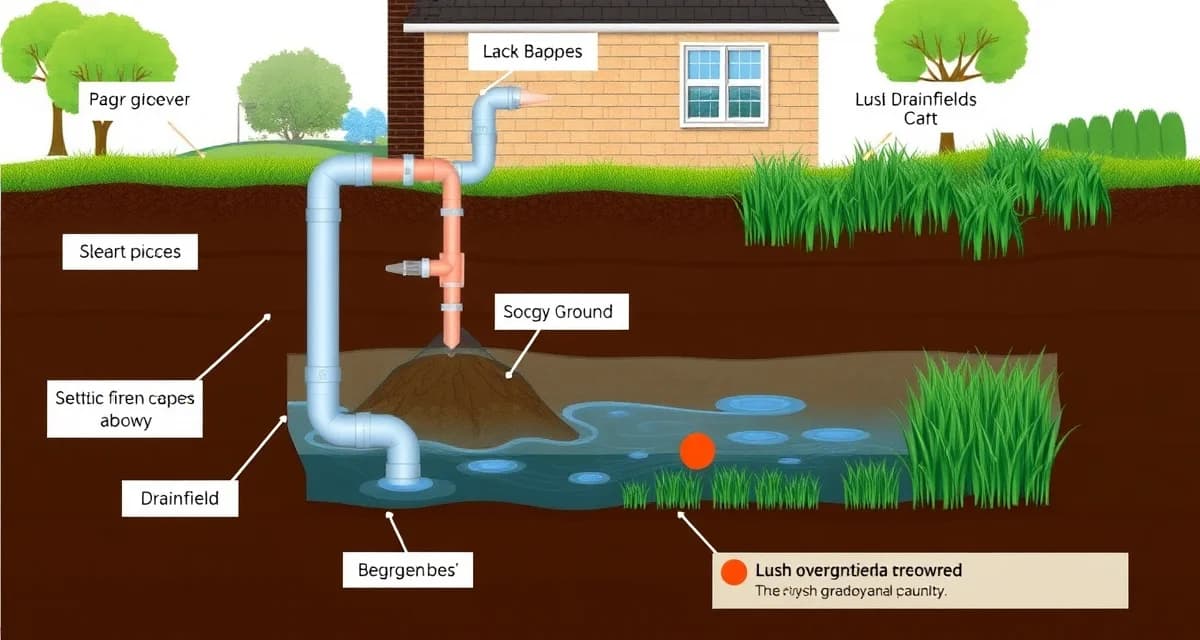
Signs of a Failing Septic System
By the SepticMind Editorial Team
I've walked up to hundreds of properties where the homeowner said "I think something might be wrong with my septic." Usually, by the time they're calling, the signs have been there for weeks or months. People see the warning signs and hope it goes away. It doesn't.
TL;DR
- By the time most homeowners call about a septic problem, the warning signs have been present for weeks or months.
- Sewage backup into ground-floor drains is hydraulic failure and a health emergency requiring immediate response.
- Slow drains throughout the house simultaneously (not just one fixture) indicate a septic system restriction, not a localized clog.
- Wet or spongy ground over the drainfield without recent rain is hydraulic failure in progress.
- Visible sewage surfacing is a mandatory reporting condition in most states, requiring notification to the local health authority within 24-48 hours.
- A full distribution box (D-box) with effluent backed up to the inlet level is one of the most reliable indicators of drainfield saturation.
Here's what a failing septic system actually looks like, the observable signs, what they mean mechanically, and when you need to act.
The Most Obvious Sign: Sewage Backup
If sewage is backing up into toilets, floor drains, or bathtubs, especially ground-floor drains that are lowest in the plumbing, that's hydraulic failure. The system can't accept more waste and it's coming back.
What it means: The drainfield is saturated or the tank is full to the point where waste has nowhere to go. This is a health emergency, not a maintenance issue.
What to do: Stop using water in the house immediately (every flush makes it worse). Call a septic company for emergency service. Don't wait.
Slow Drains Throughout the House
One slow drain is usually a plumbing clog. Slow drains throughout the house simultaneously, especially when they're all in separate plumbing lines, suggests the septic system is backing up gradually.
The pattern matters: If only the kitchen sink is slow, it's a kitchen issue. If the kitchen sink, downstairs bathroom, and laundry drain are all slow at the same time, that's a septic issue.
What it means: Either the outlet of the tank is partially blocked, the distribution box is blocked, or the drainfield is becoming saturated.
What to do: Schedule a septic inspection soon. This isn't an emergency yet, but it will be if ignored.
Gurgling or Bubbling Sounds
Gurgling sounds in the toilet when you flush, or in drains when water runs elsewhere in the house, are classic early warning signs. The gurgling is gas displacing water because the normal drainage path is partially blocked.
What it means: The system isn't draining freely. There's a restriction somewhere between the house and the drainfield. This can be a blocked pipe, a full tank, or early-stage drainfield saturation.
What to do: Schedule a pump-out and inspection. The gurgling is a warning before it becomes a backup.
Lush, Green Grass Over the Drainfield
If one section of your lawn is noticeably greener and more lush than the rest, and it happens to be over the drainfield, effluent is fertilizing the grass from below. In wet conditions, this can mean effluent is near the surface.
What it means: Either the drainfield is receiving heavy effluent load and treating it just below the surface (not necessarily a failure, but a warning), or the drainfield is saturating and effluent is rising toward the surface.
What to do: Have the drainfield evaluated, especially if the lush growth is accompanied by soft, spongy ground or any odor.
Wet or Spongy Ground Over the Drainfield
If the ground over the drainfield is wet when it hasn't been raining, or if it's soft and spongy when the surrounding soil is firm, effluent is saturating the upper soil zone. This is hydraulic failure.
What it means: The drainfield can't absorb effluent as fast as it's being delivered. This is a system failure, not just a maintenance issue.
What to do: Call for emergency service. A saturated drainfield that's actively surfacing effluent is a health hazard and a regulatory violation in most states.
Visible Sewage on the Surface
If you can see raw sewage, gray or brown liquid with odor, surfacing anywhere near the septic system, the drainfield has failed completely. Effluent is coming to the surface rather than being absorbed and treated.
What it means: Drainfield failure. This is a public health emergency and a mandatory reporting condition in most states.
What to do: Immediately restrict access to the affected area. Call a septic company for emergency service. In most states, the property owner or the inspector who discovers this has a reporting obligation to the local health authority.
Odors Near the Tank or Drainfield
A septic system in good working order produces some odor, it's sewage. But persistent, strong odor near the tank lid, over the drainfield, or near access points suggests the system isn't functioning correctly.
Tank odors: If you can smell it at the tank lid without opening it, there may be a venting issue or the tank may be full.
Drainfield odors: Odor over the drainfield area suggests effluent is near the surface. Combined with lush vegetation or wet ground, this confirms saturation.
Odors inside the house: Sewer gas entering the house through drains suggests venting problems in the plumbing or a backed-up septic system. This can be a health hazard, sewer gas contains hydrogen sulfide.
High Water Level in the Distribution Box
If you inspect the D-box (distribution box) and find it full of liquid with effluent backed up to the inlet pipe level, the drainfield is rejecting effluent. This is one of the most reliable indicators of drainfield saturation.
What it means: The drainfield can't accept effluent fast enough. Effluent is backing up through the distribution system to the D-box.
What to do: The drainfield needs evaluation, probe tests to determine saturation depth, and an assessment of whether the failure is partial or system-wide.
Get Started with SepticMind
SepticMind is designed around the actual workflows of septic service companies, from county permit tracking to automated maintenance reminders. Whether you are managing a single truck or a multi-county fleet, the platform scales with your operation. See how it works for your business.
FAQ
What are the most common signs of a failing septic system?
The most common early warning signs are: slow drains throughout the house (not just one fixture), gurgling sounds in toilets and drains when water is used elsewhere in the house, and unusually lush or green grass over the drainfield. More advanced signs include wet or spongy ground over the drainfield, sewage odors in the yard near the tank or drainfield, and sewage backup into the house. Any combination of these signs warrants immediate inspection.
How quickly can a septic system fail after first showing signs?
It depends on the nature of the failure. A drainfield that's gradually saturating may show warning signs for months before complete failure. A structural failure, a collapsed tank or distribution box, can happen suddenly. A pump failure on an ATU or pump system can cause backup within hours. When you see any warning signs, don't assume they'll resolve on their own. The time between first signs and complete failure is unpredictable.
What's the difference between a slow drain and a failing septic system?
A single slow drain is almost always a plumbing issue, hair, grease, or mineral buildup in that specific drain line. A failing septic system causes slow drains throughout the house simultaneously, because the restriction is in the common drain line or the septic system itself. If you run the kitchen sink, flush the toilet, and run the laundry simultaneously and all drain slowly, that's a septic issue. If only one fixture is slow, start with drain cleaning.
What should a property owner do if they discover visible sewage surfacing?
Immediately restrict access to the affected area before doing anything else. Stop all water use in the home to reduce hydraulic loading on the system. Document the condition with timestamped photos, including GPS location if possible. Contact your local health authority as required by state law, typically within 24-48 hours for surfacing effluent. Then call a licensed septic service company for emergency response. The service company's emergency report will support both the regulatory notification and the repair permit application.
How do you distinguish between an odor problem and a structural system failure?
Tank odors detectable without opening the lid, odors inside the house through drain pipes, and odors near the tank area suggest a full tank or venting problem that pump-out will resolve. Odors over the drainfield combined with wet or spongy ground indicate the drainfield is saturating and effluent is near the surface. This second pattern indicates hydraulic failure requiring professional evaluation, not just pumping. A service call to inspect the distribution box level, drainfield condition, and tank level provides the information needed to distinguish a maintenance-due situation from a system failure.
Try These Free Tools
Sources
- National Onsite Wastewater Recycling Association (NOWRA)
- US EPA Office of Wastewater Management
- NSF International
- Water Environment Federation
- National Environmental Services Center (NESC)