Should you use septic tank treatment? What the science says
By the SepticMind Editorial Team
TL;DR
- Most healthy septic tanks need no additives.
- A properly sized, regularly pumped tank already holds billions of bacteria per milliliter of sludge.
- The EPA says biological additives are "generally not needed" for normal systems, and chemical additives can wreck your drain field.
- Spend the money on pumping every 3 to 5 years instead.
- That is the whole answer.
What is septic tank treatment and what types exist?
Septic tank treatment is any product you flush, pour, or drop into your tank to boost bacterial activity, break down solids, or kill odors. Three categories cover almost everything on the shelf: biological additives, chemical additives, and inorganic additives.
Biological additives are the most common. They pack live bacteria, bacterial spores, or enzymes into liquids, powders, or dissolvable packets, and the pitch is that they replenish or boost the microbes already living in your tank. Chemical additives use solvents, acids, or alkalis to dissolve grease and solids. Inorganic additives, like hydrogen peroxide, flood the tank with oxygen or oxidizing agents to speed breakdown.
Formulations are all over the map. A University of Minnesota Extension review of biological products found ingredient lists that ran from a single Lactobacillus strain to complex enzyme blends, with little consistency between the marketing claims and the actual microbial counts in the bottle [1]. That gap matters when you're weighing whether to spend $10 to $50 a month.
Here's the fact that shapes everything else. A working septic tank already holds somewhere between 100 million and 1 billion bacteria per milliliter of sludge. It is not sterile. Under normal use, it does not need seeding.
Do septic tank additives actually work?
Probably not for a healthy tank, and possibly harmful for a struggling one. The research is genuinely thin, and what exists does the additive industry no favors.
The most-cited independent work comes out of field trials referenced by the University of Minnesota Extension, which compared biological additives in side-by-side systems over two full years. Researchers found no statistically significant difference in solids accumulation, effluent quality, or drain field performance between treated and untreated tanks [1]. The treated tanks needed pumping on the same schedule as the untreated ones.
The EPA's SepticSmart program puts it plainly. Additives, "including biological additives such as bacteria and enzymes, are generally not needed to help a septic system work and may cause harm to your system" [2]. That "generally not needed" is the EPA being careful. It's about as close to a dismissal as a federal agency prints.
Chemical additives get a flat no. Organic solvents like methylene chloride and 1,1,1-trichloroethane, once common in septic products, are banned in several states because they dissolve the greasy scum layer that's supposed to float on top, then push fine particles into your drain field where they clog the soil [3]. The cure is worse than the disease.
There are narrow spots where a biological additive is defensible: after a tank is pumped completely dry, or after a household member finishes a long course of antibiotics that beat down the tank's bacteria. Some practitioners add a biological starter in those cases. The science behind even that is mostly anecdotal.
What does the EPA say about septic tank additives?
The EPA's SepticSmart initiative is the most-cited federal guidance on home septic care, and its position on additives hasn't shifted in years [2]. Normal biological activity inside a tank doesn't need supplementing, and the evidence for additive effectiveness is weak.
Instead, the EPA points to a short list. Pump every 3 to 5 years, adjusted for household size and tank volume. Protect the drain field from heavy loads and compaction. Flush nothing but toilet paper and human waste. Buying a monthly additive is on none of those lists.
Here's a point manufacturers blur: the EPA does not approve or certify septic additives. When a label reads "EPA registered," that's almost always a pesticide registration number under FIFRA, the Federal Insecticide, Fungicide, and Rodenticide Act [4]. It means the EPA reviewed the product's safety data. It says nothing about whether the product treats your tank. Marketers lean on that phrase hard, and it means something very different from endorsement.
Some states go further. Wisconsin restricts certain chemical additives under its onsite wastewater code. Washington State's Department of Health flatly discourages additive use in its homeowner guidance [5]. Check your own state's onsite wastewater regulations before you pour anything into your system.
Can septic additives damage your drain field?
Yes. This is the part that makes chemical additives dangerous rather than merely useless.
Your drain field works because wastewater percolates slowly through soil, where microbes in the biomat treat it before it reaches groundwater. That whole process depends on solids staying inside the tank. Chemical solvents that break up the scum layer or over-liquefy the sludge let fine particles slip through into the effluent, and those particles clog the soil pores in your leach field.
Once a leach field is clogged with fine solids, recovery is hard and expensive. A new drain field runs $5,000 to $20,000 depending on soil conditions and local permit requirements [6]. A $15 bottle that speeds that failure along is about the worst return in home maintenance.
Biological additives rarely cause acute damage, but some high-enzyme products break down material that should stay as sludge, which can disrupt the natural separation of solids and produce the same effluent problem over time. The University of Minnesota Extension review flagged this as a real risk even for products sold as safe [1].
Simplest rule I know: if the label brags that it "liquefies" sludge or "breaks down" solids, read that as a warning, not a selling point.
When might a septic additive be worth trying?
A few narrow situations make a biological additive at least defensible, even with limited evidence.
First, right after a complete pump-out. When a tank is emptied, its bacterial population starts over. Some operators add a small biological starter to speed recolonization. The tank will repopulate on its own from incoming waste within days to weeks, so this is mostly peace of mind, but it's unlikely to hurt [1].
Second, a vacation home or seasonal property where the tank sits idle for months. Long dormancy can drop bacterial populations, and a biological product at reopening is plausible as a restart aid. Even then, the first few flushes of normal waste do most of the work.
Third, an RV holding tank. That's a different animal from a residential septic tank. RV tanks are small, have no drain field, and get pumped often. Odor control matters more in a confined space, and the risk of additives is lower because there's no soil treatment system to protect. Non-formaldehyde biological RV products are widely used and far less controversial than residential additives. More on RVs below.
Outside those three, a healthy residential system on a regular septic tank pumping schedule doesn't need anything in a bottle.
Can you use septic tank treatment in an RV?
You can, and plenty of RV owners do. The distinction that matters: an RV holding tank is not a septic system. It's a sealed vessel that stores waste until you dump it at a station. No drain field to protect, no soil biology to disrupt, and the main job is odor control, not treatment.
For RV use, buy formaldehyde-free. Older RV treatments used formaldehyde or bronopol as the biocide, and those chemicals pass straight through to dump stations and campground septic systems where they kill the bacteria doing the real treatment work. Most states and nearly all national park campgrounds ban formaldehyde-based RV treatments [7].
Modern biological RV treatments use enzyme blends or bacterial cultures and are generally safe for dump stations. They break down solids and knock back odor in a sealed tank, which is exactly the job they're built for.
One practical note. If you dump your RV into a residential septic system (some rural properties allow it), treat the additive with the same caution you'd give any product. Heavy enzyme formulas can briefly upset your residential tank's bacterial balance. Stick to a plain bacterial culture with no harsh solvents and you're on safer ground.
What actually keeps a septic system healthy?
This matters more than any product decision, and the research and the regulators land in the same place. Four practices, done consistently.
Pump on schedule. The EPA and most state guidelines say every 3 to 5 years for a typical household, with the real interval set by tank size and number of occupants [2]. A 1,000-gallon tank serving four people needs pumping more often than a 1,500-gallon tank serving two. If you're unsure how often to pump your septic tank, the table below gives the standard reference ranges.
Watch what goes down the drain. Grease, wipes (even the ones labeled "flushable"), feminine hygiene products, and medication all cause trouble. Grease congeals and clogs the outlet baffle. Wipes never break down and build up as a rag-like mat that has to be pulled out during septic tank cleaning.
Protect the drain field. Don't park on it, don't plant deep-rooted trees near it, and route roof gutters away from it. Saturated soil can't treat effluent.
Inspect regularly. A septic tank inspection every 1 to 3 years catches cracked baffles, inlet blockages, and rising sludge before they turn into drain field failures. Fixing a baffle early costs a few hundred dollars. Ignoring it can lead to septic system repair bills in the thousands.
None of those four cost you a product purchase. That's the part the additive industry keeps quiet.
How much do septic tank treatments cost compared to pumping?
The math is not close.
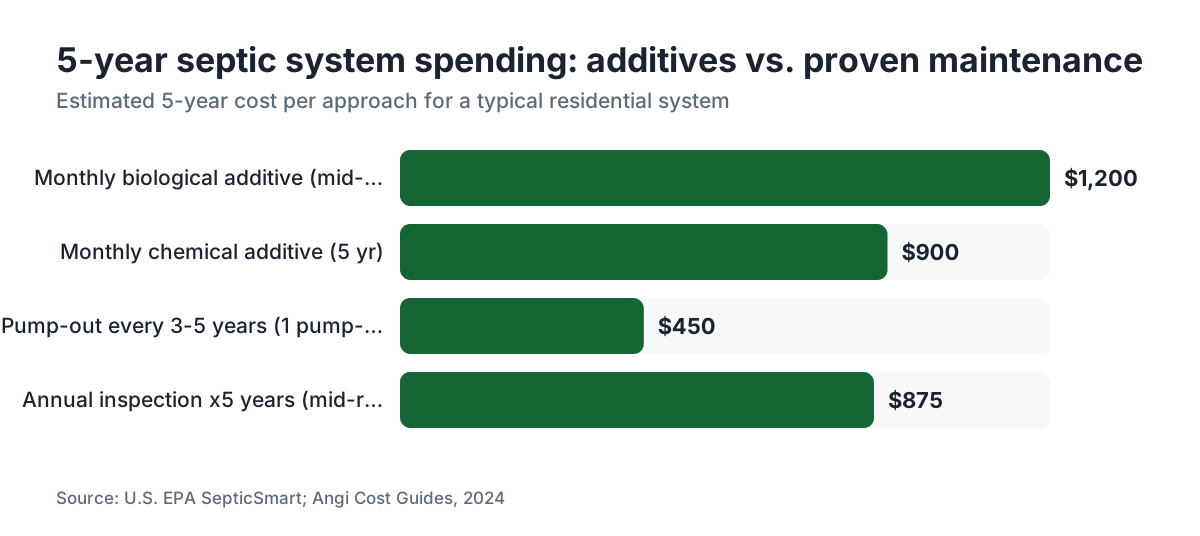
A monthly biological additive runs $10 to $50, depending on brand and dose. That's $120 to $600 a year. Over the 3-to-5-year gap between pump-outs, you've spent $360 to $3,000 on a product the EPA says you don't need.
A standard septic tank pump out costs $300 to $600 for most residential tanks, with wide swings by region and tank size [8]. In high-cost metros, $700 to $900 is common. In rural areas you might pay $200.
The industry argues that regular treatment stretches the interval between pump-outs. No peer-reviewed evidence supports that [1]. The sludge and scum you pay to pump are largely inorganic material and non-digestible solids that no additive can touch. What's left after the bacteria finish still needs a vacuum truck.
Want to spend money on your septic system? Spend it on a scheduled pump-out and a real inspection. That's what extends system life.
| Expense | Annual cost | 5-year cost | Evidence of benefit |
|---|---|---|---|
| Monthly biological additive (mid-range) | $240 | $1,200 | None in peer-reviewed trials |
| Monthly chemical additive | $180 | $900 | Potentially harmful |
| Pump-out every 3-5 years | $60-$200 amortized | $300-$600 | Strong; standard of care |
| Annual inspection | $100-$250 | $500-$1,250 | Strong; catches failures early |
What do state regulations say about septic additives?
State rules vary more than most homeowners think, and some are strict enough to make certain products technically illegal to use.
Wisconsin's Department of Safety and Professional Services restricts chemical additives under its onsite wastewater code. Washington State's Department of Health guidance discourages additives outright and states that no additive can substitute for regular pumping [5]. Several other states, Texas and Florida among them, require that any additive used in a permitted onsite system not harm the biological treatment process, which effectively bars most solvent-based products.
NSF International publishes standards, NSF/ANSI 40 and NSF/ANSI 245, that cover the performance of onsite treatment systems. There is no equivalent NSF certification for septic additives that would hand consumers a reliable quality signal [9].
If you're an operator or a homeowner in a state with active inspection and permitting, check with your state environmental or health department before recommending or using any additive. Using a prohibited product in a permitted system can affect your compliance status. SepticMind's operator tools let service companies track system notes, product use, and inspection schedules so that detail doesn't slip through the cracks during a busy season.
Your state extension service is usually the best practical source for local rules. Land-grant university extension programs in most states publish free, unbiased guidance on onsite wastewater management tuned to your soil types and climate [10].
How do you read septic additive product claims?
Labels in this category are stuffed with language that sounds scientific but promises nothing you can check. Here's how to decode the usual claims.
"Billions of bacteria per dose." Sounds big. Your tank already holds billions per milliliter of sludge. Adding a few billion to a tank with hundreds of billions does essentially nothing. The claim is numerically true and practically meaningless.
"EPA registered." As covered above, that's a FIFRA pesticide registration number, not EPA approval for effectiveness. It tells you the EPA reviewed safety data. It tells you nothing about whether the product works [4].
"Reduces pumping frequency." No peer-reviewed study backs this. The sludge layer builds from non-digestible material, not from underperforming bacteria [1].
"Restores failing systems." The most dangerous one. A failing system usually has a mechanically blocked inlet or outlet baffle, hydraulically overloaded soil, or a collapsed pipe. Those are physical problems needing physical repair. No bacterial product fixes a crushed pipe or a saturated drain field. Pour a product into a failing system instead of calling for septic tank repair and you're delaying a fix that only gets pricier.
"Natural and safe." Probably true for biological products. But "safe" and "effective" are not the same word. The product may not hurt your system. It also may not help it.
What's the verdict: should you use septic tank treatment?
For a healthy, regularly pumped residential system: no. Put the money toward your next pump-out. The risk of harm from chemical additives is real, and the risk from biological additives is mostly just wasted cash.
For an RV holding tank: yes. A formaldehyde-free biological or enzyme product makes sense for odor control and carries low risk in that setting.
For a system right after a complete pump-out, or after a household stretch of heavy antibiotic use: a biological starter is a defensible choice with low downside, even if the upside evidence is thin.
For a failing system: no additive fixes it. Call a licensed pumper or inspector. The septic tank emptying and inspection conversation will tell you whether you're looking at a simple baffle repair, a drain field problem, or something bigger.
Here's the broader point. Septic systems are not fragile. A properly sized tank under normal household loading does not need help doing its job. The bacteria are already there. The process works. What it needs is to not be overwhelmed, not be starved of time between pump-outs, and not have the wrong things flushed into it. No product changes those fundamentals.
If you manage multiple systems as a service operator, accurate records of pump intervals, inspections, and any additive history are worth far more than any product on a shelf. Tools that tie those records to scheduling and customer communication, like the ones built into SepticMind, keep operators ahead of failures instead of chasing them.
Frequently asked questions
Can septic tank treatment replace regular pumping?
No. No additive removes the need for pumping. Sludge builds partly from inorganic material and non-digestible solids that bacteria cannot break down. The EPA recommends pumping every 3 to 5 years no matter what products you use. Any product claiming to end pump-outs has no peer-reviewed evidence behind it.
Is it safe to use septic tank treatment every month?
Monthly biological use is unlikely to cause acute damage in a healthy system, but there's no evidence of monthly benefit either. High-enzyme products used over and over can disrupt the solid separation layer. Chemical additives used regularly are riskier and have been tied to drain field damage. Monthly use is also monthly spending on something with no proven return.
What happens if you never use septic tank treatment?
Nothing bad, as long as you pump on schedule and watch what goes down the drain. The vast majority of septic systems that run well do so with no additive at all. Bacterial populations in a healthy tank sustain themselves from normal household waste. Skip additives and put that budget toward timely pump-outs. That's the better play.
Do yeast and sugar work as a septic tank treatment?
Flushing yeast, or yeast with sugar, is a folk remedy with no scientific support. Yeast adds organisms that aren't part of septic biology, and the sugar is just food that raises your organic loading. It's harmless in small amounts and completely pointless. Your tank's existing bacteria don't need a sugar boost.
Can I use septic tank treatment in an RV holding tank?
Yes, and it's one of the few uses where additives make practical sense. RV holding tanks have no soil treatment component to protect, so the goals are odor control and solid breakdown before dumping. Use a formaldehyde-free product; older formaldehyde-based treatments are banned at most dump stations and campgrounds because they kill bacteria in downstream systems.
Will septic tank treatment fix a slow drain or a clogged system?
No. Slow drains usually mean a blocked inlet pipe, a failed inlet baffle, a clogged outlet, or a saturated drain field. Those are physical problems that need inspection and repair. Pouring a biological product down a slow drain delays the diagnosis and can turn a manageable problem into a major one. Get the system inspected first.
Are enzyme septic treatments better than bacterial treatments?
Enzyme products act faster on specific materials but don't reproduce, so the effect is short-lived. Bacterial products colonize and self-sustain, at least in theory. In practice, neither type shows measurable benefit in controlled field studies for a normally running residential tank. The difference matters more in marketing than in your actual tank.
Is septic tank treatment safe for the environment?
Biological treatments are generally low environmental risk. Chemical additives are another story: solvent-based products that pass into groundwater are regulated as contaminants in many states. Hydrogen peroxide-based products can briefly disrupt soil biology in the drain field. When in doubt, check your state's onsite wastewater guidelines before using any product.
How do I know if my septic system actually needs treatment?
Real problems show up as sewage odors inside or outside the house, slow drains throughout the home, wet or unusually green patches over the drain field, and sewage backing up into fixtures. None of those call for a bottle of additive. They call for a pump-out and inspection. Only after a licensed inspector rules out mechanical problems does biology enter the conversation.
Does Rid-X or similar products actually work?
Rid-X is a biological enzyme and bacteria product. The University of Minnesota Extension review of biological additives found no statistically significant benefit in treated versus untreated systems over a two-year study. Rid-X's own labeling does not claim to replace pumping. The product is not harmful, but the evidence that it helps a functioning residential system is essentially absent.
How long after adding septic treatment does it take to work?
Manufacturers typically claim active colonization within 24 to 72 hours for bacterial products. Enzymes act within hours but don't persist. The honest answer: if there's no measurable benefit in two-year controlled field studies, how fast it works is beside the point. For RV tanks, biological products noticeably cut odor within 24 to 48 hours in most user reports.
Can I use household bleach to clean my septic system?
Normal household bleach use, a load of laundry or the occasional toilet bowl cleaning, does not kill enough bacteria to harm your tank. High-concentration bleach poured straight into the tank in large amounts can disrupt the bacterial population temporarily. Don't do that. Routine bleach in normal quantities passes through diluted enough that it's no real concern for most systems.
What should I put in my septic tank to help it?
The most helpful things are nothing but water, human waste, and toilet paper. Keep grease, wipes, medications, and harsh chemicals out. Pump every 3 to 5 years. Inspect every 1 to 3 years. Use water efficiently to avoid hydraulic overloading. Those practices do more for system life than any product on a store shelf.
Sources
- University of Minnesota Extension, 'Septic System Additives': A review of biological septic additives found no statistically significant difference in solids accumulation or drain field performance between treated and untreated tanks over a two-year study period.
- U.S. EPA, SepticSmart Program: EPA SepticSmart states additives 'are generally not needed to help a septic system work and may cause harm to your system,' and recommends pumping every 3-5 years.
- U.S. EPA, Onsite Wastewater Treatment Systems Manual: Chemical solvent additives can dissolve the scum layer and push fine particles into the drain field, causing clogging of soil pores.
- U.S. EPA, Federal Insecticide, Fungicide, and Rodenticide Act (FIFRA) Overview: EPA registration numbers on product labels reflect FIFRA pesticide safety review, not endorsement of product effectiveness for a specific purpose.
- Washington State Department of Health, On-Site Sewage Systems: Washington State Department of Health explicitly discourages use of septic additives and states no additive can substitute for regular pumping.
- HomeAdvisor / Angi, Drain Field Replacement Cost Guide: Drain field replacement costs typically range from $5,000 to $20,000 depending on soil conditions and local permit requirements.
- U.S. National Park Service, Camping Regulations and RV Dump Station Guidance: Most national park campgrounds prohibit formaldehyde-based RV tank treatments at dump stations.
- HomeAdvisor / Angi, Septic Tank Pumping Cost Guide: Standard residential septic tank pump-out costs range from $300 to $600, with higher costs in metro areas and lower costs in rural areas.
- NSF International, Onsite Wastewater Treatment Systems Standards (NSF/ANSI 40 and 245): NSF/ANSI standards cover onsite treatment system performance but there is no NSF certification program specifically validating septic additive effectiveness.
- National Environmental Services Center (NESC) / WVU, Small Flows Quarterly: State university extension programs publish unbiased, region-specific guidance on onsite wastewater management including additive evaluation.
- U.S. EPA, Onsite Wastewater Treatment Systems: A Homeowner's Guide: EPA guidance identifies pumping schedule, drain field protection, and waste stream management as the primary factors in septic system longevity.
Last updated 2026-07-09