PL-68 effluent filter: what it does, when to clean it, and whether to upgrade
By the SepticMind Editorial Team
TL;DR
- The Polylok PL-68 is a 4-inch effluent filter that drops inside a standard septic tank outlet baffle and blocks solids from reaching the drain field.
- Clean it every 1 to 3 years, or at every pump-out.
- The filter alone costs $20 to $50.
- The PL-525 is its 5-inch sibling for larger outlet tees.
What is the PL-68 effluent filter and what does it actually do?
The PL-68 is a cylindrical effluent filter made by Polylok, one of the biggest septic accessory manufacturers in the U.S. It slides into a 4-inch outlet baffle or tee at the exit end of your septic tank, right before effluent flows to the distribution box or drain field. Its job is simple. It catches particles larger than roughly 1/16 inch (about 1.6 mm) before they leave the tank.
Your tank sorts waste into three layers. Grease and oils float on top (the scum layer). Heavy solids sink (sludge). The middle layer, called clarified effluent, is what's supposed to travel out to the leach field. That middle layer is never perfectly clean, though, especially when the tank is near full or getting worked hard. Without a filter, any agitation, high-flow event, or sludge buildup can shove particles out the outlet and into pipes that were never built to handle them.
The PL-68 stops that. Effluent has to pass through a sleeve of slotted plastic before it exits, and solids stay trapped inside the filter body where they belong. When enough particles pile up, flow slows and water can back up inside the house. That backup is the point. It's the warning that tells you the filter needs cleaning.
This is not a fancy device. It's a $20 to $50 piece of slotted plastic. But the EPA's SepticSmart program lists effluent filters among the more effective ways homeowners extend the life of a drain field [1], and several state onsite wastewater codes now require them on new installs.
How does the PL-68 differ from the PL-525?
The PL-68 and the PL-525 are both Polylok effluent filters with the same slot size and the same basic design. The one difference is pipe diameter.
The PL-68 fits a 4-inch outlet tee or baffle. That's the standard in most residential tanks installed before the mid-2000s and in plenty installed since. The PL-525 fits a 5-inch outlet, which shows up more in larger tanks, commercial systems, and some newer residential designs.
Not sure which your tank needs? Measure the inside diameter of the outlet pipe or baffle tube, not the outside. A 4-inch nominal pipe measures roughly 3.98 inches inside. A 5-inch pipe runs about 4.97 inches. Drop a PL-525 into a 4-inch outlet and it won't seal. Drop a PL-68 into a 5-inch opening and you leave a gap that solids slip through.
Past diameter, the two are the same filter. Same slot openings, same cleaning routine, same service life. If a tech quotes you one and installs the other without saying why, ask.
| Feature | PL-68 | PL-525 |
|---|---|---|
| Fits pipe diameter | 4 inch | 5 inch |
| Typical retail price | $20 to $40 | $25 to $50 |
| Slot size (filtration) | ~1/16 inch | ~1/16 inch |
| Common use | Standard residential tanks | Larger residential or commercial |
| Cleaning method | Pull, hose off, reinstall | Same |
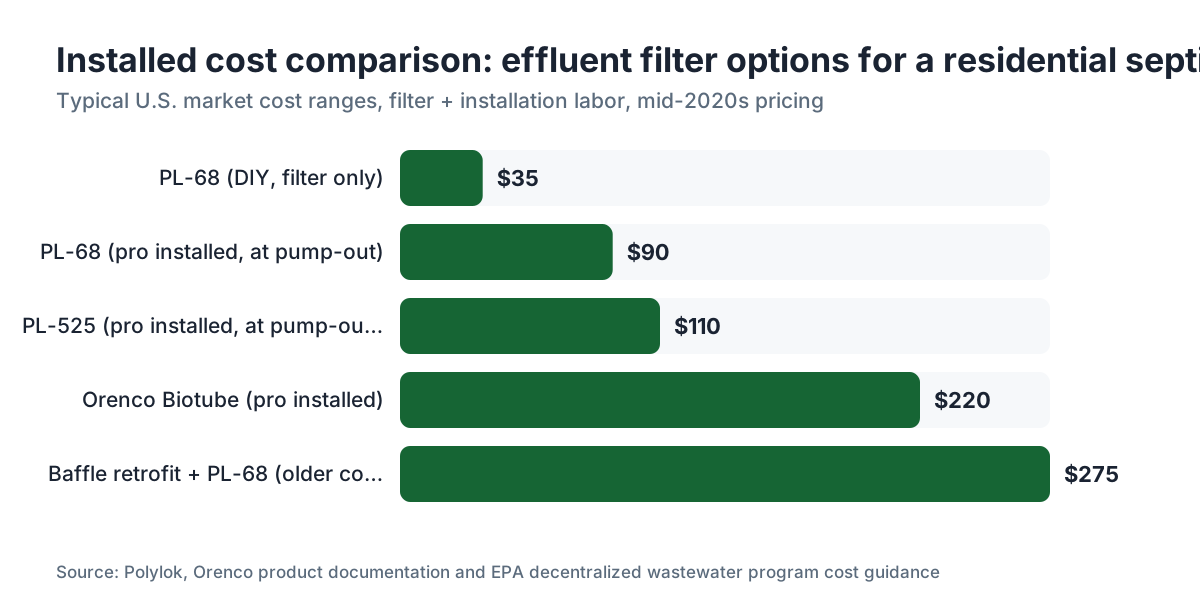
Both are sold through plumbing distributors, septic supply houses, and online. Your pumper can usually supply and install one during a routine septic tank pump out for another $30 to $80 in labor.
How often should you clean a PL-68 effluent filter?
Clean the filter every time the tank gets pumped. For most households that's every 3 to 5 years, which is the baseline the EPA and most extension programs land on [2]. Heavy water use, a big family, or a daily garbage disposal can push that to once a year.
The honest version is that it depends on your household size, water use, and how fast your tank builds sludge. Some installers set customers up with an alarm float that trips when filter restriction backs effluent up into the riser, giving you a heads-up before it reaches the house. If you tend to forget scheduled maintenance, that's a reasonable setup.
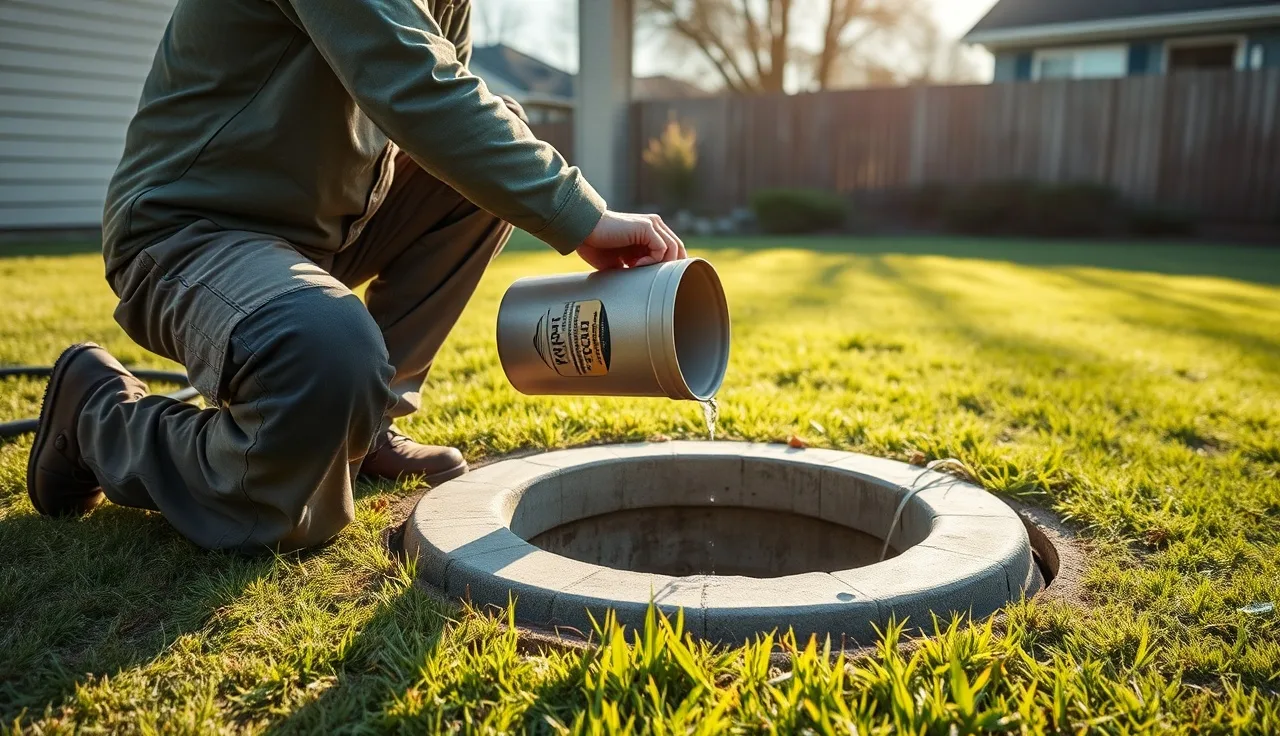
The cleaning itself takes minutes. Open the tank access lid (or the riser lid if you have risers). Pull the filter straight up out of the baffle. Hold it over the open tank, never over the lawn, and rinse it with a garden hose. The solids drop back into the tank. Slide the filter back in, close the lid. Done.
One caution. If you pull the filter and it's packed solid with dark sludge and barely passing water, you waited too long. That condition means solids were close to escaping or backing up hard. Check how often to pump septic tank to fix your pumping schedule going forward. A clogged filter that caused a backup is also worth flagging to your septic tank inspection tech, so they can check whether any solids got past before it blocked.
What are the signs that your effluent filter is clogged?
The clearest sign is slow drains across the whole house, more than one fixture at once. One slow drain usually means a clog in that branch line. Every drain slowing together, or toilets gurgling when the washing machine runs, points to a restriction downstream of all of them. A clogged effluent filter makes exactly that pattern.
Sewage backing up into the lowest fixture is another signal. Basement bathtubs and floor drains get it first, because gravity. See sewage in your basement floor drain with no obvious pipe blockage? Check the filter before you call for emergency septic system repair.
Some homeowners hear a gurgle from toilets right when the washing machine drains. That's back-pressure from a restricted outlet, venting at the nearest open point, which is usually the toilet.
Outdoor signs are less common when the filter is doing its job, but worth knowing. If years of occasional gurgling suddenly stop, don't assume the problem healed itself. The filter may have failed (cracked or come unseated) and solids may now be running straight to the field. A wet, smelly patch over your leach field during a dry spell is one clue.
When in doubt, open the lid and look. A healthy filter is wet but mostly clear. A clogged one is visibly packed. Trust your eyes over guesswork.
How do you install a PL-68 in an existing septic tank?
Installing a PL-68 is a DIY job if you're comfortable opening a septic tank lid and working around wastewater. Here's how it goes.
First, find your outlet baffle. Your tank has two: an inlet baffle where waste comes in, and an outlet baffle where clarified effluent leaves toward the field. You want the outlet. If you can't tell them apart, the outlet baffle sits on the side of the tank closest to your drain field distribution box or pipe. The filter goes on the outlet only.
With the lid open, look down into the outlet baffle tube. Older tanks may have a concrete or cast-iron baffle that the PL-68 won't slip into without a retrofit adapter. Many older baffles have to be swapped for a 4-inch outlet tee first, a straightforward job for a tech during septic tank repair. The filter body has a handle up top and slots down the cylinder. Slide it into the outlet tee until the handle rests on the top of the tee. It doesn't screw in or lock. Gravity and a snug fit hold it.
Depth matters. The filter body should reach down into the liquid zone but not so far it sits in the sludge layer. Polylok's installation guidance puts the filter roughly 18 inches below the outlet pipe invert, though it varies by tank depth [3]. If your outlet tee is too short, a riser tee extension is available.
Having a pro do the first install is reasonable, especially if your tank has no risers and you'd have to reach down into an open tank. A tech can also confirm the baffle is intact and flag anything else worth knowing. A professional supply-and-install during a pump-out runs $50 to $130 in most markets.
Does your state require an effluent filter?
Requirements vary a lot by state, and sometimes by county. Several states now require effluent filters on all new conventional septic installs. Others strongly recommend them but stop short of a mandate. A few older code frameworks don't mention them at all, because the technology moved faster than the rulemaking.
California's onsite wastewater policy has pushed effluent filtration for years in sensitive watershed areas [4]. Florida's Department of Health onsite sewage program treats filtration as a best management practice in its guidance [5]. Many Northeast states with shallow soils and high water tables have moved toward requiring filters on new permits.
The EPA's SepticSmart materials state that "a properly functioning septic system treats wastewater before it can contaminate local water supplies" and list effluent filters among the maintenance components homeowners should understand [1]. That's guidance, not a federal mandate. Onsite sewage regulation is a state function under the Clean Water Act framework.
Buying a home with a septic system? A septic tank inspection should note whether a filter is present. Many real estate inspection protocols now flag the absence of one in states where they're required. Doing a septic tank installation or major repair in a filter-required state and your contractor never mentions it? Ask directly. Skipping a required filter can void a permit or create liability at resale.
Operators tracking permit compliance across jobs live and die by this detail. Knowing which systems have filters, and when they were last serviced, is exactly the thing that slips away without a structured workflow. SepticMind's job management tools let operators log filter status per system so nothing gets missed at inspection time.
What can go wrong with an effluent filter, and how do you fix it?
The most common failure isn't dramatic. It's neglect. A filter that hasn't been cleaned in 7 or 8 years can pack so tight it drops flow to near zero, and then you've got sewage backing up in the house. The fix is usually pulling and cleaning it, then pumping the tank if it's overdue. No permanent damage, assuming solids didn't bypass.
Actual physical failure is rarer. The PL-68 is polypropylene or similar, built to resist the hydrogen sulfide and biological soup inside a tank. Even so, filters crack from UV exposure if someone leaves the lid off long-term, or from being forced into an undersized baffle. A cracked filter can look fine from above and still pass solids. Pull one and see cracks in the body or slots that look stretched wide? Replace it. At $20 to $40, reinstalling a compromised filter isn't worth it.
A filter can also come unseated if the baffle tube isn't straight or someone reinstalled it carelessly. It sits off-center and leaves a gap for solids to escape. When you clean and reinstall, confirm the handle seats flat across the top of the tee.
One that catches people off guard: a brand new filter that clogs within weeks. That usually means the sludge layer is already at or above outlet level and the tank is badly overdue for pumping. The filter is doing its job. It just can't rescue a tank that was already failing. Pump first, clean or replace the filter, and set a tighter pumping schedule. See septic tank cleaning for what a proper pump-out looks like.
Is an effluent filter worth the cost, and will it actually protect your drain field?
Yes, as long as you know what it does and doesn't do.
A drain field fails mostly from biomat buildup, a dense layer of organic material and bacteria that forms at the soil interface and blocks effluent from soaking in. Suspended solids in effluent speed that buildup along. A filter that catches those solids slows the process in a way you can measure. The University of Minnesota Extension, which has published widely on onsite wastewater systems, ties effluent quality directly to drain field life and calls cutting total suspended solids one of the more effective ways to stretch system life [6].
What a filter can't do: it can't fix hydraulic overloading. Send twice the design flow to your field from heavy household use or groundwater intrusion, and the field fails no matter how clean the effluent is. A filter also won't save a field that's already biomat-saturated.
The math is simple. A new drain field costs $5,000 to $20,000 depending on soil, system type, and region [7]. A PL-68 costs $20 to $50 and takes 15 minutes to clean. If it buys the field even two or three extra years, it pays for itself hundreds of times over. This is one of the few septic accessories I'd call genuinely worth the money rather than a sales upsell.
For the full picture on replacement, see cost to install septic system.
How does the PL-68 compare to other effluent filter brands?
Polylok dominates the U.S. effluent filter market, but it isn't your only choice. Orenco Systems, Zoeller, and Infiltrator Water Technologies all make competing filters. Here's the general lay of the land.
Orenco's Biotube is probably the most specified filter in engineered systems and advanced treatment units. It filters finer (some models down to 1/32 inch) and has more filter area, so cleanings run further apart. It also costs more, $80 to $200 depending on configuration [10]. For a standard gravity system, that's overkill.
Zoeller and other mid-tier brands make filters much like the PL-68 at similar prices. Build quality and slot consistency vary more than Polylok's, which has made these long enough to hold tight tolerances.
Generic filters from online marketplaces tempt you at $10 to $15, but they carry real risk. Slot consistency matters. Too wide and the filter passes particles it should catch. Brittle plastic cracks in the tank environment. I wouldn't put an unbranded filter in a tank I cared about.
For a standard 4-inch outlet residential gravity system, the PL-68 is the right call for most homeowners. Reliable, cheap, everywhere, easy to service. The PL-525 steps in on a 5-inch outlet. Step up to an Orenco Biotube only if you have an ATU, a pressure-dosed system, or a permit that specifies finer filtration.
What do septic service operators need to know about the PL-68?
If you run a pumping or inspection operation, effluent filters are a steady upsell and service item, but they come with responsibility. A few things that matter in practice.
Service frequency. When you pump a tank and find a filter, clean it before you leave. Every time. Some operators charge a small cleaning fee ($10 to $25), others fold it into the pump-out. Either way, leaving without cleaning it is incomplete service. If it clogs before the next pump-out, the homeowner blames the last person who was in the tank.
Installing on existing systems. A large share of older residential tanks were built before effluent filters became common, so many unfiltered tanks are still in service [8]. Every pump-out on an unfiltered tank is a chance to add one. The pitch is easy. "Your tank doesn't have an effluent filter. It's a $50 part that helps protect your drain field. Want me to add one while I'm here?" Most say yes once they hear what a drain field costs to replace.
Tracking filter status across a customer base is harder than it sounds when you're running dozens or hundreds of jobs. SepticMind's operator platform lets you log filter type, install date, and last cleaning date per customer, so you're not leaning on memory or paper notes. That matters when a customer calls with a backup and you need to know whether the filter got serviced six months ago or four years ago.
Permit and inspection records. In states where filters are required, your install record is your proof of compliance. Keep it.
How much does a PL-68 effluent filter cost, installed?
The filter alone costs $20 to $50 at plumbing supply houses and online. That price has held for several years and isn't likely to move much.
Installing during an existing pump-out adds $30 to $80 in labor in most markets, bringing installed cost to $50 to $130. If the outlet baffle needs replacing first to accept the filter, add $75 to $150 for the baffle work, depending on tank access and concrete condition.
A standalone install visit costs more, because you're paying for the truck roll. Expect $150 to $250 total for a service call plus the filter if it's done on its own. That's a solid argument for doing it at the next scheduled pumping instead of as its own trip.
Replacement filters cost the same as the original, $20 to $50. Most last 10 to 20 years before they need replacing if you clean them regularly, though nobody has clean longitudinal data on this. Manufacturer design life for the materials is typically around 20 years.
For the full maintenance cost picture, the septic tank pumping article covers what to expect for the pump-out itself, which is the natural time to add or service a filter.
Frequently asked questions
What size is the PL-68 effluent filter?
The PL-68 is built for a 4-inch outlet baffle or tee, the standard size in most residential septic tanks. The body slides into the 4-inch pipe opening and a handle rests across the top of the tee to hold it. If your outlet pipe measures 5 inches inside, you need the PL-525 instead.
Can I install a PL-68 myself, or do I need a septic professional?
You can do it yourself if your tank has a riser and lid that gives easy access without reaching into the tank. The filter slides straight into the outlet tee, no tools required. If you'd have to reach down through the opening into liquid, or the existing baffle needs replacing first, hire a tech. The risk isn't the filter install, it's working safely around an open septic tank.
How do I know if my septic tank already has an effluent filter?
Open your access lid (or the outlet-side riser lid if you have two risers) and look into the outlet baffle. If a filter is installed, you'll see a plastic handle or cap sitting at the top of the outlet tee. No handle means no filter. Not comfortable opening the tank? Ask your next pumper to check. It takes about 30 seconds to confirm.
What happens if I never clean my effluent filter?
It eventually packs with solids and drops flow to near zero. Then effluent backs up in the tank and into the house through the lowest fixtures. The backup itself doesn't permanently damage the system, but it's unpleasant and forces an emergency call. If solids partially bypassed a nearly blocked filter before it sealed off, some may have reached the drain field.
Will an effluent filter set off my septic alarm?
A clogged filter can trigger a high-water alarm if your tank has one, because outlet restriction raises the liquid level in the tank. If the alarm sounds and the tank isn't due for pumping, check the filter first. Clean it, and if the alarm clears, that was the cause. If it returns quickly, you likely need a pump-out and maybe a larger filter or more frequent cleaning.
Can I use a PL-68 with a mound system or pressure-dosed system?
Yes, but check what your system design specifies. Mound and pressure-dosed systems often need finer filtration than the PL-68's standard slot provides, especially to protect pressure distribution orifices from clogging. Some state permits for these systems require 1/32-inch slots rather than 1/16-inch. Confirm with your engineer or the permit documents before installing a PL-68 on an advanced treatment system.
How long does a PL-68 effluent filter last before it needs to be replaced?
The body is designed for 15 to 20 years in normal tank conditions. Replace it when it's physically cracked, when the slots look deformed or widened, or when it no longer seats properly in the outlet tee. Cleaning alone, no replacement, handles most of the filter's life. At $20 to $40 for a new one, there's no reason to push a damaged filter.
Does an effluent filter reduce pumping frequency?
No, it works the other way. A filter keeps solids in the tank instead of letting them exit to the field. Those captured solids build up in the tank, which if anything fills it with sludge a little faster. Your pumping schedule should stay the same. What changes is the quality of what leaves for your drain field, which is the whole point.
Is the PL-68 the same as a septic tank filter or effluent screen?
Yes. "Effluent filter," "septic filter," "outlet filter," and "effluent screen" all name the same category of device. The PL-68 is Polylok's model number for their 4-inch filter in that category. Other manufacturers use their own names and model numbers for equivalent products.
Will installing an effluent filter fix a failing drain field?
No. A filter stops future solids from reaching the field, but it can't reverse damage already done. If your field is saturated or showing biomat failure, the filter is part of prevention going forward, not a cure for the current problem. A failing field needs its own assessment and likely repair or replacement. See the leach field article for what those options look like.
Does the PL-68 work in concrete septic tanks?
Yes, with one catch. Older concrete tanks often have concrete baffles instead of PVC tees, and you can't slide a PL-68 into a solid concrete baffle. A tech has to break out or cut the old concrete baffle and install a PVC outlet tee first, then the filter drops in. This retrofit costs $75 to $200 in most markets and is worth doing.
Where can I buy a PL-68 effluent filter?
Polylok filters sell through plumbing and septic supply distributors, some big-box home improvement stores, and online retailers. Prices run $20 to $50 depending on the seller. A septic supply house is usually cheaper than a home improvement store, and your local pumper may stock them and can install one during your next service visit.
Sources
- U.S. EPA, SepticSmart homeowner information: EPA SepticSmart program lists effluent filters among effective maintenance components and notes that a properly functioning septic system treats wastewater before it can contaminate local water supplies
- U.S. EPA, Septic systems overview: how to care for your septic system: Most household septic tanks should be pumped every 3 to 5 years as a baseline maintenance interval
- Polylok Inc., PL-68 effluent filter product and installation guidance: Polylok installation guidance for the PL-68 specifies filter depth in the outlet baffle relative to the outlet pipe invert
- California State Water Resources Control Board, Onsite wastewater treatment systems policy: California onsite wastewater policy references effluent filtration requirements in sensitive watershed areas
- Florida Department of Health, Onsite sewage program guidance: Florida Department of Health onsite sewage program references filtration as a best management practice in its guidance documents
- University of Minnesota Extension, Septic system owners guide: University of Minnesota Extension ties effluent quality to drain field longevity and identifies reducing total suspended solids in tank effluent as an effective way to extend system life
- U.S. EPA, Decentralized wastewater management program: New drain field (leach field) replacement costs range from approximately $5,000 to $20,000 depending on soil conditions, system type, and region
- U.S. EPA, Onsite Wastewater Treatment Systems Manual (EPA/625/R-00/008): A significant share of existing residential septic tanks in the U.S. were installed before effluent filter requirements became common, particularly older systems
- National Environmental Services Center at West Virginia University: Effluent filters reduce suspended solids in tank effluent and are recognized as a practical tool for protecting soil absorption systems
- Orenco Systems, Biotube effluent filter product documentation: Orenco Biotube filters are available in filtration sizes down to 1/32 inch and are commonly specified for pressure-dosed and advanced treatment systems
Last updated 2026-07-10