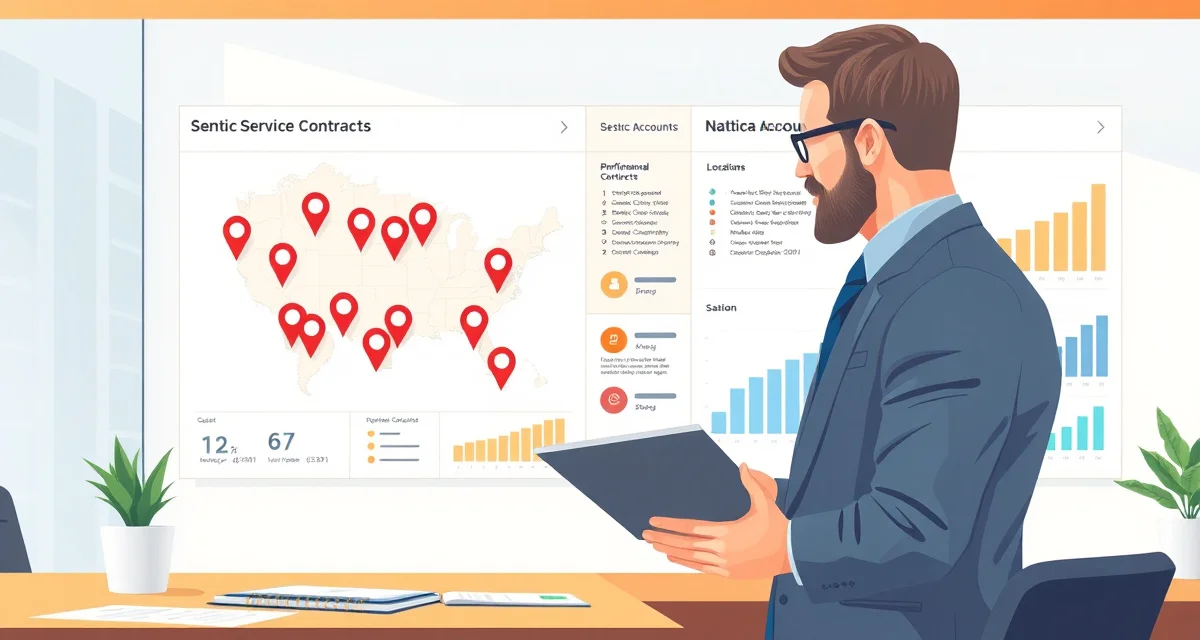
Septic Service National Account Management: Serving Multi-Location Brands
By the SepticMind Editorial Team
National accounts in septic service represent contracts averaging $28,000 per year in revenue. National account customers require consolidated billing and performance reporting that generic field service management tools cannot provide, and that gap is why most regional septic companies can't compete for national account business even when they have the service capability.
TL;DR
- National account contracts for property management companies, franchise operators, and multi-site businesses provide large recurring revenue with centralized billing.
- Winning national accounts requires demonstrating geographic coverage, consistent service quality across locations, and centralized reporting capability.
- National account pricing typically includes volume discounts in exchange for committed service volume; the discount should not compress margin below target.
- Centralized service reporting for national accounts requires technology that aggregates service records across multiple locations into a single view.
- National account relationships are won by demonstrating compliance documentation quality and reporting capability as much as by price.
- Building national account relationships requires sales outreach at the corporate or regional management level, not property-by-property acquisition.
SepticMind's national account structure serves multi-location brands with location-level records and company-wide reporting so you can deliver what national clients actually require.
What National Account Clients Look Like
A national account in the septic industry is any client with multiple locations that you service under a single vendor relationship, with consolidated billing and performance reporting at the company level. The most common categories:
Restaurant chains. A QSR or fast-casual chain with 30-50 locations in your service area represents a meaningful account, particularly when the chain has a standardized approach to vendor management that simplifies the relationship once you're approved. Restaurant chains typically want monthly consolidated invoices covering all location services.
Property management companies. Commercial and residential property managers handling hundreds of properties across a region often include septic-dependent properties. A property management company that manages rural commercial properties, apartment complexes with private systems, and retail centers with onsite wastewater all needs a single trusted vendor.
Retail chains. Big box retailers, convenience store chains, and gas station brands with rural locations are common national accounts. Many rural retail locations have onsite septic rather than municipal sewer.
Hotel and hospitality groups. Hotel management companies and ownership groups often manage clusters of properties across a region with mixed sewer and septic configurations. Properties on private systems need service; having one vendor relationship for all of them simplifies management.
Self-storage chains. As covered separately, self-storage chains are a distinct category with multiple locations and minimal on-site staff, exactly the customer type that benefits most from organized service management and consolidated reporting.
The National Account Qualification Process
National account relationships typically require a vendor qualification process before the first location goes live. This is where most regional septic companies fall short, not on service capability, but on documentation capability.
Vendor qualification questionnaire. Most national account procurement processes start with a questionnaire covering: company licensing and credentials, insurance coverage types and limits, safety program documentation, years in business, service area coverage, and references from comparable clients. Have these documents organized and ready to respond quickly.
Insurance requirements. National accounts typically require higher insurance limits than residential or small commercial clients. Expect to provide: commercial general liability ($1 million per occurrence, $2 million aggregate minimum, sometimes more), pollution liability (non-negotiable for a septic company serving national accounts), commercial auto for all vehicles, and workers' compensation. Some clients also require umbrella/excess liability.
Service area confirmation. National account clients need to know you can cover all their locations in your region. Map their locations before the sales conversation so you can confirm coverage confidently and identify any gaps.
References from comparable accounts. A restaurant chain wants to talk to another restaurant chain you've served. A property manager wants a property manager reference. Generic residential references don't carry weight with national account procurement.
Delivering National Account Performance Reporting
Once you've won a national account, the ongoing relationship depends on delivering the reporting the client requires. This is the operational capability that separates companies that keep national accounts from those that lose them at renewal.
Location-level service records. Every service visit at every location generates a service record, date, service type, gallons, condition notes. These are accessible at the location level for the local facilities manager and at the account level for the corporate procurement team.
Consolidated billing. Monthly consolidated invoices covering all locations, typically broken out by location with a summary total. Some clients require billing by cost center or property code. Configure your invoicing to match the client's accounting requirements.
Compliance status reports. National account clients want periodic reporting on compliance status across their portfolio: which locations are current on service, which are overdue, what conditions have been identified, and what actions have been taken or are recommended.
Incident reporting. When a notable finding occurs (a system failure, a compliance issue, an emergency response) the client needs a prompt incident report. Don't let national clients learn about problems at their locations from sources other than you.
SepticMind's commercial accounts module supports the multi-location account structure with location-level records and account-level consolidated reporting. Service agreement management covers the contract terms that govern national account relationships.
Pricing National Accounts
National account pricing involves a balance between volume discount (recognizing the efficiency of serving many locations under one relationship) and premium pricing for the documentation and reporting services that come with national accounts.
Don't underprice national accounts trying to win on price. National account procurement teams understand that documentation quality, compliance management, and consolidated reporting have value. Price those services into your contract rate rather than trying to compete as the cheapest bidder, because cheap bidders rarely survive at the documentation standard national accounts require.
Price the account based on: number of locations, service frequency per location, estimated gallons per service, disposal costs, documentation and reporting labor, and emergency response commitment. Your proposal should show the client how you've priced the account and why the price is justified.
Get Started with SepticMind
SepticMind is designed around the actual workflows of septic service companies, from county permit tracking to automated maintenance reminders. Whether you are managing a single truck or a multi-county fleet, the platform scales with your operation. See how it works for your business.
Frequently Asked Questions
How do I manage septic service contracts for a client with 40 restaurant locations?
Start with a structured account setup: one account record for the company with 40 individual location records, each containing that location's system details, service schedule, and service history. Configure consolidated invoicing monthly across all locations with location-level line items. Establish a single point of contact at the client's facilities management or procurement team for account-level issues, and a secondary contact at each location for scheduling and access coordination. Develop a service reporting cadence, monthly summary report covering all locations serviced that month, quarterly compliance status report, and immediate notification for any notable findings. National account management is relationship management as much as service delivery: the facilities director who trusts you is your insurance against competitive bids at renewal.
Can SepticMind generate consolidated compliance reports for a national account client?
Yes. SepticMind's account-level reporting generates consolidated views across all locations within a national account. A compliance summary report shows which locations have been serviced in a defined period, which are approaching their next service date, and which have any outstanding conditions. Location-level detail is available within the same account, so the client's facilities manager for a specific region can see that region's records while the corporate procurement team sees the full portfolio. Reports can be exported for client delivery in formats that match what the client expects to receive. PDF or Excel depending on their preference. This reporting capability is often the deciding factor in national account vendor selection, because it addresses the client's need for oversight of their distributed portfolio.
What reporting do national account clients typically require from their septic vendors?
At minimum: monthly consolidated service logs covering every location serviced in the period, showing date, location, service type, gallons, and condition notes. Quarterly compliance status reports showing service frequency adherence across the portfolio (which locations are on schedule and which are overdue. Annual system condition summaries including any components identified as approaching end of service life. For regulated industries (restaurants, healthcare, hospitality), compliance documentation that can be presented during regulatory inspections at individual locations. Incident reports within 24 hours when a notable condition) failure, emergency response, notable repair, occurs at any location. Some national accounts also require performance metrics: average response time, service completion rate, documentation turnaround time.
What reporting do national account customers typically require from their septic service provider?
National account customers managing multiple properties typically require monthly or quarterly service reports that aggregate service activity across all locations: addresses serviced, service dates, volumes pumped, compliance status by location, and any deficiencies requiring follow-up. Some national accounts also require electronic service records with photos attached, audit-ready documentation for health department inspections, and API integration with their property management software. Service companies that can provide centralized digital reporting have a significant competitive advantage in national account sales over companies that provide only property-by-property paper receipts.
What is the typical sales cycle for winning a national account in septic service?
National account sales typically take 3-12 months from initial contact to contract execution. The process involves identifying the right decision-maker (regional facilities director, VP of facilities, or property operations manager rather than individual property managers), demonstrating geographic coverage in the prospect's portfolio, providing references from comparable accounts, submitting a formal bid with pricing and service specifications, and going through the prospect's vendor qualification process. The qualification process frequently includes insurance verification, license confirmation, background check requirements, and sometimes a site visit to your operation. Starting with a small pilot portfolio and earning expansion is a common path.
Try These Free Tools
Sources
- National Onsite Wastewater Recycling Association (NOWRA)
- US EPA Office of Wastewater Management
- NSF International
- Water Environment Federation
- National Environmental Services Center (NESC)