Septic Service for Auto Repair and Oil Change Facilities
By the SepticMind Editorial Team
Auto repair shops and oil change centers produce wastewater that's categorically different from standard commercial gray water. Floor wash water at auto shops contains petroleum hydrocarbons that are regulated before septic entry, and EPA regulates petroleum discharge from auto service facilities under the Clean Water Act. Operating an auto shop without the proper pretreatment infrastructure and the compliance documentation to match is a regulatory exposure that most shop owners don't fully appreciate until there's an enforcement action.
TL;DR
- Car Dealership Service facilities have distinct wastewater loading patterns that affect septic system sizing, service frequency, and permit requirements.
- Commercial and institutional properties like car dealership service typically require more frequent pumping than residential systems due to higher daily usage.
- Some car dealership service operations generate waste streams (grease, chemicals, or high-volume flow) that require pre-treatment before reaching the septic system.
- Service contracts for car dealership service provide predictable recurring revenue and are easier to manage with a platform that tracks commercial account schedules.
- Health department inspections for car dealership service properties may require septic system condition documentation as part of facility licensing.
- Septic companies specializing in car dealership service service build referral networks with property managers, architects, and health inspectors in that niche.
The Petroleum Contamination Problem
Auto repair shops generate petroleum contamination in floor wash water through routine operations that happen every day: oil dripping from vehicles during repair, transmission fluid and coolant spills during servicing, gasoline and diesel contamination from fuel system work, and lubricant residue from brake and drivetrain work.
This water doesn't just disappear. It flows to your floor drains. Without the right pretreatment equipment between those drains and your septic system, petroleum hydrocarbons enter the tank. In your tank, petroleum doesn't break down the way organic waste does. It floats, accumulates, and eventually migrates to the drainfield, where petroleum contamination can:
- Kill the soil bacteria that make drainfield absorption work
- Contaminate groundwater with BTEX compounds (benzene, toluene, ethylbenzene, xylene)
- Create environmental liability under CERCLA and state cleanup programs
This isn't a compliance technicality. It's a genuine environmental risk that auto shops on private septic face more acutely than most people realize.
Oil-Water Separators: The Required Pretreatment
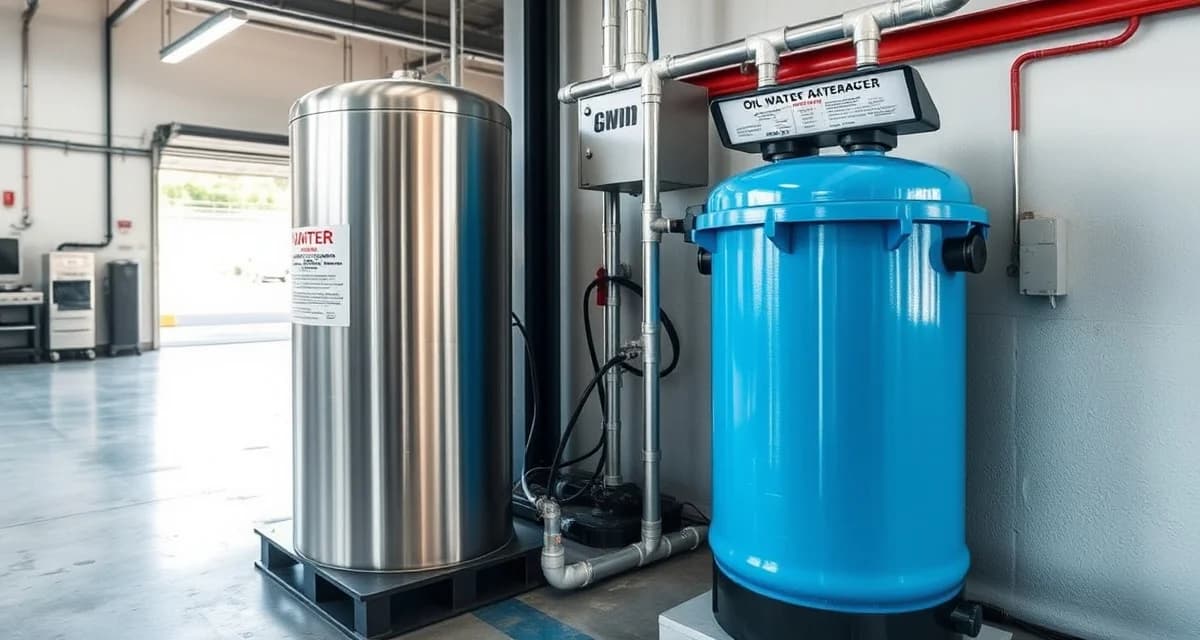
The standard pretreatment requirement for auto repair facilities is an oil-water separator (OWS), also called an oil trap or API separator. This device uses gravity separation to capture petroleum products floating on top of the water before the wastewater reaches the septic system or other disposal pathway.
An oil-water separator doesn't eliminate all petroleum contamination, but it captures the bulk of floating oil and allows the water portion to continue to the septic system in a much cleaner state.
Key things to know about oil-water separators:
They need regular cleaning. An OWS that isn't cleaned regularly fills with captured oil and solids until it stops working. Most shop-scale separators need cleaning every 1-3 months depending on service volume.
They need proper sizing. An OWS sized for a 2-bay shop won't work for a 10-bay facility. Confirm your separator is sized for your current service volume.
The waste captured in the separator is regulated petroleum waste and needs to be disposed of by a licensed waste hauler. You can't just pump it to a truck and dump it.
SepticMind's auto repair account type tracks oil-water separator service alongside septic maintenance. Both have their own service schedules and records, which is what the EPA and state environmental agencies want to see during a facility inspection.
EPA and State Compliance for Auto Shops
The EPA's Clean Water Act creates a compliance framework for petroleum discharge from auto service facilities. Key elements:
Stormwater permits: Most auto repair facilities with more than a certain size threshold need a stormwater permit under EPA's NPDES program. Stormwater from the parking lot and service areas can carry petroleum to nearby waterways.
Best Management Practices (BMPs): EPA and state environmental agencies expect auto shops to implement BMPs for petroleum management, including oil-water separators, proper spill response, and regular inspection of floor drains.
Used oil management: Used oil from oil changes is a regulated substance under EPA rules and must be managed as used oil, not as waste that goes down the drain.
State environmental program: Most states have their own underground storage tank (UST) and petroleum contamination programs that add state-level requirements on top of EPA federal standards.
How Often Should an Auto Shop Service Its System?
Service intervals for auto repair shops depend on repair volume, number of bays, and types of services performed. An oil-change-only facility generates different loads than a full-service shop doing transmission rebuilds and engine work.
For the oil-water separator: every 1-3 months for high-volume shops, quarterly at minimum for any shop doing petroleum-generating work.
For the main septic tank serving employee facilities: annual inspections with pump-outs every 2-3 years for shops with standard employee headcount. The employee septic system is a separate load from the floor drainage system.
For auto dealership septic management, the same pretreatment framework applies but at larger scale.
Get Started with SepticMind
Managing service contracts for car dealership service properties is easier with a platform built for the septic trade. SepticMind tracks commercial service schedules, documents every inspection visit, and keeps your compliance records organized by property. See how it handles your commercial account portfolio.
Frequently Asked Questions
What pretreatment equipment do auto repair shops need for onsite septic compliance?
Auto repair shops need an oil-water separator (OWS) between their floor drains and any connection to the septic system or other wastewater disposal. The OWS uses gravity separation to capture petroleum products before they reach the septic tank. The separator needs to be properly sized for the shop's service volume, regularly cleaned (typically every 1-3 months), and the captured waste must be disposed of by a licensed petroleum waste hauler. Additional BMPs including proper spill response procedures and stormwater management may also be required depending on the facility size and jurisdiction.
How often should an auto repair shop's oil-water separator be cleaned?
Most auto repair shop oil-water separators need cleaning every 1-3 months, depending on service volume and the types of repairs performed. A high-volume quick-lube shop doing 50+ oil changes per day may need monthly cleaning. A lower-volume general repair shop may go 2-3 months between cleanings. The indicator for cleaning is when the accumulated oil layer in the separator reaches about 50% of the design capacity, which your service provider can assess during routine visits. Never let an OWS go more than 3 months without inspection, because a full separator provides essentially no pretreatment protection.
Does SepticMind track oil-water separator maintenance for auto repair accounts?
Yes. SepticMind's auto repair account type maintains separate service records for the oil-water separator and the main septic system serving employee facilities. Each has its own service schedule based on the appropriate maintenance interval for that component. Service reminders for the OWS fire more frequently than the main tank reminders because cleaning frequency is higher. When EPA or state environmental agency inspectors review your facility's compliance records, you can produce the complete service history for both components immediately. For auto dealerships managing multiple service departments, all locations can be tracked under a single account.
How often should a septic system serving a car dealership service property be inspected?
Septic systems at car dealership service properties should be inspected at least annually and pumped more frequently than residential systems, since commercial-scale daily water usage accelerates sludge and grease accumulation. The exact frequency depends on the specific activities at the facility, peak occupancy, any food service or chemical use on-site, and local regulatory requirements. A service provider familiar with car dealership service operations can recommend an appropriate inspection and pumping schedule based on the system's actual usage profile.
What septic system issues are most common at car dealership service properties?
The most common septic problems at car dealership service properties are rapid sludge accumulation from high occupancy, grease trap failure if food service is involved, hydraulic overloading during peak-use periods, and non-biodegradable waste disposal from cleaning or maintenance activities. Regular inspection and a service contract with clear maintenance intervals are the most effective ways to catch these problems before they cause system failure or regulatory violations.
Try These Free Tools
Sources
- National Onsite Wastewater Recycling Association (NOWRA)
- US EPA Office of Wastewater Management
- NSF International
- Water Environment Federation
- National Environmental Services Center (NESC)