Plastic drain field chambers: the complete guide for homeowners and installers
By the SepticMind Editorial Team
TL;DR
- Plastic drain field chambers are open-bottomed, arch-shaped units that replace gravel in a leach field.
- They give effluent more soil surface to soak into, cost $3 to $8 per linear foot installed, and last 30 to 50 years.
- Most new residential septic systems use them because they're lighter, faster to install, and easier to inspect than gravel trenches.
What are plastic drain field chambers and how do they work?
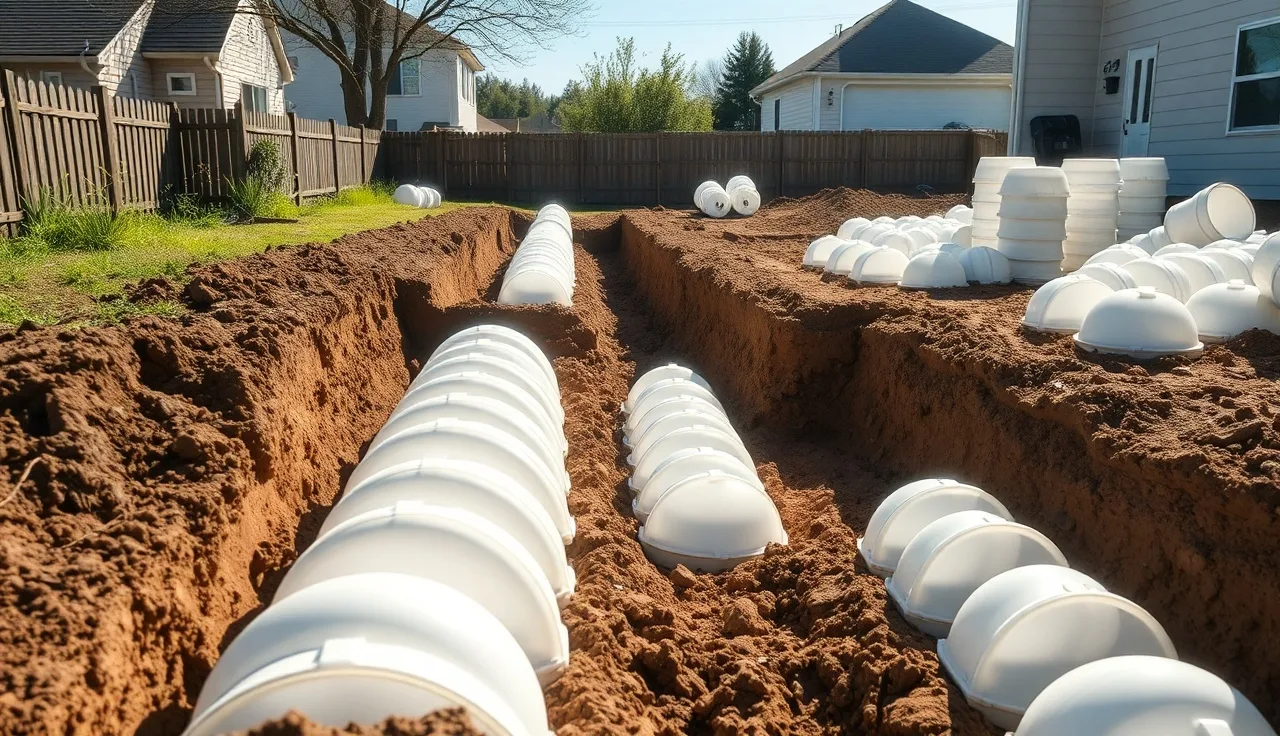
A plastic drain field chamber is an arch-shaped, open-bottomed unit that sits in a soil trench. Effluent flows in from the septic tank, moves through a perforated distribution pipe or straight through the chamber's corrugated sidewalls, then seeps down into the exposed soil at the chamber's base. The soil does the treatment. The chamber just holds the space and spreads the liquid out.
In a gravel system, crushed stone surrounds a perforated pipe and does that same job. Chambers do it without the stone. The inside of the chamber is open air, so liquid can pool for a moment and then drain at the soil's own pace instead of being pushed through packed rock. That open space roughly doubles the effective infiltrative surface compared to a gravel trench of the same width [1].
Chambers run 12 to 34 inches wide and 8 to 16 inches tall. They snap or slip together end to end into rows called "runs," and several runs tied to a distribution header make up the full drain field (also called a leach field). End caps seal each run. Inspection ports on top let a technician check ponding levels or drop a camera in.
The brands you'll see most in North America are Infiltrator Systems (now owned by Advanced Drainage Systems), Cultec, and ADS itself. If you've watched a septic install in the last decade, you've probably seen Infiltrator's Quick4 series go into the ground.
Why did chambers replace gravel in most new installations?
Gravel ran residential septic for decades, and it still works fine when it's installed right. Chambers took over for a handful of practical reasons.
Start with weight. A truckload of washed stone is heavy, expensive to deliver, and a pain to spread by hand in a tight yard. A pallet of chambers is light enough that two workers can carry the units one at a time without a machine.
Then speed. A crew that spends a full day shoveling and leveling gravel can drop in the equivalent chamber system in a few hours. Labor is the biggest line item in septic work, so those hours are real money.
Design flexibility is the third reason. Many state codes let engineers size a chamber system into a smaller footprint than the equivalent gravel system, because chambers can prove higher hydraulic loading rates through third-party testing. The EPA notes that alternative systems, chamber systems included, can work on sites where a conventional gravel field would fail for lack of room [2].
Inspection access is the fourth. A 4-inch cleanout in a gravel trench tells you almost nothing. Chambers have inspection risers you can look down or run a camera through. For a real estate inspection or a troubleshooting call, that access is genuinely useful.
Gravel still wins in a few spots. Rocky soils or sites with very slow percolation sometimes do better with the stability and even distribution of stone. And some counties run older codes that size gravel differently, which makes gravel the easier permit. But for a standard new residential install, chambers are the default across most of the country.
What do plastic drain field chambers cost?
Expect $3 to $8 per linear foot of installed trench for a chamber drain field, and that includes materials, labor, excavation, and backfill. A typical 3-bedroom home needs roughly 300 to 500 linear feet of trench depending on soil type and state loading rates, which puts the field alone at $900 to $4,000. Full septic installation (tank plus field) runs $10,000 to $25,000 or more depending on soil, lot complexity, and local permit fees [3].
The chambers are a small slice of that. Individual Infiltrator Quick4 units retail for roughly $15 to $30 each depending on size. A 50-foot run might use 25 to 30 chambers. The money goes to excavation, inspection fees, and labor.
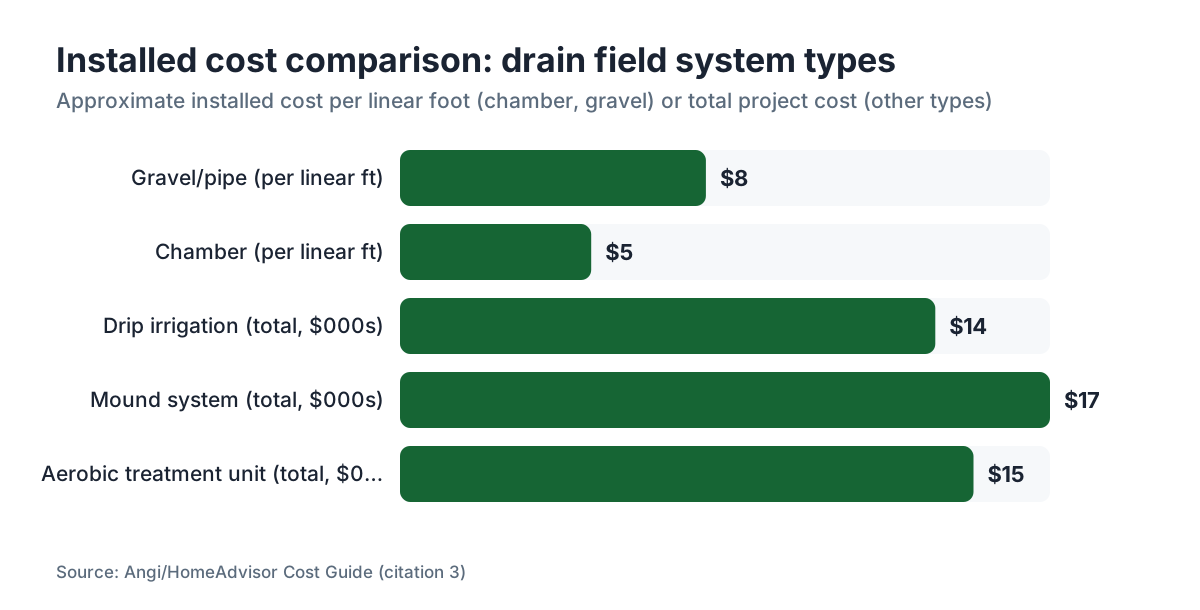
Here's how chamber systems stack up against other drain field types on installed cost:
| System type | Installed cost per linear foot | Notes |
|---|---|---|
| Gravel/pipe | $5 to $12 | Higher stone and labor cost, simple design |
| Chamber | $3 to $8 | Lower labor, no stone delivery |
| Drip irrigation (pressure-dosed) | $8,000 to $20,000 total | Per-system pricing; used on difficult sites |
| Mound system | $10,000 to $25,000 total | Required where water table is high |
| Aerobic treatment unit (ATU) | $10,000 to $20,000 total | High-quality effluent, high maintenance cost |
Prices swing hard by region. Rural areas with long drive times cost more. States with strict setbacks or high permit fees add to the bill. Get at least two quotes from licensed septic contractors and have each one name the chamber brand and size, because a quote built on 4-inch-wide chambers and one built on 12-inch chambers are not the same quote. For the full system picture, see the cost to install septic system guide.
How are plastic chambers sized and designed for a specific house?
Sizing a chamber drain field comes down to three things: how much wastewater the house makes, how fast the soil can take it (the percolation rate or soil loading rate), and what the local code allows.
A licensed engineer or soil scientist starts with a perc test or a soil morphology evaluation. Perc tests measure how fast water drops in a drilled hole. Slower percolation means the soil takes less water per square foot, which means more infiltrative area, which means more chambers or longer runs.
Bedroom count is the standard stand-in for daily flow. Most state codes assume 75 to 150 gallons per day per bedroom. A 3-bedroom house makes about 300 to 450 gallons per day [4]. Divide that by the soil's loading rate (in gallons per square foot per day) and you get the minimum infiltrative area the system needs. The manufacturer's tested loading rate then tells you how many linear feet of chamber trench delivers that area.
Infiltrator's design manual shows the Quick4 series providing 6.8 square feet of infiltrative bottom area per linear foot of trench, which lets a designer compare it directly against a gravel system's area [1]. Many states accept these tested values outright, or apply a reduction factor to the raw perc results.
Setbacks box in the layout too. Most states want drain field trenches at least 10 feet from property lines, 25 feet from a well, and further from surface water. You also need a reserve area, usually 100% of the primary field size, left untouched for a future replacement. Your installer should stake that area out before backfilling.
What does installation actually look like, step by step?
Installation starts with permit approval. Your installer files a site plan, soil evaluation, and system design with the local health department or environmental agency. Most jurisdictions require a licensed designer and a licensed installer. A few still let homeowners install their own systems under inspection, but that's rare and getting rarer [5].
Once the permit clears, the crew digs trenches to the depth in the design, usually 18 to 36 inches, keeping the bottom level or on the slight slope (under 1%) the code allows. They may spread a thin layer of sand to level the bottom if the soil is uneven.
Chambers go straight onto the native soil. The crew starts at the distribution box or header, sets the first chamber, snaps the next onto its end coupling, and works down the trench. End caps seal the last unit in each run. Inspection risers get fitted over the knockout ports.
Then backfill goes over the top. The manufacturer sets a minimum cover depth, usually 6 to 12 inches of native soil. Installers add another 6 inches or so to allow for settling. After that, no vehicles, heavy planters, or structures over the field. Ever.
A final inspection by the local authority happens before permanent backfill in most places. The inspector checks trench depth, chamber seating, distribution, and setback distances. Once it passes, the system gets covered and the site gets restored. Excavation to final cover usually takes one to three days for a standard residential system.
For the tank side of the same project, the septic tank installation guide walks through that half of the process.
How long do plastic chambers last, and what can shorten their life?
Plastic drain field chambers, installed right, last 30 to 50 years under normal residential use. Infiltrator has published data showing high-density polyethylene (HDPE) chambers hold their structural integrity for decades under typical soil loads [1]. That's roughly on par with or better than gravel-and-pipe systems, where the pipe holds up but the gravel can shift and compact over time.
Here's what shortens their life.
Biomat buildup is the most common problem. Biomat is the dark, slimy layer that forms where effluent meets soil. In a healthy field it forms slowly and then levels off. Skip your tank pumping and extra solids flow to the field and speed the biomat up. Once the mat seals the soil surface, the field fails. That's a maintenance failure, not a chamber failure, and a gravel field fails the same way when biomat takes hold.
Hydraulic overload kills drain fields faster than almost anything. Push 600 gallons through a system sized for 300 gallons a day and the soil can't keep up. The usual culprits are leaky toilets (a running toilet can waste 200 gallons a day or more), water softener backwash plumbed into the septic, and a garbage disposal piling on solids.
Vehicle traffic crushes chambers. A standard residential chamber handles about 2 feet of cover load with no vehicle on top, but a truck driven across the field can crack or collapse the units. Mark the perimeter and keep it clear.
Tree roots are a smaller risk for chambers than for perforated pipe, but watch large trees within 10 to 20 feet of the field. Roots chase moisture, and a working field is a moisture source. Give them time and they'll find it.
Pumping your tank every 3 to 5 years is the single best thing you can do for the drain field. The how often to pump septic tank guide has the full breakdown on intervals.
How do you maintain a chamber drain field properly?
Maintenance is mostly about what you don't do, not what you do.
Don't skip tank pumping. Sludge and scum stack up in the tank over time. Once either layer gets deep enough to slip past the outlet baffle, solids reach the field and start clogging the chamber-soil interface. EPA guidance recommends pumping every 3 to 5 years for a typical household [2]. Homes with a garbage disposal, more people than the system was sized for, or heavy water use need it more often.
Don't flush things that don't break down. Wipes (even the ones labeled "flushable"), feminine hygiene products, and paper towels sit as solids that either fill the tank faster or slip through and clog the field.
Don't buy chemical drain field additives. Products sold as chamber or leach field restorers have thin evidence behind them and some evidence of harm. Per EPA, there is no peer-reviewed evidence that septic additives help drain field performance [2].
Do check your inspection ports now and then, especially after heavy rain. A little ponding after a big storm is normal. Ponding that hangs on more than 24 to 48 hours after a storm means the field is stressed or starting to fail.
Do divert surface water. Downspouts, sump pump discharge, and yard runoff that flow onto the field soak the soil and cut its ability to accept effluent. Grade the yard so water runs away from the field.
Do keep the field in grass or shallow-rooted ground cover. Plants pull moisture out through transpiration and keep the soil from going waterlogged. Bare soil compacts easier and loses infiltration capacity.
Operators running multiple residential accounts can track pump intervals and field inspection records in a software platform like SepticMind. That kind of record keeping heads off the deferred maintenance that turns a $400 pump-out into a $15,000 field replacement.
What are the signs a chamber drain field is failing?
Drain field failure shows up in a few recognizable ways, and the earlier you catch it, the more options you keep.
Slow drains across the whole house, more than one fixture, are a red flag. One clog backs up one drain. When the whole house drains slow, the trouble is usually downstream at the tank or the field.
Wet, spongy ground over the field that lingers days after rain means the soil can't take effluent fast enough. Sewage smells near the field, or standing water with a gray tint, mean effluent is surfacing. That's a public health problem more than a plumbing annoyance, and in most states you're legally on the hook to fix it fast [5].
Stripes of unusually lush grass running along the chamber rows can mean the field is overloaded and fertilizing the surface with partly treated effluent. A little extra green over the field is fine. Dramatic stripes are not.
Alarms or pump failures on pressurized systems are obvious signals, but plenty of gravity-fed chamber systems have no alarm at all. If you've got a gravity system and haven't had it looked at in a while, a surfacing field might be your first warning.
A qualified septic tank inspection can tell you whether a sluggish system is a tank problem (full tank, failed baffle) or a field problem. Those two causes need different fixes, and guessing wrong wastes money.
Can a failed chamber drain field be repaired or does it need full replacement?
Sometimes repair works. Sometimes you need a new field. It depends on why it failed.
If the failure came from hydraulic overload (a leaky toilet, too much water use) and the soil isn't permanently sealed, cutting the load may let the field rest and recover. Some installers use a field-resting approach, diverting flow to an alternate field (if the system has one) for 6 to 12 months. Caught early, this works better than most homeowners expect.
If the failure came from biomat sealing the soil surface after years of solids carryover, recovery gets harder. Aerobic bacteria injected through the inspection ports (sometimes called bioremediation) has mixed evidence. It's worth a shot on a field that would otherwise need full replacement, since the cost is low next to excavation. Just don't expect a guarantee.
If the chambers themselves are crushed by vehicle traffic or root intrusion, you're excavating. Individual sections can sometimes be swapped if the damage is local. More often, the whole field comes out.
Full field replacement runs $5,000 to $20,000 depending on size and site. If the soil is salvageable, a new chamber system drops into the same footprint after excavation and soil scarification to break up the biomat layer. If the original soil is too far gone, the field moves to the reserve area.
Before you sign off on any big repair, get the field inspected through the cleanout ports and have someone run a camera. Replacing a whole field over a single failed distribution line is expensive and unnecessary. The septic system repair guide covers repair options across the whole system.
Are chamber systems approved in all states, and do codes vary?
Chamber systems are approved in all 50 states, but the design rules vary a lot. There's no single federal septic code. The EPA sets broad guidance and leaves regulation to the states, which sometimes hand it down to counties [2].
A few examples of that variation. Florida's Chapter 64E-6 of the Florida Administrative Code sets minimum chamber dimensions and loading rates separately from gravel systems [5]. Texas runs its On-Site Sewage Facility rules under 30 TAC Chapter 285 [8]. Massachusetts is notably strict and requires variance applications for some chamber configurations in certain soils.
The practical takeaway: confirm chamber product acceptance with your local health department before you buy any materials. Most jurisdictions keep an approved products list, and your local designer knows what's accepted. Infiltrator and Cultec sit on nearly every approved list in the country [10]. Smaller regional brands may not.
Code also governs setbacks, burial depth, minimum trench dimensions, and reserve area. Those don't change with chamber type, but they shape the design in ways that matter for lot planning. Your permit application needs a site plan showing every setback, and the inspector verifies them before signing off.
The National Environmental Services Center at West Virginia University keeps a database of state onsite wastewater regulations that's a reasonable starting point for state-specific research [6].
How do chambers compare to other modern drain field alternatives?
Chambers are the mainstream alternative to gravel, but they aren't the only one. Here's an honest comparison.
Plastic chambers vs. gravel and pipe: Chambers are lighter, faster to install, and easier to inspect. Gravel does better in very rocky soils where chamber trench walls might collapse before placement, and it sometimes costs less per foot where local stone is cheap. Over the long haul, performance is comparable when both are maintained.
Chambers vs. drip irrigation fields: Drip irrigation pressure-doses treated effluent through small-diameter tubing buried just under the surface. It works on sites with slow soils or high water tables where chambers would fail. It needs a pump, filters, and annual maintenance, and it costs a lot more. Chambers are the right call when the site allows them. Drip is for the hard sites.
Chambers vs. mound systems: A mound raises the drain field above the natural soil by importing sand fill. It's for sites where the water table sits too shallow or the perc rate runs too slow for a conventional field. Mounds cost more and stand out visually. If your lot supports chambers, use chambers.
Chambers vs. aerobic treatment units (ATUs): ATUs treat effluent to a much higher quality before it reaches the field, which allows a smaller field and use on more restricted sites. They have electrical components, need quarterly maintenance contracts in most states, and cost $10,000 to $20,000 installed. Chambers need no power and no maintenance contract. ATUs are for sites that can't carry a passive system.
The leach field guide covers these options in more depth if you're early in design and still weighing what field suits your site.
What should homeowners and operators know before buying or specifying chambers?
If you're a homeowner getting a new system, you probably won't pick the chamber brand yourself. Your installer uses what's on the local approved list and what they have a good supplier relationship with. That's fine. What you should check: make sure a licensed engineer or certified designer stamped the design, ask to see the permit approval before work starts, and confirm the inspection risers go in so you can check the field later without digging.
Ask your installer to walk you through the reserve area. If you ever want a deck, a pool, or a parking pad, you need to know exactly where you can't build. Get it in writing.
For septic operators and designers: Infiltrator's design manual is free and worth keeping on file. It has load tables, sizing worksheets, and installation details that come in handy when a county inspector starts asking questions on-site. Cultec publishes the same kind of documentation. Both run technical support lines for design questions.
Managing multiple properties, you'll want a record of which chamber brand, model, and design loading rate went in at each site, because that data matters for future troubleshooting. Operators running field service businesses can log it in a platform built for septic work. SepticMind, for one, lets operators attach permit documents and design specs to individual site records, so a technician has them on the truck instead of hunting through paper files.
On the homeowner side, routine pump-outs stay the core task. A septic tank pump out every 3 to 5 years protects the chamber field more reliably than anything else you can do.
Frequently asked questions
How long do plastic drain field chambers last?
Plastic chambers made from high-density polyethylene typically last 30 to 50 years under normal residential use with proper maintenance. The chamber material is durable; the more common failure is soil clogging from biomat buildup caused by skipped tank pumping, not chamber breakdown. Pumping the tank every 3 to 5 years is the best way to protect the full lifespan.
Can I drive over a plastic chamber drain field?
No. Residential chambers aren't built for vehicle loads. A truck or heavy equipment can crack or collapse individual units. Some manufacturers offer traffic-rated chambers for parking lots or shallow cover installations, but standard residential models need a vehicle-free buffer. Mark the field perimeter clearly during any landscaping or driveway work.
Do plastic chambers need to be cleaned or pumped?
The chambers don't get pumped, but the septic tank upstream does. Pumping the tank every 3 to 5 years keeps solids from migrating to the field and clogging the soil. Some technicians run a camera through the inspection risers to check ponding levels or biomat depth during a service visit. There's no routine cleaning protocol for the chambers themselves under normal operation.
What is the difference between Infiltrator chambers and Cultec chambers?
Both are HDPE arch-shaped chambers accepted across the U.S. Infiltrator's Quick4 series and Cultec's Contactor and Recharger series perform comparably in most designs. The practical differences are local supplier availability and the specific dimensional specs used in sizing math. Your designer and installer usually pick based on regional supplier relationships and what the local permit authority has approved.
How deep should plastic chambers be buried?
Minimum cover over a chamber is typically 6 inches of native soil per manufacturer specs, but most state codes want 12 inches of total cover. Maximum depth is usually 36 inches to the chamber bottom, though some cold-climate codes allow deeper installation for frost protection. Your permit design specifies the exact burial depth for your site and jurisdiction.
Can I install a plastic chamber drain field myself?
A few states still let licensed homeowners install their own systems under permit with inspection oversight, but most require a licensed installer. Even where DIY is allowed, a licensed designer or engineer must complete the design, a permit must clear before any excavation, and inspections happen at multiple stages. Getting it wrong creates health violations and can make your property unsellable.
How do I know if my chamber drain field is failing?
Watch for slow drains throughout the house (not one fixture), soft or spongy ground over the field, sewage odors near the field, or standing gray water on the surface. Lush grass in stripes following the chamber rows can also mean surfacing effluent. Any of these warrants a professional inspection. Early overloading can sometimes be reversed; surfacing sewage is a health code violation that needs immediate attention.
How many chambers do I need for a 3-bedroom house?
A 3-bedroom house typically makes 300 to 450 gallons per day. Using Infiltrator Quick4 standard chambers at 6.8 sq ft of infiltrative area per linear foot, and a soil loading rate around 0.5 gallons per square foot per day, you'd need roughly 90 to 130 linear feet per run, with 3 to 4 runs, totaling 300 to 500 linear feet. Your designer calculates the exact number from your actual perc test and state code.
Are plastic chambers better than gravel for a drain field?
For most residential installations, yes. Chambers are lighter, faster to install, easier to inspect, and often allow a smaller footprint because their tested loading rates run higher than equivalent gravel trenches. Gravel can be preferable in very rocky soils or where local stone is extremely cheap. Long-term performance is comparable when both get proper maintenance, meaning regular tank pumping.
What plastic material are drain field chambers made from?
Most chambers are molded from high-density polyethylene (HDPE). HDPE resists soil acids, moisture, and the biologically active environment of a drain field. Some manufacturers use polypropylene for specific product lines. Both meet ASTM F2922 testing standards for structural performance under soil loads. Avoid any product that doesn't reference ASTM compliance, since that's the baseline for state approval.
Does a chamber drain field require a distribution box?
Not always. Older and some current designs use a distribution box (D-box) to split flow evenly between chamber runs. Newer designs often use a manifold or header pipe that distributes flow without a separate box. Both are code-compliant in most states. The manifold approach has fewer failure points, since D-boxes can tilt over time and cause uneven distribution, loading one run while others stay dry.
How much does it cost to replace a failed chamber drain field?
Full drain field replacement typically costs $5,000 to $20,000 depending on field size, site conditions, and local labor rates. The range is wide because cost swings on excavation difficulty, soil import needs, and permit fees. If the existing soil is reusable after scarification, you land at the lower end. If the system has to move to the reserve area on a tight lot, design and permitting add time and money.
Can tree roots damage plastic drain field chambers?
Roots are a lower risk with chambers than with perforated pipe because there are fewer entry points. But roots chase moisture, and a working drain field is a moisture source. Large trees within 10 to 20 feet of the field can eventually work roots into chamber joints or end caps. Keep large deciduous trees and willows well away at planting; 20 feet is a reasonable minimum, and 50 feet for willows and other aggressive water-seekers.
Do plastic chambers work in cold climates?
Yes, with design changes. In cold climates, designers call for greater burial depth to keep the field below the frost line, often 48 inches or deeper in northern states. The soil cover also insulates. Active systems with regular effluent flow make enough heat to prevent freezing in most conditions. Seasonal or vacation properties that sit empty over winter are more vulnerable, so a professional winterization protocol helps there.
Sources
- Infiltrator Water Technologies, Quick4 Chamber System Design Manual: Infiltrator Quick4 chambers provide 6.8 sq ft of infiltrative bottom area per linear foot of trench; HDPE chamber structural integrity maintained for decades under typical soil loads
- U.S. EPA, SepticSmart Program: EPA recommends pumping septic tanks every 3 to 5 years and notes no peer-reviewed evidence supports septic additive effectiveness; alternative systems including chamber systems work in space-constrained areas
- HomeAdvisor / Angi, Septic System Installation Cost Guide: Full septic system installation (tank plus drain field) costs $10,000 to $25,000 on average; drain field component runs $3 to $8 per linear foot installed
- U.S. EPA, Onsite Wastewater Treatment Systems Manual (EPA/625/R-00/008): Standard design assumes 75 to 150 gallons per day per bedroom; a 3-bedroom house generates approximately 300 to 450 gallons per day
- Florida Department of Health, Chapter 64E-6 Florida Administrative Code, Onsite Sewage Treatment and Disposal Systems: Florida specifies minimum chamber dimensions, loading rates, and licensing requirements for septic system installation; surfacing sewage must be addressed promptly as a public health violation
- National Environmental Services Center, West Virginia University, State Onsite Wastewater Regulations Database: NESC maintains a database of state onsite wastewater regulations useful for state-specific code research
- ASTM International, ASTM F2922 Standard Specification for Prefabricated Septic Leaching Chambers: ASTM F2922 defines structural performance standards for plastic drain field chambers under soil loads, required for state product approval in most jurisdictions
- Texas Commission on Environmental Quality, 30 TAC Chapter 285, On-Site Sewage Facilities: Texas regulates on-site sewage facility design and installation under 30 TAC Chapter 285, including chamber system specifications
- University of Minnesota Extension, Septic System Owner's Guide: Tree roots follow moisture to drain fields; large trees within close proximity of the field can intrude into drain field components over time
- Cultec Inc., Chamber Product Design and Installation Manual: Cultec Contactor and Recharger HDPE chambers meet ASTM standards and are approved across U.S. states for residential drain field use
Last updated 2026-07-09