Plastic septic tanks: everything you need to know before you buy
By the SepticMind Editorial Team
TL;DR
- Plastic (polyethylene or fiberglass) septic tanks cost $500, $2,000 for the tank itself, weigh far less than concrete, and don't corrode.
- They last roughly 30 to 40 years with proper care.
- Most states allow them, but local codes vary.
- They can float in high water tables and crack under heavy loads, so site conditions matter a lot.
What exactly is a plastic septic tank, and what materials are used?
The phrase "plastic septic tank" covers two products that behave very differently in the ground: high-density polyethylene (HDPE) tanks and fiberglass tanks. Both are made off-site, shipped whole or in sections, and buried to receive household wastewater. Neither is concrete.
HDPE tanks are rotationally molded or blow-molded from polyethylene resin. The walls are typically 0.25 to 0.5 inches thick, and the finished tank is one piece with no joints to leak. Fiberglass tanks are built from glass fiber reinforced polyester or vinyl ester resin. They're stiffer than HDPE, have smoother interiors, and are sometimes easier to inspect visually because you can see stress fractures forming before they get serious.
A third category, polypropylene tanks, shows up occasionally in commercial settings, but for residential use you're almost always looking at HDPE or fiberglass. A handful of manufacturers also sell polyethylene tanks with ribbed or corrugated exteriors to handle soil loading, which matters a lot once you get past 24 inches of burial depth.
For this article, "plastic septic tank" means any non-concrete, non-steel tank, which includes both HDPE and fiberglass unless the text says otherwise.
How do plastic septic tanks compare to concrete and fiberglass tanks?
The comparison that matters most to homeowners is plastic versus concrete, because concrete is by far the most common residential septic tank material in the U.S. [1]
| Feature | Concrete | HDPE Plastic | Fiberglass |
|---|---|---|---|
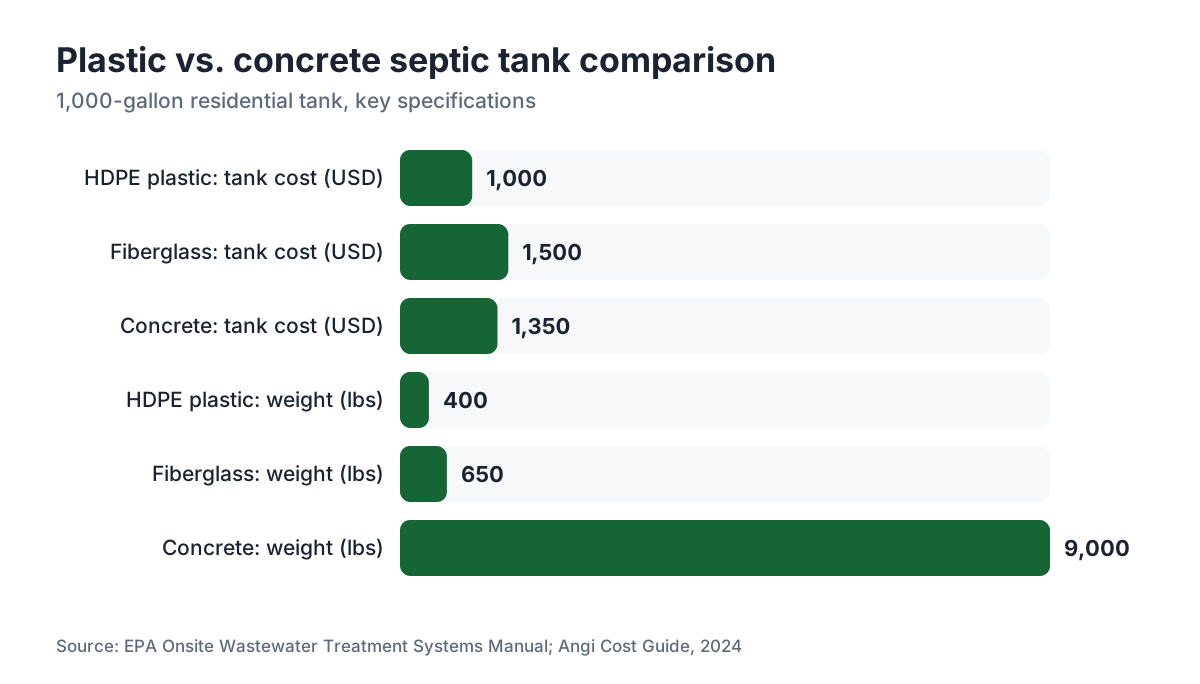
| Typical installed cost (tank only) | $700, $2,000 | $500, $1,500 | $1,000, $2,000 |
| Weight (1,000-gal tank) | 8,000 to 10,000 lbs | 300 to 500 lbs | 500 to 800 lbs |
| Lifespan (estimated) | 40 to 50 years | 30 to 40 years | 30 to 40 years |
| Corrosion resistance | Moderate (acid degrades) | Excellent | Excellent |
| Crack risk | Moderate (freeze/thaw, age) | Low (flexes) | Moderate (brittle if overtorqued) |
| Float risk in high water table | Very low | High | Moderate |
| Accessibility for pumping | Good | Good | Good |
| Code acceptance | Universal | Most states | Most states |
Concrete tanks carry their own weight as ballast, so buoyancy in a saturated yard is rarely a concern. Plastic tanks can float if they're not anchored or backfilled right, and that's the single biggest real-world failure mode. A floated tank breaks the inlet and outlet pipes and can lift the entire system [2].
Concrete tanks degrade when hydrogen sulfide gas (produced by anaerobic bacteria) reacts with moisture and forms sulfuric acid inside the tank. This is a documented, measurable process that shortens concrete tank life in warmer climates or heavily used systems [3]. HDPE and fiberglass don't react with hydrogen sulfide, which is a genuine, practical advantage.
Fiberglass sits in an interesting middle ground. It resists corrosion like HDPE, but it's more rigid. Rigidity means it handles soil load better (less deformation over time), but it also means a point load, like a vehicle crossing above it, can cause a brittle fracture rather than a dent. HDPE tends to flex and recover. Neither should have vehicles driven over them, but in practice, people do.
How much does a plastic septic tank cost, installed?
Tank price and installed price are two very different numbers. Here's the honest breakdown.
A 1,000-gallon HDPE plastic tank runs $500, $1,500 at supply houses, depending on brand, wall thickness, and ribbing. Fiberglass tanks of the same size run $1,000, $2,000. Those are tank-only prices. Once you add excavation, backfill, inlet/outlet fittings, risers, a pump (if required), permits, and labor, the total septic tank installation bill lands somewhere between $3,000 and $10,000 for a basic single-tank gravity system [4].
The cost to put in a septic tank varies most by soil conditions and local permit fees, not by tank material. Rocky soil or a high water table that needs dewatering during installation can add $1,000, $3,000 by itself. In remote areas, mobilizing an excavator costs more just because the operator has to drive further.
Some installers charge a flat rate that includes the tank; others itemize. Get both, and ask specifically what happens if they hit groundwater during the dig. That question alone tells you a lot about how experienced the contractor is.
One cost note on plastic. Because HDPE and fiberglass tanks are lighter, the equipment needed to set them is smaller. A small excavator and two workers can handle a 1,000-gallon HDPE tank. Concrete tanks sometimes need a crane or a larger machine, which adds mobilization cost. On tight lots or backyards with limited access, plastic tanks are genuinely cheaper to install because you need less iron on site.
Are plastic septic tanks approved and legal in all states?
No, not in all states, and this is where you have to do local homework. Most states follow National Sanitation Foundation (NSF) Standard 40 or NSF/ANSI Standard 46 for septic tank materials, and plastic tanks that carry those certifications are accepted widely [5]. Individual states add their own requirements on top of the NSF baseline.
Some states require minimum burial depth that exceeds what a standard HDPE tank is rated for without extra support. Others require tanks to pass a specific load test (ASTM D1227 or similar) at the depth of burial written on the permit. A few states keep explicit approval lists, and a tank model not on the list simply cannot be used regardless of NSF certification.
The EPA's SepticSmart program tells homeowners to contact their local health department or permitting authority to find out what types of systems and materials are approved in their area [6]. That's genuinely the right answer, not a bureaucratic dodge. A county in Florida may have completely different rules from a county in Minnesota, and the county rules control, not the state average.
For operators running service businesses across county lines, tracking which tank makes and models are approved where is real administrative work. Tools like SepticMind let operators tag jobs by jurisdiction and attach permit requirements to customer records, which cuts the chance of quoting a tank that fails permit review.
Call your local health department before buying any tank. Ask for the written approval list if one exists, and ask whether the specific model you're eyeing has been used in a recent permitted installation in your county. The permit office's institutional memory is often more useful than the formal written code.
What are the real advantages of plastic septic tanks?
Weight is the advantage you feel first. A 1,000-gallon HDPE tank weighs 300 to 500 pounds versus 8,000 to 10,000 pounds for an equivalent concrete tank [1]. That difference drives shipping cost, installation equipment, and whether you can even get a tank to a remote or access-constrained site.
Corrosion resistance is the second real advantage. Concrete tanks serving households that produce a lot of grease, or sitting in warm, humid climates, corrode faster than the 40-50 year advertised lifespan. HDPE and fiberglass don't corrode in the presence of the gases and acids that normal household wastewater produces. A study of failed concrete tanks in Florida found hydrogen sulfide-driven corrosion to be a leading cause of premature failure [3].
Plastic tanks are also watertight from the factory. Concrete tanks are poured in sections and develop hairline cracks at joints over time, which can let groundwater infiltrate (diluting the septic process) or let effluent exfiltrate (contaminating soil and groundwater). A one-piece rotationally molded HDPE tank has no seams to fail.
For rural installs on sloped terrain, or sites where you're moving the tank 300 feet from the road, the weight difference is more than a convenience. It's a cost driver. Smaller equipment equals lower mobilization and labor cost.
Plastic tanks are easier to transport, too. They ship on a standard flatbed and move with a forklift or small loader. That matters for contractors in areas where crane permits or oversized load permits add time and money to a concrete tank delivery.
What are the real risks and disadvantages of plastic septic tanks?
Buoyancy is the risk that keeps experienced installers up at night. An empty 1,000-gallon tank displaces roughly 1,000 gallons of water, which weighs about 8,330 pounds. If the soil around and below the tank becomes fully saturated (a high water table event, heavy rain, or a nearby burst pipe), the upward buoyant force on an empty or near-empty tank can beat the weight of the backfill holding it down. The tank floats [2].
When a tank floats, it shears the inlet and outlet pipes. Raw sewage backs up into the house. The tank itself may tilt, making the baffles useless. Repairing a floated tank usually means excavating, reanchoring, and replacing all disturbed pipe, which can run $3,000, $8,000 see septic system repair. In high water table areas you can manage this risk with concrete anchor straps or by filling the tank with water during and after installation, but it's a real site-specific concern.
Load bearing is the second real limitation. HDPE tanks rated for standard burial depths (typically 24 to 36 inches of cover) are not rated for vehicle traffic. Concrete tanks, being rigid and heavy, handle incidental vehicle crossing much better. If your driveway runs near the tank, or if there's any chance a delivery truck could drive over the burial area, concrete is the safer choice.
Some inspectors note that HDPE tanks can deform slightly under soil load over years. This deformation is usually minor and doesn't cause functional failure, but it can make the lid harder to open and can shift the inlet/outlet pipe angles slightly, which throws off the baffle position. Periodic septic tank inspection catches this before it becomes a problem.
Plastic tanks also have a shorter proven track record than concrete. Concrete septic tanks have been in the ground since the early 20th century. HDPE septic tanks became common in the 1980s and 1990s. The 30 to 40 year lifespan estimate rests on accelerated aging tests and field observation of early installations, not a 50-year longitudinal study. That's honest uncertainty worth naming.
How long do plastic septic tanks last?
The honest answer is 30 to 40 years under normal conditions, and that range comes with real caveats.
HDPE has excellent chemical resistance and doesn't degrade in the presence of typical household wastewater. UV degradation, which shortens the life of HDPE above ground, isn't a factor underground. What does affect lifespan is soil chemistry (highly alkaline or acidic soils can attack fiberglass resins over long periods), physical stress from soil movement or freeze-thaw cycles at shallow burial depths, and mechanical damage from vehicles or heavy equipment.
Fiberglass tanks age differently. The resin matrix can develop microcracks over decades, especially if the tank went in with even minor misalignment in the pipe connections, which puts constant stress on a rigid vessel. Those microcracks let moisture into the glass fiber layer, which eventually compromises structural integrity.
For comparison, well-maintained concrete tanks regularly last 50-plus years, which is why you'll find functioning 1960s concrete tanks still in service today. The oldest HDPE septic tanks in widespread residential use went in during the mid-1980s, so we're only now reaching the outer end of their expected service window. The next 10 years will produce much better real-world longevity data.
Maintenance matters more than material for lifespan. A plastic tank that's pumped on schedule (every 3 to 5 years for a typical household) see how often to pump septic tank, inspected for baffle condition, and kept clear of vehicle traffic will reliably hit the 30-year mark. One that's never pumped and has a truck parked over it won't.
Can you install a plastic septic tank yourself, or do you need a contractor?
In most jurisdictions, a licensed installer or contractor must pull the permit and sign off on the installation, even if the homeowner owns the property and does the digging. Some rural counties allow owner-installer permits, but they're the exception. Check your county health department before assuming self-installation is an option.
That said, the weight of plastic tanks does make DIY more physically feasible than concrete. Two adults with straps can move a 500-gallon HDPE tank. A 1,000-gallon tank needs at least a small loader or tractor. The excavation itself, for a typical 6-8 foot deep hole, needs a mini-excavator at minimum.
The work that's dangerous to get wrong is not the digging or the tank placement. It's the pipe connections, the grading of the inlet and outlet lines, the installation of the inlet and outlet baffles, and the compaction of the backfill. Improper backfill compaction is a leading cause of tank deformation in plastic systems. The backfill has to go in in lifts and get compacted evenly on both sides of the tank at the same time, or the walls deflect. Most manufacturers spell out the backfill procedure in writing, and it's worth reading carefully [7].
The leach field design and installation is the other piece that genuinely warrants a licensed professional. Sizing the drain field wrong costs far more than getting the tank slightly off-level.
For pumping and maintenance after installation, septic tank pumping and septic tank cleaning work the same whether the tank is plastic or concrete. A vacuum truck doesn't care what the tank is made of.
What maintenance do plastic septic tanks require, and how often should they be pumped?
Plastic tanks need the same maintenance routine as concrete tanks. The EPA's SepticSmart program recommends inspecting your septic system at least every three years and pumping it every three to five years for a typical household [6]. That schedule holds for HDPE and fiberglass tanks without modification.
A few things are worth checking specifically because of the material. First, the inlet and outlet baffles. Plastic tanks typically use plastic (PVC or polyethylene) tee baffles rather than concrete baffles. These don't corrode, but they can pop loose if the tank deflects or if there's hydraulic surging during heavy use. During any septic tank pump out, the technician should confirm both baffles are present and seated.
Second, the lid and riser connections. Most plastic tanks now come with, or work with, plastic riser extensions that bring the access port to grade. The connection between the tank and the riser is a gasket seal, and those gaskets can crack after 10 to 15 years in the ground. If the technician notices groundwater in the tank at pumping (the tank refills faster than house use alone explains), a failed riser gasket is a common cause.
Third, after any significant flooding event or stretch of unusually wet weather, have someone check that the tank hasn't shifted. A shifted tank changes the pipe slope, which can cause backing up or slow draining before any other symptom shows.
For operators managing scheduled maintenance across many customers, automated reminders tied to each tank's pump history cut missed service intervals. SepticMind handles that scheduling and customer notification automatically, which matters when you're running dozens of service routes.
For septic tank emptying frequency, the rule of thumb is 3 to 5 years, but a household of 5 will fill a 1,000-gallon tank faster than a couple using the same tank. Get an inspection after two years if you're unsure of the actual accumulation rate.
What do I need to know about plastic septic tanks in high water table areas?
High water table sites are where plastic tank selection and installation technique matter most. The problem is keeping a buoyant, lightweight vessel in the ground when saturated soil is pushing up on it.
The standard fixes are: (1) concrete anti-flotation collars poured around the base of the tank after placement, (2) concrete deadman anchors with straps over the tank, (3) installing the tank full of water right after placement and keeping it full during backfill, and (4) using a heavier fiberglass tank instead of HDPE. Many manufacturers offer tanks with integrated anchor lugs made for high water table installations.
Some states, Florida being the most prominent example given its shallow water table, have specific code requirements for below-water-table septic installations that address buoyancy head-on [8]. In those jurisdictions, the permit reviewer will ask about the seasonal high water table elevation and may require engineered anti-flotation calculations.
If your site has a water table within 4 feet of the surface, have a frank conversation with your installer about whether HDPE is the right choice. A heavier fiberglass tank or a concrete tank may be the better long-term decision even if the upfront cost is higher. The cost to repair or replace a floated tank dwarfs any savings on the original purchase.
Some installers in wet areas run a two-tank setup where the first tank sits in a higher, drier location and gravity feeds a pump chamber that lifts to the drain field. This keeps the primary tank out of the wettest zone of the yard.
How do plastic septic tanks affect inspections and resale?
Home inspectors and real estate transactions treat plastic septic tanks the same as concrete ones for the inspection checklist. The inspector cares about whether the system works, whether the tank is accessible, whether the baffles are intact, and whether the drain field shows signs of failure. Tank material gets noted in the report but is not itself a red flag [9].
Some buyers' agents run into buyers who ask about plastic tanks after reading something online, but in practice, a properly installed, regularly maintained plastic tank in good condition does not cut the sale price or create title issues. What creates issues is an uninspected, unpumped system with missing maintenance records, regardless of material.
Get a septic tank inspection before listing if you have any doubts about the system's condition. A $200, $500 inspection is money well spent against a failed inspection during a sale, which can crater the transaction or force a price cut bigger than the repair cost.
For the inspection itself, plastic tanks push the inspector to physically assess the structural condition of the tank walls, beyond the liquid levels and baffle condition. Minor denting or deformation in an HDPE tank may be cosmetic; significant deformation that has shifted the pipe connection angle is a functional defect. A good inspector knows the difference. If you're not sure yours does, ask before booking.
What sizes of plastic septic tanks are available, and how do you pick the right one?
HDPE and fiberglass tanks come in sizes from 300 gallons (small seasonal cabins) up to 10,000-plus gallons for commercial jobs. For residential use, the common sizes are 500, 750, 1,000, 1,250, and 1,500 gallons.
Sizing is almost entirely set by local code, not by personal preference. Most state codes tie minimum tank size to the number of bedrooms in the house, using the assumption that each bedroom adds a defined daily wastewater load. The common baseline is 1,000 gallons for a 1 to 3 bedroom home, with 250 additional gallons per bedroom after that [10]. Your local health department will give you the exact sizing table for your jurisdiction.
One practical note on plastic. Because HDPE tanks are made in standard mold sizes, the available sizes may not match exactly what the code wants. A code requiring a 1,100-gallon tank usually accepts a 1,250-gallon HDPE tank as the next available size up. Confirm with the permit office before purchasing.
For two-compartment systems (which some states require as standard), most plastic tank manufacturers offer single-piece two-compartment tanks, usually with the inlet compartment holding about two-thirds of the total volume and the outlet compartment holding one-third. You can also plumb two tanks in series, with the second tank acting as the final settling chamber before the drain field.
For pump systems (where effluent is pumped to a mound system or pressure-dosed drain field), a separate pump chamber usually goes in downstream of the primary tank. This chamber is often HDPE or fiberglass too, and the same installation and sizing considerations apply.
Frequently asked questions
Are plastic septic tanks as good as concrete?
For corrosion resistance and lightweight installation, plastic tanks are genuinely better than concrete. For load-bearing capacity and resistance to floating in high water tables, concrete has the edge. Neither is universally superior. Plastic tanks work well in most residential settings with competent installation and proper backfill. Concrete is still the safer default for sites with high water tables or where vehicle traffic near the tank is unavoidable.
How long will a plastic septic tank last?
Expect 30 to 40 years under normal conditions. HDPE resists chemical corrosion well, but the long-term field data is thinner than for concrete because widespread residential plastic tank adoption only began in the 1980s. Routine pumping every 3 to 5 years, keeping vehicles off the tank, and inspecting baffles at each pump-out will get you to the top of that range.
Can a plastic septic tank float out of the ground?
Yes. An empty or near-empty plastic tank can float in saturated soil. The buoyant force on a 1,000-gallon tank in fully saturated soil exceeds the weight of most plastic tanks. The fix is anti-flotation anchoring during installation: concrete collars, deadman anchors, or keeping the tank filled with water during backfill. High water table sites need this step without exception.
Do plastic septic tanks need to be pumped differently than concrete tanks?
No. The pumping process is identical. A vacuum truck connects to the access port, the technician breaks up the scum layer and removes solids from both compartments, and baffles get checked visually. The only practical note is that plastic tanks can flex slightly under suction, which is normal and not a cause for concern unless deformation is significant.
Are plastic septic tanks approved by the EPA?
The EPA doesn't approve specific tank models. It publishes the SepticSmart guidance program, which directs homeowners to their local permitting authority for approved materials and systems. Most plastic tanks are certified to NSF/ANSI Standard 46, the industry baseline for septic tank materials, and that certification satisfies most state requirements. Always verify with your county before purchasing.
What is the cheapest type of septic tank?
HDPE plastic tanks are typically the least expensive option, running $500, $1,500 for a 1,000-gallon tank at supply houses. Concrete tanks range $700, $2,000 for the same size. Total installed cost depends heavily on site access, excavation difficulty, and local permit fees, which can equalize or reverse the material cost difference on complicated sites.
Can I replace a concrete septic tank with a plastic one?
Yes, in most jurisdictions, with a permit. If the concrete tank has failed and needs replacing, an HDPE or fiberglass tank of equivalent or larger capacity is an accepted replacement in most states provided it meets local code. The inlet and outlet pipe locations must match, and the installer should confirm the new tank's burial depth rating fits your site's conditions.
How deep can you bury a plastic septic tank?
It depends on the tank's rated burial depth, which the manufacturer specifies. Most standard residential HDPE tanks are rated for 24 to 36 inches of soil cover. Some ribbed or reinforced tanks are rated for 48 inches or more. Exceeding the rated depth without engineering approval can cause wall deformation under soil load. Your permit application will specify the required burial depth.
Do plastic septic tanks smell more than concrete?
No. Odors from a septic tank come from gas production inside the tank, not from the tank material. Both plastic and concrete tanks produce hydrogen sulfide and methane from anaerobic decomposition. If you're noticing odors near your tank, the cause is a failed vent, a cracked lid, or an overloaded system, not the tank material.
Are fiberglass septic tanks better than polyethylene tanks?
Fiberglass is stiffer and handles soil load better at depth, making it a stronger choice for deeper installations or sites with heavy above-ground loads. HDPE is more flexible, one-piece, and slightly lighter. For standard residential burial depths with no unusual load, the difference is minor. Availability and what your local code's approved list includes will likely drive the decision more than material preference.
What size plastic septic tank do I need for a 3-bedroom house?
Most state codes require a minimum 1,000-gallon tank for a 1 to 3 bedroom home. Some states set the baseline at 1,000 gallons and add 250 gallons per bedroom above three. Always check your local code. Because plastic tanks come in standard mold sizes, a code requiring exactly 1,000 gallons usually accepts the next available size up if 1,000-gallon units are unavailable.
Can tree roots damage a plastic septic tank?
Plastic tanks resist root intrusion better than concrete because there are no joints or hairline cracks for roots to exploit in a one-piece HDPE tank. Roots can still follow pipe connections into the inlet or outlet fittings, which is the same vulnerability any tank has. Keeping deep-rooted trees and shrubs at least 10 feet from the tank and 25 feet from the drain field is standard practice.
How do I find out if a plastic septic tank is approved in my county?
Call your county health department or environmental health office and ask for the approved materials list for onsite wastewater treatment systems. Ask specifically whether the tank make, model, and size you're considering is on the list. If it's not on a formal list, ask whether NSF/ANSI Standard 46 certification is enough for approval. Get the answer in writing before buying the tank.
Sources
- EPA SepticSmart Program, United States Environmental Protection Agency: Concrete is the most common residential septic tank material in the U.S.; the SepticSmart program covers approved system types and maintenance guidance.
- Florida Department of Health, Onsite Sewage Program Technical Guidance: Plastic tanks can float in high water table conditions when empty, shearing inlet and outlet pipes.
- University of Florida IFAS Extension, Septic Systems and the Environment: Hydrogen sulfide-driven corrosion is a documented cause of premature concrete septic tank failure, particularly in warm climates.
- HomeAdvisor / Angi Cost Guide, Septic Tank Installation: Total installed cost of a basic residential septic system ranges from $3,000 to $10,000 depending on site conditions and local permit fees.
- NSF International, NSF/ANSI 46: Evaluation of Components and Devices Used in Wastewater Treatment Systems: NSF/ANSI Standard 46 is the baseline certification for septic tank materials, including HDPE and fiberglass tanks, accepted by most states.
- EPA SepticSmart, Homeowner Guidance, United States Environmental Protection Agency: SepticSmart directs homeowners to their local health department for approved materials, and recommends inspection at least every three years and pumping every three to five years.
- Infiltrator Water Technologies, Installation Guide for IM Series Tanks: Plastic tank manufacturers specify that backfill must be placed in lifts and compacted evenly on both sides simultaneously to prevent wall deformation.
- Florida Administrative Code Chapter 64E-6, Standards for Onsite Sewage Treatment and Disposal Systems: Florida code requires anti-flotation measures for tanks installed in high water table conditions, with specific engineering calculations in some cases.
- American Society of Home Inspectors, Standards of Practice: Home inspectors evaluate septic system function, access, and baffle condition; tank material is noted but is not itself a disqualifying defect.
- National Environmental Services Center, NESC, West Virginia University: Minimum tank sizing is tied to bedroom count, commonly 1,000 gallons for a 1 to 3 bedroom home with 250 gallons added per additional bedroom; plastic tanks became common in residential septic use in the 1980s and 1990s.
Last updated 2026-07-09