Drain field pipe: types, sizes, failures, and replacement costs
By the SepticMind Editorial Team
TL;DR
- Drain field pipe carries clarified wastewater from your septic tank into the soil for final treatment.
- Most systems use perforated 4-inch PVC or corrugated polyethylene pipe in trenches 18 to 36 inches deep.
- When pipe collapses or clogs beyond cleaning, full replacement costs $3,000 to $20,000 depending on system size, soil type, and local labor rates.
What is drain field pipe and what does it actually do?
Your septic system has two jobs. Separate solids from liquid inside the tank, then spread that liquid across enough soil that bacteria and filtration clean it before it reaches groundwater. Drain field pipe handles the second job.
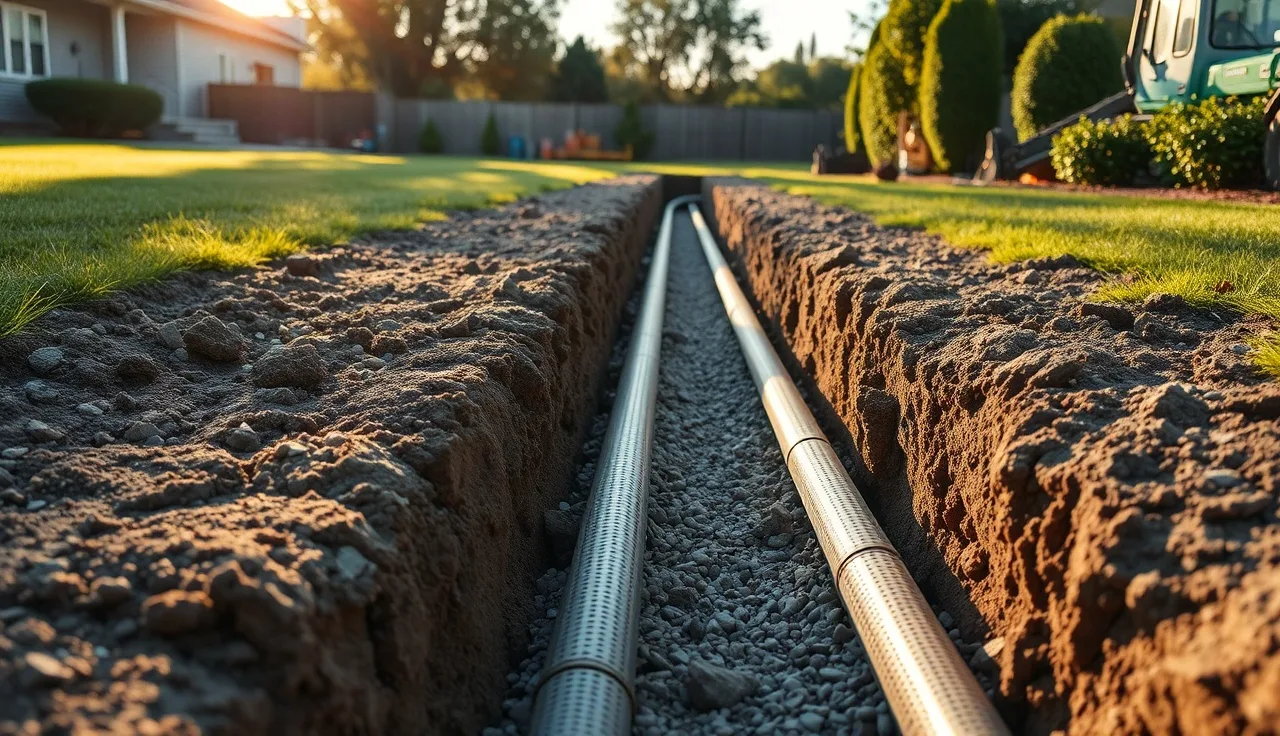
Effluent (the clarified liquid that floats above the sludge layer in your tank) flows by gravity or pump through a distribution system and into a network of perforated pipes buried in gravel-filled trenches. The perforations face down. Wastewater seeps out through those holes, drains through the gravel, and percolates into the native soil where aerobic bacteria and physical filtration remove pathogens and nutrients.
The EPA SepticSmart program describes the drain field as "a shallow, covered excavation made in unsaturated soil" where pretreated wastewater is "discharged through piping onto porous surfaces that allow wastewater to filter through the soil" [1]. That one sentence captures the whole design idea. The pipe exists to spread liquid across a large soil surface, not to carry it away.
Get the distribution wrong and the whole field fails. That's why pipe size, pipe material, slope, hole spacing, and trench width all matter, and why they're spelled out in state onsite wastewater codes.
What types of pipe are used in drain fields?
Three materials dominate. Choosing between them is partly a code question and partly a budget question.
Perforated PVC (SDR-35 or Schedule 40) is the most common pipe installed since the 1980s. It's rigid, resists root intrusion better than corrugated pipe, holds its slope reliably, and lasts 25 to 50 years when installed correctly. Most state codes accept it. SDR-35 is the typical spec for drain field laterals because its wall thickness balances cost and crush resistance. Schedule 40 is thicker and used where soil load runs high.
Corrugated perforated polyethylene (HDPE) is cheaper and flexible, which makes it easier to install in curved or irregular trench layouts. The downside is that corrugated pipe can flatten under heavy soil loads or vehicle traffic, and its ridged profile traps biofilm more readily than smooth-wall pipe. Plenty of systems installed in the 1970s and 1980s used corrugated pipe. That's one reason drain field failures cluster in systems of that age.
Concrete distribution boxes and clay tile were standard before plastic arrived. You'll still find clay tile laterals in homes built before 1960. Clay lasts a long time in stable soil, but the bell-and-spigot joints open up as the ground shifts, letting roots in and letting effluent out in concentrated spots rather than spread evenly.
Beyond the laterals, the system includes inlet and outlet pipes to the distribution box (usually solid 4-inch PVC SDR-35), the distribution box itself (plastic or concrete), and in pressure-dosed systems a force main from the pump chamber to the laterals. That force main is typically solid 1.5-inch or 2-inch PVC.
| Pipe material | Typical cost per foot (material only) | Expected lifespan | Root resistance |
|---|---|---|---|
| PVC SDR-35 perforated | $3 to $8 | 25 to 50 years | Good |
| Corrugated poly (HDPE) | $2 to $5 | 15 to 30 years | Fair |
| Clay tile (legacy) | Not installed new | 30 to 60 years | Poor |
| Concrete pipe (legacy) | Not installed new | 20 to 40 years | Poor |
Those figures are material only. Installed cost in a trench with gravel, filter fabric, and backfill is a different number entirely.
What size pipe does a drain field use?
Four inches is the near-universal standard for lateral lines in residential systems. That's both a hydraulic reality and a regulatory consensus. USDA soil-based design guidance and nearly every state onsite wastewater code specify 4-inch perforated pipe for gravity laterals [2].
The header line that connects the septic tank outlet to the distribution box, and the box to the start of each lateral, is also typically 4-inch solid PVC. Some older gravity systems used 3-inch header pipe, which creates a bottleneck if solids ever get pushed out of the tank.
Pressure distribution systems work differently. The manifold and lateral pipes are often 1.5-inch or 2-inch PVC with small orifices (1/8 to 3/16 inch diameter) drilled at regular intervals. These systems dose the field in controlled pulses instead of relying on gravity, which spreads effluent more evenly and stretches field life [9]. Your state code decides whether a gravity or pressure system is required for a given site.
Lateral length varies by soil percolation rate and household size. A percolation rate of 30 minutes per inch might call for 100 to 150 feet of lateral per bedroom. A slow-perc soil (60 minutes per inch) might need double that. That's how a modest three-bedroom house in clay-heavy soil ends up with 600 to 800 feet of total lateral pipe.
How deep should drain field pipe be buried?
Most state codes require the top of the drain field aggregate (gravel) to sit at least 6 inches below finished grade and no deeper than 36 inches below the surface. The pipe rests on top of the gravel bed, which puts it roughly 18 to 30 inches below grade in most residential installations.
Depth matters for two reasons. Too shallow and the system is exposed to frost heave, vehicle damage, and UV degradation if gravel works its way to the surface. Too deep and the soil column below the pipe can shift from aerobic to anaerobic, which kills the bacteria doing the treatment work.
USDA Natural Resources Conservation Service guidance notes that effective treatment needs 12 to 24 inches of unsaturated soil between the bottom of the trench and the seasonal high water table or bedrock [2]. That requirement is what rules out drain fields in areas with high water tables or shallow soils. There simply isn't enough treatment depth available.
Slope matters as much as depth. Gravity laterals should run at 1/16 to 1/8 inch per foot (roughly 0.5% to 1.0% grade). Less than that and effluent pools in the pipe. More than that and flow races past the perforations instead of seeping out.
Wrong slope is a common error in DIY and low-bid installations. A field that drains too fast to one end shows up as wet spots and odors at the downhill end while the uphill portion stays dry and does no work.
What are the signs that drain field pipe has failed?
Drain field failure almost never happens overnight. It's a slow slide that gives you warning signs if you're paying attention.
The most common signs:
- Slow drains or gurgling throughout the house, especially after heavy rain
- Sewage odors in the yard, near the drain field, or in the basement
- Wet, spongy, or perpetually green grass over the drain field area
- Sewage surfacing on the lawn (the unmistakable gray-black liquid with obvious odor)
- Toilets and drains backing up when the tank was pumped recently and isn't full
- High nitrate readings in a nearby well (test annually, this one is a public health issue)
Not every symptom means the pipe itself failed. Surfacing liquid in isolated spots often means a single lateral has collapsed or crushed. Surfacing across the whole field points to biomat buildup, which is a soil failure rather than a pipe failure. That distinction changes both the repair strategy and the cost by thousands of dollars.
A septic tank inspection with camera scoping of the laterals confirms whether the pipe is intact or compromised. Camera inspection runs $200 to $600 and saves you from guessing.
The EPA lists early warning signs of system failure that include "water and sewage from toilets, drains, and sinks are backing up into the home" and "bright green, spongy lush grass over the septic system" [1]. Catch those early and you're often cleaning or rerouting rather than replacing.
What causes drain field pipe to fail?
The cause determines the fix. A crushed pipe is a mechanical repair. A biomat-clogged field may be an irreversible soil failure.
Physical damage is the clearest case. Vehicles driven over the drain field compact soil and can crush corrugated laterals. Tree roots seeking moisture find pipe joints and perforations and fill the interior. A single large root can block an entire lateral within a few seasons. Frost heave shifts clay-tile joints and cracks older plastic pipe.
Biomat formation is the most common reason otherwise intact pipe stops working. Biomat is a dark, gelatinous layer of anaerobic bacteria and organic material that builds at the soil-gravel interface along the trench bottom and sidewalls. It's a normal part of how the field operates. But if the tank isn't pumped regularly and solids carry over into the field, or if the field gets overloaded with water, biomat grows thick enough to seal the soil pores and stop absorption completely [3].
Overloading speeds up biomat growth. A leaky toilet flapper can add 200 gallons a day to a system designed for 150. Garbage disposals push extra solids into the tank and field. A family that doubled in size since the system was designed strains the hydraulic capacity every single day.
Age and material degradation eventually catch every system. Corrugated poly pipe installed in the 1970s is 50 years old now. The plastic gets brittle, the corrugations flatten, and joints separate. If your system is that age and showing symptoms, the pipe is a fair suspect.
Regular septic tank pumping every 3 to 5 years is the single most effective way to prevent solids carryover and extend drain field pipe life. This isn't marketing. University of Minnesota Extension guidance ties irregular pumping and solids carryover directly to premature drain field failure [3].
Can drain field pipe be repaired, or does the whole field need replacement?
Sometimes repair works. Often replacement is the only honest answer.
If a single lateral has collapsed or been crushed by a root, excavating that one run and replacing 20 to 50 feet of pipe restores function. Spot repair like that costs $500 to $2,500 depending on depth and access. It's worth doing when the rest of the field is healthy and the tank is working well.
If the distribution box has cracked or its outlet baffles have failed, that's a $200 to $800 repair that can fix uneven loading across the laterals.
But if the soil itself is sealed by biomat, new pipe in the same trench fixes nothing. The soil needs to rest so aerobic bacteria can degrade the biomat, or it needs to be replaced, and sometimes the treatment capacity is just gone. Some contractors sell aeration or terralift services that claim to break up biomat and reopen soil pores. The evidence is thin. The closest thing to controlled work is University of Minnesota Extension research suggesting that field resting (diverting flow to a secondary field for 12 to 18 months) can restore some absorption capacity, though results vary a lot [3].
Full replacement means excavating all laterals, removing old gravel and pipe, installing new distribution components, and laying fresh pipe in either the original footprint (if the soil has rested and recovered) or a new location on the property. That's a real construction project, and it requires a permit in every state.
For septic system repair decisions, the honest framing is simple. Get a professional inspection with camera scoping and a perc test of the existing trench soil before you commit to any repair path.
How much does it cost to replace a drain field or its pipe?
This is the question most homeowners actually need answered. The range is wide enough that you should be skeptical of any single number quoted without knowing your specifics.
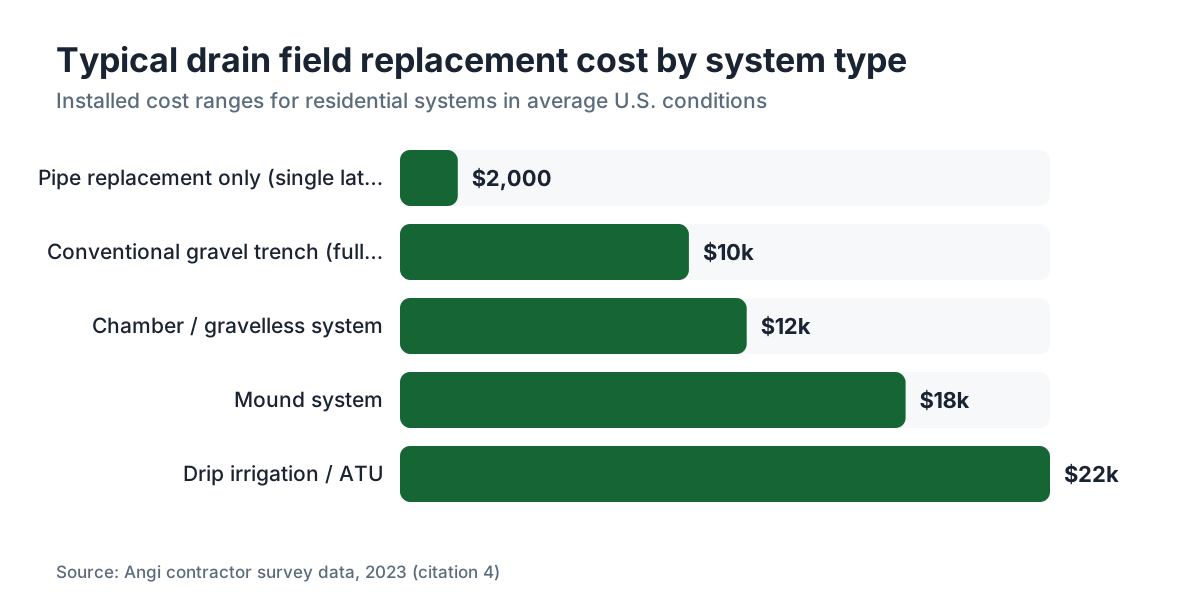
National cost data from contractor surveys and homeowner reporting platforms puts full drain field replacement at $3,000 to $20,000 for a typical residential system [4]. The middle of that range, $8,000 to $12,000, is a reasonable expectation for a three-bedroom home in average soil with normal access.
Here's what pushes the cost up or down:
System size. Bedroom count drives design flow, which drives required lateral footage. A two-bedroom house might need 300 feet of lateral. A four-bedroom house in the same soil might need 600. More footage means more pipe, more gravel, more labor.
Soil conditions. Sandy, well-draining soil means shorter laterals and shallower trenches. Clay or high-water-table sites need longer runs, mound systems, or advanced treatment units that add $5,000 to $15,000 over a conventional field.
Site access. Trenching equipment has to reach the field. A drain field ringed by mature trees, a deck, or a finished landscape costs more to reach and more to restore after excavation.
Permitting and inspection fees. Most states require a permit, a licensed contractor, and at least one inspection. Fees range from $200 to $1,500 depending on the jurisdiction.
Alternative system types. If a conventional trench system can't be built (bad perc, setback conflicts, small lot), you're looking at a mound system ($10,000 to $25,000), a chamber system ($5,000 to $15,000), or an aerobic treatment unit plus drip irrigation ($10,000 to $30,000).
| System type | Typical installed cost | Best for |
|---|---|---|
| Conventional gravel trench (pipe replacement only) | $3,000 to $7,000 | Good soil, adequate lot space |
| Conventional gravel trench (full replacement) | $5,000 to $15,000 | Standard residential sites |
| Chamber/gravelless system | $5,000 to $15,000 | Variable soil, easier install |
| Mound system | $10,000 to $25,000 | High water table, poor perc |
| Drip irrigation / ATU | $15,000 to $30,000 | Difficult sites, small lots |
Get at least three bids. The cost to replace a septic drain field swings hard by region. Contractors in the Northeast and Pacific Coast often quote 30 to 50% higher than Midwest or Southeast contractors for the same work, mostly because of labor rates and permit complexity.
SepticMind's job costing tools help operators track actual drain field replacement costs by system type and region, which is where cleaner benchmarks come from if you're an installer pricing a job.
For related numbers, see cost to install septic system and cost to put in a septic tank.
Does homeowner's insurance or any program help cover drain field replacement cost?
Most standard homeowner's policies exclude septic failures caused by wear, age, or gradual deterioration, which describes almost every drain field failure. Some policies cover sudden, accidental damage, so if a tree falls and physically crushes your field, you might have a claim worth filing. Read the policy language carefully and ask your agent specifically about "underground service line" or "equipment breakdown" riders, which some carriers sell as add-ons.
Some states and counties run low-income or failing-system replacement assistance programs funded partly through EPA money. The EPA's Clean Water State Revolving Fund sends money to states for exactly this kind of water quality work [5]. Whether that money reaches homeowners as direct assistance depends entirely on your state and county. Call your local health department or cooperative extension office and ask what programs exist.
USDA Rural Development's Section 504 program offers loans and grants to low-income rural homeowners for septic repair or replacement, with grants available to applicants over 62 who meet income limits [6]. Plenty of eligible homeowners never learn it exists.
For most middle-income homeowners, drain field replacement is out of pocket. Budget for it the way you'd budget for a roof. It's not an emergency you couldn't see coming, and the timeline (systems last 20 to 30 years on average with proper maintenance) gives you a real planning window.
What permits and codes govern drain field pipe installation?
Every state regulates onsite wastewater systems, and most require a permit for any new installation or full replacement of a drain field. The regulatory home varies. In some states it's the Department of Health, in others the Department of Environmental Quality or an equivalent agency.
The EPA doesn't directly regulate individual septic systems under the Clean Water Act, but it publishes guidance through programs like SepticSmart and funds state programs through the Clean Water State Revolving Fund [5]. The National Onsite Wastewater Recycling Association (NOWRA) publishes model codes that many states have adopted in whole or in part [7].
State codes set minimum setbacks from wells, property lines, surface water, and structures. Common setbacks include 50 to 100 feet from a drinking water well, 10 to 25 feet from property lines, and 25 to 50 feet from streams or lakes [10]. Those setbacks can make replacement on a small or irregular lot genuinely impossible without a variance.
Pipe specifications in state codes typically cover minimum diameter (usually 4 inches for laterals), perforation size and spacing, minimum slope, minimum gravel depth above and below the pipe, and requirements for geotextile filter fabric over the gravel. North Carolina's onsite wastewater rules, for example, specify perforated pipe with holes 3/8 inch to 1/2 inch in diameter spaced no more than 5 feet apart [8].
Always pull the permit. Unpermitted drain field work becomes a legal problem at resale, and it can force costly removal and reinstallation at the homeowner's expense.
How long does drain field pipe last, and when should you plan for replacement?
Honest answer: the range is 15 to 40 years, and nobody has great population-level data on it. The closest authoritative number comes from the EPA, which cites a typical system lifespan of 20 to 30 years, with proper maintenance stretching that considerably [1].
The pipe itself, if it's SDR-35 PVC in undisturbed soil with no root intrusion, can last 50 years or longer. The limiting factor is almost always the soil's absorption capacity, not the pipe material. A field that was never overloaded and was paired with a properly maintained tank can outlast the pipe's nominal lifespan. A field that received raw solids from a tank nobody ever pumped can be destroyed in 5 to 10 years.
System age at purchase is one of the most useful questions to ask before buying a home on septic. A 25-year-old system with no maintenance records is a liability. A septic tank inspection before purchase, with camera scoping of the laterals, runs $300 to $700 and is money well spent.
For maintenance planning: pump the tank on schedule (every 3 to 5 years for a typical household, see how often to pump septic tank), keep heavy vehicles off the field, don't plant trees within 30 feet of the lateral lines, and fix leaky fixtures fast. Those four habits extend drain field life more reliably than any additive or treatment product sold.
SepticMind tracks maintenance intervals and inspection history for operators who service many properties. The pattern in that data matches the research. Systems with documented, regular pumping stay in service much longer.
Can a homeowner replace drain field pipe themselves?
Technically possible. Legally complicated. Practically a bad idea in most cases.
The technical barriers are real. You need to locate existing pipe accurately (without a design map, that means digging blind or renting a pipe locator), hold proper slope with a transit or laser level, size the system correctly for your soil's perc rate, install filter fabric and gravel to spec, and make watertight connections at the distribution box. None of it is rocket science, but all of it takes equipment and knowledge most homeowners don't have.
The legal barrier is usually the deciding one. Most states require a licensed contractor and a permit for drain field installation or replacement. Some states let a homeowner pull a permit for their own primary residence and do the work, but you still need an inspection from the county or state health department. Skipping the permit to dodge scrutiny is a common temptation and a bad bet. Unpermitted work surfaces at sale and can force complete demolition and reinstallation.
If you're in a state that allows homeowner installation, and you have the equipment, the permit, the soil report, and a willing inspector, a DIY replacement on a simple gravity system in good soil is a genuine option. Material cost for pipe, gravel, and distribution components on a three-bedroom system runs $1,500 to $3,500. The labor you'd save is $3,000 to $8,000. That's real money if you know what you're doing.
For most homeowners, the honest advice is short. Get bids, check contractor licenses with your state licensing board, and hire a pro.
Frequently asked questions
What kind of pipe is used in a septic drain field?
Most residential drain fields built after 1980 use 4-inch perforated PVC SDR-35 pipe laid in gravel-filled trenches. Older systems may have corrugated polyethylene (HDPE) or clay tile laterals. PVC is preferred for new installations because it holds its shape, resists root intrusion better than corrugated pipe, and keeps consistent slope over decades.
How much does it cost to replace a septic drain field?
Full drain field replacement typically costs $3,000 to $20,000 for a residential system, with most three-bedroom homes falling in the $8,000 to $12,000 range. Mound systems, drip irrigation, and aerobic treatment units push costs to $15,000 to $30,000 on difficult sites. Site access, soil type, system size, and local labor rates drive the final number. Get at least three bids from licensed contractors.
How long do drain field pipes last?
PVC laterals can last 25 to 50 years in stable soil without root intrusion. Corrugated poly pipe typically lasts 15 to 30 years. The limiting factor is usually soil absorption capacity, not the pipe itself. A field that received raw solids from an unmaintained tank can fail in under 10 years, while a well-maintained system paired with regular tank pumping can exceed 40 years of service.
What depth should drain field pipe be installed at?
Gravity lateral pipe typically sits 18 to 30 inches below grade, with state codes requiring the gravel bed top to be at least 6 inches below finished grade and no deeper than 36 inches. There must be 12 to 24 inches of unsaturated native soil below the trench bottom to the seasonal high water table or bedrock for effective treatment.
Can you repair drain field pipe without replacing the whole field?
Yes, if the damage is localized. A single collapsed or root-blocked lateral can often be excavated and replaced for $500 to $2,500. A failed distribution box costs $200 to $800 to repair. But if the soil itself is sealed by biomat or saturated throughout the field, pipe repair won't help. A camera inspection of the laterals tells you which problem you're actually dealing with before you spend money on the wrong fix.
What is the slope requirement for drain field pipe?
Gravity drain field laterals should run at 1/16 to 1/8 inch per foot of fall, equal to roughly 0.5% to 1.0% grade. Too little slope causes ponding inside the pipe. Too much and effluent flows past the perforations instead of seeping out evenly. Incorrect slope is one of the more common installation errors and shows up as wet spots at the downhill end of the field.
What are the signs that drain field pipe has failed or is failing?
Watch for slow drains throughout the house, gurgling plumbing, sewage odors in the yard, wet or spongy grass over the field, or sewage surfacing on the lawn. Backups that happen even after the tank was recently pumped point specifically to the drain field rather than the tank. Early symptoms caught quickly often mean cleaning or limited repair instead of full replacement.
Does homeowner's insurance cover drain field replacement?
Standard homeowner's policies almost always exclude gradual deterioration and wear, which describes most drain field failures. Some policies cover sudden, accidental physical damage. Ask your insurer about underground service line or equipment breakdown riders. USDA Section 504 grants and loans are available for low-income rural homeowners. State revolving fund programs sometimes provide assistance through local health departments.
Can tree roots damage drain field pipe?
Yes, and it's a common cause of lateral failure. Roots from trees and large shrubs seek moisture and find pipe perforations and joints. Once inside, they fill the pipe and block flow within a few seasons. Keep all trees at least 30 feet from lateral lines. Willows, poplars, and silver maples are especially aggressive and should be planted even farther away. Camera scoping confirms root presence before you excavate.
How do I find out where my drain field pipes are located?
Start with your property records and as-built septic design drawings, often filed with the county health department. If those aren't available, a septic inspector can probe the soil or use a pipe locator tool. Some states require as-built drawings be filed at installation and kept with the property record. Knowing the location before any landscaping, construction, or vehicle use protects the system.
What is the difference between a drain field and a leach field?
No functional difference. Both terms refer to the same component: the network of perforated pipes and surrounding aggregate that distributes and treats septic effluent in the soil. "Drain field" and "leach field" are used interchangeably across regions and state codes. Some older texts also use "absorption field" or "disposal field" for the same thing. See our full guide on the leach field for more detail.
How many feet of pipe does a drain field need?
It depends on the soil's perc rate and household size. A rule of thumb for moderate-perc soil (30 minutes per inch) is 100 to 150 feet of lateral per bedroom. A three-bedroom home might need 300 to 450 feet of total lateral. Slow-perc clay soil can double that. Your state code and a site-specific perc test set the actual design, not rules of thumb.
Is a permit required to replace drain field pipe?
In nearly every state, yes. Permits are required for new installation and for full replacement. Some states allow partial repairs without a permit, but full trenching and pipe replacement always needs approval from the county health department or state environmental agency. Skipping the permit creates legal exposure at resale and can force expensive demolition and reinstallation at the homeowner's cost.
How often should a septic tank be pumped to protect the drain field?
Every 3 to 5 years for a typical household of 3 to 4 people, or per the schedule from your last inspection. Skipping pumping lets solids build above the outlet baffle and carry over into the drain field, speeding up biomat formation and clogging. Regular pumping is the most cost-effective way to extend drain field pipe life and avoid the $8,000 to $20,000 cost of replacement.
Sources
- U.S. EPA, SepticSmart: How Your Septic System Works: The EPA describes the drain field as a shallow covered excavation in unsaturated soil where pretreated wastewater is discharged through piping onto porous surfaces that allow filtration through the soil; also cites typical system lifespan of 20-30 years and lists early warning signs of failure.
- University of Minnesota Extension, Septic System Owner's Guide: University of Minnesota Extension guidance ties irregular pumping and solids carryover to premature drain field failure, discusses biomat formation, and describes field resting as a partial restoration strategy with variable results.
- Angi, Septic System Replacement Cost Guide: National contractor survey data places full residential drain field replacement in the $3,000-$20,000 range, with the average three-bedroom installation running $8,000-$12,000.
- U.S. EPA, Clean Water State Revolving Fund: The EPA's Clean Water State Revolving Fund provides money to states for water quality projects including septic system replacement assistance programs for homeowners.
- USDA Rural Development, Section 504 Home Repair Program: USDA Rural Development's Section 504 program offers loans and grants to low-income rural homeowners for septic system repair and replacement, with grants available for applicants over age 62 who meet income limits.
- National Onsite Wastewater Recycling Association (NOWRA): NOWRA publishes model codes for onsite wastewater systems that many states have adopted, governing pipe specifications, setbacks, and installation standards.
- North Carolina Department of Health and Human Services, Onsite Wastewater Rules (15A NCAC 18A .1900): North Carolina onsite wastewater rules specify that perforated pipe must have holes of 3/8-inch to 1/2-inch diameter spaced no more than 5 feet apart for drain field laterals.
- U.S. EPA, Onsite Wastewater Treatment Systems guidance: EPA guidance on decentralized systems describes pressure-dosed distribution using 1.5-2 inch manifold pipe with orifices as an effective alternative to gravity systems for improved effluent distribution.
- Virginia Department of Health, Sewage Handling and Disposal Regulations: State onsite wastewater code example specifying minimum setbacks of 50-100 feet from drinking water wells and 25-50 feet from streams for drain field installation.
Last updated 2026-07-09