Commercial aerobic septic systems: how they work, what they cost, and how to keep them running
By the SepticMind Editorial Team
TL;DR
- Commercial aerobic septic systems force air into the treatment chamber so oxygen-loving bacteria break down waste faster and cleaner than a conventional tank.
- They fit restaurants, campgrounds, office parks, and sites too large or too soil-limited for a standard system.
- Installed cost usually runs $15,000 to $100,000 or more depending on daily flow, discharge standards, and soil.
- A state-mandated maintenance contract is almost always required.
What is a commercial aerobic septic system and how does it work?
A conventional septic tank is anaerobic. Bacteria break down waste without oxygen, which works fine for a single-family home but struggles when daily flows climb, nutrient limits tighten, or shallow bedrock leaves almost no room for a drain field. An aerobic treatment unit, usually called an ATU, fixes those problems by injecting air into the treatment chamber so oxygen-loving bacteria eat waste far faster and more completely than their anaerobic cousins.
The treatment sequence in a commercial ATU typically has four stages. Wastewater enters a trash or pre-treatment tank first, where solids settle and floating grease gets trapped. From there, effluent moves into the aeration chamber, where a compressor or blower forces air through diffusers or a spray manifold, keeping dissolved oxygen high enough for aerobic digestion. The third stage is a clarifier or settling zone: treated effluent slows down, residual solids drop to the bottom (and cycle back to the aeration chamber), and the clarified liquid rises to the top. Last, the effluent passes through a disinfection stage, usually UV or chlorine tablets, before it discharges to a drain field, drip irrigation system, or sometimes a surface spray area, depending on state permit terms. [1]
The result is effluent with biochemical oxygen demand (BOD) and total suspended solids (TSS) far lower than conventional septic output. EPA guidance on onsite systems notes that advanced treatment systems including ATUs can reduce BOD to under 10 mg/L compared to 150 to 300 mg/L from a standard septic tank. [1] That cleaner effluent is why regulators allow smaller drain fields, tighter lot setbacks, or even surface disposal in some states where you simply couldn't get a permit for a conventional system.
Who actually needs a commercial aerobic system, and when is a conventional system good enough?
The word "commercial" on an ATU label doesn't always mean it belongs at a business. States define "commercial" in their onsite wastewater codes, and the threshold varies. In Texas, any system serving a property other than a single-family home falls under commercial rules from the Texas Commission on Environmental Quality (TCEQ). [2] In other states the cutoff is daily flow: anything above 1,500 or 2,000 gallons per day (GPD) triggers commercial permitting.
The sites that most often end up with a commercial ATU fall into a few groups. Restaurants, food truck parks, and event venues produce high-strength waste with elevated grease and BOD. Campgrounds and RV parks handle large peak flows from many users at once. Office parks, small apartment complexes, churches, and schools generate flows too high for a residential tank but not enough to justify connecting to a municipal sewer. Rural healthcare clinics and food processing facilities may also need the tighter treatment standards an ATU provides to meet state nutrient limits.
On a standard residential lot with good soil percolation and a household-scale flow, a conventional system is almost always cheaper and simpler. A septic tank installation for a typical home runs $3,000 to $10,000, versus $15,000 to $100,000-plus for a commercial ATU. The aerobic premium is justified by flow volume, lot constraints, or regulatory requirements, not by brand preference or novelty.
One thing worth saying plainly: some homeowners get sold residential aerobic systems when a conventional system would work just fine. That happens. If a contractor is pushing an aerobic unit for a 3-bedroom house on good sandy loam, get a second opinion from your county health department before signing anything.
What does a commercial aerobic septic system cost to install?
Installed cost has a wide range because system size is almost entirely dictated by peak daily flow, and the dispersal method (drip field, leach field, spray irrigation) can swing costs hard.
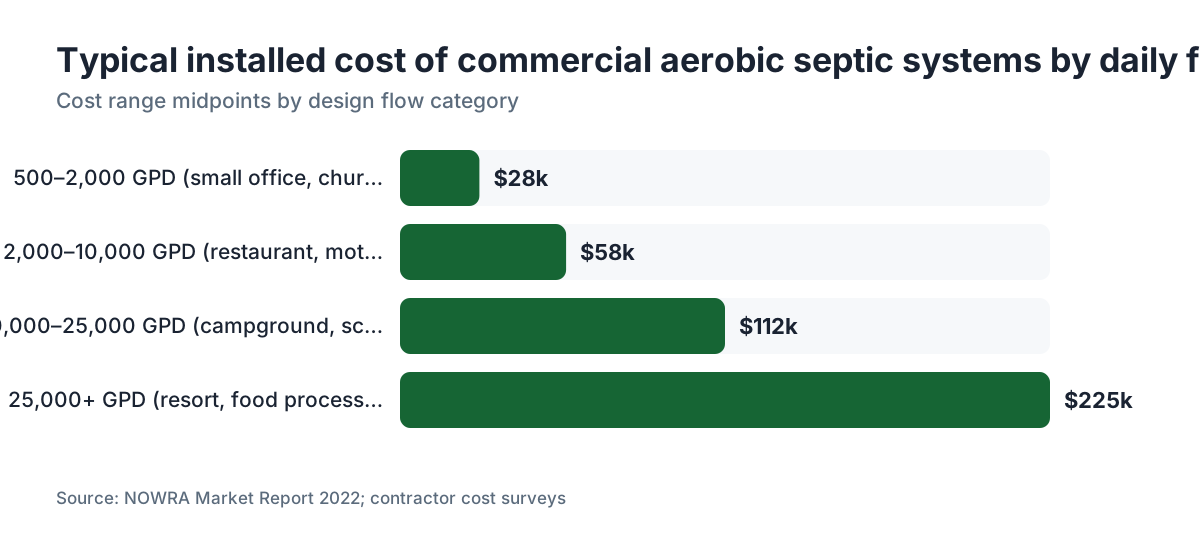
For small commercial sites in the 500 to 2,000 GPD range, a packaged ATU with a drip field or small leach field typically costs $15,000 to $40,000 installed. Mid-size sites running 2,000 to 10,000 GPD, think a small restaurant or a 20-unit motel, commonly run $40,000 to $75,000. High-flow sites above 10,000 GPD can push $100,000 to $300,000 or more once you factor in multiple units, engineered dispersal systems, monitoring hardware, and permitting fees. [3]
| Flow range (GPD) | Typical installed cost | Common site type |
|---|---|---|
| 500 to 2,000 | $15,000 to $40,000 | Small office, church, retail |
| 2,000 to 10,000 | $40,000 to $75,000 | Restaurant, small motel |
| 10,000 to 25,000 | $75,000 to $150,000 | Campground, school, clinic |
| 25,000+ | $150,000 to $300,000+ | Food processing, resort |
Those numbers come from contractor data and state sizing guides; they shift with regional labor rates and material costs. Soil conditions matter enormously. Rocky or clay-heavy sites need more engineered dispersal, which adds cost. Permitting and engineering fees run $2,000 to $15,000 depending on state complexity, and they're often quoted separately, which surprises owners who only asked for the equipment price.
Against conventional septic tank installation costs, a standard gravity-fed system is almost always the cheaper path when the site qualifies for one. The aerobic premium buys you regulatory approval on sites where conventional systems aren't allowed, plus cleaner effluent.
One number worth anchoring: the National Onsite Wastewater Recycling Association (NOWRA) reported in its 2022 market data that the average installed cost of an ATU at small commercial sites was roughly $32,000, though methodology differences between states make that a rough benchmark, not a firm quote. [3]
What are the ongoing maintenance costs and requirements for commercial ATUs?
This is where owners get surprised most often. The equipment cost is one-time. The maintenance cost never stops.
Every state that permits commercial ATUs requires an ongoing maintenance contract with a licensed service provider, usually quarterly or semi-annual visits. Those contracts typically run $400 to $1,200 per year for small systems and $1,500 to $5,000 per year for larger or more complex units. [4] The technician checks air pressure, dissolved oxygen levels, blower function, clarifier sludge depth, disinfection supply (chlorine tablets or UV lamp hours), and effluent quality. They submit reports to the state regulatory agency, often quarterly.
Beyond the service contract, you have consumable costs. Chlorine tablets run roughly $50 to $150 per year for small systems. UV bulbs cost $100 to $400 each and need replacement every 12 to 24 months depending on manufacturer specs. Blower and compressor maintenance adds another $100 to $300 annually. Blowers are the most common failure point in ATUs; a replacement blower typically costs $300 to $800 plus labor.
Sludge pumping is still required even in aerobic systems. The pre-treatment tank (and often the clarifier) accumulate biosolids that have to be pumped and disposed of properly. Most commercial ATUs need septic tank pumping every 1 to 3 years depending on loading; high-strength waste from food service sites may require annual pumping.
The EPA SepticSmart program, which publishes guidance for homeowners and operators, states that "aerobic treatment systems require more frequent inspections than conventional systems." [1] That's an understatement for commercial sites. The record-keeping burden alone, with monthly or quarterly effluent testing submitted to the state, takes real staff time.
Operators tracking service schedules, permit deadlines, and effluent test submissions across multiple sites often use software built for this workflow. SepticMind, for instance, is designed for septic service companies managing commercial maintenance contracts, with scheduling, reporting, and permit tracking in one place.
How do state regulations and permits work for commercial aerobic systems?
There is no single federal permit for a commercial ATU. The EPA sets treatment goals and provides technical guidance through programs like SepticSmart and its onsite wastewater technology fact sheets, but the actual permitting authority sits with each state's environmental or health agency. [1] Some states delegate permitting to county health departments. This fragmentation is genuinely inconvenient: what's allowed in rural Texas is not the same as what's allowed in North Carolina or Washington state.
Most states require at minimum a site evaluation by a licensed engineer or soil scientist, a design stamped by a licensed engineer, a permit application with fee, construction inspection, and a startup inspection before the system goes into service. After startup, the operator must hold a valid maintenance contract and submit effluent quality reports on a state-specified schedule. Many states publish approved ATU model lists; you can only install units on that list. [2]
Texas is one of the more detailed states to use as an example. TCEQ regulates commercial onsite systems under 30 TAC Chapter 285, which specifies treatment standards (30 mg/L BOD and TSS for standard drip dispersal, 10 mg/L for sites with tighter limits), approved unit lists, maintenance company licensing, and quarterly reporting requirements. [2] Other states follow similar frameworks with different numerical thresholds.
Surface spray disposal, where treated effluent is sprayed onto a managed area, is permitted in some southern states but prohibited in most northern ones. Subsurface drip irrigation is increasingly popular because it uses small-diameter tubing at shallow depths, which works in soils that would fail a traditional perc test for a leach field. Your leach field options are shaped directly by state rules and soil conditions, and an aerobic system doesn't automatically give you a free pass on dispersal. The dispersal field still has to be designed and permitted.
Starting a new commercial project? Budget 60 to 180 days for permitting. Complex sites, sensitive watersheds, or states with backlogged review queues can push that past a year.
What are the most common commercial ATU failures, and how do you prevent them?
The blower or compressor failing is the single most common problem. Without air injection, the aerobic bacteria die back within 24 to 48 hours, and the system reverts to anaerobic conditions. Effluent quality drops fast. A backup blower alarm, which most commercial units include, should be wired to an audible alert and ideally a remote monitoring connection so the operator knows immediately.
Clarifier problems are the second most frequent issue. If sludge isn't pumped often enough, solids carry over into the disinfection stage and out into the dispersal field. That clogs drip lines and ruins leach field soils. The fix is sticking to the pumping schedule, which is why septic tank pump out frequency matters so much in commercial ATUs.
Disinfection failures show up in effluent testing. An empty chlorine tablet canister or a burned-out UV lamp means the system is releasing undertreated effluent. State regulators take this seriously: fines for permit violations at commercial sites can run hundreds of dollars per day. Most operators check disinfection supplies at every service visit.
Grease loading is a chronic problem at food service sites. Grease traps upstream of the ATU are required and have to be maintained separately from the septic system. Grease that reaches the pre-treatment tank accelerates sludge buildup and can coat aeration diffusers, cutting oxygen transfer. The cleanest food service operations pump their grease traps on a set schedule, often monthly, rather than waiting for backup signs.
Drain field or drip system clogging is often the end-of-life failure mode. Even with well-treated effluent, biofilm builds up in drip emitters and soil pores over years of operation. Drip lines can often be flushed and restored. A failed leach field is a more expensive septic system repair that may mean full replacement.
How is a commercial aerobic system sized for a specific business or facility?
Sizing starts with calculating design daily flow. Every state has a table of estimated wastewater generation by facility type, expressed in gallons per day per unit of capacity. For a restaurant, the unit is typically seat count: Texas TCEQ uses 10 GPD per seat for food service. [2] A 100-seat restaurant generates an estimated 1,000 GPD of design flow, which sets the minimum treatment capacity of the ATU.
Other facility types use different units. Schools are sized per student (typically 10 to 15 GPD per student for a school without showers). RV parks are sized per hookup (roughly 50 to 100 GPD per site). Office buildings use square footage or employee count. The state-specific table is always the controlling document; a design engineer uses those figures plus a peaking factor to select equipment.
The ATU itself must be rated at or above the design daily flow. Manufacturers publish NSF/ANSI Standard 40 (for residential-scale units) or NSF/ANSI Standard 245 performance data for larger commercial systems; specifying a unit with NSF certification gives you some confidence the equipment actually performs to stated treatment levels. [5]
Dispersal sizing depends on local soil loading rates from perc testing or soil texture analysis. Sandy soils accept higher loading rates (0.5 to 1.0 GPD per square foot), while clay soils may allow only 0.1 to 0.2 GPD per square foot. For a 1,000 GPD restaurant on average soil with a 0.3 GPD/sq ft loading rate, you need roughly 3,300 square feet of leach field, and that has to fit within setbacks from wells, property lines, buildings, and waterways.
Can you do any of this yourself, or does a commercial aerobic system require licensed contractors?
The short answer: almost nothing on a commercial ATU is a legitimate DIY job. This is not the same situation as a homeowner doing basic maintenance on their residential system.
For residential systems, there's a reasonable DIY role. Homeowners can add chlorine tablets, check the blower alarm, and keep the area around the unit clear. Some states let homeowners perform their own residential ATU maintenance if they take a short course. Commercial systems are a different regulatory category entirely. The design must be stamped by a licensed engineer. Installation requires a licensed contractor. Ongoing maintenance must be performed by a state-licensed service provider who submits signed reports to the regulatory agency. There is no DIY path through those requirements.
What operators and facility managers can do themselves is monitor alarm panels, keep records of chlorine tablet additions between service visits, report unusual odors or surfacing effluent to their service provider immediately, and track permit deadlines. Those habits catch problems early and keep you out of regulatory trouble.
For homeowners on residential aerobic systems who want to know what they can reasonably do without a service contract, the line is checking and replacing chlorine tablets, resetting tripped blower alarms (after finding the cause), and basic visual inspection. Anything involving the blower motor, air diffusers, or effluent testing samples should go through a licensed technician, because in most states those actions are tied to the permitted maintenance record.
How do commercial aerobic systems compare to alternative commercial wastewater treatment options?
The realistic alternatives to a commercial ATU depend on your flow volume and location.
For sites within reach of a municipal sewer, connecting is usually the simplest long-term path. Connection costs $3,000 to $15,000 or more in lateral and tap fees, plus monthly sewer charges, but it eliminates on-site maintenance and regulatory burden. For a restaurant in a dense area, this is almost always the right call if service is available.
For sites too remote for sewer, the main alternatives to an ATU are a mound system, a standard gravity septic with a larger leach field, or a constructed wetland. Mound systems work on sites with shallow restrictive layers and are cheaper than ATUs ($15,000 to $30,000 for small commercial sizes) but need good available land area. Standard gravity systems are the cheapest option but require suitable soil and often can't meet the treatment standards commercial-scale flows demand. Constructed wetlands are relatively rare in commercial applications outside specialty environmental projects.
For very high flow sites (above 25,000 GPD), packaged treatment plants using activated sludge, extended aeration, or sequencing batch reactor (SBR) technology become competitive. These are essentially scaled-down municipal treatment plants and cost $100,000 to $500,000+, but they can meet very tight effluent standards including nutrient removal.
A septic tank inspection from a licensed engineer early in the planning process is the most valuable investment a commercial site owner can make before committing to any treatment path. The engineer evaluates soil, flow, and regulatory requirements together and tells you which options are actually available on your specific site.
What should you look for when hiring a commercial aerobic septic contractor or maintenance company?
Licensing is the non-negotiable starting point. Every state licenses septic system installers and maintenance companies separately. Ask for the contractor's current license number and verify it with your state agency before signing anything. Some states maintain online lookup tools; your state environmental agency's website should have one.
For installation, ask whether the contractor has specific experience with the ATU brand you're specifying. ATUs from different manufacturers (Orenco, Norweco, Infiltrator, Consolidated Treatment Systems, among others) have different service requirements and parts availability. A contractor who has installed dozens of a given model calibrates startup settings better than one working from a manual for the first time.
For maintenance contracts, compare what's actually included. A basic contract might cover quarterly visits and report submission. A full-service contract should also include blower inspection and lubrication, dissolved oxygen testing, sludge depth measurement, and disinfection supply replacement. Get specifics in writing, more than "full service."
Response time for alarms matters enormously. A commercial ATU alarm at a restaurant on a Friday night needs a technician, not a Monday morning callback. Ask prospective contractors what their guaranteed alarm response time is and get it in the contract.
Service companies managing multiple commercial ATU contracts use maintenance scheduling and reporting software to stay on top of permit deadlines and effluent test submissions. SepticMind offers this kind of workflow management for operators running commercial maintenance programs, which is worth asking a prospective service company about.
Check references from other commercial clients in your industry. A maintenance company that's great with rural homeowners may not understand the grease loading patterns at a food service site or the flow variability of a seasonal campground.
How often does a commercial aerobic system need to be pumped and serviced?
Pumping frequency for the pre-treatment tank at a commercial ATU depends mostly on loading. For most small commercial sites (under 2,000 GPD), annual pumping is a safe starting point. High-strength waste from kitchens or food processing can push that to every 6 months. Large sites may need quarterly pumping of the pre-treatment compartment.
The clarifier or secondary settling chamber is often pumped on the same schedule but may go longer if sludge accumulation is slow. Your service technician measures sludge depth at each visit; when depth reaches roughly one-third of the chamber volume, it's time to pump. Don't defer this. Carryover solids from an overfull clarifier are the fastest way to destroy a drip field.
For more detail on timing and what drives the schedule, the guidance in how often to pump septic tank applies to the principles even if the commercial context adds complexity.
Beyond pumping, routine service visits on a commercial ATU should happen at minimum quarterly, and many state permits require that frequency. Each visit should document blower performance (amperage draw is a practical proxy for blower health), dissolved oxygen in the aeration chamber (target is typically 1 to 3 mg/L), chlorine residual or UV intensity in the disinfection stage, and a visual inspection of the dispersal system for surfacing effluent or ponding.
Keep a service logbook on-site, separate from the electronic records submitted to the state. When something goes wrong, being able to show an inspector 3 years of signed maintenance records demonstrating good-faith compliance is the difference between a warning and a fine.
Frequently asked questions
What daily flow triggers the need for a commercial aerobic septic system instead of a conventional one?
The threshold varies by state but commonly falls around 1,500 to 2,000 gallons per day, or whenever a site is non-residential. Texas TCEQ requires commercial ATU permitting for any non-single-family application regardless of flow. Some states trigger commercial rules at 600 GPD. Check your state's onsite wastewater code or consult a licensed engineer before assuming a conventional system qualifies.
How long does a commercial aerobic treatment unit last?
The concrete or fiberglass tank structure typically lasts 20 to 40 years. Mechanical components have shorter service lives: blowers generally last 5 to 10 years with proper maintenance, and UV lamps need annual or biennial replacement. The dispersal field is usually the long-term limiting factor; a drip field or leach field on a well-maintained commercial ATU can last 20 to 30 years before rehabilitation is needed.
Do commercial aerobic systems smell more than conventional septic systems?
A properly working commercial ATU should produce less odor than a conventional system because aerobic digestion generates far less hydrogen sulfide than anaerobic breakdown. Odor complaints almost always point to a mechanical problem: a failed blower reverting the system to anaerobic conditions, a full pre-treatment tank, or a disinfection failure. If a system consistently smells, that's a diagnostic signal, not a feature of aerobic treatment.
Can a commercial aerobic septic system discharge directly to surface water?
Almost never without a separate NPDES permit from the EPA or state agency. Surface discharge of treated effluent from an onsite system typically requires a National Pollutant Discharge Elimination System permit, a separate and more demanding process than an onsite wastewater permit. Some states allow spray disposal to managed land surfaces with strict setbacks, but direct discharge to streams or lakes is prohibited in nearly all circumstances without an NPDES permit.
What effluent quality standards does a commercial ATU have to meet?
Standards vary by state and dispersal method. A common benchmark for drip-field dispersal is 30 mg/L BOD and 30 mg/L TSS before disinfection (called secondary treatment). Sites near sensitive waters may face tertiary standards of 10 mg/L BOD and TSS, plus nutrient limits on nitrogen or phosphorus. The ATU equipment must be certified to meet the applicable standard, and effluent testing proves ongoing compliance.
What is NSF/ANSI Standard 40 and does it apply to commercial systems?
NSF/ANSI Standard 40 is a third-party performance certification for residential-scale aerobic treatment units, covering systems up to about 1,500 GPD. Commercial-scale units are evaluated under NSF/ANSI Standard 245, which covers nitrogen reduction performance, or under state-specific approval processes. Both NSF certifications require the unit to demonstrate actual treatment performance in independent testing, more than design intent.
Are there federal grants or financing options available for commercial aerobic septic installation?
USDA Rural Development offers Water and Waste Disposal loans and grants for rural businesses and communities, and these can include onsite wastewater systems through Section 306C and similar programs. EPA's Clean Water State Revolving Fund can fund wastewater infrastructure at the state level. Some states also run specific onsite system loan programs. Eligibility depends on community size, income thresholds, and project scope; check USDA Rural Development's website and your state environmental agency.
Can I convert an existing conventional commercial septic system to an aerobic system?
Sometimes, but it depends on tank condition, available space, and whether the existing dispersal field can handle the flows from an upgraded system. In many cases, adding an ATU after an existing pre-treatment tank is feasible if the tank volume is adequate. A licensed engineer needs to evaluate the existing infrastructure before any retrofit. The permit process for a conversion is essentially the same as for new installation in most states.
What happens if a commercial aerobic system fails a routine effluent test?
A failed effluent test triggers a notification requirement to the state regulatory agency, usually within 24 to 72 hours depending on state rules. The licensed maintenance company must investigate the cause, make repairs, and retest. Repeat failures can result in fines, mandatory system upgrades, or operating permit suspension. This is why catching blower failures, disinfection gaps, or clarifier problems during routine service visits matters so much.
How does a commercial aerobic system handle seasonal or highly variable flow from businesses like campgrounds?
Variable flow is one of the harder design challenges. ATUs sized for peak season flow sit under-loaded in the off-season, which can actually harm performance because the aerobic bacteria population declines without consistent organic loading. Good designs for seasonal facilities include provisions for system hibernation or reduced-mode operation in the off-season, and some manufacturers offer automatic flow-pacing blower controls. Your design engineer should explicitly address flow variability in the sizing calculations.
What's the difference between a packaged ATU and a field-built aerobic system for commercial use?
A packaged ATU is a factory-built unit, typically fiberglass or polyethylene, shipped to the site and installed as a complete assembly. They're NSF-certified, faster to install, and easier to permit in states with approved-product lists. Field-built or engineered systems are designed and constructed on-site using concrete tanks and specified components; they allow more customization for unusual site conditions or very high flows but require more engineering documentation and inspector oversight.
Does a restaurant with a grease trap still need a commercial aerobic system?
The grease trap (or grease interceptor) and the septic/ATU system are separate pieces of infrastructure that work in sequence. The grease trap removes fats, oils, and grease before wastewater reaches the treatment system. A restaurant can have both: a required grease trap plus a commercial ATU for the downstream treatment. The ATU still handles the remaining BOD and solids load. Having a grease trap does not eliminate the need for an appropriately sized treatment system.
What records does a commercial aerobic septic operator have to keep?
Most state permits require the maintenance company to keep signed service reports for every visit, effluent test results (typically quarterly or semi-annual), pumping receipts with disposal records, alarm event logs, and equipment repair records. Many states require these records to be retained for 3 to 5 years and available for inspection on demand. The facility owner should keep independent copies, because if the company goes out of business, you're responsible for producing those records.
Sources
- U.S. EPA, Septic Systems Overview and SepticSmart Program: EPA guidance that advanced treatment systems including ATUs can reduce BOD dramatically compared to conventional septic tanks, and that aerobic treatment systems require more frequent inspections.
- Texas Commission on Environmental Quality (TCEQ), 30 TAC Chapter 285, On-Site Sewage Facilities: Texas commercial ATU permitting requirements including 30 mg/L BOD/TSS treatment standards for drip dispersal, approved unit lists, and flow estimation tables (10 GPD per restaurant seat).
- National Onsite Wastewater Recycling Association (NOWRA), Market Report 2022: Average installed cost of ATUs at small commercial sites approximately $32,000 per NOWRA 2022 market data; installed cost ranges for commercial ATUs by flow volume.
- U.S. EPA, Septic Systems Program (onsite wastewater technology guidance): Maintenance contract requirements for commercial ATUs and typical service visit components including effluent quality testing and blower inspection.
- NSF International, Wastewater Treatment Standards (NSF/ANSI Standard 40 and Standard 245): NSF/ANSI Standard 40 covers residential-scale ATUs up to roughly 1,500 GPD; NSF/ANSI Standard 245 covers nitrogen reduction performance for commercial-scale aerobic systems.
- USDA Rural Development, Water and Environmental Programs: USDA Rural Development Section 306C and related programs fund rural wastewater infrastructure including onsite systems for eligible communities and businesses.
- U.S. EPA, National Pollutant Discharge Elimination System (NPDES) Overview: Surface discharge of treated effluent from onsite systems to surface waters requires an NPDES permit, a separate and more demanding regulatory process.
- University of Minnesota Extension: Technical background on ATU treatment stages, clarifier function, blower maintenance, and typical service lifespans for mechanical components.
- North Carolina Department of Environmental Quality: State-level permitting framework, approved ATU product lists, and record-keeping requirements as an example of state regulatory structure for commercial ATUs.
- U.S. EPA, Clean Water State Revolving Fund: EPA Clean Water State Revolving Fund can finance wastewater infrastructure including onsite commercial treatment systems at the state level.
Last updated 2026-07-09