Septic vs sewer pros and cons: the honest comparison
By the SepticMind Editorial Team
TL;DR
- Septic costs $3,000 to $15,000 to install with no monthly bill, but needs pumping every 3 to 5 years at $300 to $600.
- Sewer costs $1,500 to $20,000 to tap in and runs $30 to $100 a month forever.
- Septic wins on recurring cost.
- Sewer wins on being hands-off.
- Neither is better everywhere.
- Your lot, location, and household size decide it.
What is the core difference between septic and sewer?
Septic is private and on-site. Sewer is shared and off-site. That single distinction drives almost every cost and headache that follows.
A septic system is a wastewater treatment setup buried on your own property. Wastewater flows from the house into a tank, solids settle out, and the liquid effluent drains into a leach field where the soil finishes the job. You own every piece of it, and you're the one who fixes it.
A municipal sewer moves your wastewater through underground pipes to a publicly owned treatment plant that processes it at scale. You pay the city or a utility district for that service, usually on a monthly or quarterly bill.
About 21% of U.S. homes rely on septic or another individual onsite system, according to the EPA [1]. In rural and low-density suburbs that share climbs a lot higher. Connecticut's Department of Energy and Environmental Protection estimates roughly one-third of homes in the state use onsite systems [2]. What each system does day to day matters far more than any abstract ranking of which is "better."
How do upfront costs compare for septic vs sewer?
Neither one is cheap, and the ranges are wide because soil, lot size, distance to the main, and local fee schedules all move the number hard.
A conventional gravity septic system runs roughly $3,000 to $10,000 for a straightforward install on a well-draining lot [3]. Fail a perc test and need an alternative system (mound, drip irrigation, aerobic treatment unit) and you're looking at $15,000 to $25,000 or more. The full breakdown is in our guide to the cost to install a septic system.
Sewer isn't free either. Tap-in fees, connection permits, and the lateral pipe run from your house to the street main usually total $1,500 to $20,000 depending on distance and local fees [4]. Some towns waive or finance those charges. Others pile on capacity fees that run several thousand dollars by themselves.
Buy an existing home already on sewer and that capital cost is baked into the price. Build on a raw lot and you may not get a choice: plenty of counties require a sewer hookup if you're within a set distance of an existing main.
| Scenario | Typical cost range |
|---|---|
| New conventional septic install | $3,000 to $10,000 |
| New alternative septic system (mound, ATU) | $10,000 to $25,000+ |
| Sewer tap-in fee + lateral (existing main nearby) | $1,500 to $8,000 |
| Sewer main extension (no main nearby) | $10,000 to $30,000+ |
| Septic-to-sewer conversion (existing home) | $5,000 to $20,000 |
What are the ongoing costs of septic vs sewer?
Sewer costs you every single month for as long as you own the house. Septic costs you nothing until pump day. That's the whole story in one sentence, and the rest is detail.
Monthly sewer bills across the U.S. average about $50 to $90 depending on usage and the utility, with some urban systems higher [4]. That's $600 to $1,080 a year, every year, forever. You don't think about it. You just pay it.
Septic has no monthly bill. Your recurring cost is pumping every 3 to 5 years, the interval the EPA recommends for most households [1], at $300 to $600 in most markets. A septic tank pump out is the most important maintenance task there is. Skip it and you risk a $5,000 to $30,000 drain field failure. Do it on schedule and many systems run 25 to 40 years without a major bill.
The catch: septic repairs are entirely yours. A cracked tank baffle is a few hundred dollars. A full drain field replacement is $5,000 to $20,000. With sewer, the utility owns the main and the plant. You own only the lateral from your house to the street, and repairs there usually top out at a few thousand.
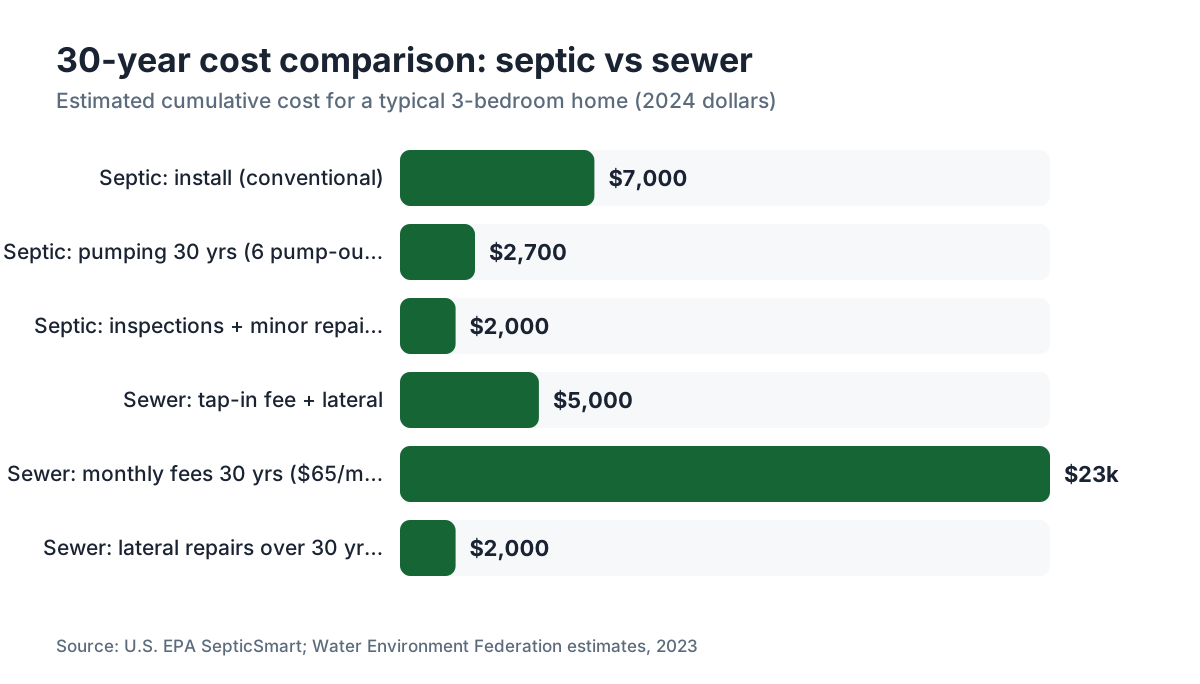
Over 30 years, a septic owner on a typical 3-bedroom house might spend $4,000 to $8,000 total on pumping, inspections, and minor repairs if the system stays healthy. A sewer customer paying $65 a month over those same 30 years pays $23,400 in service fees before a single repair or rate hike enters the math.
What are the main advantages of having a septic system?
Lower long-term cost is the big one. No monthly bill, and pumping stays cheap if you keep to the schedule. Across decades the savings are real, not theoretical.
You control your own system. When a municipal main backs up, you wait on the utility. When your septic tank needs attention, you call a contractor and it gets handled on your timeline.
Septic recycles water locally. The effluent that soaks into your drain field recharges groundwater on your own property instead of getting piped miles away. The EPA's SepticSmart program describes properly sited and maintained onsite systems as able to "provide high-quality treatment that protects human health and the environment" [1].
There's also freedom from municipal infrastructure. Where sewer systems are aging or maxed out, septic owners don't sweat connection moratoriums, capacity fee hikes, or rate increases funding plant upgrades.
And septic isn't a liability if you treat it right. A well-maintained system on suitable soil can last the life of the house.
What are the main disadvantages of having a septic system?
Maintenance is on you, and the failure modes are expensive. Miss a few pump cycles, flush the wrong things, or pour grease down the drain often enough, and you buy yourself a failed drain field. Read our guide on how often to pump a septic tank before you decide it can wait another year.
Septic systems have hard physical limits. They need a lot with enough suitable soil for a drain field, which rules out small urban lots, rocky terrain, and high-water-table sites. Some properties just can't hold one.
The failure risk lands entirely on you. A drain field replacement runs $10,000 to $20,000. No monthly sewer bill ever produces a hit that size in a single year, even if the costs even out over decades.
Selling gets more complicated. Some buyers get nervous about septic, especially older systems. Many lenders require a septic tank inspection before closing, and a system that fails inspection means negotiating repairs mid-sale.
Alternative systems (aerobic units, drip fields, mounds) demand more active upkeep, sometimes a service contract running $100 to $300 a month, which wipes out the cost advantage completely. Know which type you have before you run any numbers.
What are the main advantages of municipal sewer?
Convenience is the obvious one. You flush, it's gone, you never think about it again. No inspection schedule, no pump truck in the driveway, no field lines to work around when you landscape.
Sewer scales with your household. Six people living in the house for a year? The utility absorbs the load. With septic, heavy use accelerates solids buildup and can overwhelm a system sized for a smaller family.
Dense lots work fine. Urban and close-in suburban homes with small lots, tough soils, or high water tables could never run on septic. Sewer makes those properties livable.
And there's no catastrophic single-point failure on your end. The plant and the main lines belong to the utility. Your liability stops at the lateral running from your house to the street.
What are the main disadvantages of municipal sewer?
The bill never stops, and you don't control it. Sewer rates have climbed faster than inflation in many cities over the past decade as utilities pay for plant upgrades, regulatory compliance, and aging pipe replacement.
You're at the mercy of the utility. Main line backups, capacity limits, and sewer moratoriums are real in some regions. When a system surcharges during heavy rain, sewage can back up into your basement. A backflow preventer helps, but the vulnerability is baked in.
Connecting an existing property gets expensive and disruptive, especially if the main is far off or the lot grades badly. Some owners have been forced to connect when a town extended a main nearby, paying tens of thousands in fees with no say in it.
Tap-in fees in some markets have ballooned. The Water Environment Federation has documented residential capacity fees that alone exceed $10,000 per connection [4].
How does septic vs sewer affect home resale value?
The research here is thinner than people assume, and the honest answer is that it depends on your market and the condition of the system. A healthy, documented system is close to a non-issue. A failing one is a discount.
In rural and exurban markets, nearly everything is on septic and buyers don't blink. A recently pumped system with paperwork is a non-issue, sometimes a mild plus (no sewer bill).
In suburbs where some homes have sewer and some have septic, buyers occasionally offer less for the septic house out of unfamiliarity rather than any real cost gap. A 2013 study in the Journal of Real Estate Finance and Economics found mixed results tied to distance from municipal systems, with a small effect in markets where septic is common [5].
What actually kills value is a failing or freshly-replaced system, or an obvious deficiency flagged in an inspection report. Selling? Get a current septic tank inspection done before you list, pump the tank, and keep the documentation. That erases the uncertainty buyers price in.
Connecticut law requires an onsite inspection at or before the point of sale in most circumstances, under the DEEP Public Health Code Section 19-13-B103d framework [2]. Massachusetts runs a similar Title 5 inspection regime. Buyers in those markets are used to the process and expect the paperwork.
Which is better for the environment, septic or sewer?
Neither wins outright. Both treat wastewater well when they work, and both foul waterways when they fail. Condition matters more than category.
A working septic system treats wastewater on-site and returns treated effluent to local groundwater, recharging aquifers and using less energy than pumping sewage to a central plant. The EPA's SepticSmart program states that onsite systems "can provide high-quality treatment that protects human health and the environment when properly sited, designed, and maintained" [1].
A failing septic system is a pollution source. Untreated effluent reaches groundwater, nearby wells, and surface water. Nitrogen from neglected systems in coastal areas has been tied to harmful algal blooms in estuaries, a documented problem on Long Island, in the Chesapeake Bay region, and on Cape Cod [6].
Centralized treatment done well hits consistent effluent quality and handles nutrients more reliably than most residential septic. But aging sewer pipes leak too. The American Society of Civil Engineers reports that sewer overflow events release billions of gallons of raw sewage into U.S. waterways every year [7].
So: a well-maintained septic system in good soil, pumped on time, is a net positive. A neglected one is not. Sewer wins on consistency. Septic wins on distributed water cycling, but only when it's working right.
Is septic or sewer better in Connecticut and other New England states?
The math in Connecticut lands where it does nationally: sewer wins on convenience, septic wins on operating cost if the system is sound. The difference here is that buyers expect service records and an inspection at sale.
Connecticut sits between dense suburbs (mostly sewer) and rural towns (mostly septic), which makes it a useful case. The DEEP and Department of Public Health jointly regulate onsite systems under Section 19-13-B103d of the Public Health Code [2].
Older conventional systems installed before modern codes are common across New England and often undersized or too close to wells and wetlands. Current regulations require larger setbacks, deeper treatment soils, and in some cases nitrogen-reducing technology, especially in coastal Nitrogen Sensitive Areas [2].
Operators working the Connecticut and broader New England market can track service schedules and inspection histories across their customer base using platforms like SepticMind, which is built for septic service companies running recurring maintenance workflows.
Buying in a Nitrogen Sensitive Area (most shoreline communities)? Ask specifically whether the system meets current nitrogen standards. Older systems in those zones can need costly upgrades, and that cost is yours to inherit.
Can you convert from septic to sewer, and is it worth it?
Yes, you can convert whenever a municipal main runs close enough. You abandon the septic system (pumped and filled with sand per local code, usually) and run a new lateral to the main. Cost typically runs $5,000 to $20,000 depending on distance, excavation, and tap-in fees.
Whether it's worth it comes down to why you're doing it. If your septic is failing and you're staring at a $15,000 drain field replacement, connecting to sewer may cost about the same and ends the maintenance for good. That's a fair trade.
If your septic is healthy and you just want the convenience, the math rarely works. You'd spend $5,000 to $15,000 up front and then pay $50 to $90 a month for the rest of your ownership. On pure cost, the payback period is basically never.
Some towns require conversion once a main reaches your street. Check local ordinances before you assume you have a say. In some states and counties the connection mandate kicks in on a deadline no matter what condition your septic is in.
What should you do before buying a home on septic?
Get a full inspection by a licensed inspector, not a visual glance. A real inspection covers tank condition, inlet and outlet baffles, the distribution box, and a field assessment of the drain field for surfacing effluent or saturated soil. Many inspectors pump the tank as part of the job, which is worth doing even if it was pumped recently.
Ask for records. When was it last pumped? Any repairs or replaced components? How old is the system, and what type is it (conventional gravity, mound, ATU)? A seller with no records is a yellow flag, not a red one, but it means you're starting blind.
Budget for a pump-out shortly after you close, regardless of what the seller says. Our guide to septic tank pumping walks through what's involved.
For alternative systems, aerobic treatment units especially, confirm whether there's an active maintenance contract and what it costs each year. Some states require these contracts by law. Texas mandates a maintenance contract on aerobic systems [8].
Last, find the drain field and think hard about what you plan to do with that ground. No parking on it. No heavy equipment. No deep-rooted trees nearby. That part isn't negotiable.
Frequently asked questions
Is a septic system cheaper than sewer over the long run?
Usually yes, if the system stays healthy. Septic has no monthly fee; pumping every 3 to 5 years costs $300 to $600. Sewer averages $50 to $90 a month, roughly $18,000 to $32,000 over 30 years in service fees alone. A drain field replacement ($10,000 to $20,000) can close that gap fast, though. The math favors septic on a well-maintained system on a suitable lot.
How often does a septic tank need to be pumped?
The EPA recommends pumping every 3 to 5 years for a typical household. Actual frequency depends on tank size and how many people live in the home. A 1,000-gallon tank serving four fills faster than a 1,500-gallon tank serving two. Skipping pumping is the most common cause of premature drain field failure, which costs far more than any pump-out ever would.
Does having a septic system lower your home's value?
Not inherently. In rural and exurban markets where septic is the norm, it has little to no effect on price. In mixed suburban markets, some buyers discount septic homes out of unfamiliarity. A healthy system with documented maintenance and a recent inspection usually erases any penalty. A failing or uninspected system is a different story and can cut offers materially.
What can you not put down a drain with a septic system?
Avoid flushable wipes (they don't break down), grease, large amounts of bleach, heavy use of antibacterial soaps, and anything non-biodegradable. These kill the bacteria that make the system work or clog the drain field. Regular garbage disposal use also speeds up solids buildup and usually forces more frequent pumping. The EPA's SepticSmart program keeps a detailed do's and don'ts list.
Can a septic system fail suddenly?
Yes, though most failures build slowly and warn you first: slow drains, gurgling pipes, soggy areas over the drain field, or sewage odors in the yard. Sudden failures (a backup into the house) usually follow years of missed pumping or a physical collapse. An annual look at the drain field plus pumping on schedule catches most problems before they become emergencies.
What is a septic inspection and when do you need one?
A septic inspection assesses the tank's physical condition, the inlet and outlet baffles, the distribution box, and signs of drain field stress. You need one when buying or selling a home with septic (required by lenders in many cases), after any sign of trouble, and as a routine check every 3 to 5 years, ideally alongside pumping. States like Connecticut require it at point of sale.
What happens when a septic drain field fails?
The drain field stops accepting and treating effluent. Sewage backs up toward the house or surfaces in the yard. The fix is usually a full or partial drain field replacement, costing $5,000 to $20,000 depending on system type and soil. Sometimes a repair to the distribution box or a single trench solves it for less. A licensed inspector can tell you which scenario you're facing.
Are there environmental risks to having a septic system?
Yes, if the system is failing or poorly sited. Failing systems can push pathogens and excess nitrogen into groundwater and nearby surface water. Properly working systems recharge local aquifers, and the EPA recognizes them as environmentally beneficial. The risk concentrates in older systems near wells, wetlands, or in Nitrogen Sensitive coastal areas where stricter standards now apply.
Is sewer always available if you want it?
No. Sewer service exists only where a municipal main runs and the utility has capacity for new connections. Rural properties often have no sewer option no matter what you want. Even in suburbs, lots at the edge of a service district can face expensive main extension costs. Some municipalities also impose connection moratoriums when treatment plant capacity is tight.
How do septic rules differ in Connecticut compared to other states?
Connecticut regulates onsite systems under Section 19-13-B103d of the Public Health Code, administered jointly by DEEP and the Department of Public Health. Inspection at point of sale is standard, and Nitrogen Sensitive Areas (mostly coastal communities) carry stricter design requirements. These rules track closely with Massachusetts Title 5, making New England one of the more tightly regulated regions for septic in the country.
What type of septic system is cheapest to maintain?
A conventional gravity-fed system with a concrete tank and a properly sized stone-and-pipe leach field is the simplest and cheapest to maintain. Pumping every 3 to 5 years is usually all it needs for decades. Alternative systems (aerobic treatment units, mounds, drip irrigation) carry more mechanical parts, higher repair costs, and sometimes mandatory service contracts that run $100 to $300 a month.
Can you install a new septic system on any property?
No. The property has to pass a percolation test and often a soil profile evaluation confirming the soil can treat effluent. Small lots, high water tables, clay-heavy soils, and proximity to wells or wetlands can disqualify a site for conventional systems. An alternative system may be permitted in some cases at higher cost. Some lots can't support any onsite system and require sewer.
What size septic tank do you need for a 3-bedroom house?
Most state codes require a minimum 1,000-gallon tank for a 3-bedroom home, though many jurisdictions now mandate 1,250 or 1,500 gallons to account for modern water use. Drain field size is calculated separately from soil absorption rate and estimated daily flow (typically 150 gallons per bedroom per day). Check your specific state code, since minimums vary.
How long do septic systems and sewer laterals last?
A concrete septic tank lasts 40+ years if maintained; plastic and fiberglass tanks can match that with proper installation. Drain fields last 20 to 30 years under normal use, sometimes 40+ with careful maintenance. Sewer laterals (the pipe from your house to the main) last 50 to 100 years for clay or cast iron, though tree root intrusion can cause earlier failures. Plastic laterals installed since the 1980s generally last longer.
Sources
- U.S. EPA, SepticSmart Program: About 21% of U.S. homes use onsite wastewater treatment; EPA recommends pumping every 3 to 5 years; properly maintained systems provide environmental benefits.
- Connecticut DEEP, Onsite Wastewater Disposal Systems: Roughly one-third of Connecticut homes use onsite systems; systems regulated under Public Health Code Section 19-13-B103d; Nitrogen Sensitive Area requirements for coastal communities.
- U.S. EPA, Decentralized Wastewater Treatment Systems: A Program Strategy: Conventional septic system installation costs and alternative system cost ranges referenced.
- Water Environment Federation, Residential Sewer Connection Fee Survey: Sewer tap-in fees, capacity fees, and monthly sewer rates for residential connections.
- Journal of Real Estate Finance and Economics, Vol. 46 (2013): Mixed evidence on septic vs sewer effect on residential property values depending on market and proximity to municipal systems.
- U.S. EPA, Nutrient Pollution: Nitrogen loading from poorly maintained onsite systems linked to algal blooms in coastal estuaries.
- American Society of Civil Engineers, 2021 Infrastructure Report Card: Aging sewer infrastructure produces combined sewer overflow events releasing billions of gallons of untreated sewage annually.
- Texas Commission on Environmental Quality, Aerobic Sewage Treatment Systems: Texas requires a maintenance contract on aerobic septic treatment systems.
- U.S. Census Bureau, American Housing Survey: National data on share of homes using septic vs public sewer connections.
- National Environmental Services Center (NESC) at WVU, Septic System Fact Sheet: Typical septic system lifespan, maintenance intervals, and drain field replacement cost ranges.
Last updated 2026-07-09