Clogged leach field: causes, signs, and how to fix it
By the SepticMind Editorial Team
TL;DR
- A clogged leach field happens when the soil around your drain field pipes gets saturated or sealed by biomat, so effluent stops draining.
- Early signs are soggy ground over the field, slow drains, and sewage odors.
- Some fields recover with pumping and rest.
- Others need full replacement, which runs $3,000 to $15,000 depending on soil and system size.
What is a clogged leach field and why does it matter?
Your leach field (also called a drain field or absorption field) is where clarified wastewater from your septic tank soaks into the soil. Billions of soil bacteria finish treating that effluent before it reaches groundwater. When something blocks the soaking process, effluent backs up. It has nowhere to go but back toward your house or up through the ground.
A clog is not a single event. It is a condition that builds over months or years. The soil around your perforated pipes slowly loses the ability to accept liquid at the rate your household produces it. Once it hits that tipping point, things go bad fast.
This matters beyond the smell and the wet yard. Untreated sewage reaching the surface or a nearby water source is a public health problem and a legal one. Most state codes require you to repair or replace a failing system within a set window, often 30 to 120 days after a notice of violation, though deadlines vary by state [1].
Understanding what caused your clog is the only way to pick the right fix and avoid paying for it twice.
What causes a leach field to clog?
The most common cause is biomat buildup. A biomat is a dark, gelatinous layer of anaerobic bacteria and their byproducts that forms at the soil interface around your drain pipes. Some biomat is normal and actually helps filter pathogens. Too much of it seals the soil like plastic wrap [2].
Biomat builds fastest when:
- The septic tank is not pumped often enough, so solids carry into the field and feed the mat.
- Hydraulic overload pushes more water through the system than the soil can absorb, keeping the field wet and starved of oxygen.
- A garbage disposal adds fats, oils, and fine organic particles that feed bacteria far past normal levels.
Physical causes matter too. Tree roots find their way into perforated pipes and crack distribution boxes. Vehicles driven over the field compact the soil and crush pipes. One bad afternoon, like parking a concrete truck on the field during a renovation, can destroy lateral pipes that look fine from the surface.
Then there is soil failure. Some soils, heavy clays especially, become biologically sealed to the point where no biological treatment brings back permeability. Soil that saturates over and over can also collapse structurally at the pore level, and no additive reverses that.
High water tables get misread as clogs constantly. If your water table rises seasonally to meet or top the bottom of your trenches, the field cannot drain no matter how clean the pipe or soil is. The fix for a high water table is a redesigned system, not a bottle of biomat treatment [3].
What are the signs of a clogged leach field?
The earliest sign most homeowners notice is slow drains throughout the house. Not one slow drain (that is a household pipe clog) but every drain acting sluggish at once, especially after heavy water use.
Then comes the smell. A sulfur or sewage odor in the yard, right over the drain field, means effluent is surfacing or at least reaching the root zone. Indoors, you may catch it near floor drains or in the lowest bathroom.
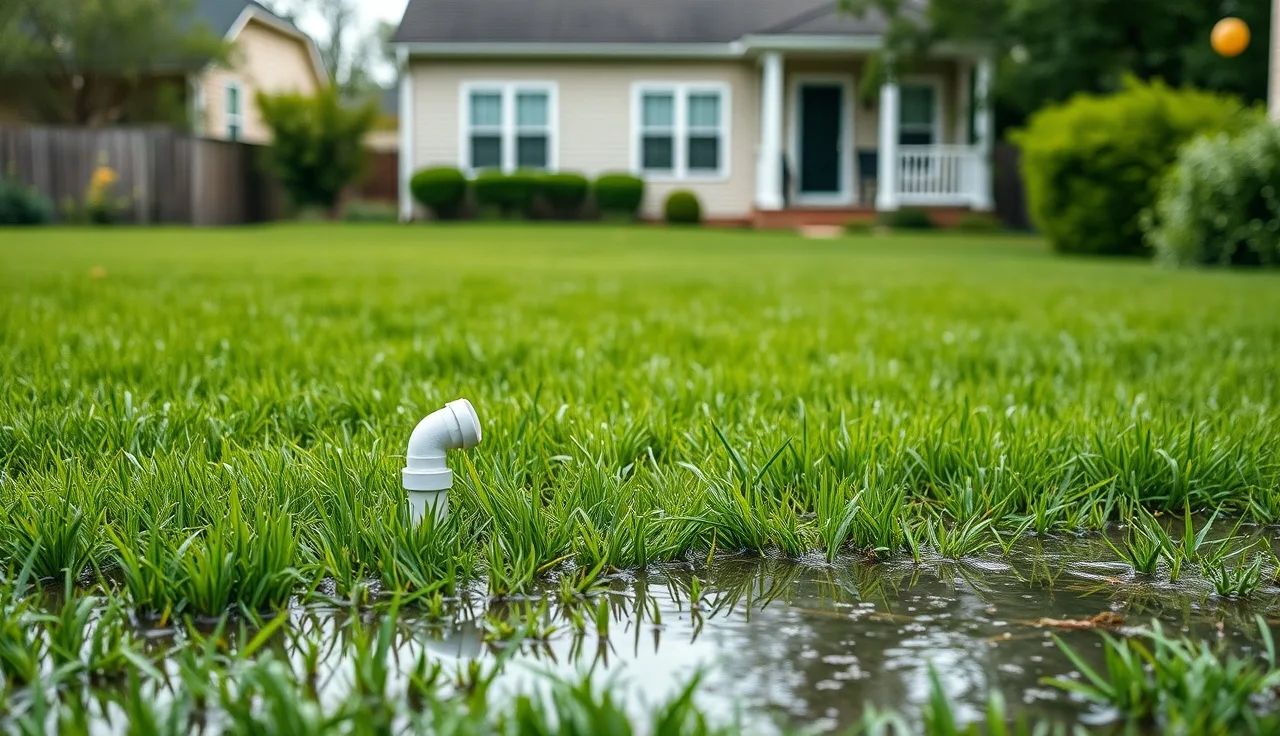
Wet or spongy ground over the leach field is the classic sign. The grass above a failing field is often the greenest, lushest patch in the yard. Plants love the nutrients. That is not a feature. It is a symptom.
Sewage backing up into the lowest fixtures in your home, usually a ground-floor toilet or laundry tub, means the system is already past the early stage. By then the tank is at or near capacity and the field is not accepting anything.
You might also hear gurgling from drains or toilets when water flows elsewhere in the house. That gurgle is the system fighting to equalize pressure.
One thing worth checking yourself: lift the lid on your septic tank outlet or distribution box if you can reach it safely. If liquid is standing above the normal outlet level, the field is not draining. If it looks normal, the problem may be upstream (a tank baffle, a clogged pump, or a household drain line) and not the leach field at all. Misdiagnosing the location wastes thousands of dollars.
How do you diagnose a leach field clog properly?
Visual observation gets you partway. A licensed septic inspector or pumper can open the system and run a hydraulic load test: they fill the tank to outlet level and watch whether the field takes any liquid at all [4]. That tells you the field is failing without guessing.
A sharper diagnosis uses a camera inspection of the lateral pipes. A flexible scope goes into each lateral and shows root intrusion, pipe collapse, sediment fill, and standing effluent. That $150 to $400 is worth spending before you drop $10,000 on a fix, because a crushed pipe needs a different solution than a biomat-sealed trench.
Some inspectors use dye testing: a fluorescent dye goes through the system and the yard gets checked for surfacing. Useful as confirmation, weak for pinpointing cause.
For an inspector you can trust, look for certification through a state program or the National Association of Wastewater Technicians [5]. A basic inspection that opens the tank, checks baffles, and observes the field typically runs $250 to $500. Full camera work and soil assessment cost more.
Operators who manage many properties increasingly use software like SepticMind to log inspection history and flag systems due for assessment, so nothing slips through.
Soil testing (a perc test or soil morphology assessment by a licensed site evaluator) may be needed if you are planning a repair or replacement. That test decides what replacement system the site can support and is required by most state codes before a permit is issued [1].
Can you fix a clogged leach field yourself?
Sometimes. The honest answer depends on the cause.
If the clog is biomat-related and the field has not fully failed, rest is the intervention with the most evidence behind it. The EPA's SepticSmart program notes that a complete rest period, meaning zero wastewater input for weeks to months, lets oxygen return to the soil so aerobic bacteria can break down the biomat [2]. In practice that means staying elsewhere or using a portable toilet while the field rests. Most homeowners cannot pull that off easily.
Pumping the tank is always step one. If solids are spilling into the field and feeding the biomat, pumping stops the source. Our guide on septic tank pumping covers what to expect from that service. For many mild cases, pumping plus a 2 to 4 week rest period brings back partial function.
Cutting hydraulic load helps a lot. Fix leaking faucets and running toilets. Spread laundry across the week. Route roof drains and sump pumps well away from the field. Each of those drops the daily volume hitting the soil.
Septic additives (bacterial enzymes, acid treatments, oxidizing agents) get sold hard as leach field restorers. The EPA and most state extension services found no reliable evidence they do anything beyond what already happens naturally, and some acid-based products damage pipes and soil structure [6]. I would not spend a dime on them.
Aeration is a different story. Terralift and similar services inject compressed air, sometimes with nutrients, into the soil around the trenches to fracture compaction and restore pore space. Some homeowners report success. Controlled studies are thin. Costs run $1,000 to $3,000 and results are inconsistent enough that I would treat it as a last try before replacement, and only on a system with good pipe and a compaction problem.
What you should not do yourself: dig up lateral pipes, jet water at pressure into the field, or add anything to the tank that your state health department has not approved. Those moves can cause damage you cannot undo, and they may put you in violation of your state's onsite wastewater code.
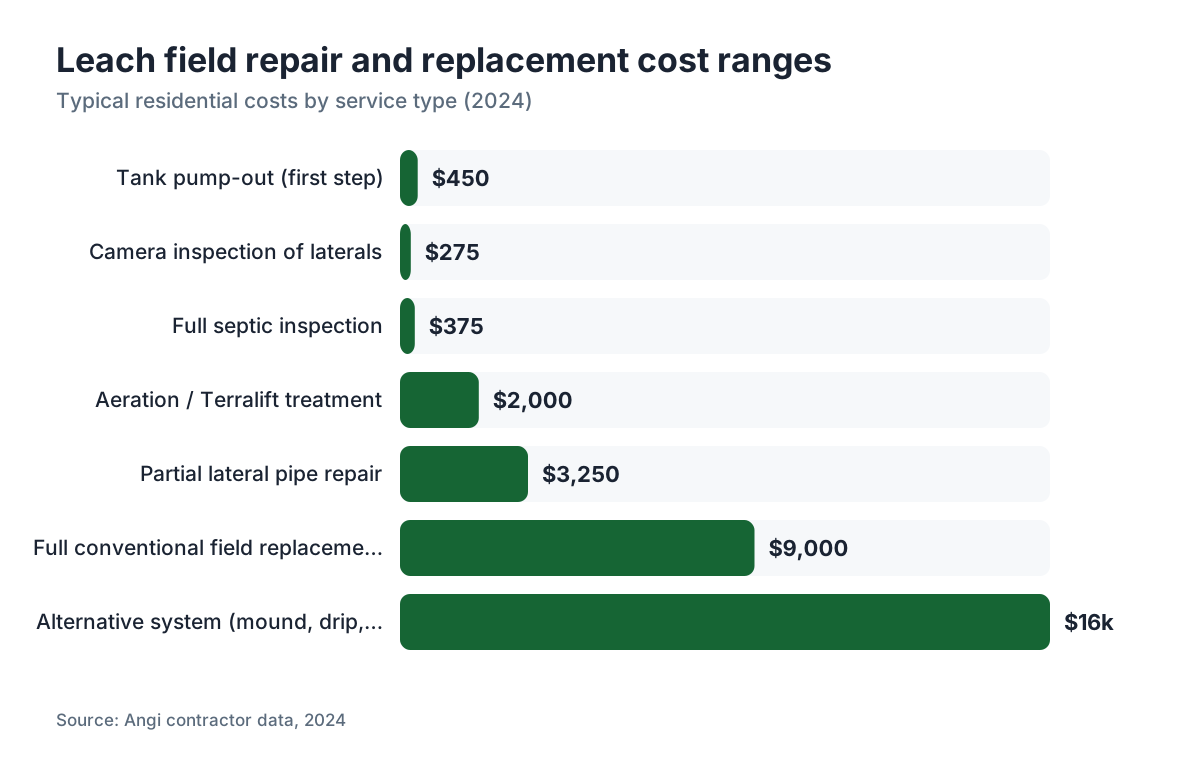
What does it cost to fix a clogged leach field?
Cost rides almost entirely on how far gone the field is and what your site can support as a replacement.
| Repair or service | Typical cost range |
|---|---|
| Septic tank pump-out (first step) | $300 to $600 |
| Camera inspection of laterals | $150 to $400 |
| Septic inspection (full) | $250 to $500 |
| Aeration / Terralift treatment | $1,000 to $3,000 |
| Lateral pipe repair (partial) | $1,500 to $5,000 |
| Full conventional field replacement | $3,000 to $15,000 |
| Alternative system (mound, drip, aerobic) | $8,000 to $25,000+ |
Those ranges come from contractor data aggregated by Angi, and they swing a lot by region, soil, and local permit fees [7]. In coastal or rocky areas where excavation is expensive, expect the top of every range.
Permit fees alone run $200 to $2,000 depending on the county [8]. Some states require a fresh perc test before issuing a repair permit, adding $500 to $1,500.
If your field is simply undersized for the household (common in older homes that got additions), full replacement is almost always the outcome. On a site with good soil and easy access, a conventional gravity replacement averages roughly $6,000 to $10,000. Poor soil, a high water table, or tight space usually pushes you into an alternative system and costs north of $15,000.
For the bigger picture on total system cost, our article on cost to install septic system breaks down what each system type runs from scratch.
What are the repair options for a failed leach field?
Repair or replace. Those are the two buckets. Within replacement, several system types may or may not work for your site.
Conventional trench replacement means excavating the old field (or an adjacent area, since the old soil is often exhausted), laying new perforated pipe in gravel-filled trenches, and tying it back to the existing septic tank if that tank is sound. This is the cheapest path when the site has the space and the right soil.
Mound systems get built when the water table is too high or the soil too shallow or too tight for conventional trenches. A sand mound sits above grade and a pump doses effluent into it. They work well but cost more to build and need an effluent pump that wants periodic maintenance. Costs typically run $8,000 to $20,000 [9].
Drip irrigation systems push effluent through small-diameter tubing in the upper soil. They use water efficiently and can work where trenches cannot. They need fine filtration and regular maintenance of the dripper heads. Costs run $10,000 to $20,000 or more.
Aerobic treatment units (ATUs) treat effluent to a higher quality before it hits the soil, which cuts biomat formation sharply and allows a smaller dispersal area. They are common in Texas, Florida, and other states with restrictive soils. They need a maintenance contract, usually $100 to $300 per year, and the owner is generally required by state code to keep that service agreement active [10].
Before any replacement, a licensed designer or engineer has to assess your site. Going straight to excavation without permits is illegal in every state and costs far more once it gets discovered. Our article on septic system repair walks through the permitting side.
If the tank gets damaged during the work or was already failing, see septic tank repair.
How long does a leach field last, and how do you prevent clogs?
A well-maintained conventional leach field lasts 20 to 30 years. Some run 50. Some die at 10. The gap is almost all maintenance behavior and loading.
The EPA's SepticSmart guidance is blunt about it: "Have your septic system inspected at least every three years by a septic service professional and have your tank pumped when necessary, generally every three to five years." Following that schedule alone prevents most premature field failures, because it keeps solids from ever reaching the field [2].
Specific moves that protect your field:
- Pump the tank on schedule. See how often to pump septic tank for a household-size guide. A 1,000-gallon tank serving 4 people needs pumping roughly every 3 years [11].
- Never flush wipes (even the "flushable" ones), feminine hygiene products, medications, or cooking grease. They speed up biomat formation or physically clog pipes.
- Keep vehicles, heavy equipment, and livestock off the field for good. Compaction does not undo without excavation.
- Plant only shallow-rooted grass over the field. No trees, shrubs, or gardens within 10 feet of the lateral lines.
- Direct all surface water (gutters, sump pumps, French drains) well away from the field. Extra water is the fastest way to saturate and kill a field.
- Skip the garbage disposal if you can. NC State Extension found garbage disposal use substantially raises suspended solids loading to a septic system, which cuts effective tank capacity and pushes more solids toward the field [12].
For operators juggling service schedules across many customer systems, consistent tracking is what separates catching a problem early from running an expensive emergency call. SepticMind is built for septic operators who need scheduling and field history in one place.
Regular septic tank cleaning keeps solids below the danger line. Think of it as protecting a $10,000 investment with a $400 service every few years.
Does a clogged leach field mean you need a new septic system?
Not always. But often.
Catch the clog early, pump the tank, cut the hydraulic load, and give the field a rest, and some fields recover enough to run for years more. That is most likely with early-stage biomat and otherwise intact pipe.
If the pipes are crushed, root-infiltrated, or the trenches are packed with solids, recovery is off the table. The pipes need replacing.
If the soil itself is biologically sealed or compacted past recovery, the field has to be relocated or rebuilt. Sometimes the existing site cannot support any new field, and an alternative system is the only road left.
The septic tank itself is often perfectly fine even when the field fails. A tank that is structurally sound, correctly sized, and has intact baffles usually gets reused when only the field needs work. Replacing the field alone, and keeping the tank, can cut the total bill a lot.
Get the camera inspection and the hydraulic load test before anyone tells you the whole system has to go. A straight contractor will show you why replacement is necessary. If they cannot show you diagnostic data, get a second opinion.
Are there health and legal risks to ignoring a clogged leach field?
Yes, and they are serious.
Surface-breaking sewage carries pathogens including E. coli, Salmonella, Hepatitis A, and Giardia. Kids playing in the yard, pets, and anyone who touches that soil is exposed. If the field sits near a well, drinking water contamination is possible and can happen faster than most homeowners expect, especially in sandy soils.
Environmentally, nitrogen and phosphorus from untreated effluent reaching groundwater feed algae blooms and degrade local watersheds. That is why state agencies regulate it hard.
Legally, a failing septic system is a code violation in every state. Consequences range from daily fines (often $100 to $1,000 per day in states like California and Florida) to orders to vacate the property until the system is fixed [1]. Real estate disclosure laws in most states require you to disclose a known failing system when you sell. Hiding a known failure can expose you to civil liability after the sale.
Homeowners insurance almost never covers septic failure or leach field replacement. It is treated as a maintenance item, not a covered peril. A few specialty riders exist. They are rare and expensive.
Move early and you keep your options and your cash. A field showing early signs might recover with pumping and rest. A field that has been failing for two years and is surfacing sewage almost always needs full replacement.
What questions should you ask a contractor before hiring them?
Not every septic contractor is qualified to diagnose and repair a leach field. Some specialize in pumping, which is a different job from system repair and design.
Ask these before signing anything:
- Are you licensed for onsite wastewater system design and installation in this state? (Requirements differ; some states split the license for design and installation.)
- Will you do a camera inspection of the laterals before recommending replacement?
- What permits are required and who pulls them? (A contractor who says "we do not need permits" is a red flag.)
- What diagnostic evidence supports your recommendation, and can I see it?
- What is the warranty on the new field, and what voids it?
- Do you carry general liability and worker's compensation insurance?
- Have you done repairs on this system type (conventional, mound, ATU) recently in this county?
For a septic tank inspection specifically, the inspector should be independent of any company that profits from recommending repairs. Some states bar inspectors from also being the repair contractor on the same job.
Get at least two written estimates before committing to any repair over $2,000. The spread between contractors on the same work is often 30 to 50%, and it almost always reflects real differences in proposed scope, more than markup.
Frequently asked questions
How do I know if my leach field is clogged or if it's just a tank problem?
Open your septic tank outlet access. If the liquid level in the tank sits above the outlet pipe, the field is not accepting flow and the problem is downstream of the tank. If liquid is at normal levels, the clog is likely upstream: a pipe, a baffle, or the tank itself. A licensed inspector can confirm this with a hydraulic load test in under an hour.
Can heavy rain cause a leach field to stop working?
Yes. Saturated soil cannot accept more liquid, and a high water table can rise to meet the bottom of your trenches. This mimics a clogged field exactly: slow drains, wet ground, odors. If symptoms appear only during or after heavy rain and clear within a few days, your field may be structurally fine but undersized or poorly located. Persistent trouble after rain often means the site needs a different system type.
Do septic additives actually unclog a leach field?
The evidence is poor. The EPA and most state extension services have reviewed commercial additives and found no reliable proof they restore drain field function. Some enzyme and bacterial products may give minor benefit in early-stage biomat, but none have shown the ability to reverse serious soil clogging. Acid-based products can damage pipes and soil. Skip them and put the money into pumping and field rest instead.
How long does it take to replace a leach field?
Permit approval is usually the longest part: 2 to 8 weeks depending on your county and whether new soil testing is required. The actual excavation and installation of a conventional replacement field takes 1 to 3 days for a typical home. Alternative systems like mounds or drip fields take longer, sometimes a full week, because of extra material and equipment. Plan for 4 to 10 weeks total from diagnosis to completion.
Can tree roots permanently damage a leach field?
Yes. Roots from trees and large shrubs can enter perforated pipe joints, block flow, and eventually crack the pipe. If roots have been present for years, they may have displaced gravel and fractured the pipe runs badly enough that replacement is the only fix. Camera inspection shows exactly how far root intrusion goes. Removing the tree afterward does not undo existing pipe damage, but it prevents a repeat after repair.
What is the difference between a leach field clog and a saturated field?
A clog means something physically or biologically blocks flow: biomat, root intrusion, collapsed pipe, or sediment fill. A saturated field means the soil is holding more water than it can drain, often from hydraulic overloading or a seasonally high water table. Saturation clears once the load drops. A true clog does not. Both produce identical symptoms, which is why diagnostic testing matters before you spend money on a fix.
Is it safe to use my house during a leach field failure?
Briefly and minimally, yes. Fully, no. If sewage is surfacing or backing up into the house, continued use adds volume to an already overwhelmed system and raises the health risk. Cut water use to the absolute minimum and call a licensed septic contractor right away. Avoid contact with any wet area over the field. If sewage is backing into living space, stop using the plumbing and get the system pumped before using it further.
Does homeowners insurance cover leach field replacement?
Standard homeowners policies almost never cover septic failure because it is classified as a maintenance issue, not a sudden covered peril. Some specialty riders or home warranty plans include limited septic coverage, but read the fine print: most cap coverage well below actual replacement cost and exclude pre-existing conditions. Do not count on insurance to pay for a leach field. Budget for it as a maintenance reserve instead.
How much does it cost to replace a leach field?
A conventional replacement field runs $3,000 to $15,000 for most homes. Sites with poor soil, high water tables, or tight space often require alternative systems (mound, drip, aerobic) that cost $8,000 to $25,000 or more. Regional labor rates, permit fees, and whether the existing tank can be reused all move the final number. Get at least two written estimates and ask each contractor to show you the diagnostic basis.
How often should a leach field be inspected to catch problems early?
The EPA recommends a professional inspection at least every 3 years for systems without mechanical parts, and annually for systems with pumps or aerobic units. A trained inspector can often spot early biomat, distribution box problems, and hydraulic issues before they turn into field failure. Pairing inspection with routine tank pumping every 3 to 5 years is the cheapest way to extend field life a lot.
Can a clogged leach field contaminate a well?
Yes, and it is a serious risk. Untreated or partly treated effluent reaching groundwater can carry nitrates, E. coli, and other pathogens. The distance between your field and well matters: most state codes require a minimum 50 to 100 foot separation, but sandy or fractured bedrock soils can carry contamination farther and faster. If you have a failing field and a nearby well, test the water immediately for coliform bacteria and nitrates.
What is a distribution box and how does it relate to a leach field clog?
A distribution box (D-box) sits between the septic tank and the lateral pipes and splits effluent evenly among the field trenches. If the D-box is cracked, tilted, or clogged with solids, some laterals get no flow while others get all of it, which causes premature failure in parts of the field. A D-box problem is far cheaper to fix than a full field failure, which is one more reason to do camera work before committing to excavation.
Sources
- EPA, SepticSmart: Homeowner's Guide to Septic Systems: Recommendations for inspection frequency and state regulatory requirements for septic system repair timelines
- EPA SepticSmart Program, Biomat and Field Rest Guidance: Biomat description as a gelatinous layer that can seal soil, field rest as an evidence-supported intervention, and inspection-every-3-years guidance
- University of Minnesota Extension, Septic System Owner's Guide: High water tables mimicking clogged fields and requiring system redesign rather than biomat treatment
- National Environmental Services Center (NESC), West Virginia University, Septic System Troubleshooting: Hydraulic load testing method for confirming drain field failure
- National Association of Wastewater Technicians (NAWT), Inspector Certification: Certification body for septic inspectors referenced as a credential to look for when hiring
- EPA, Response to Congress on Use of Septic System Additives: EPA finding no reliable evidence that commercial septic additives provide meaningful benefit to drain field recovery
- Angi, Septic System Repair Cost Guide: Contractor-aggregated cost ranges for septic repairs including field replacement and aeration services
- National Onsite Wastewater Recycling Association (NOWRA), State Regulations Overview: Permit fee ranges by county and state code requirements for septic repair permits
- University of Minnesota Extension, Mound Septic Systems: Mound system construction cost range of $8,000 to $20,000 and maintenance requirements
- Texas Commission on Environmental Quality (TCEQ), Aerobic Septic System Requirements: State requirement for aerobic treatment unit owners to maintain an active maintenance contract, typically $100 to $300 per year
- EPA, How to Care for Your Septic System: Pumping frequency recommendation: a 1,000-gallon tank serving a 4-person household requires pumping approximately every 3 years
- NC State University Cooperative Extension, Septic System Management: Garbage disposal use substantially increases suspended solids loading to a septic system, reducing effective tank capacity
Last updated 2026-07-09