Drain field treatment: what actually works and what doesn't
By the SepticMind Editorial Team
TL;DR
- Drain field treatment means any effort to restore a failing or sluggish leach field, from pumping the tank more often to physical aeration, bacterial additives, or full replacement.
- The EPA does not endorse most commercial additives.
- Real restoration (hydro-jetting, terralift, or re-grading) costs $500 to $5,000.
- Full replacement runs $3,000 to $15,000 or more.
- Catch problems early and your odds of dodging replacement go way up.
What is drain field treatment and why does it matter?
A drain field, also called a leach field or soil absorption system, is the network of perforated pipes buried in gravel trenches that takes clarified wastewater from your septic tank and spreads it into the soil. Bacteria and soil particles finish the treatment job the tank started. When that system clogs or fails, sewage backs up into your house or surfaces in the yard. Now you have a public health problem, not a plumbing nuisance.
Drain field treatment is any deliberate action meant to prevent failure or reverse it. The category is broad on purpose. It includes pumping the septic tank more often so solids never reach the field, adding live bacterial cultures to reset the microbial balance, physically breaking up biomat (the black organic layer that chokes pipe perforations), aerating the soil around the trenches, or in the worst cases, installing entirely new pipes or a new field.
The stakes are high. About one in five U.S. households relies on a septic system or other onsite treatment, according to the EPA [1]. A failed drain field can contaminate groundwater, spread pathogens to nearby wells, and trigger a code violation that forces an expensive permitted repair. Early, cheap intervention beats emergency replacement almost every time.
For a broader look at what goes wrong upstream of the field, see our guide to septic system repair.
How does a drain field actually fail?
Most fields fail for one of three reasons: biomat buildup, hydraulic overload, or physical soil compaction.
Biomat is the usual culprit. Every drain field grows a thin anaerobic layer where the wastewater meets the soil. In a healthy system that layer stays thin and actually improves treatment by slowing the water just enough. When solids escape the tank because it hasn't been pumped often enough, or when grease loads run high, the biomat thickens until it seals the pipe perforations and the trench walls. Water has nowhere to go.
Hydraulic overload is simpler. You're pushing more water through the field than the soil can absorb. This happens when water-softener backwash is routed to the septic system, when a leaky toilet runs for months, or when the household grows past what the original system was sized for. A single leaky toilet can waste 200 gallons a day, according to the EPA WaterSense program [2]. That's a heavy extra load on a field designed for normal use.
Soil compaction matters more than most homeowners realize. Drive a vehicle over the drain field, or let heavy equipment park there during construction, and you crush the pore spaces the soil needs to absorb and treat effluent. Once compacted, soil doesn't recover on its own.
There's a fourth, slower failure mode: iron precipitation and mineral fouling, common in areas with hard well water or certain soil chemistry. Pipes and gravel gradually clog with mineral deposits. Treatment options for this cause are thinner than for biomat.
What size septic drain field do you need?
Drain field size is set by your local health authority using two inputs: the estimated daily wastewater flow for your household and the absorption rate of your soil, measured by a percolation test (perc test) or soil morphology evaluation.
The daily flow estimate usually runs 100 to 150 gallons per person per day in most state codes, though some jurisdictions size by bedroom count instead of occupants. A three-bedroom home in many states is designed for 450 gallons per day. The soil absorption rate then determines how many square feet of trench bottom are needed to move that volume safely.
Percolation results are expressed in minutes per inch (MPI). Soil that absorbs water in 1 to 5 MPI is fast. Soil at 60 MPI or slower is often rejected for conventional drain fields under state codes. North Carolina State University Extension, whose onsite wastewater guidance is widely cited, notes that most states require a minimum trench-bottom area of 150 to 250 square feet per bedroom, with the actual number driven by perc rate [3].
The table below shows how trench-bottom area requirements shift with perc rate under a common sizing formula.
| Perc rate (min/inch) | Sq ft of trench bottom per 100 gpd |
|---|---|
| 1 to 5 | 20 to 40 |
| 6 to 15 | 45 to 75 |
| 16 to 30 | 80 to 120 |
| 31 to 45 | 125 to 165 |
| 46 to 60 | 165 to 190 |
| Slower than 60 | Often requires alternative system |
Your drain field size drives your treatment options. A field that was undersized from the start, because soil conditions were misread or code was ignored, will fail again and again no matter how often you treat it. That's the honest reason some systems never respond to anything short of a new field in better soil.
For context on what a new installation costs if you reach that point, see our guide to the cost to install septic system.
Do septic drain field treatment products actually work?
This is where a lot of homeowners spend money they shouldn't. The short answer: some bacterial and enzymatic additives help in narrow circumstances, but most commercial "restore your drain field" products have weak evidence or none at all.
The EPA's SepticSmart program says the agency does not recommend routine use of chemical additives as a substitute for proper maintenance, and that some additives can harm system performance or damage components [1]. That's not a hedge. It's a flat warning.
The most honest independent review of additive evidence comes from a University of Minnesota Extension report that examined 26 types of products (biological, chemical, and organic solvents). It found organic solvents harmful, inorganic acids and bases risky, and biological additives backed by "insufficient evidence" for a clear recommendation [4]. The report is older, but the underlying chemistry hasn't changed.
Where biological additives might genuinely help: a system that took a one-time shock, like a large dose of bleach or antibacterial cleaner wiping out tank bacteria, may recover faster with a bacterial supplement. A mildly sluggish field that still has permeable soil under the biomat may respond to an enzyme-based treatment that speeds biomat digestion. These are marginal cases. A field with thick biomat sealing truly impermeable soil won't be saved by a bottle of bacteria.
If you want to try an additive, skip any product that contains solvents, strong acids, or bases. Stick to live bacterial cultures or enzymes. Don't expect miracles. And pump the tank first, because no additive works well when solids are already overflowing into the field.
What are the best mechanical drain field treatment methods?
When the biomat is thick enough to cause real symptoms (slow drains, wet spots, odors), you need physical intervention, not a bottle of bacteria. The main options are hydro-jetting, terralift or air injection, pipe replacement in place, and rest-and-rotation.
Hydro-jetting sends a high-pressure water jet through the distribution pipes to blast out accumulated solids and break up biomat. It's the most widely available mechanical option and costs roughly $300 to $600 per line, depending on length and access [5]. It can work well for organic clogging. It won't fix compacted soil or a field that was sized wrong.
Terralift and similar air-injection systems drive a probe into the soil around the trenches and inject compressed air (sometimes with polystyrene particles) to fracture the surrounding soil and restore pore space. Published outcomes are mixed. Some operators report good results on biomat-clogged fields with otherwise decent soil structure. Cost runs $1,000 to $3,500 for a typical residential field. The technology has been around since the late 1980s and has decent anecdotal support from licensed operators, but peer-reviewed outcome data is thin.
Pipe replacement in place means digging out the old field, removing fouled gravel and pipe, installing new perforated pipe and clean drain rock, and backfilling. You keep the same footprint but start fresh. Cost is $3,000 to $8,000 for a typical single-family system, depending on depth and local labor rates [5]. This works well when soil absorption is still fine and the failure came from solids overload rather than soil chemistry.
Rest-and-rotation is free. If you have an alternating field (two separate sections with a diverter valve), taking one section fully offline for 6 to 12 months while the other handles all flow lets the resting section's biomat oxidize. It genuinely works for mild to moderate biomat and costs nothing but attention to the valve position. Not every system has this. If yours does, use it.
For operator teams tracking which fields have been treated and when, software like SepticMind can log treatment history alongside pump schedules so nothing falls through the cracks.
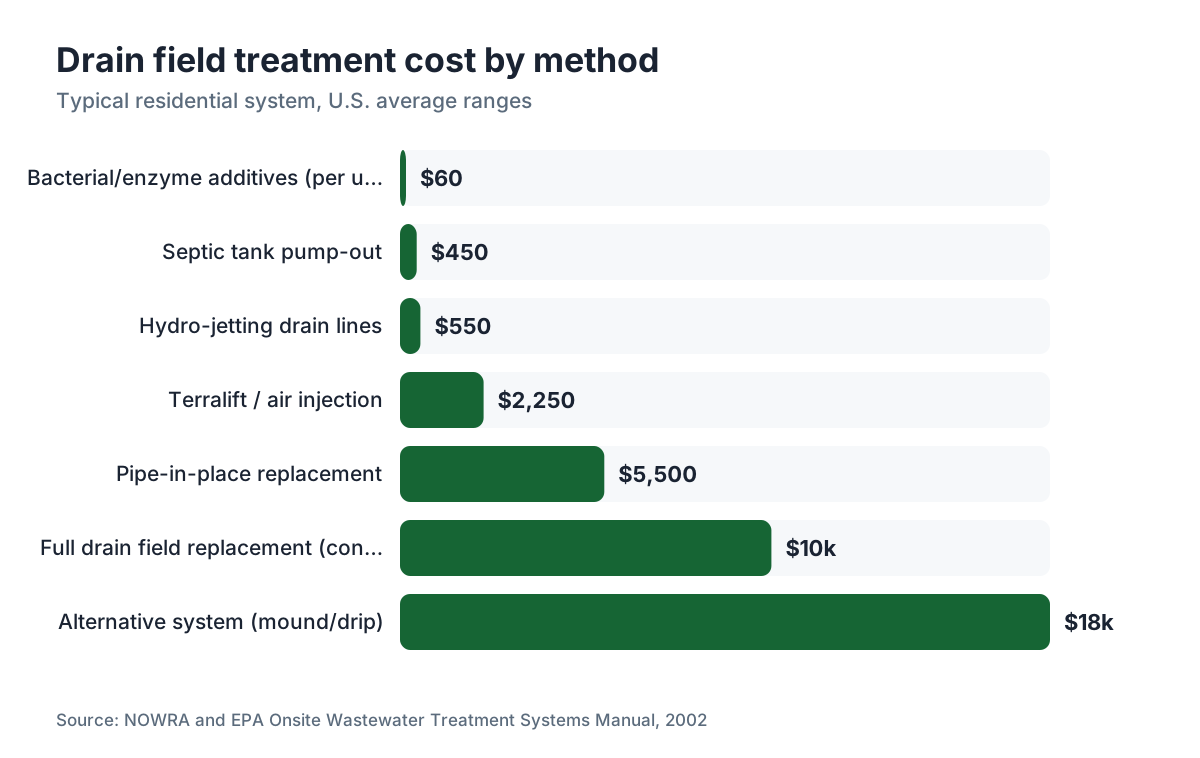
How much does drain field treatment cost?
Cost depends heavily on which treatment you're talking about, plus your soil, your field size, and your region. Here's a realistic breakdown.
Pumping the septic tank, which should come before any other treatment, costs $300 to $600 for a typical residential tank [6]. It's step one regardless of what else you do.
Bacterial or enzymatic additives cost $20 to $100 per application at retail. Monthly maintenance additives run $10 to $30 a month. Low financial risk, modest expected benefit.
Hydro-jetting runs $300 to $800 for a residential field. Terralift or air injection is $1,000 to $3,500. Pipe-in-place replacement is $3,000 to $8,000. Full drain field replacement with excavation and new pipe in the original footprint (if codes allow) runs $5,000 to $15,000 or more for larger systems or difficult soil access.
If your soil has failed the perc test and you need an alternative system (mound system, drip irrigation field, aerobic treatment unit), costs jump to $10,000 to $25,000 depending on site and system type [7].
Here's the honest sequence. Try a tank pump-out first. If symptoms persist after two to four weeks, hire a licensed inspector to camera the distribution lines and read the biomat. Then match the treatment to the actual failure mode. Spend $80 on bacteria when you need hydro-jetting and you waste both the $80 and three months of field deterioration.
See our detailed breakdown of the cost to put in a septic tank if you're weighing repair against full replacement.
How often should you pump the septic tank to protect the drain field?
The EPA's SepticSmart program recommends pumping every three to five years for a typical household [1]. That range exists because the right interval depends on tank size, number of occupants, and how much solid waste the household puts out.
A more precise rule shows up in multiple state codes: pump when the sludge layer reaches one-third of the tank's liquid capacity. For a 1,000-gallon tank serving two people, that might be every five to seven years. For the same tank with five people who lean hard on a garbage disposal, it might be every two years.
The link between pumping frequency and drain field health is direct. Every time solids escape the tank and reach the field, they speed up biomat growth. A field you pump-protect diligently can last 20 to 40 years. A field fed unsettled effluent for a decade often fails in 15 years or less.
Keep a log. Note the pump date, the sludge depth found, and any additives used. That data tells your pumper whether your interval is right or needs adjusting.
Our guide on how often to pump septic tank works through the math in more detail, including how tank size and household occupancy interact.
Can a failed drain field be repaired, or does it always need replacement?
It depends on the failure mode and how far it has gone. This is where an honest conversation with a licensed onsite wastewater professional matters more than anything you read online, including here.
Biomat-driven failure that hasn't yet wrecked soil permeability can often be reversed with hydro-jetting plus a rest period, especially if you also fix whatever caused excess solids loading (pump the tank, fix the leaky toilet, stop sending garbage disposal waste to the system). Success rates aren't tracked in any national database I know of, but experienced operators report good outcomes in maybe half to two-thirds of cases where biomat is the primary cause and the soil structure is still intact.
Soil compacted by vehicle traffic, or saturated to the point of anaerobic failure, is harder to fix. Terralift helps some. In severe cases only excavation and new gravel restores absorption.
A field that was originally undersized, or one installed in soil that never really passed a proper perc test, is the toughest case. Treatment buys time but doesn't change the math. Eventually you're choosing between a permitted repair and a move to an alternative system.
State codes matter here. Some states allow repair-in-place with new pipe and gravel without a full new permit if the footprint doesn't change. Others require bringing the entire system up to current code, which can mean a bigger field or a different system type. Check your state's onsite wastewater regulations or ask your county health department before assuming repair is on the table.
For deeper reading on what a full repair involves, our septic tank repair and leach field guides cover the process.
What home practices protect a drain field long-term?
The drain field you protect is the drain field you don't replace. Most long-term protection comes from simple habits, not products.
Pump the tank on schedule. This is the single highest-return maintenance action you can take. A pump-out costs about $400. A drain field replacement costs $10,000 or more. Nothing else in septic maintenance has better math behind it.
Fix leaks fast. A running toilet or dripping faucet wastes water and hydraulically overloads your field at the same time. Fix leaks within days, not months.
Keep roots out. Tree and shrub roots hunt moisture and nutrients. Willows, poplars, and silver maples are the worst offenders. Plant them at least 30 feet from any drain field trench. Established roots can crack distribution pipes from the inside.
Don't drive on the field. Not once. Compaction from a single pass of a heavy vehicle can take years to reverse, if it reverses at all.
Spread water use through the day. Six loads of laundry on Saturday morning send a surge to the field that it can't absorb as well as the same water spread over several days.
Go easy on garbage disposals. University of Minnesota Extension research found that garbage disposal use significantly increases solids loading to the tank [4]. If your field is already marginal, compost food scraps instead.
Keep grease, paint, solvents, and heavy doses of antibacterial products out of the drains. Grease solidifies in pipes. Solvents kill the bacteria doing the treatment work. A single heavy bleach cleaning won't destroy a healthy system, but routine chemical loads will.
For a full maintenance schedule including tank cleaning, see our septic tank cleaning guide.
How do you know if your drain field is failing?
Early signs are easy to miss, which is exactly why fields jump from "slightly slow" to "sewage in the yard" faster than homeowners expect.
The clearest early warning is slow drains throughout the house. Not one fixture, which points to a line clog, but all of them. If toilets flush slowly and the kitchen sink is sluggish at the same time, the problem is likely downstream of the house, in the tank or field.
Wet, spongy, or unusually green grass over the drain field is a strong sign. The grass is green because leaking effluent is fertilizing it. If the lawn looks perfect in a rectangle over your field while the rest of the yard is dry, that's bad news dressed up as a healthy lawn.
Odors outside, especially near the field or downhill from it, mean untreated effluent is surfacing. That's a public health issue demanding immediate action in most states, not a maintenance question you can sit on.
Inside, the scariest sign is sewage backing up into the lowest fixtures, usually a basement toilet or floor drain. That means the tank or field is so saturated the effluent has nowhere to go but backward.
A camera inspection of the distribution lines ($150 to $400) gives you objective information about whether the pipes are intact and flowing. Pair that with a visual check of the tank's outlet baffle and a look at the distribution box (if you have one) and you get a fairly complete picture without excavating anything.
Get a licensed septic tank inspection done any time you suspect field trouble. Most state codes require one at point of sale anyway, and doing it proactively is far cheaper than responding to a failure.
What do state and EPA regulations say about drain field treatment?
Federal regulation of individual septic systems is indirect. The EPA sets water quality standards under the Clean Water Act and offers guidance through programs like SepticSmart, but it doesn't directly regulate individual system maintenance in most cases. Its position on additives is clear: the agency does "not recommend" them as a maintenance substitute and warns that some can cause harm [1].
State and local rules are where the real teeth are. Every state has an onsite wastewater code that spells out design criteria, setbacks, soil requirements, and repair procedures. Most states require a permit for any drain field repair or replacement. Some states, including North Carolina and Florida, have detailed performance standards for alternative drain field systems (drip irrigation, mound systems, aerobic treatment units) that run stricter than conventional field rules [3][8].
California's State Water Resources Control Board oversees onsite systems through regional water quality control boards, and several counties require periodic inspections of systems near sensitive water bodies [9].
Operators doing drain field restoration work commercially should check their state's licensing requirements. Most states require a licensed contractor or registered sanitarian to pull permits for drain field work. Doing restoration without a permit can void the property owner's insurance coverage and expose the contractor to liability if the system later contaminates a well.
Here's a useful line from the primary source. The EPA's 2002 Onsite Wastewater Treatment Systems Manual states that "soil-based systems depend on the ability of the native soil to accept, treat, and disperse wastewater," and that this soil capacity is the binding design constraint [10]. That sentence captures the core engineering reality: no treatment product changes the soil's capacity. Only matching load to capacity does.
When should you just replace the drain field instead of treating it?
There's a point where treatment is throwing good money after bad. Knowing that point saves homeowners real money.
Replace rather than treat if the soil percolation rate has degraded permanently (tested, not assumed), so no amount of aeration restores absorption. Replace if the field was undersized for the household from day one and keeps failing despite correct maintenance. Replace if tree roots have physically destroyed the pipe network and the damage is extensive. Replace if the system is so old that the entire gravel bed is saturated with decades of sludge (some fields installed before 1970 have never been pumped or maintained).
Replace, too, if your state requires it. Some state codes mandate full replacement when a system fails a performance inspection at point of sale, no matter what a treatment might accomplish.
Run the cost comparison out loud. If you've already spent $1,500 on hydro-jetting and additives and the field is still wet and slow, you've burned 10 to 30 percent of replacement cost with no durable result. A licensed inspector who tells you the soil absorption is permanently gone is giving you valuable news, not bad news. Act on it.
New field installation, including permitting, soil evaluation, excavation, pipe and gravel, and inspection, runs $3,000 to $15,000 for a conventional system on a suitable site, or $10,000 to $25,000 for an alternative system on difficult soil [7]. Get at least two licensed bids. Costs swing a lot by region and site conditions.
For the full picture on replacement costs, see our septic tank installation and cost to install septic system guides. For the pump-out that should always come first, see septic tank pump out.
SepticMind's operator platform lets service companies track field treatment history, set follow-up reminders, and attach inspection photos to job records so nothing gets lost between visits.
Frequently asked questions
Do septic tank additives actually help the drain field?
Most commercial additives offer marginal benefit at best. The EPA's SepticSmart program does not recommend additives as a substitute for regular pumping. Biological additives with live bacteria may help a system recover from a one-time shock, like a heavy bleach dose. They won't fix compacted soil or a severely clogged field. Pump the tank first. If that doesn't resolve symptoms, get a professional inspection before spending money on additives.
How long does a drain field last?
A well-maintained conventional drain field typically lasts 20 to 40 years. Systems that are never pumped, take on excess solids, or were installed in marginal soil can fail in 10 to 15 years. Soil type, household water use, and pumping history are the main variables. There's no universal lifespan number because site conditions vary so much.
What is the best septic drain field treatment product?
No single product earns a blanket recommendation. For mild sluggishness with biomat as the likely cause, enzyme-based products with documented live bacterial cultures are the safest bet. Avoid anything containing solvents, acids, or bases. The EPA warns these can damage pipes or harm the soil. Honest answer: pumping the tank on schedule does more for field health than any product you can add.
Can you restore a completely failed drain field?
Sometimes. If failure is biomat-driven and the underlying soil still has some permeability, hydro-jetting combined with a rest period and corrected loading can restore function. If the soil itself has permanently lost absorption capacity, restoration isn't realistic and replacement is the practical option. A licensed inspector with a camera and a percolation test can tell you which situation you're in before you spend money on treatment.
How do I know what size septic drain field I have?
The original permit on file with your county health or building department should include the as-built drawing showing trench dimensions and total square footage. If that record doesn't exist, a licensed inspector can probe the field to locate trench edges and measure the system. Typical residential fields for a three-bedroom home range from 300 to 900 square feet of trench bottom, depending on soil percolation rate.
How much does it cost to fix a drain field?
Minor fixes like hydro-jetting cost $300 to $800. Terralift or air injection runs $1,000 to $3,500. Pipe-in-place replacement is $3,000 to $8,000. Full drain field replacement on a conventional system costs $5,000 to $15,000. If the site requires an alternative system like a mound or drip-irrigation field, costs can reach $10,000 to $25,000 or more. Pump the tank first (about $400) regardless of which repair you pursue.
Can tree roots destroy a drain field?
Yes, and it's more common than most homeowners expect. Roots from willows, poplars, silver maples, and other moisture-seeking trees grow into perforated pipes and break them from the inside. Roots can also wrap around distribution lines and crush them. Keep trees and large shrubs at least 30 feet from drain field trenches. Established roots near an old field warrant a camera inspection to check for pipe damage.
Does doing laundry affect the drain field?
Yes, especially if you run many loads in a single day. A standard washing machine uses 15 to 40 gallons per cycle. Six loads on one day send a surge of water to the field that exceeds what the soil absorbs efficiently. Spreading laundry across multiple days lowers hydraulic load. High-efficiency front-load washers use roughly 15 to 25 gallons per cycle versus 30 to 45 for top-load machines, a meaningful difference for a marginal system.
Is it safe to plant a garden over a drain field?
Shallow-rooted vegetables and flowers are generally fine. Deep-rooted plants, trees, and shrubs are not. Avoid planting anything you intend to eat where surface pooling or odors have shown up, since raw effluent contact on edible plants is a health risk. Grass is the best cover for most drain fields. It takes up excess moisture, discourages foot traffic, and doesn't send roots deep enough to damage pipes.
Do garbage disposals damage drain fields?
Frequent garbage disposal use increases the volume of solids entering the tank, which speeds the rate at which solids escape into the field and build biomat. University of Minnesota Extension research found garbage disposals significantly increase solids loading. If your system is marginal or your field is already stressed, composting food scraps is a practical step. At minimum, pump more often if you use a disposal heavily.
How do I find my drain field location?
Start with the permit records at your county health or building department. Most jurisdictions file as-built drawings showing the field location relative to the house. If no record exists, trace the outlet pipe from the septic tank. The distribution box or first distribution pipe is usually within 10 to 20 feet of the tank outlet. A metal probe rod can then locate the gravel trenches. A licensed inspector can also use ground-penetrating radar on some sites.
What happens if I ignore a slow drain field?
A slow field that isn't addressed progresses to full failure. Wastewater backs up into the tank, then into the house through the lowest fixtures. Effluent surfaces in the yard, creating a sewage pool that's a pathogen and odor problem and a code violation in every state. Emergency repairs during active failure cost more than preventive work because you're paying for urgency on top of the fix. Most state codes require notifying the health department when a system fails.
Can a drain field be cleaned without full replacement?
Often, yes. Hydro-jetting removes accumulated solids from distribution pipes without excavation. For biomat in the soil around trenches, biological shock treatment combined with a rest period can reduce the layer thickness. Neither method works on soil that has permanently lost permeability, but for many biomat-driven failures these approaches restore function at a fraction of replacement cost. Success depends on how early you intervene and on soil quality.
Sources
- U.S. EPA SepticSmart Program: EPA does not recommend routine use of chemical additives and states that some additives can harm system performance; also cites one in five U.S. households on septic or onsite systems.
- U.S. EPA WaterSense Program: A leaky toilet can waste 200 gallons of water per day, creating excess hydraulic load on a septic drain field.
- North Carolina State University Cooperative Extension, Onsite Wastewater: Most states require minimum trench-bottom area of 150 to 250 square feet per bedroom; perc rate drives the actual requirement.
- University of Minnesota Extension, Septic System Owner's Guide: Review of 26 additive types found organic solvents harmful and biological additives had insufficient evidence; garbage disposal use significantly increases solids loading to septic tanks.
- National Onsite Wastewater Recycling Association (NOWRA): Hydro-jetting costs roughly $300 to $800 for residential fields; pipe-in-place replacement runs $3,000 to $8,000 for typical single-family systems.
- Angi Septic Tank Pumping Cost Guide: Average septic tank pump-out cost is approximately $300 to $600 for a residential tank.
- U.S. EPA, Onsite Wastewater Treatment Systems Manual (EPA/625/R-00/008): Soil capacity is the binding design constraint for drain fields; alternative systems (mound, drip) can cost $10,000 to $25,000 or more on difficult sites.
- Florida Department of Health, Onsite Sewage Program: Florida has detailed performance standards for alternative drain field systems stricter than conventional field rules.
- California State Water Resources Control Board, Onsite Wastewater Treatment Systems Policy: California oversees onsite systems through regional boards; several counties require periodic inspections near sensitive water bodies.
- U.S. EPA, Onsite Wastewater Treatment Systems Manual 2002: The manual states: 'soil-based systems depend on the ability of the native soil to accept, treat, and disperse wastewater' as the binding design constraint.
Last updated 2026-07-09