1500 gallon septic tank: size, cost, pumping schedule, and lifespan
By the SepticMind Editorial Team
TL;DR
- A 1500 gallon septic tank is the standard size for homes with 4 to 6 bedrooms in most U.S.
- states.
- The tank alone costs $800 to $2,500, or $3,500 to $8,000 installed.
- Pump it every 3 to 5 years.
- Concrete tanks last about 40 years with proper care; plastic and fiberglass last 30 to 50 years.
What is a 1500 gallon septic tank and who actually needs one?
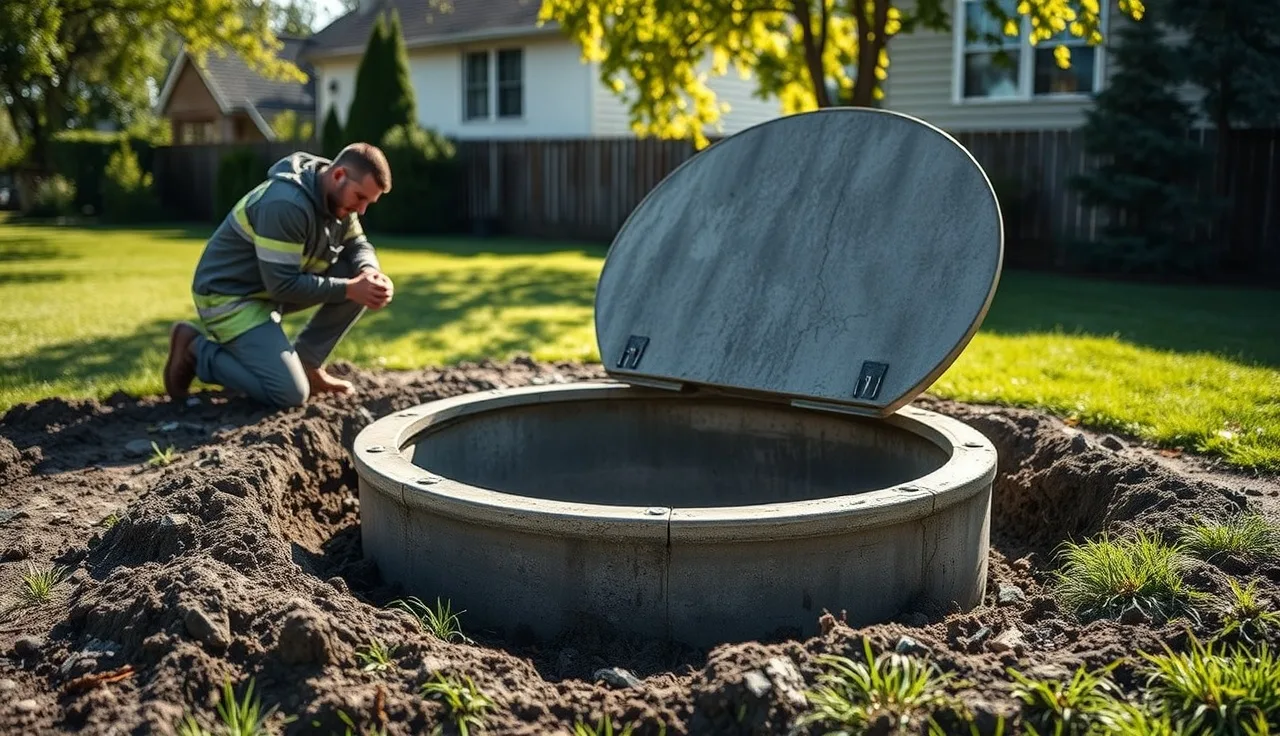
A 1500 gallon septic tank is a two-compartment buried vessel that holds and partially treats household wastewater before it flows to a leach field. Solids settle to the bottom as sludge, grease floats to the top as scum, and the liquid effluent in the middle exits to the drain field.
States size septic tanks to bedroom count, not the number of people living there. Bedroom count is a reliable stand-in for peak occupant load, and the EPA uses the same metric in its SepticSmart guidance [1]. Here's how the sizing usually works out:
| Bedrooms | Minimum tank size (most states) |
|---|---|
| 1 to 2 | 750 gallon |
| 3 | 1,000 gallon |
| 4 | 1,250 to 1,500 gallon |
| 5 to 6 | 1,500 gallon |
| 7+ | 1,750 gallon+ |
A 750 gallon tank fits a small cabin or a one-bedroom accessory dwelling unit. It cannot handle the daily flow of a four-bedroom house. A 1,500-gallon tank sits at the top of the residential range and gives a household of five or six real headroom before the next pump becomes urgent.
Some counties now require a 1,500-gallon minimum no matter the bedroom count. Several states, including North Carolina and Florida, have moved toward 1,000-gallon minimums for any new install, and some already require 1,500 for homes on lots under a half acre [2]. Check your local onsite wastewater code before you buy anything.
How much does a 1500 gallon septic tank cost?
The tank by itself, before excavation or labor, runs $800 to $2,500 depending on material and where you live. Concrete precast is cheapest per gallon, usually $900 to $1,500 for a 1,500-gallon unit. Polyethylene (plastic) tanks run $1,200 to $2,000. Fiberglass lands in the same neighborhood, $1,100 to $2,100, and shows up often where the water table is high or the soil eats concrete.
Installed cost is a different animal. Budget $3,500 to $8,000 for tank plus installation on a straightforward residential job [3]. The range is wide on purpose. Excavation depth, soil type, distance from the road, permit fees, and whether the crew has to demo an old tank all push the number up fast. Expensive metros like the Bay Area or coastal Massachusetts can hit $10,000 or more for a tank swap alone.
See the full breakdown of what drives these numbers in our article on cost to put in a septic tank.
One honest note on comparisons. Nobody tracks a clean national average for 1,500-gallon installs specifically. The figures above come from state extension surveys and contractor pricing, and your quote may land outside this range without anyone ripping you off. Get three quotes and compare line items, more than bottom lines.
How often does a 1500 gallon septic tank need to be pumped?
The EPA recommends pumping a typical household tank every 3 to 5 years [1]. For a 1,500-gallon tank, the real interval hinges on two things: how many people live in the house, and how fast sludge and scum pile up.
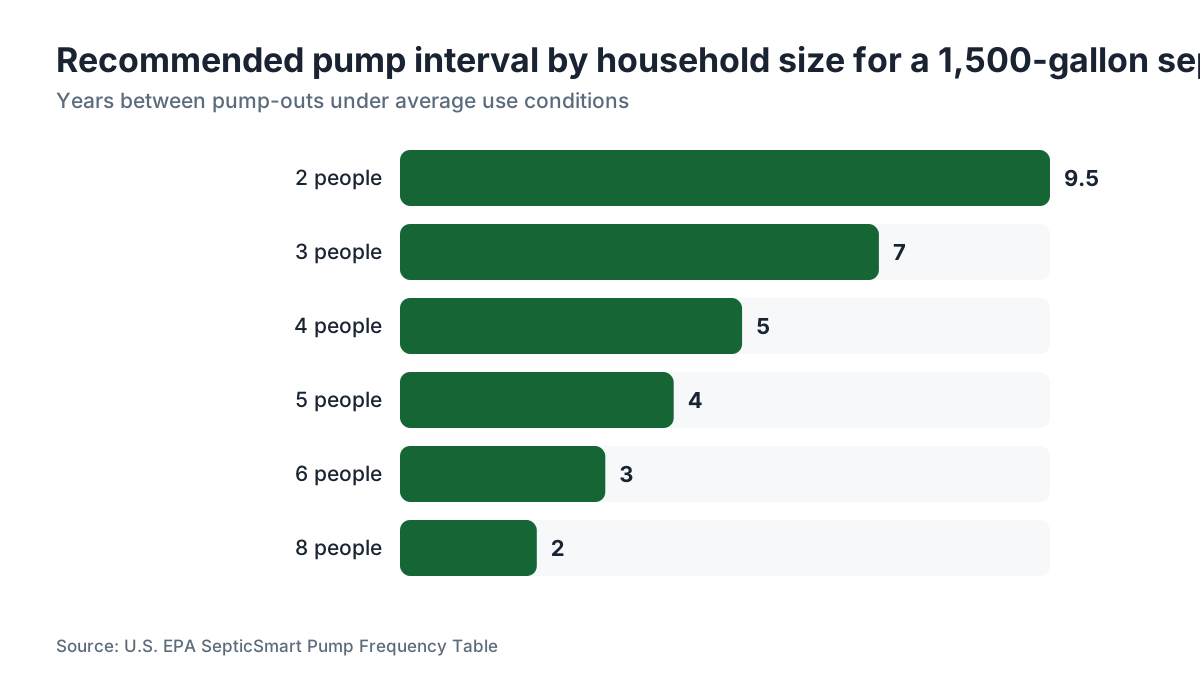
The EPA's own pump frequency table, published in its "How to Care for Your Septic System" guidance, shows a 1,500-gallon tank serving two people can go roughly 9.5 years between pumpings if sludge stays manageable, while the same tank serving eight people needs pumping about every 2 years [12]. Most four-person households land in the 4-to-5 year range.
The only honest way to know is to open the lid and measure. A technician checks the sludge and scum layers directly. Pump when the sludge layer climbs within 12 inches of the outlet baffle, or when sludge plus scum together fill more than a third of the tank. At 1,500 gallons, a third is 500 gallons of solids. That fills faster than most people expect, especially with a garbage disposal running daily or wipes going down the toilet.
For a full pumping schedule and what to expect on service day, see our guide to how often to pump a septic tank.
Pumping cost runs $300 to $600 for a 1,500-gallon tank in most markets. A standard septic tank pump out in rural areas with long haul distances can push past $700. Operators who run route-optimization software schedule these more tightly, which is part of where tools like SepticMind keep costs down on both sides of the transaction.
What are the dimensions of a 1500 gallon septic tank?
Dimensions change by manufacturer and material, but a concrete 1,500-gallon two-compartment tank usually measures about 8 feet long by 5 feet wide by 5.5 to 6 feet deep. Plastic and fiberglass tanks tend to run longer and narrower, closer to 10 to 11 feet long by 4 feet wide, so they stay light enough to ship and set by hand.
Burial depth matters too. Most residential codes want at least 6 inches of cover over the lid, and many require 12 to 24 inches. When a tank sits deep to clear the frost line up north, the riser pipe to the surface adds real length to the dig.
Trying to figure out what's already buried on your lot? The tank dimensions and burial depth show up on the original permit drawing, which the county health department keeps on file. No permit on record? A locator rod or a basic septic tank inspection with a camera will find it.
How long does a 1500 gallon septic tank last?
Material sets lifespan more than anything else.
Concrete tanks last about 40 years under normal conditions, but they take damage from hydrogen sulfide corrosion inside and from roots and soil movement outside [4]. Tanks poured before the mid-1980s often used lower-grade concrete and thinner walls, and those can crack in 20 to 30 years. If your concrete tank is older than 30 years and nobody has looked at it lately, a camera inspection is worth the $150 to $300 it costs.
Polyethylene tanks shrug off corrosion but can warp or float in a high water table if they sit empty during installation. Most makers rate them for 30 to 50 years. Fiberglass tanks match that longevity and hold up well in coastal and humid regions.
Steel tanks were common from the 1950s into the early 1980s. They rust. If you have one, assume it is at or near the end of its life no matter when it went in. A septic tank repair might buy a few years, but replacement is usually the right call.
The biggest killer of any tank is neglect. Skip pumping for 15 or 20 years and the sludge gets thick enough that solids ride out with the effluent and clog the drain field. That turns a $400 pump job into a $10,000 to $20,000 drain field replacement.
What materials are 1500 gallon septic tanks made from?
Three materials own the market.
Concrete precast is the most common in the U.S. A 1,500-gallon concrete tank weighs 8,000 to 12,000 pounds empty, so setting it takes a crane or heavy equipment. That weight cuts both ways. It also keeps the tank from floating in a high water table. Concrete builds up its own microbial population over time, which helps the biological treatment along.
Polyethylene tanks are light, easy to haul to tough sites, and fully corrosion-proof. A 1,500-gallon poly tank usually weighs under 400 pounds. Installers like them for tight-access lots. The catch is ballasting: in saturated soil they need anchoring to stop them from floating.
Fiberglass sits between the two. It's stronger than poly, lighter than concrete, and resists corrosion. It's the go-to in many coastal states where salty soil chews through concrete.
A few high-end aerobic treatment units (ATUs) use 1,500-gallon fiberglass tanks as the primary chamber, but those are a separate product with their own maintenance demands.
For a plain residential install on flat ground with good access, the choice often comes down to what your installer stocks and what your county approves. Both concrete and plastic are legal in all 50 states. A few counties still require concrete for primary tanks.
How do you maintain a 1500 gallon septic tank properly?
The EPA SepticSmart program boils it down: pump on schedule, watch what goes down the drain, and protect the drain field [1]. Here's what that means in practice for a 1,500-gallon tank.
Pump every 3 to 5 years. Don't wait for signs of a backup. By the time sewage surfaces in the yard, the drain field is often already hurting. Our full septic tank pumping guide covers what good service looks like.
Never flush wipes, even the ones marked "flushable." They don't break down in an anaerobic tank and they build up in the scum layer faster than almost anything. Same goes for feminine hygiene products, dental floss, and paper towels.
Go easy on the garbage disposal. Every pound of food scraps is organic solid that speeds up sludge buildup. Heavy disposal use can cut your pumping interval by a year or two.
Keep grease out of the drain. It thickens the scum layer and migrates to the outlet baffle, where it does real damage.
Keep vehicles off the tank and the drain field. A standard residential concrete lid is not built for vehicle loads. A cracked lid is one of the most common paths to tank failure and groundwater contamination.
Bacterial additives? The research is mixed. The EPA neither recommends nor requires them, and a healthy tank grows its own microbial community. Save the money and spend it on more frequent pumping.
For the difference between a full cleaning and a standard pump-out, see our septic tank cleaning guide.
What are the signs that a 1500 gallon septic tank is failing or full?
Some signs are obvious. Others show up months before an emergency if you know what to watch for.
Slow drains across multiple fixtures point to the tank or the line from the house backing up. A single slow drain is usually just a clogged pipe, not a tank problem.
Sewage smells inside the house, or outside near the tank or drain field, are a warning. Outdoor odors after heavy rain can be normal, because water table pressure forces gases up. Persistent indoor odor means trouble with the inlet or outlet baffle, or the liquid level in the tank is riding too high.
Wet or spongy ground over the drain field when it hasn't rained recently means the field is saturated with effluent. That usually traces back to a tank that went too long between pumpings, letting solids escape into the field.
Bright green, unusually lush grass over the drain field in summer tells the same story from above. Effluent is fertilizing the grass because it isn't dispersing the way it should.
If any of these apply, stop running laundry and the dishwasher until a technician is on site. Those high-volume appliances add 30 to 50 gallons a load and can shove a struggling system into a full backup fast.
See our guide to septic system repair for what happens after a failure diagnosis.
Can a 1500 gallon septic tank be too big for a house?
Yes, and it's a real problem. An undersized tank is more common, but oversizing has its own failure mode.
Septic tanks work through anaerobic biological treatment. Bacteria digest organic solids. That microbial community needs steady organic loading to stay healthy. A 1,500-gallon tank serving a one-bedroom cottage where the owner shows up on weekends doesn't get enough waste flow to keep the bacteria fed. The anaerobic environment breaks down, temperatures drop, and the system does a worse job separating solids from effluent.
The result: effluent from an underfed tank is less treated than it should be before it reaches the drain field. That shows up as early biomat formation and a shorter drain field life.
The minimum loading rate for most residential tanks is roughly 150 gallons per day. A 1,500-gallon tank is designed for 300 to 600 gallons per day under typical use. If your daily flow sits well under 150 gallons, a 1,000-gallon tank is the better fit. But once a 1,500-gallon tank is in the ground and working, don't rip it out over this. Pump it more often and the biological activity stays adequate.
What permits and regulations apply to a 1500 gallon septic tank installation?
Septic installation is regulated at the state and county level. There's no single federal permit, but the EPA sets baseline guidance through the Clean Water Act and its SepticSmart program, and states must meet or exceed those standards [8].
Most states require a site evaluation (a soil percolation test or soil profile), a permit application, an approved design from a licensed engineer or soil scientist, an inspection during installation, and a final sign-off before the tank gets covered. The process usually takes 2 to 8 weeks and costs $200 to $800 in permit fees.
Florida requires a permit from the county health department under Chapter 64E-6 of the Florida Administrative Code and sets minimum tank sizes for residential use, with 1,500 gallons required in many cases [2]. North Carolina's rules under 15A NCAC 18A .1900 set minimum tank sizes by daily flow tied to bedroom count [5]. Texas regulates onsite systems through the TCEQ under Title 30 TAC Chapter 285 [6].
Local rules vary and they change. Before you buy a tank, call your county health department or environmental health office. On most jobs the installer pulls the permit, not the homeowner. If a contractor offers to skip the permit to save time and money, walk away. An unpermitted tank can block a home sale, trigger fines, and leave you personally on the hook for groundwater contamination.
For the full process from start to finish, see our septic tank installation article.
How does a 1500 gallon tank compare to other common septic tank sizes?
Size comparisons matter when you're replacing a tank, adding an ADU, or sizing up a home you might buy.
A 750-gallon tank is usually the smallest allowed for an occupied residence in states that permit it at all. It fits small cabins, tiny homes, and one-bedroom units with low daily flow. Compared to a 1,500-gallon unit, the 750 holds exactly half the volume and supports roughly half the occupant load before pumping frequency turns into a chore.
The 1,000-gallon tank is the workhorse for three-bedroom homes and the minimum standard for new installs in many states as of 2024.
Here are the major size tiers side by side:
| Tank size | Typical household size | Approx. pump interval (4 people) | Installed cost range |
|---|---|---|---|
| 750 gallon | 1 bedroom, low use | 2 to 3 years | $2,500 to $5,000 |
| 1,000 gallon | 2 to 3 bedrooms | 3 to 4 years | $3,000 to $6,000 |
| 1,250 gallon | 3 to 4 bedrooms | 4 to 5 years | $3,200 to $6,500 |
| 1,500 gallon | 4 to 6 bedrooms | 4 to 6 years | $3,500 to $8,000 |
| 2,000 gallon | 6+ bedrooms or commercial | 5 to 7 years | $5,000 to $12,000 |
The full cost to install a septic system picture includes the drain field, which often runs two to three times the cost of the tank itself.
Operators managing routes across a mix of tank sizes need to track intervals by property. That's exactly what SepticMind's scheduling tools handle, keeping pump reminders accurate without manual calendar math.
What should you do when buying a home with a 1500 gallon septic tank?
Get an inspection before closing. Not after. A pre-purchase septic inspection, called a Title 5 inspection in Massachusetts or a point-of-sale inspection elsewhere, involves pumping the tank, checking every component, and flow-testing the system [7]. It runs $300 to $600 in most markets and is one of the smarter dollars you'll spend on a home purchase.
Ask the seller for maintenance records. A 1,500-gallon tank pumped every three years with clean records is a very different asset than one with no service history. Missing records usually mean missing service, and a tank that hasn't been pumped in a decade may have sent solids into the drain field years ago.
Confirm the permit record matches what's in the ground. The county file should show tank size, install date, and drain field design. If the file says 1,000 gallons and the technician finds a 1,500-gallon tank with no permit, that's worth investigating before you close.
Check the drain field on its own. An intact tank doesn't mean a healthy system. Probe rods and a camera inspection of the distribution box tell you whether the field is absorbing effluent or already saturated.
Our septic tank inspection guide covers what a pre-purchase inspection should include and what to do with the findings.
Frequently asked questions
How many bedrooms can a 1500 gallon septic tank support?
Most state codes size a 1,500-gallon tank for 4 to 6 bedrooms. The exact number depends on your state's rules, which typically use daily wastewater flow tied to bedroom count. In states like Florida and North Carolina, 1,500 gallons is commonly required for four-bedroom homes. Always verify with your county health department, since minimums vary and some states have raised their requirements since 2020.
How long does it take to pump a 1500 gallon septic tank?
A standard pump-out takes 20 to 45 minutes once the truck is on site and the lid is exposed. The truck removes all liquid and solids and hauls them to a licensed disposal facility. If the technician has to locate the lid, dig it out, or clear a blocked inlet baffle, the job can run 90 minutes or more. Keeping your lid risers at grade speeds things up considerably.
What happens if you never pump a 1500 gallon septic tank?
Sludge and scum build until solids exit with the liquid effluent into the drain field. Once solids reach the field, they clog the soil pores and form a biological mat that blocks drainage. This is biomat failure. Drain field replacement costs $10,000 to $25,000 or more depending on soil and system size. The tank itself may survive, but the whole system becomes unusable.
Can I install a 1500 gallon septic tank myself?
In most states, no. Installation requires a permit, a licensed installer, and a county inspection before the tank is covered. Some rural counties allow owner-installed systems on the owner's own property with a permit, but that's the exception. Installing without a permit creates liability, potential fines, and can make the property harder to sell. Hire a licensed installer and pull the permit properly.
What is the difference between a 1-compartment and 2-compartment 1500 gallon tank?
A two-compartment tank has an internal wall separating the primary settling zone from a secondary clarification zone. Effluent leaving the first compartment still carries fine particles; the second compartment settles those out before the liquid reaches the outlet baffle and the drain field. Two-compartment tanks are required by code in most states for new installs and produce meaningfully cleaner effluent. Single-compartment tanks are mostly found in older systems.
How deep does a 1500 gallon septic tank need to be buried?
Most codes require at least 6 inches of soil cover over the lid, with 12 to 24 inches more common in cold climates to clear the frost line. In northern states, tanks may sit 4 to 6 feet deep. The inlet pipe from the house drives minimum depth more than any code number: the pipe must slope at least 1/8 inch per foot from the house to the tank inlet, which sets burial depth on flat lots.
Is a 1500 gallon concrete septic tank better than plastic?
Neither is universally better. Concrete is heavy, resists buoyancy, and lasts a long time in stable soil, but it can crack over the years and suffers hydrogen sulfide corrosion. Plastic resists corrosion completely but can float or deform in saturated or unstable soil. In most residential installs with good access and normal soil, concrete is standard. In high-water-table or coastal conditions, fiberglass or anchored poly often performs better.
How much does it cost to replace a 1500 gallon septic tank?
Replacement runs $3,500 to $9,000 in most U.S. markets, covering excavation, the new tank, installation, and permit fees. If the old tank must be crushed and buried in place (common with concrete), add $500 to $1,500. If access requires a crane for a concrete tank, add another $500 to $1,000. Costs climb in high-labor metros and jump sharply if drain field work is needed at the same time.
Does a 1500 gallon septic tank need a filter?
Effluent filters on the outlet baffle are required by code in most states for new installs and are one of the best low-cost upgrades for existing tanks. They trap solids that escape the tank and protect the drain field. A standard outlet filter costs $20 to $60 and should be cleaned every time the tank is pumped [11]. Without one, fine particles gradually clog the drain field and shorten its life.
What is the weight of a 1500 gallon concrete septic tank?
A precast concrete 1,500-gallon tank weighs 8,000 to 12,000 pounds empty, depending on wall thickness and whether it's one-piece or two-piece construction. That weight requires a crane or a tracked excavator with lifting capability to install. It also means the tank won't float during high groundwater, a meaningful advantage in many soil conditions.
Can a 1500 gallon septic tank handle a garbage disposal?
Technically yes, but regular disposal use speeds up sludge accumulation a lot. Studies estimate garbage disposal use can raise the solid loading to a tank by 50 percent or more, shortening pump intervals by one to two years [9]. If you use a disposal heavily, pump your 1,500-gallon tank every 2 to 3 years instead of every 4 to 5. Some county codes prohibit disposals on properties with small septic systems for this reason.
How do I find the lid of my 1500 gallon septic tank?
Start with the original permit drawing on file at the county health department. It shows the tank location relative to the house. If no drawing exists, follow the main sewer pipe out from the house; the tank is typically 5 to 20 feet from the foundation. An 18-inch metal probe rod can locate the top of a concrete tank. Most concrete tanks have two lids, one over each compartment, spaced roughly 4 to 5 feet apart.
Do I need to be home when my 1500 gallon septic tank is pumped?
You don't have to be, but it's worth being home for the first pump if you're new to the property. A good technician will report on sludge depth, scum thickness, baffle condition, and any cracks or damage. That information helps set your next service interval. If you can't be there, ask the company for a written condition report and confirm they'll contact you if they find anything needing follow-up.
Sources
- U.S. EPA, SepticSmart: How to Care for Your Septic System: EPA recommends pumping every 3 to 5 years and publishes pumping frequency tables by household size and tank volume; bedroom count is used as the household size proxy for sizing.
- Florida Department of Health, Chapter 64E-6 Florida Administrative Code: Standards for Onsite Sewage Treatment and Disposal Systems: Florida requires county health department permits for septic tank installation and sets minimum tank sizes; 1,500 gallons is commonly required for four-bedroom homes under current standards.
- Virginia Cooperative Extension, Homeowner's Guide to Septic Systems: Installed cost for a residential septic tank ranges from approximately $3,500 to $8,000 for the tank and installation on a standard site, with variation by region and site conditions.
- Penn State Extension, Septic System Maintenance and Management: Concrete septic tanks last approximately 40 years on average; hydrogen sulfide corrosion from inside and root intrusion are the primary failure mechanisms.
- North Carolina Administrative Code, 15A NCAC 18A .1900: Sewage Treatment and Disposal Systems: North Carolina sets minimum septic tank sizes by daily flow calculations tied to bedroom count under 15A NCAC 18A .1900.
- Texas Commission on Environmental Quality (TCEQ), Title 30 TAC Chapter 285: On-Site Sewage Facilities: Texas regulates onsite sewage systems under Title 30 TAC Chapter 285, requiring permits and licensed installers for all septic system installations.
- Massachusetts Title 5: State Environmental Code for Septic Systems: Massachusetts Title 5 requires a point-of-sale inspection (often called a Title 5 inspection) before property transfer, covering tank pumping, visual inspection, and flow testing.
- U.S. EPA, Septic Systems Overview: The EPA Clean Water Act provides the federal baseline for onsite wastewater treatment; states must meet or exceed EPA standards in their own septic regulations.
- University of Minnesota Extension, Septic System Owner's Guide: Garbage disposal use can increase the solid loading to a septic tank by 50 percent or more, shortening pump intervals by one to two years.
- National Environmental Services Center (NESC) at West Virginia University, Septic Tank Sizing Guidelines: A two-compartment tank provides meaningfully cleaner effluent than a single-compartment tank; two compartments are required by code in most states for new installations.
- Oklahoma State University Extension, Septic Tank Maintenance: Effluent filters on the outlet baffle are a low-cost upgrade ($20 to $60) that protect the drain field from fine solids and should be cleaned at each pump-out.
- U.S. EPA, SepticSmart Pump Frequency Table: EPA's published pump frequency table shows a 1,500-gallon tank serving two people may go approximately 9.5 years between pumping, while serving eight people requires pumping approximately every 2 years.
Last updated 2026-07-09