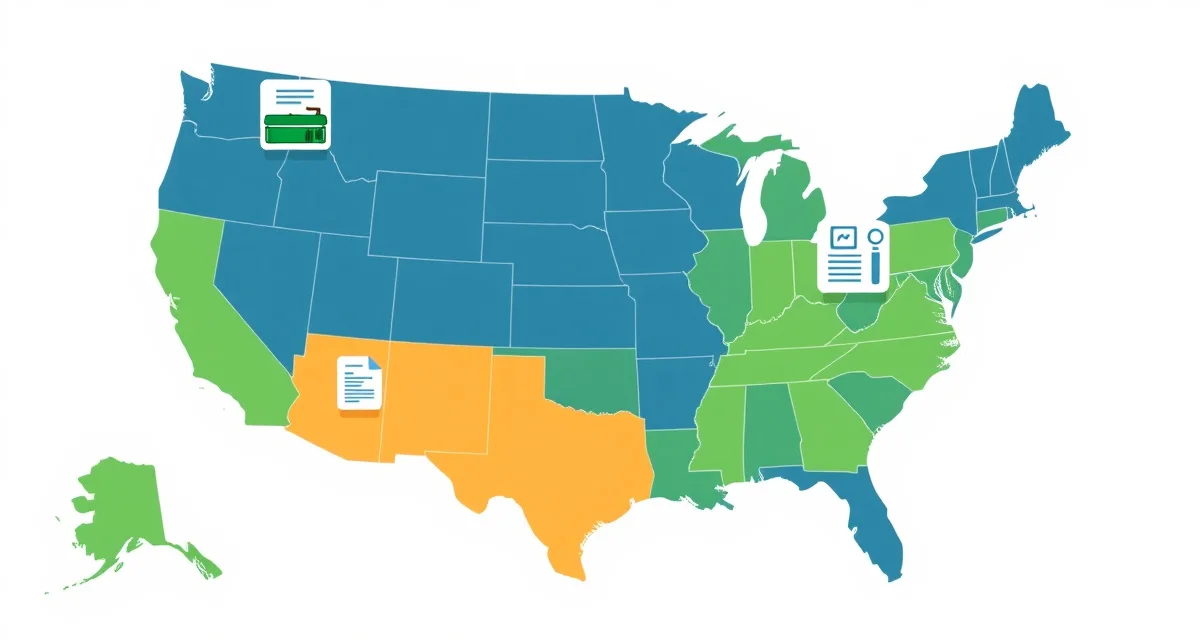
State Onsite Wastewater Regulations: A 50-State Overview for Pros
By the SepticMind Editorial Team
If you've been in this business more than a few years, you know the regulations don't stop at state lines. But they start there. Every state has its own framework for onsite wastewater treatment, who's licensed to do the work, what systems are permitted, how inspections are documented, and what happens when something fails.
TL;DR
- Septic permit and compliance requirements are set at the state level but administered at the county level, creating significant variation within a single state.
- Operating without required permits or missing compliance deadlines can result in fines, stop-work orders, and license referrals.
- Permit applications must include specific documentation (soil evaluations, site plans, contractor license) that varies by county.
- Multi-county operations need a systematic approach to tracking permit applications, status updates, expiration dates, and renewal deadlines.
- Digital permit tracking reduces the risk of missed deadlines that compound into compliance notices and license risk.
- SepticMind's county permit database covers all 50 states with current forms, fees, and review timelines.
Getting it wrong doesn't just mean a fine. Regulatory penalties for onsite wastewater violations average $3,800 per incident. And that's before you factor in the cost of remediation, the hit to your license, and the customer who tells everyone in town what happened.
This guide covers the regulatory landscape across all 50 states, the framework, the quirks, the strictest markets, and what you need to have in place if you're operating in multiple states or expanding into new territory.
How State Septic Regulation Works
Most states regulate onsite wastewater treatment through one of three agency structures:
State Department of Health, Handles septic regulation in states where onsite sewage is primarily a public health concern. Common in the Southeast and Northeast.
Environmental Quality or Environmental Management Agency, Handles regulation in states where water quality and groundwater protection drive the regulatory approach. Common in the Mountain West and Pacific states.
Hybrid systems, Many states split authority between a health agency (which handles permits and inspections) and an environmental agency (which handles enforcement, especially near water features). Florida, Virginia, and North Carolina operate this way.
Below that, most states delegate day-to-day permit issuance to county health departments. The state sets the rules; the county applies them. But the state retains enforcement authority, especially for major violations.
The States with the Most Complex Regulations
Not every state is equal when it comes to compliance burden. A few are known for strict, detailed requirements that require significant documentation and follow-through:
Massachusetts
Title 5 (310 CMR 15.000) is probably the most famous state septic regulation in the country. It governs every aspect of septic system design, installation, inspection, and failure response. The key feature is the mandatory inspection tied to real estate transfer, every property sale in Massachusetts requires a Title 5 inspection, and the results must be filed with the local Board of Health.
Inspectors must be licensed by the state. Systems that fail must be upgraded within a defined timeline, or the sale doesn't close. Systems that conditionally pass have a two-year window for repairs.
Operating in Massachusetts without understanding Title 5 in detail means you're going to have problems with real estate agents, buyers, sellers, lenders, and local health boards on a regular basis.
California
California's Onsite Wastewater Treatment System (OWTS) Policy, adopted by the State Water Resources Control Board in 2012, was a major regulatory shift. Before it, each county operated largely independently. The OWTS Policy established a tiered system based on risk level, with Tier 1 covering standard residential systems and Tier 2-3 covering systems near water bodies or in areas with high density.
California still runs through 58 counties and several regional Water Quality Control Boards, and variation between counties is significant. Los Angeles County's standards differ substantially from Sonoma County's, which has added nitrate loading requirements that go beyond the state policy.
If you're operating in California, you need to know which regional board governs your service area and what additional county requirements apply.
North Carolina
NC operates under the Sanitation of Subsurface Disposal Systems rules administered by the Division of Public Health. The state has a detailed permit and inspection process for new installations and repairs, with 100 county health departments handling day-to-day permitting.
What makes North Carolina notable is its system of Operation and Maintenance (O&M) permits for non-conventional systems, aerobic treatment units, drip irrigation systems, and low-pressure pipe systems all require O&M permits with regular inspection and reporting requirements. The state tracks this through county EHS offices, and failure to maintain O&M records is a common compliance gap for companies that service these systems without knowing the requirement exists.
Florida
Florida's onsite system regulation is administered by 67 county health departments under the Florida Department of Health (DOH). The state Onsite Sewage Treatment and Disposal Systems (OSTDS) rules are comprehensive, but enforcement varies significantly by county.
What makes Florida complex is the density of failing and marginal systems, Florida has a large stock of older systems, many installed in the 1960s-1980s, that regularly come up for inspection in real estate transactions. The state also has strict setback requirements from surface water, which matters enormously given the state's hydrology.
Aerobic treatment units are increasingly common in Florida for lots that can't support a conventional drainfield. These require ongoing O&M contracts that the septic company must maintain documentation of.
Virginia
Virginia's Sewage Handling and Disposal Regulations (12VAC5-610) govern septic systems, with the Virginia Department of Health setting standards and local health departments handling permits and inspections.
Virginia is notable for its Voluntary Maintenance Program and the complexity of its approval process for alternative systems. The state also has a significant number of systems in the Chesapeake Bay watershed area, where nutrient reduction requirements add another layer to system design and upgrade decisions.
Mid-Tier States: Regulated but Workable
Most states fall into a middle tier, they have clear regulations and licensing requirements, but the day-to-day compliance burden isn't as heavy as Massachusetts or California.
Texas
Texas is unusual. The Texas Commission on Environmental Quality (TCEQ) regulates onsite sewage facilities (OSSFs), but enforcement is heavily county-dependent. Many rural Texas counties have adopted rules that give them their own permitting authority, while others follow TCEQ rules directly.
Texas licenses septic installers through TCEQ, with different designations for installer, designated representative, and maintenance provider. Licensing requirements are real but the exam process is accessible.
The challenge in Texas is the county-by-county variation. Companies that cover large service areas in Texas, and the state is huge, need a system for tracking which counties follow TCEQ rules directly versus counties with their own additional requirements.
Pennsylvania
PA regulates through the Department of Environmental Protection under the Pennsylvania Sewage Facilities Act (Act 537). Municipalities (townships and boroughs) serve as the local authority, similar to how Massachusetts uses towns and cities.
Pennsylvania requires Sewage Enforcement Officers (SEOs) to be employed by the municipality, so when you're pulling permits in PA, you're dealing with municipal SEOs rather than county health departments. This creates even more local variation than the county-based states.
Michigan
Michigan's Onsite Water Supply and Sewage Disposal Programs are administered through local health departments under state Act 368. The state has 45 local health departments that vary in their interpretation and enforcement of state rules.
Michigan is notable for its strict requirements around systems near the Great Lakes and inland lakes, where setback and nitrogen management requirements are stricter than standard residential rules.
New York
New York regulates through the State Department of Health but administers through local boards of health at the county level. Standards in New York vary significantly between downstate counties (Long Island, Westchester) and upstate counties. Long Island has some of the strictest septic requirements in the country due to groundwater contamination concerns, including requirements for nitrogen-reducing systems in certain zones.
Western States: Less Dense but Complex Near Water
Oregon
Oregon DEQ administers the Onsite Sewage Disposal Program. The state has detailed rules for alternative systems and requires Licensed On-Site System Installers for all permitted work. Oregon is notably strict around systems near water bodies, with the most stringent requirements in the Willamette Valley and coastal counties.
Washington
Washington State DOH administers Onsite Sewage System (OSS) rules, with 39 counties serving as the local authority. Washington has been progressively tightening requirements around Puget Sound, where failing septic systems have contributed to shellfish harvest closures.
Colorado
Colorado's Water Quality Control Division handles onsite wastewater through the OWTS Standards (Regulation 43). Local public health agencies and counties have authority to set stricter local standards. Colorado requires OWTS Design permits and Construction permits for new systems, with some counties additionally requiring O&M plans for non-standard systems.
Arizona
Arizona is one of the few states where the Arizona Department of Environmental Quality (ADEQ) is the sole permitting authority for conventional systems, there's no county-level delegation for standard residential permits in most cases. This actually makes Arizona more consistent across counties than most states. Alternative systems have more complex approval pathways through ADEQ.
Licensing: What Each State Requires
Most states require some form of licensing or registration for septic contractors. The specifics vary:
- Installer licenses, Required in most states for new system installation. Usually involves an exam and continuing education requirements.
- Pumper registrations, Many states require septic haulers to be registered and to use approved disposal facilities.
- Inspector certifications, Some states have separate certification requirements for inspectors vs. installers. Massachusetts and Massachusetts-adjacent states are strict about this distinction.
- Maintenance provider approvals, States with mandatory O&M programs (North Carolina, Florida for ATUs) often require maintenance providers to be approved or registered separately.
When you're expanding into a new state, the first step is always checking the licensing requirements. Operating without the right license is the fastest way to face regulatory action.
Documentation Requirements That Vary by State
Beyond permits, states differ in what documentation they require you to maintain:
Service manifests, Most states require documentation of where pumped waste is disposed. Some states require the manifest to be filed with the state or county. Louisiana, Mississippi, and several other states have strict manifest filing requirements with short deadlines.
Inspection reports, States with inspection programs have specific form requirements. Massachusetts Title 5 forms are standardized statewide. North Carolina uses DEH-EHS forms. Some states accept any format as long as required fields are covered; others reject reports that aren't on the official form.
Failure reports, Many states require failed systems to be reported to the local health authority within a defined timeframe. Virginia requires reporting within 24 hours in some cases.
O&M records, States with mandatory O&M programs require maintenance records to be kept and sometimes filed with the county. North Carolina's O&M permit system is one of the most formalized.
How Software Helps With Multi-State Compliance
If you're operating in a single state, you can manage compliance manually. You know your state's rules, you know the forms, and you probably have the county permit contacts in your phone.
The moment you cross a state line, even for a few jobs a month, manual management stops working reliably. Different forms, different filing requirements, different permit fees, different inspection standards. Keeping it all in a spreadsheet is a recipe for gaps.
SepticMind's state compliance templates auto-populate into inspection reports based on the job location. When a tech creates an inspection record in Massachusetts, they get a Title 5-formatted template. When they're in North Carolina, they get the DEH-EHS format. The system knows which template to use because it knows what county the job is in.
That means your techs aren't guessing which form to use in the field, and you're not reviewing reports that were done on the wrong template.
What to Do When Regulations Change
State septic regulations change more often than most contractors expect. Massachusetts revised Title 5 multiple times in the last decade. North Carolina made significant rule changes to its O&M program in 2017. California's OWTS Policy is regularly updated with guidance documents.
The companies that stay ahead of changes typically do three things:
- Belong to state trade associations, State chapters of NAWT and state-specific groups like the Massachusetts Onsite Wastewater Association track regulatory changes and notify members.
- Maintain direct relationships with regulators, A phone number for your state's septic program manager is worth having. They'll often tell you what's in the pipeline before it's finalized.
- Use software with live regulatory updates, SepticMind pushes database updates when state regulations change, so your templates and compliance checklists reflect current requirements.
Get Started with SepticMind
SepticMind is designed around the actual workflows of septic service companies, from county permit tracking to automated maintenance reminders. Whether you are managing a single truck or a multi-county fleet, the platform scales with your operation. See how it works for your business.
FAQ
Which states have the most complex onsite wastewater regulations?
Massachusetts, California, North Carolina, and Florida consistently present the highest compliance complexity for septic contractors. Massachusetts requires Title 5 inspections for every real estate transfer with standardized forms filed with local boards of health. California operates through 58 counties and multiple regional water boards with significant local variation. North Carolina has a formal O&M permit system for alternative systems with regular reporting requirements. Florida runs through 67 county health departments with strict setback requirements and mandatory ATU maintenance contract documentation.
How often do state septic regulations change?
More often than most contractors expect. Major revisions happen every 3-7 years in most states, with interim guidance documents and rule clarifications coming more frequently. California has issued multiple OWTS Policy updates since the original 2012 adoption. North Carolina made significant O&M rule changes in 2017. Massachusetts periodically revises Title 5 setback and repair requirements. The best way to stay current is through state trade association membership and using software that tracks regulatory changes automatically.
Does SepticMind update automatically when regulations are revised?
Yes. SepticMind's state compliance template database is updated when regulations change, and updates push to your account without requiring manual action on your part. The system covers all 50 states with templates formatted to each state's specific inspection and permit documentation requirements. When you create an inspection record, the system auto-selects the correct template for the job location.
What are the consequences of performing septic work without a required permit?
Performing septic work without required permits can result in stop-work orders halting the project, fines on a per-day or per-violation basis, mandatory removal of unpermitted work at the contractor's expense, and referral to the contractor licensing board for potential license action. In some states, unpermitted septic work also creates civil liability for the contractor if the system later fails and the homeowner can show the work was not properly inspected. Obtaining permits before beginning work protects both the contractor and the property owner.
How should a septic company track permit deadlines across multiple counties?
A spreadsheet can work for a single county, but multi-county permit tracking requires a system with automated deadline alerts, status tracking, and the ability to store permit documents by project. The most common failure mode is a permit that was applied for and approved but whose inspection deadline was missed because no one was actively monitoring it. Purpose-built septic software with a permit tracking module flags upcoming deadlines automatically and keeps all permit documentation attached to the relevant project record.
Try These Free Tools
Sources
- National Onsite Wastewater Recycling Association (NOWRA)
- US EPA Office of Wastewater Management
- NSF International
- Water Environment Federation
- National Environmental Services Center (NESC)