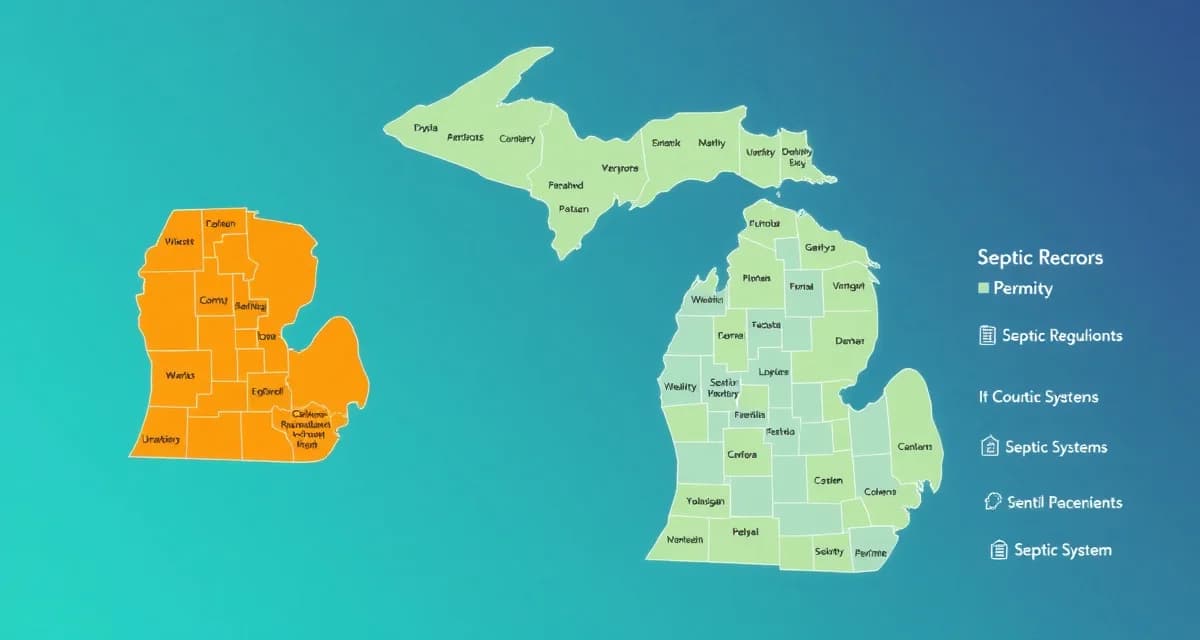
Michigan Onsite Wastewater Regulations: Navigating 83 County Codes
By the SepticMind Editorial Team
Michigan's lack of a statewide code means two adjacent counties can have completely different permit requirements. SepticMind is the only FSM platform mapping all 83 Michigan county health department septic requirements. Michigan's 83 county codes vary so widely that requirements in Washtenaw County have no counterpart in Keweenaw County.
TL;DR
- Michigan septic regulations are administered at the state level with enforcement typically delegated to county health or environmental departments.
- Licensing requirements for pumping, inspection, and installation work vary by county within Michigan and should be verified with local authorities.
- Operating, maintenance, and inspection reporting requirements in Michigan differ for conventional systems versus alternative systems like ATUs.
- Companies operating in multiple Michigan counties need to track permit and reporting requirements by county, not just by state.
- State-mandated inspection report formats in Michigan must be used for regulatory submissions; generic forms are typically not accepted.
- SepticMind's permit database covers Michigan county-level requirements to reduce the research burden for multi-county operations.
This is not an exaggeration. Michigan is genuinely the most complex septic compliance environment in the United States. Every state creates some county-level variation, but Michigan has no statewide septic code at all, giving counties essentially free rein to develop their own standards. The result is 83 different regulatory frameworks that a company operating across county lines must navigate simultaneously.
Why Michigan Has No Statewide Septic Code
Michigan's lack of a statewide code is a political and historical reality rather than a regulatory choice. Michigan law delegates authority for onsite sewage regulation to county health departments under the Michigan Public Health Code. Attempts to establish a statewide code have stalled in the legislature, leaving the county-by-county system in place.
The Michigan Department of Environment, Great Lakes, and Energy (EGLE) does provide technical guidance and oversight of groundwater quality issues related to septic systems, but EGLE is not a permit-issuing authority for routine residential septic installation. That authority rests with the county health department, all 83 of them.
This means:
- There is no single permit application format that works in all Michigan counties
- Setback requirements vary notably by county
- Approved system types differ, a system type approved in one county may require a variance or may not be approved at all in an adjacent county
- Inspection requirements and timing differ
- Record-keeping and reporting obligations vary
- Fees vary widely
The Range of County-Level Variation
To illustrate how dramatic the variation is, consider these examples of areas where Michigan counties have developed notably different standards:
Setback distances. The minimum setback from a septic system to a private water well ranges from 50 feet to 150 feet across Michigan counties. A system installed 75 feet from a well may be compliant in one county and non-compliant in the next.
Minimum lot sizes. Some Michigan counties require larger minimum lot sizes for properties served by private septic than others. A subdivision that's permissible in one county may not meet minimum lot requirements in the adjacent county.
System types. While most Michigan counties permit standard gravity-fed conventional systems, alternative system approvals vary considerably. Some counties have well-developed alternative system programs; others rarely permit anything other than conventional systems.
Designer and installer qualifications. Some Michigan counties require specific credentials for people who design or install septic systems; others have less defined requirements.
Record access. Michigan counties have varying practices for maintaining and providing access to historical septic records. Some have digitized their permit records; others still operate from paper files that require in-person requests.
Practical Guidance for Multi-County Operations
Companies operating across county lines in Michigan need a county-by-county reference for permit requirements. There is no shortcut, each county's health department has to be understood on its own terms.
Before starting work in a new county:
- Contact the county health department environmental health division
- Ask specifically about permit application forms (county-specific), required supporting documents, approved system types for common site conditions, setback requirements, inspection timing and requirements, and fees
- Document these requirements and keep them current, county standards do change
Building county relationships. The environmental health staff at county health departments are your primary compliance resource. Companies that invest in these relationships (treating health department staff as partners rather than obstacles) find permit processes go more smoothly. Call with questions before submitting applications, not after.
Permit applications. In Michigan, there is no universal state permit application form. Each county has its own. Some counties have downloadable forms on their websites; others require you to obtain them in person or by phone.
Inspection requirements. In most Michigan counties, the county health department performs inspections at key installation milestones. The timing requirements and number of required inspections vary by county.
Michigan-Specific Record Access
Michigan counties are the gatekeepers for historical septic records within their jurisdiction. When a real estate buyer or seller needs records for a property transaction, the county health department is where those records live.
Some Michigan counties have excellent searchable online databases; others require written records requests. A few counties in northern Michigan and the Upper Peninsula have records gaps for systems installed before systematic record-keeping began.
For companies doing real estate inspection work in Michigan, knowing each county's records access process (and building it into your inspection workflow when records lookups are needed) is a practical operational requirement.
SepticMind maps all 83 Michigan county health department requirements so operators don't have to maintain their own county-by-county reference. When you create a job in SepticMind for a property in any Michigan county, the system surfaces the applicable county requirements before you begin the permit process.
State onsite wastewater regulations provides the broader national context. Michigan's county-code-only framework is unique even among states with notable county-level variation.
What Michigan Is Doing About the Code Gap
There have been ongoing efforts to establish a statewide minimum code in Michigan, driven primarily by the public health and environmental concerns created by the current patchwork system. Various legislative proposals have been introduced over the years.
The most recent notable effort focused on addressing aging systems and establishing minimum maintenance requirements statewide, without fully replacing county authority. The policy debate continues, and service companies should monitor developments, as any statewide code adoption would notably change the compliance landscape.
Michigan's current environment means that the compliance complexity problem is likely to persist for years. Companies with organized county-by-county compliance management are better positioned than those approaching each job without that structure.
Get Started with SepticMind
Operating in Michigan means navigating county-level variation in permit requirements, inspection formats, and reporting deadlines. SepticMind's permit database covers Michigan counties with forms, fee schedules, and timelines so you are prepared before you apply. See how it supports compliance in your service area.
Frequently Asked Questions
Which Michigan county has the most complex septic permit requirements?
Washtenaw County (Ann Arbor area) and Oakland County (suburban Detroit) are generally considered among the most complex for onsite sewage permitting due to high development density, water quality sensitivity, and detailed permit requirements. In northern Michigan, counties with notable lake frontage (Emmet, Charlevoix, Benzie, and others) have developed detailed setback and design requirements around water quality protection for their lakes. The Upper Peninsula counties with sparse population often have simpler administrative processes but may have challenges related to limited technical staff and resources. The "most complex" county depends on what's driving complexity, administrative requirements, technical standards, or site conditions.
Does Michigan plan to adopt a statewide septic code?
This has been discussed for decades and multiple legislative attempts have been made. As of early 2026, Michigan still does not have a statewide minimum code. The political dynamics have consistently favored county autonomy over state standardization. The most likely path to any state-level framework would be a minimum standards law that establishes a floor without replacing county authority, similar to what some other states have done. Service companies operating in Michigan should monitor legislative developments through the Michigan Septic Tank Association and local trade publications, as any change to the regulatory framework would require operational and compliance adjustments.
How does SepticMind handle Michigan jobs that cross county lines with different requirements?
SepticMind assigns the applicable county's requirements to each job based on the job's property address. When a property is in Livingston County, the Livingston County health department requirements apply, setback references, permit application documentation, inspection timing, and any county-specific system type approvals or restrictions. If your company serves multiple Michigan counties, SepticMind maintains separate requirement profiles for each county and applies the correct profile automatically. For the specific situations where a property straddles a county line (rare but possible), the dispatcher can manually confirm which county's jurisdiction applies and adjust the job's requirement profile accordingly. The system doesn't assume uniform requirements across the state and always references the county-level standards that actually apply to each specific job location.
What state agency regulates septic systems in Michigan?
Septic system regulation in Michigan falls under the state environmental or health agency, with day-to-day enforcement handled by county health departments or environmental offices. Licensing for pumping, installation, and inspection work is issued at the state level, but permit applications for individual projects are reviewed at the county level. Contact both the state agency and your specific county office to confirm current requirements, since county rules can differ from the state baseline.
Do Michigan septic inspection reports need to be filed with the county?
In Michigan, most inspection reports for real estate transactions and O&M permit systems must be filed with the relevant county health department or environmental office within the timeframe specified by state regulation. The required form and filing timeline vary by report type; real estate inspection reports typically have stricter deadlines than routine O&M reports. Using state-standardized digital report templates ensures the format meets Michigan's requirements and can be submitted electronically.
Try These Free Tools
Sources
- National Onsite Wastewater Recycling Association (NOWRA)
- US EPA Office of Wastewater Management
- NSF International
- Water Environment Federation
- National Environmental Services Center (NESC)