Perc test before buying land: what you need to know
By the SepticMind Editorial Team

TL;DR
- A percolation (perc) test measures how fast your soil absorbs water, which decides whether the land can legally support a septic system.
- You can get one before buying, and on raw land with no municipal sewer you almost certainly should.
- A failed test can make a parcel unbuildable.
- Tests run $150 to $1,500 depending on your state and lot.
What is a perc test when buying land?
A perc test, short for percolation test, measures how fast water drains through the soil at a set depth on your lot. The result is usually given in minutes per inch (MPI): how many minutes it takes for water to drop one inch in a test hole. That single number drives whether your county health department will permit a conventional septic system, an alternative system, or nothing at all. [1]
Here's why it matters so much for land buyers. If no municipal sewer line reaches your parcel, the only way to handle household wastewater is an onsite system, usually a septic tank paired with a leach field. No perc approval, no permit. No permit, no house. In a lot of rural counties, a parcel that can't pass a perc test or its modern equivalent (a soil evaluation) is worthless for residential building, no matter how pretty the acreage looks.
The test itself is low-tech. A certified soil evaluator or licensed engineer digs or bores test holes, usually 4 to 12 inches wide and 24 to 36 inches deep, pre-soaks them for at least 24 hours (some states want longer), then measures the drop rate over a set period. The pre-soak matters more than people think. Skip it or rush it and you get artificially fast results that fall apart the first wet season. [2]
Regulators in many states have moved past the simple perc test toward a full soil morphology evaluation, where a licensed soil scientist reads the color, texture, and mottling of the soil layers to judge drainage without pouring any water at all. Plenty of states still require a traditional perc test, and some want both. The goal is the same either way: prove the soil can handle effluent without fouling groundwater or surfacing in the yard.
Can you do a perc test before buying land?
Yes. You can get a perc test before buying land, and it's one of the smartest moves a raw-land buyer makes. The real question is whether the current owner will grant access and whether the county will issue a test permit to someone who isn't yet on title.
Most counties issue perc test permits to prospective buyers, licensed engineers, or agents acting for the buyer. You'll usually need the current owner's written permission to enter the property, and you'll file a permit application (often $50 to $300) with the local health department or environmental agency. Some counties require the landowner to be the applicant of record. In those cases you negotiate with the seller to apply jointly or write testing access into the contract as a contingency. [3]
The cleanest way to handle this is in the purchase contract itself. Write a contingency that makes the sale conditional on the lot passing a perc test or soil evaluation within a set window, typically 30 to 60 days. The buyer pays for the test; the seller grants access. If the lot fails, you walk and get your earnest money back. This is standard in rural real estate, and any seller who refuses to allow testing on vacant land should worry you.
One timing note. Many counties limit when perc tests can run. Frozen ground, drought, and seasonal high water tables all skew results, so some jurisdictions only accept tests done in certain months, often fall or spring when soil moisture is representative. Check your county health department's calendar before you plan a closing date.
How much does a perc test cost?
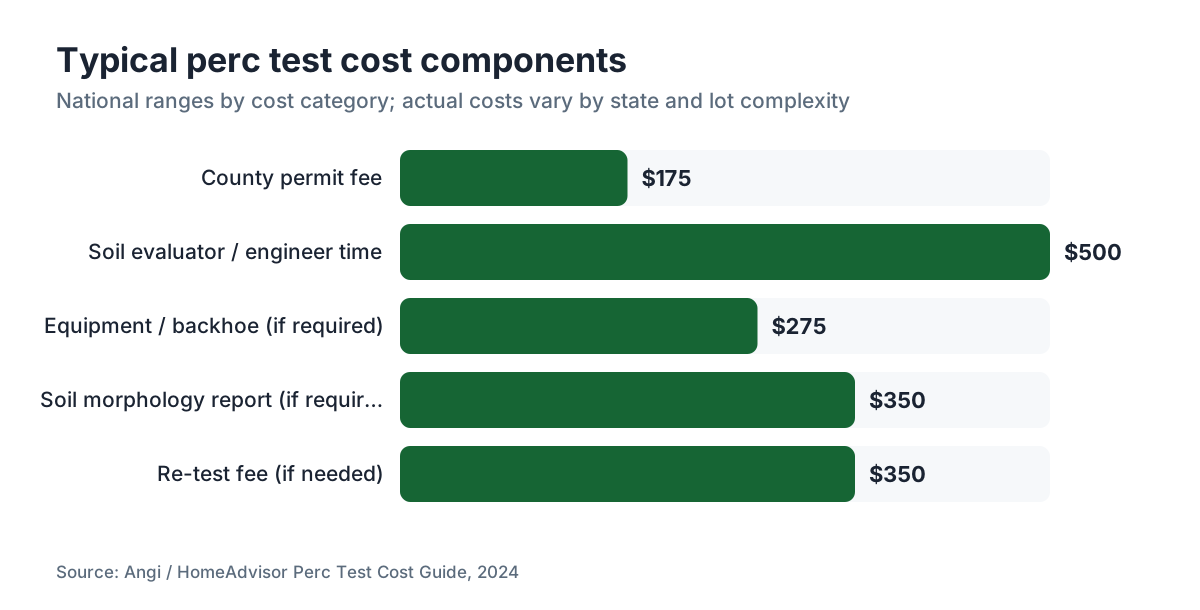
Perc test cost varies by state, lot complexity, and who does the work. The national range runs roughly $150 on the low end (simple flat lots in rural counties with cheap permit fees) to $1,500 or more for tough parcels with steep slopes, multiple test holes, or soil borings on top of the perc test. [4]
Here's what drives the price:
| Cost component | Typical range |
|---|---|
| County permit fee | $50 to $300 |
| Soil evaluator / engineer time | $100 to $900 |
| Equipment (backhoe if required) | $150 to $400 |
| Soil morphology report (if required) | $200 to $500 |
| Re-test fee (if first test fails) | $100 to $600 |
If the county requires a licensed professional engineer to certify results, expect the higher end. If a soil scientist runs the evaluation instead of a traditional perc test, costs can climb because reading soil profiles takes time. Some states bundle the perc test and soil evaluation into one application; others treat them as separate steps with separate fees.
For context, a septic tank installation on a lot that passes typically runs $3,000 to $15,000 or more depending on system type and site conditions. [5] A $500 perc test that keeps you from buying a lot you can never build on is one of the best returns you'll ever see on a few hundred dollars. Don't skip it to save money up front.
What perc test results mean: pass, fail, and marginal
Perc test results get read against your state's or county's accepted absorption rate ranges. A typical passing rate for a standard gravity septic system sits somewhere between 1 and 60 minutes per inch (MPI), with the sweet spot around 1 to 30 MPI. [6] Exact cutoffs differ by jurisdiction, so always check your local health department's standards.
Soil that absorbs faster than 1 MPI (under one minute per inch) is usually too coarse and sandy. Effluent passes through before the soil can treat it, which risks groundwater contamination. Soil that absorbs slower than 60 MPI (sometimes 90 MPI in some states) is too dense, typically heavy clay, and a conventional drainfield won't work.
Marginal results in the 30 to 60 MPI range often mean a conventional system is borderline. Regulators may approve an oversized drainfield, require a pressure-dosed system, or demand an advanced treatment unit (ATU) as a permit condition. These alternatives cost more, sometimes a lot more, but they can save a lot that would otherwise be undevelopable. [7]
A hard fail is a different animal. If the perc rate falls completely outside acceptable limits and there's no alternative system the county will approve, the lot legally cannot support a septic system. Your options shrink: appeal (rarely works), connect to a municipal sewer if one sits nearby (usually pricey), or walk away. Most of the time, walking away is the right call.
One thing that surprises buyers. A failed perc test on one part of the lot doesn't always sink the whole parcel. If there's enough usable acreage, a soil scientist may find a workable drainfield location elsewhere on the property. Ask about that before you give up on land you otherwise love.
What's the difference between a perc test and a soil evaluation?
A traditional perc test uses water absorption rate as a stand-in for soil drainage quality. A soil evaluation (also called a soil morphology study or soil profile analysis) has a licensed soil scientist dig pits and read the physical traits of the soil layers directly: texture, structure, consistence, color, mottling, and any restrictive layers like hardpan or fragipan. [2]
Both approaches answer the same question (will this soil handle septic effluent?) from different angles. Soil evaluations are generally treated as more accurate, because a perc test result can swing a lot depending on when it's run, how carefully the holes were pre-soaked, and whether the test hit the seasonal high water table. A soil morphology evaluation doesn't ride on those timing factors.
Many states have either replaced the traditional perc test with a soil evaluation or require both. North Carolina moved primarily to soil evaluations decades ago. Virginia uses a similar system. States like Texas, Georgia, and Tennessee still lean on some form of percolation testing, sometimes paired with soil borings. [8]
For land buyers, the takeaway is simple: find out what your county requires before you budget or schedule anything. Call the local health department's environmental or onsite wastewater division and ask directly. The answer takes five minutes and saves you from hiring the wrong professional.
Who performs a perc test, and who approves the results?
The person who runs the test and the person who approves it are usually different, and that distinction matters when you're coordinating a land purchase.
On the testing side, depending on the state, the work goes to a licensed soil scientist, a professional engineer (PE), a registered sanitarian, or a county health department employee. In some jurisdictions the county both conducts and approves the test as a single step. In others you hire a private professional and submit their report to the county for review.
Approval always runs through the local regulatory authority, usually the county health department or the state department of environmental quality. The EPA's SepticSmart program notes that "homeowners are responsible for operating their system properly and following local regulations," but permitting decisions are made at the county or state level, not by the federal government. [9] Federal law sets a floor (the Clean Water Act, the Safe Drinking Water Act), while the actual perc test standards, approved system types, and setback distances come from your state's onsite wastewater code and get enforced by your county.
When you hire a private professional, ask for their state license number and check it. Most state licensing boards have online lookup tools. A perc test done by an unlicensed person may not be accepted by the county, which means you pay twice. Get the right person the first time.
What other septic-related due diligence should you do when buying land?
A perc test tells you about soil absorption. It doesn't tell you everything else you need to know before you commit. Here's what experienced rural land buyers also check.
Setback requirements. Every state sets minimum distances between the septic system and property lines, wells, surface water, buildings, and steep slopes. On a small lot, these setbacks can eat up so much space that there's nowhere left to site a compliant system even if the soil passes cleanly. Ask the county for the setback table and map it against your parcel before you assume you can build where you want. [10]
Seasonal high water table. Standing water in the test holes or mottled soil (gray, orange, or blue-green streaking) tells a soil scientist the water table rises seasonally to that depth. A drainfield sitting in seasonally saturated soil doesn't treat effluent and will fail. Some states require a minimum vertical separation, often 24 to 36 inches, between the bottom of the drainfield and the seasonal high water table.
Existing system records. If you're buying land with an older structure on it, check whether a septic system was ever permitted and where the records live. The county health department often keeps permit records going back decades. A septic tank inspection on an existing system is a must before closing; a buried tank that's never been pumped is a hidden liability. You can read up on ongoing maintenance, including how often to pump a septic tank, once you own the place.
Alternative system feasibility. If the soil is marginal, ask the county whether an engineered alternative system (mound system, drip irrigation, aerobic treatment unit) could get approved. These systems work in tighter site conditions but cost more to install and maintain. Get a ballpark on cost to install a septic system for the most likely system type before you finalize your offer price.
For operators running onsite wastewater service businesses, tools like SepticMind help manage inspection records, maintenance schedules, and permit tracking across many properties, which matters the moment a new landowner brings a lot online.
How long does a perc test take, and when does approval expire?
The test itself usually takes one to two days: the first day for digging and pre-soaking the holes, the second for the timed absorption test. A soil evaluation can happen in a single site visit if the scientist doesn't need to return after pre-soaking. County review of submitted results typically adds one to four weeks, depending on how busy the health department is and whether they run their own site visit to verify the findings.
Total timeline from permit application to written approval: plan on two to eight weeks in most jurisdictions. That's the number to build into your purchase contract contingency period.
Expiration is something a lot of buyers overlook. A perc test approval or septic permit is not permanent. Most states issue approvals that expire in two to five years if construction hasn't started. North Carolina issues improvement permits that expire if the permitted system isn't installed within a set period. [8] If you're buying land speculatively and plan to build years later, you may need to re-test. Check the expiration terms in your state's onsite wastewater code, more than the approval letter.
What happens if the land fails a perc test?
A failed perc test isn't always a death sentence for the lot, but it changes the math on your purchase in a hurry.
First, find out whether the failure is absolute or conditional. An absolute failure means no system can be approved anywhere on the parcel under any conditions. A conditional failure means the primary location didn't pass but alternatives may exist: a different spot on the lot, a different system design, or an engineered solution the county will weigh on a variance basis.
If you're under contract and the contingency is written right, a failed test lets you exit and recover your earnest money. Use that as your bargaining position. Don't renegotiate the price and keep the contract alive unless you fully understand what an alternative system will cost and whether the county will actually approve it. Get that approval commitment in writing from the county before you proceed.
If you already own the land and find out it fails, the options narrow. You could pursue an engineered alternative system if the county allows it. You could petition for a variance if hardship conditions apply. You could explore connecting to municipal sewer, which can cost tens of thousands of dollars in connection fees and line extensions. Or you could sell to someone who plans to use the land in a way that needs no septic system; agricultural or conservation easement buyers sometimes fit that profile.
The EPA's guidance on decentralized wastewater treatment notes that improperly sited or designed systems are a leading cause of system failure and groundwater contamination. [7] A failed perc test is the county telling you the site conditions don't support safe disposal. That's not bureaucratic obstruction. That's the system doing its job.
Does a perc test approval mean a septic system is definitely possible?
A passing perc test is necessary but not sufficient. Passing the soil absorption test gets you through one gate. The county still has to approve the full system design, which depends on house size, bedroom count, setback compliance, lot dimensions, and proximity to wells or water features.
Bedroom count drives system sizing in almost every state. A bigger house needs a bigger tank and a longer drainfield. If your lot barely fits a drainfield sized for a three-bedroom house, adding a fourth bedroom later may be impossible without a permit amendment and a larger field than your lot can hold.
The permitted system type also drives long-term cost. A conventional gravity system is cheapest to install and maintain. A pressure-dosed system, a mound system, or an aerobic treatment unit needs more equipment, more septic tank pumping attention, and sometimes annual service contracts. Know before you close what type of system the county is likely to permit, and get a realistic cost to put in a septic tank estimate for that specific system.
Treat a passing perc test as a green light to move to full system design review, not as a guarantee you can build whatever house you want wherever you want on the lot.
State-by-state variations you need to know about
Onsite wastewater regulation in the United States is almost entirely a state and local function. There is no single national perc test standard. The variation between states is real and large, so anything you read (this article included) has to be checked against your specific jurisdiction. [3]
A few examples of how much the rules differ:
Texas: The Texas Commission on Environmental Quality (TCEQ) oversees onsite wastewater under Title 30, Chapter 285 of the Texas Administrative Code. Perc testing is one accepted method, but soil profile analysis is increasingly required. Many Texas counties layer their own rules on top of state minimums. [10]
California: The State Water Resources Control Board sets standards for onsite wastewater treatment systems (OWTS) under the statewide OWTS Policy (Resolution 2012-0032). Counties implement it with local addenda. Perc test requirements vary a lot by county; some California counties have moved almost entirely to soil evaluation. [11]
Florida: The Florida Department of Health regulates septic systems under Chapter 64E-6 of the Florida Administrative Code. Florida requires both a percolation test and a soil profile evaluation in many cases, and the process ties closely to setbacks from surface water given the state's shallow water table. [12]
New York: The New York State Department of Health sets minimum standards, but individual county health departments often go stricter. Westchester County, for one, has some of the tightest OWTS regulations in the state.
The practical advice: call your county health department's environmental health or onsite wastewater division before you hire anyone or sign anything. Ask exactly what tests are required, who can perform them, what the permit fee runs, and how long approval takes. That call costs nothing and gives you the ground truth for your jurisdiction.
Frequently asked questions
Can you get a perc test before buying land if you're not yet the owner?
Yes. Most counties let a prospective buyer apply for a perc test permit with the current owner's written permission. Some counties require the owner to be the permit applicant, in which case you negotiate that access as part of your purchase contract. Either way, include a perc test contingency in your offer so you can exit without penalty if the lot fails.
How long does a perc test take from start to finish?
The physical test takes one to two days, including the mandatory pre-soaking period. Add one to four weeks for county review and written approval. Total time from permit application to approved results is typically two to eight weeks. Build that window into your purchase contract contingency or you may find yourself closing before you have an answer.
What is a good perc test result?
A passing result for a conventional gravity-fed septic system is typically between 1 and 60 minutes per inch (MPI), meaning water drops one inch every 1 to 60 minutes in the test hole. The sweet spot is 1 to 30 MPI. Rates faster than 1 MPI suggest soil too coarse for adequate treatment; rates slower than 60 MPI (sometimes 90 MPI) indicate soil too dense for a standard drainfield.
What happens if a lot fails a perc test?
If you have a purchase contingency, you can exit the contract and recover your earnest money. If you want to proceed anyway, ask whether an alternative engineered system (mound, aerobic, drip irrigation) could be approved by the county. Some lots can be saved with a more expensive design. Others are genuinely unbuildable for residential use. Get a written answer from the county before renegotiating your offer.
How much does a perc test cost?
Nationally, perc tests run $150 to $1,500. Simple rural lots with low permit fees land at the low end. Complex parcels with steep slopes, multiple required test holes, or a licensed engineer's stamp for certification push toward the high end. The county permit fee alone is usually $50 to $300, with the soil evaluator's or engineer's time adding another $100 to $900.
Is a perc test the same as a soil evaluation?
No, though they answer the same question. A perc test measures how fast water drains through soil in a timed hole test. A soil evaluation has a licensed soil scientist read the physical characteristics of soil layers directly, without pouring water. Many states have moved toward soil evaluations as more accurate and less timing-dependent. Some states require both. Check what your specific county accepts.
How long does a perc test approval last before it expires?
Most state approvals expire in two to five years if a permitted septic system hasn't been installed. If you're buying land speculatively and plan to develop years later, you may need to re-test before building. Check the expiration terms written into your approval letter and confirm them against your state's onsite wastewater code. Don't assume an old approval letter is still valid.
Does a passing perc test guarantee I can build a house?
No. A passing perc test clears the soil absorption hurdle, but the county still must approve a full system design based on your house size, bedroom count, lot setbacks, proximity to wells and water, and available space for the drainfield. A lot might pass perc testing but still lack room for the size of drainfield the house requires. Always verify with a complete site evaluation.
Who is licensed to perform a perc test?
Depending on the state, a perc test or soil evaluation must be performed by a licensed soil scientist, a professional engineer, a registered environmental health specialist (sanitarian), or a county health department employee. In some jurisdictions the county runs the test itself. Always hire someone whose credentials the county will accept. Ask the health department directly who qualifies before you hire anyone.
Can a perc test be done in winter?
Many counties restrict perc testing to specific seasons, often spring or fall, when soil moisture is representative of typical conditions. Frozen ground generally disqualifies a test. Testing during drought can produce artificially fast results that don't reflect real wet-season performance. Check your county health department's testing calendar before scheduling and before setting a closing date.
What's the difference between a perc test and a septic inspection?
A perc test evaluates raw land to determine if a new septic system can be built there. A septic inspection examines an existing system on a property that already has one, checking the tank condition, drainfield function, and compliance with current standards. If you're buying land with an existing structure and system, you need a septic inspection, not a perc test. If you're buying raw land with no system, you need a perc test.
What setback requirements affect where a septic system can go on a lot?
Every state sets minimum distances between septic components and features like property lines (typically 5 to 10 feet), drinking water wells (50 to 100 feet or more), surface water like streams or lakes (often 50 to 150 feet), and the home's foundation. These setbacks can leave very little usable area on a small lot. Map all applicable setbacks against the parcel before assuming the soil test result is the only constraint.
Should I use a real estate agent's recommendation for a perc test professional?
Use it as a starting point, not the final answer. A local agent may know reputable soil evaluators. But independently confirm the professional holds the license your county requires and check their standing with the state licensing board. Also ask how many tests they've done in that specific county, since familiarity with local health department staff and procedures can speed your approval.
Sources
- EPA, SepticSmart program: Onsite septic systems serve about one in five U.S. households and require soil conditions that support safe effluent treatment.
- Penn State Extension, home page: Perc test holes must be pre-soaked for at least 24 hours before the timed test to produce valid results.
- EPA, Onsite Wastewater Treatment Systems Manual (EPA/625/R-00/008): Onsite wastewater regulation in the U.S. is primarily a state and local function with no single national perc test standard.
- Angi, Perc Test Cost Guide: National perc test cost range is approximately $150 to $1,500 depending on location and lot complexity.
- Angi, Septic Tank Installation Cost: Septic system installation typically costs $3,000 to $15,000 or more depending on system type and site conditions.
- University of Minnesota Extension, home page: Acceptable soil percolation rates for a conventional gravity septic system are typically 1 to 60 minutes per inch.
- EPA, Decentralized Wastewater Treatment Systems program: Alternative and engineered systems can be approved for marginal soil sites where conventional gravity drainfields cannot be permitted, and improperly sited systems are a leading cause of failure.
- North Carolina Department of Health and Human Services, Environmental Health section: North Carolina uses soil morphology evaluations rather than traditional perc tests, and improvement permits expire if installation does not begin within the specified period.
- EPA, SepticSmart for Homeowners: The EPA SepticSmart program states that 'homeowners are responsible for operating their system properly and following local regulations.'
- Texas Commission on Environmental Quality (TCEQ), On-Site Sewage Facilities program: Texas regulates onsite wastewater under Title 30, Chapter 285 of the Texas Administrative Code, with perc testing and soil profile analysis both accepted methods.
- California State Water Resources Control Board, OWTS Policy (Resolution 2012-0032): California's statewide OWTS Policy establishes standards implemented by counties with local addenda, and perc test requirements vary significantly by county.
- Florida Department of Health, Onsite Sewage program: Florida regulates septic systems under Chapter 64E-6 of the Florida Administrative Code and requires both percolation testing and soil profile evaluation in many cases.
Last updated 2026-07-09