Perc test in NC: what it costs, how it works, and what happens if you fail
By the SepticMind Editorial Team
TL;DR
- A perc test (officially a soil evaluation) in North Carolina costs roughly $250 to $1,200 depending on the county and site complexity.
- The state requires a licensed soil scientist or county environmental health specialist to conduct it before any septic permit is issued.
- Results are tied to the land, not the owner, and a failed evaluation doesn't always mean the lot is unbuildable.
What is a perc test and what does North Carolina actually require?
A perc test, short for percolation test, measures how fast water drains through soil. The idea is simple: pour water in a hole, time how fast it drops, and use that rate to decide whether the ground can safely absorb septic effluent. That's the old method.
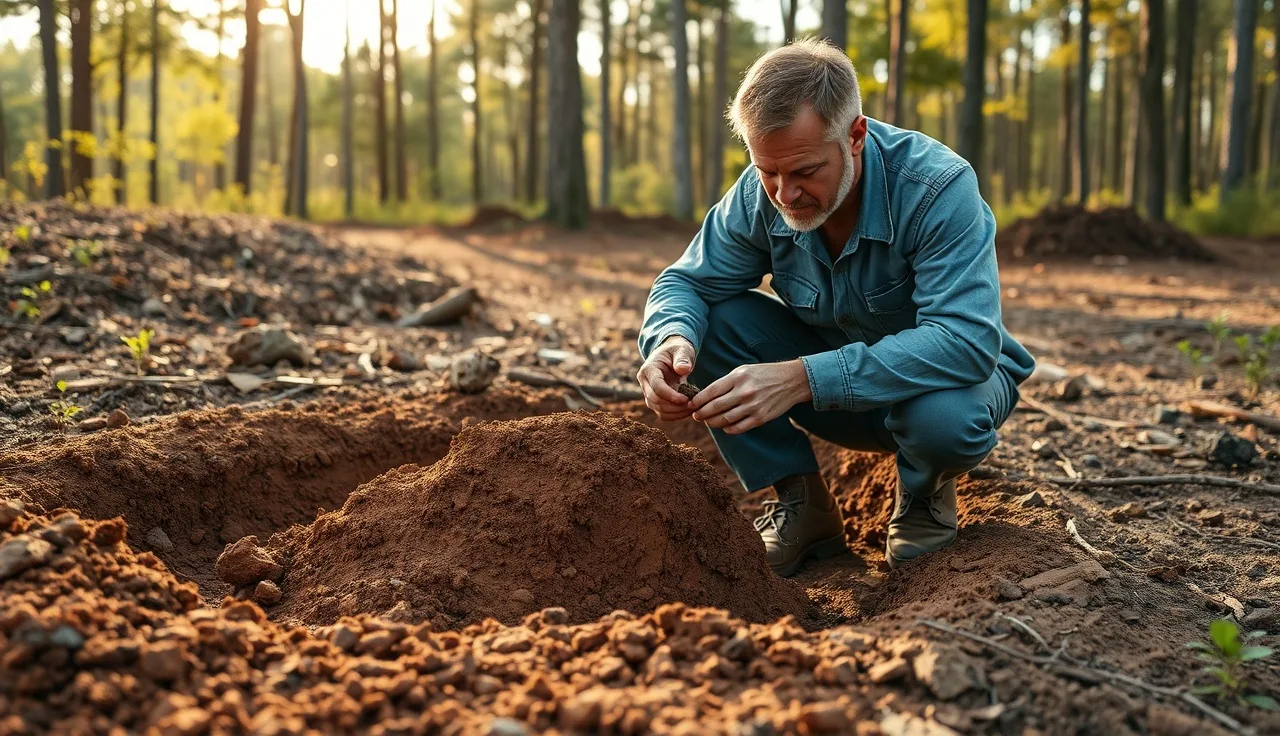
North Carolina ditched the timed percolation test years ago. The state now uses a morphological soil evaluation. A licensed soil scientist examines the actual physical properties of the soil, including texture, structure, color mottling, and restrictive horizons, instead of just timing a water drop [1]. The North Carolina Administrative Code, specifically 15A NCAC 18A .1941 through .1948, governs how these evaluations must run and what soil conditions approve a site [2].
Here's why the change matters. A timed perc test gives you one number on one day. Soil conditions shift with rainfall and season, so that number can lie. A morphological evaluation shows you what the soil does year-round.
The evaluation sets the "long-term acceptance rate" (LTAR) of the soil, the number designers use to size your drainfield. Every septic permit in the state traces back to that LTAR.
How much does a perc test cost in North Carolina?
Most homeowners in North Carolina pay between $250 and $800 for a standard soil evaluation on a single residential lot. Complex sites with multiple borings, difficult access, or messy soil can push that past $1,200. A few counties bundle the evaluation into the overall septic permit fee. Most don't.
The fee goes to the licensed soil scientist or environmental health specialist you hire. The county charges a separate permit application fee, usually $100 to $400 depending on the jurisdiction. Davidson County's Environmental Health office sets its own schedule for application and permit fees, so call before you assume anything [3]. Chatham County works similarly: the county handles septic permit applications through Environmental Health, but the site evaluation itself often involves a private soil scientist you contract on your own [4].
What drives cost up:
- Remote or wooded lots that need equipment to reach
- Lots with suspected limiting horizons (clay pans, shallow rock, seasonal saturation)
- Multiple potential drainfield locations to evaluate
- Rush turnaround from private consultants
What keeps cost down:
- Flat, cleared lots with obvious suitable soil
- Using the county's own staff evaluator instead of a private soil scientist (where the county still offers this)
- Combining the evaluation with a full site plan review in one visit
The honest answer: quotes vary enough that you should call at least two licensed soil scientists before you hire. The North Carolina Board of Licensing for Soil Scientists keeps a public list of licensees where you can find practitioners near you [5].
What is the step-by-step process for getting a perc test in NC?
The process isn't complicated. But the steps are specific and you can't skip them.
Step 1: Apply through your county environmental health department. You submit an application for an improvement permit (the official NC term for a septic permit). You'll need a plat or survey of the property, documentation of the proposed structure's bedroom count or water use, and the application fee.
Step 2: Schedule the site evaluation. Either a county environmental health specialist or a private licensed soil scientist runs the evaluation. On evaluation day, the evaluator digs soil borings, usually to a depth of 48 inches or more, at several spots across the potential drainfield area [2]. They log the soil profile: texture at each layer, structure, color (mottling flags seasonal water saturation), and any restrictive features like fragipans or rock.
Step 3: Receive the LTAR determination. From the soil morphology, the evaluator assigns an LTAR value in gallons per day per square foot. The state's table of LTAR values by soil texture and structure sits in 15A NCAC 18A .1955 [2]. A sandy loam with good structure might get an LTAR of 0.6 to 1.0 gpd/sq ft. A heavy clay might get 0.1 or fail outright.
Step 4: Permit issued or denied. If the site passes, the county issues an improvement permit. That permit authorizes a system of a specified design flow (tied to bedroom count) and names the system type: conventional gravity, low-pressure pipe, drip irrigation, and so on.
Application to permit takes two to six weeks depending on county workload and whether you need extra engineering. Some western NC counties with complex soils run longer.
What soil conditions cause a site to fail a perc test in NC?
North Carolina's rules spell out conditions that either prohibit a conventional system or force an alternative design [2]. The common failure causes:
Seasonal high water table too shallow. If evidence of seasonal saturation (mottling, gleying) shows up within 12 inches of the proposed trench bottom, a conventional gravity system won't fly there. The state demands minimum separation between the trench bottom and the seasonal high water table.
Restrictive soil horizons. A fragipan, claypan, or bedrock layer near the surface blocks vertical movement of effluent and can sink the system. Some Piedmont sites, including parts of Davidson County, have dense subsoil clay at 18 to 30 inches that creates exactly this problem.
Soil too slowly permeable. Soils with very high clay content have LTARs so low that the required drainfield would be bigger than the usable lot.
Soil too rapidly permeable. Fast-draining sands and gravels can fail too, because effluent races through the soil before treatment finishes. The state sets minimum hydraulic loading requirements for this reason.
Not enough lot area for setbacks. Even good soil fails if there isn't room to meet setbacks from wells, property lines, streams, and structures while still fitting the required drainfield.
A failed evaluation isn't automatically a dead end. NC rules allow alternative systems including drip irrigation, mound systems, and other engineered options that work where conventional systems won't. A licensed engineer or soil scientist can tell you whether an alternative is feasible before you walk away from a property.
How do Davidson County and Chatham County handle perc tests differently?
The underlying rules are identical statewide, set by NCDEQ and the state sanitarian code. County environmental health offices differ in staffing, backlog, and how much they lean on private soil scientists versus their own staff.
Davidson County. Davidson County Environmental Health handles improvement permit applications in-house [3]. They assign a county environmental health specialist to conduct or review the site evaluation. Wait times swing with the season; spring, the busiest planning stretch, usually runs longest. For a Davidson County NC perc test, expect the county to set the appointment after you submit your application, rather than you booking an independent soil scientist first. Check the Davidson County office directly on current processing times before you buy raw land.
Chatham County. Chatham County has taken on real growth pressure from its nearness to the Research Triangle and the Chatham Park development in Pittsboro. That growth loads up the Environmental Health staff. For a Chatham County NC perc test, some applicants hire a private licensed soil scientist to do the preliminary evaluation, then submit those findings to the county for review, which can speed things up. The county's Environmental Health department confirms this pathway, though final approval still rests with county staff [4].
For both counties, a call to Environmental Health before you apply pays off. Staff can tell you current wait times, whether the site has prior evaluation history, and whether known soil or regulatory issues touch the area. That five-minute call can save weeks.
The Davidson County perc test process matters for real estate buyers in one more way: the county keeps records of prior improvement permits. If a lot was already evaluated and approved (or denied), that record is public and you can often pull it before closing.
How long is a perc test result (improvement permit) valid in NC?
This question matters most to real estate buyers and developers.
In North Carolina, an improvement permit issued under the current rules does not expire [6]. The state dropped the old five-year expiration. Once a lot has an approved improvement permit on record with the county, that approval runs with the land with no deadline.
There's a catch. The approval dies if site conditions change. Grading, filling, installing a well or structure, removing trees that protected wetland buffers, or changes to the proposed structure that raise design flow (adding bedrooms) can all force a new evaluation. Buy land with an existing improvement permit, and you should verify that nothing on the site has changed since the evaluation.
A construction authorization (the permit to actually build the system once you've hired a contractor) does expire. It runs five years from the date of issuance, and the system must be inspected and the authorization renewed if construction hasn't started [6].
For anyone buying rural NC property: always ask for a copy of the improvement permit during due diligence. If none exists, budget time and money to get one before closing when septic is the only wastewater option.
What happens if your land fails a perc test in NC?
A failed evaluation means the county issues a written denial of the improvement permit. That's not the end of the story.
Your first option is a formal reappraisal. Site conditions change, evaluations miss optimal areas, and you can hire a licensed soil scientist to find a different spot on the lot that performs better. This isn't always possible on small lots, but it's worth the look.
Your second option is an alternative system design. North Carolina rules explicitly authorize a range of alternative systems for sites that can't support conventional gravity [2]. Low-pressure pipe, drip irrigation, and mound systems handle soil conditions that would drown a conventional trench. They cost more, often $8,000 to $20,000 above a standard system, and they carry ongoing maintenance agreements. Get a cost estimate on an alternative before you decide a failed site isn't worth developing. For more on what a full install involves, see cost to install septic system.
Your third option, if the denial rests on an error or misapplication of the rules, is an appeal. NC General Statute 130A-24 provides a formal hearing process for challenging county environmental health decisions [7]. This path eats time and usually needs an attorney, but it's real.
If none of those work, the lot may simply not support a septic system. That's a hard outcome, but it happens. A lot with no viable wastewater solution has badly limited development potential unless public sewer is available or can be extended.
Do you need a licensed soil scientist or can the county do it?
Both paths are legal in North Carolina. Which one makes sense depends on your situation.
County environmental health specialists are authorized to conduct soil evaluations and issue improvement permits. For straightforward residential lots, county staff is the standard path and often the cheaper one, since the evaluation folds into the permit application fee.
A licensed soil scientist (LSS), licensed through the North Carolina Board of Licensing for Soil Scientists, can run the evaluation independently and submit results to the county [5]. This path fits when:
- You need faster turnaround than the county's wait time allows
- The site is complex and you want the most thorough analysis before you buy
- You're prepping for a real estate transaction and need a preliminary read before the official permit
- You want an advocate who can make the best case for your site to the county
Private soil scientists typically charge $400 to $1,000 for a residential evaluation, more on complex sites. The county still has to approve their findings, but those findings generally carry weight.
Managing multiple site evaluations gets messy fast if you're a contractor or land developer. Platforms like SepticMind handle that kind of workflow, tracking permit status, evaluation results, and contractor assignments across projects.
For a single residential lot, the county path is usually fine. For anyone juggling multiple parcels or racing a closing deadline, a private LSS earns the premium.
What does the perc test result mean for septic system sizing and design?
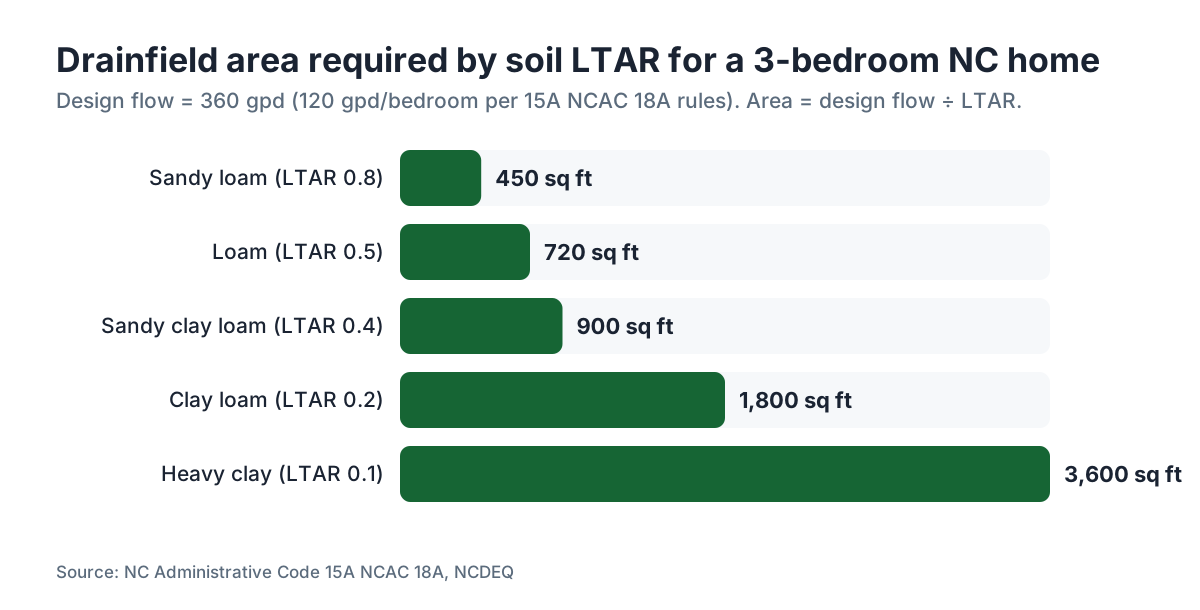
The LTAR value from the soil evaluation sets how large the drainfield must be. The math is simple: divide the design flow (in gallons per day) by the LTAR (in gpd per square foot) to get the required trench bottom area in square feet [2].
Design flow follows bedroom count under NC rules. A three-bedroom house is assigned 360 gallons per day (120 gpd per bedroom) [2]. A four-bedroom house gets 480 gpd.
Example: a three-bedroom house (360 gpd design flow) on soil with an LTAR of 0.4 gpd/sq ft needs 900 square feet of trench bottom area. Drop that soil to the 0.2 LTAR category and you need 1,800 square feet. On a small lot, that difference decides everything.
The soil evaluation shapes more than whether you can build but what you can build. A lot with a high LTAR might support a four-bedroom house with room to spare. A lot with marginal soil might support only a two-bedroom home before it runs out of suitable drainfield. Buyers of rural NC land should get the evaluation done and know the LTAR number before designing a house.
The system type the designer specifies also follows from the soil. Conventional gravity systems need LTAR above a minimum threshold. Lower LTARs or sites with specific restrictions get pushed toward alternative types. For more on how the drainfield works once installed, see leach field.
| Soil Texture (approx.) | Typical LTAR (gpd/sq ft) | 3-BR Area Required |
|---|---|---|
| Loamy sand / Sandy loam | 0.6 - 1.0 | 360 - 600 sq ft |
| Sandy clay loam / Loam | 0.4 - 0.6 | 600 - 900 sq ft |
| Clay loam | 0.2 - 0.4 | 900 - 1,800 sq ft |
| Heavy clay | 0.1 - 0.2 | 1,800 - 3,600 sq ft |
| Fails / Unsuitable | N/A | Alternative system required |
What should you do before buying land in NC to check the septic situation?
Raw land purchases in North Carolina go sideways most often because buyers don't verify septic feasibility until after closing. By then, the lot may be worth a fraction of what they paid.
Here's what I'd actually do, in order.
Check for an existing improvement permit first. Call the county environmental health office and ask if there's a permit on record for the parcel. Give them the parcel identification number (PIN) from the county GIS or tax records. If a permit exists, get a copy and check when it was issued and what it authorized.
Pull up the county GIS and USDA soil surveys. The USDA Web Soil Survey covers most of North Carolina and is free online [8]. It won't replace a formal evaluation, but it'll tell you whether you're sitting on Georgeville sandy clay loam (good) or Cid silt loam with a fragipan at 24 inches (a warning).
Write a perc test contingency into any rural purchase contract. Standard NC contracts allow it. Make the contingency period long enough to actually get an evaluation done, at least 30 days, ideally 45 to 60 in busy seasons or complex-soil counties.
Talk to neighbors with existing systems. Informal but useful. If every house within a quarter mile has a mound system, the soil is telling you something.
Hire a licensed soil scientist for a pre-application evaluation if the lot is expensive. Paying $600 to $1,000 for a preliminary opinion is cheap insurance on a $150,000 land purchase.
See also septic tank inspection if the land already has a system you'd be assuming.
How does a perc test connect to the full septic system installation process?
The perc test (soil evaluation) is step one of a process that ends with a working system. Knowing the full sequence keeps your timelines and budgets honest.
Once you have an improvement permit, you hire a licensed septic system contractor to design and install the system. In North Carolina, installers must be certified through the NCDEQ on-site wastewater program [9]. The contractor submits a site plan, the county issues a construction authorization, and installation begins.
Installing a conventional system on a straightforward lot takes one to three days. More complex alternative systems can run a week or more. After installation, the county inspector must approve the work before the system gets covered.
For a ballpark on what comes after the perc test, see cost to put in a septic tank and septic tank installation. Total project costs in NC, from permit through installation of a standard three-bedroom conventional system, generally run $6,000 to $15,000. Alternative systems can reach $20,000 to $35,000.
Once the system is in the ground, the work continues. The EPA's SepticSmart program calls regular pumping every three to five years the single most effective step homeowners can take to extend system life [10]. Skipping pumping is how most NC homeowners end up with a failed drainfield and a $15,000 repair bill. For a practical guide on pumping, see how often to pump septic tank.
If you're a septic service operator tracking permit work, installs, and maintenance across a book of customers, SepticMind's operations platform runs that workflow.
Are there any NC programs that help with septic costs for low-income homeowners?
Yes, though funding is limited and every program has eligibility strings.
USDA Rural Development Section 504 Loans and Grants. The USDA offers loans and grants for rural homeowners to repair or replace failing septic systems. Grants go to homeowners 62 and older whose income sits below 50% of the area median income [11]. Loans carry 1% interest over 20 years. The program runs through the USDA Rural Development state office.
NC Division of Water Infrastructure funding. The North Carolina Division of Water Infrastructure administers state and federal funding that can, in certain cases, help with failing on-site wastewater systems. This is mostly aimed at systems with documented public health impact.
County health department assistance programs. Some counties run local programs, sometimes funded through Community Development Block Grants, to help low-income households fix failing systems. Contact your county environmental health office directly. Not all counties take part, and the programs come and go with annual funding.
If you can't afford a new system but you've got a failing one, your first call should be to county environmental health. They can sometimes point you to funding sources, and they've got their own interest in resolving failing systems that create public health risks. The second call goes to USDA Rural Development at 1-800-670-6553 or through their online portal.
Frequently asked questions
How long does a perc test take in North Carolina?
The on-site evaluation takes two to four hours for most residential lots. Scheduling lag is the bigger issue: county environmental health offices in NC typically book one to four weeks out, longer in spring and summer. Hire a private licensed soil scientist and you may get on their schedule faster. Budget four to eight weeks from application to permit in hand on a typical residential project.
Can a perc test be done in winter in NC?
Yes, and in some ways winter is ideal. Soil mottling, the color evidence of seasonal saturation, is easiest to read during or just after wet periods, and the soil profile shows its worst-case water table conditions. NC evaluators work year-round. No regulation blocks winter evaluations, and a site that passes in winter tends to perform well in drier months too.
Who is qualified to do a perc test in North Carolina?
Either a county environmental health specialist employed by your county health department, or a Licensed Soil Scientist (LSS) licensed by the NC Board of Licensing for Soil Scientists. You cannot legally conduct your own evaluation for permit purposes. The final permit must be issued by the county, no matter who did the field evaluation.
How much does a perc test cost in Davidson County NC?
Davidson County charges a permit application fee (call their Environmental Health office for the current schedule), and county staff typically conduct the initial evaluation as part of that process. Hire a private licensed soil scientist to supplement or speed up the process and you'll pay $400 to $900 on top of the county fee. Total out-of-pocket for application plus any private evaluation work generally runs $500 to $1,200.
How much does a perc test cost in Chatham County NC?
Chatham County's Environmental Health office sets permit fees, and the county has seen high demand from growth around Pittsboro. Many Chatham applicants hire a private licensed soil scientist first for faster turnaround, adding $500 to $1,000 to the county's application fee. Expect total costs of $600 to $1,400 depending on lot complexity and whether you use private or county-only evaluation.
Does a perc test result expire in North Carolina?
An improvement permit, the document issued after a passed evaluation, does not expire under current NC law. It runs with the land permanently, as long as site conditions haven't changed. A construction authorization, the permit to actually build the system, expires after five years if construction hasn't been completed. Always verify that site conditions match the original evaluation before relying on an old permit.
What happens to the perc test result when I sell the property?
The improvement permit is a county record tied to the parcel, not the owner. It transfers with the land at sale. Buyers should request a copy of the permit during due diligence. If the permit exists and site conditions haven't changed since it was issued, the new owner can move to construction authorization without starting the evaluation over.
Can a lot that failed a perc test ever be built on in NC?
Often yes. A failed conventional evaluation doesn't automatically mean no development. North Carolina authorizes alternative systems including drip irrigation, mound systems, and low-pressure pipe for sites that can't support conventional gravity trenches. These cost more to install and maintain, but they open up many sites that would otherwise be undevelopable. A licensed soil scientist or engineer can assess alternative feasibility after a failed initial evaluation.
Do I need a new perc test if I want to add a bedroom to my house?
Yes, almost certainly. Adding a bedroom raises your design flow under NC rules (120 gpd per bedroom), which may demand a larger drainfield than your current improvement permit authorizes. You need to apply for an amended improvement permit, which triggers a review of whether your existing drainfield area is adequate or needs expansion. Contact your county environmental health office before starting any addition that adds bedrooms.
What is the difference between a perc test and a soil evaluation in NC?
In North Carolina, these terms describe different methods. A traditional perc test times water draining through a bored hole, an older approach. A soil evaluation, which is what NC requires today under 15A NCAC 18A .1941, has a licensed evaluator examine physical soil properties through borings: texture, structure, mottling, and restrictive layers. NC moved off the timed perc test because morphological evaluation reads more accurately across seasonal conditions.
How many soil borings are done during a NC perc test?
The number varies with lot size and complexity, but evaluators typically dig three to six borings in potential drainfield areas for a standard residential lot. Each boring goes to a minimum of 48 inches deep. On complex sites with varying topography or suspected variable soil, an evaluator might dig eight to twelve borings to fully characterize the lot. The goal is to find the best available area and confirm it meets state standards.
Can I watch the perc test evaluation on my property?
Yes, and you should. Property owners and their representatives are welcome during the evaluation. If you hired a private soil scientist, being there lets you ask questions and understand what they're finding in real time. If it's a county evaluator, attending lets you hear preliminary observations before the formal permit decision. No regulation requires you to be there, but it's often informative.
What documents do I need to apply for a perc test / improvement permit in NC?
Most counties want a completed application form, a plat or recorded survey showing dimensions and acreage, documentation of the proposed structure (bedroom count, type of use), and the application fee. Some counties also want a sketch showing the proposed house location, well location, and any easements. Call your specific county environmental health office to confirm their current checklist before submitting, since requirements vary slightly.
Is a perc test required if I'm connecting to county sewer?
No. A perc test and improvement permit are only required for properties using an on-site wastewater (septic) system. If public sewer service is available and you're connecting to it, no soil evaluation is needed for wastewater purposes. Check with your county or municipality whether sewer connection is available and what the connection fee runs; in many rural NC areas it's not available, making the perc test evaluation mandatory.
Sources
- NCDEQ Division of Water Resources, On-Site Wastewater guidance: North Carolina uses morphological soil evaluation rather than timed percolation tests for septic site approval
- NC Administrative Code, Title 15A Subchapter 18A (On-Site Wastewater Rules), .1941 through .1955: Rules governing soil evaluation methods, LTAR values by soil texture, setback requirements, and system sizing including 120 gpd per bedroom design flow
- Chatham County, NC, Environmental Health: Chatham County Environmental Health manages improvement permit applications and allows private soil scientist submissions for site evaluation
- NC Administrative Code, 15A NCAC 18A, Improvement Permit and Construction Authorization validity provisions: NC improvement permits do not expire; construction authorizations expire after five years if the system is not installed and inspected
- NC General Statute 130A-24, Appeals of Local Health Department Decisions: NC GS 130A-24 provides a formal hearing and appeal process for challenging county environmental health permit decisions
- USDA Natural Resources Conservation Service, Web Soil Survey: USDA Web Soil Survey provides publicly available soil mapping data for North Carolina parcels useful for preliminary assessment before formal evaluation
- NCDEQ, on-site wastewater program: Septic system installers in North Carolina must be certified through the NCDEQ on-site wastewater program
- US EPA SepticSmart: EPA SepticSmart identifies regular pumping every three to five years as an effective step to extend septic system life
- USDA Rural Development, Single Family Housing Repair Loans and Grants (Section 504): USDA Section 504 provides grants for rural homeowners 62 and older with income below 50 percent of area median to repair or replace failing septic systems
Last updated 2026-07-09