Liquid septic tank treatment: what works, what doesn't, and when to skip it
By the SepticMind Editorial Team
TL;DR
- Liquid septic tank treatments are bottles of bacteria, enzymes, or acids you pour down a drain to change tank biology.
- The EPA says a healthy septic system already holds enough bacteria and that no additive has been proven to eliminate pumping.
- Some enzyme products modestly help between pump-outs.
- Acid and solvent additives can wreck tanks and drain fields.
- Pumping every 3 to 5 years is still the foundation.
What is liquid septic tank treatment, exactly?
Liquid septic tank treatment is any pourable product sold to change the biology or chemistry inside your tank. You pour a measured dose down a toilet or drain, and the product is supposed to travel into the tank and do something useful: add bacteria, feed the bacteria already there with enzymes, dissolve grease, or cut odor.
There are three categories on the market, and they are not interchangeable [1]:
- Biological treatments (bacteria or enzyme-based): These add live bacterial cultures or the enzymes those bacteria make. The point is to speed up the breakdown of organic solids.
- Inorganic chemical treatments (acids, alkaline compounds): These change tank pH or break down solids chemically. This is the most controversial category by a wide margin.
- Organic solvent treatments (surfactants, degreasers): These thin or dissolve grease and scum. They can also thin the solids layer until particles escape into the drain field, which is exactly what you don't want.
The labels all promise the same things. Odor gone, less pumping, a healthier drain field. Actual performance runs from mildly helpful to actively harmful, depending on the chemistry in the bottle.
Do liquid septic treatments actually work?
Here's the honest answer. For biological treatments, the evidence is mixed-to-weak but not zero. For chemical and solvent products, the evidence is mostly negative.
The U.S. EPA's SepticSmart program says a well-maintained septic system doesn't require additives, and that biological additives may help restart a system after it's been pumped but cannot replace regular maintenance [2]. That's about as warm as a federal endorsement gets on this subject.
The most cited independent work is a 1994 University of Wisconsin-Extension review by Patricia Wegner, which looked at hundreds of additive products and found insufficient evidence that any of them consistently improved performance enough to use as a primary maintenance tool [3]. More recent state reviews say the same. The Oklahoma Cooperative Extension Service concluded that biological additives can give a modest benefit under specific conditions (low bacterial counts after pumping, or heavy antibiotic use in the household) but do nothing for a normal, working system [4].
So what about odor specifically? Bacterial products do seem to cut odor in the short term, because more microbial activity consumes the organic matter that feeds odor-producing bacteria. A dose after a pump-out or after a course of antibiotics can rebuild the microbial community faster than the tank would alone. That's a real benefit, if a small one.
What doesn't work: any product claiming it ends pumping. Solids pile up no matter how active your bacteria are. The scum layer (fats and oils) and the sludge layer (settled inorganic solids) grow every year, and bacteria cannot fully break them down. When those layers crowd out the liquid zone, solids escape into your leach field and clog it. A clogged drain field is a $5,000 to $30,000 repair or replacement [5]. No $15 bottle is worth that gamble.
What types of liquid treatments are sold and how do they compare?
Here's a straight comparison of the main product types [1][2][4]:
| Product type | Active ingredient | Claimed benefit | Actual evidence | Risk level |
|---|---|---|---|---|
| Bacterial/biological | Live bacteria cultures | Speed up solids breakdown | Weak positive, context-dependent | Low |
| Enzyme-only | Cellulase, lipase, protease | Break down specific organic molecules | Modest for grease/paper; enzymes are already present naturally | Low |
| Inorganic acid | Sulfuric or muriatic acid | Dissolve solids, kill odor bacteria | Can kill beneficial bacteria; corrodes concrete tanks | High |
| Alkali compounds | Sodium hydroxide (lye) | Similar to acid products | Similar damage profile | High |
| Organic solvents | Surfactants, trichloroethylene | Dissolve grease scum | Can liquefy solids into drain field; solvents are toxic to soil bacteria | High |
| Yeast-based | Baker's yeast | Add natural microbes | Marginal effect; yeast is already present in most tanks | Very low |
The low-risk bacterial and enzyme products are the only ones worth a look. Even then, read the label. Some products sold as "natural" still carry surfactant carriers that can push liquefied solids downstream.
A few states go further than the EPA and ban certain additive categories outright. Illinois prohibits chemical solvents and some biological additives under its private sewage disposal rules [6]. Check your state's onsite wastewater code before you buy anything. If a product is banned where you live and you use it, you could void your system permit or take on liability when the drain field fails.
When might liquid septic treatment actually help?
A few situations make adding a biological liquid treatment worth doing.
After a pump-out. Pumping hauls out most of the microbial community along with the solids. Seeding the freshly pumped tank with a biological treatment can speed up the return of anaerobic bacteria. Most septic pros will tell you this isn't strictly necessary, because backflow and normal household wastewater re-seed the tank on their own within a few weeks. If you want to hurry it along, a biological product is a fine choice.
After heavy antibiotic use. Antibiotics leave the body in urine and feces, reach the tank, and can knock down bacterial populations. If someone in the house finishes a long antibiotic course (more than 10 days), a bacterial treatment afterward is one of the better-supported uses in the extension literature [4].
For odor control in older or undersized tanks. If you get steady septic tank odor between pump-outs, and the tank has been inspected and isn't failing, a monthly biological treatment can take the edge off. This manages a symptom. It doesn't fix a cause.
For seasonal cabins or vacation homes. Systems that sit idle for months go nearly dormant. A biological dose before the season starts makes sense.
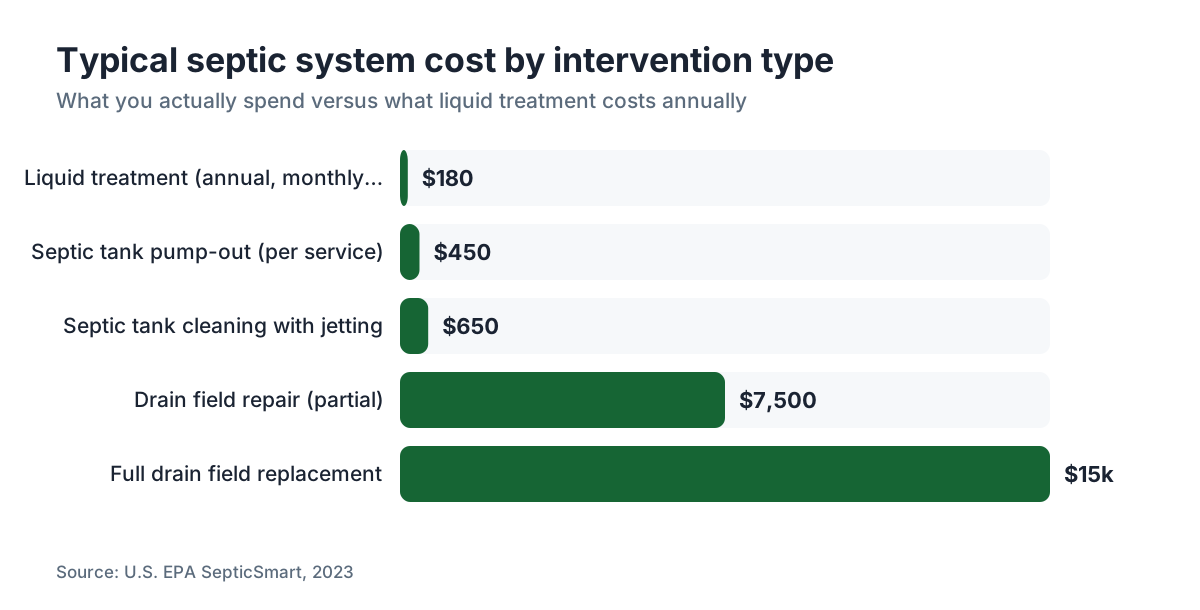
What you should never do: use liquid treatment instead of pumping because pumping feels expensive. Routine septic tank pumping runs $300 to $600 in most U.S. markets [5]. A failed drain field costs 10 to 100 times that.
How do you use liquid septic treatment correctly?
Dosing matters more than most people think. Pour the treatment into a flushed toilet, not a sink, because the toilet connects most directly to the main waste line running into the tank. Sinks route through a P-trap with standing water that dilutes or slows the product before it ever reaches the tank.
Most biological liquid treatments call for an initial "shock dose" (often double or triple the maintenance amount), then a monthly maintenance dose. Follow those numbers literally. More is not better. Overloading a tank with bacterial cultures doesn't give you a proportionally better result, and some products carry surfactants that cause trouble in large amounts.
Timing counts too. Pour treatments at night, after the last water use of the day. That gives the cultures several hours to settle and start working before the next flush dilutes and partly washes them out. Skip the washing machine and dishwasher for a few hours before and after.
Don't add liquid treatment right before or after using drain cleaners, bleach, or antibacterial soaps in strong doses. Those kill the exact bacteria you're introducing. Household chlorine bleach used normally (laundry, bathroom cleaning) is diluted enough by the time it reaches the tank that it doesn't seriously hurt the microbial population. But a full bottle of bleach or drain cleaner within 24 hours of a biological dose just wastes the treatment.
Store liquid treatments at room temperature. Hard cold can kill live cultures before you open the bottle.
Can liquid treatments reduce how often you need to pump your septic tank?
No credible evidence supports this, and several state agencies say so plainly.
The EPA recommends a septic tank pump-out every 3 to 5 years for most household systems, with the exact timing tied to tank size and household occupancy [2]. The National Onsite Wastewater Recycling Association (NOWRA) uses a similar interval [9]. Those schedules come from the physical accumulation rate of scum and sludge, which is governed by physics and household habits, not by bacteria in a bottle.
An active bacterial population breaks down organic solids faster than a depleted one. But "faster" is not "completely." Inorganic solids (sand, grit, hair, synthetic fibers, non-degradable wipes) don't biodegrade at all. Even organic solids leave a residue layer that stacks up year over year. The math never lands in favor of skipping the pump-out.
To set the right schedule for your own household, see our guide on how often to pump your septic tank. The variables that actually drive frequency are tank volume, number of occupants, and whether you run a garbage disposal, not additive use.
The Federal Trade Commission has gone after companies making unsubstantiated pumping-reduction claims for septic additives [11]. If a product promises to eliminate or sharply reduce pump-out frequency, read that as a warning label, not a feature.
What ingredients in liquid treatments can damage your septic system?
This is the more urgent question for most homeowners, because damage is irreversible in ways that weak effectiveness is not.
Organic solvents are the biggest concern. Products with trichloroethylene (TCE), 1,1,1-trichloroethane, methylene chloride, or similar solvents liquefy the grease scum layer fast. That sounds helpful but isn't. The scum layer is supposed to stay floating as a contained mat until you pump it out. Once it liquefies and disperses, it can ride effluent into the drain field biomat and clog soil pores in a way that's very hard to undo [1][12].
Those same solvents are classified as hazardous under the EPA's Resource Conservation and Recovery Act (RCRA) [7]. They don't biodegrade in soil the way organic waste does. They persist, and they can reach groundwater. If a state inspection finds solvent contamination traceable to additive use, remediation lands on you.
Acids and alkalis strip the concrete walls of older tanks (which is most installed tanks in the U.S.), corrode steel outlet baffles, and can kill the biofilm on drain field media in mound and drip-irrigation systems. One dose won't destroy a tank. Years of repeated use will speed up its structural decay.
Heavy surfactant loads can cause surfactant poisoning in the drain field soil, where detergent compounds block the soil's ability to absorb water. It looks exactly like a failing drain field and may force septic system repair or full replacement.
Safe products avoid all of this. Look for a plain ingredient list: bacterial species names (Bacillus subtilis, Lactobacillus acidophilus, and the like) plus a water carrier. That's it. Anything with a long chemical solvent name on the label goes back on the shelf.
How do liquid treatments compare to solid or powder septic additives?
The active ingredients across liquid, solid, and powder formats are mostly the same: bacteria, enzymes, or chemicals. Format is about delivery and shelf life, not different chemistry.
Liquid formulations have one real edge. The bacteria are already in suspension and start working as soon as they hit the tank. They don't need to dissolve first. The trade-off is shelf life. Live bacterial cultures in liquid form last a shorter time than freeze-dried powder, usually 12 to 24 months versus 2 to 5 years for good powders.
Powder and tablet formats are more concentrated per unit volume, so they ship and store easier. Some use spore-forming bacteria (like Bacillus subtilis) that survive drying and storage well. Others use freeze-dried active cultures that wake up when they touch liquid.
On effectiveness, there's no strong data showing liquids beat powders or the other way around. The bacterial strain, the colony count (measured in CFUs, or colony-forming units per dose), and whether the product has been third-party tested matter far more than whether it pours or scoops.
If you're choosing a biological product, look for one that lists CFU count on the label (a real product will; a vague one often won't), names specific bacterial strains, and prints a clear expiration date. Those signals point to a manufacturer that's at least trying to make a consistent product.
What does liquid septic treatment cost, and is it worth the money?
Liquid septic tank treatments run $5 to $30 per bottle at big-box retailers and online, with monthly maintenance doses usually sized at 8 to 32 ounces. A monthly regimen costs $60 to $360 a year depending on the product.
Is it worth it? Depends on what you're after.
Using a biological product after a pump-out or antibiotic course? The cost is low and the potential benefit is real. Ten or fifteen dollars for a single application in that spot is reasonable.
Using it monthly as prevention on a healthy system? The science doesn't justify the spend for most households. You'd be paying $60 to $200 a year for a benefit that's hard to measure and might be zero.
Using chemical, solvent, or alkali products? You're paying money to maybe damage your system. That's clearly not worth it.
The one place modest odor reduction earns its keep is a system serving a business, or a home with outdoor entertaining areas where odor is a guest problem. There, $15 a month to cut vent odor is a fair operating cost. For odor specifically, pairing a biological liquid product with an inspection of the vent stack and inlet baffle (the two most common odor sources) gets you further than the bottle alone.
For operators running multiple systems and tracking maintenance across properties, tools like SepticMind can log treatment dates, track pump-out intervals, and flag systems due for septic tank inspection. That takes the guesswork out of when a biological treatment is warranted versus when a pump-out is overdue.
What does the EPA say about septic tank additives?
The EPA's SepticSmart program is the clearest federal guidance on this topic. The program's guidance states that biological additives such as bacteria and enzymes may help a system that needs extra help getting started, for example after a pump-out or after heavy antibiotic use, but that no additive has been proven to work well enough to eliminate the need for regular pumping [2].
Sit with that last part. No additive has been proven to work well enough to eliminate the need for regular pumping. That's the EPA's bottom line after reviewing the evidence.
On chemical additives the agency is sharper. It has flagged organic solvent additives as potential groundwater contaminants and recommends against using them. Several states have followed by banning or restricting these products in their onsite wastewater rules.
The SepticSmart program names four core practices for septic health: pump every 3 to 5 years, inspect the system regularly, use water efficiently, and dispose of waste properly (meaning nothing that shouldn't go down a drain goes down a drain). Additives appear nowhere in those four [10].
State codes vary but mostly mirror the EPA. The North Carolina Division of Water Resources states that chemical additives are not a substitute for proper maintenance and recommends only biological products if an owner chooses to use anything [8]. Many states require that any additive not harm the tank structure or drain field, which effectively bans chemical and solvent products by performance standard even without naming them.
How do you know if your septic system actually needs treatment versus something more serious?
Slow drains, gurgling pipes, sewage odor inside the house, and wet spots over the drain field are not signs you need a liquid treatment. They're signs you need a professional septic tank inspection and probably a pump-out or septic tank repair.
Liquid treatments are maintenance products for healthy systems. They're not diagnostic tools and they're not repairs. Adding a bottle of bacterial treatment to a system showing symptoms is like putting air freshener in a car with the engine light on.
The gap between a sluggish system that a pump-out fixes and a failing drain field matters enormously for cost. A pump-out runs $300 to $600. A septic tank cleaning with jetting runs $400 to $900. Full drain field replacement runs $5,000 to $20,000 or more depending on soil and system type [5]. Dumping additives into a failing system while you delay the diagnosis doesn't save money. It compounds the damage.
Signs to call a professional and skip the bottle:
- Sewage backing up into drains or toilets
- Wet, spongy ground directly over the drain field (especially if it smells)
- Grass growing noticeably faster or greener over one section of the yard
- Tank alarm triggering (for systems with pump chambers)
- Any drain odor inside the house
If your system is otherwise healthy and you're shopping for liquid treatment purely as prevention, a biological product used per label directions is unlikely to help much but also unlikely to hurt. That's the honest read on risk versus benefit.
For what happens when systems need real intervention, see our guides on septic system repair and septic tank emptying.
What's the best liquid septic treatment to buy?
There's no single government-approved product list, and SepticMind doesn't sell additives, so there's no conflict in handing you the actual criteria.
A biological liquid treatment worth buying has all of these:
- Lists specific bacterial species (Bacillus subtilis, Bacillus licheniformis, Bacillus amyloliquefaciens, and similar anaerobic-tolerant species are common and legitimate)
- States a CFU count per dose (anything under 1 billion CFU per dose is probably too weak to matter; good products list 10 billion or more)
- Prints a clear expiration date on the bottle (bacteria die; a product with no date isn't tracking this)
- Keeps the ingredient list short and free of organic solvents, surfactants beyond trace levels, acids, or alkalis
- Names anaerobic bacteria specifically, because your tank is oxygen-poor and aerobic-only cultures will die before doing much
Products sold hard on odor elimination alone are often surfactant-heavy. Products sold on "cleans your whole system" often carry solvent carriers. The simpler the claim, the more likely the product is legitimate.
Where to buy: hardware stores, plumbing supply houses, and online retailers all carry these. Price is not a reliable quality signal here. Some $10 products perform as well as $30 ones in independent testing, and the testing itself is thin.
One note on yeast. Baker's yeast (one cake or packet flushed monthly) is a folk remedy with a long history. It adds a naturally occurring microorganism at near-zero cost. The evidence it helps is thin, and the evidence it harms is also thin. If money is tight, it's not the worst choice for someone who wants to do something. It's just not meaningfully better than doing nothing on a healthy system.
Frequently asked questions
How often should you add liquid septic tank treatment?
Most biological liquid treatments call for a monthly maintenance dose after an initial larger shock dose. In practice, the strongest evidence supports using a product after a pump-out or after heavy household antibiotic use. Monthly use on a healthy, working system isn't well-supported by research. If you do run a monthly product, follow label directions and don't double-dose thinking more is better.
Can liquid septic treatment eliminate septic tank odor?
Biological treatments can cut odor by raising microbial activity and reducing the organic compounds that odor-causing bacteria feed on. The effect is real but usually temporary. If odor is persistent, the cause is more likely a deteriorated inlet baffle, a blocked vent stack, or a failing drain field, none of which a bottle fixes. Treat odor as a symptom to investigate rather than mask.
Is it safe to use liquid septic treatment with a mound system or aerobic system?
Biological treatments are generally safe with most system types including mound systems. Aerobic treatment units (ATUs) already run a much higher bacterial population than conventional tanks, so biological additives give little benefit there. Chemical and solvent products are wrong for any system type. Always check the product label for compatibility and your state's rules for alternative systems.
Will liquid septic treatment hurt the drain field?
Biological products with no solvent or surfactant carriers are unlikely to hurt a drain field. Organic solvent products and heavy surfactant formulas can damage the soil biomat and clog drain field pores, mimicking a failing system. This is the main reason most state extension services and the EPA recommend against chemical additives. Stick to pure bacterial or enzyme formulas to keep risk low.
Can you use too much liquid septic treatment?
With biological products, overdosing mostly wastes money rather than causing harm, though products with surfactant carriers can cause trouble in large amounts. Chemical or solvent products are genuinely dangerous in excess and can kill the tank's bacterial population, damage concrete, or push liquefied solids into the drain field. Follow label dosing regardless of which product type you use.
Does liquid septic treatment work in cold weather?
Bacterial activity slows sharply below about 50 degrees F (10 degrees C), so biological treatments are less effective in cold climates during winter. Live cultures can also die from freezing before you use them, so store products above freezing. For seasonal systems being winterized, a biological dose before closing down can hold minimal microbial activity through the dormant period.
What liquid septic treatment does the EPA recommend?
The EPA's SepticSmart program does not endorse specific products or brands. The agency's position is that a healthy system already holds enough bacteria, and that no additive eliminates the need for pumping every 3 to 5 years. The EPA says biological additives may help after a pump-out or heavy antibiotic use, but warns against chemical and solvent-based products as potential groundwater contaminants.
How long does liquid septic treatment take to work?
Bacterial cultures need time to establish and multiply in the tank. Most manufacturers suggest 2 to 4 weeks before any measurable effect on odor or sludge. Enzyme-only products act faster because they don't reproduce, but their effect ends when the enzymes flush out or denature. Don't expect overnight results. This is a slow maintenance tool, not a quick fix.
Can liquid septic treatment fix a failing septic system?
No. A failing system, meaning one with a clogged or saturated drain field, sewage backing up, or structural damage, needs professional inspection and likely repair or replacement. Liquid treatments cannot restore clogged soil pores, replace damaged baffles, or make room in a tank at capacity. Using treatment to delay dealing with a failing system makes the eventual repair more expensive and the environmental damage worse.
Are there any liquid septic treatments that are banned?
Yes. Several states ban or restrict specific categories. Illinois prohibits certain chemical and biological additives under its private sewage disposal rules. Many states ban organic solvent additives because the EPA classifies several common solvents (trichloroethylene, methylene chloride) as hazardous under RCRA. Check your state's onsite wastewater or private sewage disposal code before buying. Using a banned product can void your system permit.
Is liquid septic treatment the same as septic tank cleaning?
No, they're completely different. Liquid treatment adds bacteria or chemicals to the water already in the tank. Septic tank cleaning means physically pumping out the accumulated sludge, scum, and liquid, and sometimes jetting the inlet and outlet baffles. No liquid product removes accumulated solids. The EPA recommends actual pump-outs every 3 to 5 years regardless of additive use.
Can I make a homemade liquid septic treatment?
The most common DIY approach is flushing one packet of active dry yeast monthly, which adds Saccharomyces cerevisiae, a naturally occurring microorganism. Cost is near zero and the risk of harm is very low. Evidence of real benefit is thin, but so is evidence of harm. Homemade chemical brews (baking soda, vinegar, bleach) aren't recommended; they either do nothing useful or hurt the bacteria the tank needs.
Does liquid septic treatment affect how often you need to pump?
No credible independent research shows any liquid additive meaningfully extends pump-out intervals. The EPA and multiple state extension services state plainly that additives can't substitute for pumping. Scum and sludge accumulation is driven by household size, tank volume, and what goes down the drains, not by bacterial activity. The recommended pump-out interval of 3 to 5 years applies regardless of additive use.
What's the difference between enzyme treatments and bacterial treatments for septic tanks?
Bacterial treatments add live microorganisms that reproduce in the tank and make enzymes as a byproduct of their metabolism. Enzyme-only treatments add the enzymes directly, without the bacteria. Bacterial products have a longer-lasting effect because the bacteria keep making enzymes as long as they survive. Enzyme-only products act faster at first but fade as the enzymes are consumed or flushed out. Both are low-risk; bacterial formulas are generally considered more effective.
Sources
- University of Minnesota Extension, Septic System Owner's Guide: Additives: Classification of septic additives into biological, inorganic chemical, and organic solvent categories with distinct risk profiles
- U.S. EPA SepticSmart Program, Septic System Additives Fact Sheet: EPA statement that no additive eliminates the need for pumping and that biological additives may help after a pump-out or antibiotic use
- University of Wisconsin-Extension, Septic System Additives Review (Wegner, 1994): 1994 review of hundreds of additive products finding insufficient evidence any consistently improved system performance enough to recommend as primary maintenance
- Oklahoma Cooperative Extension Service, Septic Tank Additives Fact Sheet: Biological additives may provide modest benefit after pump-out or heavy antibiotic use but do not help normally functioning systems
- U.S. EPA SepticSmart, Septic System Costs and Maintenance: Drain field replacement costs and standard pump-out cost ranges; EPA recommendation for 3-to-5-year pump-out frequency
- Illinois Department of Public Health, Private Sewage Disposal Code (77 Ill. Adm. Code 905): Illinois prohibition on certain chemical solvents and biological additives under state private sewage disposal rules
- U.S. EPA, Resource Conservation and Recovery Act (RCRA) Hazardous Waste program: Organic solvents including trichloroethylene classified as hazardous under RCRA; do not biodegrade in soil
- North Carolina Department of Environmental Quality, Septic System Additives Guidance: NC guidance that chemical additives are not a substitute for proper maintenance; recommends only biological products if any are used
- National Onsite Wastewater Recycling Association (NOWRA), Septic System Maintenance Best Practices: NOWRA recommended pump-out interval of 3 to 5 years based on physical accumulation rates of scum and sludge
- U.S. EPA SepticSmart, Four Core Septic System Maintenance Practices: EPA SepticSmart program four core practices: pump every 3-5 years, inspect regularly, use water efficiently, dispose of waste properly; additives not listed
- Federal Trade Commission, Consumer Information on Septic Additives and Unsubstantiated Claims: FTC enforcement actions against companies making unsubstantiated pumping-reduction claims for septic additives
- University of Nebraska-Lincoln Extension, On-Site Wastewater Systems: Additives: Organic solvent liquefaction of scum layer can cause solids migration into drain field biomat and clogging of soil pores
Last updated 2026-07-09