Maintaining a septic system: the complete homeowner guide
By the SepticMind Editorial Team
TL;DR
- A well-maintained septic system lasts 25 to 40 years.
- Pump every 3 to 5 years, keep the drain field clear, watch what goes down your drains, and get a professional inspection every 1 to 3 years.
- Skip those and you risk more than a smelly yard.
- You risk a $15,000-plus system replacement.
Why does septic maintenance matter so much?
About 21 percent of U.S. households run on a septic system instead of a municipal sewer, according to the EPA [1]. If that's you, the system on your property is a private wastewater treatment plant. Nobody else is responsible for it. Nobody else pays when it fails.
A conventional system has two main parts. A buried tank separates solids from liquid. A drain field (also called a leach field) disperses the clarified liquid into the soil. The tank needs periodic pumping. The drain field needs to stay uncompacted, unplanted, and free of the grease and solids that clog soil pores. Both need occasional inspection.
Neglect either piece and you get one of three bad outcomes: sewage backing up into your house, sewage surfacing in your yard, or slow invisible contamination of the groundwater beneath you. The EPA's SepticSmart program names failing septic systems as one of the top sources of groundwater contamination in the country [1]. That's not a scare tactic. That's plumbing physics.
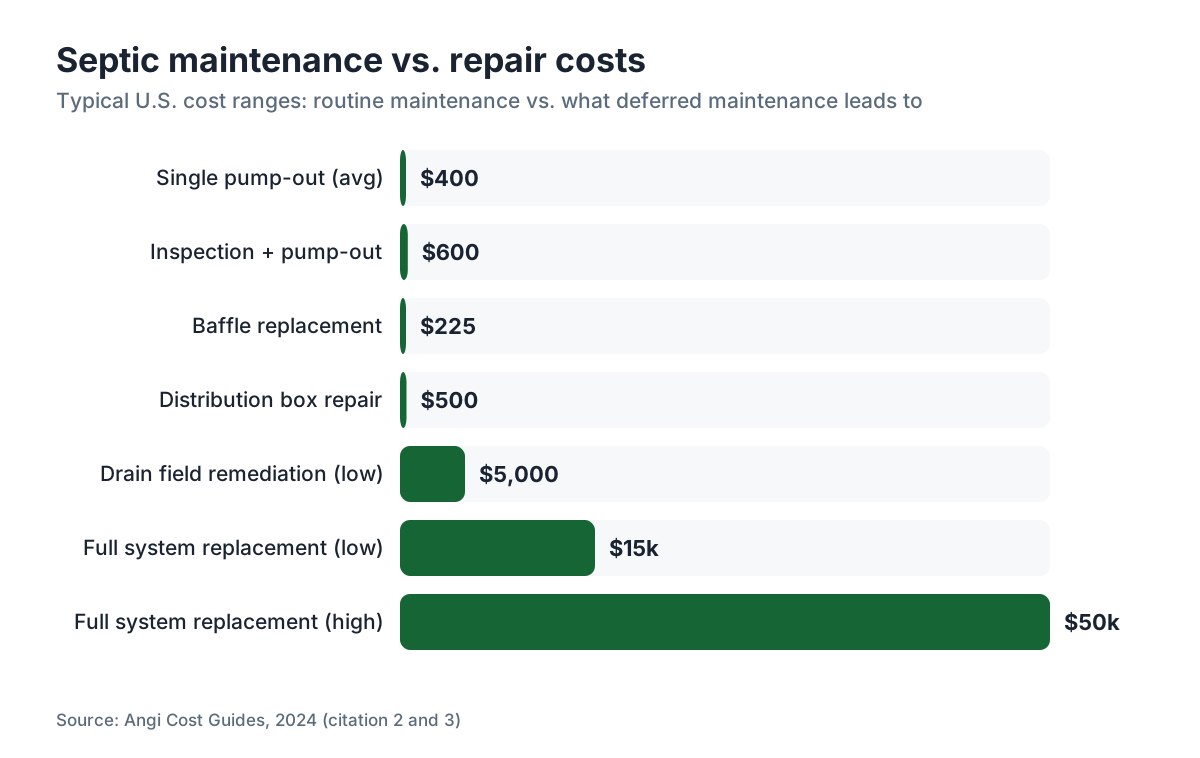
Maintenance is cheap next to replacement. A pump-out costs $300 to $600 in most markets [2]. A full system replacement can run $15,000 to $50,000 or more depending on soil type and local rules [3]. Maintenance wins that math every time.
How does a septic system actually work?
Wastewater from your toilets, sinks, showers, and laundry flows into the septic tank. Heavy solids sink and form a sludge layer at the bottom. Grease and soap scum float and form a scum layer on top. The liquid in the middle, called effluent, flows out an outlet pipe into the drain field [6]. Understanding this makes every maintenance decision easier.
In the drain field, perforated pipes spread the effluent through gravel trenches or chambers. The liquid percolates down through soil, where bacteria and natural filtration strip out pathogens before the water reaches the groundwater table. The soil is doing real treatment work. That's exactly why compaction and overloading do so much damage.
The sludge and scum don't disappear on their own. They build up. Once they take up too much of the tank's volume, effluent can't settle long enough, and solids start slipping out to the drain field. That's when the field clogs. See leach field for a closer look at how drain fields work and fail.
Some systems carry extra parts: a pump chamber with a dosing pump, an aerobic treatment unit (ATU) that injects air to speed up bacterial action, a filter at the outlet baffle, or a pressure-distribution manifold. Each add-on brings its own maintenance needs. Know what type of system you have before you assume the basic advice below covers everything you've got.
How often should you pump your septic tank?
The EPA recommends pumping most household septic tanks every 3 to 5 years [1]. The range exists because the right interval depends on four things: tank size, number of people in the house, total wastewater generated, and how much solid material is in that wastewater.
The EPA publishes a lookup table that captures those relationships [1]:
| Household size (people) | Tank size 1,000 gal | Tank size 1,500 gal | Tank size 2,000 gal |
|---|---|---|---|
| 1 | 12 years | 16 years | 19 years |
| 2 | 6 years | 11 years | 12 years |
| 3 | 4 years | 7 years | 9 years |
| 4 | 3 years | 5 years | 7 years |
| 6 | 2 years | 4 years | 5 years |
Those numbers assume no garbage disposal. Use a disposal heavily and you should cut the interval roughly in half, or ditch the disposal. The University of Minnesota Extension recommends skipping in-sink garbage disposals on septic entirely, because they roughly double the solids load hitting the tank [4].
Here's the honest answer to the question: a pumper doing the job right measures sludge and scum depths before deciding whether the tank actually needed pumping. That measurement, not a date on the calendar, is the real trigger. Ask for it. Once the combined sludge and scum reach about one third of the tank's liquid volume, it's time regardless of the schedule [6].
For more on scheduling and what to expect, see how often to pump septic tank and septic tank pumping.
What does septic pumping cost, and what does it include?
A standard septic pump-out runs roughly $300 to $600 nationally, with most homeowners paying around $400 for a 1,000-gallon tank [2]. Larger tanks, hard access, and high-cost metros push that toward $800 or more. Remote rural properties with long drive times often tack on a trip charge.
What a basic pump-out includes: the pumper shows up with a vacuum truck, locates and uncovers the tank lid (expect an extra charge if they have to dig for it), pumps out all liquid and sludge, and eyeballs the accessible components (inlet and outlet baffles, tank walls, the visible stretch of outlet line). What it usually leaves out: jetting the lines, inspecting the drain field, or replacing a broken baffle.
Want a real read on the tank's condition? Ask for a pumping combined with an inspection. That usually adds $100 to $250 and is worth doing every few pump cycles. See septic tank pump out and septic tank cleaning for what these services cover.
The pumping visit is your cheapest shot at catching small problems. A cracked baffle costs maybe $150 to $300 to fix. Ignore it, and solids flow to the drain field, and now you're staring at field repair or replacement in the thousands.
What should you never put down a septic-system drain?
The tank's bacteria break down organic waste. They can't handle many common household products, and the drain field's soil takes permanent damage from grease and non-biodegradable junk.
The EPA's SepticSmart guidance is blunt about it. The program tells homeowners to "never flush cooking grease or oil" and to keep wipes, feminine hygiene products, dental floss, diapers, cigarette butts, coffee grounds, cat litter, paper towels, and household chemicals out of the system [1]. Wipes are a special headache because they don't break down. They pile up in the tank and pump chambers, wrap around impellers, and clog screens. "Flushable" on the label means nothing here.
Fats, oils, and grease are the drain field's worst enemy. They don't stay in the tank. They ride the effluent out to the field and coat the soil pores with a biological mat called biomat. Caught early, biomat is partly reversible. In bad cases it seals the soil for good. Don't pour cooking grease down the sink. Ever.
Household chemicals are more nuanced. Normal amounts of bleach, cleaning products, and antibacterial soap in a typical household get diluted enough in the water stream that they won't wipe out the tank's bacteria. The University of Minnesota Extension found that normal household chemical use has minimal impact on a properly sized septic system [4]. The real risks are draining a swimming pool into a septic-connected drain, dumping large volumes of paint thinner or solvents, or grinding medication through a garbage disposal.
One more that surprises people: water softener backwash. High-salt regeneration cycles can disrupt the tank's bacterial activity and, depending on soil type, hurt the drain field's permeability. Check your state's onsite wastewater code, because some states restrict or regulate softener discharge to septic systems.
How do you protect your drain field from damage?
The drain field is the part most homeowners forget about until it fails. Keeping it healthy is mostly about what you don't do.
Never drive or park over the drain field. The soil has to stay loose enough to accept effluent. A single pass from a loaded pickup can compact the soil enough to cut percolation measurably. Mark the field boundaries if you have to. It's worth it.
Keep tree and shrub roots away. Willows, poplars, silver maples, and other fast-growing trees hunt down the moisture in a drain field and grow right into the pipes. The generally accepted safe distance is 10 feet from the field for most trees, and more for the aggressive species [4]. Grass and shallow-rooted groundcover are fine, and they actually help by taking up moisture and holding the soil.
Don't cover the field with anything impermeable: concrete, pavers, dense plastic sheeting. The field needs to breathe, and it needs rain to help flush the soil profile over time.
Manage your water use. The field is built for a set daily hydraulic load. Run the dishwasher, three loads of laundry, two showers, and the lawn irrigation all in one day and you can hydraulically overload it. Spread laundry across the week instead of blitzing it on Saturday. Fix leaky toilets fast. A single running toilet can dump 200 gallons of wasted water a day into the system [1].
For a closer look at field problems and what causes them, see leach field.
How often should you get a professional septic inspection?
The EPA recommends that systems with mechanical parts (pumps, aerobic units, float switches) get inspected every year, and points homeowners toward regular inspection of conventional systems too [1]. For a conventional gravity system, every 1 to 3 years is reasonable, and it's smart to time it with a pumping.
Two situations call for an inspection no matter the schedule: before you buy a home with a septic system, and any time you notice warning signs (slow drains, gurgling pipes, wet spots over the field, sewage odors inside).
A professional inspection goes past what you can see at the surface. The inspector locates and opens all tank lids, checks inlet and outlet baffles, probes sludge and scum depths, looks for structural cracks or root intrusion, confirms the distribution box is level and working, and may run a dye test or camera the outlet line. Some states require a licensed inspector to file a specific form, so check your local onsite wastewater rules.
Buying a home? A standard home inspection does not include the septic system. Budget $300 to $500 for a dedicated septic inspection on its own [2]. It's one of the cheaper insurance policies in real estate. See septic tank inspection for what a full inspection covers and how to read the results.
SepticMind's inspection tracking tools let operators log inspection reports, sludge depths, and component condition digitally. Handy if you run a service company juggling multiple client properties and need to stay ahead of follow-up schedules.
Do septic tank additives actually work?
The research gives a pretty clear answer: probably not, and some may do harm.
The EPA says it has not found sufficient evidence that biological additives (bacterial or enzyme products) improve system performance or stretch out pumping intervals [1]. The tank already holds billions of bacteria, restocked with every flush. A commercial bacterial packet doesn't meaningfully grow that population.
Chemical additives are a different, worse story. Some older products used solvents like methylene chloride to break up grease. The EPA warns these can damage the tank, disrupt the bacterial ecosystem, and carry contaminants into groundwater [1]. Several states have banned specific additive formulations outright.
The honest summary: keep the $20 to $100 a year you'd spend on additives and put it toward your pumping fund. The research doesn't back spending money here.
What are the warning signs your septic system is failing?
Some of these are obvious. Some aren't.
The obvious ones: sewage backing up into your lowest drains or toilets, sewage smell inside the house, wet spongy ground or lush green grass over the drain field while the rest of the yard sits dry, standing water pooling in the field area.
The subtle ones: multiple slow drains throughout the house (one slow drain is usually a local clog, but several at once points to a system problem), gurgling from drains after you flush a toilet, and an oddly lush stripe of grass along the line from the house to the tank (that can mean a broken pipe leaking effluent before it even reaches the tank).
See or smell surface sewage inside the house? Stop using water in the home and call a septic professional. Don't open the tank yourself. Septic gases include hydrogen sulfide and methane, and the CDC documents that both have killed people who entered tanks without proper equipment [8]. This is not a DIY situation.
Early intervention almost always costs less than waiting. A failing distribution box runs a few hundred dollars to fix. A fully failed drain field costs $5,000 to $20,000 to replace, and that assumes the soil is still suitable for a conventional system [3]. See septic system repair and septic tank repair for what different repairs involve.
What does a full year of septic maintenance actually look like?
There's no single month where everything happens at once. Maintenance is a set of ongoing habits plus a few scheduled tasks.
Ongoing: watch what goes down your drains, fix running toilets fast, spread water use across days instead of dumping it all on laundry day, and stay off the drain field with vehicles.
Every 1 to 3 years: schedule a professional inspection, ideally timed with a pumping. Get sludge and scum depths recorded so you can trend them over time.
Every 3 to 5 years (or per your household's specific number from the table above): septic tank pumping and septic tank emptying. Don't skip it because the system seems fine. It seems fine right up until it doesn't.
After major rain: walk the drain field and look for ponding or unusual saturated soil. Heavy rain can stress a field for a day or two, but wet spots that linger after the rest of the yard dries out warrant a call.
Got a pump chamber or aerobic treatment unit? Follow the manufacturer's maintenance schedule. These systems usually need annual service by a licensed technician, and your state's onsite wastewater code likely mandates a maintenance contract for ATUs. Check your permit.
Keep a maintenance log. Write down every pumping date, inspection date, and repair. When you sell the home, that documentation has real value. When something goes wrong, it tells the professional exactly what's been done.
How much does it cost to maintain a septic system over time?
Here are real numbers on the full lifecycle.
Pumping amortized over a 3-year cycle: roughly $130 to $200 a year. An inspection every 3 years adds maybe $100 to $170 a year on average. Minor repairs (baffle replacement, filter cleaning, riser install) might average $50 to $100 a year over a long ownership stretch. Total routine maintenance lands around $300 to $500 a year depending on system type, local costs, and household size [2].
Now compare that to failure. A new conventional septic installation runs about $3,500 to $10,000 for a basic system in good soil, and $15,000 to $50,000 for mound systems, drip irrigation, or the alternative designs required in poor-soil areas [3]. Some states require engineered systems in certain soils, and those cost more still.
The EPA estimates that a meaningful share of septic systems in the U.S. are in some stage of failure, and its SepticSmart materials tie those failures to skipped maintenance [1]. Routine care almost certainly tracks with which systems survive and which don't.
For context on new-system pricing if you ever face replacement, see cost to put in a septic tank and cost to install septic system.
SepticMind's scheduling and reporting tools help service operators track customer pump-out intervals automatically, so a client doesn't slip off the schedule and call with a failed field instead of a routine pumping.
Are there state or local regulations that govern septic maintenance?
Yes, and they vary a lot.
The EPA sets general guidance through programs like SepticSmart, but it doesn't directly regulate individual septic systems. That authority sits with state environmental and health agencies, which hand it further down to county health departments in many states. The result is a patchwork. What's required in one county can differ from the county right next door.
Common requirements you might run into: mandatory pumping intervals (some states require pumping every 3 years regardless of condition), mandatory inspection at property transfer, mandatory maintenance contracts for alternative or aerobic systems, permit requirements for any repair or modification, and setback rules for new construction near a septic system.
A few examples show the range. Virginia regulates onsite sewage through its Department of Health and requires inspections tied to certain property transfers. Washington State's Department of Health requires ongoing inspection and reporting for many alternative systems. Florida runs county-level rules that vary on pumping frequency. Always check your specific county's onsite wastewater program, more than the state-level rules.
The National Onsite Wastewater Recycling Association (NOWRA) keeps state-by-state regulatory information that can point you to the right agency [5]. Your county health department is usually the best first call for local specifics.
Frequently asked questions
How do I find my septic tank if I don't know where it is?
Start with your property records or the county health department. Most jurisdictions keep the original septic permit and a site diagram on file. If that comes up empty, a septic professional can probe the soil or use an electronic locator. The tank usually sits 10 to 25 feet from the house, downstream from the main sewer cleanout. Some pumpers locate it free as part of the service call.
Can I do my own septic tank pumping?
No. Pumping needs a vacuum truck holding 1,500 to 3,000 gallons of septage, plus disposal at a licensed facility. Septage is regulated as a pollutant under federal law. DIY attempts are illegal and physically dangerous because of the toxic gases inside the tank. What you can do yourself: keep the area over the tank clear, install risers so the lid stays accessible, and keep records.
What happens if I don't pump my septic tank?
Sludge and scum build until solids overflow into the drain field. Once solids reach the field, they clog the soil pores and form a permanent biomat that stops effluent from draining. At that point the field needs expensive remediation or full replacement. The tank itself can develop structural problems from the pressure of overfilled solids. Field repair typically starts at $5,000 and can top $20,000.
Is it okay to use bleach and household cleaners with a septic system?
Normal household amounts are generally fine. The University of Minnesota Extension found that typical residential use of bleach, antibacterial soap, and standard cleaners dilutes enough in the water volume to avoid killing the tank's bacteria. The real trouble comes from pouring a big slug of bleach or solvent down at once, draining pool water into the system, or regular heavy disinfectant use far above household levels.
Do I need a septic inspection when buying a home?
Yes, always. A standard home inspection does not evaluate the septic system. Hire a licensed septic inspector separately before closing. A full inspection costs $300 to $500 and includes pumping, baffle inspection, distribution box check, and drain field assessment. A failed system found after closing is entirely your financial problem. Some states require sellers to disclose known septic issues, but known and all are different things.
How do I know if my drain field is failing?
The clearest signs are soggy or perpetually wet ground over the field, a stripe of lush bright-green grass over the field during dry weather, sewage odors outdoors, and slow or backed-up drains inside. A professional can also catch failure through dye testing or by reading effluent levels in the distribution box. Early-stage failure is sometimes reversible. A fully saturated field with permanent biomat usually needs replacement.
How long does a septic system last?
A well-maintained conventional system typically lasts 25 to 40 years. A concrete or fiberglass tank can last longer. The limiting factor is usually the drain field. Fields fail earlier when overloaded with solids from skipped pumpings, flooded by too much water, compacted by vehicles, or invaded by tree roots. Alternative systems have shorter service lives for their mechanical parts, though field longevity is similar.
What size septic tank do I need?
Most residential codes require a minimum 1,000-gallon tank, and many jurisdictions require 1,250 or 1,500 gallons for a 3-bedroom home. The rough rule is 250 gallons of capacity per bedroom, though local codes often demand more than that minimum. Sizing also depends on the number of bathrooms and whether you run a garbage disposal. Check your county's onsite wastewater code for the exact requirement.
Can heavy rain damage my septic system?
Heavy rain can temporarily saturate the soil around the drain field, slowing absorption and raising water levels in the tank. That's usually temporary, and the system recovers within a day or two. The bigger risk is surface water flowing toward the tank or field. Large amounts of stormwater seeping into the tank can hydraulically overload the system and push solids to the field. Route surface drainage away from the field.
Should I install a septic tank riser?
Yes, and most septic professionals will push you toward one. A riser extends the tank's access port to ground level, so nobody digs up the lid every time you pump. It costs about $200 to $400 installed and pays for itself in reduced labor within one or two pump-out cycles. Risers also let you do quick visual checks without digging. If your tank is buried more than a foot deep, a riser is genuinely worth it.
What is a septic system maintenance contract, and do I need one?
A maintenance contract is an agreement with a licensed septic company to handle scheduled inspections, pumping, and any required mechanical service on alternative systems. For conventional gravity systems, a contract is optional but useful for staying on schedule. For aerobic treatment units and other alternative systems, most state regulations require a contract as a condition of the operating permit. Check your permit documents or call your county health department.
Can I plant a garden over my septic drain field?
A vegetable garden directly over the field is not recommended. The concern is pathogen uptake into root vegetables and possible contact with incompletely treated effluent during field maintenance or failure. Shallow-rooted flowers and ornamentals are generally fine, and grass is ideal. Trees and deep-rooted shrubs should stay at least 10 feet away. Whatever you plant, avoid irrigation that adds extra water. The field already receives effluent every day.
What's the difference between a septic tank inspection and just pumping?
Pumping removes accumulated sludge and scum from the tank. An inspection evaluates the physical condition of the system: baffles, walls, lids, distribution box, outlet line, and drain field. Pumping alone tells you the tank is empty. Inspection with pumping tells you whether the system is healthy. Ask your company to include sludge depth measurements and a baffle check at every pumping. Combined service costs more and gives you real information.
Sources
- U.S. EPA, SepticSmart Program: 21% of U.S. households use septic; recommended pumping every 3-5 years; failing septic systems are a top source of groundwater contamination; additives lack sufficient evidence of benefit; guidelines on what not to flush; hydraulic overloading risks; annual inspection of mechanical systems.
- Angi, Septic Tank Pumping Cost Guide: National average septic pumping cost $300-$600; inspection adds $100-$250; dedicated septic inspection at property sale $300-$500.
- Angi, Septic System Installation Cost Guide: New conventional septic system installation ranges $3,500-$10,000; alternative or mound systems $15,000-$50,000+; drain field replacement $5,000-$20,000.
- University of Minnesota Extension: Garbage disposals roughly double solids load; typical household chemicals have minimal impact on properly sized systems; tree root safe distances from drain field.
- National Onsite Wastewater Recycling Association (NOWRA): NOWRA maintains state-by-state septic regulatory information.
- U.S. EPA, How to Care for Your Septic System: Description of septic tank sludge, scum, effluent layers; soil treatment in drain field; one-third tank volume threshold for pumping.
- U.S. EPA, Septic Systems section: EPA has not found sufficient evidence biological additives improve performance; some chemical additives (solvents) can damage tanks and contaminate groundwater.
- CDC, Sanitation and Wastewater section: Septic system failure risks for public health; hydrogen sulfide and methane hazards in septic tanks.
- U.S. EPA, Septic Systems section: Alternative systems with mechanical components should be inspected annually; conventional systems every 1-3 years.
- Virginia Department of Health: Virginia regulates onsite sewage and requires inspection tied to certain property transfers.
- Washington State Department of Health: Washington State requires ongoing inspection and maintenance reporting for many alternative systems.
Last updated 2026-07-09