Perc test for septic: what it is, how it works, and what it costs
By the SepticMind Editorial Team
TL;DR
- A perc test (percolation test) measures how fast your soil absorbs water.
- Health departments require it before they approve a septic permit.
- The test usually costs $250 to $1,500 depending on your state, the number of test holes, and whether a licensed engineer has to run it.
- Failing doesn't always mean no septic.
- Alternative systems often work where conventional ones can't.
What is a perc test for septic, and why does it matter?
A percolation test, almost always called a perc test, measures how fast water drains through the soil on your property. The number it produces, called a percolation rate, tells your local health department whether the ground can safely absorb the treated effluent a septic system releases from the drain field. No number, no permit. No permit, no septic system.
The test exists because soil varies enormously, even within a single half-acre lot. Sandy loam might absorb an inch of water in a couple of minutes. Dense clay might take 60 minutes or longer to absorb the same inch, which is usually too slow for a conventional drain field to work without flooding. Bedrock at three feet can kill a project outright. A perc test is how regulators and engineers get an objective reading on what your soil will actually do.
The EPA's SepticSmart program describes the drain field as the component that "removes contaminants from the wastewater that emerges from your septic tank" [1]. That treatment depends entirely on the soil doing its job. A perc test is how you confirm it can.
Homeowners buying rural land, splitting a parcel, or replacing a failed system all need a perc test before they move forward. If you're already on a working septic, your original test is on file with the county, and you generally don't need another one unless you're expanding the system or the rules have changed since.
How is a perc test for a septic system actually done?
The process varies by state, but the core steps hold across most of the U.S.
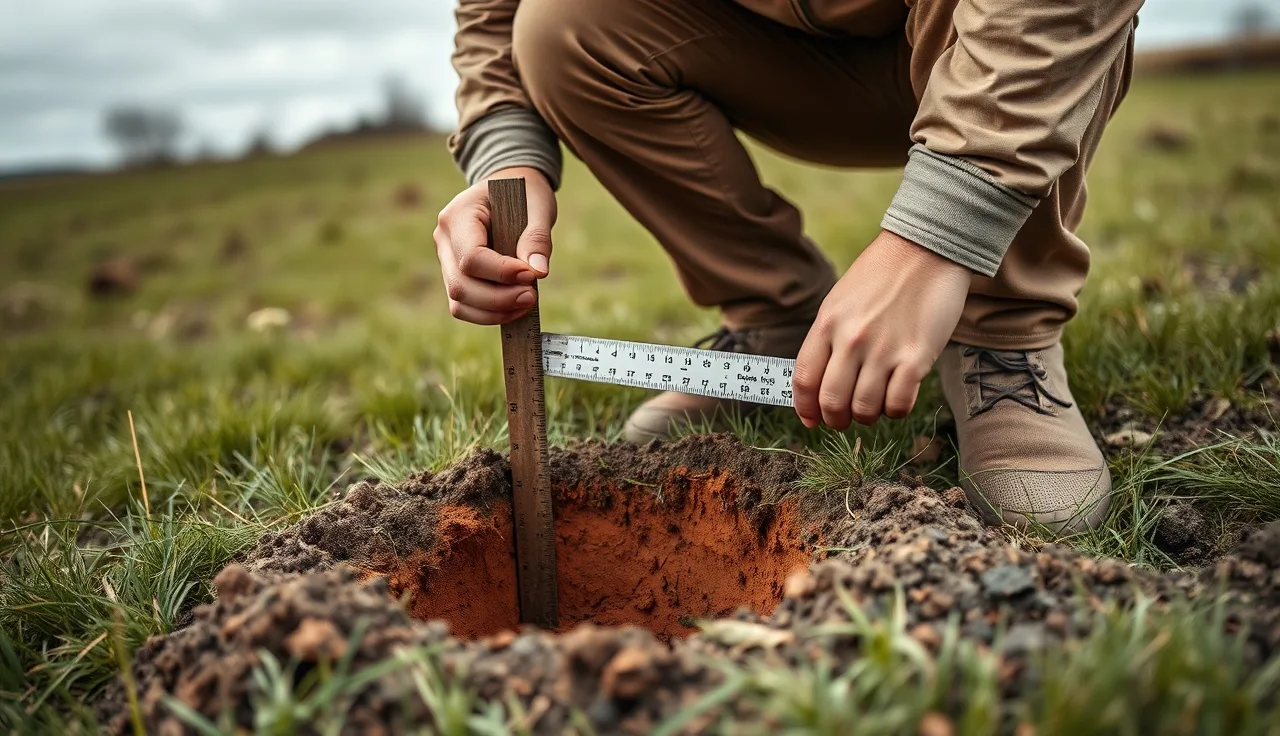
First, the tester digs or bores a series of holes, usually 6 to 12 inches wide and 12 to 36 inches deep. How many holes depends on your local code. Some counties want two, others want six or more spread across the proposed drain field. The holes go down to roughly the depth where the drain field pipes would sit.
Next comes presaturation. The tester fills each hole with water and lets it drain completely, often more than once, over a 24-hour period. This step is not optional, and skipping it is the most common reason a test comes back invalid. Presaturation copies what happens after a septic system has run for years: the soil is wet, not bone-dry the way it might be after a summer drought. Testing dry soil produces numbers that are far too optimistic.
Once presaturation is done, the tester fills the hole to a set depth and measures how many minutes it takes for the water to drop one inch. That rate, in minutes per inch (MPI), is the percolation rate. The tester takes several readings. Most codes use the slowest reading or an average, depending on the rule.
The tester writes down the readings, usually on a state-specific form, and submits them to the local health department. In most states the person running the test has to be a licensed soil scientist, a certified professional engineer, or a registered sanitarian [2]. Homeowners often ask whether they can run their own test. In practice almost no county accepts self-conducted results, because the liability for a failing drain field is too high.
What perc rate is acceptable for a conventional septic system?
Most states set acceptable perc rates between 1 and 60 minutes per inch. If water drops an inch in fewer than 1 to 3 minutes, the soil is too fast: it won't filter pathogens before effluent reaches groundwater. If the drop takes longer than 60 minutes per inch, the soil is too slow: effluent backs up and the drain field fails.
The cutoffs differ by state and, in some states, by county. North Carolina uses a range of 1 to 120 MPI depending on system type [3]. Virginia sets a standard rate of 1 to 60 MPI for conventional systems, with slower soils allowed for alternative designs [4]. Your local health department's onsite wastewater code is the only document that actually governs your property.
| Perc Rate (min/inch) | What it typically means |
|---|---|
| Less than 1 | Too fast; poor filtration; may require engineered system |
| 1 to 30 | Ideal for most conventional drain fields |
| 31 to 60 | Acceptable in many states; may require larger field |
| 61 to 120 | Marginal; some states allow alternative systems |
| Greater than 120 | Fails in virtually every state for conventional septic |
A single number doesn't tell the whole story. Soil texture, depth to groundwater, depth to bedrock, and lot size all factor into the final permit decision. Soil morphology evaluations, which a soil scientist performs alongside the perc test, often carry more weight with regulators than the raw perc rate alone.
How much does a perc test cost?
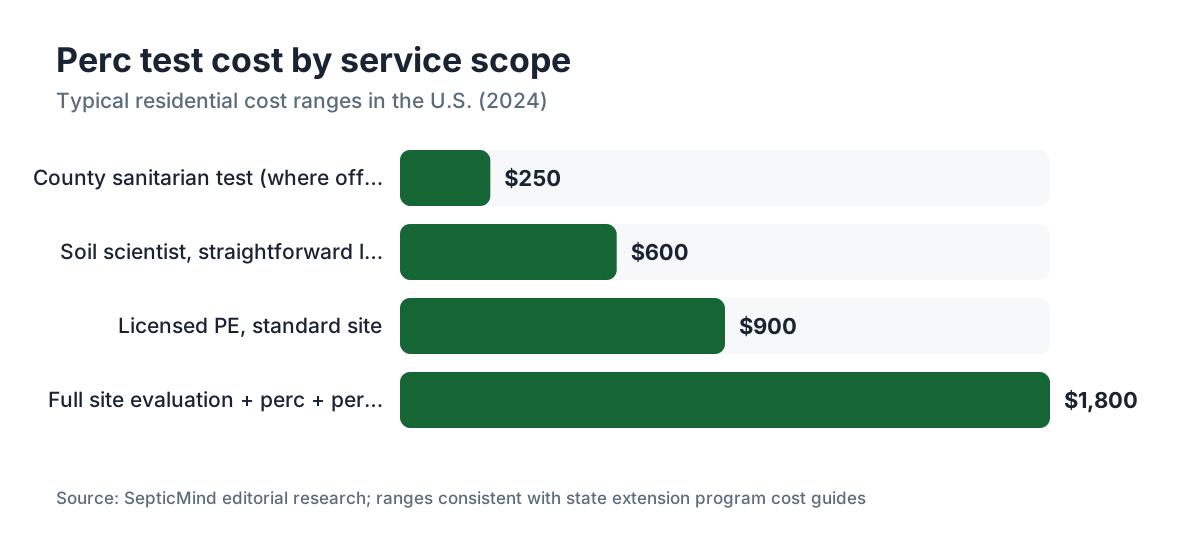
Perc tests run from about $250 in rural areas where a county sanitarian does the work, up to $1,500 or more when a licensed engineer or soil scientist has to be hired and the site is hard to reach or needs many test holes. The midpoint for a straightforward residential lot tends to land around $500 to $700, though nobody has clean aggregated data on this, and regional variation is large.
A few things push the price up. Rocky or heavily wooded land takes longer to excavate, which adds time. States that require a licensed professional engineer (PE) to supervise or certify the test add liability fees on top of the fieldwork. If the county wants five or more holes, you pay for each one. Some consultants charge a flat fee per test; others bill hourly, typically $75 to $150 per hour for a soil scientist or sanitarian.
The permit application fee, which goes to the county health department, is separate from the test. That runs $50 to $400 depending on the county.
If you're getting a full site evaluation, which bundles a soil profile analysis, a site sketch, and the formal permit application, expect $800 to $2,500 for the whole package.
A perc test is a small fraction of what a full septic tank installation costs, which typically runs $3,000 to $15,000 or more. Paying for a proper test upfront is almost always cheaper than finding out the drain field fails two years after construction. See the full cost to install a septic system for a line-by-line breakdown.
When do you actually need a perc test?
You need a perc test any time you apply for a new septic permit. That covers new construction on raw land, adding a structure that increases the system's load (a guest house or ADU), replacing a failed system in a spot that hasn't been approved before, or buying land where septic feasibility is unknown.
You generally don't need a new test if you're repairing an existing permitted system in the same footprint. Septic system repair or septic tank repair work on an already-approved site usually doesn't trigger a new perc requirement, though some counties ask for a site re-evaluation if the repair moves the drain field.
Real estate deals are a common trigger. Many buyers make offers contingent on a passing perc test, especially on raw rural parcels. A failed test can kill a deal or force a price renegotiation, since an alternative system costs more to install. The test often has to be scheduled months out, because most states require testing during the wet season (typically spring or fall). Soil at maximum saturation is what matters for a worst-case reading.
Inherited family land is a trap. If the parcel has been in the family for decades, check with the county health department before assuming there's a recorded perc result on file. Tests from the 1970s or early 1980s may predate current standards and might not be accepted for a new permit.
What happens if your land fails a perc test?
A failed perc test is not the end of the road. It means a conventional gravity-fed drain field won't work on that soil profile. Alternative and advanced treatment systems can often handle sites that conventional systems can't.
For slow soils (high MPI), the usual fix is a mound system, where treated effluent gets pumped to an elevated sand bed above the native soil, giving it extra filtration distance before it reaches groundwater [5]. For fast soils (very low MPI), an advanced treatment unit (ATU) with extra filtration stages may satisfy the health department. Drip irrigation systems, peat filter systems, and constructed wetland systems are approved in various states for sites that don't meet conventional standards.
These alternatives cost more. A mound system typically runs $10,000 to $20,000 installed, against $5,000 to $12,000 for a conventional system on a suitable lot. That gap is real, and if you're buying land, it matters for what you offer.
A second test, done after soil corrections or at a different location on the same parcel, sometimes passes. Soil varies across a lot, and a test in one corner might fail while a test 50 feet away passes. Talk to the soil scientist before you give up.
Some parcels genuinely can't support any onsite septic. In those cases, connecting to a public sewer (if one is available), a holding tank (which needs regular septic tank pump out service), or simply not building may be the only options.
Who can perform a perc test, and how do you find a qualified tester?
This is where homeowners get tripped up. The answer is highly state-specific, and getting the wrong person to run your test means the county won't accept the results.
In most states the test has to be conducted by, or at least witnessed by, a licensed professional. Qualifying license types include licensed soil scientists, registered professional engineers (civil or environmental), registered sanitarians, and in some states, licensed onsite wastewater installers. A handful of rural counties still let the county sanitarian run the test at no charge as part of permitting, though that's increasingly rare.
Your first call should go to your county health department's environmental health or onsite wastewater section. Ask who they accept as a qualified tester in your jurisdiction. They often keep a list of approved consultants. Your state's department of environmental quality or department of health will have the applicable regulations.
When you hire a soil consultant or engineer, ask specifically whether they're licensed to conduct perc tests and submit results in your county. Ask how many holes they'll dig, whether presaturation is included, and whether their fee covers the report you'll need for the permit application. Get it in writing.
SepticMind's operator tools include a job-tracking workflow that helps septic service companies manage perc test scheduling, result documentation, and permit follow-up across multiple sites at once, which helps when a company handles both testing and installation.
What is the difference between a perc test and a soil evaluation?
They're related but not the same, and plenty of homeowners swap the terms when they shouldn't.
A perc test is a hydraulic measurement: water in a hole, timed as it drops. It tells you about drainage rate. It tells you nothing about soil structure, horizon depths, texture, mottling (which flags a seasonal high water table), restrictive layers, or distance to bedrock. Those things matter enormously for septic siting.
A soil evaluation (also called a soil morphology assessment or soil profile evaluation) has a soil scientist digging test pits, reading the layers by sight and texture, and documenting conditions a perc test never captures. Many states now require a soil evaluation in addition to, or instead of, a perc test, because regulators learned over decades that perc results alone sometimes approved systems that failed within a few years.
The National Environmental Services Center at West Virginia University, in its Small Flows Quarterly guidance, notes that soil morphology evaluations "provide a more complete picture of long-term soil suitability" than percolation testing alone [6]. Several states, including Virginia, have largely moved to soil morphology as the primary tool, with perc used as a secondary check.
When you hire a consultant, ask whether you're getting both. A perc-test-only evaluation that misses a seasonal high water table two feet below the drain field is a setup for a failed leach field and a very expensive repair.
What are typical perc test requirements by state?
State requirements differ enough that this table is a starting point, not a substitute for reading your actual state code or calling your county.
| State | Who can test | Required season | Acceptable MPI range (conventional) | Notes |
|---|---|---|---|---|
| North Carolina | Licensed soil scientist or PE | No fixed season; county discretion | 1 to 120 MPI (system-dependent) | Soil eval required; very detailed morphology rules [3] |
| Virginia | Licensed soil scientist | No fixed season | 1 to 60 MPI conventional | Morphology primary; perc secondary [4] |
| Texas | Licensed professional | No fixed season; varies by county | County-specific | No statewide rule; TCEQ delegates to counties [7] |
| Florida | Licensed engineer or soil scientist | No fixed season | 1 to 60 MPI | Soil eval required alongside perc [8] |
| New York | PE or licensed surveyor | Wet season preferred | 1 to 60 MPI | County health departments set final rules [9] |
| California | PE or geologist | No fixed season | 1 to 30 MPI for most systems | Strong emphasis on regional board rules |
Most western states follow individual regional water quality control board standards, which means the rules in Los Angeles County and Shasta County are not the same document.
The EPA's Onsite Wastewater Treatment Systems Manual [1] sets a federal baseline framework, but permitting authority sits entirely with state and local agencies. Always verify with your county environmental health department.
How long does a perc test take, and how do you schedule one?
The field portion of a perc test, from digging the holes to recording the final readings, takes one to three days. Most of that is presaturation: you're waiting for water to drain overnight, not watching someone work the whole time. The timed measurements on the final day take an hour or two.
Scheduling is the real variable. In states that require wet-season testing, you're competing with every other homeowner and developer who also needs a test in that window. Booking a licensed soil scientist in October for a March test is common in the Southeast and mid-Atlantic. Some counties schedule county-conducted tests six to twelve weeks out.
The permit process after a passing test adds more time. Submitting results, waiting for county review, getting conditional approval, then the final permit can take four to twelve weeks in a typical county. In busy areas or peak construction season, it stretches longer.
Here's the practical takeaway: if you're buying land and want to break ground by summer, schedule the perc test as early as the season allows. Don't wait for closing.
Once the system is installed and running, your maintenance focus shifts to pumping schedules and drain field health rather than anything test-related. See how often to pump septic tank for the timeline once you're operational.
How do you prepare your property for a perc test?
There's less to do than most homeowners expect, but a few things matter.
Clear access to the test area. The tester needs to get equipment to the holes, and if they're renting a power auger or bringing a small excavator, vehicle access saves time and money. Mark any buried utilities before anyone digs. Call 811 (the national Dig Safe line) at least three business days ahead.
Don't try to improve drainage before the test. This should go without saying, but some homeowners add gravel or till the soil hoping for a better result. Testing agencies look for signs of disturbance, and a manipulated result can void your permit and leave you liable if the system fails later.
If the test area is heavily overgrown, cutting back brush so the tester can work is helpful. Otherwise, stay out of the way and let the professional do their job.
Have the site plan or survey ready. The tester usually needs property lines, proposed building footprints, and any setbacks (wells, property lines, water features) marked or available so they can place holes inside the proposed drain field.
Ask the tester ahead of time what you need to provide and what they bring. Sorting this out avoids the classic delay where someone shows up without enough water to presaturate, which happens more than you'd think.
Does a perc test result expire?
Yes, and the expiration window varies by state and county. Most jurisdictions let a perc test result stay valid for two to five years from the test date. After that, you typically retest, because soil conditions and regulatory standards may have changed.
Some counties issue a perc permit with a fixed validity period tied to the original permit application rather than the test date. If you're buying land with a passed perc test on file, ask specifically when it was conducted and whether it's still inside the county's validity window. A result from seven years ago is likely expired and won't support a permit application today.
Virginia's onsite wastewater regulations, for example, specify that a site evaluation stays valid for a set number of years and requires a re-evaluation if conditions have materially changed [4]. North Carolina similarly ties permit validity to specific time periods [3].
The reason expiration rules exist is sensible: land changes. A new road, a neighbor's new well, a boundary change, or a new regulatory standard can all shift what system is appropriate. Treating a decade-old perc result as current is a gamble nobody should take.
If you're tracking multiple parcels or managing permits for a septic service business, SepticMind's platform flags permit and test expiration dates automatically so nothing slips through.
Frequently asked questions
Can I do my own perc test for a septic system?
Almost never, in practice. Nearly every county requires a licensed soil scientist, professional engineer, or registered sanitarian to conduct or witness the test and certify the results. A homeowner-run test won't be accepted for a permit application. You can hire someone who walks you through the process on your site, but the credentials and the signature on the report have to meet your county's specific requirements.
How much does a perc test for a septic system cost?
Expect $250 to $1,500 for a residential perc test, with the typical range around $500 to $700 for a straightforward lot. Cost drivers include the number of test holes required, whether your state mandates a licensed PE or soil scientist, site access, and whether presaturation monitoring is included. The county permit application fee, usually $50 to $400, is billed separately.
What does it mean if your property fails a perc test?
It means conventional gravity-fed septic won't be approved for that test location. It doesn't mean you can't have septic at all. Mound systems, drip irrigation systems, advanced treatment units, and other alternatives are approved in most states for marginal or failing soils. A second test at a different spot on the parcel sometimes passes. Talk to a licensed soil scientist before you write off the lot.
How long does a perc test take from start to finish?
The field work takes one to three days, mostly because presaturation needs an overnight wait between water fills. The timed measurement phase on the final day takes one to two hours. Scheduling waits are usually the bigger delay: in peak seasons, qualified testers book out four to twelve weeks, and county permit review after submission adds another four to twelve weeks.
What is a good perc rate for a septic system?
For a conventional drain field, most states accept a percolation rate between 1 and 60 minutes per inch (MPI). The ideal range is roughly 1 to 30 MPI. Faster than 1 MPI and the soil drains too quickly to filter pathogens. Slower than 60 MPI and it drains too slowly, so effluent backs up. Your specific state and county code sets the exact cutoffs for your permit.
Is a perc test the same as a soil evaluation?
No. A perc test measures hydraulic drainage rate: how fast water drops in a hole. A soil evaluation (or soil morphology assessment) examines soil layers, texture, mottling, depth to bedrock, and seasonal high water table indicators. Many states now require both. A perc test alone can miss conditions that cause a drain field to fail within a few years, which is why soil morphology has become the primary standard in several states.
How long is a perc test result valid?
Typically two to five years, depending on your state and county. Many jurisdictions tie validity to the permit application rather than the test date. After the window closes, you need a new test. Always confirm the current status of any test result on file before relying on it for a permit application, especially on land tested several years ago under potentially different regulations.
Does a perc test tell you where to put the drain field?
Not exactly. The test tells you whether the soil in the tested area can support a drain field. Actual siting also depends on setbacks from wells, property lines, surface water, and structures, all governed by local code. A licensed soil scientist or engineer usually recommends a specific layout based on the test results plus a site plan. The health department makes the final call on approval.
What time of year is best for a perc test?
Most states either require or strongly prefer wet-season testing, typically spring or fall, when soil is at or near maximum saturation. Testing during a dry summer can produce an artificially fast perc rate that doesn't reflect real performance. Check your state's onsite wastewater regulations for any mandatory season window, and book a tester well ahead since wet-season slots fill up fast.
Do you need a perc test to replace an existing septic system?
Usually not, if the replacement stays in the same footprint and the site was previously permitted. If the repair relocates the drain field to a new area, or the county updated its standards since the original permit, a new test may be required. Call your county environmental health department before assuming your old permit covers the replacement. Some counties require a site re-evaluation for any major system change.
Can a perc test be done in winter?
In many northern states, winter testing isn't permitted because frozen ground gives unreliable results. In southern states with mild winters, year-round testing is common. Some states specify that ground temperature at test depth must be above a threshold (often 40 degrees F) for results to count. Check your state regulations. In most cases, late fall and early spring, when soil is wet but not frozen, are the best windows.
What happens during the presaturation step of a perc test?
After the test holes are dug, they're filled with water and allowed to drain completely, usually twice over a 24-hour period. This saturates the surrounding soil to simulate conditions after years of system use. Without presaturation, dry soil gives an artificially fast rate that overstates the drain field's real capacity. Most state codes specify the number of presaturation cycles and the required wait before timed measurements begin.
What alternative septic systems are approved for sites that fail a perc test?
Common alternatives include mound systems (for slow-draining soils), drip irrigation systems, peat filter systems, aerobic treatment units (ATUs), and constructed wetland systems. Each has its own soil and site requirements. Mound systems are the most widely approved alternative across states. These systems cost more to install and often require ongoing maintenance contracts, but they allow building on sites where conventional septic isn't possible.
Sources
- U.S. EPA, SepticSmart: How Your Septic System Works: The drain field removes contaminants from wastewater emerging from the septic tank; the EPA SepticSmart program describes this treatment function and the role of soil.
- U.S. EPA, Onsite Wastewater Treatment Systems Manual (EPA/625/R-00/008): Federal guidance establishing that percolation testing and soil evaluation are the primary site assessment tools for onsite wastewater system siting.
- North Carolina Department of Health and Human Services, Onsite Water Protection (15A NCAC 18A .1900): North Carolina accepts percolation rates of 1 to 120 MPI depending on system type; soil morphology evaluation is required alongside perc testing.
- Virginia Department of Health, Sewage Handling and Disposal Regulations (12VAC5-610): Virginia sets a conventional system perc rate of 1 to 60 MPI and uses soil morphology as the primary evaluation method with perc as secondary; site evaluations have defined validity periods.
- University of Minnesota Extension, Septic Systems: Mound systems are used on sites with slow or seasonally saturated soils that fail conventional perc requirements; effluent is pumped to an elevated sand bed.
- National Environmental Services Center, West Virginia University, Small Flows Quarterly: Soil morphology evaluations provide a more complete picture of long-term soil suitability than percolation testing alone.
- Texas Commission on Environmental Quality (TCEQ), On-Site Sewage Facilities: Texas delegates onsite wastewater permitting authority to counties with no single statewide perc rate standard; licensed professionals are required for site evaluations.
- Florida Department of Health, Onsite Sewage Programs: Florida requires both a percolation test and a soil evaluation conducted by a licensed engineer or soil scientist; acceptable perc rate for conventional systems is 1 to 60 MPI.
- New York State Department of Health, Appendix 75-A Realty Subdivisions and Individual Water Supplies and Sewage Disposal Systems: New York requires a PE or licensed land surveyor to conduct perc testing; county health departments set final approval standards.
- University of Minnesota Extension, Septic Systems: Mound septic systems typically cost more to install than conventional systems; cost range guidance for alternative systems used on failing-perc sites.
- Penn State Extension, Septic Systems: Describes the presaturation requirement as essential to valid perc testing and explains why dry-soil tests produce misleadingly fast rates.
Last updated 2026-07-09