Perc test in Fredericksburg, VA: what to expect and what it costs
By the SepticMind Editorial Team
TL;DR
- A perc test (percolation test) in Fredericksburg, VA measures how fast soil absorbs water, which decides whether your land can support a septic drainfield.
- In Virginia, the test runs under Virginia Department of Health authority.
- Expect to pay $250 to $900 for a licensed soil evaluator, wait 1 to 4 weeks for scheduling, and allow one to two days on-site.
- Failing soil doesn't always mean you can't build.
What is a perc test and why does Fredericksburg require one?
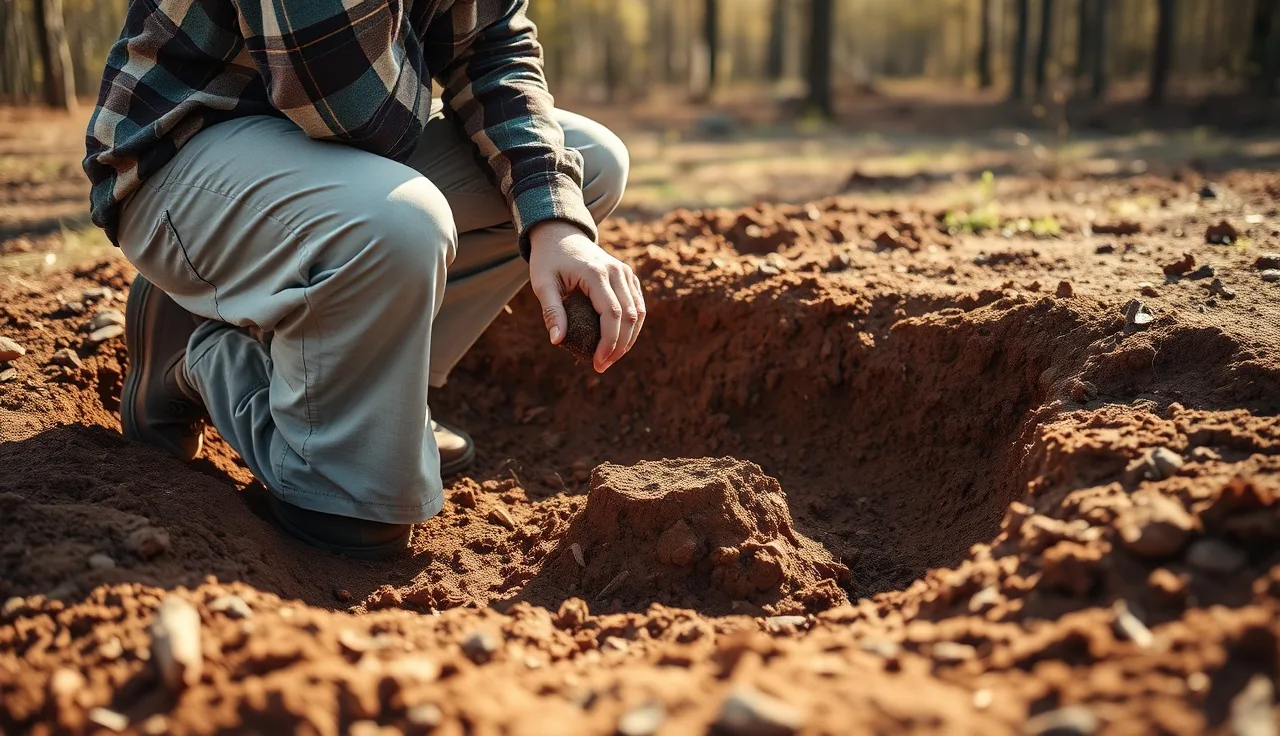
A percolation test, almost always called a perc test, measures how fast water drains through soil at the exact depth where a drainfield would sit. The number it produces, expressed in minutes per inch, tells the health department whether your soil can treat and absorb septic effluent without surfacing or fouling groundwater.
Fredericksburg sits inside Spotsylvania, Stafford, and the independent City of Fredericksburg, all of which fall under Virginia Department of Health (VDH) oversight for onsite sewage systems [1]. Virginia does not accept a bare perc test. State regulations require a full soil evaluation that pairs a perc test with a soil morphology evaluation, which reads soil color, texture, and structure to find limiting factors like clay hardpan or a seasonal high water table [2].
Subdividing land, buying an undeveloped parcel, or building a home outside a public sewer service area all trigger the same rule. No approved septic site evaluation from VDH, no building permit. Full stop.
The test matters again when you replace a failed system. Even on a lot that already has a house, VDH wants a new site evaluation before it approves a replacement drainfield. If you're staring at a failing system right now, read up on septic system repair to see the whole path from dead field to working system.
Who actually conducts perc tests in the Fredericksburg area?
Virginia requires onsite soil evaluations to be done by a Licensed Onsite Soil Evaluator (LOSE) or a Licensed Professional Engineer (PE) who has met the soil science qualifications [2]. VDH local health departments can also run evaluations, but their wait times have historically run longer than going private.
For most of the Fredericksburg area, the relevant VDH office is the Rappahannock Area Health District, covering the City of Fredericksburg, Spotsylvania County, Stafford County, King George County, and Caroline County [3]. You can submit your application and pay the state fee straight to that office, but the field work is increasingly done by private LOSEs who file reports with VDH.
Private soil evaluators usually schedule faster, often within one to two weeks instead of a month or more through the health department alone. Their fee covers the site visit, test holes, the percolation test, and a written report. They do not issue your permit. VDH reviews the report and issues the Construction Permit (CP) if the site qualifies.
To find a licensed evaluator, VDH keeps a public list of LOSEs. You can also ask your builder, real estate agent, or the Rappahannock Area Health District directly. Word of mouth from contractors who work Spotsylvania and Stafford every week is genuinely useful here.
How does the perc test process work, step by step?
The Virginia process is more involved than pouring water in a hole and timing it. Here's the real sequence:
Step 1: Application. You or your LOSE submits an application to VDH with a plat or survey showing property boundaries, well locations, and structures. There's a state application fee, separate from what you pay the evaluator.
Step 2: Pre-saturation. Virginia regulations require test holes to be pre-saturated, usually 24 hours before the timed percolation readings. This mimics saturated soil and stops artificially fast readings off dry ground. The evaluator or a hired helper fills the holes the day before and covers them.
Step 3: Soil morphology evaluation. The evaluator digs test pits (usually with a backhoe you may need to arrange) and reads the soil profile by hand. They look at color, mottling, texture, and structure down to the required depth. This step can kill a site before the water timing even begins, if the limiting zone sits too shallow.
Step 4: Timed percolation readings. Water goes into the holes in measured increments. The evaluator records how far the water drops each 30 minutes (or per the approved method). The result is expressed in minutes per inch (MPI).
Step 5: Report to VDH. The LOSE submits a written soil evaluation report. VDH reviews it and either issues a Construction Permit specifying the system type and location, or denies the application with a written reason.
Step 6: System design. If approved, a licensed designer (often the same LOSE or a PE) sizes the drainfield off the perc rate, soil type, and bedroom count. Virginia uses a table of daily design flows per bedroom to size systems [2].
Using a private evaluator, the full run from application to permit in the Fredericksburg area usually takes three to six weeks, assuming no soil problems force extra testing.
What does a perc test cost in Fredericksburg, VA?
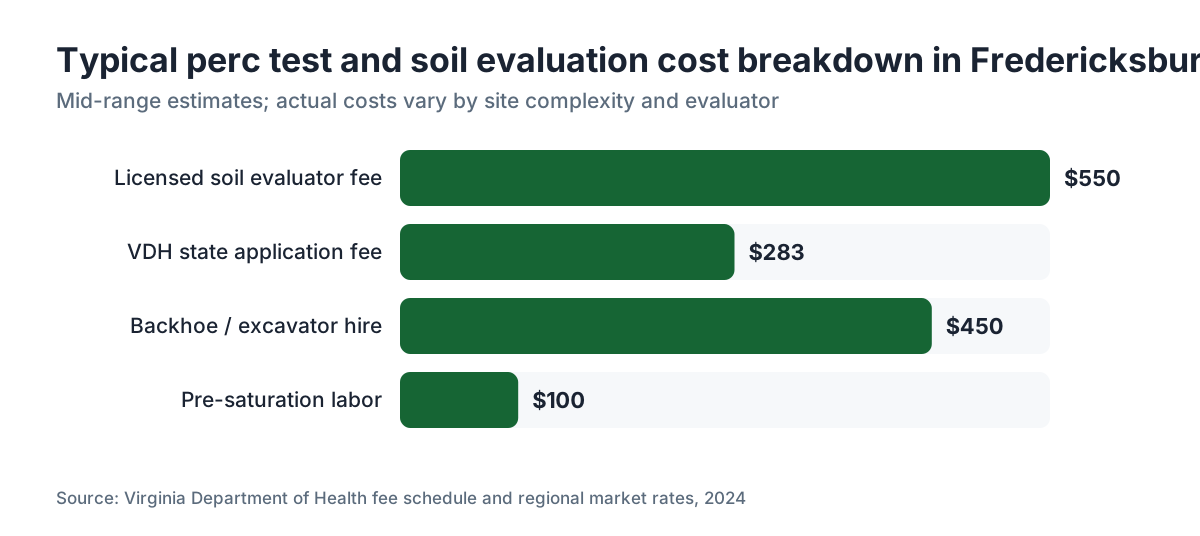
Plan for $250 to $900 for a private licensed soil evaluator in the Fredericksburg region, with most straightforward evaluations landing between $400 and $700. That number covers the evaluator's time, the written report, and the VDH filing. It does not cover the state application fee or any equipment you supply.
On top of the evaluator's fee, VDH charges a state application fee. As of 2024, Virginia's onsite sewage permit application fee for a conventional system was $315 for a new system and $250 for a repair permit, though fee schedules change and you should confirm current amounts with the Rappahannock Area Health District [1].
You'll almost certainly hire a backhoe operator separately. Test pits for the soil morphology evaluation often need to reach 60 inches or more, and hand-digging that isn't realistic. A half-day backhoe rental or operator hire in Spotsylvania and Stafford typically runs $300 to $600, depending on site access and hole count.
Here's a realistic all-in budget for a perc test plus soil evaluation in Fredericksburg:
| Cost Item | Typical Range |
|---|---|
| Licensed soil evaluator fee | $400, $700 |
| VDH state application fee | $250, $315 |
| Backhoe / excavator (if needed) | $300, $600 |
| Pre-saturation labor (if separate) | $50, $150 |
| Total | $1,000, $1,765 |
Complex sites, multiple candidate drainfield areas, or repeat testing after remediation all push costs higher. Nobody should quote you a firm number sight unseen.
Once you have an approved site, you'll want a realistic read on full system cost. The cost to install a septic system swings hard on what system type VDH requires.
What perc rates pass or fail in Virginia?
Virginia's regulations set specific percolation rate limits for different system types [2]. The rate is measured in minutes per inch (MPI), meaning how many minutes it takes the water level in a test hole to drop one inch. Faster is better.
| Perc Rate (MPI) | System Type Allowed |
|---|---|
| 1 to 60 MPI | Conventional gravity drainfield |
| 61 to 120 MPI | May qualify for low-pressure distribution or other alternative systems |
| 0 MPI (no absorption) or >120 MPI | Conventional system not permitted; engineered alternatives evaluated case by case |
| Limiting zone above 18 inches | Conventional system not permitted regardless of perc rate |
The most common failure around Fredericksburg isn't a specific perc rate. It's a shallow limiting zone. Much of Spotsylvania and Stafford County carries heavy clay subsoil or seasonal high water tables that push the restrictive zone too close to the surface for a conventional trench system. The VDH soil evaluator flags this in the morphology evaluation before the timed test even matters.
Failing one test area doesn't fail the whole parcel. Evaluators often test two or three candidate drainfield spots on a single lot. A location that fails conventional criteria may pass 50 feet away, or may qualify for an alternative system type.
Virginia's alternative and innovative technology programs allow systems like drip irrigation, aerobic treatment units, and mound systems on sites that would flunk conventional gravity criteria [2]. These systems cost more to install and maintain, but they make marginal land buildable. Virginia Cooperative Extension confirms the same threshold: perc rates of 1 to 60 minutes per inch qualify for conventional gravity drainfields, and slower soils need alternative distribution [6].
What happens if your land fails the perc test?
A failed perc test is not automatically the end of a building project. It depends on why the site failed.
If the perc rate is slow but not absent, an alternative system may still get approved. Virginia authorizes a range of engineered systems under the Sewage Handling and Disposal Regulations, and VDH runs a formal process for reviewing experimental and innovative designs [2]. Your LOSE or a licensed designer can tell you whether an alternative fits your specific soil.
If the limiting zone sits too shallow, a mound system or fill can sometimes raise the effective treatment area above the problem layer. Mound systems in Virginia cost roughly $15,000 to $30,000 more than conventional systems, so this is a real decision, not a formality.
If the site fails outright, with no viable alternative location and no approved technology that works, VDH denies the permit. Your options then narrow to three: appeal the decision, commission evaluations of other areas of the parcel, or accept that public sewer connection (if it's available) is the only route.
Before buying undeveloped land in Spotsylvania or Stafford County, make the purchase contingent on a passing perc test and approved site evaluation. Local agents know this contingency cold. Skipping it on a rural parcel is one of the more expensive mistakes a buyer makes.
If you already have a system and the drainfield is struggling, that's a different animal. A leach field failure has its own diagnostic path and its own fixes.
How long does a perc test approval last in Virginia?
Once VDH issues a Construction Permit off your soil evaluation, that permit is valid for 18 months in Virginia [2]. Miss the 18-month window without starting construction and the permit expires, so you apply again, though in practice VDH sometimes grants extensions for documented cause.
The soil evaluation report itself (the underlying data) may support a later permit application without fully repeating the testing, at VDH's discretion, if soil conditions haven't changed and the evaluator certifies the report still holds. Don't bank on that automatically. Confirm with the Rappahannock Area Health District what they require.
One common misconception: a perc test approval doesn't cross county lines. Build in Spotsylvania County, later buy a parcel in Stafford, and you start fresh. Each locality under the Rappahannock Area Health District follows the same state regulations but processes applications on its own.
Sellers disclosing an existing system take note. A prior VDH site evaluation record is public and can be pulled from the health district. If a home went up in the last 20 years, odds are decent the original site evaluation is on file. Useful background, but no substitute for a current septic tank inspection when you're buying an existing home with a working system.
How do you apply for a perc test through VDH in the Fredericksburg area?
The application goes to the Rappahannock Area Health District, which serves Fredericksburg, Spotsylvania, Stafford, King George, and Caroline [3]. You can reach them by phone or walk into the district office.
What you typically need to submit:
- A completed VDH onsite sewage permit application (available from VDH)
- A plat or survey of the property with dimensions, including the location of any existing wells, structures, property lines, and easements
- The application fee
- Contact information for access to the property
If you've already hired a private LOSE, they often handle the submission as part of their service. Confirm this upfront so you're not double-filing.
After submission, the health district assigns the case and either schedules its own field visit or reviews the private evaluator's report, depending on the path you chose. They may ask for more information or revised drawings before issuing the Construction Permit.
One practical tip: call the Rappahannock Area Health District before you submit. Ask about current wait times and whether they'd rather you use a private evaluator. Their answer shifts with their workload, and the district staff will usually walk you through the process on a quick call.
Does the type of septic system change based on perc test results?
It does, directly. The perc rate and soil morphology evaluation together decide which system types VDH will approve for your site, and that drives both construction cost and long-term maintenance.
A site with a good perc rate (say, 20 to 40 MPI) and a deep limiting zone qualifies for a conventional gravity trench system, the cheapest to install and maintain. These systems run on gravity and passive soil treatment with no mechanical parts.
A site with a moderate rate (60 to 120 MPI) may need low-pressure distribution (LPD), which uses a small pump to dose effluent evenly across a bigger drainfield. That adds a pump, a dosing chamber, and yearly maintenance.
Slow or failing sites may require an aerobic treatment unit (ATU), a drip irrigation system, or a mound. These engineered systems can get permits on hard land, but Virginia regulations mandate maintenance contracts for many alternative types [2]. Budget $200 to $600 per year for a maintenance contract on an ATU or drip system.
If you end up needing a full septic tank installation with an alternative system, get at least two bids from contractors with active experience on that exact system type in Spotsylvania or Stafford. Not every septic contractor installs every system type.
For tracking inspections, maintenance records, and permit dates across multiple properties, operators in this region use platforms like SepticMind to keep site documentation organized and stop inspection alerts from slipping through the cracks.
Can you do anything to improve perc test results?
Probably less than you'd hope, and trying to game the test can backfire.
The honest answer is that soil is what it is. You can't chemically treat soil before a test to change a legitimate perc rate. Over-wetting the test holes beyond protocol, or gaming abnormally dry conditions for faster readings, produces numbers that don't reflect real field performance and can hand you a system that fails early.
What you can legitimately do: pick the best part of your parcel. On 10 acres, an experienced LOSE will help you spot the candidate areas worth testing before you lock in a building footprint. Sometimes the best drainfield spot isn't where you'd naturally set a house.
You can also wait for the right season. Virginia regulations tell evaluators to account for seasonal high water tables. A test in a dry August may miss a February problem. VDH evaluators know to read soil morphology for signs of seasonal saturation regardless of test timing, but timing still helps accuracy.
If a site fails on a thin layer of tight soil over better material, a designer can sometimes spec a system that bypasses that layer, but that needs engineering justification and VDH sign-off.
The most cost-effective move before you spend on testing: hire the LOSE for a preliminary consultation. Many will walk the property and give you an honest read on your odds before you pay for the full evaluation. That $100 to $200 conversation can save thousands.
What should you know about perc tests when buying land in Fredericksburg?
Buying rural land in Spotsylvania, Stafford, or the surrounding counties without a perc test contingency is a real financial risk. A parcel advertised as "perc tested" should come with documentation: the actual VDH site evaluation report or Construction Permit number, more than a seller's verbal claim.
Ask for the VDH permit number and verify it with the Rappahannock Area Health District. The district can confirm whether a valid Construction Permit exists and whether it's still inside the 18-month window.
If the seller says a test was done years ago but no permit issued, that's a partial story. A passing perc rate from a 1995 soil evaluation means almost nothing under today's rules. Virginia has updated its Sewage Handling and Disposal Regulations several times since then, and the design standards have moved [2].
For land with an existing septic system, the perc test question is separate from system condition. An older system may run fine on soil that wouldn't pass today's evaluation criteria for a new system, which is fine as long as the existing system works. But the day that system fails and needs replacement, the replacement has to meet current standards. That's when marginal soil turns into a serious problem.
Before closing on any property, with or without an existing system, get a septic tank inspection and understand the gap between a working system and a system that can be replaced or expanded under current rules. Those are two different things.
SepticMind's documentation tools help real estate professionals and buyers track evaluation dates, permit numbers, and inspection history across multiple properties during due diligence, but the underlying evaluation still has to come from a licensed professional on the ground.
What are the Virginia regulations that govern perc tests?
Virginia's primary regulatory document for septic site evaluations is the Sewage Handling and Disposal Regulations, in the Virginia Administrative Code at 12VAC5-610 [2]. This regulation sets the standards for soil evaluation methods, percolation test procedures, minimum lot sizes, system sizing, and permit requirements.
The EPA's SepticSmart program gives federal guidance on onsite system siting and soil evaluation that matches Virginia's approach: "Soil absorption systems depend on the soil to treat wastewater before it reaches groundwater" [4]. Virginia's regulations put that principle to work through the combined perc and morphology evaluation.
For the Fredericksburg area, the Rappahannock Area Health District administers 12VAC5-610 locally [3]. They have authority to approve, deny, and condition Construction Permits, and they handle first-level appeals.
Virginia also runs the Virginia Housing statewide septic and well repair programs, which offer help with septic repair and replacement on properties that may sit on failed site conditions [5]. That doesn't touch the perc test process, but it matters if you land in a replacement system on difficult soil.
For related reading on keeping a system healthy after install: how often to pump a septic tank is a common question once a system is in the ground, and the EPA SepticSmart program has guidance on that too [4].
Frequently asked questions
How much does a perc test cost in Fredericksburg, VA?
All-in, plan for $1,000 to $1,765 for a complete soil evaluation in the Fredericksburg area. That includes the private licensed soil evaluator ($400 to $700), the VDH state application fee ($250 to $315), and backhoe costs for test pits ($300 to $600). Simple flat parcels with good access come in lower; complex sites with multiple test areas cost more.
Who can perform a perc test in Virginia?
Only a Licensed Onsite Soil Evaluator (LOSE) or a qualified Licensed Professional Engineer can conduct soil evaluations in Virginia. The VDH local health department can also perform them. For the Fredericksburg area, the Rappahannock Area Health District is the relevant VDH office. Private LOSEs are often faster to schedule than going through the health department alone.
How long does a perc test take in Virginia?
The on-site work spans two days minimum: one day for pre-saturation and soil pit excavation, one day for timed percolation readings. Scheduling lead time with a private evaluator in the Fredericksburg area is typically one to two weeks. After the field work, VDH review and permit issuance adds another two to four weeks, so the total process from application to permit is usually four to six weeks.
What perc rate is needed to pass in Virginia?
A perc rate of 1 to 60 minutes per inch (MPI) qualifies for a conventional gravity drainfield. Rates of 61 to 120 MPI may qualify for alternative systems with low-pressure distribution. Rates above 120 MPI or sites with a limiting zone shallower than 18 inches do not qualify for conventional systems, though some alternative technologies may still be approvable.
Can you build a house if land fails a perc test in Fredericksburg?
Sometimes. A failed conventional perc test doesn't automatically kill a building permit. Virginia authorizes alternative systems, including mound systems, aerobic treatment units, and drip irrigation, for sites that don't pass conventional criteria. These cost more to install and require maintenance contracts. Only a complete failure with no viable system alternative in any location on the parcel results in a denied permit.
How long is a perc test approval valid in Virginia?
The Construction Permit issued after a successful VDH site evaluation is valid for 18 months. If construction hasn't started by then, the permit expires and you must reapply. VDH may grant extensions for documented cause. If you're buying land with a claimed perc test, verify with the Rappahannock Area Health District that a valid, unexpired permit actually exists.
Do I need a perc test to replace an existing septic system in Fredericksburg?
Yes. Virginia requires a new VDH site evaluation before approving a replacement drainfield, even on a lot with an existing system. The replacement system must meet current design standards, which may be stricter than what the original system was built under. This can be a significant issue on older properties where the soil is marginal.
What is the difference between a perc test and a soil evaluation in Virginia?
In Virginia, a perc test is one component of a full soil evaluation, not the entire evaluation. The complete evaluation also includes a soil morphology assessment, where the evaluator examines soil pits for texture, color, mottling, and limiting zones. A site can fail the soil morphology portion even if the percolation rate is acceptable, typically because the limiting zone is too shallow.
Which VDH office handles perc tests for Fredericksburg, Spotsylvania, and Stafford?
The Rappahannock Area Health District covers the City of Fredericksburg, Spotsylvania County, Stafford County, King George County, and Caroline County. All septic permit applications, soil evaluation reports from private LOSEs, and Construction Permit issuance flow through that district. You can submit applications in person or by mail to their offices.
Can I do a perc test myself in Virginia?
No. Virginia requires that soil evaluations be conducted by a Licensed Onsite Soil Evaluator or a qualified Licensed Professional Engineer. A DIY perc test has no standing with VDH and cannot be submitted for a permit. The requirement exists because interpreting soil morphology and applying the regulatory standards correctly requires professional training that goes beyond timing water in a hole.
Does a perc test contingency matter when buying land in Fredericksburg?
It matters a great deal. Land without an approved site evaluation or active Construction Permit may not be buildable for a home on septic. Always make a purchase contingent on a passing site evaluation. Verify any claimed prior perc test directly with the Rappahannock Area Health District using the permit number, more than the seller's word. Permits expire after 18 months.
What happens if there is no public sewer and the land fails the perc test?
If a site fails every viable alternative system type and no approvable design exists for any location on the parcel, VDH denies the permit. At that point you can appeal, commission additional evaluations of untested parcel areas, or accept that the land cannot support a septic system. Without public sewer access, this effectively makes the parcel unbuildable for a residence.
How do I find a licensed soil evaluator in the Fredericksburg area?
VDH maintains a public registry of Licensed Onsite Soil Evaluators. Ask the Rappahannock Area Health District for a current list, or ask local home builders and real estate agents who regularly work in Spotsylvania and Stafford. Word of mouth from contractors with active local experience is often the most reliable filter, since scheduling responsiveness and report quality vary considerably.
What is the cost to install a septic system after passing a perc test in Virginia?
A conventional gravity system in the Fredericksburg area typically costs $8,000 to $20,000 installed, depending on drainfield size and site conditions. Alternative systems like mound systems or aerobic treatment units run $20,000 to $45,000 or more. System size is determined by bedroom count and the perc rate from your approved evaluation. See more detail on full system costs at the cost to install a septic system guide.
Sources
- Virginia Department of Health, Rappahannock Area Health District, Onsite Sewage Programs: The Rappahannock Area Health District administers VDH onsite sewage permits for the City of Fredericksburg, Spotsylvania County, Stafford County, King George County, and Caroline County, including application fees for new and repair permits.
- Virginia Administrative Code, 12VAC5-610, Sewage Handling and Disposal Regulations: Virginia's Sewage Handling and Disposal Regulations set percolation test procedures, soil morphology evaluation requirements, limiting zone depth thresholds, system sizing by daily design flow per bedroom, Construction Permit validity of 18 months, and authorization of alternative system types.
- Virginia Department of Health, Office of Environmental Health Services (Onsite Sewage and Water): VDH oversees onsite sewage system permitting statewide through local health districts, requiring Licensed Onsite Soil Evaluators or qualified Licensed Professional Engineers to conduct site evaluations.
- U.S. EPA, SepticSmart Program: EPA SepticSmart states: 'Soil absorption systems depend on the soil to treat wastewater before it reaches groundwater,' which is the foundational principle Virginia's perc test and soil morphology evaluation implement.
- Virginia Housing, Home Repair and Septic/Well Assistance Programs: Virginia offers assistance for septic system repair and replacement on qualifying properties, including those with failing systems and difficult soil conditions.
- Virginia Cooperative Extension, Septic System publications: Virginia Cooperative Extension guidance on septic system siting explains that percolation rates between 1 and 60 minutes per inch qualify for conventional gravity drainfields, and rates above that threshold require alternative distribution methods.
- U.S. EPA, Onsite Wastewater Treatment Systems Manual: EPA's Onsite Wastewater Treatment Systems Manual documents that percolation test pre-saturation requirements exist to prevent artificially fast drainage readings in dry soil, ensuring test results reflect actual field conditions.
- National Environmental Services Center (NESC), West Virginia University: NESC documents that the all-in cost of a soil evaluation including percolation test, soil morphology assessment, and professional fees ranges from several hundred to over one thousand dollars depending on region and site complexity.
- Stafford County, Virginia, official government site: Stafford County requires VDH-approved septic site evaluation as a prerequisite for residential building permits on parcels served by onsite sewage systems.
Last updated 2026-07-10