Green Gobbler septic tank treatment: does it actually work?
By the SepticMind Editorial Team

TL;DR
- Green Gobbler septic tank treatment drops live bacteria and enzymes into your tank to help digest solids and control odors.
- It won't replace pumping every 3 to 5 years, but used monthly it can slow sludge buildup a little.
- Independent lab data on bacterial additives is thin.
- EPA says most healthy tanks don't need them at all.
What is Green Gobbler septic tank treatment and what's actually in it?
Green Gobbler septic tank treatment is a consumer bacterial additive sold in pre-measured packets (sometimes called pods) that you flush down a toilet once a month. Each packet holds a blend of live bacteria, mostly anaerobic and facultative anaerobic strains, plus enzymes that go after grease, paper, and organic solids.
The active cultures are Bacillus species, the same genus used in most commercial septic additives. The enzyme mix usually covers lipase (fats), protease (proteins), amylase (starches), and cellulase (paper fiber). Green Gobbler prints a bacterial count of roughly 2 billion CFU per treatment on the box. Independent verification of that number is hard to find.
The packets come 12 to a box, one per month for a year. The pods dissolve in water, so you drop one in the toilet, flush, and the bacteria settle into the anaerobic layer below the scum line.
Here's the honest framing. This product sits in the same category as dozens of near-identical treatments from brands like Green Pig and RID-X. They all do roughly the same thing: deliver Bacillus spores that wake up in the warm, wet environment of a septic tank. The formulas differ in CFU count and enzyme ratios. The underlying biology does not.
Does the science actually support using septic bacterial additives?
The science is genuinely mixed. Anyone who tells you these products definitely work, or definitely don't, is oversimplifying.
EPA's SepticSmart program takes a clear position. It states that "the use of biological additives to augment the naturally occurring microbes in a septic system is not necessary for a properly functioning system." That's the primary federal body on onsite wastewater telling you a healthy tank doesn't need help. [1]
Some state extension programs land in a softer spot. University of Minnesota Extension guidance notes that bacterial additives may help restore microbial populations after a tank has been disturbed by heavy antibiotic use, a large pumping event, or a long stretch of disuse, but finds no strong evidence they improve performance in tanks that already work fine. [2]
The core problem is math. A healthy septic tank already holds billions of native bacteria from human waste. Adding a packet of 2 billion CFU to a 1,000-gallon tank that's already teeming with adapted microbes is like adding a cup of water to a swimming pool. The native population tends to outcompete introduced strains within days.
Where additives might genuinely help:
- Right after a tank pump-out, when bacterial populations have crashed
- Seasonal or vacation homes with long idle stretches
- Households that lean hard on antibacterial soaps and disinfectants, or someone on a long antibiotic course
- Systems showing early sluggish drainage
Where they won't help at all:
- Replacing an overdue septic tank pumping. No bacterial product dissolves non-biodegradable solids.
- Fixing a failing drain field or leach field
- Correcting hydraulic overload from too much water use
Nobody has strong long-term controlled trial data on consumer septic additives specifically. The closest published work is a 2007 study in Bioresource Technology, which found some bacterial additives modestly raised volatile solid reduction in lab anaerobic digesters. Those lab conditions don't map cleanly onto a real backyard tank. [3]
How do you use Green Gobbler septic tank treatment correctly?
The directions are short. Drop one pod or packet in a toilet, flush it, and skip that toilet for six to eight hours if you can. That gap lets the bacteria reach the tank and start establishing before the next flush dilutes them.
Monthly dosing is the standard schedule. After a pump-out, some homeowners run two packets the first month to rebuild the bacterial layer faster. Green Gobbler's own packaging backs this, recommending a double dose after pumping.
A few practical tips from how tanks actually behave:
Flush at night. The quietest water window in most homes runs from late evening to early morning. Less flow means the bacteria get the longest possible window to settle in before the system stirs again.
Keep harsh chemicals away that day. Bleach, drain cleaners, and antibacterial products kill introduced bacteria before they establish. Put at least 24 to 48 hours between chemical cleaning and your treatment.
Store packets cool and dry. The bacteria ride in spore form and hold up reasonably well, but heat and humidity chip away at viability over time. A cabinet away from the stove is fine.
Consistency beats dose size. A homeowner who runs one packet a month for two years ends up with a healthier tank than someone who dumps six at once and forgets about it until next year.
Green Gobbler vs. Green Pig vs. RID-X: how do these products compare?
The three most-searched septic additives are Green Gobbler, Green Pig, and RID-X. All three are Bacillus-based. Here's an honest look at how they stack up on the things that actually vary.
| Product | Form | CFU per dose | Enzyme types | Approx. cost per month |
|---|---|---|---|---|
| Green Gobbler | Packets/pods | ~2 billion | Lipase, protease, amylase, cellulase | $3-5 |
| Green Pig | Packs | ~8 billion | Lipase, protease, amylase | $3-4 |
| RID-X | Powder or liquid | ~9.8 billion | Lipase, protease, amylase, cellulase | $3-5 |
CFU count is the difference everyone cites. Green Pig and RID-X both advertise higher bacterial counts per dose. Whether that buys you better real-world performance is genuinely unclear. Above a certain threshold the limiting factor is tank conditions and available substrate, not raw bacterial count.
RID-X has been on shelves since 1958 and carries more brand history than either rival. More history hasn't produced more independent scientific validation.
Green Pig leans hard on its high CFU number in marketing and skips cellulase, which Green Gobbler keeps. If your household pushes a lot of toilet paper through the tank, that enzyme difference is at least theoretically worth something.
For a tank that already works, the differences between these three are unlikely to show up in any way you'd notice. Buy whichever is on sale or easy to find. If you're dosing after a pump-out or for a vacation home, the higher CFU options from RID-X or Green Pig may give you a faster microbial recovery window. No controlled study proves that, so treat it as a reasonable bet, not a fact.
Can Green Gobbler replace regular septic tank pumping?
No. This is the single most important thing to understand about any bacterial septic additive.
Septic tanks build up two layers. Sludge is the heavy layer at the bottom: inorganic solids, grit, and material bacteria can't digest. Scum is the floating layer of grease and lighter solids up top. Bacteria break down organic material in the liquid layer and chew through some sludge, but they can't clear it. Inorganic solids, synthetic fibers, and anything microbes can't metabolize just keep stacking up.
EPA recommends pumping every 3 to 5 years for a typical household. [1] Some state codes go further. North Carolina, for example, requires inspection every three years for systems serving a single family. [4] Your real interval depends on tank size, household size, and water habits.
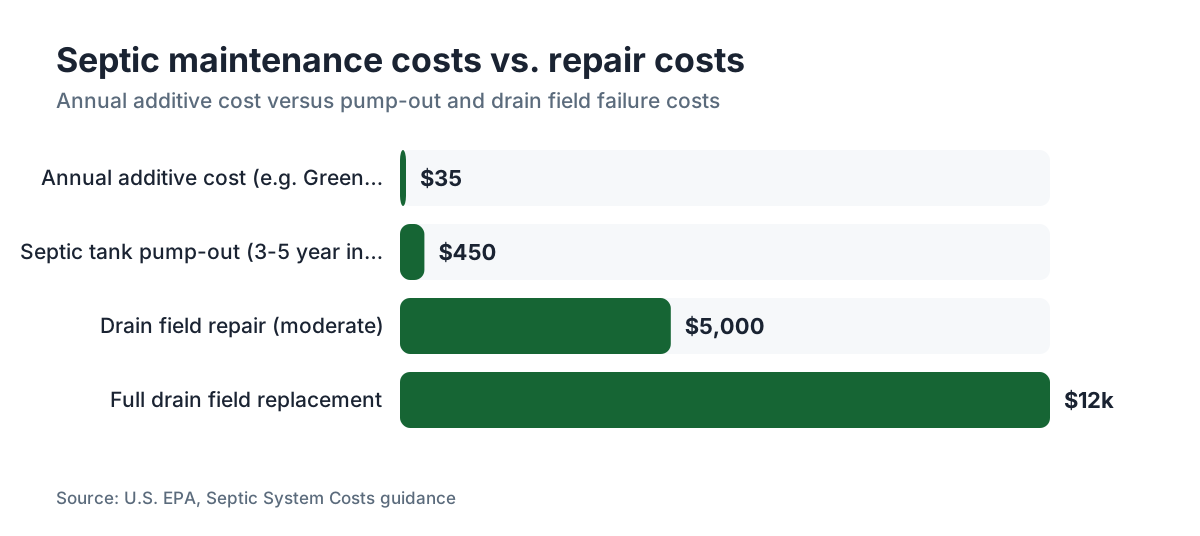
When sludge and scum together fill more than about a third of the tank's liquid capacity, the tank stops separating solids from effluent. Solids start flowing into your leach field and clog the soil. [8] That's when a $400 to $600 pump-out turns into a $3,000 to $10,000 drain field repair or replacement. [5]
No additive at any dose changes that physical reality. Running Green Gobbler while skipping pumping is like taking vitamins over a bleeding wound. It isn't harmful. It also isn't the intervention.
Not sure when your tank was last pumped? Book a septic tank inspection before you worry about additives. The inspector measures your sludge depth and tells you whether pumping is due now.
Are septic tank additives safe for your system and the environment?
Bacterial additives like Green Gobbler are generally safe for conventional septic systems. The Bacillus species involved aren't pathogenic and occur naturally in soil, so the environmental risk from occasional overflow or seepage is low.
Three concerns are still worth knowing.
A different class of additives, the solvent-based and acid-based chemical products, can damage tank components and leach toxic compounds into groundwater. Green Gobbler is biological, not chemical, so this one doesn't apply to it directly. It's a good reason to read labels on anything you buy.
Enzyme additives can, in theory, thin sludge enough that it moves into the drain field more easily and speeds up field clogging. That risk gets cited mostly for products with very high enzyme concentrations. At standard monthly doses, Green Gobbler's enzyme levels are unlikely to cause it.
Washington State's Department of Health puts it bluntly: "no additive has been proven to reduce the need for regular pumping or to rehabilitate a failing drainfield," and it steers maintenance dollars toward inspection and pumping instead. [6]
One more thing for anyone with alternative treatment gear like an aerobic treatment unit (ATU). Check the manufacturer's guidance before adding any bacterial or enzyme product. Some ATU makers void warranties over unapproved additives because introduced bacteria can interfere with the calibrated biological process inside the unit.
What does Green Gobbler cost and where can you buy it?
Green Gobbler septic tank treatment is sold at Home Depot, Amazon, Walmart, and Lowe's. Pricing moves around, but a 12-pack (one year's supply) generally runs $25 to $45 as of 2024 to 2025. That works out to roughly $2 to $4 a month.
Per year, a $35 box is one of the cheaper maintenance moves you can make. For contrast, a septic tank pump out costs $300 to $700 depending on location and tank size. If monthly additives cut pumping frequency even a little, the math isn't crazy.
Here's the honest version of that math. The evidence that additives stretch pumping intervals in a meaningful way is weak. So call the $35 a year what it is: a low-cost, low-harm habit, not a money-saving strategy.
If you run multiple properties or manage septic schedules at scale, tracking which property uses which additive and when it was last dosed is exactly the kind of detail that slips through the cracks. SepticMind lets service operators log maintenance by property so nothing gets missed in the inspection cycle.
The pod version is the same product in pod form, packaged for slightly easier handling. There's no performance difference between packets and pods.
When should you actually use a septic bacterial additive?
Here's the practical framework for deciding whether Green Gobbler, or any bacterial additive, earns its spot in your routine.
Use it if:
Your tank was just pumped and you want to support microbial recovery. Right after a septic tank cleaning is probably the single best use case. The native population is way down, and a concentrated dose of Bacillus spores can help the active layer rebuild faster.
You have a seasonal or vacation property. A tank that sits idle for three to six months comes back to a depleted bacterial population. Dosing before and after a long absence helps restart the biology.
Someone in the house is on a long course of broad-spectrum antibiotics. Antibiotics that pass into the tank can disrupt the microbial community. A monthly additive during and after treatment is a reasonable precaution.
Skip it if:
Your system works fine, you pump on schedule, and you use normal household products. You don't need it. Your tank is already full of active, well-adapted bacteria.
You're hoping it fixes a slow drain, a sewage smell in the yard, or wet spots near the drain field. Those are system problems that need a physical inspection and possibly septic system repair, not a packet of bacteria.
You're trying to dodge a pump-out. Get the pump-out. There's no bacterial shortcut around it.
What do homeowners actually report about using Green Gobbler?
Consumer reviews on Amazon and Home Depot lean positive, with Green Gobbler averaging around 4.4 to 4.6 stars across thousands of reviews as of 2025. The most common wins people report are odor reduction and the sense that they're doing something proactive.
Here's the fair read on that feedback. Odor control is a real, documented effect of active bacterial cultures in a septic tank. When organic material is being digested well, hydrogen sulfide production (the rotten egg smell) tends to drop. So if Green Gobbler cuts odors, there's a plausible mechanism behind it, more than placebo.
Negative reviews usually come from homeowners who expected the product to rescue an already-failing system, or who bought it hoping to delay a pump-out that was due. That's beyond what any additive can do.
One pattern stands out. Homeowners who use the product consistently and still pump on schedule are the most satisfied. Makes sense. They're treating the additive as a supplement to real maintenance, not a replacement for it.
How does your state's septic code affect what additives you can use?
This surprises a lot of homeowners: some states regulate or restrict septic additives by statute.
Wisconsin prohibits septic additives that contain solvents, acids, or other substances harmful to the system or groundwater under its Comm 83 administrative code. Bacterial additives are generally allowed, but the ban on chemical products is enforceable. [7]
A few states, including Washington and Massachusetts, tell homeowners in their onsite wastewater guidance that additives are unnecessary and potentially problematic, though they stop short of banning biological products outright. [6][9]
If your system falls under a local health department oversight plan, say in a sensitive groundwater area or near a public water supply, check with your local onsite wastewater authority before adding anything. That's uncommon for standard residential systems, but it matters in designated wellhead protection areas.
For most homeowners on conventional septic in most states, Green Gobbler and similar bacterial products are unregulated consumer goods you can use freely. Still, spend five minutes on your state environmental or health department website if you're in a sensitive area. [4]
When you need to track your system's maintenance history for a home sale or inspection, that documentation usually lives with your county health department. Knowing your system type (conventional, ATU, mound, and so on) matters for additive compatibility too.
What's the right overall septic maintenance plan that includes additives?
Additives are one small piece of a much bigger picture. EPA's SepticSmart guidance boils good maintenance down to four behaviors: inspect regularly, pump frequently, use water efficiently, and protect the drain field. [10] Here's how additives fit into that.
Pump on schedule. For most households that's every 3 to 5 years. A four-person household on a 1,000-gallon tank probably needs pumping closer to every three years. A retired couple with a 1,500-gallon tank might stretch to five or six. The how often to pump septic tank answer depends on your load, and guessing wrong is expensive.
Inspect regularly. Many states recommend or require inspection every one to three years depending on system type. A licensed inspector measures your sludge and scum layers and tells you exactly when to pump. Don't skip it. Catching a drain field problem early is the difference between a repair and a replacement.
Watch what goes in. No wipes, flushable or not. No grease down the drain. Go easy on the garbage disposal. These habits matter far more than any additive. Pour cooking grease down the sink every month and a $35 box of bacteria won't save you.
Conserve water. Hydraulic overload, too much water hitting the tank too fast, is one of the leading causes of drain field failure. Spread laundry through the week. Fix running toilets fast.
Use additives as a supplement, not a strategy. Do everything above right and the extra benefit from a monthly treatment is small. For $35 a year, it's still not a bad habit, especially for vacation homes or post-pump recovery.
SepticMind's tracking tools help homeowners and operators stay on top of the whole schedule, more than additive use but inspection dates, pump-out history, and system-specific notes that tend to vanish between service calls.
One last cost comparison. A $35 a year additive habit sits next to a $5,000 to $20,000 drain field replacement. That's not a hard call. Do the maintenance. Everything else is marginal. [5]
Frequently asked questions
How often should I use Green Gobbler septic tank treatment?
Once a month is the standard schedule. Green Gobbler recommends flushing one packet or pod down the toilet monthly, and doubling the dose right after a pump-out to help rebuild the bacterial layer. Consistency matters more than occasional heavy dosing. Set a monthly phone reminder so you don't skip months during low-use seasons.
Will Green Gobbler help with septic odors in the yard or house?
It can help with indoor toilet odors and mild tank odors by promoting active bacterial digestion, which lowers hydrogen sulfide production. It won't fix outdoor sewage smells near the drain field. That smell usually means effluent is surfacing, which is a physical system problem needing inspection and possibly repair, not something a bacterial additive can touch.
Is Green Gobbler safe for all types of septic systems?
It's safe for conventional gravity-fed septic systems. If you have an aerobic treatment unit (ATU), a mound system, or another engineered alternative, check the manufacturer's guidance first. Some ATU warranties are voided by unapproved additives because introduced bacteria can interfere with the system's calibrated biological process. When in doubt, call your system's service provider.
Green Gobbler vs. RID-X: which is better for my septic tank?
Both are Bacillus-based additives with similar enzyme blends. RID-X advertises roughly 9.8 billion CFU per dose against Green Gobbler's roughly 2 billion. Whether the higher count matters in a working tank is unclear, since native bacteria usually swamp introduced strains anyway. For post-pump recovery, the higher CFU products have a slight theoretical edge. For routine monthly use, the difference is unlikely to show up.
Can I use Green Gobbler if my septic tank was just pumped?
Yes, and this is the best time to use it. After a pump-out, the bacterial population in your tank is way down. Dosing two packets the first month, then one monthly, can help the active anaerobic layer re-establish faster. It's one of the few use cases where independent research suggests bacterial additives give a measurable benefit.
What are green gobbler septic tank treatment pods compared to the packets?
Same product, different packaging. The pods come individually wrapped in a water-soluble film that dissolves on contact with toilet water. The packets are a slightly different physical format. Performance is identical. The pods are a touch more convenient since there's no tearing or measuring, but neither version does better inside the tank.
How is Green Gobbler different from Green Pig septic tank treatment?
Both are Bacillus-based. Green Pig typically advertises a higher CFU count (around 8 billion per dose) and skips the cellulase enzyme, which Green Gobbler keeps. Cellulase targets paper fiber breakdown, so a household that runs a lot of toilet paper might get theoretical value from it. Price and availability are similar. Neither has published independent trial data showing it beats the other.
Does Green Gobbler actually reduce how often I need to pump my septic tank?
Probably not in any meaningful way. No controlled study has shown bacterial additives reliably extend pumping intervals in real residential systems. They can help digest organic solids, but inorganic and non-digestible material still builds up in sludge no matter what. Stick to your pumping schedule of every 3 to 5 years based on tank size and household load.
Can Green Gobbler fix a slow-draining or backing-up septic system?
No. Slow drains or backups usually mean the tank is full, the drain field is failing, or there's a physical blockage in the line. Those need a physical inspection, not a bacterial additive. Using additives to dodge a slow drain is how a manageable $400 to $600 pump-out becomes a $5,000 to $15,000 drain field repair. Call a septic pro first.
Are septic additives banned or regulated in any states?
Some states restrict or discourage them. Wisconsin's Comm 83 code prohibits chemical-based additives that could harm the system or groundwater. Washington and Massachusetts guidance says additives are unnecessary. Bacterial products like Green Gobbler are generally allowed in most states, but if your system is in a wellhead protection zone or under special health department oversight, check local rules before using any additive.
Is it safe to use Green Gobbler if someone in my household is on antibiotics?
Yes, and it's one of the more defensible reasons to use it. Broad-spectrum antibiotics that pass into the septic tank can disrupt the resident bacterial community. A monthly additive during and for a few months after a course helps keep microbial activity going. Extension programs commonly cite this as a reason for additive use, though long-term data is limited.
Where can I buy Green Gobbler septic tank treatment, and what does it cost?
Green Gobbler is sold at Home Depot, Lowe's, Walmart, and Amazon. A 12-pack (one year's supply) runs roughly $25 to $45 depending on retailer and timing, or about $2 to $4 a month. It's one of the lower-cost maintenance habits available. For comparison, a septic pump-out costs $300 to $700 depending on tank size and location, which is where your budget should go first.
Sources
- U.S. EPA, SepticSmart homeowner guidance: EPA states bacterial additives are not necessary for a properly functioning septic system and recommends pumping every 3 to 5 years
- University of Minnesota Extension, Septic System Owner's Guide: Bacterial additives may help restore microbial populations after pumping or antibiotic disturbance but show no strong benefit in already-functioning systems
- Bioresource Technology, 2007, study on bacterial additives in anaerobic digesters: Some bacterial additives modestly increased volatile solid reduction in lab anaerobic digesters under controlled conditions
- North Carolina Department of Environmental Quality, Onsite Wastewater Section: North Carolina requires inspection every three years for single-family septic systems
- U.S. EPA, Septic System Costs and Homeowner Information: Drain field repair or replacement costs $3,000 to $10,000 or more depending on system type and extent of damage
- Washington State Department of Health, On-Site Septic Systems guidance: Washington DOH states no additive has been proven to reduce the need for pumping or rehabilitate a failing drainfield
- Wisconsin Department of Safety and Professional Services, Comm 83 Administrative Code: Wisconsin prohibits septic additives containing solvents, acids, or substances harmful to the system or groundwater
- U.S. EPA, How Your Septic System Works: When sludge and scum occupy too large a share of tank volume, solids can flow to the drain field and cause failure
- Massachusetts Department of Environmental Protection, Title 5 Septic Regulations: Massachusetts state septic guidance advises homeowners that additives are unnecessary and focuses on inspection and pumping
- U.S. EPA SepticSmart, Protect Your Investment fact sheet: EPA recommends four key behaviors: inspect regularly, pump frequently, use water efficiently, and care for the drain field
Last updated 2026-07-09