1000 gallon septic tank: sizing, costs, pumping schedule, and limits
By the SepticMind Editorial Team
TL;DR
- A 1000-gallon septic tank is the smallest size most U.S.
- states allow for a single-family home, usually sized for 1 to 3 bedrooms.
- Plan on pumping every 3 to 5 years for an average household.
- The tank alone costs $700 to $2,000; a full system runs $3,000 to $15,000 depending on soil and location.
- Undersize it and the drain field fails early.
What is a 1000-gallon septic tank and what does it actually do?
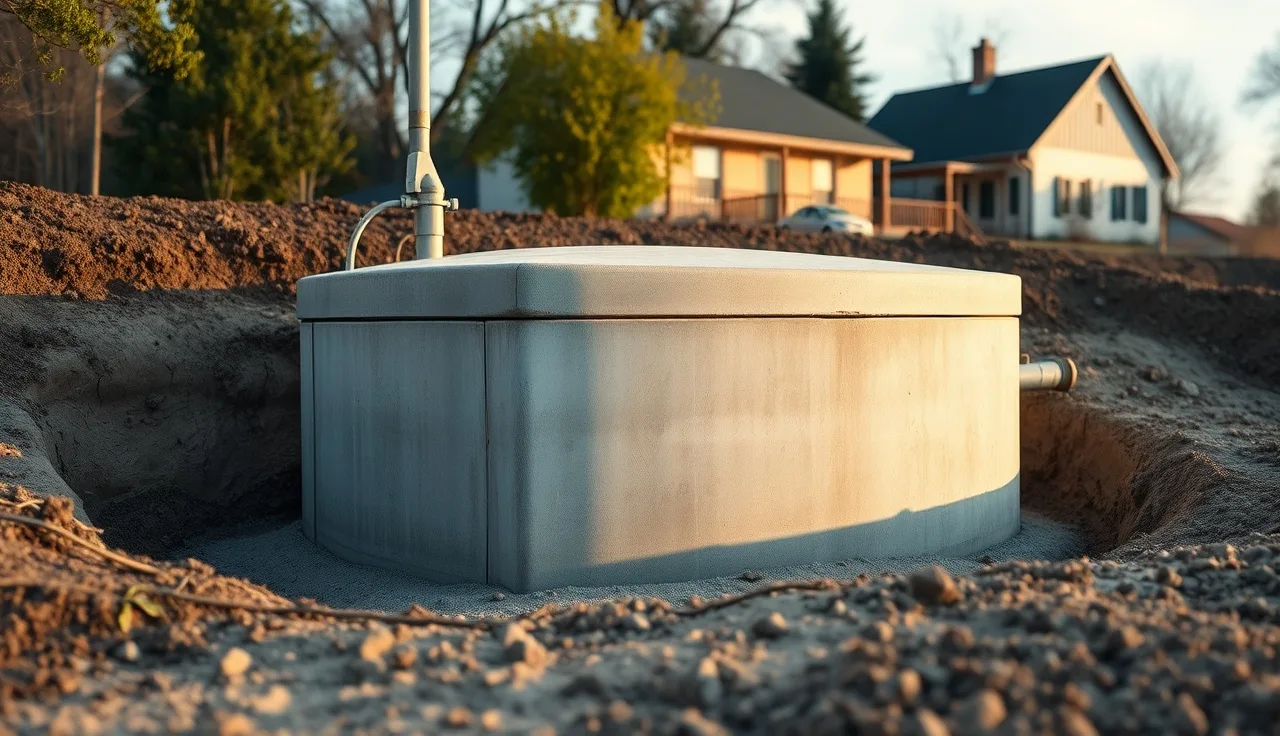
A 1000-gallon septic tank is a buried, watertight container, usually precast concrete, polyethylene, or fiberglass, that catches all the wastewater from a home's toilets, sinks, showers, and appliances. Inside, solids settle to the bottom as sludge, grease and oils float to the top as scum, and the middle layer of relatively clear liquid (effluent) flows out to the drain field.
That separation takes roughly 24 to 48 hours per load of incoming wastewater [1]. The tank doesn't treat sewage in any final sense. It's a settling chamber and a buffer that keeps solids out of the drain field, where they would clog the soil. The real treatment happens in the ground beneath the leach field.
At 1,000 gallons, the tank holds enough liquid to handle daily flows from a small household while giving solids the time they need to settle out. Too small for the actual daily flow, and solids carry over into the leach field before they settle. Field failure follows faster than most homeowners expect.
What size house does a 1000-gallon septic tank fit?
Most state codes tie minimum tank size to bedroom count, not to the number of people living there, because bedrooms set the design occupancy. The EPA's SepticSmart guidance names 1,000 gallons as the typical minimum for homes up to 3 bedrooms [1]. Many states make this a hard floor: even a studio or one-bedroom home has to install at least a 1,000-gallon tank.
Here's how bedroom count generally maps to tank size across most state codes:
| Bedrooms | Minimum tank size (common) | Estimated daily flow |
|---|---|---|
| 1-2 | 750-1,000 gal | 150-300 gpd |
| 3 | 1,000 gal | 300-450 gpd |
| 4 | 1,200-1,500 gal | 450-600 gpd |
| 5 | 1,500-2,000 gal | 600-750 gpd |
The EPA's design standard assumes 150 gallons per day per bedroom [2]. A three-bedroom home therefore generates an estimated 450 gpd, and a 1,000-gallon tank gives roughly 2 days of hydraulic retention, which is the floor for effective solids separation.
Got a 3-bedroom house with 5 or 6 people in it? A 1,000-gallon tank is technically code-compliant in most states but tight in practice. Pumping frequency climbs. Some installers push you to 1,250 or 1,500 gallons in that case, and I'd agree with them. The upsell costs a few hundred dollars on a new install and can save you a $10,000-plus drain field replacement.
How often does a 1000-gallon septic tank need to be pumped?
The EPA recommends pumping most household septic tanks every 3 to 5 years [1]. For a 1,000-gallon tank, the real interval turns on three things: how many people live there, their water habits, and what they flush that they shouldn't.
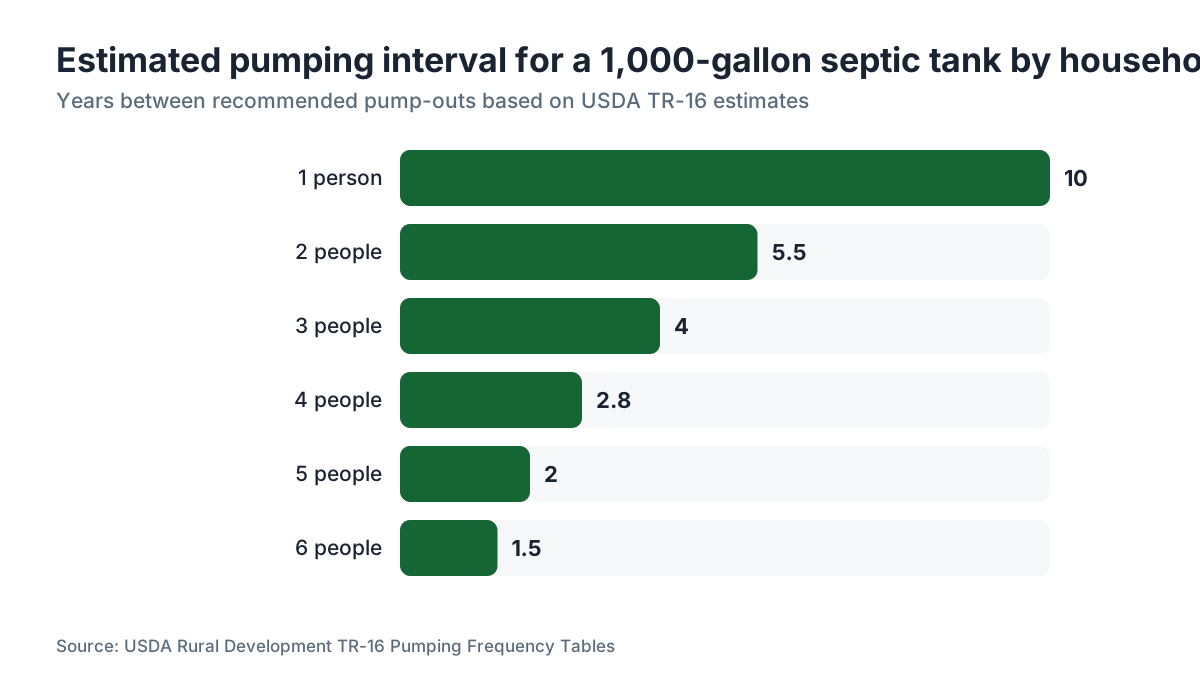
A USDA study that many state extension services still lean on gives a lookup table based on tank size and household size [3]. For a 1,000-gallon tank:
| Household size | Estimated pumping interval |
|---|---|
| 1 person | 9-12 years |
| 2 people | 5-6 years |
| 3 people | 4 years |
| 4 people | 2.5-3 years |
| 5 people | ~2 years |
| 6 people | ~1.5 years |
These are estimates. Nobody has clean data on how much individual households vary, and the closest large study (USDA TR-16) says the ranges are wide [3]. What it does confirm holds up: every extra person in the house shortens the pumping cycle in a real way.
A few things pile up sludge and scum faster than headcount alone. Garbage disposals add about 50% more solids to the tank by some estimates [4]. Heavy water use from long showers, leaky toilets, or several appliances running at once shoves hydraulic load past the tank's separation capacity. Flushing wipes labeled "flushable," feminine hygiene products, or paper towels fills the tank faster and can clog the inlet baffle.
The practical answer: 3 or 4 people in a 3-bedroom house on a 1,000-gallon tank, pump every 3 years, and have the pumper measure sludge depth while the lid is off. Sludge under a third of the liquid depth means you can stretch the interval. Close to halfway means you're already behind.
For a full breakdown of pumping schedules, see our guide on how often to pump septic tank.
How much does a 1000-gallon septic tank cost to install?
The tank itself, bought on its own, runs $700 to $2,000 depending on material. Precast concrete tanks own the market and usually cost $900 to $1,400. Polyethylene tanks cost $700 to $1,200 and get used in areas with high water tables or tight access. Fiberglass runs $1,200 to $2,000 and shrugs off corrosion, but it's less common [5].
The tank price is the smallest line on a full installation. A new septic system with a 1,000-gallon tank runs from roughly $3,000 on the low end (good sandy soil, light permitting, rural area) to $15,000 or more where perc results are poor, regulation is heavy, or the site fights you. The national average for a complete conventional system sits around $7,000 to $10,000 [5].
Permitting adds $200 to $1,500 depending on the state and county. Site evaluation (perc test or soil profile) adds $300 to $1,000. If the soil flunks a standard perc test, you may need an alternative system, which can push costs past $20,000.
For a tank replacement only (tank failed but the drain field is still good), the labor to dig out, haul off the old tank, and set a new 1,000-gallon tank usually adds $1,500 to $4,000 to the tank price. That brings total replacement cost to roughly $2,500 to $6,000 in most markets [5].
See our detailed breakdowns on cost to put in a septic tank and cost to install septic system for a full cost map by region and system type.
What materials are 1000-gallon septic tanks made from, and which one should you get?
Three materials run the residential market: precast concrete, polyethylene (plastic), and fiberglass. Each has real trade-offs.
Precast concrete is the most common by a wide margin. It's heavy, so it won't float when the water table rises for a spell, and it's strong enough to sit under a driveway with traffic overhead. The downsides: concrete can crack over decades, and the seams between tank sections are a common leak point. Concrete also corrodes slowly from the hydrogen sulfide gas the tank produces. A well-made tank with dense, sulfate-resistant concrete should last 40 years or more, but I've seen 20-year-old concrete tanks badly deteriorated in high-use homes.
Polyethylene tanks are lighter, easier to haul to tight sites, and molded in one piece with no seams to leak. They don't corrode. The catch is buoyancy: in a high water-table area, an empty poly tank can pop out of the ground if it isn't anchored or backfilled right. Any reputable installer knows this and plans for it. Poly tanks are a solid pick for most residential jobs.
Fiberglass sits between the two. It resists corrosion, weighs little, has no seams, and floats more than concrete but less than poly. It costs more and is harder to find. In coastal or acidic-soil areas where concrete breaks down faster, fiberglass earns its keep.
For most homeowners, go with whatever material the dominant local installer uses. They know the local soil, the water table swings, and which products hold up. The tank material matters less than a proper installation and regular septic tank pumping.
What are the components inside a 1000-gallon septic tank?
The tank itself is just a box. What makes it work are the baffles, the access risers, and the outlet filter (if one is installed).
The inlet baffle deflects incoming wastewater downward so it doesn't churn up the settled sludge. When the inlet baffle fails, raw sewage hits the scum layer and stirs solids toward the outlet. Inlet baffles are usually concrete on older tanks or a PVC tee on newer ones.
The outlet baffle or effluent screen keeps solids from escaping to the drain field. This is the most important part inside the tank. Modern installs use a filter cartridge (Zoeller, Orenco, or a similar brand) that pulls out for cleaning during a pump. If your 1,000-gallon tank went in before the mid-1990s, it may have only a concrete outlet baffle or a plain tee, no filter at all. Adding a filter at the next pump-out is a cheap upgrade ($50 to $150 in parts) that can add years to your drain field.
Access risers bring the tank lid up to grade so the tank can be pumped without digging. A buried concrete lid means excavating every single time, which tacks $50 to $200 onto each pump-out. Plastic risers put in during a replacement or new install pay for themselves in 2 or 3 pump cycles. Buried lids? Ask your pumper about adding risers.
Two-compartment tanks are common in some states and add a second settling chamber before the outlet. A 1,000-gallon two-compartment tank holds solids back better than a single-compartment tank of the same total volume, and some state codes require them on new installations.
How do you know if your 1000-gallon tank is failing or full?
Slow drains all over the house are usually the first sign, followed by gurgling from toilets or floor drains. Sewage odors outside near the tank or drain field, or soggy, oddly green grass over the field, mean the system is in trouble.
A full tank and a failing tank throw off similar symptoms, which is exactly why a professional inspection matters. A pumper can tell you on the spot whether the tank is just overdue or whether something structural has gone wrong: cracked walls, failed baffles, a collapsed inlet pipe, or a drain field backing up into the tank.
Inspection rules vary by state. Many states require a septic inspection at the sale of a home. Some counties require inspections on a set cycle, every 3 to 5 years whether or not the house sells. The EPA's SepticSmart program tells homeowners to get an inspection whenever they pump, which is sound advice because the pumper has full access at that moment [1].
For a step-by-step walkthrough of what inspectors check and what to expect, see our guide on septic tank inspection. If the inspection turns up a problem past normal wear, our septic tank repair and septic system repair guides cover what those fixes involve and cost.
What can and can't go into a 1000-gallon septic tank?
A 1,000-gallon tank has less room for abuse than a bigger one. The biology inside depends on anaerobic bacteria to break down solids. Several common household products either kill those bacteria or dump in solids the system can't handle.
Things that should never go into any septic tank: bleach in bulk (a splash in a toilet bowl is fine; pouring in half a gallon kills the tank's bacteria), antibacterial cleaners used constantly, paint, solvents, motor oil, medications, and anything labeled "flushable" that isn't toilet paper. Cooking grease earns its own mention. Even small amounts build up in the scum layer faster than the system can process them and clog the outlet filter.
Garbage disposals are a legitimate worry with a 1,000-gallon tank. The EPA notes that garbage disposals sharply increase the solids entering the tank, which means pumping more often [2]. Disposal plus a 1,000-gallon tank serving 3 or more people? Plan to pump every 2 to 3 years, not 3 to 5.
High-efficiency appliances actually matter here. A standard washing machine uses 40 to 45 gallons per load; a high-efficiency machine uses 15 to 25 [6]. Running several loads of laundry in one day can briefly blow past the tank's hydraulic capacity and shove partly settled solids toward the drain field. Spreading laundry across a few days is easy and genuinely helps.
Additive products sold as tank treatments, bacterial boosters, or enzyme packets have mixed evidence behind them. The EPA does not endorse septic additives as a substitute for pumping [1]. Some peer-reviewed studies found no measurable benefit from biological additives in a healthy system. A healthy system doesn't need them. A failing one won't be saved by them. Save the money.
What are the rules and permits for a 1000-gallon septic tank installation?
Septic systems are regulated at the state and local level in the United States, not federally, so the details swing hard from place to place. Every state has onsite wastewater rules that set minimum tank sizes, setback distances, soil testing, and installer licensing. The EPA writes national guidance, but enforcement sits with state environmental or health agencies [2].
As a general frame across most states:
- A permit is required before any new tank install or replacement. Skip it and you risk fines, and you may void your homeowner's insurance on sewage-related claims.
- A licensed installer has to do the work in the vast majority of states. A few states let homeowners install on their own primary residence; most don't.
- Setbacks run about 10 feet from property lines, 50 to 100 feet from wells, and 25 feet from surface water, though these vary by state.
- A 1,000-gallon minimum tank size applies in most states for new construction [7].
North Carolina's rules (15A NCAC 18E) set a 1,000-gallon minimum for residential systems and require soil evaluation before any permit is issued [7]. California's state code (Title 17 CCR) and local county health departments regulate systems together. Texas hands almost everything to the county level, which creates big variation inside the state [9].
Call your county health department or state environmental agency before you buy a tank or hire anyone. The permit process protects you too: the inspector who signs off confirms the system went in right, which matters at resale.
How long does a 1000-gallon septic tank last?
A well-maintained concrete tank can last 40 to 50 years or longer. Polyethylene and fiberglass tanks are built for similar lifespans, and some manufacturers warrant them 30 to 50 years against structural defects.
Real-world lifespan comes down to soil (highly acidic soil corrodes concrete faster), groundwater level (constant saturation stresses the joints), the quality of the original install, and maintenance history. A tank that never gets pumped doesn't last longer. It fails sooner. Sludge past the outlet baffle drives solids into the drain field, which is a separate failure, but the overflow also makes the tank work harder.
The usual failure modes for older 1,000-gallon tanks are cracked concrete walls (often hairline cracks that leak effluent into the surrounding soil), failed inlet or outlet baffles (the concrete baffles in pre-1980 tanks corrode and crumble), and collapsed or rotted inlet pipes.
Baffle replacement is a repair worth doing. Swapping a failed outlet baffle costs $150 to $400 and can add years to a tank's life. If the walls are cracked and leaking, your options are epoxy injection (a temporary fix, $500 to $1,500) or full replacement. A leaking tank is also a regulatory violation in most states because it contaminates groundwater.
If you're unsure about your tank's condition, a septic tank inspection with a camera run through the inlet and outlet pipes shows you clearly where things stand.
Is a 1000-gallon septic tank big enough for your house?
For a 1 to 3 bedroom home with average water use and 1 to 4 people, yes, a 1,000-gallon tank is usually enough. It's the legal minimum in most states for that size home, and the engineering behind it (150 gpd per bedroom, 2-day retention) is sound.
A 1,000-gallon tank turns genuinely undersized in a handful of situations: more than 4 or 5 regular occupants in a 3-bedroom home, a garbage disposal running hard, a water softener discharging into the tank (most codes now ban this, but older homes often still do it), or steady overnight guests that spike flow during peak periods.
Buying a home with a 1,000-gallon tank and planning to move 5 or 6 people in? I'd budget for a tank upgrade, or at the very least a hard pumping schedule and a drain field inspection before you close. The drain field is where the real money gets lost when a tank stays overloaded. A drain field replacement for a 3-bedroom home usually runs $5,000 to $30,000 depending on size, soil, and state rules [5].
Operators running a portfolio of client systems get value from tracking tank size against household occupancy. SepticMind's service management tools let you flag accounts where documented occupancy suggests the tank size is marginal, so you can schedule ahead of a problem call instead of reacting to one.
Planning a new install with any budget room? Stepping from 1,000 to 1,250 gallons costs little on top and buys real insurance. That said, I wouldn't lose sleep over a properly installed, regularly pumped 1,000-gallon tank in the right home.
What happens during a 1000-gallon septic tank pump-out?
A pump-out on a 1,000-gallon tank takes 20 to 45 minutes for an experienced crew once they reach the lids. Here's what actually happens.
The technician finds and uncovers the access lids (or pulls the riser covers if you have them). They drop a vacuum hose into the tank and use a truck-mounted vacuum to pull out all the liquid and solids. A thorough pump-out removes everything, including the sludge on the bottom, more than the liquid layer. Some pumpers do a partial pump. That's a shortcut that leaves sludge behind and shortens your effective interval.
After pumping, the technician should inspect the inlet and outlet baffles, check the tank walls for cracks, and note the condition of the outlet filter if there is one. A clogged outlet filter gets cleaned as a matter of course; replacement runs $50 to $200 if the cartridge is shot.
A standard 1,000-gallon pump-out costs $250 to $600 depending on region, local disposal fees, and whether the lids have to be dug up [5]. Urban markets tend to run higher. Rural markets with cheaper disposal can come in lower. Getting a couple of quotes is smart, but hard price-shopping on pump-outs often lands you a crew that skips the inspection steps.
For more on what to expect and how to find a good pumper, see our guides on septic tank pump out, septic tank cleaning, and septic tank emptying.
What's the difference between a 1000-gallon tank and the larger options?
The real difference between a 1,000-gallon tank and a 1,250 or 1,500-gallon tank comes down to hydraulic buffer and pumping frequency. More volume means more time for solids to settle before effluent leaves for the drain field, and it means the sludge and scum layers take longer to reach the point where pumping is due.
Here's a direct comparison for a 4-person household at 150 gpd per person (600 gpd total daily load), using EPA design assumptions:
| Tank size | Retention time at 600 gpd | Estimated pump interval (4 people) |
|---|---|---|
| 1,000 gal | ~1.7 days | 2-3 years |
| 1,250 gal | ~2.1 days | 3-4 years |
| 1,500 gal | ~2.5 days | 4-5 years |
| 2,000 gal | ~3.3 days | 5-7 years |
The price gap between a 1,000 and 1,500-gallon precast concrete tank is usually $200 to $600 in the tank alone. Labor to set them is nearly the same. Over a 20-year span, a 1,500-gallon tank may save you 2 or 3 pump-outs against a 1,000-gallon tank, roughly $500 to $1,500 in avoided pumping, while easing drain field stress. The math often favors going bigger if the code and site allow it.
For big homes (4-plus bedrooms), there's no serious case for a 1,000-gallon tank. State codes won't permit it for new construction, and that's the right call. See the septic tank installation guide for a full walkthrough of the sizing process.
Frequently asked questions
Can a 1000-gallon septic tank serve a 4-bedroom house?
In most states, no. A 4-bedroom home typically requires a 1,200 to 1,500 gallon minimum tank under state onsite wastewater codes, because the design flow (150 gallons per day per bedroom) exceeds what a 1,000-gallon tank can handle with adequate retention time. If you're buying a 4-bedroom home with a 1,000-gallon tank, check whether it was permitted correctly and get a professional inspection before closing.
How much does it cost to pump a 1000-gallon septic tank?
A pump-out on a 1,000-gallon tank runs $250 to $600 in most U.S. markets, with regional swings based on local disposal fees and labor rates. Urban areas and states with stricter waste disposal rules run higher. Buried lids that need excavation add $50 to $200. Getting two quotes is reasonable; the cheapest option often means a crew that skips the post-pump inspection.
How do I find my 1000-gallon septic tank location?
Start with the as-built drawing filed with your county health department when the system was permitted. If no drawing exists, the inlet pipe from the house points toward the tank; trace it with a plumber's snake or a pipe locator. A septic tank locator probe (a long metal rod) confirms the lid location once you're close. Many counties post septic records on GIS maps online.
How heavy is a 1000-gallon concrete septic tank?
An empty precast concrete 1,000-gallon tank usually weighs 8,000 to 10,000 pounds (4 to 5 tons). That weight is part of why concrete tanks resist buoyancy in high water-table areas. It also means delivery and placement need a crane or boom truck, which is baked into installation pricing. Polyethylene 1,000-gallon tanks weigh 200 to 500 pounds empty, far easier to handle on tight sites.
Can you drive over a 1000-gallon septic tank?
Generally no, unless it was designed and rated for traffic loads and installed with enough cover. Standard residential concrete tanks aren't built for vehicle traffic. Driving over one risks cracking the lid or walls and compacting the soil above in ways that hurt the system. If a driveway has to cross near the tank, you need a traffic-rated lid and proper depth; check with your installer and local code.
What are the dimensions of a 1000-gallon septic tank?
Dimensions vary by manufacturer and shape. A typical precast concrete 1,000-gallon single-compartment tank is roughly 8 to 9 feet long, 5 feet wide, and 5 to 6 feet tall. Some makers build a more compact square footprint (about 5 by 5 feet, 6 feet deep) for tight sites. Polyethylene tanks tend to be a bit smaller overall. Always confirm dimensions with your supplier before site prep.
Does a 1000-gallon septic tank need a drain field?
Yes. A septic tank alone doesn't treat wastewater to safe levels; it only separates solids. The clarified effluent leaving the tank flows to a drain field (also called a leach field or soil absorption system) where final treatment happens in the soil. No jurisdiction approves a tank without an approved dispersal system. A tank discharging to the ground surface or a ditch is illegal and a public health hazard.
How do I know if my 1000-gallon tank is full between pump-outs?
Early signs are slow drains in several fixtures at once, gurgling from toilets when water runs elsewhere, or sewage odors indoors or near the tank. Wet, spongy ground or unusually lush grass over the drain field means effluent is surfacing. A septic professional can measure sludge and scum depth at any time, without a full pump-out, and tell you exactly where you stand.
Is a 1000-gallon plastic septic tank as good as concrete?
For most residential jobs, yes. Polyethylene tanks are molded in one piece, corrosion-resistant, and good for 30 to 50 year lifespans with proper installation. Their main limit is buoyancy in high water-table areas, which calls for correct backfill and sometimes anchoring. Concrete's edge is weight and compressive strength. Which is better depends on your site; your installer's read on local conditions is the right guide.
Can I install a 1000-gallon septic tank myself?
In a few states, a homeowner can install a septic system on their own primary residence with a permit. In most states, a licensed septic contractor is required. Even where DIY is legal, the tank weighs 4 to 5 tons and needs machinery to set safely, soil and site evaluation has to meet code, and the install has to pass inspection. Most homeowners find the savings aren't worth the regulatory and physical risk.
What happens if a 1000-gallon septic tank is never pumped?
Sludge and scum build up until they reach the outlet baffle, then solids flow out with the effluent into the drain field. Biomat forms in the drain field soil and clogs the infiltrative surface. Eventually the field backs up into the tank and then into the house. Drain field replacement typically costs $5,000 to $30,000. Regular pumping, at $250 to $600 every 3 to 5 years, is one of the most cost-effective maintenance decisions a homeowner makes.
Do septic tank additives help a 1000-gallon tank work better?
The EPA does not recommend additives as a substitute for regular pumping and says there's no scientific evidence that biological or chemical additives improve tank performance or reduce pumping frequency in a working system. Some products with strong solvents or acids can actually damage the tank or leach field. Save the money. A healthy, regularly pumped tank gets all the biology it needs from incoming household waste.
What is the difference between a septic tank pump-out and cleaning?
In practice, most professionals use the terms interchangeably. Technically, a pump-out removes the liquid and loose sludge; a cleaning implies a more thorough job that backflushes the tank walls with water and pulls the remaining sludge cake. A thorough job every time is what you want. When you schedule, ask whether the crew removes all solids or only the liquid layer. Partial pump-outs shorten your effective interval.
Sources
- U.S. EPA SepticSmart Program - Septic System Care: EPA recommends pumping household septic tanks every 3-5 years and notes 1,000 gallons as the typical minimum tank size for small homes; also advises against septic additives as pumping substitutes.
- U.S. EPA - Septic System Design and Sizing Guidance: EPA design standard assumes 150 gallons per day per bedroom for residential septic system sizing; garbage disposals significantly increase solids load.
- USDA Rural Development - Pumping Frequency Table for Septic Tanks (TR-16): USDA lookup table estimates pumping intervals by tank size and household size; for a 1,000-gallon tank with 4 occupants, interval is approximately 2.5-3 years.
- University of Minnesota Extension - Septic System Owner's Guide: Garbage disposals increase solids entering septic tanks by an estimated 50%, requiring more frequent pumping.
- HomeAdvisor / Angi - Septic Tank Installation and Pumping Cost Data: Precast concrete 1,000-gallon tank costs $900-$1,400; full system installation averages $7,000-$10,000; pump-out costs $250-$600; drain field replacement $5,000-$30,000.
- U.S. Department of Energy - Energy Star Clothes Washers: Standard washing machines use 40-45 gallons per load; high-efficiency models use 15-25 gallons per load.
- North Carolina Department of Health and Human Services - Onsite Wastewater Rules 15A NCAC 18E: North Carolina rule 15A NCAC 18E sets a 1,000-gallon minimum septic tank size for residential systems and requires soil evaluation before permit issuance.
- Pennsylvania DEP - Onsite Sewage Facilities Program: State septic regulations require licensed installers and permits before any septic tank installation or replacement; setback requirements and minimum sizes codified in state regulations.
- Texas Commission on Environmental Quality - On-Site Sewage Facilities: Texas delegates septic system permitting and enforcement largely to county level, creating significant variation in requirements across the state.
- University of Florida IFAS Extension - Septic Tank Maintenance: Regular inspection at time of pumping is recommended to check baffles, structural condition, and outlet filter; adding outlet filters to older tanks extends drain field life.
- Oregon DEQ - Onsite Septic System Rules: State onsite wastewater codes set minimum tank sizes, installer licensing requirements, and setback distances from wells and surface water for new septic installations.
Last updated 2026-07-09