Advanced treatment septic system cost: what to expect in 2025
By the SepticMind Editorial Team
TL;DR
- Advanced treatment septic systems (ATUs, aerobic units, drip irrigation, mound systems) typically cost $10,000 to $30,000 installed, depending on system type, soil conditions, and local permitting.
- Annual maintenance contracts add $300 to $700 per year.
- Conventional septic runs $3,000 to $10,000 by comparison, so expect to pay roughly two to four times more for an advanced system.
What is an advanced treatment septic system?
A conventional septic system has two jobs: settle solids in a tank, then push effluent into a drain field where soil finishes the treatment. That works well on the right lot. But millions of homes sit on clay soils, shallow bedrock, high water tables, or small parcels where basic soil treatment is not enough. That's where advanced treatment units come in.
Advanced treatment systems, often called alternative or innovative/alternative (I/A) systems, add one or more extra treatment steps before effluent reaches the soil or a surface water body. The EPA's SepticSmart program describes them as systems that "provide additional treatment of wastewater beyond what a conventional septic system provides," typically reducing biochemical oxygen demand (BOD), total suspended solids (TSS), and in some designs, nitrogen and pathogens to levels that meet stricter discharge standards [1].
The broad category covers several distinct technologies: aerobic treatment units (ATUs), drip irrigation systems, mound systems, recirculating sand filters, constructed wetlands, and nitrogen-reducing systems. Each solves a different site problem, which is why costs vary so widely. A mound system on a high water table lot is a completely different engineering problem from a nitrogen-reducing ATU in a Chesapeake Bay watershed.
Figure out which type your site needs, and why, before any cost conversation makes sense.
What are the main types and how much does each cost to install?
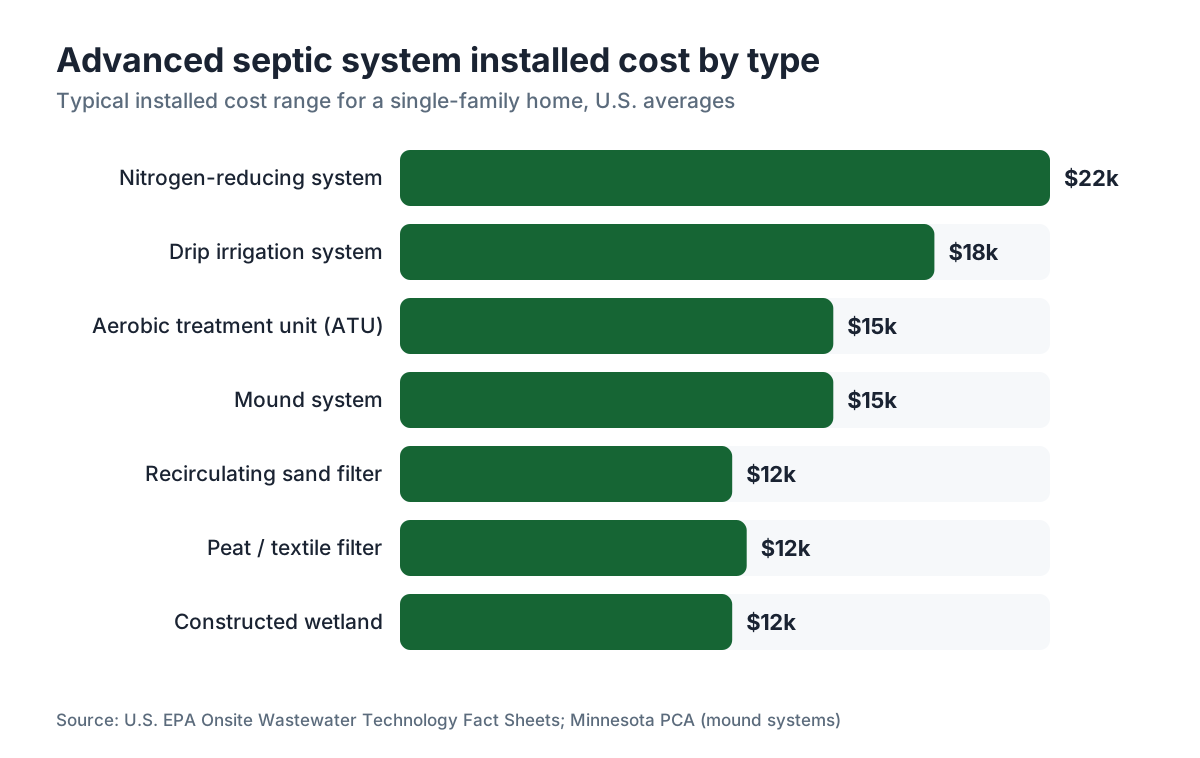
Here is how the major system types compare on installed cost. These ranges come from state extension programs, EPA guidance, and installer surveys. Every site is different, so treat these as starting bands, not quotes.
| System type | Typical installed cost | Best for |
|---|---|---|
| Aerobic treatment unit (ATU) | $10,000, $20,000 | Poor soil, small lots, failing conventional systems |
| Mound system | $10,000, $20,000 | High water table, shallow soil depth |
| Drip irrigation (subsurface) | $12,000, $25,000 | Challenging soils, nitrogen-sensitive areas |
| Recirculating sand filter | $8,000, $15,000 | Pre-treatment before disposal field |
| Constructed wetland | $8,000, $15,000 | Rural lots, low-maintenance preference |
| Nitrogen-reducing (e.g., denitrification) | $15,000, $30,000+ | Sensitive watersheds, regulatory mandate |
| Peat or textile filter | $8,000, $16,000 | Small lots, seasonal homes |
ATUs are the most common advanced system in the U.S., and their price range is the one most homeowners run into. The ATU itself, a tank with an aerator, costs roughly $3,000 to $7,000 for the unit; the rest of the installed price covers excavation, drain field or drip tubing, electrical hookup, controls, and labor [2].
A mound system is not really a treatment technology. It moves the soil treatment zone above grade using imported sand and gravel. The extra fill material and grading work push costs up. In cold-climate states like Minnesota, mound systems are everywhere, and the Minnesota Pollution Control Agency puts typical installed costs at $12,000 to $20,000 for a single-family home [3].
Nitrogen-reducing systems are the most expensive because they combine aerobic treatment with an anoxic recirculation stage and sometimes require UV disinfection or media filters before final disposal. In coastal states like Massachusetts, where Title 5 nitrogen limits apply near estuaries, these systems regularly reach $25,000 to $35,000 installed.
What drives the cost up or down?
Soil conditions are the biggest variable most homeowners underestimate. A perc test that fails badly, or a site with less than 18 inches of usable soil before bedrock or groundwater, means the designer has fewer options, and all of them involve more imported material or more mechanical complexity. More complexity means more money.
Lot size and topography matter too. A flat half-acre lot is easy to work. A steeply sloped wooded lot needs engineered site work, possibly retaining walls, and longer pipe runs.
Permitting and regulatory requirements vary enormously by state and county. Some states, like Massachusetts and Maryland, mandate specific advanced system types in sensitive areas regardless of soil quality [4]. When you don't have a choice of system, you don't have any pricing power. Permit fees themselves range from around $200 in rural counties to over $1,500 in tightly regulated jurisdictions.
System size scales with daily flow, which tracks with bedroom count in most state codes. A three-bedroom home typically needs a 500 to 600 gallon-per-day design flow. Add two bedrooms and you may need a larger ATU tank, more drip tubing, or a bigger mound footprint. Each step up in size adds $1,000 to $4,000.
Labor costs follow local contractor rates. Rural areas often have fewer licensed installers, which keeps competition low and prices high. Suburban markets with several certified installers tend to be cheaper. Get at least three quotes from licensed, state-certified installers before signing anything.
Site access drives excavation cost. A backhoe that can drive straight to the installation area is cheap. A site with mature trees, a detached garage, or a long driveway that needs a crane or hand-digging is not.
How much does ongoing maintenance cost for advanced systems?
This is where advanced systems hurt more than the sticker price suggests. Conventional septic systems need pumping every three to five years, typically $300 to $600 per service [5], and that's mostly it if the system is healthy. Advanced systems need regular professional maintenance no matter how good everything looks.
Most states that allow ATUs and drip systems require a maintenance contract as a condition of the operating permit. The contractor inspects the aerator, checks electrical controls, tests effluent quality, and files a compliance report with the local health department, usually every six months or every year.
Typical annual maintenance contract costs:
| Service level | Annual cost |
|---|---|
| Basic inspection and report (1x/year) | $150, $300 |
| Standard contract (2 inspections/year) | $300, $500 |
| Full-service with parts coverage | $400, $700 |
| Premium with UV lamp and media replacement | $500, $900 |
Beyond the contract, expect component costs. ATU aerators last 5 to 10 years and cost $200 to $800 to replace. UV lamps need annual replacement at $50 to $150 each. Filter media in textile or peat systems needs replacement every 5 to 10 years at $500 to $2,000 depending on system size. Drip system emitters can clog and may need flushing or replacement at $200 to $600 per service visit.
Over a 20-year ownership period, add roughly $7,000 to $15,000 in maintenance and replacement costs on top of the installation price. That's real money that rarely shows up in the first comparison against a conventional system.
If you want to track inspection dates, maintenance records, and service contract renewals across multiple properties, platforms like SepticMind are built specifically for that kind of operational record-keeping, especially useful for septic service operators managing many ATU accounts.
What does a full cost comparison look like vs. conventional septic?
Here is a realistic 20-year total cost comparison for a typical three-bedroom home, using mid-range figures. This is not a warranty or a quote. It's a framework for thinking.
| Cost category | Conventional septic | ATU (advanced) |
|---|---|---|
| Installation | $6,000, $10,000 | $12,000, $20,000 |
| Pumping (every 3 yrs) | $2,400, $4,000 | $2,400, $4,000 |
| Maintenance contracts (20 yrs) | $0, $600 | $6,000, $14,000 |
| Component replacement | $500, $2,000 | $2,000, $6,000 |
| Total 20-year cost | $9,000, $16,600 | $22,400, $44,000 |
The gap is large. For many homeowners the choice is not optional: either your site requires an advanced system or your local regulations mandate one. But if you're deciding between repairing a failing conventional system versus replacing it with an advanced one, this comparison matters a lot. See our guide to septic system repair for what a conventional repair actually costs before you assume replacement is the only path.
One genuine upside: advanced systems often produce effluent clean enough to protect the soil and cut drain field stress, which can extend drain field life. If your soil is marginal, a cleaner effluent stream may mean the drain field lasts 25 years instead of 15. That deferred replacement (drain fields cost $5,000 to $15,000 to replace) can narrow the gap somewhat. See the leach field guide for more on drain field life expectancy.
Are there grants, subsidies, or financing options to reduce the cost?
Yes, and more homeowners should hunt for them than actually do.
The USDA Rural Development program offers loans and grants through its Single Family Housing Repair program (Section 504) for income-qualified rural homeowners. Septic system replacement, including advanced systems, qualifies. Grants go up to $10,000 for very low-income homeowners 62 and older; loans go up to $40,000 at 1% interest [6].
The EPA's Clean Water State Revolving Fund (CWSRF) flows money to states, which can and do use it for onsite wastewater programs. Some states pass this funding directly to homeowners as low-interest loans or grants, particularly in sensitive watershed areas [12]. Check your state environmental agency's website for current programs.
Some states and counties run their own septic loan programs. Maryland's Bay Restoration Fund, for example, pays for nitrogen-reducing septic upgrades for eligible homeowners in the Chesapeake Bay watershed, with grants covering part or all of the upgrade cost [4]. Virginia has a similar program through the Department of Health [10].
Local health departments sometimes have emergency assistance programs for failing systems that pose a public health risk. If your current system is failing, say so when you apply; urgency sometimes opens funding doors that routine upgrades don't.
Some ATU manufacturers offer financing directly, and many septic contractors work with third-party home improvement lenders. Interest rates vary widely. Compare those carefully against a HELOC before signing a contractor-arranged loan.
Don't forget the federal tax angle. Home energy and environmental improvements have historically generated credits, though septic systems specifically have not qualified for standard energy credits. Check with a tax professional. The rules change year to year.
What permits and inspections do you need for an advanced system?
Every state requires a permit for a new advanced treatment system installation, and most require the design to be stamped by a licensed engineer or soil scientist. The permitting process usually goes: site evaluation (perc test and soil profile), system design, permit application, health department review, installation, and final inspection [7].
For advanced systems, many states also require an operating permit separate from the construction permit. The operating permit ties to the mandatory maintenance contract and requires the contractor to submit inspection reports. If reports lapse, the permit can be revoked, which becomes a legal headache if you're selling the home.
Inspections happen at multiple stages: before backfill (so the inspector can see the tank placement and pipe grades), after backfill but before landscaping, and then annually or biannually as part of the operating permit. Some states require effluent sampling for nitrogen or pathogen levels at each inspection.
Buying or selling a home with an advanced system? Most states require a system inspection at the point of sale, and the maintenance and inspection records become part of the transaction. A system with complete records and a current maintenance contract sells cleaner than one with gaps. See our septic tank inspection guide for what inspectors look at and what failing looks like.
When does it make sense to upgrade to an advanced system?
There are really four situations where an advanced system makes sense, or becomes unavoidable.
First, your site won't support a conventional system. Failed perc test, insufficient soil depth, lot too small for a standard drain field. You don't have a conventional option.
Second, your state or county requires it. Nitrogen-sensitive watersheds, proximity to wells, setback violations from property lines that a conventional system can't meet. The regulator tells you what you're getting.
Third, your existing system is failing and there's no room for a new conventional drain field. If the existing field is the only area that passes perc and it's saturated, an advanced system's smaller footprint may fit where a conventional replacement wouldn't.
Fourth, you're on a lot that produces high-strength wastewater, like a property with a heavily used garbage disposal, a home-based food business, or a large household. Advanced treatment handles higher organic loads better.
The situation where it's genuinely optional is rarer than you'd think. If you're in that situation and you have a healthy conventional system that just needs routine service, keep the conventional system. The extra cost of an advanced system buys you nothing if your soil is already doing the job. Regular septic tank pumping and staying off the drain field is cheaper than upgrading for no reason.
If you're not sure whether your existing system is salvageable, the answer is usually a professional inspection and a site re-evaluation, not a replacement quote.
How do you find and vet an advanced system installer?
Advanced systems require a different skill set than conventional septic. Not every contractor who installs conventional systems is qualified to install and maintain an ATU or a drip irrigation system. Ask directly: how many ATUs (or mound systems, or drip systems) have you installed in the past year? A contractor who has installed two of them is not the same as one who installs fifteen a year.
Look for state certification. Most states certify installers separately for alternative systems, and some require the installer to also be licensed as a service provider for ongoing maintenance. Your state health department or environmental agency website will have a searchable database of licensed contractors. Start there.
ATU manufacturers often keep lists of certified installers for their specific products. Fuji Clean, Norweco, Jet, and Infiltrator all train and certify contractors for their systems. A manufacturer-certified installer for the specific ATU you're buying is a reasonable baseline.
Get three quotes, and make sure they're quoting the same system type and size. It's easy to compare apples to oranges when one contractor quotes a smaller ATU and another quotes the system your site actually needs. Ask each to walk you through the design rationale.
Ask for references from homeowners with the same system type who are at least three years post-installation. New installations usually look fine. It's the second and third year where a contractor's workmanship and service responsiveness shows up.
Operators managing a fleet of advanced system service accounts might find it useful to track inspection schedules and permit compliance in purpose-built software. SepticMind is designed for exactly that workflow.
What happens if you skip maintenance on an advanced system?
Short answer: the system fails faster and you face bigger costs than if you'd just kept up with the contract.
ATUs depend on active aeration. When the aerator motor burns out and nobody catches it, the system reverts to anaerobic conditions within days. The anoxic effluent that reaches the drain field is much harder on soil structure than the partially treated aerobic effluent the system was designed to produce. Drain field damage can be permanent. A new drain field costs $5,000 to $15,000.
Beyond the mechanical failure, skipping inspections on a permitted ATU system can put you in permit violation. In many states, a lapsed maintenance contract voids the operating permit. If you're selling the home, a title search or real estate inspection can surface the lapsed permit as a material defect. Buyers and their attorneys take that seriously.
Drip irrigation systems that aren't flushed regularly get clogged emitters. A partial clog goes unnoticed until one zone of your disposal field is getting nothing and another is getting double the hydraulic load. Uneven loading speeds up soil clogging in the overloaded zone.
The maintenance contract is not optional from a regulatory standpoint in most jurisdictions, and from a practical standpoint the cost of skipping it is nearly always higher than the cost of keeping it. If you need to know how often to pump a septic tank as part of the broader maintenance picture, that guide explains the pumping schedule that applies to advanced systems as well as conventional ones.
How do costs differ by state and region?
Regional cost variation is real, and it's driven by three things: labor rates, regulatory complexity, and required system types.
New England states (Massachusetts, Rhode Island, Connecticut) have some of the strictest onsite wastewater regulations in the country. Massachusetts Title 5 requires advanced nitrogen-reducing systems near estuaries and ponds with nitrogen limits. Installed costs in Massachusetts routinely reach $20,000 to $35,000 for these systems, with some coastal installations topping $40,000 [8].
Mid-Atlantic states (Maryland, Virginia) have watershed-driven upgrade programs that can cut net homeowner cost through grants, but the base system price is similarly high: $15,000 to $30,000 for nitrogen-reducing ATUs.
The Midwest and Great Plains states have lower labor costs and somewhat simpler regulatory frameworks in rural areas. A mound system in Minnesota or Wisconsin might run $12,000 to $18,000 installed, versus $18,000 to $25,000 for a similar system in New Jersey.
Southern states vary widely. Florida, with its shallow water tables, requires performance-based systems in many counties, and costs in coastal counties run $15,000 to $25,000. Inland rural areas of Alabama or Mississippi may have fewer regulatory requirements and lower installer costs, bringing some ATUs in under $12,000.
The Pacific Northwest (Oregon, Washington) has its own set of performance standards, particularly in areas draining to sensitive salmon habitat. Oregon's Department of Environmental Quality prescribes specific treatment levels, and installed costs in those areas are $15,000 to $25,000 [9].
Nobody has clean national average data on this. The closest published figures come from state extension programs and EPA's onsite wastewater technology fact sheets, which confirm the broad $10,000 to $30,000 range with big state-level variation [2].
What questions should you ask before signing a contract?
Before you sign anything with an installer, get clear answers to these questions in writing.
What specific system model and tank size are you quoting? Make sure the design matches the permitted design, not a cheaper alternative the installer prefers.
What is included in the installation price? Excavation, backfill, electrical hookup, controls panel, alarm system, permit fees, and final inspection should all be itemized. Surprises in change orders are the main reason final costs blow past quotes.
Who handles the mandatory maintenance contract and what does it cost annually? Some installers hand you off to a third-party service company after installation. Know who that is and what the contract terms are before you commit to the system.
What is the warranty on the equipment and the installation workmanship? ATU manufacturers typically warrant the unit for one to three years; workmanship warranties from installers vary. Get it in writing.
How long will installation take? Advanced systems often take two to four days of active work, but permitting and inspection scheduling can stretch the full timeline to several weeks. If you're on a failing system, know the realistic timeline before assuming a quick fix.
If you want to compare pricing, our cost to install septic system guide covers the full installation cost picture for both conventional and advanced systems, and the cost to put in a septic tank guide breaks down the tank component specifically.
Frequently asked questions
How much does an aerobic septic system cost compared to a conventional one?
An aerobic treatment unit (ATU) system typically costs $10,000 to $20,000 installed, versus $3,000 to $10,000 for a conventional septic system. The gap comes from the ATU unit itself ($3,000 to $7,000), required electrical hookup, more complex controls, and mandatory annual maintenance contracts that add $300 to $700 per year. Over 20 years, the total cost difference is usually $10,000 to $25,000.
Do advanced septic systems require a maintenance contract?
In most states, yes. Advanced systems like ATUs and drip irrigation systems operate under a permit that legally requires an active maintenance contract with a certified service provider. The contractor inspects the system and submits compliance reports to the local health department, usually once or twice a year. Letting the contract lapse can void your operating permit and create a problem if you sell the home.
Can I get a grant or subsidy to pay for an advanced septic system?
Possibly. The USDA Section 504 program offers grants up to $10,000 and loans up to $40,000 for income-qualified rural homeowners. Maryland's Bay Restoration Fund covers advanced nitrogen-reducing systems for Chesapeake Bay watershed homeowners. Some states run CWSRF-funded loan programs. Check your state environmental agency and local health department for current programs before assuming you're paying full price out of pocket.
How long does an advanced septic system last?
With proper maintenance, the tank and disposal components of an advanced system should last 20 to 30 years. Individual components fail sooner: aerator motors typically last 5 to 10 years ($200 to $800 to replace), UV lamps need annual replacement, and filter media needs replacement every 5 to 10 years. Systems that miss maintenance intervals consistently fail faster, sometimes within 10 years, because poorly treated effluent damages the drain field.
What is a nitrogen-reducing septic system and how much does it cost?
A nitrogen-reducing system adds a denitrification stage, typically an anoxic recirculation zone, after the aerobic treatment step. It reduces total nitrogen in effluent from roughly 40 to 60 mg/L in a conventional system down to 10 to 19 mg/L or lower. These systems are required in nitrogen-sensitive watersheds. Installed cost runs $15,000 to $30,000 or more, with Massachusetts and Maryland coastal installations sometimes exceeding $35,000.
How much does a mound septic system cost?
Mound systems typically cost $10,000 to $20,000 installed for a single-family home, with Minnesota Pollution Control Agency figures citing $12,000 to $20,000 as the typical range in that state. The mound itself requires engineered fill sand and gravel plus a dosing pump and controls. Cold-climate sites may also need insulation over the mound, adding $500 to $1,500. Costs are higher where imported sand hauls long distances.
Can an advanced system save my failing drain field?
Sometimes. Replacing a conventional system with an ATU or drip irrigation system produces cleaner effluent, which can let a rested drain field partially recover. But if the biomat in a failing drain field is extensive, cleaner effluent alone may not rescue it. A soil scientist or licensed designer should evaluate the field before you spend $15,000 on an upgrade based on the hope that the old field will recover.
What permits do I need to install an advanced septic system?
You need a construction permit from your local health department or environmental agency before installation starts. Most jurisdictions also require a separate operating permit once the system is running, which ties to the mandatory maintenance contract. The design typically must be stamped by a licensed engineer or certified soil scientist. Permit fees range from about $200 to over $1,500 depending on your jurisdiction.
How often does an advanced septic system need to be pumped?
ATUs and other advanced systems still need regular pumping of the septic tank portion, typically every two to three years rather than the three to five years common for conventional systems. Advanced systems process more wastewater mechanically, which can speed up sludge accumulation. Your maintenance contractor should check sludge depth at every inspection and recommend pumping before the sludge reaches 30 to 50 percent of tank capacity.
What is the best advanced septic system for a small lot?
Drip irrigation systems and ATUs are generally the best fit for small lots because they have a smaller footprint than mound systems and can distribute effluent more precisely. Some ATU-plus-drip systems can work on lots where a conventional drain field simply won't fit. Recirculating sand filters are another space-efficient option. Your site conditions, not a preference, should drive the choice; work with a certified designer who knows your state's options.
Do advanced septic systems add value to a home?
Modestly, in markets where buyers understand what they're buying. A properly permitted, maintained advanced system is a positive disclosure compared to a failing conventional system. But buyers often focus on the ongoing maintenance cost, which can factor into purchase negotiations. A complete maintenance record and current operating permit transfer cleanly. A system with gaps in the record is a negotiating liability.
How much does it cost to replace an ATU aerator?
Aerator motor replacement typically costs $200 to $800 for the part, plus one to two hours of labor at your contractor's hourly rate, usually $75 to $150 per hour. Total out-of-pocket is often $350 to $1,100. Some maintenance contracts include parts coverage that reduces or eliminates this cost. Ask specifically whether aerator replacement is included before signing a contract.
Is a drip irrigation septic system worth the extra cost?
On the right site, yes. Drip irrigation distributes treated effluent through shallow, pressurized tubing across a larger area than a conventional drain field, which reduces hydraulic loading per square foot and extends system life. It's especially useful on sloped sites or in areas with tight soil. The system needs more maintenance than a conventional drain field and a UV disinfection stage adds cost, but on a site where it's the only option that works, it's worth every dollar.
What happens if I don't maintain my advanced septic system?
The aerator or dosing pump fails without anyone catching it, and untreated or poorly treated effluent reaches the drain field. Soil clogging speeds up, sometimes permanently damaging the field. You also risk permit violation, which surfaces as a legal problem when selling the home. Repair or replacement costs from deferred maintenance almost always exceed the cost of the missed maintenance contracts. This is not an area to cut corners.
Sources
- U.S. EPA, SepticSmart: Types of Septic Systems: Advanced treatment systems provide additional treatment of wastewater beyond what a conventional septic system provides, reducing BOD, TSS, nitrogen, and pathogens.
- U.S. EPA, Onsite Wastewater Treatment Systems Technology Fact Sheets: Installed cost ranges for ATUs, drip irrigation, and other advanced systems; broad national range of $10,000 to $30,000 with significant site-specific variation.
- Minnesota Pollution Control Agency, Subsurface Sewage Treatment System Design: Mound systems in Minnesota typically cost $12,000 to $20,000 installed for a single-family home.
- Maryland Department of the Environment, Bay Restoration Fund Septic Program: Maryland's Bay Restoration Fund provides grants for nitrogen-reducing septic upgrades for eligible homeowners in the Chesapeake Bay watershed.
- U.S. EPA, Septic System Maintenance: Conventional septic system pumping costs approximately $300 to $600 per service and is recommended every three to five years.
- USDA Rural Development, Single Family Housing Repair Loans and Grants (Section 504): Section 504 grants up to $10,000 for eligible homeowners 62+ and loans up to $40,000 at 1% interest for rural home repair including septic systems.
- U.S. EPA, A Homeowner's Guide to Septic Systems: Permitting process for advanced systems typically requires site evaluation, licensed design, health department review, installation inspection, and in many states an operating permit tied to a maintenance contract.
- Massachusetts Title 5 Regulations, 310 CMR 15.000: Massachusetts Title 5 requires advanced nitrogen-reducing systems in nitrogen-sensitive areas; installed costs in coastal Massachusetts routinely reach $20,000 to $35,000.
- Oregon DEQ, Onsite Wastewater Program: Oregon prescribes specific treatment performance standards for onsite systems in sensitive areas, with installed costs in regulated zones of $15,000 to $25,000.
- Virginia Department of Health, Alternative Onsite Sewage Systems: Virginia's nitrogen-reducing septic upgrade program provides financial assistance for homeowners in Chesapeake Bay watershed localities.
- EPA Clean Water State Revolving Fund, Onsite and Decentralized Wastewater: CWSRF funds can be used by states for onsite wastewater programs including homeowner loan and grant programs for advanced system upgrades.
Last updated 2026-07-09