Septic distribution box inspection: what to look for and when
By the SepticMind Editorial Team
TL;DR
- A septic distribution box (d-box) splits effluent equally among drain field laterals.
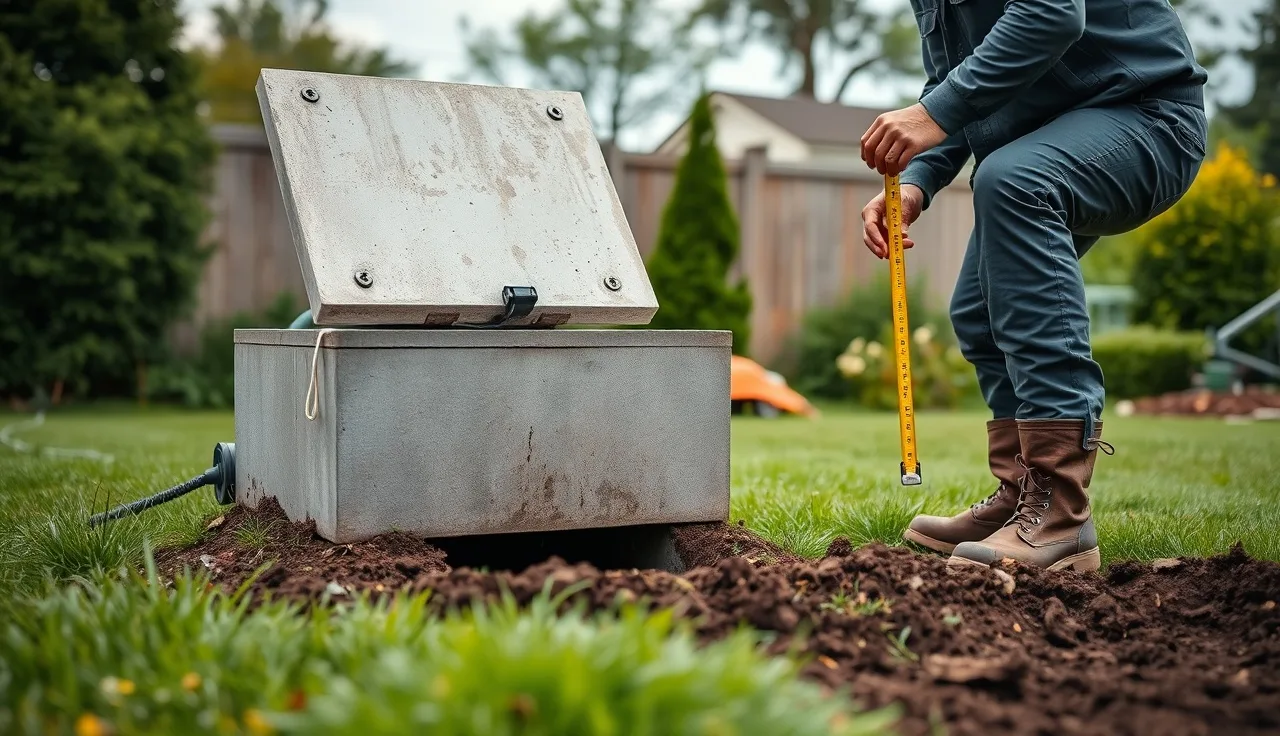
- Inspecting one takes 30-60 minutes: you dig it up, check for cracks, measure outlet pipe elevations, and look for solids backup.
- Problems caught early cost $200-$600 to fix; a ruined drain field from a neglected d-box runs $5,000-$20,000.
What is a septic distribution box and why does it matter?
A distribution box, almost always called a d-box, sits between your septic tank and your drain field. Effluent flows out of the tank, into the d-box, and then splits into two or more pipes that lead to individual drain field laterals. That split is supposed to be equal. Each lateral gets roughly the same volume of liquid so the soil in the drain field loads evenly and has time to absorb and treat effluent before it reaches groundwater.
When the d-box works right, you never think about it. When it fails, one lateral gets almost all the flow while the others starve. The overloaded lateral saturates the surrounding soil, biomat builds up faster than the soil can recover, and you end up with sewage surfacing in the yard or backing up into the house. That sequence can wreck a $10,000-$20,000 drain field in a year or two if nobody catches it [1].
Most d-boxes are concrete, though older ones can be clay or brick and newer ones are sometimes plastic. They're typically a foot to three feet underground, usually 10-30 feet from the septic tank, directly in line with the drain field. If you don't know where yours is, check your system's as-built drawing (many counties record these) or probe the ground in a straight line from your tank toward the drain field.
When should you inspect a distribution box?
Inspect the d-box every time you pump the septic tank. That's the practical answer. The tank is already open, a technician is on site, and the marginal cost of also exposing and checking the d-box is small. The EPA's SepticSmart program recommends having your entire septic system, including the d-box, inspected every 1-3 years depending on household size and system age [2].
Beyond routine cycles, inspect immediately if you see any of these signs: wet spots or lush green grass over the drain field when surrounding grass is dry, sewage odor in the yard, slow drains in the house that don't respond to normal snaking, or a tank that's backing up faster than its pumping schedule would predict.
Home sales also trigger an inspection. Most states require a full septic inspection before transfer of property, and a proper inspection always includes the d-box. If you're buying a house and the inspection report doesn't mention the d-box specifically, ask why. Some inspectors skip it because digging takes time. That's a gap worth pushing back on.
New England states tend to have the most prescriptive inspection requirements. Massachusetts Title 5, for example, requires a full system inspection at the time of sale and sets specific pass/fail criteria for distribution boxes [3]. Other states leave frequency to the homeowner's judgment, which is why most d-boxes go a decade or more without anyone looking at them.
How is a distribution box inspection done?
A proper d-box inspection has six steps. Skip any of them and real problems slip through.
Step 1: Locate and expose the box. If the location isn't marked, a technician probes the soil or uses a pipe locator. The box lid gets dug up by hand or with a small shovel. Most lids are 6-18 inches down. Some older systems have the d-box buried 3 feet deep, which adds time.
Step 2: Pump back or establish flow. The inspector needs to see how effluent behaves when it enters the box. On some inspections this happens during a pump-out; on others, a hose simulates flow. You want to watch whether liquid distributes evenly across all outlet pipes.
Step 3: Measure outlet elevations. This is the single most important check. Every outlet pipe should sit at the same height. If one outlet is even a quarter-inch lower than the others, it will carry a disproportionate share of flow. Inspectors use a level or a simple water level to compare pipe invert elevations. A difference of more than roughly 1/8 inch is considered out of spec in most state codes, though the exact threshold varies [4].
Step 4: Inspect the box itself. Look for cracks, spalling concrete, missing mortar, separated joints, and any sign of root intrusion. Tree roots can get through hairline cracks and eventually break the box apart. A box that's structurally compromised needs repair or replacement regardless of how the outlets measure.
Step 5: Check the inlet and outlet pipes. The inlet pipe should be intact and properly sealed where it enters the box. Outlet pipes should be tight, not pushed out of their sockets or clogged with solids. Solid material in the d-box usually means the septic tank is overdue for pumping and solids are carrying over.
Step 6: Check for water intrusion. If groundwater is seeping into the box, it dilutes effluent and can cause the tank to fill faster than normal. Groundwater intrusion also means the box lid or walls aren't watertight, which is a structural deficiency.
What are the most common distribution box problems?
Uneven outlet elevations are by far the most common finding. Over years, soil settles unevenly, and the d-box shifts slightly. A fraction of an inch is enough to throw off distribution. This is fixable without replacing the box: a technician adjusts the pipe inverts or installs distribution box leveling devices (plastic flow equalizers that thread into the outlet sockets).
Cracked or crumbling concrete is the second most common problem. Concrete d-boxes take a beating from freeze-thaw cycles, root pressure, and the slow chemical attack of hydrogen sulfide. Small cracks can be patched with hydraulic cement or epoxy. Large cracks, especially ones that let in groundwater or have separated the box walls, usually mean replacement.
Solid backflow into the d-box points to a tank that's full or nearly full of solids. The baffles in the tank are supposed to prevent this. If solids are reaching the d-box, either the baffles have failed or the tank is severely overdue for a pump-out. Left alone, those solids will clog the outlet pipes and kill the laterals downstream.
Root intrusion is common in older systems with clay or concrete boxes near mature trees. Roots follow moisture, and a d-box is a reliable moisture source. Once roots get in, they expand every season and eventually crack the box or block outlets.
Missing or broken outlet pipe extensions are less dramatic but worth noting. Some systems install short extensions on the outlet pipes to control the depth of flow. If those extensions are gone or broken, distribution can be uneven even when the pipe inverts sit level.
What does a distribution box inspection cost?
The inspection itself, bundled with a routine pump-out, typically adds $50-$150 to the pump-out bill. Standalone d-box inspections, including locating and excavating the box, run $150-$350 in most markets, though prices in high cost-of-living areas or on systems that are hard to find can go higher.
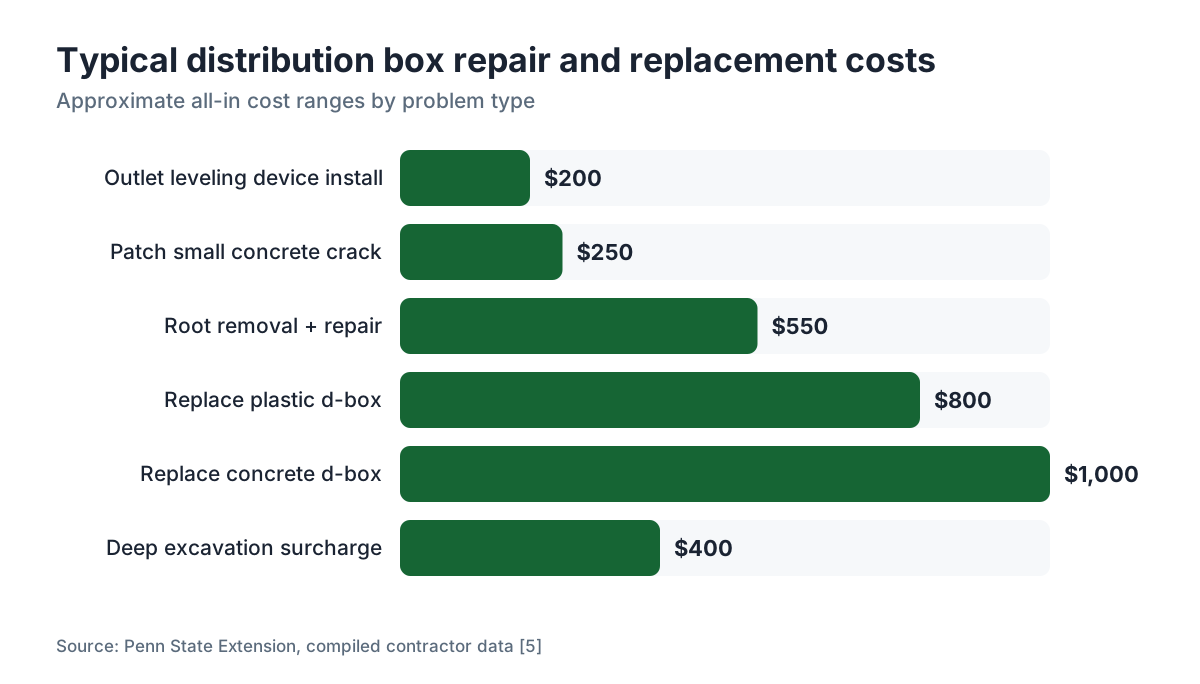
Repair costs depend on what's wrong. The table below summarizes typical ranges based on contractor pricing data compiled from state extension service resources and industry surveys [5].
| Problem | Typical repair cost |
|---|---|
| Adjust/level outlet pipes (leveling device) | $100-$300 |
| Patch small concrete crack | $150-$350 |
| Replace entire concrete d-box | $500-$1,500 |
| Replace plastic d-box (materials cheaper, labor similar) | $400-$1,200 |
| Root removal plus box repair | $300-$800 |
| Excavation if box is more than 2 ft deep | add $200-$600 |
These are rough ranges. Your actual quote will depend on local labor rates, soil conditions (rocky or clay soils cost more to dig), and whether the system has an accurate as-built drawing on file. Get two quotes for anything over $300.
Compare those numbers to the cost of a new drain field. A conventional leach field replacement runs $5,000-$20,000 depending on system size and site conditions [6]. A neglected d-box that costs $500 to fix today can lead to a drain field failure that costs 20 times more. That math is not subtle.
Can a homeowner inspect a distribution box themselves?
You can do a basic visual check yourself. The lid is usually a concrete slab or square cap you can lift with a pry bar. Look for standing water in the box, visible cracks, roots, and obvious blockage at the outlet pipes. If the box smells heavily of sewage or you see solid material, those are clear red flags worth a call to a pro.
What you can't do without equipment is accurately measure outlet elevations. A standard carpenter's level isn't precise enough. A water level or a machinist's level is needed for the quarter-inch accuracy this job requires. You also can't simulate realistic flow without either timing it right after a pump-out or using a hose setup that doesn't overwhelm the system.
More practically: most homeowners have no idea where their d-box is. Without an as-built drawing, locating it yourself means a lot of probing. An experienced technician can find most d-boxes in 15-20 minutes using a pipe locator.
The EPA recommends that homeowners leave the actual repair and assessment work to licensed professionals, particularly because improper repairs to distribution boxes can violate local septic codes and potentially void system warranties [2]. Do the visual check if you're curious. But for anything involving measurements, repairs, or a real condition assessment, pay for a pro. The inspection cost is trivial against what a mistake costs.
What does a failed distribution box look like from above ground?
The clearest above-ground sign is uneven drain field performance. If one section of your yard over the drain field is persistently wet, greener than the rest, or smells bad, while another section looks dry and normal, that pattern points strongly to uneven distribution from the d-box. One lateral is getting all the flow. The others are dry.
Sewage surfacing anywhere in the yard is a system failure. If it's directly over the d-box location, the box itself may be cracked or its lid has failed.
Repeated slow drains after the tank has recently been pumped are another indicator. If the tank isn't full but drains still back up, the effluent has nowhere to go. That could mean a clogged d-box outlet or a saturated lateral caused by long-term uneven distribution.
None of these signs are exclusive to d-box problems. A failing leach field, a broken outlet baffle in the tank, or a crushed pipe can cause the same symptoms. That's why a real diagnosis means physically opening the d-box, more than reading the yard.
What do state codes say about distribution box inspections?
Regulation varies a lot by state, which makes a single answer impossible. Here's what's consistent across most state codes.
Most states require d-box inspection as part of a full system inspection, particularly at point of sale. The specific criteria differ. Massachusetts Title 5 is probably the most detailed: it requires that all outlet pipes be at the same invert elevation, that the box be watertight, and that there be no evidence of solids carryover or hydraulic failure [3]. A d-box that fails any of these criteria triggers a system failure under Title 5, which legally blocks a property sale until repairs are completed.
North Carolina's rules require inspection of distribution devices as part of any permitted repair or modification to a system [4]. Florida's onsite sewage rules require that distribution devices maintain equal flow to each absorption area [7].
Most state codes are administered at the county level. Your local health department is the right place to ask what's required for your specific address. The EPA's SepticSmart resources give a national framework but defer to state authority on specifics [2].
For septic service operators, managing inspection records across dozens or hundreds of active accounts is where a platform like SepticMind becomes practical. Tracking which systems have documented d-box inspections, flagging ones overdue, and generating inspection reports that match state documentation requirements is genuinely hard to do in a spreadsheet at scale.
One thing almost all codes agree on: you need a licensed or certified inspector for any inspection that produces an official record used in a property transaction. DIY inspections are fine for your own maintenance awareness. They carry no legal weight.
How often should a distribution box be replaced?
There's no fixed service life for a d-box the way there is for, say, an effluent filter. A well-made concrete d-box in stable soil, on a properly maintained system, can last 40-50 years without replacement. A poorly cured box, or one in aggressive soil chemistry, might start crumbling in 20 years.
The real answer: replace it when inspection shows it's structurally compromised or can't be repaired cost-effectively. A d-box with multiple cracks, spalling walls, and a history of water intrusion is usually cheaper to replace than to patch repeatedly. A box with one small crack in stable concrete might just need a patch and another look in two years.
Plastic d-boxes (polyethylene) are increasingly common in new installations because they don't crack and don't corrode. They're lighter, easier to handle, and hold their shape better over time. If you're replacing a concrete box on an otherwise functional system, a plastic replacement is worth considering. Cost is similar to concrete once you account for installation.
The drain field connection is where the real money is. If the drain field itself is damaged by years of uneven distribution from a failed d-box, replacing the d-box alone won't fix the system. Sometimes the failed lateral can be rested (taken offline for a year or more to let the biomat die back), but often a septic system repair or full field replacement is needed. A good inspector will tell you honestly which situation you're in.
What should a distribution box inspection report include?
A complete d-box inspection report should include these elements, and this matters to a homeowner filing away a record and a service operator documenting a site visit alike.
Location and access. GPS coordinates or measured distance from known reference points. Depth to lid. Condition of access cover.
Structural condition. Material type (concrete, plastic, clay). Presence and size of any cracks. Evidence of root intrusion. Evidence of groundwater infiltration.
Outlet pipe assessment. Number of outlets. Invert elevation of each outlet, measured from a common reference point. Whether flow appeared equal during the inspection. Condition of each outlet pipe and any extensions or risers.
Inlet pipe condition. Whether properly seated, sealed, and free of damage.
Content observations. Whether effluent in the box appeared normal (liquid only) or showed evidence of solids carryover. Water level in the box relative to outlet inverts.
Photographs. At minimum: the open box from above, each outlet pipe, any observed defects.
Recommendations. Clear language about what, if anything, needs repair, estimated timeline for follow-up, and whether the system passes or fails applicable state criteria.
A report missing any of these elements is incomplete. If you're paying for an official inspection for a property transaction, ask to see the report format before the inspection so there are no surprises about what's documented.
Does every septic system have a distribution box?
No. A d-box is a feature of conventional gravity-fed systems with multiple laterals. Single-lateral systems don't need one. Pressure distribution systems use a pump and a pressure manifold instead of a d-box; flow is equalized by pump pressure and orifice sizing rather than gravity and level pipe inverts. Chamber systems and drip irrigation systems have their own distribution mechanisms.
If your system went in before the 1970s, it may use a serial distribution setup, where laterals connect in sequence rather than branching from a central box. Serial distribution was common in older codes. It's fallen out of favor because the first lateral always gets the most flow.
Ask your installer or your county health department what type of distribution your system uses. The as-built drawing should show it. If you don't have an as-built drawing, most county health departments have them on file for permitted systems. Call and ask.
If you don't know your system type, the simplest starting point is a full septic tank inspection that traces all the pipes. A competent inspector will identify what distribution method is present and whether it's working correctly. That's where to start if you're coming in blind.
Frequently asked questions
How do I find my septic distribution box?
Start with your system's as-built drawing, which most county health departments have on file for permitted systems. If you have that, the d-box location is usually shown as a symbol between the tank and the drain field. Without a drawing, probe the soil in a straight line from the tank outlet toward the drain field. Most d-boxes are 10-30 feet from the tank and 1-3 feet underground. A pipe locator or metal probe speeds this up significantly.
How long does a distribution box inspection take?
Allow 30-60 minutes for a straightforward inspection when the box location is known and the box is shallow. If the technician has to locate the box first, or if it's buried more than two feet deep, add another 30-60 minutes. Inspections done alongside a scheduled pump-out are usually faster because flow timing and access are already coordinated.
What happens if a distribution box is uneven?
Uneven outlet elevations send most of the effluent to one or two laterals instead of spreading it equally. The overloaded laterals saturate faster, biomat builds up more quickly, and that section of the drain field can fail while the rest sits underused. Catching uneven outlets early, when adjustment costs $100-$300, prevents drain field damage that can cost $5,000-$20,000 to fix.
Can a cracked distribution box be repaired?
Yes, in many cases. Small cracks in concrete d-boxes can be patched with hydraulic cement or epoxy mortar. The repair holds well if the surrounding structure is sound and the box isn't shifting. Large cracks, cracks that are letting in groundwater, or a box that's structurally broken apart are better candidates for full replacement. A plastic replacement box costs roughly the same as a concrete one once you include labor.
Is a distribution box inspection required when selling a house?
In many states, yes. States like Massachusetts require a full Title 5 inspection at point of sale, which includes the d-box. Other states leave it to contract or local jurisdiction. If you're in a state without a mandatory inspection law, a buyer's agent will often request one. Regardless of what's legally required, any competent septic inspection for a real estate transaction should include checking the distribution box.
How do I know if my distribution box is failing?
The most visible sign is uneven grass or wet spots over the drain field: one section lush and soggy, another dry and normal. Sewage odor in the yard, slow drains that don't improve after pumping, or a tank that fills up faster than expected are also signs. None of these are conclusive on their own; a physical inspection of the d-box is the only way to confirm it's the source of the problem.
What's the difference between a distribution box and a manifold?
A distribution box uses gravity and level pipe inverts to split flow equally among multiple laterals. A manifold is part of a pressure distribution system, where a pump pushes effluent through a pressurized pipe network with calibrated orifices to ensure equal distribution. Pressure systems cost more to install but hold equal distribution better over time, especially on sloped sites or in soils that need dosed loading.
How much does it cost to replace a distribution box?
Concrete d-box replacement typically runs $500-$1,500 all in, including excavation, materials, and reinstallation of the lateral pipes. Plastic boxes are comparable in total cost once labor is included. Costs rise if the box is deep (over 2 feet), hard to locate, or if any lateral pipes need repair at the same time. Always get two quotes for replacements; pricing varies significantly by region.
Will my homeowner's insurance cover a failed distribution box?
Standard homeowner's policies almost never cover septic system components, including d-boxes. Coverage exclusions for septic failures are nearly universal in standard policies. Some insurers offer home warranty add-ons or separate service line policies that include septic components, but read the fine print carefully. Sudden accidental damage (like a vehicle crushing a d-box) is more likely to be covered than gradual deterioration.
Can tree roots really break a distribution box?
Yes. Tree roots actively seek moisture and can penetrate hairline cracks in concrete or clay boxes. Once inside, roots expand seasonally and can crack the walls of the box, displace outlet pipes, and block flow. Willows, poplars, and silver maples are the worst offenders because of their aggressive root systems. If you have large trees within 30 feet of your drain field, mention it to your inspector so they look specifically for root intrusion.
What is a distribution box leveling device and does it work?
Leveling devices are plastic inserts that thread into the outlet sockets of a concrete d-box. They create an adjustable weir that can be set precisely level, correcting for minor box settling without excavating and relaying pipes. They work well when the underlying problem is minor settling and the box is otherwise sound. They're not a fix for a cracked or structurally compromised box, and they don't address solids buildup or root intrusion.
Should I add a riser to my distribution box lid?
Adding a riser to bring the d-box lid to or near grade level is one of the best low-cost improvements you can make to a septic system. It eliminates the need to excavate the lid for every inspection, which saves $50-$150 per service visit. Risers pay for themselves in two or three pump cycles. Most contractors can install one at the same time as an inspection or pump-out for $100-$250.
Do plastic distribution boxes last longer than concrete ones?
In most conditions, yes. Plastic (polyethylene) d-boxes don't crack from freeze-thaw cycles, don't spall, and aren't attacked by hydrogen sulfide the way concrete is. They're also lighter and easier to handle. The main limitation is that plastic boxes can shift more in expansive soils. For new systems or replacement projects, plastic is generally a better long-term choice at comparable cost.
What's the difference between a distribution box inspection and a full septic inspection?
A full septic inspection covers the tank (levels, baffles, structural condition), all accessible pipes, the distribution box, and the drain field condition. A d-box-only inspection is narrower: just the box, its inlets and outlets, and flow distribution. For routine maintenance, a full inspection every 1-3 years is recommended. A d-box check can be done more frequently as a targeted follow-up if you've had distribution problems or recent repairs.
Sources
- EPA, "How Your Septic System Works": Uneven loading of drain field laterals from distribution failure accelerates biomat buildup and can cause drain field failure
- EPA SepticSmart Program: EPA SepticSmart recommends inspecting septic systems every 1-3 years and leaves repair work to licensed professionals
- Massachusetts Department of Environmental Protection, Title 5 of the State Environmental Code (310 CMR 15.000): Massachusetts Title 5 requires all outlet pipes in a distribution box to be at the same invert elevation and the box to be watertight; failure results in a system failure that blocks property sale
- North Carolina Department of Health and Human Services, On-Site Water Protection: North Carolina rules require inspection of distribution devices as part of permitted repair or modification, and out-of-spec outlet elevations are a common code deficiency
- Penn State Extension, "Septic System Operation and Maintenance": Cost ranges for distribution box repair and replacement compiled from contractor data in state extension service resources
- University of Minnesota Extension, "Septic System Costs": Conventional drain field replacement costs $5,000-$20,000 depending on system size and site conditions
- Florida Department of Health, Onsite Sewage Program (Chapter 64E-6, F.A.C.): Florida's onsite sewage rules require that distribution devices maintain equal flow to each absorption area
- EPA, "Septic System Maintenance": Regular septic inspections including distribution components are recommended to prevent costly failures
- Virginia Department of Health, Office of Environmental Health Services: State onsite wastewater programs require equal distribution among drain field laterals and inspect distribution devices during system evaluations
- National Environmental Services Center (NESC), West Virginia University: Distribution boxes that shift or crack due to soil settlement are a common cause of unequal lateral loading in conventional septic systems
Last updated 2026-07-09