Septic drain field depth: what the numbers actually mean
By the SepticMind Editorial Team
TL;DR
- Most septic drain field trenches are dug 18 to 36 inches deep, with the perforated pipe sitting 6 to 24 inches below the surface.
- The minimum separation from the seasonal high water table runs 2 to 4 feet, depending on your state code.
- Shallower systems drain better in many soils.
- Deeper ones risk saturation.
- Depth also controls what you can plant on top and how hard repairs will be.
What is the standard depth for a septic drain field?
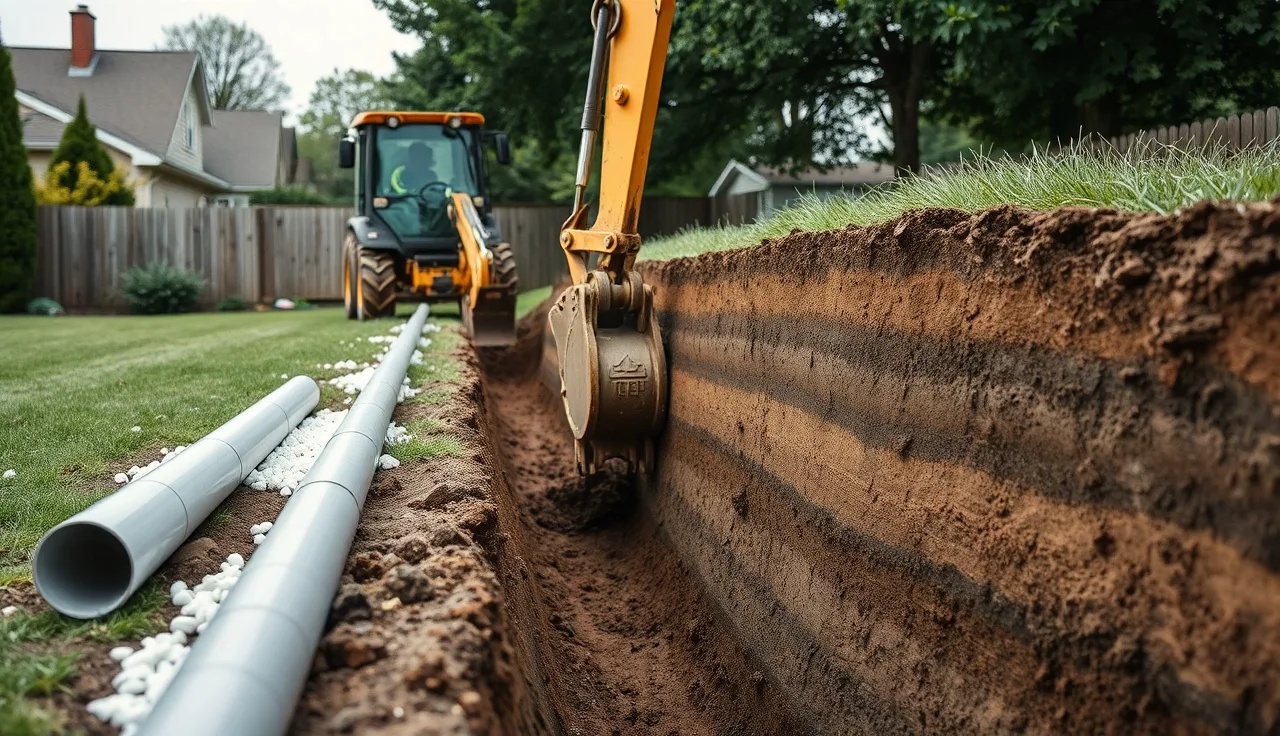
Trench bottoms usually sit 18 to 36 inches below grade. The perforated distribution pipe rests on 6 to 12 inches of gravel inside that trench, so the pipe itself lands roughly 6 to 24 inches down [1]. But 'standard' is a misleading word here. Every state writes its own onsite wastewater code, and those codes set minimums and maximums that vary more than most homeowners expect.
The EPA's SepticSmart program describes conventional systems as a network of perforated pipes in gravel-filled trenches, but the agency defers depth requirements to state and local health departments [2]. The numbers in your permit come from your state environmental or health agency, not from a national rule.
Look at how much the real codes swing. North Carolina's onsite wastewater rules set a minimum trench depth of 12 inches and a maximum of 36 inches for a conventional system. Minnesota requires at least 3 feet of unsaturated soil below the trench bottom, which in areas with a high water table forces the trench shallower, sometimes only 6 to 12 inches down [3]. Florida allows 18 to 36 inch trench depths but adjusts based on the limiting condition (rock, water table, or clay layer) found during a soil evaluation [4].
Depth is not arbitrary. It comes out of two measurements pulling in opposite directions: enough depth to keep odors and pathogens buried, but not so deep that effluent hits the saturated zone before the soil has had time to treat it.
Why does drain field depth matter for how the system works?
Soil treatment is the whole job of a drain field. Effluent leaving the septic tank still carries pathogens, nitrogen, and biochemical oxygen demand. The unsaturated soil between the pipe and the water table is where most of that gets removed [1]. Depth controls how much of that treatment zone you have.
Too shallow and you get surface breakout. Effluent wicks up through sandy or high-organic soils and puddles on the lawn. You also lose the insulating soil layer that keeps things working in cold climates. Too deep and the pipe sits in saturated or nearly saturated soil where aerobic treatment stalls, anaerobic conditions take over, and the system slowly fails.
EPA guidance on conventional drainfields states that "the soil below the drainfield filters and treats the wastewater before it reaches the groundwater" [2]. That separation from the water table is the mechanism that protects drinking water supplies. State codes call it the "limiting layer setback," and it is the single most important number in the site evaluation.
Depth also drives loading rate. Shallower trenches sit in more aerobic topsoil, which handles effluent faster. That is why many newer systems, including some low-pressure-dose designs, deliberately place pipe at 6 to 12 inches. Deeper conventional systems make up for the slower zone with more linear footage of trench.
How much separation from the water table does code require?
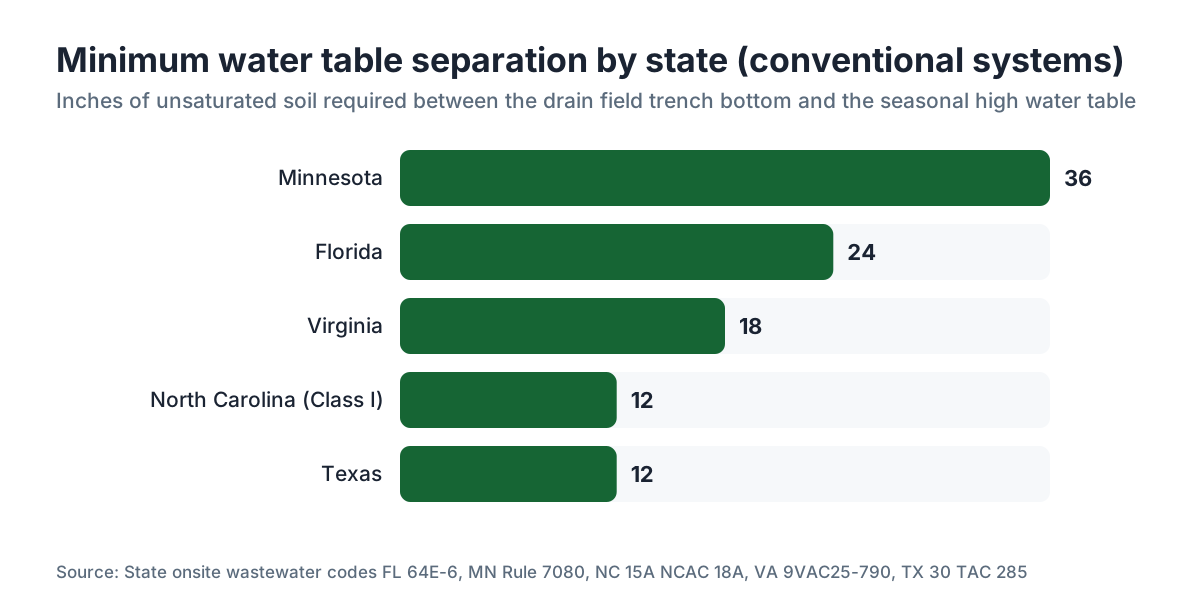
This is where state rules split apart the most. The table below shows minimums for conventional gravity systems in standard soils.
| State | Min. separation from seasonal high water table | Source |
|---|---|---|
| Florida | 24 inches below trench bottom | FL Admin Code 64E-6 [4] |
| Minnesota | 36 inches below distribution media | MN Rule 7080 [3] |
| North Carolina | 12 inches below trench bottom (Class I soils) | 15A NCAC 18A [5] |
| Virginia | 18 inches below trench bottom | 9VAC25-790 [6] |
| Texas | 12 inches minimum for conventional | 30 TAC Chapter 285 [7] |
If your site has limiting conditions, a different system type (mound, aerobic treatment unit, low-pressure-dose) gets engineered to a completely different depth profile.
The seasonal high water table is not the water table you see today. It is the highest level the water table reaches over a year, read from mottled soil or gleyed (gray) soil horizons that a licensed soil evaluator identifies during a site assessment. Building to the current table in a dry August and missing the March saturation level is one of the most common reasons new systems fail early.
Buying a property and want to know whether the drain field has enough separation? A proper septic tank inspection should include a review of the original soil evaluation report, more than a walk around the yard.
What is the minimum cover (soil over the pipe) required?
Cover is the soil between the top of the gravel bed (or pipe) and the finished ground surface. Most state codes require 6 to 12 inches of cover minimum [1][5]. A few require up to 18 inches in cold climates to stop freeze-up.
North Carolina specifies 6 inches of cover above the gravel in a conventional system [5]. Minnesota requires at least 12 inches of cover for frost protection [3]. Florida allows as little as 6 inches but recommends more where vehicles or heavy landscaping come into play [4].
Cover matters for three practical reasons. Soil insulates the pipe from cold, and thin cover in northern states leads to frozen pipes and a shut-down system in January. Cover limits compaction damage from vehicles or equipment driven over the field. And it slows roots from colonizing the pipe and gravel bed.
Homeowners sometimes add soil over a field themselves, trying to fix a soggy yard or smooth out grades. That is almost always a mistake. Even 6 extra inches of clay-heavy fill can smother the aerobic zone and kill the bacterial community in the soil below. Run any grade change over a drain field past a licensed designer or your local health department first.
How deep is a septic drain field in different soil types?
Soil texture and structure set both how fast effluent moves and how much treatment it gets. The permitted depth in your jurisdiction reflects what the soil evaluation found.
Sandy soils move water fast. Too fast, actually. In coarse sand, a deeper trench risks pushing effluent to the water table before pathogens are removed. Many codes answer by requiring shallower trenches (12 to 18 inches) in sandy soils, relying on longer horizontal travel and the better-aerated near-surface zone for treatment.
Clay-heavy soils move water slowly. They need more trench area to handle the hydraulic load, but depth is not the fix. Spreading laterals over a larger footprint is. Very tight clays (percolation rate slower than 60 minutes per inch) usually do not qualify for a conventional system at all, and the designer has to switch to an alternative.
Loam and silt loam, the soils under much of the suburban mid-Atlantic and Midwest, are the 'standard' case codes are written around. Typical trench depth in loam runs 24 to 36 inches with 12 to 18 inches of gravel and 6 to 12 inches of cover.
Rock is its own headache. If bedrock is at 18 inches, you cannot put a 36-inch trench there. The designer goes with a shallower alternative system, a mound built above grade, or declares the site unsuitable. Drain field depth is always capped by whatever limiting layer shows up first: water table, rock, clay pan, or an impermeable horizon.
How does a drain field inspection check depth?
During a septic field inspection, a licensed inspector has a few ways to confirm the field is at the right depth and working. Probing is the workhorse on an existing system.
The inspector pushes a steel rod into the ground at multiple locations across the field to find the gravel bed by feel, then measures the depth to the top of the gravel and to the bottom of the trench [8]. It is not precise, but it tells you fast whether you have 6 inches of cover or 2 feet of compacted fill someone dumped years ago.
If the as-built drawing (the permit record showing the installed design) is on file, the inspector compares what the probe finds to what the permit shows. When the numbers match, the field was likely built as designed. When the trench bottom sits 6 inches higher than the permit says, someone may have hit rock or a water table issue and improvised. That improvisation may or may not have been reported to the health department.
For new construction or a septic tank inspection before purchase, some inspectors run a small camera through a cleanout to read distribution box inlet and outlet elevations, which gives indirect evidence about depth. Ground-penetrating radar (GPR) sometimes maps trench locations and depths on large properties without probing, though it is expensive and usually saved for commercial sites or complex failures.
A drain field inspection cannot see whether separation to the water table is adequate without a separate water table measurement or soil profile review. If that matters to you, ask whether the inspector will pull the original soil evaluation or take borings.
For operators tracking inspection records across many properties, tools like SepticMind attach permit documents and field notes to each service address, so the depth history follows the property instead of living in a paper file in someone's truck.
What depth do mound systems and alternative systems use?
When the native soil cannot deliver the required separation, the system gets built up instead of down. A mound system places a sand-fill bed above natural grade, with distribution pipe buried in that imported sand, typically 6 to 12 inches from the bottom of the sand bed [11].
Mound height is calculated to provide the required unsaturated depth between the pipe and the seasonal high water table. In Minnesota, where mounds are everywhere, the sand bed runs about 2 to 3 feet thick and the whole mound sits 2 to 4 feet above the natural soil surface [11]. From the road, it looks like a long raised berm in the yard.
At-grade systems are close cousins to mounds but lower, used where the limiting condition is only slightly short. The pipe sits essentially at natural grade, on a thin sand bed, with soil cover built up over it.
Aerobic treatment units (ATUs) produce higher-quality effluent that some states allow to discharge at shallower depths or into smaller fields, because less in-soil treatment distance is needed. The ATU does the work the soil would otherwise do.
Low-pressure-dose (LPD) systems pump effluent under gentle pressure through small-diameter pipe with tiny orifices. That pipe usually sits at 6 to 12 inches, much shallower than gravity systems, because pressurized distribution puts effluent right where the aerobic zone is strongest. This design is common in Texas, North Carolina, and other southern states with variable soils.
The cost to install a septic system swings a lot depending on which of these your soil and water table force on you.
Can I drive over or plant on top of my drain field?
Driving over a drain field is a bad idea at any depth. Even with 18 inches of cover, vehicle weight can crush distribution pipe (usually thin-walled perforated PVC or corrugated polyethylene) and compact the gravel bed, cutting permeability. Compact enough gravel and you have effectively sealed the field.
The rule almost every extension service and state code agrees on: no vehicles, no structures, no swimming pools, no sheds [9]. If your field is close to a driveway, ask your health department whether a concrete or asphalt cap over the trench is allowed, and if so, whether the design has to be upgraded.
Planting takes more nuance. Grass over the field is fine and actually helpful, holding soil in place and drawing up moisture. Native grasses and wildflowers are the recommended cover in most extension guidance [9]. Avoid anything with aggressive roots: trees, shrubs, and even some ornamental grasses that root deep enough to reach the pipe. Common guidance keeps trees at least 10 to 30 feet away, depending on species.
Vegetable gardens over a drain field are a separate worry. The soil is receiving partially treated wastewater. Root crops especially can take up pathogens. Most extension services advise against food crops directly over the field [9].
Depth shapes all of this. A field with only 6 inches of cover is far more open to compaction and root intrusion than one with 18 inches. Knowing your field's depth is the first step to knowing what you can and can't do above it.
What are the signs that drain field depth or construction was wrong?
A field installed at the wrong depth usually tips its hand within a few years, sometimes faster.
Too-shallow installation shows up as wet spots or sewage odor at the surface, especially after rain or heavy use. If you smell sulfur or see dark, spongy soil above the trench line, effluent is surfacing. That is a public health violation in every state, and it needs septic system repair attention right away.
A field buried too deep in high water-table soil tends to fail quietly. You won't see surfacing until the problem is severe, because the water table itself backs up into the trench and the field fills rather than drains. The early signs are slow drains in the house and gurgling from the lowest fixtures.
Improper cover, where someone dumped soil over the field to fix a grade problem, shows up as compaction failure. Water moves too slowly through the added soil, the field stays wet, and eventually the biomat at the pipe surface never dries out between loading cycles.
A licensed inspector doing a proper drain field inspection checks for all of these. They probe multiple points across the field, look for surface wet spots, and where possible check the distribution box for backup (water level above the outlet pipe means the field is not accepting effluent).
If a field failed because it was too shallow or lacked separation, the repair is rarely simple. You are usually looking at a new field in a new location, or an engineered upgrade to a mound or ATU. That is an expensive day. The septic system repair guide lays out what those options cost and involve.
How deep should the inspection port or cleanout be?
Inspection ports are vertical pipes, usually 4 inches in diameter, set at the end of each lateral. They let an inspector push a probe or camera into the trench to check water level and pipe condition without digging.
Most codes require the top of the inspection port at or slightly below finished grade, with a removable cap [5][8]. The pipe runs from grade down to the trench bottom, so port depth equals trench depth plus cover, usually 24 to 48 inches total.
Many older systems went in without inspection ports, which makes field assessment harder. If yours lacks them and you are having work done, ask the contractor to add ports at the end of each lateral. It is cheap (usually $50 to $150 per port) and makes every future inspection faster and cheaper.
Distribution boxes (D-boxes) are the related access point. The D-box usually sits 12 to 24 inches below grade and is the first thing an inspector opens. The water level inside tells you immediately whether the field is hydraulically saturated. Water above the outlet pipes means the field is in distress.
What does depth data from my permit actually tell me?
The as-built permit for your system, usually held at the county health department or environmental agency, is more useful than most homeowners realize. It shows designed trench depth, gravel depth, cover depth, the number of laterals, total linear footage, and the soil evaluation findings including the limiting layer depth and the seasonal high water table measurement.
Compare the permit to what a probe or inspector finds today and you get a story. If the permit shows a trench bottom at 30 inches and the probe finds gravel at 28 inches, that is close enough. If the probe finds the trench at 18 inches in a soil profile evaluated for 30-inch trenches, either the as-built was not built as designed, or fill was added later.
The permit also gives the design flow rate, usually in gallons per day, based on the number of bedrooms. If actual household use runs past that design flow, the system is overloaded no matter how good the depth is. EPA guidance notes residential systems are typically designed for 50 to 100 gallons per bedroom per day [2].
Planning an addition or converting an outbuilding to living space? That design flow number is the one to watch. Adding bedrooms adds design flow, which may mean adding or replacing the drain field. Depth becomes part of the conversation, because any expansion has to meet current code, which may differ from what was permitted 30 years ago.
To trace your permit records, start with your county health department or state environmental agency's onsite wastewater program. Most states have digitized records back to at least the 1990s.
How much does drain field depth affect repair and replacement costs?
Depth hits excavation cost directly, and excavation is one of the bigger line items in a field replacement. Deeper trenches mean more soil removal, more gravel, and more care near a water table or bedrock. Shallower systems in good soil are cheaper to install and to replace.
A conventional gravity drain field replacement for a three-bedroom home in average soil runs $3,000 to $15,000 depending on region, field size, and access [10]. That wide range reflects local labor rates and soil conditions more than depth alone, but a site that needs deep trenching in rocky ground climbs toward the top fast.
Mound installations, the alternative when the water table is too shallow for conventional depth, run $10,000 to $25,000 or more, because of the imported sand, the pump system, and the engineered design [10]. The mound is the depth problem made physical and visible.
When a field fails because of inadequate separation (the trench was too close to the water table), replacing it in the same spot will fail again. The site evaluation has to come first, and if it finds the same limiting layer at the same depth, you need a different system type. That redesign adds engineering cost on top of installation cost.
Knowing the original depth before you call a contractor matters. An as-built permit review paired with a septic tank inspection before you take repair quotes saves you paying for a diagnosis that is already sitting in a drawer at the health department.
For the full picture of what new or replacement systems run in your region, the cost to install a septic system guide breaks it down by system type.
Frequently asked questions
How deep is a typical septic drain field?
Most conventional drain field trenches are dug 18 to 36 inches deep from the surface to the trench bottom, with the perforated pipe resting on 6 to 12 inches of gravel inside that trench. That puts the pipe itself roughly 6 to 24 inches below grade depending on cover depth. Actual permitted depth depends on your state's onsite wastewater code and the soil evaluation findings at your specific site.
What is the minimum depth for a drain field from the water table?
State codes vary a lot. Florida requires 24 inches of separation between the trench bottom and the seasonal high water table. Minnesota requires 36 inches. North Carolina requires as little as 12 inches in Class I soils. These minimums come from soil treatment research on how much unsaturated soil is needed to remove pathogens and nutrients before effluent reaches groundwater.
How do I find out how deep my drain field is?
Two methods work well. First, pull the as-built permit from your county health or environmental department; it shows designed trench and cover depth. Second, hire a licensed inspector to probe the field with a steel rod at multiple points. The probe locates the gravel bed by feel, and a tape measure gives the depth. Some inspectors also read the distribution box to infer depth indirectly.
Can a drain field be too deep?
Yes. If the trench bottom sits in or very close to the seasonal high water table, the saturated soil cannot treat effluent aerobically. The field will fail even if it looks fine on paper. That is why state codes set maximum as well as minimum depths and require a limiting layer setback. A deep trench in high water-table soil is one of the most common causes of premature system failure.
What happens if a drain field is too shallow?
Shallow fields are open to surface breakout, freeze-up in cold climates, root intrusion, and compaction damage from foot or vehicle traffic. If the pipe is less than 6 inches below the surface, you may see wet, smelly patches in the yard after rain or heavy water use. Most state codes set 6 inches as an absolute minimum cover, and cold-climate states require 12 to 18 inches to prevent winter failure.
How deep is a drain field in clay soil?
Clay soil is a problem because it moves water slowly. Very tight clays (percolation rate over 60 minutes per inch) often cannot support a conventional system at any depth. In moderately clayey soils that do qualify, trenches are usually kept shallower (18 to 24 inches) to stay in the more permeable near-surface horizon. Designers offset clay's slow rate with more trench linear footage rather than more depth.
Does a mound system have a drain field depth?
Mound systems build the drain field above natural grade using imported sand. The distribution pipe sits 6 to 12 inches above the original soil surface, inside the sand bed. The mound itself can be 2 to 4 feet tall. The point is to provide the required unsaturated soil treatment distance between the pipe and the seasonal high water table that the native soil could not provide at or below grade.
How deep should inspection ports be on a drain field?
Inspection ports run from grade level down to the trench bottom, so total depth equals trench depth plus cover, usually 24 to 48 inches. The cap sits at or just below finished grade. If your system went in before ports were commonly required, having a contractor add them during the next service call costs $50 to $150 per port and makes every future septic field inspection much faster.
How does drain field depth affect what I can plant?
Shallower fields (less than 12 inches of cover) are especially open to root intrusion from nearby trees and shrubs. Grass and native groundcovers are safe over any field depth. Most extension guidance keeps trees at least 10 to 30 feet away depending on species. Vegetable gardens directly over the field are not recommended at any depth because partially treated effluent may move into the root zones of food crops.
What is the depth of drain field trenches in sandy soil?
In coarse sandy soil, designers often specify shallower trenches, around 12 to 18 inches, because sand moves water fast enough that a deeper trench risks pushing effluent to the water table before adequate treatment happens. The near-surface aerobic zone in sandy soils is more active, so placing pipe closer to the surface gives better treatment despite the faster hydraulic rate.
Does adding soil on top of a drain field cause problems?
It can cause serious problems. Adding even a few inches of heavy or clay-rich fill over the field compacts the gravel bed over time and blocks oxygen exchange in the aerobic treatment zone. That can kill the bacterial community the field depends on. Run any grade change over a field past a licensed designer or your county health department before you bring in soil or a grading contractor.
How does a septic drain field inspection check that depth is correct?
An inspector probes the field at multiple locations to find the gravel bed and measure depth to its top and bottom. They also check the as-built permit for the designed depth and compare. Opening and reading the distribution box water level adds information about whether the field is hydraulically saturated. Ground-penetrating radar is occasionally used on large or complex sites to map trench location and depth without probing.
How deep do the perforated pipes in a drain field sit?
The perforated pipe sits on top of the gravel bed inside the trench, usually 6 to 24 inches below the soil surface depending on trench depth and cover. In a standard 30-inch trench with 12 inches of gravel and 6 inches of cover, the pipe sits roughly 12 to 18 inches down from grade. In a shallow low-pressure-dose system, the pipe may be as little as 6 inches below the surface.
What should I do if my drain field is failing due to depth problems?
Call a licensed septic designer before you call a contractor. If the failure comes from inadequate water table separation, replacing the field in the same spot will fail again. A new soil evaluation establishes whether the site can support a conventional system at a different location or depth, or whether an alternative system (mound, ATU, or low-pressure-dose) is required. The septic system repair guide covers what each path costs.
Sources
- EPA, Onsite Wastewater Treatment Systems Manual (EPA/625/R-00/008): Conventional drain field trenches use perforated pipe on gravel beds, with pipe depth typically 6 to 24 inches below grade and trench bottoms at 18 to 36 inches.
- EPA SepticSmart, How Your Septic System Works: EPA states that soil below the drainfield filters and treats wastewater before it reaches groundwater, and that depth/separation requirements are set by state and local health departments. Residential systems are typically designed for 50 to 100 gallons per bedroom per day.
- Minnesota Pollution Control Agency, Minnesota Rules Chapter 7080, Subsurface Sewage Treatment Systems: Minnesota requires at least 36 inches of unsaturated soil below the trench bottom (distribution media) and at least 12 inches of cover for frost protection; mound systems are commonly 2 to 4 feet above natural grade.
- Florida Department of Health, Florida Administrative Code 64E-6, Standards for Onsite Sewage Treatment and Disposal Systems: Florida allows 18 to 36 inch trench depths for conventional systems and requires a minimum 24-inch separation between the trench bottom and the seasonal high water table.
- North Carolina Department of Health and Human Services, 15A NCAC 18A .1900, Sewage Treatment and Disposal Rules: North Carolina specifies minimum trench depth of 12 inches, maximum of 36 inches, minimum 12-inch water table separation for Class I soils, and 6 inches of soil cover above the gravel for conventional systems.
- Virginia Department of Environmental Quality, 9VAC25-790, Sewage Collection and Treatment Regulations: Virginia requires a minimum 18-inch separation between the trench bottom and the seasonal high water table for conventional onsite systems.
- Texas Commission on Environmental Quality, 30 TAC Chapter 285, On-Site Sewage Facilities: Texas sets a minimum 12-inch separation from the trench bottom to the seasonal high water table for conventional gravity systems.
- National Environmental Services Center (NESC) at West Virginia University, Septic System O&M Manual: Field inspection methods for drain fields include probing to locate gravel bed depth and checking distribution box water levels; inspection ports should extend from grade to trench bottom.
- Penn State Extension, Septic Systems: No vehicles or structures should be placed over drain fields; grass is the recommended cover; trees should be kept 10 to 30 feet away depending on species; vegetable gardens over fields are not recommended.
- HomeAdvisor / Angi, Septic System Installation and Replacement Cost Data: Conventional drain field replacement costs $3,000, $15,000 for a three-bedroom home in average conditions; mound system installations run $10,000, $25,000 or more depending on region and site requirements.
- University of Minnesota Extension, Septic Systems: Minnesota mound systems typically have a sand bed 2 to 3 feet thick placed above natural grade, with distribution pipe 6 to 12 inches above the original soil surface inside the sand bed.
Last updated 2026-07-09