Septic tank cleaner: what actually works and what's a waste of money
By the SepticMind Editorial Team
TL;DR
- Most septic tank cleaners sold in hardware stores do little measurable good, and a few chemical ones damage the drain field.
- The EPA says a healthy tank needs no additives.
- Pumping every 3 to 5 years is the only cleaning method with consistent scientific backing.
- A handful of enzyme products have thin supporting data.
- None replace pumping.
What does a septic tank cleaner actually do?
A septic tank cleaner is any product sold to break down sludge, kill odors, or restore bacteria inside your tank. That covers a lot: biological additives (bacteria and enzyme blends), chemical cleaners (solvents, acids, alkalis), and yeast packets from a kitchen cabinet. Each works through a different mechanism, or claims to.
Your tank already runs its own biology. Anaerobic bacteria move in the moment sewage arrives, and they break down organic matter with zero help from you. The floating scum and the settled sludge on the bottom are the leftovers bacteria can't finish digesting, and they pile up over time no matter what you pour in. That pile is why pumping exists.
So when a label says the product "cleans" the tank, what it means is it adds microbes or enzymes to top off the population, or it uses chemistry to dissolve and suspend solids. The real question is whether any of that changes the accumulation rate enough to matter. The evidence is thin [1].
What does the EPA say about septic tank additives?
The EPA's SepticSmart program is blunt about this. The agency states that "research has not shown that biological additives are harmful, but they are also not necessary or a substitute for pumping" [1]. No additive category gets an EPA endorsement as a replacement for routine maintenance.
Chemical additives get a harder look. Solvents like methylene chloride or 1,1,1-trichloroethane can kill the microbial community in the tank, push unsettled solids into the drain field, and reach groundwater. Several states have banned or restricted them outright. Wisconsin prohibits chemical additives under Administrative Code NR 113 [2]. South Carolina's health department advises against them too. Check your state's onsite wastewater code before you pour anything labeled as a drain opener or solvent into a septic system.
The agency's position lines up with the research. A University of Minnesota Extension review from around 2000 looked at 37 additives and found no evidence that any product cut sludge accumulation enough to stretch pumping intervals [3]. That study is old now. No well-controlled trial since has overturned it, and if someone ran one, they never published it in a peer-reviewed journal.
Are there septic tank cleaners that actually have evidence behind them?
Enzyme-based products, the ones with lipases, proteases, and cellulases, have the most believable mechanism. Enzymes cut molecular bonds in fats, proteins, and cellulose. A few small lab studies show faster breakdown of specific compounds. But a beaker on a bench isn't a working tank, and none of those studies follow the effluent into the drain field to see whether long-term field loading changes at all [3].
Bacillus-based bacterial supplements tell the same story. The bacteria in most commercial products are aerobic or facultatively anaerobic species picked because they survive packaging and shelf life. A septic tank is anaerobic. Whether those introduced species take hold or die off within days is barely studied. The Minnesota review found the native population usually rebounded fast and outcompeted the newcomers [3].
There are edge cases where a biological product might earn its keep. A tank hit with a heavy antibiotic load, or one that sat unused for months and lost its community, can benefit from re-inoculation. That's a niche, not the everyday situation most additive marketing chases.
Here's the clean version: no septic tank cleaner has passed a rigorous, independently funded, peer-reviewed trial showing a real drop in pumping frequency or real drain field protection.
How does regular pumping compare to using a septic tank cleaner?
Pumping removes the material that piles up. Cleaners don't remove anything; they might slow or speed the breakdown, but the residue sits in the tank until a pump truck hauls it out. From an engineering standpoint these aren't rivals. Pumping is the only reset.
The EPA and most state extension programs recommend pumping every 3 to 5 years for a typical household [1]. The real interval hangs on tank size and household size. A 1,000-gallon tank serving four people fills faster than a 1,500-gallon tank serving two. The table below gives standard estimates.
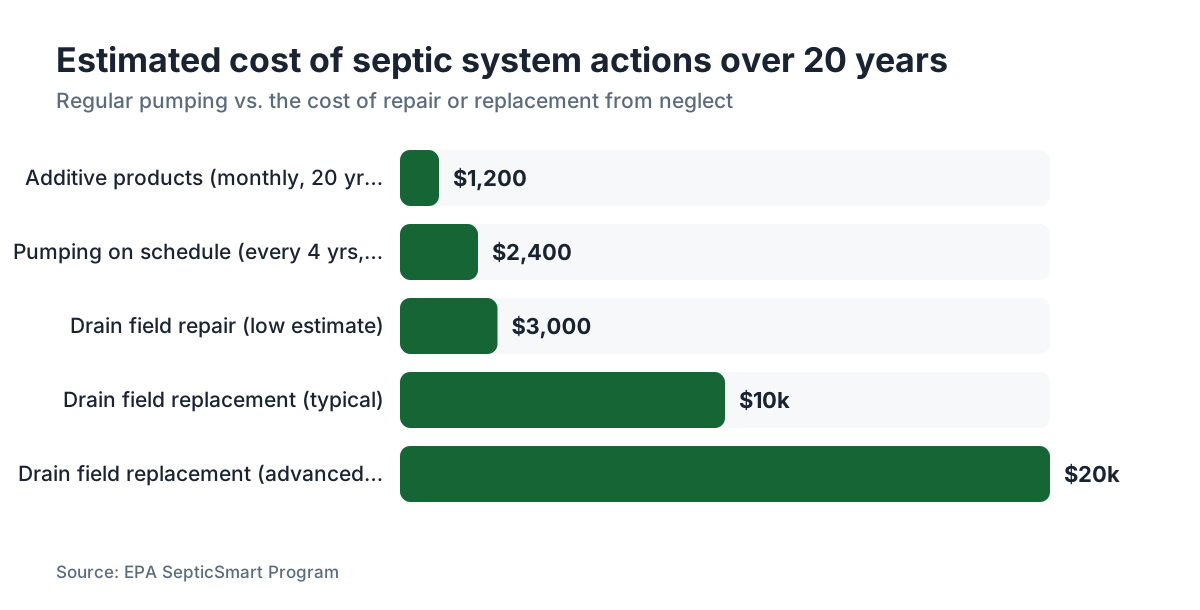
Skip pumping and lean on additives, and sludge climbs until it spills past the outlet baffle and into the drain field. Once solids reach the field, biomat builds fast and field replacement gets likely. A new drain field costs $3,000 to $15,000 or more depending on soil, design, and region [4]. A pump-out costs $300 to $600 in most markets [5]. That math isn't hard.
For more on schedules, see our guide on how often to pump septic tank.
| Household Size | Tank Size | Pumping Interval |
|---|---|---|
| 1-2 people | 1,000 gal | 5-7 years |
| 3-4 people | 1,000 gal | 3-4 years |
| 3-4 people | 1,500 gal | 4-5 years |
| 5-6 people | 1,500 gal | 2-3 years |
| 5-6 people | 2,000 gal | 3-4 years |
Source: EPA SepticSmart guidelines and University of Minnesota Extension.
What types of septic tank cleaners are sold and how are they categorized?
Walk the septic aisle at any hardware store and you find four broad types.
Biological additives hold live bacteria, bacterial spores, or enzymes. Rid-X, Bio-Clean, and Green Gobbler Septic Saver live here. These are the safest category from a system-damage standpoint, even when the benefits stay unproven.
Chemical cleaners use acids, alkalis, or organic solvents to dissolve grease and organic matter. These are the products most likely to wreck a system. They kill beneficial bacteria, push suspended solids into the drain field, and leach toxic compounds toward groundwater. The EPA and most state regulators warn against them [1][2].
Odor neutralizers go after hydrogen sulfide and other stinking gases with masking agents or oxidizers. They don't clean anything. Some contain formaldehyde, a listed hazardous substance banned from septic use in many states.
Yeast-based home remedies, usually a packet of baker's yeast down the toilet, have floated around online for years. Yeast makes enzymes and CO2. No published evidence says it changes tank dynamics, and it's basically harmless. If it makes you feel better, go ahead. It won't hurt anything.
For a full breakdown of the physical cleaning process, see septic tank cleaning.
Which ingredients in septic cleaners are banned or restricted?
Several chemical categories are restricted or banned in specific states, and a few are federally regulated as hazardous substances.
Formaldehyde, once common in septic treatments, is banned from septic use in Connecticut, Washington, and other states. It kills the microbial community and is a probable carcinogen [6].
Methylene chloride and 1,1,1-trichloroethane show up in some older chemical cleaners and drain openers. The EPA classifies these as hazardous air pollutants, and they have no business in a septic tank under any circumstances [6].
Surfactants at high concentration mess with settling in the tank. Solids stay suspended and ride straight through to the drain field. Many liquid "septic cleaners" in the drain-opening category are heavy surfactant blends.
Antibacterial soaps and bleach aren't septic cleaners as such, but they're the most common household chemicals that damage tank biology. Daily use of antibacterial products suppresses the microbial population. A weekly bleach clean is fine. Dumping it in every day is not.
Not sure a product is legal in your state? Search your state's environmental quality department or onsite wastewater program. Wisconsin's NR 113 is a good model for the level of detail states can apply [2].
How much do septic tank cleaners cost compared to pumping?
Additive products are cheap. A month of Rid-X runs about $10 to $15. An annual subscription to a biological additive program might cost $60 to $120 a year. Over five years, that's $300 to $600 spent on additives with no confirmed benefit.
One pump-out runs $300 to $600 in most U.S. markets, though rural areas or places with steep disposal fees can hit $800 to $1,000 [5]. In some high-cost metros, $700 is routine. The EPA recommends pumping every 3 to 5 years, so over 20 years you pay for 4 to 6 pump-outs, roughly $1,200 to $3,600 total.
Drain field repair or replacement, the thing you risk by skipping pumping, costs $3,000 to $15,000 for conventional systems and can top $20,000 for advanced treatment systems or bad soil [4]. One avoided drain field job pays for a decade of pumping.
Operators tracking service history and pumping intervals across many accounts can handle that data more cleanly with purpose-built tools. SepticMind is built for that septic service operations workflow.
For what professional service involves, see septic tank pump out and septic tank pumping.
Can a septic tank cleaner fix a failing drain field?
No. This is one of the most damaging myths in septic marketing. A failing drain field has biomat, crushed gravel, compacted soil, or hydraulic overload at its root. None of those conditions respond to bacterial additives or chemical treatments.
Some companies sell "septic field restorers" with bacteria that supposedly eat the biomat. Independent testing has not backed those claims. The biomat is a dense anaerobic community locked into the soil matrix, and seeding it with surface bacteria doesn't reliably change how it behaves.
The one real exception is a system that failed from a temporary shock: a big antibiotic dump, a bleach spill, or a long vacancy. In those cases, resting the system (alternating to another field cell if the design allows it) plus normal use restores biology on its own. No product needed.
If your drain field is backing up, surfacing, or soaking the yard, call a licensed septic inspector. The fix is physical, not chemical. See septic drain field and septic system repair for what real remediation looks like.
What should homeowners actually do to keep their septic tank clean?
The honest list is short, and none of it involves buying a product.
Pump on schedule. Every 3 to 5 years is standard, adjusted for tank size and household size. A pumper can measure the sludge and scum layers during service and tell you whether to tighten or stretch the interval. That real measurement beats any calendar rule.
Watch what goes down the drain. Wipes (even the "flushable" ones), grease, medications, and big volumes of antibacterial cleaner all drag system performance down. The EPA's SepticSmart campaign names these as the main behavioral causes of early failure [1].
Protect the drain field. Don't park on it, plant trees near it, or route surface water over it. Compaction and root intrusion are common physical failures that no additive touches.
Get an inspection when buying or selling. A licensed inspector checks the tank, baffles, and field. Problems caught early cost far less than emergency repairs. See septic tank repair for what inspectors look for.
Keep records. Know your tank size, when it was last pumped, and what the pumper found. If you ever need to troubleshoot or sell the house, that history pays off.
That's the whole program. It costs almost nothing beyond the pumping fee and a little attention.
Are there any situations where a biological septic tank cleaner is worth using?
Honestly, yes, in a narrow set of cases.
New construction or a long-vacant home. A tank that's never held sewage, or one that sat empty for a year, lacks the established community that processes waste efficiently. A bacterial starter may speed colonization. Some extension programs suggest this, though formal evidence is limited [3].
After heavy antibiotics. If someone in the house took a long course of antibiotics and you noticed slow drainage or odor soon after, a biological additive might help rebuild the population. That's anecdotal, but the mechanism holds up.
Heavy grease loads. Some food service accounts (catering kitchens, small restaurants on septic) benefit from regular enzyme dosing for grease hydrolysis. That's a different world from residential use, and some licensed operators do recommend it there, usually alongside more frequent pumping.
For a normally occupied, normally maintained home, skip the additive and put that money toward pumping on schedule. The risk of harm from biological products is low. So is the benefit. Chemical cleaners are a harder no: the risk is real and the benefit isn't demonstrated.
Operators who track pumping history consistently across accounts catch overdue intervals before they turn into failures. Steady maintenance data is worth more than any additive.
How do state regulations govern septic tank cleaners?
No federal law regulates residential septic additives as a category, but the EPA's position under the Clean Water Act pushes states to restrict products that threaten groundwater [6]. Regulation happens at the state level, and it varies a lot.
Wisconsin is the strictest major example. Administrative Code NR 113 prohibits chemical additives in septic systems and requires that any biological additive used in a registered system be free of regulated hazardous substances [2]. Installers and service providers can lose license standing for recommending prohibited products.
Massachusetts Title 5 (310 CMR 15.000) requires that products used in septic systems not interfere with system function or soil absorption [7]. It publishes no list of approved additives. The burden sits on the product to cause no harm.
California's State Water Resources Control Board has guidance discouraging chemical additives and noting that some surfactant-based products have been linked to early drain field failure [8].
The practical takeaway: before you use any septic tank cleaner, check your state's onsite wastewater rules. Most state environmental agency sites publish this under titles like "onsite sewage systems" or "septic system maintenance." When in doubt, call your county health department. The answer takes five minutes and could save you a five-figure repair.
What is the difference between a septic tank cleaner and a septic tank cleaning?
These two terms get mixed up, but they describe completely different things.
A septic tank cleaner is a product, usually a liquid, powder, or packet, that you add through a toilet or drain. It carries bacteria, enzymes, or chemicals meant to act on the tank's contents.
A septic tank cleaning is a professional service. A licensed pumper shows up with a vacuum truck, opens the access lids, pulls out all liquid and accumulated solids, checks the baffles and walls, and hauls the waste to an approved facility. This is the only process that actually removes material from the tank.
The confusion is partly semantic and partly on purpose. Some marketing borrows the word "cleaning" to imply an outcome like professional service. It isn't. A pump-out removes 100 to 1,000 gallons of waste. A packet of bacteria adds a few grams of culture. Not the same thing.
If a neighbor says they "clean their septic tank" every month with a hardware-store product, they're using an additive, not getting a cleaning. Their tank still needs pumping on schedule.
See septic tank emptying for what the removal process involves and what a pump-out report should include.
Frequently asked questions
Does Rid-X actually work in a septic tank?
Rid-X contains bacteria and enzymes that break down some organic compounds in lab conditions. No independent, peer-reviewed study has shown it reduces sludge or extends pumping intervals in a real tank. It's unlikely to harm a healthy system, but it's no substitute for pumping. The EPA endorses no biological additive product and recommends pumping every 3 to 5 years regardless of additive use.
Can I use bleach or cleaning products if I have a septic system?
Occasional bleach use, like cleaning a toilet once a week, doesn't typically wipe out the bacterial community in a tank. The concern is high-volume or daily use. Large quantities of bleach, antibacterial soap, or disinfectant flushed regularly suppress the microbial population. Routine household cleaning is generally fine. Avoid dumping large amounts of disinfectant down the drain at once.
How do I know if my septic tank needs cleaning versus just pumping?
In practice, professional pumping is the cleaning. A pump-out removes all accumulated solids and liquids. Some pumpers also rinse the walls and inspect baffles as part of the job. There's no separate "cleaning" process for residential tanks beyond that. Slow drains, odors, or wet spots near the drain field are signs of a system problem that needs a physical inspection, not a cleaning product.
What happens if you never pump your septic tank?
Sludge and scum build until they reach the outlet baffle and flow into the drain field. Once solids enter the field, the biomat thickens, soil permeability drops, and the field loses its ability to treat effluent. The result is sewage backing up into the house, surfacing in the yard, or reaching groundwater. Drain field replacement costs $3,000 to $15,000 or more. Pumping on schedule is far cheaper.
Are enzyme-based septic cleaners safe for the drain field?
Generally yes. Enzyme products carry no hazardous solvents and are unlikely to push solids into the field or kill soil bacteria. The problem with enzymes isn't safety, it's effectiveness: no strong evidence says they change long-term sludge accumulation in a working residential tank. They're the least risky additive category and also the one with the least demonstrated benefit.
Which septic tank additives are banned?
Chemical additives with formaldehyde, methylene chloride, or 1,1,1-trichloroethane are banned or restricted in multiple states and don't belong in a septic system. Formaldehyde is specifically banned in Connecticut and Washington, among others. Wisconsin's NR 113 code prohibits all chemical additives in registered septic systems. Check your state's onsite wastewater code before using any product not labeled specifically safe for septic systems.
How often should I use a septic tank cleaner product?
Most biological additives recommend monthly use. If you use one despite limited evidence, following label directions is reasonable. What matters more is the actual maintenance schedule: professional pumping every 3 to 5 years, and inspection every 1 to 3 years depending on system age and local rules. No additive, at any frequency, replaces those physical service visits.
Can I use a septic tank cleaner to fix a sewage smell in my yard?
Odors in the yard usually mean a failing drain field, a cracked distribution line, or a full tank, not a bacterial shortage an additive can fix. Pouring a biological product into the toilet won't touch a physical failure. Get the tank inspected and pumped if it's overdue. If the smell hangs on after pumping, you need a licensed inspector to evaluate the drain field and distribution system.
What is the best way to clean a septic tank naturally?
The most effective natural approach is pumping on schedule, then letting the native microbial community do its job without interference. Avoid antibacterial soaps, go easy on the garbage disposal (food solids speed sludge buildup), and flush nothing but toilet paper. Some homeowners flush a packet of baker's yeast now and then; it's harmless and may support enzyme activity, though no study confirms a real benefit.
How much does it cost to have a septic tank professionally cleaned?
Professional pumping, the actual cleaning service for a residential tank, costs $300 to $600 in most U.S. markets. Rural areas with long haul distances or high disposal fees can push prices past $800. The interval is typically 3 to 5 years, so the annualized cost is roughly $60 to $200 a year. That's modest next to drain field repair, which commonly runs $3,000 to $15,000.
Do I need a septic tank cleaner after pumping?
No. After pumping, the small amount of liquid and residue left in the tank holds enough bacteria to rebuild the population quickly once normal flow resumes. Some pumpers suggest a bacterial starter as a precaution, but the EPA and most extension research say the native community restores itself without help. Spending $15 on an additive after a pump-out isn't harmful, but it's probably unnecessary.
What should I look for on a septic tank cleaner label to know if it is safe?
Look for "septic safe" language and an ingredient list with no high-concentration surfactants, formaldehyde, bleach, or solvents like methylene chloride. Biological products should name specific bacterial strains or enzyme types. Skip anything labeled mainly as a drain opener or degreaser. When uncertain, contact your state's department of environmental quality to ask whether a specific product is allowed under your onsite wastewater rules.
Can a septic tank cleaner help after flushing too many wipes or non-flushable items?
No. Wipes and non-flushable solids don't break down biologically at any meaningful rate. They pile up as a rag layer in the tank and have to come out by pumping. A bacterial additive won't dissolve them. If you've flushed a lot of wipes, schedule a pump-out sooner than your normal interval and have the pumper check the inlet baffle for blockage.
Sources
- EPA SepticSmart Program: EPA states that research has not shown biological additives are necessary or a substitute for pumping, and recommends pumping every 3 to 5 years.
- Wisconsin DNR, Administrative Code NR 113: Wisconsin NR 113 prohibits chemical additives in septic systems and restricts biological additives that contain hazardous substances.
- University of Minnesota Extension: University of Minnesota review of dozens of additives found no evidence any product reduced sludge accumulation or extended pumping intervals.
- EPA Septic Systems (SepticSmart), system failure and repair guidance: Drain field replacement costs vary widely; EPA guidance documents system failure causes and soil absorption system requirements.
- EPA SepticSmart, Septic System Maintenance: EPA SepticSmart cites routine pumping as the primary maintenance cost, with professional service typically in the $300 to $600 range depending on location.
- EPA Safer Choice Program: Formaldehyde and chlorinated solvents including methylene chloride are listed hazardous substances under EPA programs and are inappropriate for septic system use.
- Massachusetts DEP, Title 5 Regulations (310 CMR 15.000): Massachusetts Title 5 requires that products used in septic systems not interfere with system function or soil absorption.
- California State Water Resources Control Board, Onsite Wastewater (OWTS): California SWRCB guidance discourages chemical additives and notes surfactant-based products have been linked to drain field failure.
- Penn State Extension: Penn State Extension notes that most residential septic tanks do not need additives and that pumping remains the recommended maintenance approach.
- NSF International, Consumer Resources: NSF provides certification standards for septic system components; no NSF standard certifies additive products for performance claims.
Last updated 2026-07-09