Types of septic systems: every major design explained
By the SepticMind Editorial Team
TL;DR
- The three most common septic systems are conventional gravity systems, chamber systems, and aerobic treatment units (ATUs).
- Past those, you'll run into mound systems, drip irrigation, sand filters, constructed wetlands, and recirculating media filters.
- Your soil, lot size, water table depth, and local code decide which one you can build.
- Installed costs run from about $3,000 to $20,000 or more.
What are the main types of septic systems?
Most people picture a concrete tank buried in the backyard with a leach field running behind it. That's the conventional system, and for decades it was the only game in rural residential construction. Regulators now recognize more than a dozen distinct septic designs. Some states require an alternative on any lot that fails a standard perc test.
The EPA's SepticSmart program sorts onsite systems into two families: systems that lean on soil absorption after minimal treatment in the tank, and systems that treat wastewater harder before it ever reaches the soil [1]. Conventional gravity systems and chamber systems sit in the first family. Aerobic treatment units, mound systems, drip irrigation systems, sand filters, and constructed wetlands sit in the second.
Ask "what are the 3 types of septic systems," and the practical answer is (1) conventional gravity systems with a perforated-pipe drainfield, (2) chamber or infiltrator systems, and (3) aerobic treatment units. Those three cover most residential installations in the United States. Everything else is a specialized fix for a hard site.
The table below maps the major septic types to the soil and site conditions each one handles best.
How does a conventional gravity septic system work?
A conventional system has three parts: the septic tank, distribution pipes or a distribution box, and a drainfield made of perforated pipe in gravel trenches. Wastewater flows from the house to the tank by gravity. Solids settle to the bottom, liquid effluent flows out to the drainfield, also by gravity, and percolates into the soil.
This design dates to the late 1800s. It works reliably when the soil has a percolation rate between roughly 1 and 60 minutes per inch, the seasonal high water table sits at least 2 to 4 feet below the trench bottom (the exact number varies by state), and the lot has room for the required drainfield square footage [2].
The catch is that conventional systems are passive. Nothing moves unless there's enough elevation drop from the house to the field. If the lot is flat, or the soil is too fast (sandy) or too slow (clay-heavy), you need something else. Installation runs roughly $3,000 to $7,000 for a typical 3-bedroom house, though that range shifts hard by region and soil [3].
See cost to install septic system for a full regional breakdown.
Conventional systems need pumping every 3 to 5 years on average. The EPA SepticSmart guidance says to "have your system inspected (in many cases pumped) by a qualified inspector or pumper every 3 to 5 years." [1] Learn more about timing at how often to pump septic tank.
What is a chamber septic system and how does it differ from gravel trenches?
Chamber systems swap the gravel-and-pipe drainfield for a row of plastic arch-shaped chambers (Infiltrator is the common brand) set right in native soil. Effluent flows into the chambers, pools briefly, and seeps through the open bottom into the soil below. No gravel at all.
The big draw is flexibility. Chamber systems need about 30 to 50 percent less drainfield area than gravel systems for the same hydraulic load, per Infiltrator Water Technologies' design guides and state engineering standards [4]. They go in faster on tight lots and in places where trucking gravel gets expensive. They also ride out intermittent loading well, which matters for vacation homes that sit empty for months.
Here's the trade-off. Chambers can clog if the tank isn't pumped on schedule, because there's no gravel to buffer biomat growth. If you own a chamber system, a firm septic tank pumping schedule matters more, not less.
Cost is roughly the same as a conventional gravel system, sometimes a few hundred dollars less because the labor is lighter. Most modern codes in the lower 48 accept chamber systems as a straight substitute for gravel-and-pipe.
What is an aerobic treatment unit (ATU) and when do you need one?
An aerobic treatment unit pumps oxygen into the treatment process, which lets aerobic bacteria break down waste far harder than the anaerobic process inside a standard septic tank. A healthy ATU produces effluent with biochemical oxygen demand (BOD) and total suspended solids (TSS) in the 10 to 25 mg/L range, against 150 to 200 mg/L for typical septic tank effluent [5]. That's close to secondary-treated municipal wastewater.
You need an ATU on lots that can't support a conventional drainfield: shallow soil, poor percolation, closeness to a water body, or a small lot. Texas, Louisiana, and much of the southeastern United States run very high ATU rates because sandy or caliche soils make standard drainfields impractical, or ban them outright near shellfish waters.
The downside is complexity. ATUs have compressors, aerators, clarifiers, and in many places a surface spray or drip dispersal field. Most states require an annual maintenance contract, usually $200 to $500 a year [6]. They cost more to install ($10,000 to $20,000 or more depending on size and dispersal method) and carry more moving parts that can fail. Septic system repair costs more on ATUs than on passive systems for that same reason.
My honest take: if your soil passes the perc test, skip the ATU and build the conventional system. Simpler wins over 30 years.
What is a mound system and what site conditions require it?
A mound system is exactly what it sounds like: a raised drainfield built on top of the native soil instead of in trenches cut into it. Engineered sand fill gets trucked in and shaped into a mound, often 2 to 4 feet above grade, and perforated pipe spreads effluent through the sand before it reaches the native soil below.
You need a mound when the seasonal high water table sits too close to the surface, when restrictive clay or bedrock shows up within 18 to 24 inches of grade, or when the percolation rate is too slow for a conventional trench. The Wisconsin Department of Natural Resources, which publishes some of the most detailed mound guidance in the country, specifies that mound systems use a pressurized distribution system and are designed for sites with limiting layers between 12 and 24 inches of the surface [7].
Mounds cost more, roughly $10,000 to $20,000 installed, because of the imported fill, the pump chamber that doses the mound, and the extra labor. They also stand up in the yard, which some homeowners hate. The septic drain field in a mound is engineered like a small dam and needs the same care as any drainfield: no vehicle traffic, no tree planting, and regular checks of the pump and timer controls.
How does a drip irrigation septic system work?
A drip irrigation system takes ATU-quality effluent and pushes it through small-diameter subsurface emitter tubing straight into the root zone, usually 6 to 12 inches deep. Dosing pumps drive effluent through the tubing in timed cycles, and backflush cycles keep the emitters clean.
They shine on rough lots: steep slopes, thin soil, odd shapes, parcels near sensitive water. The emitters spread effluent across a wide area in tiny doses, so the load per square foot stays very low, which protects soil structure. Oregon and New Mexico use drip dispersal often on lots near surface water that can't take any extra nutrient loading [11].
The complexity is real. Drip systems carry filters, pressure-regulated pumps, control panels, and dozens or hundreds of emitters that can clog or fail. Annual maintenance is basically mandatory. Install cost runs $12,000 to $18,000 and up, on top of the ATU pretreatment unit that most codes require upstream of drip dispersal [6].
What is a sand filter septic system?
A sand filter is a treatment step that sits between the septic tank and the dispersal field. Effluent from the tank gets dosed in bursts over a bed of clean sand, which grows a bacterial treatment layer. The treated effluent drains to collection pipes, then to a drainfield or surface dispersal.
Sand filters come in two flavors. An intermittent sand filter (ISF) doses, then lets the sand dry between cycles, which holds aerobic conditions and very high treatment quality. A recirculating sand filter (RSF) runs effluent back through the sand several times before discharge, which shrinks the required filter footprint.
Treatment quality is excellent. BOD removal above 90 percent is typical [5]. Sand filters fit lots with moderate soil limits, where you need cleaner effluent than a plain tank gives but don't need the full ATU package. Cost runs roughly $7,000 to $15,000 for the filter unit alone, before dispersal [3]. North Carolina State University Extension lists sand filters among the standard alternatives for restricted-soil sites [10].
What is a constructed wetland septic system?
A constructed wetland is an engineered gravel bed planted with wetland vegetation (cattails, bulrushes, reeds) that effluent flows through slowly. Microbes on the gravel and plant roots do the treating. They come as subsurface flow (effluent stays below the gravel surface) or free water surface (a shallow open marsh) [10].
Subsurface flow wetlands are the residential standard because they hold down odors and keep mosquitoes from breeding. They work best in warm climates. In northern states, cold winters slow the treatment way down, so you rarely see them above roughly the 40th parallel.
The appeal is low energy use and a natural look. The problem is size. A constructed wetland wants a big footprint, typically 5 to 10 square feet per gallon of daily flow or more, plus a long hydraulic retention time. A 3-bedroom home putting out 300 gallons a day would need a 1,500 to 3,000 square foot wetland cell. That's fine on a large rural parcel. It's a nonstarter on a suburban quarter-acre.
What is a cesspool and how is it different from a septic system?
A cesspool is a pit, usually lined with loose stone or brick, that takes raw sewage directly. There's no treatment. Liquids seep out through gaps in the lining, and solids pile up in the pit. Most cesspools in the United States went in before modern septic codes existed, mostly before the 1970s.
Cesspools are illegal to install in nearly every U.S. jurisdiction today. In Hawaii they're being phased out entirely under state law, with mandatory upgrades or sewer connections required by set deadlines that depend on location [8]. If you're buying an older home and the inspection report says "cesspool" instead of "septic system," budget the full replacement cost. That's a different conversation from routine septic tank repair.
Don't mix up a cesspool with a holding tank, which is a sealed, pump-out-only tank with no dispersal at all. Holding tanks are legal in some jurisdictions for cabins or seasonal places, but they need very frequent pumping, often every 4 to 8 weeks under full-time use [9].
How do site conditions determine which septic system type you need?
Your soil is the first filter. A perc test and soil evaluation, usually done by a licensed soil scientist or engineer, tells you how fast water moves through your native soil and how deep the limiting layers sit. That data drives system selection more than anything else.
The EPA's general guidance is blunt: "The type of soil determines the type of system needed." [1] Most state codes turn that into design tables that map perc rate ranges to allowable system types. A lot with a 5 minute per inch perc rate in well-drained loam almost always qualifies for a conventional gravity system. A lot with 90-minute perc in heavy clay does not.
Water table depth is the second filter. Most codes want at least 24 inches of unsaturated native soil between the drainfield bottom and the seasonal high water table, and some states demand 36 or even 48 inches [2]. If you can't get that separation with a conventional trench, you move to a mound, a drip system, or an ATU with surface dispersal.
Lot size shapes the choice too. A small suburban lot often can't fit the setbacks from property lines, wells, and structures plus a full conventional drainfield, which is why many newer septic subdivisions require ATUs with drip dispersal.
For contractors juggling projects across different soils and different county rules, tracking which system went where turns into a real operations headache. That's the recordkeeping SepticMind is built for: operators log system type, install date, service history, and permit numbers in one place, which makes the state reporting many counties now require for ATUs a lot less painful.
See septic tank installation for what permitting and installation look like start to finish.
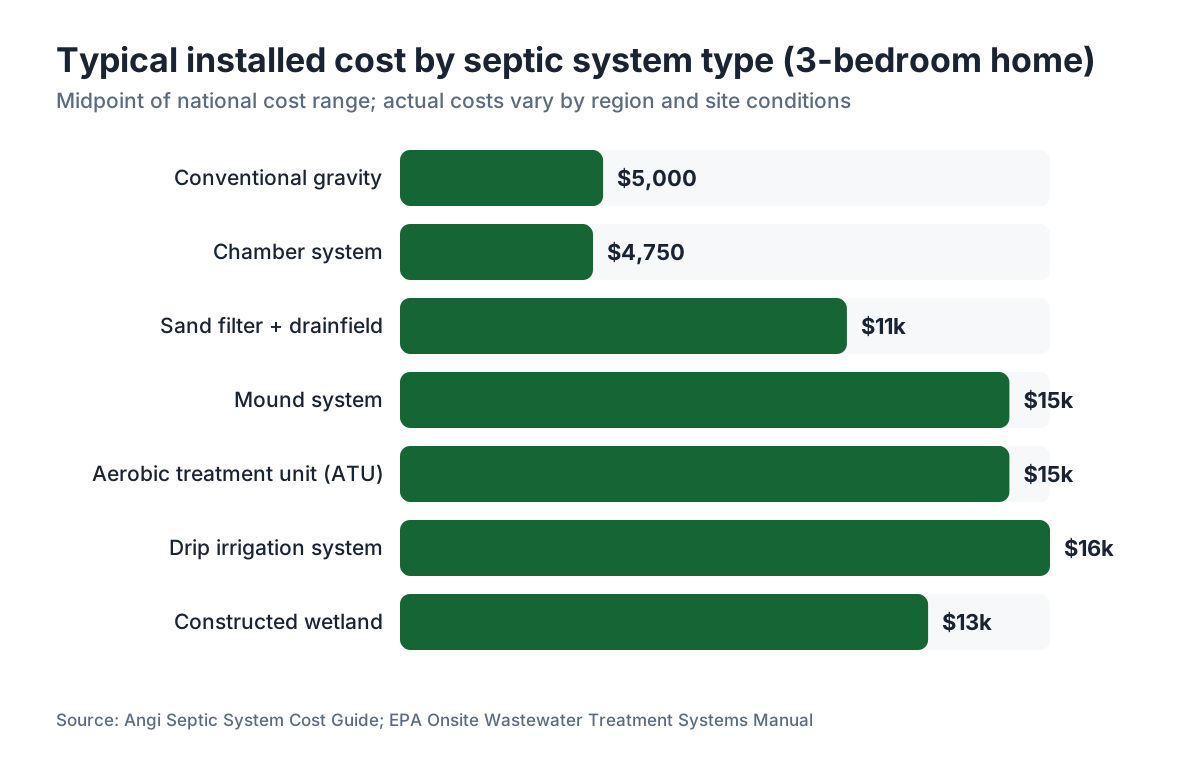
What does each type of septic system cost to install?
Cost ranges move a lot with region, contractor availability, and site difficulty, so read these as rough national midpoints, not bids.
| System Type | Typical Installed Cost (3-BR home) | Key Cost Driver |
|---|---|---|
| Conventional gravity (gravel trench) | $3,000 to $7,000 | Trench length, gravel haul |
| Chamber system | $3,000 to $6,500 | Chamber count, labor |
| Mound system | $10,000 to $20,000 | Imported fill, pump chamber |
| ATU (aerobic) | $10,000 to $20,000+ | Equipment, dispersal type |
| Drip irrigation system | $12,000 to $20,000+ | Emitter network, controls |
| Sand filter + drainfield | $7,000 to $15,000 | Filter media, construction |
| Constructed wetland | $8,000 to $18,000 | Gravel, plants, area |
| Holding tank (no dispersal) | $3,000 to $5,000 install | Very high pumping costs ongoing |
These figures pull from EPA guidance, Angi survey data, and state extension publications [3][6]. The cost to put in a septic tank article breaks down individual component costs.
The spread inside any one system type is wide. Rocky terrain adds excavation cost. Remote sites add trucking. Jurisdictions that require a licensed engineer for alternative system design tack on $1,000 to $3,000 in design fees. Get at least three bids from licensed contractors in your county before you sign anything.
How do maintenance requirements differ across septic system types?
Conventional gravity systems are the low-maintenance baseline. Pump the tank every 3 to 5 years, keep vehicles off the drainfield, and stop flushing wipes and grease. Most run 25 to 40 years without major work [9]. Septic tank cleaning and septic tank pump out are the main recurring costs.
Chamber systems run on the same schedule. Pump-out interval depends on household size and tank volume, same as gravel systems.
ATUs need real attention. Most state ATU codes require a signed maintenance contract with a licensed service provider. Tennessee, for one, requires inspection and service every 4 months for ATUs [6]. That's at least two to three visits a year, each running $75 to $150. The compressor or aerator motor usually needs replacing every 5 to 10 years at $300 to $800 for the part alone.
Mound systems need an annual look at the dosing pump, timer, and alarm float. The pump is the usual failure point and costs $200 to $600 to replace. Access is easier if the installer set septic tank risers to bring the pump vault lid up to grade.
Drip systems demand the most. Filters need cleaning every 3 to 6 months. Emitters clog, especially when upstream treatment gets sloppy. Control panels need annual calibration. Budget $400 to $800 a year in service beyond the basic pump-out.
The pattern is simple. More complexity means higher annual maintenance cost. That's no reason to dodge an ATU or drip system when the site demands one, but it's a real line item in long-term ownership.
What are the signs that a septic system type isn't working?
The failure signs look about the same across every system type: slow drains, sewage odors in the yard or house, wet soggy patches over the drainfield, sewage surfacing above grade, or high nitrate readings in a nearby well.
ATUs add their own failure modes. If the compressor dies, aerobic treatment stops and the unit basically drops back to a conventional tank, often with a code violation riding along. Most ATUs carry alarm panels that flag pump or blower failures, but those alarms only help if someone actually checks them.
Mound systems fail at the pump, at the distribution laterals (which crack in freeze-thaw cycles), or at the mound surface if vehicles compact the fill. Drip systems fail most often at the emitters or the upstream filter.
Any system showing surface breakout or backing up into the house needs attention now. Don't try to diagnose a suspected drainfield failure on your own. Call a licensed inspector. See septic system repair for what the repair process involves and what each failure mode usually costs to fix.
Frequently asked questions
What are the 3 types of septic systems most commonly installed?
The three most common are conventional gravity systems with gravel trenches, chamber systems using plastic arch units instead of gravel, and aerobic treatment units (ATUs). Conventional and chamber systems work on lots with adequate soil percolation. ATUs step in when soil or site conditions rule out a standard drainfield. These three cover the vast majority of residential installations in the U.S.
Which type of septic system lasts the longest?
Conventional gravity systems with concrete tanks and gravel drainfields typically last 25 to 40 years with proper maintenance, and the concrete tank alone can last 50 years or more. ATUs and mound systems have shorter effective lifespans for their mechanical and engineered parts, usually 15 to 25 years before major component replacement. Soil-based systems with no moving parts consistently outlast systems with pumps and motors.
Can I choose my septic system type or does the county decide?
Your county health department or environmental agency has the final say. They review your soil evaluation and perc test results, lot size, setback requirements, and local code, then decide which system types are permittable on your parcel. You can pick among the approved options, and a licensed designer can sometimes find room within code limits, but you can't override the site data.
What type of septic system is best for a small lot?
ATUs with drip irrigation dispersal are often the best fit for small lots because drip systems need far less land than trench drainfields. The load spreads across a large emitter network at shallow depth, and the treated ATU effluent is clean enough for subsurface dispersal in tighter setbacks. The trade-off is higher install cost ($12,000 to $20,000 or more) and ongoing maintenance.
What type of septic system is best for a high water table?
Mound systems are the standard answer for a high water table, because they raise the drainfield above the seasonal high water table on imported engineered fill. Drip irrigation with ATU pretreatment is another option. Both need a pump to distribute effluent. The minimum separation required between the dispersal zone and the water table varies by state, typically 24 to 36 inches of native unsaturated soil.
How much does an aerobic septic system cost compared to a conventional one?
An ATU system runs roughly $10,000 to $20,000 installed, against $3,000 to $7,000 for a conventional gravity system in similar soil. ATUs also carry annual maintenance contracts of $200 to $500 in most states. Over a 20-year ownership period, the total difference including maintenance often lands at $15,000 to $25,000 more for the ATU. That extra cost is unavoidable when the site requires it.
Do aerobic septic systems require more maintenance than conventional ones?
Yes, a lot more. Most states require a maintenance contract for ATUs, with inspection intervals of every 3 to 4 months in many jurisdictions. Compressors and aerator motors need periodic replacement. Alarm systems need testing. A conventional gravity system needs pumping every 3 to 5 years and little else. If your site permits a conventional system, the lower maintenance burden is a strong argument for it.
What is the difference between a septic tank and a septic system?
The septic tank is one component: the buried container that takes raw sewage, lets solids settle, and holds scum. The septic system is the whole assembly, the tank plus the distribution network plus the drainfield or dispersal method. A failing drainfield is still a failing septic system even if the tank is in perfect shape. Pumping the tank is maintenance; treating the effluent and returning it to soil is the system's actual job.
Can a conventional septic system be converted to an aerobic system?
Yes, in most cases. An ATU can go in-line: the existing septic tank stays as a pretreatment or pump vault, and the ATU chamber is added ahead of a new or modified dispersal field. Conversion costs vary widely with what the existing system includes and what the new state-permitted design requires, but typically run $8,000 to $15,000. Permits are always required, and the new design has to meet current code.
How do I find out what type of septic system I have?
Start with your county health department. Most keep septic permit records going back 20 to 40 years, and many have online lookup tools. A licensed septic inspector can also identify the type by locating the tank, checking for pump chambers or ATU components, and probing the drainfield. If you're buying a home, insist on a full inspection and system identification before closing, more than a tank pump-out.
Are there septic systems that don't need a drainfield?
Holding tanks have no drainfield: all waste is stored and pumped out periodically. They're legal in some jurisdictions for camps or seasonal properties but impractical for full-time use because the pump-out frequency and cost run very high. Composting toilets paired with a graywater-only system can reduce or eliminate the need for a conventional drainfield in some states, but regulations vary a lot and not all jurisdictions allow them.
What is a perc test and how does it determine septic system type?
A percolation test (perc test) measures how fast water drains through your soil. A soil scientist digs test holes, saturates them, and measures the drop rate in minutes per inch. Fast rates (1 to 30 min/in) typically qualify for conventional systems. Very slow rates (above 60 min/in) usually force alternatives like mounds, ATUs, or drip. Many states now prefer or require full soil profile evaluations rather than just perc tests for design.
What type of septic system is best for clay soil?
Clay soil with very slow percolation (above 60 minutes per inch) typically needs a mound system, an ATU with drip dispersal, or a sand filter ahead of a drainfield. The idea is to either bypass the clay by raising the dispersal zone (mound) or pre-treat effluent to a quality high enough for reduced-area dispersal. A conventional gravel trench in dense clay fails fast by hydraulic overload.
Sources
- U.S. EPA, SepticSmart Program: EPA recommends septic system inspection and pumping every 3 to 5 years; organizes onsite systems around soil-based and advanced treatment categories
- U.S. EPA, Onsite Wastewater Treatment Systems Manual (EPA/625/R-00/008): Minimum separation between drainfield bottom and seasonal high water table and soil percolation rate requirements for conventional systems
- Angi (formerly HomeAdvisor), Septic System Cost Guide: National cost ranges for conventional, mound, ATU, and sand filter septic system installation
- Infiltrator Water Technologies, Design & Installation Manual: Chamber systems can reduce required drainfield area by 30 to 50 percent compared to conventional gravel systems
- U.S. EPA, Onsite Wastewater Treatment Systems Technology Fact Sheet: Aerobic Treatment Units: ATUs produce effluent BOD and TSS in the 10 to 25 mg/L range versus 150 to 200 mg/L for conventional septic tank effluent; sand filters achieve BOD removal above 90 percent
- Wisconsin Department of Natural Resources, Mound System Design Guidance: Mound systems required when limiting soil layers are 12 to 24 inches from surface; require pressurized distribution
- Hawaii Department of Health, Cesspool Upgrade Program: Hawaii law requires phased mandatory upgrade or replacement of cesspools by specific deadlines depending on location and size
- University of Minnesota Extension, Septic System Owner's Guide: Conventional septic systems with concrete tanks typically last 25 to 40 years with proper maintenance; holding tanks require pump-out every 4 to 8 weeks for full-time use
- North Carolina State University Extension, Alternative Septic Systems: Overview of drip irrigation, constructed wetland, and sand filter system types and their soil and site suitability
- Oregon Department of Environmental Quality, Onsite Wastewater Program: Drip dispersal systems used in Oregon on lots near sensitive water bodies with shallow or restrictive soils
Last updated 2026-07-09