Septic tank treatment nearby: what works, what doesn't, and where to buy it
By the SepticMind Editorial Team
TL;DR
- Septic tank treatments (liquids, powders, and tablets) sit on shelves at almost every hardware store, home center, and plumbing supplier within a few miles of your house.
- The harder question is whether they do anything.
- Enzyme and bacterial additives have weak independent evidence, and the EPA does not endorse them as a replacement for pumping.
- A healthy tank pumped on schedule rarely needs them.
What is septic tank treatment, exactly?
Septic tank treatment is any product you add to your system to change what happens inside the tank or drain field. Products fall into three groups: biological additives (live bacteria or bacterial spores), enzymatic additives (enzymes that break down fats, proteins, or starches), and chemical additives (acids, solvents, or other reactive compounds).
Biological and enzymatic products are what you find at the hardware store. They come as liquids you flush down a toilet, powders you dissolve in water, or tablets you drop straight into the tank access port. The makers claim they boost the microbial population that digests solids.
Chemical additives are a different animal. Solvents like methylene chloride and 1,1,1-trichloroethane were once sold as drain openers that doubled as septic treatments. The EPA has flagged them as harmful to the microbes in the tank and a risk to groundwater. Several states banned them outright. Stick to biological or enzymatic products if you use anything at all.
Here's the honest framing. A healthy septic tank already holds billions of anaerobic bacteria that showed up on their own from human waste. The question isn't whether bacteria live in your tank. It's whether adding more of a specific strain does anything you can measure.
Where can I buy septic tank treatment near me?
Almost every retail chain that sells home products carries at least one septic treatment brand. Here's where to look without driving more than a few miles in most metro and suburban areas.
Big-box home improvement stores. Home Depot and Lowe's both stock several brands, usually in the plumbing or outdoor living aisle. You'll find liquids poured monthly, powders, and treatment tablets. Prices run roughly $8 to $25 for a one-month supply depending on brand and format [1].
Hardware stores. Ace Hardware, True Value, and regional independents reliably carry at least one biological additive. Smaller stores sometimes stock only one brand, so call ahead if you want something specific.
Farm and ranch supply stores. Rural King, Tractor Supply, and similar retailers often carry a wider selection than suburban hardware stores because their customers skew rural and on septic. Gallon jugs of liquid bacterial concentrate are common here.
Plumbing supply houses. Wholesale suppliers like Ferguson and Winsupply carry professional-grade bacterial cultures at larger volumes. You don't need a contractor license to buy in most states, though the pricing assumes you're buying in bulk.
Online. Amazon, Walmart.com, and specialty wastewater supply sites ship within one to two days in most areas. If you use tablets that go directly into the tank access port, ordering by the case online usually costs less per dose than buying monthly at retail.
Your pumping contractor. Many pumpers sell or recommend a maintenance product. Ask yours what they actually see making a difference in the tanks they service. They've looked into more tanks than anyone else in your county, and they have no loyalty to a shelf planogram.
Do septic tank treatments actually work?
This is where honest writing gets uncomfortable, because the evidence is genuinely mixed. Regulators don't recommend additives. Some university programs say they help in narrow cases. Neither camp says buy them every month.
The EPA's SepticSmart program does not recommend using septic system additives as a substitute for regular pumping and maintenance [2]. That isn't the same as saying they cause harm. It reflects that no additive has cleared an independent efficacy trial convincing enough for regulators to back.
The most-cited independent review, a 2005 study in the journal Bioresource Technology by Roeleveld and colleagues examining bacterial and enzymatic additives, found no statistically significant improvement in effluent quality or sludge reduction versus untreated controls under normal residential loading. The study noted that native microbial communities in septic tanks adapt fast and tend to outcompete introduced strains within days [3].
University extension programs tell a narrower story. Penn State Extension notes that biological additives may help restart a system after it's been stressed by heavy antibiotic use, a long vacancy at a vacation home, or a fresh pump-out where the bacterial population is basically starting over [4]. That's a far more plausible claim than "add monthly for a healthier tank."
Here's the practical read. If your system runs fine, treatment tablets and liquids are probably doing close to nothing. If your biology recently crashed, a bacterial starter dose might help it recover a few weeks faster. Neither scenario supports the marketing line that regular additives prevent pumping or extend the life of your drain field.
Chemical additives with bleach, strong acids, or organic solvents can actively damage the bacteria in your tank and should be avoided entirely [2].
How often should septic tank treatment be applied?
Most retail products tell you to dose monthly. That schedule is a marketing decision more than a scientific one. No published data shows monthly beats quarterly for a healthy system.
If you decide to use a biological additive, dose it once after pumping, when the tank's bacteria are genuinely depleted. Then dose again after any event that kills off large numbers of them: a course of antibiotics flushed through the system, a heavy cleaning episode, or a long vacancy where the tank sat with almost no flow.
Routine monthly dosing in a healthy, occupied home has no strong evidence behind it [3]. Spending $10 to $20 a month on something you probably don't need adds up to $120 to $240 a year. Over ten years that's real money, enough to cover most of a pump-out.
For slow-release tablets used in access ports or distribution boxes, follow the maker's dosing intervals, because tablet dissolve rates are tuned to specific time periods. Some are built for 90-day release, others for 30 days. Using them faster than designed just wastes product.
One place a consistent schedule does matter: aerobic treatment units (ATUs) that ship with a manufacturer-specified bacterial blend as part of a maintenance contract [11]. Those are a different product class from the additives on the hardware store shelf.
What septic tank treatment products are actually sold at hardware stores?
A handful of brands own the retail shelf in the U.S. This isn't an endorsement of any of them. It's an honest description of what you'll run into.
Rid-X. The market leader. Comes in powder, liquid, and tablet form. Active ingredients are bacterial cultures and enzymes (lipase, protease, cellulase, amylase). You'll find it at nearly every retailer. The company's own research is the main evidence for its efficacy claims. Independent studies are less flattering.
Green Gobbler Septic Saver. Pod-format tablets you drop in the toilet monthly. Bacterial and enzymatic blend. Solid Amazon reviews, limited independent testing.
Cabin Obsession / Bio-Tab. Annual tablet you drop straight into the tank. Popular with vacation homeowners who want to set it and forget it. Dissolves over several months.
Roebic Laboratories products. Roebic K-37 and K-570 are liquid bacterial concentrates with a longer shelf history than most. Available at hardware and farm stores.
Septic Drainer. A newer product aimed at drain field restoration rather than tank biology. Claims to break up biomat buildup in the leach field. The evidence is anecdotal. Real drain field restoration is a bigger job (see the leach field article).
The EPA classifies all of these as additives, not treatments in any regulatory sense. None need EPA registration to be sold, which means no one reviews their efficacy before they hit the shelf [2].
How do septic tank treatment tablets work differently from liquids?
The active biology in tablets and liquids is basically the same: dormant bacterial spores and enzymatic proteins that switch on when they hit water. What changes is the delivery format and how much attention it takes from you.
Liquids get poured into a toilet and flushed, so they disperse through the system right away. Tablets can go the same route, dissolve in a bucket of warm water first, or drop straight into the tank access port for slow release.
Direct-access tablets skip the house plumbing entirely, which matters if you worry that chlorinated tap water or cleaning products in sinks and toilets kill the bacteria before they reach the tank. That worry has some logic. A working tank dilutes incoming water fast enough that normal cleaning product use rarely crashes the microbial population, though.
For vacation homes and seasonal properties, a slow-release tablet dropped in before you close up is popular because it needs no monthly attention. Whether it measurably helps versus leaving the tank alone isn't well established. The harm potential from a biological tablet is basically zero.
Tablets sold for distribution boxes or pump chambers do a different job. They put bacteria right where effluent enters the drain field. These products sit in a grayer zone. If your leach field has a biomat problem, a tablet isn't a reliable fix. You need to look at actual septic system repair options.
What does the EPA say about septic system additives?
The EPA's guidance on additives has been consistent since the early 2000s. The SepticSmart initiative, run through the EPA's Office of Water, gives the clearest summary of federal thinking on residential septic maintenance [2].
On biological additives, the EPA's position is blunt: these products introduce bacteria or enzymes meant to jump-start the treatment process, and the scientific evidence suggests they do not provide any significant benefit [2].
The EPA's actual recipe for keeping a system alive is simple. Pump the tank on a regular schedule. Conserve water so you don't overload it hydraulically. Flush nothing but toilet paper and human waste. Keep vehicle traffic and deep-rooted plants off the drain field. Inspect the system periodically [2].
State rules vary. Massachusetts has formal regulations governing what you can add to a septic system. The Title 5 regulations (310 CMR 15.000) don't prohibit biological additives, but they give them zero credit toward reducing required pump-out frequency [5]. Florida's onsite wastewater rules treat additives as neutral at best [6].
The regulatory bottom line: additives are legal to use in most states, but no state or federal agency has approved them as a way to stretch pumping intervals or replace any part of proper maintenance.
Can septic treatment replace or delay regular pumping?
No. This is the single most important thing to understand before you spend a dollar on any additive.
The sludge that settles in your tank and the scum layer that floats on top do not vanish with bacterial or enzymatic treatment. They pile up over time and have to be physically pumped out. Once sludge and scum together pass roughly 30 percent of the tank volume, the tank starts sending partly treated solids into the drain field, where they clog the soil and cause the system to fail [2].
The EPA and most state extension programs recommend pumping every 3 to 5 years for a typical household, with the real interval hinging on tank size and how many people live there [2][4]. No additive has been shown in a controlled study to stretch that interval. A 1,000-gallon tank serving four people builds sludge at about the same rate with or without monthly bacterial additives.
For the full picture on schedules and costs, the how often to pump septic tank article breaks it down. The septic tank pumping article covers what happens during a pump-out and what to ask your contractor.
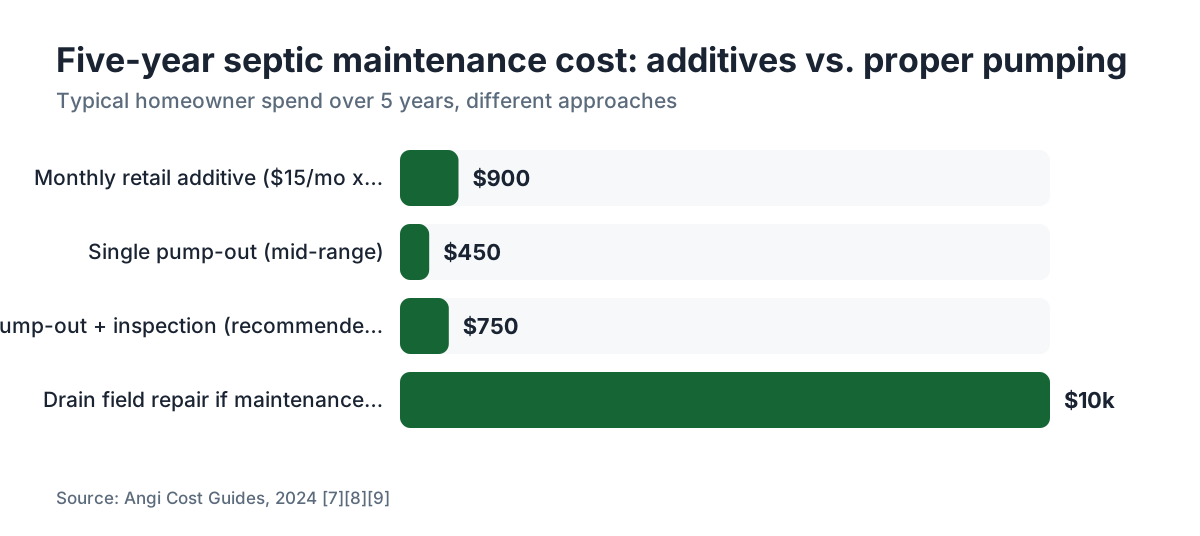
Some people use additives to delay a pump-out because money's tight. The pressure is real, but the bet is expensive. A pump-out runs $300 to $600 [7]. Drain field repair or replacement runs $3,000 to $20,000 or more depending on your state and soil [8]. The math points hard toward pumping on schedule.
Are there situations where septic treatment genuinely helps?
Yes. A few specific scenarios have real logic behind them, unlike routine monthly dosing.
After a pump-out. When a tank is pumped near empty, its bacterial population drops sharply. A biological additive in the first few weeks may help the microbial community bounce back faster. The tank will repopulate on its own within a few weeks of normal use, but if you want to speed that up, this is the most defensible use case there is.
After antibiotic use. When someone in the house takes a course of oral antibiotics, residues pass into the tank. Heavy use over multiple weeks can measurably knock down bacterial populations. A bacterial additive after the course ends has some logical support, though the evidence is observational, not from controlled trials [4].
Vacation homes with seasonal shutdowns. A slow-release tablet dropped in before a long closure keeps some bacterial activity going during periods of almost no flow. Whether it makes a measurable difference on reopening is unproven, but there's no harm and modest potential upside.
New systems. A newly installed tank starts with no established bacteria. Some installers seed new tanks with a bacterial starter. This probably speeds initial establishment by days to weeks, though the system would populate on its own within a few weeks of normal use anyway.
None of these support the message on most retail labels, which implies regular use prevents failures, extends tank life, and cuts pumping needs. Independent evidence doesn't back those claims.
What should I actually do to maintain my septic system?
The things that measurably extend a septic system's life are well-proven, cheap, and have nothing to do with additives.
Pump on schedule. Pump the tank every 3 to 5 years, or as your local rules require. Some jurisdictions require inspections on that same cycle. Check your county health department's website or your state's onsite wastewater program for the local requirement.
Watch what goes down the drain. Wipes (including the ones labeled flushable), grease, medications, heavy garbage disposal waste, and harsh chemical cleaners all stress the system. The most common preventable cause of septic trouble is flushing things that don't belong [2].
Protect the drain field. Don't park over it. Don't plant trees or shrubs with aggressive roots near it. Don't aim roof drainage or sump pump discharge at it. Saturated or compacted drain field soil is the leading cause of system failure [2].
Get an inspection. If you bought a house with a septic system and don't know when it was last pumped, start with a septic tank inspection. An inspector can measure sludge depth, check baffles and risers, and give you an honest read on where you stand.
Keep records. Write down every pump-out, inspection, and repair with the date and contractor. When you sell the house, that record is worth real money at the negotiating table. When something goes wrong, it helps pin down the cause.
Operators running multiple properties or service routes can lean on tools like SepticMind to centralize maintenance records, pump-out schedules, and inspection reports across a customer base, so no tank slips through the cracks between service cycles.
The septic tank cleaning article goes deeper on what a thorough cleaning involves beyond a standard pump-out.
How do I compare the cost of septic treatments versus proper maintenance?
Lay the numbers side by side and the trade-offs get obvious fast.
| Maintenance option | Typical cost | Frequency | Evidence base |
|---|---|---|---|
| Septic tank pump-out | $300 to $600 [7] | Every 3 to 5 years | Strong; industry standard |
| Septic tank inspection | $100 to $300 [9] | Every 1 to 3 years | Strong; required in many states |
| Retail bacterial additive (liquid/powder) | $8 to $25/month | Monthly | Weak; no independent efficacy data |
| Treatment tablets (slow-release) | $15 to $40/quarter | Quarterly or annually | Weak; no independent efficacy data |
| Drain field aeration service | $1,000 to $3,000 [8] | As needed | Moderate; situational benefit |
| Drain field replacement | $3,000 to $20,000+ [8] | Once on failure | N/A (repair, not prevention) |
Monthly additive use at $15 a month costs $180 a year, or $900 over five years. A single pump-out across that same five years costs $300 to $600. So the additive habit runs two to three times the cost of the pump-out it's supposed to prevent, with no credible evidence it prevents anything.
If budget is tight, cut the additives and put that money toward staying on a proper septic tank pump out schedule. That's the one maintenance choice with real evidence behind it.
What state regulations apply to septic treatment products?
Federal law doesn't require pre-market approval or efficacy testing for biological septic additives. They aren't pesticides (so no EPA registration under FIFRA), and they aren't drugs. That gap is exactly why manufacturers can make sweeping claims with little accountability.
State rules run the range from strict to silent.
Massachusetts has some of the toughest onsite wastewater rules in the country under Title 5 (310 CMR 15.000). The regulations don't ban biological additives but give them no credit toward maintenance requirements. Chemical additives that harm the biological process are prohibited [5].
Florida regulates onsite sewage treatment under Chapter 64E-6 of the Florida Administrative Code. Additives aren't prohibited, but they can't substitute for required maintenance. The state discourages products with harsh chemicals [6].
California has no statewide septic additive rule, but individual counties with local onsite wastewater ordinances may restrict products. Check with your county environmental health department.
North Carolina and Virginia publish extension guidance that discourages relying on additives, in line with the EPA's position [4][12].
The practical takeaway: in nearly every state, you're legally required to maintain your system through pumping and inspection on schedule, no matter what additives you use. An additive can't substitute for a required pump-out, and using one won't protect you if your system fails and the county pulls your maintenance records.
SepticMind's maintenance tracking helps operators and homeowners show regulators a clean service record when it matters.
What are signs that my septic system needs real help, more than a treatment product?
No additive fixes a mechanically or structurally failing system. Knowing when to quit hoping a product helps and start calling a professional is what saves you money.
Slow-draining fixtures throughout the house, more than one drain at once, suggest the tank may be full or the line to the tank is backing up. A single slow drain is usually just a line clog, not a septic problem.
Wet, spongy, or greener-than-surrounding ground over the drain field means effluent is surfacing. That's a failure event, not a maintenance chore. A bacterial product won't touch it. You need a professional to assess whether the field can be rehabilitated or needs replacement [8].
Sewage odors inside the house, especially near floor drains or at night when no water's running, can mean a baffle has failed and gases are back-flowing through the system. That's a septic tank repair job.
Any sewage odor in the yard near the tank or drain field is worth investigating right away, not treating. Outdoor odors can point to a cracked tank, a failed distribution box, or surfacing effluent.
If you've been adding products and nothing's improving, stop buying additives and put the money toward an inspection or pump-out. The septic system repair article covers what a contractor looks for when sizing up a troubled system.
Frequently asked questions
Is there a septic tank treatment I can buy at Walmart or Target?
Yes. Walmart stores reliably stock Rid-X in powder, liquid, and tablet formats. Target's coverage varies by location, but larger Target stores with a full home section often carry one or two additive products. Walmart's online store ships to most addresses with next-day or two-day delivery if local stock is out. Prices at mass-market retailers usually run a dollar or two below dedicated hardware stores.
Do septic tank treatment tablets work as well as liquid products?
For the same active ingredients (bacteria and enzymes), tablets and liquids perform about the same. Format affects delivery and convenience more than efficacy. Slow-release tablets placed directly in the tank access port skip house plumbing and may reduce exposure to chlorinated tap water, but no independent study shows that translates to better tank outcomes. Pick whichever format fits your routine.
Can I use too much septic tank treatment?
Overdosing a biological or enzymatic product at normal retail concentrations is unlikely to cause harm, but it won't help either. The tank's existing microbial ecosystem regulates itself. Excess introduced bacteria die off fast when they can't compete. Chemical additives are different: too much of a solvent or strong acid product can genuinely damage tank biology and should be avoided at any dose.
How long after a pump-out should I add a bacterial treatment?
Wait two to three days after the pump-out so fresh waste has a chance to reintroduce native bacteria, then add the product. Some contractors add it at the time of service. Either timing works. The tank repopulates within a few weeks from the bacteria in normal household waste anyway, so a bacterial starter is a modest convenience, not a requirement.
Will septic treatment help a slow-draining toilet or sink?
Probably not, and it won't work fast enough to matter if the system is backing up. Slow drainage in one fixture is almost always a pipe clog, not a septic biology problem. Whole-house slow drainage may mean the tank is near capacity and needs pumping. Add a bacterial product after pumping if you like, but the pump-out is the fix, not the additive.
Are enzyme-based treatments different from bacterial ones, and which is better?
Enzymatic products supply proteins (lipase, protease, amylase) that break down specific waste compounds. Bacterial products supply live organisms that produce enzymes and keep producing them as they reproduce. In practice, combination products with both dominate retail shelves. Neither type shows a clear advantage in independent studies. The distinction matters less than whether any additive is needed at all.
Can septic treatment products damage my drain field?
Biological and enzymatic products in retail formulations won't damage a drain field. Chemical additives, especially solvents, are another matter: they can mobilize greases and oils in a way that pushes them into the drain field soil, making biomat problems worse rather than better. The EPA has flagged certain chemical compounds in older products as groundwater risks. Check the ingredient list and avoid anything with chlorinated solvents or strong acids.
How much does septic tank treatment cost per year?
Monthly retail products cost $8 to $25 per dose, so $96 to $300 a year for year-round dosing. Annual slow-release tablets cost $20 to $50 for a full year, making them the cheapest option if you use anything at all. Compare that to a pump-out at $300 to $600 every three to five years. The math rarely makes monthly additives the best use of your maintenance budget.
Do I need septic treatment if I use a garbage disposal?
Heavy garbage disposal use increases the solids load entering your tank, so the tank fills faster and needs more frequent pumping. The EPA recommends minimizing disposal use for this reason. An additive won't offset the extra load. What you actually need is to pump more often, roughly every two to three years instead of four to five, if you use the disposal heavily.
What's the difference between septic tank treatment and septic tank cleaning?
Treatment means additive products meant to maintain the biological activity inside the tank. Cleaning means physically removing sludge, scum, and accumulated solids, which is what a pump-out does. Cleaning takes material out of the system; treatment adds biology to what's left. The two are complementary at best, never substitutes. See the full breakdown in the septic tank cleaning article.
Does the EPA approve any septic tank additive products?
No. The EPA does not register, approve, or endorse any commercial septic tank additive as effective. Biological products don't require EPA registration under the Federal Insecticide, Fungicide, and Rodenticide Act because they aren't pesticides. The EPA's SepticSmart program does not recommend additives as a substitute for regular pumping and proper maintenance.
Is there a septic treatment specifically for older tanks or failing systems?
Products marketed for failing drain fields exist, claiming to break up biomat (the biological crust that clogs soil pores). Independent evidence for these products is anecdotal at best. A legitimate failing-system evaluation assesses soil saturation, distribution box function, and whether the field can be rested and recovered or needs replacement. A product dropped in a toilet is not a credible alternative to that assessment.
What's the best way to find a reputable septic service near me for treatment or pumping?
Your state's onsite wastewater program, the National Onsite Wastewater Recycling Association (NOWRA), and your county health department all keep contractor directories. Google reviews help, but read for patterns rather than star averages. Ask specifically whether the contractor measures sludge and scum depth during a pump-out and gives you a written report. The ones who do are usually more thorough than the ones who don't.
Sources
- Home Depot product listings, Septic System Treatments: Retail septic treatment products (liquids, powders, tablets) priced roughly $8 to $25 per month's supply
- U.S. EPA SepticSmart, Caring for Your Septic System: EPA does not recommend septic additives as a substitute for pumping; recommends pump-out every 3 to 5 years; chemical additives can harm the microbial ecosystem
- Bioresource Technology, Roeleveld et al., 2005, review of septic additive efficacy: No statistically significant improvement in effluent quality or sludge reduction from biological or enzymatic additives in controlled comparisons
- Penn State Extension, Septic System Maintenance: Biological additives may help restart a system after bacterial populations are disrupted by antibiotics, long vacancy, or post-pump-out; routine monthly dosing in healthy systems is not supported
- Massachusetts Department of Environmental Protection, Title 5 Regulations, 310 CMR 15.000: Massachusetts Title 5 does not credit biological additives toward maintenance requirements; chemical additives that harm system biology are prohibited
- Florida Department of Health, Chapter 64E-6 FAC, Onsite Sewage Treatment: Florida onsite wastewater rules do not prohibit biological additives but do not allow them to substitute for required maintenance; harsh chemical products are discouraged
- Angi, Septic Tank Pumping Cost Guide: Typical septic tank pump-out costs $300 to $600 nationally
- Angi, Septic System Repair and Drain Field Replacement Cost: Drain field repair or replacement costs $3,000 to $20,000 or more depending on extent and location; drain field aeration services cost $1,000 to $3,000
- Angi, Septic Tank Inspection Cost: Septic tank inspection costs $100 to $300 depending on scope and region
- National Onsite Wastewater Recycling Association (NOWRA), Consumer Resources: NOWRA maintains contractor directories and industry standards for onsite wastewater system maintenance
- U.S. EPA, Types of Septic Systems: EPA overview of aerobic treatment units and other advanced onsite wastewater systems requiring manufacturer-specified maintenance protocols
- North Carolina Cooperative Extension, Septic System Additives: NC Extension guidance discourages reliance on septic additives, consistent with EPA position; notes no additive replaces pumping
Last updated 2026-07-09