Chlorine tablets for aerobic septic systems: the complete guide
By the SepticMind Editorial Team
TL;DR
- Aerobic septic systems need regular disinfection with chlorine tablets dropped into a dedicated feeder tube.
- Most 3-4 person households use 2-4 one-inch trichlor tablets every 4-6 weeks to hold a 0.5-1.0 mg/L chlorine residual in the final effluent before surface spray or drip discharge.
- Wrong tablet type or skipped doses risk permit violations and pathogen exposure.
Why do aerobic septic systems need chlorine in the first place
Aerobic septic systems need chlorine because they discharge treated water to the ground surface, where people and pets can touch it. Conventional systems bury their effluent in a leach field and let soil finish the job. Aerobic Treatment Units (ATUs) don't work that way, and that changes everything about disinfection.
An ATU pumps air through the waste to speed up bacterial breakdown, then sends the treated effluent to a surface spray field, a drip irrigation network, or a shallow absorption area. The water ends up near the surface. That is the whole reason chlorine is on the table.
Because aerobically treated effluent can touch the ground surface, children, pets, and bare feet, the EPA and every state that permits ATUs requires disinfection before the final discharge. Chlorine is the common method. UV and ozone exist too. Tablets win on price and simplicity: they cost little, store easily, and dose without any powered equipment.
The EPA's SepticSmart program says aerobic systems "require more maintenance than conventional systems," and disinfection is a permit condition, not a nice-to-have [1]. Skip it and you're doing more than being sloppy. You're violating your operating permit in almost every state that allows ATUs.
What kind of chlorine tablets actually work in an aerobic septic system
Two tablet chemistries show up in real ATU manuals: trichlor (trichloroisocyanuric acid) and calcium hypochlorite. Both disinfect. They dissolve at different rates and sit at opposite ends of the pH scale, so the one your system wants is spelled out in the manual. Buy that one.
Trichlor tablets (1-inch or 3-inch): Same chemistry as swimming pool tabs. They dissolve slowly, release chlorine at a steady rate, and fill the shelves at every hardware store. Most ATU feeder tubes are sized for 1-inch trichlor. Trichlor has about 90% available chlorine by weight and a low pH (~2.8 to 3.5), which can matter in some soils if you overdose [2].
Calcium hypochlorite tablets (HTH or similar): About 65-70% available chlorine, faster to dissolve, and a high pH (~11.8). Some manufacturers require cal-hypo specifically because they worry about acid corrosion in certain feeder materials. Read your ATU manual before you assume anything.
What does NOT belong in an ATU tablet feeder:
- Dichlor (dichloroisocyanuric acid): dissolves too fast, made for shock treatment
- Stabilized pool tablets with extra cyanuric acid: cyanuric acid can build up in soil over time
- Household bleach tablets: wrong form factor, wrong concentration
- Algae tabs, mineral clarifier tabs, or anything sold as a septic "additive": none of these disinfect
Here is the safest move. Open your ATU manual, find the disinfection section, and buy the exact tablet type it names. Lost the manual? The manufacturer's site almost always has a PDF. Norweco, Jet, and most other brands say plainly which tablet belongs in their feeder.
How does a chlorine tablet holder or feeder work on an aerobic septic system
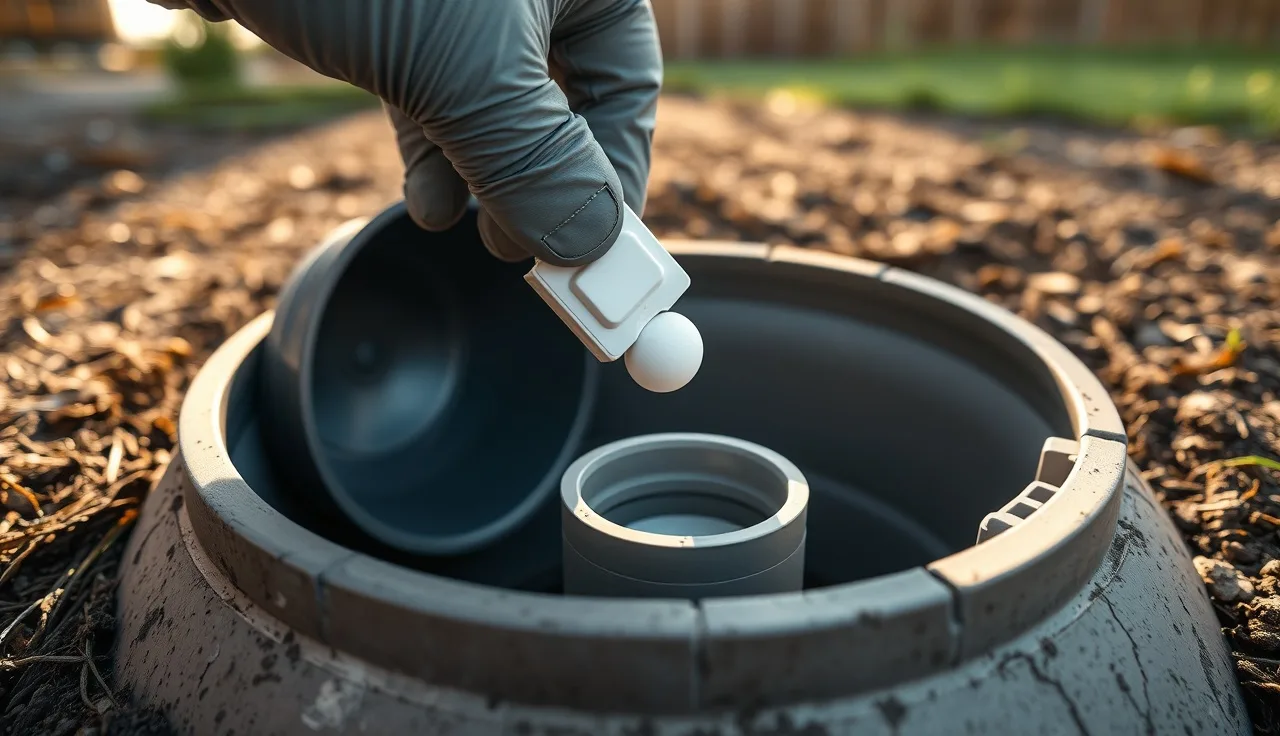
The chlorine tablet feeder is a vertical tube, usually 2-4 inches wide and 12-18 inches tall, mounted inside the ATU's final treatment or pump chamber. Treated effluent flows up through the tube, past the stacked tablets, picks up dissolved chlorine, and exits to the spray or drip field. You reach it through the inspection riser on the lid, no special tools.
The slow upward flow is on purpose. It controls contact time and how fast tablets dissolve. Load too many and the effluent comes out over-chlorinated. Load too few and it comes out under-treated.
Common feeder designs across major brands:
| Brand | Feeder Type | Typical Tablet Size |
|---|---|---|
| Norweco Singulair | External chlorinator cap | 1-inch trichlor |
| Aerobic Solutions | Internal tube in aeration chamber | 1-inch trichlor |
| Jet Inc. | Clip-in basket in final chamber | 1-inch trichlor or cal-hypo |
| Clearstream | Internal cylinder | 1-inch trichlor |
| Hoot | Separate disinfection chamber | 1-inch trichlor |
Replacement holders are at septic supply houses and some Lowe's stores. Look in the well and septic section, not the pool aisle. A replacement tube runs $15 to $45 depending on the model. Generic 2-inch PVC slip-fit holders exist, but check your permit first. Some states require OEM or listed components.
The part number is in your ATU manual. Ordering from the manufacturer or a licensed ATU dealer is the clean path. Searching "aerobic septic system chlorine tablet holder [your brand]" on the manufacturer site keeps you from buying the wrong diameter.
How many chlorine tablets should you add, and how often
For a typical 3-4 person household, start with 2 to 4 one-inch trichlor tablets every 4 to 6 weeks. That baseline comes from manufacturer manuals and state extension programs [4]. No single number fits every ATU, water usage, and climate, so treat it as a starting point and adjust from a test.
Most states want the final effluent to hold a free chlorine residual of 0.5 to 1.0 mg/L (parts per million) at the discharge point [3]. What you actually need depends on:
- Household size (gallons per day through the system)
- Water temperature (chlorine dissolves faster in warm water)
- ATU model and feeder tube volume
- Tablet brand and true available chlorine percentage
The only way to know if you're dosing right is to test the effluent residual. A pool test strip works fine. Aim for 0.5 to 1.0 ppm at the sprinkler or drip line. Zero means under-dosed. Five or more means over-dosed, which harms soil and plants.
Tablets gone in under two weeks? You're either under-loading or your water use is high. Tablets lasting two months with almost no residual? Check whether the feeder tube is actually submerged in effluent and flowing.
Heat speeds everything up. In Texas, Florida, and Arizona summers, tablets dissolve faster, so check the feeder every 3 weeks instead of every 6 through the hot months.
Where to buy chlorine tablets for aerobic septic systems
You have four realistic sources, and per-tablet price swings more than you'd guess. Big-box retail is cheapest for small quantities, bulk online is cheapest per tablet, and manufacturer-direct costs the most for the same chemistry.
Big-box retail (Lowe's, Home Depot): Both stock 1-inch trichlor pool tablets in 2 lb or 5 lb buckets. Pool section, not plumbing. HTH, In The Swim, and Clorox Pool are all widely available. A 5 lb bucket (roughly 50 one-inch tablets) runs $15 to $25. Fine as long as your manual permits trichlor.
Septic supply distributors: Companies that supply ATU service techs sell tablets labeled for aerobic use. Often the same chemistry as pool tabs, but packed in 1 lb resealable bags that match feeder capacity. Per-tablet price is similar or slightly higher, and the packaging is more practical.
Online (Amazon, eBay, specialty septic sites): Bulk online usually wins on cost per tablet. Shipping weight is the catch. A 25 lb bucket of 1-inch trichlor can run $45 to $80 and lasts a typical household 2+ years.
Manufacturer direct: Norweco, Jet, and similar brands sell their own tablets, often matching the manual's exact spec. Expect to pay 20-40% over generic pool tabs for identical chemistry.
One caution. Trichlor pool tablets at Lowe's are the right product for most systems, but spend two minutes confirming your manual doesn't call for calcium hypochlorite. If it does, note that Lowe's stocks cal-hypo shock in granular form, not tablets, so you'll likely need a septic supply source for the tablet form.
What happens if you use the wrong type or dose of chlorine
Getting this wrong has real consequences. Under-dose and you spray live pathogens on your yard. Over-dose and you kill the soil biology doing the final treatment. Wrong chemistry gives you a residual that looks fine on one test and fails on average.
Under-chlorination: The effluent leaving your sprinkler heads carries bacteria and viruses the system never finished neutralizing. Texas TCEQ sampling has found fecal coliform in ATU effluent above standards specifically because tablet feeders sat empty [5]. Surface spray with weak disinfection is a documented path for E. coli exposure, worse with small kids or pets around.
Over-chlorination: Too much chlorine in the drip or spray field kills the beneficial soil bacteria that finish treatment. It also stresses or kills landscaping around spray heads. High residual can form chlorinated byproducts (trihalomethanes, haloacetic acids) that build up in soil chemistry over years [6].
Wrong tablet chemistry: Dichlor shock tabs dissolve fast and give you a spike-then-crash pattern instead of a steady residual. A single test can catch the spike and look fine while the average residual is inadequate. Cyanuric acid buildup from stabilized tabs is a slower issue. It's real in pools, and there's legitimate concern about long-term application to drain fields, though nobody has solid field data on cumulative ATU soil impacts.
Permit violations: In Texas, Florida, Oklahoma, and most other ATU states, your permit sets a minimum residual. Licensed service providers test it at each inspection. Below standard and you get a notice of violation. Repeat failures can force system upgrades or bring fines.
How do state regulations govern chlorine use in aerobic septic systems
ATUs are regulated at the state and local level. The EPA sets broad guidance but does not license individual systems. That happens through state environmental or health agencies [10]. Most ATU states pin down a minimum chlorine residual and require a licensed maintenance contract.
How a few states handle it:
Texas: TCEQ Chapter 285 requires aerobic systems to run under a continuous maintenance contract with a licensed provider. The rules set a minimum chlorine residual of 1 mg/L in the final effluent. Tablets get added as needed, and the provider documents every visit [5].
Florida: The Florida Department of Health (Chapter 64E-6, FAC) requires disinfection of ATU effluent before surface or spray application and sets a fecal coliform limit of no more than 200 CFU per 100 mL. Florida sets a bacterial standard rather than a fixed residual, but chlorine tablets are the standard field method for hitting it [7].
Oklahoma: Title 252, Chapter 641 requires aerobic treatment with disinfection and a maintenance contract with inspections at least every 4 months.
Almost every ATU state requires a licensed provider to inspect the system 2 to 4 times a year. That provider checks tablet levels, tests residual, and logs the visit. Managing your own tablets between visits is fine and expected. The quarterly or semi-annual professional check is usually a legal requirement, not optional.
The National Environmental Services Center at West Virginia University compiles state-by-state ATU rules and is a good starting reference [8].
How to add chlorine tablets to an aerobic septic system safely
Adding tablets takes five minutes and a pair of gloves. The one rule you can't skip: never mix trichlor and calcium hypochlorite in the same feeder. In concentrated form those two react violently. Pick one chemistry and stick with it.
- Find your ATU access risers. Most systems have 2-4. The disinfection chamber is usually the last riser (closest to the spray or drip outlet) or labeled on the lid.
- Wear gloves. Trichlor irritates skin and eyes. Cal-hypo is caustic. Nitrile gloves and safety glasses cost almost nothing.
- Open the riser carefully. Wet lids get slippery. Use the lug wrench or lid tool if you need it.
- Check the feeder tube. Count the remaining tablets. If 0-1 are left, add your standard dose (2-4 for most households). If 3+ remain, skip the reload and check again in 2 weeks.
- Drop tablets in vertically. Don't break, cut, or stack different types together. Tablets go straight into the feeder tube opening.
- Test the effluent residual. Dip a pool test strip in the effluent leaving the final chamber, or in the pump tank if that's downstream. Target 0.5 to 1.0 ppm free chlorine.
- Reseal the lid. A loose ATU riser lid is a drowning risk for small children and an open door for pests.
- Log the date and dose. A note in your phone or on paper with the manual. Your provider will ask, and it helps you spot patterns ("Why 8 tablets this month when I usually use 4?").
Unsure about any step? Operators who run septic tank inspection routes also service ATUs and can walk you through it in person the first time.
How much do aerobic septic system chlorine tablets cost per year
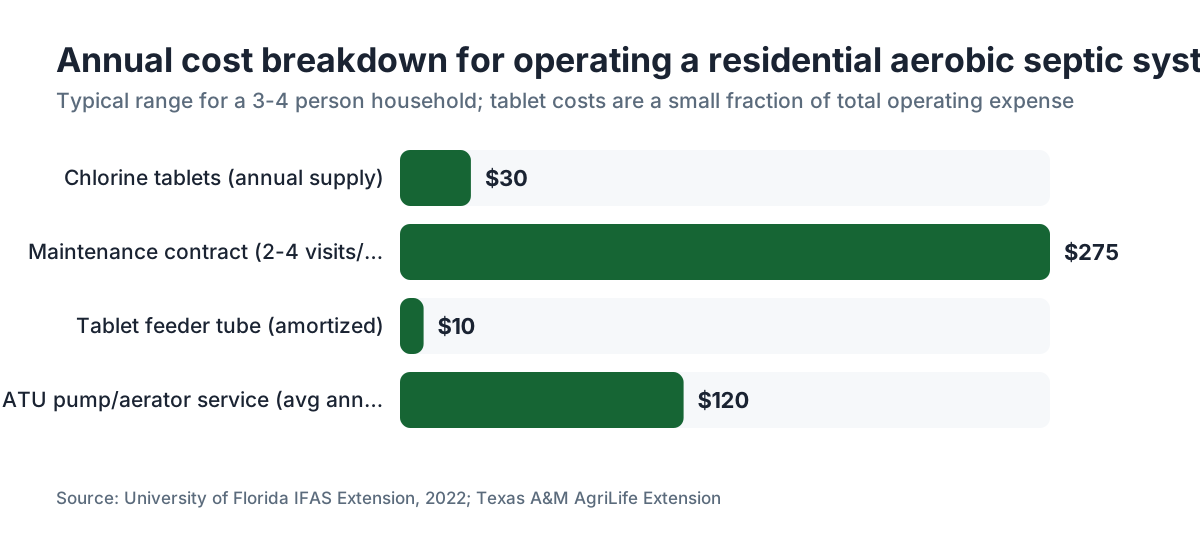
Tablets are cheap. A typical household spends $6 to $30 a year on the tablets themselves. The number that actually hits your budget is the state-required maintenance contract, which runs $150 to $400 a year.
Tablet cost alone: A 3-4 person household uses 2-4 one-inch tablets every 4-6 weeks, so 20 to 50 tablets a year. At retail pool-supply prices of $0.30 to $0.60 per 1-inch tablet, that's $6 to $30 annually. Even buying branded ATU tablets from a septic supplier at $1 to $2 each, you stay under $100 a year.
Maintenance contract (the bigger number): State-required annual contracts run $150 to $400 depending on visit frequency (usually 2-4 inspections) and region. That covers tablet checks, chlorine testing, air compressor inspection, and the paperwork your permit requires [9].
| Expense | Typical Annual Range |
|---|---|
| Chlorine tablets (DIY supply) | $10 - $50 |
| Maintenance contract (2-4 visits) | $150 - $400 |
| Tablet feeder tube replacement (every 3-5 yrs) | $15 - $45 amortized |
| ATU pump/aerator service (as needed) | $100 - $350 per event |
If your contract includes tablets, confirm it. Some do, most don't. Total annual operating cost for a healthy ATU including mandatory maintenance runs $200 to $500, well above a conventional system's once-every-3-to-5-year septic tank pump out at $300 to $500 per event.
Operators tracking ATU contracts and tablet schedules across many accounts use software to manage visit frequency and documentation. SepticMind is built for that recurring maintenance workflow.
Common problems with chlorine tablet feeders and how to fix them
The feeder tube is simple, but a handful of failures happen over and over. The two that matter most: tablets that never dissolve (no disinfection) and a full tube reading zero residual (effluent isn't flowing through it). Both mean untreated water is heading to your yard.
Tablets not dissolving: Add tablets, check two months later, find them intact. The tube probably isn't in the effluent flow. Either it sits too high in the chamber (not submerged), the effluent level is low (undersized or rarely used system), or the tube has a crack or bypass. Compare the tube's seating position to the manufacturer diagram.
Feeder tube clogged or crusted: Calcium scale or chlorine residue builds up inside over time. Pull the tube, rinse with clean water (never another chemical), and inspect for cracks. Replace if cracked. They're cheap.
Tablets bridging or clumping: Humidity fuses tablets into a solid plug that blocks the tube. Store tablets in a dry, sealed container (original bucket, lid snapped tight). If the tube is already bridged, tap it gently. If that fails, remove the plug with tongs while wearing gloves.
Residual too high with few tablets: Using 1 tablet a month and still reading 3+ ppm usually means very low water use (snowbird or seasonal home). High residual isn't an emergency, but it kills drain-zone soil bacteria over time. For a vacation property, some providers switch to a slower-release format or place tablets only around occupied periods.
Residual zero with a full tube: Check that effluent is actually flowing through the feeder. If the ATU aerator or pump isn't running, the system isn't treating waste at all, a far bigger problem than the chlorine. If the aerator light or alarm is on, call your provider. You may need septic system repair on the ATU components.
What are the alternatives to chlorine tablets: UV, ozone, and liquid chlorine
Chlorine tablets win on ATU disinfection because they're cheap, simple, and need no electricity. They aren't the only option. UV is the main alternative for homeowners who don't want chlorinated spray on the yard; liquid chlorine and ozone show up mostly on larger or commercial units.
UV disinfection: An ultraviolet lamp in the effluent stream kills pathogens with no added chemicals. No disinfection byproducts, no residual in the spray field, no tablets to buy. The trade-offs are cost ($400 to $900 installed), a lamp that needs annual replacement ($50 to $150), and electrical upkeep. Some states accept UV as equivalent to chlorine for ATU permits and some don't, so check your state before you spend.
Liquid chlorine (bleach injection): A small dosing pump injects liquid sodium hypochlorite into the effluent stream. Precise dosing, no tablet handling, easy residual adjustment. Upfront cost is $300 to $700 for pump and tank. More common on commercial or large-capacity ATUs than on homes.
Ozone: Ozone generators exist for ATU disinfection but are rare in homes because of cost and complexity. Not a realistic choice for most homeowners.
For most residential ATU owners, tablets stay the practical pick. The cost gap versus UV is small, and dropping tablets into a tube is hard to beat for simplicity. If you have a strong preference against chlorinated spray on your lawn, UV is a legitimate upgrade to raise with your licensed provider.
Aerobic vs conventional septic: is the chlorine requirement a dealbreaker
The chlorine and maintenance requirement surprises a lot of people moving from a conventional system to an ATU. It's manageable, not a dealbreaker. Two to four tablets every 4-6 weeks plus an annual contract is a light burden. The real question on any ATU home is whether the previous owner actually maintained it.
An ATU makes sense when the lot can't support a conventional drain field: small lot, high water table, poor soil percolation. If you can install a conventional system instead, skipping tablets and mandatory contracts is a genuine advantage. The cost to install septic system varies a lot by site for both types, but ATU operating costs run consistently higher year over year.
That said, ATUs discharge cleaner effluent than conventional systems, which matters near sensitive water bodies or in dense-lot areas. Some states now require ATUs in new construction near lakes, estuaries, and sensitive groundwater zones precisely because the treatment quality is better.
Buying a home with an ATU already in the ground? A septic tank inspection by a licensed ATU technician before closing is money well spent. It confirms the aerator runs, the feeder works, and the effluent actually meets residual standards. Deferred ATU maintenance compounds fast into septic tank repair bills that dwarf years of tablet and contract costs.
SepticMind's documentation tools help operators track service history across ATU accounts, which is useful context when they're asked to inspect a system that came with no paper trail.
Frequently asked questions
Can I use regular pool chlorine tablets in my aerobic septic system?
Yes, in most cases. One-inch trichlor pool tablets (about 90% available chlorine) match what most ATU manufacturers specify. Confirm your ATU manual does not require calcium hypochlorite instead. The tablets sold in the pool section at Lowe's or Home Depot are the same chemistry as 'septic' tablets, just repackaged. Never use dichlor shock tabs; they dissolve too fast for steady disinfection.
How often should I add chlorine tablets to my aerobic septic system?
Check the feeder tube every 3-4 weeks and reload when 1 or fewer tablets remain. For a 3-4 person household, most manufacturers recommend adding 2-4 one-inch tablets roughly every 4-6 weeks. Water use, water temperature, and ATU model all affect dissolution rate, so your interval may vary. Test effluent chlorine residual with a pool strip to calibrate your specific dose.
What chlorine residual should aerobic septic effluent have?
Most state regulations require 0.5 to 1.0 mg/L (ppm) free chlorine residual in final effluent before surface discharge. Texas TCEQ Chapter 285 specifies a minimum of 1 mg/L. Test with an inexpensive pool test strip at the final chamber outlet or pump tank. Below 0.5 ppm means you need more tablets; above 2-3 ppm and you risk harming the soil bacteria in the spray field.
Where exactly do I put chlorine tablets in an aerobic septic system?
Tablets go into the chlorine tablet feeder tube, which sits inside the ATU's disinfection or final treatment chamber. Access it through the inspection riser lid on that chamber. Open the lid, locate the vertical feeder tube (2-4 inches in diameter), and drop tablets in vertically. Do not put them loose in the chamber water or in any other compartment of the ATU.
What happens if I forget to add chlorine tablets to my aerobic septic system?
The chlorine residual in your effluent drops to zero. Spray or drip discharge then carries inadequately disinfected wastewater onto the surface, creating a pathogen exposure risk for people and animals. You also risk a permit violation if a state-required inspection finds zero residual. Check the feeder at least monthly and keep a backup supply of tablets on hand to avoid gaps.
Can I add too many chlorine tablets to an aerobic septic system?
Yes. Over-chlorinated effluent (above 2-3 ppm residual) damages soil microbiology in the spray or drip field, can kill surrounding grass and plants, and produces disinfection byproducts that accumulate in soil. Stick to the manufacturer's recommended dose and verify with a pool test strip. If residual is consistently high with your current dose, reduce tablets per loading by one and retest.
Do I need a maintenance contract if I add chlorine tablets myself?
In most states that permit ATUs, yes. A state-licensed maintenance provider contract is typically a permit condition, not optional, regardless of whether you handle tablet refilling yourself. Texas, Florida, and Oklahoma all require it. The contract covers periodic professional inspection, effluent testing, and documentation. Homeowner tablet management between visits is fine and expected; it does not replace the licensed inspection requirement.
What is the difference between trichlor and calcium hypochlorite tablets for aerobic septic use?
Trichlor has about 90% available chlorine, dissolves slowly, and has a low pH (~3.0). Calcium hypochlorite has 65-70% available chlorine, dissolves faster, and has a high pH (~11.8). Both work in ATU disinfection. The difference matters for feeder design and material compatibility. Some ATU manufacturers specify one over the other; always check your system manual before buying.
How long does a bucket of chlorine tablets last for an aerobic septic system?
A 5 lb bucket of 1-inch trichlor tablets (roughly 45-50 tablets) typically lasts 10-18 months for a 3-4 person household using 2-4 tablets every 4-6 weeks. Larger households or systems in warm climates with faster dissolution may go through a bucket in 6-8 months. Store tablets in the sealed original container in a cool, dry location away from children and pets.
Can chlorine tablets from my aerobic septic system harm my yard or garden?
At proper residual levels (0.5-1.0 ppm), surface-applied ATU effluent has minimal impact on established grass. Overly chlorinated effluent (3+ ppm) can bleach or kill grass near spray heads and harm ornamental plants. Never use spray-field areas as a vegetable garden. Keep pets and children away from active spray zones, and position spray heads away from areas where people spend time.
Why are my chlorine tablets dissolving too fast in my aerobic septic system?
Fast dissolution usually means high effluent flow (large household, high water use), warm water temperature, or tablets sitting in direct effluent flow rather than in the feeder tube. Check that tablets are in the correct feeder tube and not loose in the chamber. In hot climates, faster dissolution is normal in summer. Try adding one extra tablet per loading cycle and retest residual to find the right dose.
Do aerobic septic system chlorine tablets expire or degrade in storage?
Trichlor and calcium hypochlorite tablets gradually lose available chlorine over time, especially if exposed to humidity, heat, or sunlight. Properly stored in a sealed container in a cool, dry location, they retain 90%+ potency for 1-2 years. Clumped or discolored tablets are a sign of moisture exposure; they may dissolve unevenly. Buy only what you will use in a year to ensure consistent dosing.
Is there a septic-specific brand of chlorine tablets, or are pool tablets the same thing?
Chemically, many brands marketed as 'aerobic septic tablets' are the same trichlor formulation as pool tablets, just in smaller retail quantities. Some ATU manufacturers sell their own branded tablets at a premium. Pool section tablets from major brands (HTH, In The Swim, Clorox Pool) work fine in most ATUs. The key is confirming tablet type (trichlor vs. cal-hypo) matches your manufacturer spec, not the label on the bucket.
What should I do if my chlorine tablet feeder tube is cracked or missing?
A cracked or missing feeder tube means tablets are not dissolving in controlled contact with effluent, and chlorine residual will be inconsistent. Order the OEM replacement part using your ATU model number (found on the unit nameplate), or contact your licensed maintenance provider. Replacement tubes typically cost $15-$45. Do not improvise with random PVC pipe; feeder sizing is specific to flow rate and contact time requirements.
Sources
- EPA SepticSmart - Types of Septic Systems: EPA SepticSmart states aerobic systems require more maintenance than conventional systems and that disinfection is a mandatory permit-required step.
- NSF International - Wastewater Treatment Systems consumer resources: Trichlor tablets have approximately 90% available chlorine and a low pH of approximately 2.8-3.5.
- West Virginia University National Environmental Services Center - Aerobic Treatment Units: Most state regulations require 0.5 to 1.0 mg/L free chlorine residual in ATU final effluent before surface discharge.
- Texas A&M AgriLife Extension - Aerobic Septic Systems: Most manufacturer manuals and state extension programs recommend 2-4 one-inch tablets every 4-6 weeks as a baseline for typical households.
- Texas Commission on Environmental Quality - Chapter 285 On-Site Sewage Facilities Rules: TCEQ Chapter 285 requires ATU systems to maintain a minimum chlorine residual of 1 mg/L in final effluent and requires maintenance under a licensed provider contract.
- EPA - Wastewater Technology Fact Sheet: Chlorine Disinfection: Excess chlorine in discharge can create disinfection byproducts including trihalomethanes and haloacetic acids that affect soil and water chemistry.
- Florida Department of Health - Onsite Sewage Programs (Chapter 64E-6, Florida Administrative Code): Florida Chapter 64E-6 requires disinfection of ATU effluent before surface or spray application and sets fecal coliform limits of no more than 200 CFU per 100 mL.
- National Environmental Services Center at West Virginia University - Aerobic Treatment Unit Resources: NESC compiles state-by-state ATU regulations and maintenance requirements.
- University of Florida IFAS Extension (EDIS) - Aerobic Treatment Units for Onsite Sewage Treatment: State-required annual ATU maintenance contracts typically cover 2-4 inspections per year and run $150-$400 depending on region and visit frequency.
- EPA - Onsite Wastewater Treatment Systems Manual: ATUs are regulated at the state level; EPA sets broad guidance while state environmental or health agencies license individual systems.
- CDC - Septic Systems (Healthy Water): Surface discharge from aerobically treated effluent is a documented public health pathway for E. coli and other pathogens when disinfection is inadequate.
Last updated 2026-07-10