Infiltrator leach field: how it works, costs, and lifespan
By the SepticMind Editorial Team
TL;DR
- Infiltrator chambers are corrugated plastic arches placed in trenches instead of gravel and perforated pipe.
- They pass effluent to soil faster, use 30 to 50% less excavation, and cost $3,000 to $15,000 installed depending on size and soil.
- They last 30 to 50 years if you pump the tank on schedule and keep vehicles off the field.
What is an Infiltrator leach field and how does it work?
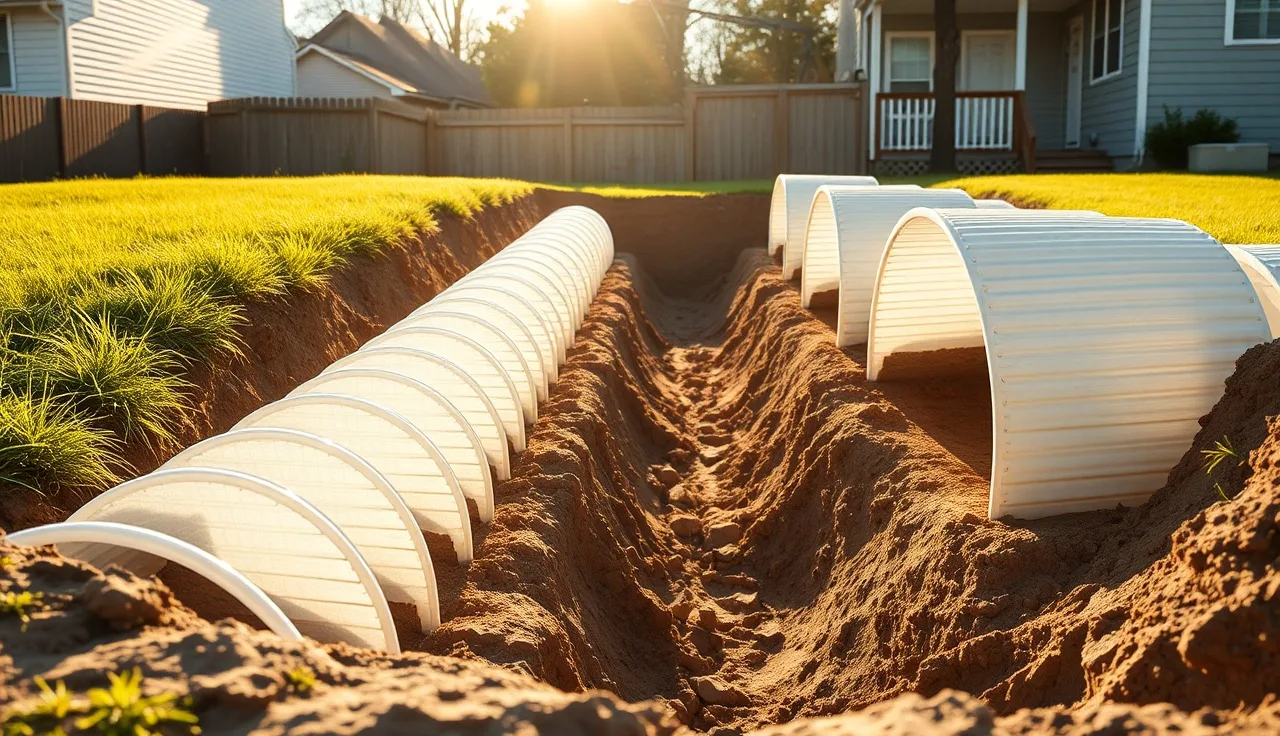
An Infiltrator leach field replaces the gravel in a drainfield with hollow plastic chambers. A conventional field runs perforated pipe through gravel-filled trenches so effluent can seep into the soil. The Infiltrator version swaps most or all of that gravel for arched plastic units made by Infiltrator Water Technologies. Effluent flows from the septic tank into the chambers, pools briefly on the bare soil at the bottom of each arch, and soaks down through the biozone, a thin bacterial layer that digests remaining solids before they reach groundwater. [1]
The chambers snap together end-to-end in a trench. The open bottom sits directly on native soil, and that is the whole point. Gravel systems create a gravel-soil interface that clogs over time. Chambers expose a much larger area of undisturbed soil instead, which is why the EPA's guidance on alternative drainfield technologies notes that chamber systems can perform equal to or better than gravel systems in many soil conditions. [2]
Infiltrator is a brand name that turned into the generic term, the way Kleenex did for tissues. Infiltrator Water Technologies, now a subsidiary of Advanced Drainage Systems, sells several lines: the Quick4 series (standard residential), the High Capacity series for tighter sites, and the EZflow chamber-geomat hybrid. When a contractor says "leach field infiltrators," they almost always mean the Quick4 or a direct equivalent.
The system still needs a properly sized septic tank upstream. Nothing about the chamber design lightens the load on the tank. It just handles the soil-absorption step more efficiently. See our guide to septic tank installation for what the upstream components look like.
How do Infiltrator chambers compare to gravel-and-pipe systems?
In most residential soils, chambers are the better choice for a new install. Gravel still wins in a few edge cases, and I'll tell you which ones below.
| Feature | Gravel-and-pipe | Infiltrator chambers |
|---|---|---|
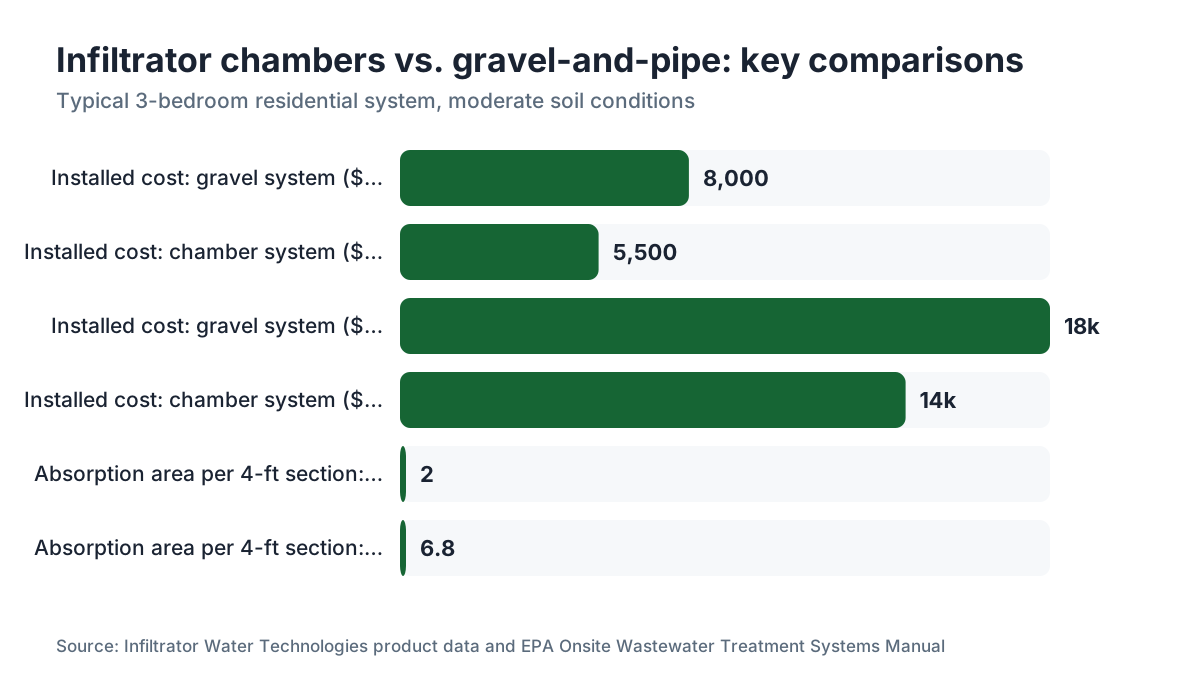
| Installed cost (typical 1,000 gpd system) | $8,000 to $18,000 | $5,500 to $14,000 |
| Excavation volume | High (gravel fill adds weight and depth) | 30 to 50% less [3] |
| Bottom absorption area per linear foot | ~2.0 sq ft (4-inch pipe in 3-ft wide trench) | ~6.8 sq ft (Quick4 Standard) [4] |
| Susceptibility to biological clogging | Moderate to high over 20+ years | Lower, because the undisturbed soil biome stays intact |
| Repair access | Requires excavating and replacing gravel | Open top cap allows inspection and jetting |
| Suitable for rocky/shallow soils | Poor | Better (less excavation depth needed) |
| Applicable to mound systems | Sometimes | Yes, widely used |
Gravel makes sense in two situations. The first is where your local health department hasn't approved chambers yet, so check your county code before any design work. The second is a very high water table where the engineer specifies an aggregate design for hydraulic reasons. Most states have signed off on Infiltrator products. As of 2024 the company reports approval in all 50 states and Canada, though local jurisdictions can still restrict use. [4]
Coarse gravel does one thing better. It provides some mechanical filtration that slows surging flow. In systems with wild daily flow swings, some engineers still spec a gravel zone at the inlet end. That's a call for your licensed designer, not a reason to default to gravel on every job.
What does an Infiltrator leach field cost to install?
Expect $3,000 to $15,000 for the drainfield alone. The range is that wide because of system size, site conditions, soil type, local labor rates, and whether you need a pump. A 3-bedroom home in the Southeast might pay $4,000 to $7,000 for chambers plus installation. The same footprint in the rocky Northeast or on a steep lot can hit $10,000 to $15,000 because of extra excavation or engineered fill. [5]
Here's where the money goes:
- Chamber materials: Quick4 Standard units run roughly $25 to $40 each at supply houses. A typical 3-bedroom system needs 50 to 120 units depending on trench length and soil loading rate. Budget $1,200 to $4,800 in chamber materials.
- Excavation: Usually the biggest line item. Even with chambers cutting excavation volume by 30 to 50%, a trackhoe and operator bills $800 to $2,000 a day in most markets.
- Permit and design: Most counties require a licensed engineer or soil scientist to run a perc test and produce a stamped design. Add $500 to $2,500 depending on site complexity. [6]
- Distribution box or manifold: $150 to $600 in materials, minimal extra labor.
- Pump (if required): If the site is flat or the drainfield sits uphill, a dosing pump adds $800 to $2,500 in equipment.
Replacing a failed gravel system with chambers usually lands at $6,000 to $20,000 once you fold in tank inspection, new distribution components, and any soil work. Our cost to install septic system guide has regional breakdowns. The chamber portion is rarely the budget surprise. Excavation and permits are what get people.
How long do Infiltrator chambers last?
Infiltrator rates the structural life of its chambers at 50 years under normal loading. [4] Installers and engineers I've talked to generally expect 30 to 50 years of functional field life, which matches a well-maintained gravel system and beats a neglected one.
The plastic isn't what sets the clock. Biomat management is.
A biomat is the organic layer that forms at the soil interface as bacteria in the effluent colonize the soil. A thin biomat is normal and actually helps treatment. A thick, greasy biomat from a tank nobody pumped, or a household dumping grease and wipes, seals the soil surface. Once the soil stops absorbing, effluent backs up. The chambers are fine. The soil under them is what fails. [1]
Four things decide how long the field lasts:
- Septic tank pumping frequency. The EPA's SepticSmart program recommends inspecting the tank every 3 years and pumping every 3 to 5 years for a typical household. [7] Every extra year of sludge past that sends more solids to the field.
- Vehicle traffic. The Quick4 Standard carries an H-10 rating (10 tons per axle), which covers lawn tractors and ATVs but not concrete trucks or loaded dump trucks. Driving over the field compresses the soil, kills the biome, and collapses the biomat's pore structure. One pass from a construction truck has ruined working fields.
- Water use. Push 400 gallons a day through a field designed for 250 and you get slow-motion failure. High-efficiency toilets and shower heads are cheap insurance.
- What goes down the drain. A little antibacterial soap is fine. Regular bleach scrubbing of sinks, or flushed medications, kills the bacteria doing the treatment work in the biozone. The field doesn't bounce back fast.
What are the signs an Infiltrator leach field is failing?
The clearest sign is sewage surfacing over the trench lines, usually wet, spongy ground that smells. That's a health code violation in every state and needs attention this week, not next month. [6]
Earlier warnings show up before the yard gets wet:
- Slow drains throughout the house, more than one fixture at once. A single slow drain is usually a clog in that line. Every drain sluggish at the same time points upstream to the tank or field.
- Gurgling in the plumbing when no one is running water.
- Bright green stripes over the trench pattern. A little extra green is normal. Vivid green lines through drought-brown grass, or any standing water, is not.
- Sewage odor in the yard or basement near the cleanouts.
- Toilets that won't fully flush with no blockage in the outlet baffle.
See any of these? Get a tank inspection first. The tank level and outlet baffle condition tell you whether the problem is upstream (tank, pump, distribution) or in the field itself. A service company can pull the access lids and camera the distribution line in under an hour. Our septic tank inspection guide covers exactly what technicians look for.
For field-specific diagnosis, a qualified inspector checks effluent levels in the observation ports, if the system has them. Effluent sitting above the bottom of the chambers means the soil isn't accepting flow. That's biomat failure or hydraulic overload, and the two get treated differently.
Can a failing Infiltrator leach field be repaired or restored?
Sometimes. It comes down to whether the failure is hydraulic overload (fixable) or biomat sealing plus destroyed soil structure (probably not without replacement).
Rest works in mild biomat cases. You take the field offline for 4 to 8 weeks while the biomat degrades aerobically, then reintroduce flow gradually. Some installers report 60 to 70% success with rest for fields that failed mainly because the tank wasn't pumped. Nobody has solid peer-reviewed data on this for chamber systems specifically. The closest work is on conventional drainfields from the University of Minnesota Extension. [8]
Biological additives, the bottles of bacteria and enzymes at the hardware store, have not been shown to fix a failed field in controlled studies. The EPA's SepticSmart guidance flatly cautions homeowners that these products are not a substitute for proper maintenance. [7] Save your money.
Aeration, where a contractor injects air into the field to revive aerobic bacteria, has better anecdotal support but the evidence is still thin. It runs $300 to $800 and is worth a try before excavation.
Full replacement is the reliable fix. An Infiltrator system in a new trench location (most codes require moving the field or using a reserve area) costs about what the original install did. Some states allow in-place replacement with chambers over a failed gravel system if the soil test still passes. That's getting more common because chambers need a shallower trench.
For the full menu of repair options, see septic system repair.
How is an Infiltrator chamber system designed and sized?
Sizing starts with a percolation (perc) test or a soil morphology evaluation by a licensed soil scientist. The perc test measures how fast a standard volume of water absorbs into the soil. The result, in minutes per inch, sets the application rate: how many gallons per square foot of trench bottom the soil can take per day. [9]
From there the designer works backward:
- Estimated daily flow. Standard residential design flow is 100 to 150 gallons per bedroom per day depending on state code. A 3-bedroom home typically designs for 300 to 450 gpd.
- Required absorption area. Daily flow divided by the application rate (gallons per square foot per day) gives the square footage of infiltrative surface you need.
- Chamber count. Each Quick4 Standard chamber provides 6.8 square feet of bottom area per 4-foot section. Divide required area by 6.8 and you have the number of chambers.
- Trench layout. Chambers run in parallel trenches (most common), bed configurations, or seepage pit arrangements where codes allow.
State codes vary on minimum trench width, depth below inlet, setbacks from wells and property lines, and reserve area. The setback from a drinking water well is commonly 50 to 100 feet, though some states require 100 to 200 feet. North Carolina, for example, sets the well setback at 100 feet for conventional systems. [6]
Fast-perc soil doesn't always let you shrink the field. Most codes set a minimum size regardless of perc rate, because a very fast perc often means the effluent won't get enough treatment before it hits groundwater. The system has to treat as well as absorb.
Operators running multiple permitted systems across counties sometimes use scheduling and documentation tools like SepticMind to track permit status, design specs, and inspection dates across a job portfolio. That kind of record-keeping pays off when a county inspector asks for the original soil evaluation on a 10-year-old install.
What maintenance does an Infiltrator leach field need?
Less than people think, but not zero.
The field itself needs no direct maintenance under normal operation. No additives, no aeration, no annual chamber inspections. What it needs is a healthy upstream system, which means a pumped tank and sane water use.
Pump the tank on schedule. For a 1,000-gallon tank serving 4 people, that's roughly every 3 to 4 years, though the real interval depends on tank size and household size. Our how often to pump septic tank guide has a table for different household setups. Skipping pumps is the number one cause of early field failure in every state health department's data.
Keep records. When were the chambers installed? What was the perc rate? Where are the observation ports? Where is the reserve area? Homeowners who can answer those questions save $1,000 to $3,000 on the diagnosis step if a problem ever shows up.
Protect the surface. Mark the trench lines so anyone doing yard work stays off them. Plant grass, not trees. Roots generally don't crack chambers the way they wreck old clay tile, but root intrusion into the distribution lines is a real problem. Keep hardwoods and large shrubs at least 10 feet away.
If the system has a pump chamber, inspect the float and alarm once a year. A dead pump sends effluent back into the tank instead of the field, and the first sign is usually the high-water alarm or a field flooded by a sudden slug of untreated wastewater. For septic tank pump out scheduling, most operators now run automated reminders.
Are Infiltrator chambers approved in all states?
Infiltrator Water Technologies reports state-level approval in all 50 states in its most recent product documentation. [4] State approval and local approval are two different things, though.
Many states hand drainfield approval to the county or local health district, which can be stricter than the state baseline. A few rural counties still run ordinances written before chamber technology was common and never updated them. Before any design work, your licensed designer should pull the specific local code, more than the state rule.
The approval framework usually has the state Environmental Protection, Environmental Health, or Onsite Wastewater program evaluate chamber systems against a performance standard. Some states issued a single statewide approval letter decades ago, and chambers have been routine since. Others (notably some New England states with complex soils and tight groundwater setbacks) do more case-by-case review.
NSF has also evaluated chamber systems under NSF/ANSI Standard 40, which some states reference for alternative system approval. Infiltrator's chamber products hold relevant certifications under NSF protocols. [10]
A deed restriction, HOA rule, or historic easement over the drainfield area is a separate overlay from the code approval. A county permit does not override a recorded deed restriction.
What happens during installation of Infiltrator chambers?
A typical residential Infiltrator field takes 1 to 3 days for the field work alone, assuming the permits are already in hand.
Day 1 is usually excavation. The contractor digs trenches to the depth on the design drawings, usually 24 to 48 inches deep with the trench bottom at the design elevation. The soil profile gets inspected. If unexpected impermeable layers (hardpan, fragipan) turn up, the installer may need to stop and have the soil scientist reassess.
The trench bottom gets scarified (raked or tilled) to remove smear from the excavator bucket. Smooth bucket passes leave a glazed surface that resists absorption, so this step matters more than it looks.
Chambers are staged at the trench edge, snapped together in the trench, and capped at both ends of each run. Inlet connections from the distribution box fit to the chamber inlet port. Some designs use a pressure-dosed manifold instead of a gravity distribution box. The chamber connections are the same either way.
Inspection happens before backfill. The county inspector or engineer walks the trench and verifies chamber type, count, orientation, inlet and end cap placement, and setback compliance. Do not backfill before inspection. You'll almost certainly have to re-excavate.
Backfill is native soil, graded to match original grade or crowned slightly to shed water. No gravel, no concrete, no heavy compaction over the chambers. They're rated for the load of a normal soil backfill. Running packing equipment directly over them can crack or deform them.
Can Infiltrator chambers be used in a mound system or alternative configuration?
Yes, and this is one place where chambers beat gravel outright.
A mound system goes in when the natural soil is too shallow, too wet, or too slow-draining for a conventional in-ground field. Imported sand fill gets mounded above grade and the distribution system is built inside it. Traditionally this used gravel and pipe. Chambers work just as well and are often preferred because they're lighter (easier to stage on a mound) and offer more infiltrative area per linear foot, which can mean a shorter or narrower mound footprint.
The EPA's Onsite Wastewater Treatment Systems Manual discusses mound design and notes that "the use of chamber systems as the distribution component in mound systems has become increasingly common." [2]
Chambers also work in bed systems (wide, shallow beds instead of narrow trenches), serial distribution systems, and pressure-dosed systems where a timer and pump deliver metered doses to prevent hydraulic overload. Pressure dosing with chambers is a common spec for slower-perc soils because it rests the soil between doses.
One thing chambers don't do well: systems that use gravel mass as thermal insulation in extreme freeze climates. In northern Minnesota or Maine, where frost drives deep, some engineers still prefer insulated aggregate designs. That's a small slice of installs nationally.
How does a homeowner know if they already have Infiltrator chambers?
Pull the permit. In most counties, the onsite wastewater permit application or inspection record names the drainfield type. The county environmental health office usually keeps this on file even for systems installed 20-plus years ago. One phone call or an online records search does it.
If the permit isn't findable, a contractor can probe the trench line with a steel rod. Gravel compresses and feels gritty. Chambers give a hollow thunk and then a hard stop when the rod hits the arch. A camera run through the distribution pipe shows clearly whether it terminates in a gravel bed or empties into a chamber.
From above ground, a chamber system looks identical to a gravel system unless access risers were installed to the chamber end caps, which some designers include. Those cover plates, usually green or black plastic, stick up slightly above grade.
System type matters most when you're buying a house. The home inspection may skip the septic entirely. A septic tank inspection by a qualified inspector before closing can tell you field type, approximate age, and remaining service life.
For homeowners managing records and maintenance schedules, SepticMind's maintenance tracking tools let you log system type, install date, and service history in one place. That helps when you're trying to remember whether the field is due for a pump-cycle check or whether the reserve area is still available.
Frequently asked questions
How long does an Infiltrator leach field last?
The manufacturer rates the chamber structure at 50 years. Functional field life in practice runs 30 to 50 years when the septic tank is pumped every 3 to 5 years, no vehicles drive over the field, and the household avoids flushing solids or heavy chemical loads. The soil, not the plastic, is what ultimately limits lifespan.
What is the cost difference between Infiltrator chambers and gravel systems?
Infiltrator chamber systems typically cost 10 to 30% less than gravel-and-pipe systems for the same absorption area, mainly because they need 30 to 50% less excavation and no gravel hauling. A gravel system for a 3-bedroom home might run $8,000 to $18,000 installed. The comparable chamber system often lands at $5,500 to $14,000 depending on region and site conditions.
Do I need to add anything to my septic system to make Infiltrator chambers work?
No additives or special products are needed. The chambers work by exposing effluent directly to native soil, where natural bacteria do the treatment work. The EPA's SepticSmart program states that biological additives are not a substitute for proper maintenance and have not been proven to improve system performance.
How often should I pump my septic tank if I have an Infiltrator leach field?
Same schedule as any septic system: inspect every 3 years, pump every 3 to 5 years for a typical household. The chamber system doesn't change the pumping requirement. Sludge that overflows the tank outlet reaches the field regardless of whether the field is gravel or chambers, and it causes the same biomat damage.
Can you drive over an Infiltrator leach field?
Quick4 Standard chambers carry an H-10 rating (10 tons per axle), so a lawn tractor or ATV won't crush them. Heavy vehicles, including delivery trucks, concrete trucks, or tractors with loaded buckets, compact the soil and damage the biozone even if the chambers survive. Keep all heavy equipment off the trench area permanently.
Can Infiltrator chambers be installed on a sloped lot?
Yes. The trenches are stepped or contour-run on slopes, holding the required depth to native soil the whole way. Steep slopes sometimes need pressure dosing to spread effluent evenly across all trenches rather than relying on gravity. An engineer or licensed designer should assess any slope steeper than about 15 to 20% grade.
What is the required setback from a well for an Infiltrator leach field?
It varies by state and local code. Common minimums are 50 to 100 feet from a private drinking water well, but some states require 100 to 200 feet depending on soil type and system design. North Carolina's rules set 100 feet as the baseline. Always check your county health department rules; state-level approval doesn't override local setback requirements.
Can Infiltrator chambers replace a failed gravel drainfield?
Sometimes. If the original soil still passes a current perc test and a new trench location is available (or the code allows in-place replacement), chambers can go in at lower cost than re-installing gravel. If the soil is saturated and degraded from long-term failure, it needs to rest before any new drainfield will work. A soil evaluation tells you which situation you're in.
Are Infiltrator chambers approved by the EPA?
The EPA doesn't issue product approvals for onsite systems; that's a state and local function. Infiltrator reports approval in all 50 states. The EPA's Onsite Wastewater Treatment Systems Manual does discuss chamber systems as an established technology performing comparably to conventional gravel systems in appropriate soils. Local health department approval is what actually gets you a permit.
What size Infiltrator chambers do I need for a 3-bedroom house?
Design flow for a 3-bedroom home is typically 300 to 450 gallons per day under most state codes. Assuming a moderate perc rate around 30 minutes per inch and a Quick4 Standard chamber providing 6.8 sq ft per unit, a typical install needs 50 to 80 chambers in 2 to 4 parallel trenches. Your licensed designer calculates the exact count after a site-specific perc test.
Can tree roots damage Infiltrator chambers?
The chambers themselves resist root intrusion because they're solid plastic with no joints for roots to exploit. The bigger risk is roots entering the inlet or distribution pipes and blocking flow upstream. Keep large trees and shrubs at least 10 feet from the trench lines. Willow, poplar, and other aggressive-rooting species should be 20 to 30 feet away.
How do I find out what kind of drainfield my house has?
Start with the county environmental health office; the onsite wastewater permit on file usually names the system type and trench layout. If records aren't available, a septic service company can probe the trench line with a steel rod (chambers give a hollow thunk versus the gritty feel of gravel) or run a camera through the distribution line to see the chamber interior.
What can I plant over an Infiltrator leach field?
Grass is the standard recommendation. It holds the soil against erosion and compaction without adding root mass. Shallow-rooted perennials are generally fine. Avoid any vegetables you'll eat raw (the soil isn't sterile), trees, large shrubs, or anything that needs regular rototilling. No raised garden beds over the trenches; added soil depth changes the drainage profile.
Sources
- EPA, Onsite Wastewater Treatment Systems Manual (EPA/625/R-00/008): Chamber systems expose native soil directly to effluent; a thin biomat forms and provides treatment before groundwater contact.
- EPA, Onsite Wastewater Treatment Systems Manual: Chamber systems can perform equal to or better than gravel systems in many soil conditions; use in mound systems is increasingly common.
- Infiltrator Water Technologies, Quick4 Chamber Product Data: Chamber systems require 30 to 50% less excavation than equivalent gravel-and-pipe systems.
- Infiltrator Water Technologies, Product Approvals and Specifications: Quick4 Standard provides 6.8 sq ft of infiltrative area per 4-foot section; manufacturer rates structural life at 50 years; approved in all 50 states.
- Angi, Septic System Cost Guide: Drainfield installation costs range $3,000 to $15,000 depending on size, soil, and region.
- North Carolina Department of Health and Human Services, On-Site Water Protection: State onsite wastewater rules set well setbacks (100 feet in North Carolina) and require permits and stamped designs for drainfields.
- EPA SepticSmart Program: EPA recommends septic tank inspection every 3 years and pumping every 3 to 5 years; biological additives are not a substitute for proper maintenance.
- University of Minnesota Extension, Septic Systems: Research on conventional drainfield resting and biomat degradation informs restoration expectations for failed fields.
- EPA, Onsite Wastewater Treatment Systems Manual: Percolation test results in minutes per inch determine the soil application rate used to size the drainfield absorption area.
- NSF International, NSF/ANSI Standard 40 for Residential Wastewater Treatment Systems: NSF/ANSI 40 provides the performance standard framework some states use to evaluate and approve alternative drainfield technologies including chamber systems.
Last updated 2026-07-09