What to put in a septic tank to break down solids
By the SepticMind Editorial Team
TL;DR
- A healthy septic tank already holds billions of anaerobic bacteria that digest solids on their own.
- Most additives do nothing, and some hurt your system.
- The single best thing you can add is nothing extra: skip antibacterial soaps, harsh cleaners, and garbage disposal waste.
- Pump every 3 to 5 years and the biology takes care of itself.
How does a septic tank break down solids in the first place?
Before you reach for a product, understand what's already working inside the tank. Wastewater enters a sealed underground chamber where three layers form almost immediately. Fats and oils float to the top as scum. Heavy solids sink and compact into a layer called sludge. The liquid in the middle, called effluent, flows out to the drain field.
The engine of the whole process is anaerobic bacteria: microbes that thrive without oxygen. They colonize the sludge layer and slowly digest organic matter, converting it into gases (mostly methane and carbon dioxide) and water. According to the EPA SepticSmart program, "the bacteria already present in household waste are generally sufficient to break down the solids in a well-functioning system" [1]. You don't seed it. You don't feed it special compounds. The bacteria arrive with every flush.
What limits digestion isn't a shortage of microbes. It's the chemistry of the environment you create. Pour bleach, drain cleaners, or big doses of antibacterial agents into the system and you kill off the bacteria doing the work. Overload the tank with grease or non-flushable solids and you swamp its capacity before biology can catch up.
Solids never fully disappear. Even a perfectly healthy tank builds up residual sludge over time, because some organic compounds resist bacterial breakdown entirely. That's why septic tank pumping is not optional. It's the mechanism that removes what biology cannot.
Do septic tank additives actually work?
This is the question the septic industry argues about most, and the honest answer is: probably not, and sometimes they cause harm.
Additives fall into three groups. Biological additives introduce more bacteria, yeast, or enzymes. Chemical additives use solvents or acids to dissolve grease and scum. Inorganic additives, which include old home remedies like baking soda, aim to adjust pH.
The most thorough independent review of the evidence came from a study commissioned by the American Ground Water Trust and reviewed by the University of Minnesota Extension, which examined more than 100 additive products and found no credible evidence that any of them reduced sludge accumulation or extended the pumping interval [2]. The EPA's guidance says the same: the agency does not endorse or recommend the use of additives, biological or otherwise [1].
Chemical additives are the clearest problem. Solvents like methylene chloride and 1,1,1-trichloroethane break up grease, but they also kill bacteria, corrode tank components, and push partially dissolved solids into the drain field where they clog soil pores. Several states have banned specific chemical septic additives outright. California, for example, prohibits any septic additive that contains a listed hazardous substance under its Water Code [3].
Biological additives are mostly harmless and mostly pointless. The bacteria strains they deliver already live in your tank in far greater numbers. Adding a packet of freeze-dried Bacillus subtilis to a tank that already holds billions of anaerobic organisms is like carrying a cup of water to the ocean.
There's one scenario where a biological product might offer a marginal benefit: after a genuinely traumatic event, like a large dose of bleach accidentally flushed, or a tank that was pumped, sanitized, and restarted cold. Even then, normal household waste rebuilds the bacterial population within days on its own.
Want to know what's actually happening inside your tank instead of guessing? A proper septic tank inspection every three to five years gives you real information.
What natural things can you add to help bacterial activity?
If you want to support the biology inside your tank, the best move is removing obstacles, not adding inputs. That said, a couple of things have a legitimate basis.
Yeast is the most cited home remedy, and there's a plausible mechanism behind it. Yeast is a facultative anaerobe, meaning it works with or without oxygen, and it produces enzymes that break down starches and sugars ahead of full anaerobic digestion. Some homeowners flush a packet of active dry baker's yeast monthly. No controlled study proves it extends pumping intervals, but it almost certainly does no harm and costs about a dollar a month. If you want to try it, that's the one home remedy I wouldn't argue against.
Rotten tomatoes, cabbage, and other vegetable waste get recommended online because they carry naturally occurring bacteria. The logic has surface appeal. It's not a practical strategy. You're adding more organic load to a tank that's already carrying plenty.
The right side of the ledger is simpler. Use only septic-safe toilet paper (single-ply breaks down faster). Space laundry loads across the week instead of running eight loads on Saturday, which floods the tank with water and pushes solids into the drain field before they've settled [4]. Fix slow leaks from toilets and faucets, because a steady trickle of water disrupts the layering that anaerobic digestion depends on.
One thing EPA SepticSmart specifically recommends is to "spread out water use throughout the week" and to "fix any leaks in toilets or faucets" to avoid hydraulic overload [1]. That advice costs nothing.
What should you never put in a septic tank?
The list of things that damage bacterial activity inside a tank is longer than most homeowners expect.
Cleaning products are the biggest daily threat. Bleach at normal household concentrations (one to two tablespoons per load of laundry) is fine. But pouring undiluted bleach straight into a drain, or running several bleach-heavy cleaning cycles back to back, will measurably knock down bacterial populations. Antibacterial soaps and disinfectants with triclosan were so common in plumbing that the FDA addressed them in a 2016 rule banning triclosan from consumer hand soaps [5]. Even without triclosan, heavy daily use of antibacterial products suppresses tank biology over time.
Garbage disposals are a serious problem. The EPA estimates a garbage disposal can increase the solids load entering a septic tank by 50 percent [1]. Most tanks aren't sized with that in mind. If you have a disposal, use it sparingly and expect to pump more often.
The standard list of things that should never enter a septic system includes wipes (even the ones labeled "flushable"), feminine hygiene products, paper towels, cigarette butts, condoms, dental floss, cat litter, medications, paint, motor oil, and any kind of chemical solvent. These either don't break down or actively poison the bacterial environment.
For more on what happens when a system gets overloaded, see our guide to septic tank repair and septic system repair.
How often should you pump your septic tank instead of relying on additives?
Pumping removes what biology cannot, and no additive on the market takes its place.
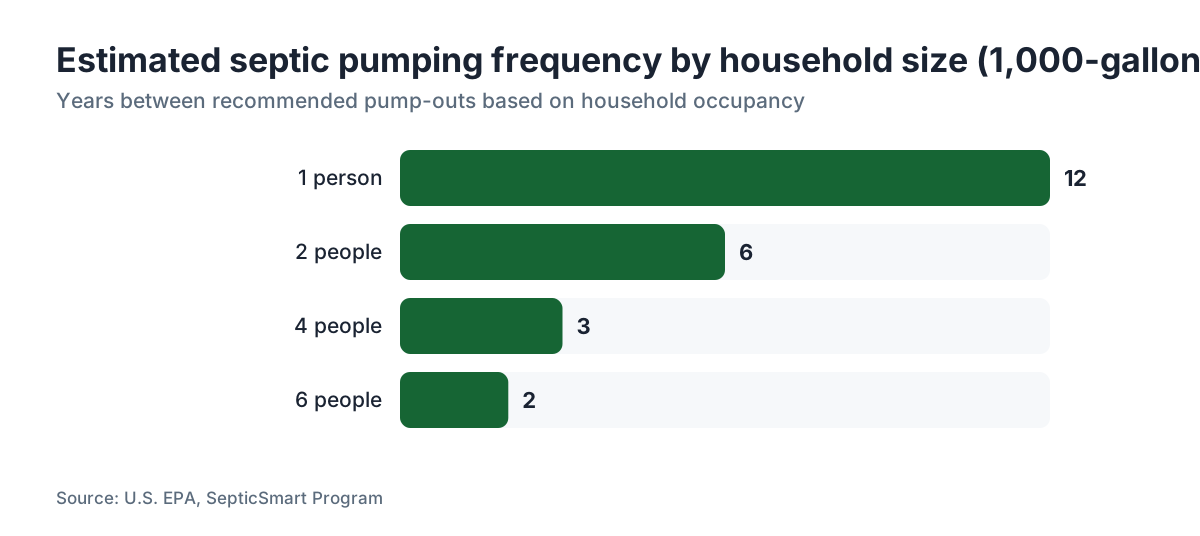
The EPA recommends pumping every three to five years for a typical household [1]. The real interval depends on tank size and household size. A 1,000-gallon tank serving four people fills faster than a 1,500-gallon tank serving two. The table below shows the EPA's general guidance on pumping frequency by tank size and number of people [6].
| Household size | 1,000-gal tank | 1,250-gal tank | 1,500-gal tank |
|---|---|---|---|
| 1 person | 12 years | 16 years | 19 years |
| 2 people | 6 years | 8 years | 10 years |
| 4 people | 3 years | 4 years | 5 years |
| 6 people | 2 years | 2.5 years | 3 years |
These are rough benchmarks. A licensed pumper can measure your sludge and scum layers with a sludge judge and tell you the actual remaining capacity. That measurement is the only honest way to know when your tank needs service.
Go too long between pumpings and solids carry over into the leach field and clog the soil. Drain field repair costs between $3,000 and $15,000 depending on size and soil type [7]. A pump-out costs $300 to $600 in most markets [7]. The math strongly favors regular pumping.
See our detailed breakdown of how often to pump your septic tank for a calculator-style guide.
Are there any EPA-approved or state-approved septic additives?
The EPA does not maintain an approved list of septic additives, and it doesn't certify products for residential septic systems [1]. What you see on product labels are marketing claims, not regulatory endorsements. Phrases like "EPA registered" on some products refer only to registration under the Federal Insecticide, Fungicide, and Rodenticide Act (FIFRA) for pest control claims, not any approval for septic performance [8].
A handful of states run their own testing programs. Washington State's Department of Ecology reviewed additive claims and found that products did not consistently demonstrate benefit in controlled conditions [9]. The National Sanitation Foundation (NSF) does test certain products against its Standard 40 and Standard 46 benchmarks for treatment systems and septic cleaners, but NSF certification doesn't mean the product improves solid digestion. It means the product meets certain safety and materials standards.
If a manufacturer claims their product is required by state code or recommended by a health department, ask for the specific citation. In most cases, no such requirement exists. Some states, including Washington and Connecticut, have moved toward restricting chemical additives rather than endorsing biological ones.
The regulatory record here isn't ambiguous: no federal or major state agency recommends routine additive use for healthy septic systems. Spend that money on septic tank cleaning or a scheduled pump out instead.
What about enzymes: do enzyme-based products help break down solids?
Enzyme-based products are the gentlest and most popular category of septic additive. They usually contain cellulase (breaks down paper), lipase (breaks down fats), protease (breaks down proteins), and amylase (breaks down starches). The pitch is that these enzymes speed up digestion beyond what your native bacteria can do.
Here's the catch. Enzymes are proteins, and proteins don't last long in a biologically active environment. They get consumed by the same bacteria they're supposed to help. University extension programs, including Penn State and North Carolina State, have reviewed the literature and concluded that enzyme additives give no measurable long-term benefit in normal residential systems [10].
Enzyme drain treatments used once for a specific clog (say, grease buildup in the inlet pipe) are a different animal. They target a localized problem over a short window, not the tank's overall biology. For that narrow use, they're unlikely to cause harm and may offer modest mechanical benefit.
Beyond that, your money is better spent on a maintenance schedule than on monthly enzyme packets.
What do septic professionals actually recommend putting in a tank?
Most licensed septic professionals and inspectors say the same thing: nothing. The bacteria already in normal household waste are the right organisms in the right numbers for an anaerobic tank. Adding more organisms or enzymes is redundant at best.
What professionals do recommend, over and over, is better water habits. The National Onsite Wastewater Recycling Association (NOWRA) puts it plainly: the single biggest variable in septic system longevity is hydraulic load management, not chemistry [11]. The volume and timing of water you push through the system matters more than any product you pour in.
For homeowners who want a structured way to track their system's health, maintenance scheduling tools like those offered through SepticMind can log pump dates, inspection results, and usage patterns so you know when your tank is actually due for service rather than guessing off the calendar.
Practical professional recommendations: pump on schedule, keep cooking grease out of drains, don't flush wipes, protect the drain field from compaction by keeping vehicles and heavy equipment off it, and divert roof runoff away from the leach field so the soil doesn't stay saturated [4].
Does a new septic tank need a starter culture or anything to begin working?
New tanks don't need a starter product. This question comes up a lot after septic tank installation or a complete pump-out and cleaning.
A newly installed or freshly pumped tank starts receiving household wastewater right away, and that wastewater carries all the bacteria needed to build the biological community inside the tank. Within a few days of normal use, anaerobic populations begin to establish in the sludge zone. Within a few weeks, the system is biologically active.
Some contractors used to recommend flushing a pound of brewer's yeast or a small amount of raw meat down the toilet to seed a new tank. No controlled evidence shows this speeds up colonization measurably. The tank builds its biology on the same timeline either way.
The one real concern with a brand-new install is making sure the tank isn't hydraulically overloaded in the first days before the bacterial population is established. Spacing out water use in the first week is a sensible precaution, not a hard rule.
If you're weighing whether a new system is worth the cost to install a septic system on your property, the biology side is the least of your worries. The tank manages itself.
What are the signs that solid buildup is becoming a real problem?
A tank that's biologically stressed or simply overfull sends clear signals before it fails completely.
Slow drains throughout the house (more than one fixture) often mean the tank is full and effluent is backing up. Gurgling in the pipes after a flush points to the same thing. Lush, oddly green grass growing directly over the tank or drain field is a sign that partially treated effluent is surfacing. Sewage odors inside the house or near the tank are serious and need attention now.
Seeing any of these? Adding a bacterial product will not solve it. The tank either needs pumping or there's a mechanical failure in the system. A qualified inspection can tell you which, and sometimes both are true.
A badly neglected tank, where sludge and scum together fill more than a third of the tank's volume, is past the point where any additive helps. That's the threshold where solid carryover to the drain field becomes likely, according to guidance from Penn State Extension [10]. The system needs septic tank emptying and a professional assessment.
SepticMind's inspection tracking and alert features help operators flag customers approaching that threshold based on prior measurements, so problems get caught before they turn into drain field failures.
How much does proper septic maintenance cost compared to additive products?
Let's put honest numbers on this.
A routine pump-out for a typical 1,000 to 1,500-gallon tank costs between $300 and $600 in most U.S. markets, though prices vary by region and access difficulty [7]. An inspection adds $100 to $250 on top of that, or gets bundled with the pump-out. Done every three to five years, the annualized cost of proper maintenance runs roughly $60 to $200 a year.
Popular enzyme or bacterial additive products retail for $15 to $40 a month. Homeowners who use them monthly spend $180 to $480 per year, every year, with no evidence they're reducing solid accumulation or extending the pumping interval.
The math isn't close. Routine pumping on schedule is cheaper than a monthly additive habit, and it actually works.
Drain field repair, the thing you're ultimately trying to avoid, runs $3,000 to $15,000 for conventional systems, and replacing a failed system can reach $10,000 to $30,000 or more depending on soil conditions and local permit requirements [7]. One skipped pump-out that kills a drain field costs more than a decade of properly scheduled maintenance.
See our detailed look at the cost to put in a septic tank if you're weighing system replacement.
Frequently asked questions
What is the best thing to put in a septic tank to break down solids?
Nothing you add outperforms the bacteria already living in the tank. A healthy system is biologically self-sufficient. The best practice is removing obstacles: go easy on antibacterial soaps, don't pour bleach directly into drains, keep grease out, and pump every three to five years. That maintenance schedule keeps solid accumulation under control, not any product on a shelf.
Can I use baking soda in my septic tank to help it work better?
Baking soda won't hurt your tank, but it doesn't help either. The pH inside a healthy anaerobic tank is naturally slightly acidic to neutral, which is exactly what the resident bacteria prefer. Adding baking soda to raise pH isn't solving a real problem in a normal tank. Save it for baking. If you're having actual septic trouble, call a licensed pumper for an inspection, not a pantry remedy.
Does flushing yeast down the toilet help a septic tank?
Baker's yeast is the one home remedy with at least a plausible mechanism. Yeast produces enzymes that break down starches and works in low-oxygen environments. No controlled study proves it extends pumping intervals, but a packet of active dry yeast monthly appears harmless and costs about a dollar. It's not a substitute for pumping. Treat it as a low-cost, low-risk experiment, not a fix.
How do I know if my septic tank bacteria are dead or not working?
Sluggish drains throughout the house, sewage odors at the tank or inside, and unusually green grass over the drain field are the practical signs. The only way to confirm bacterial activity is a professional inspection and sludge measurement. If sludge and scum together fill more than one-third of tank volume, the system is overloaded regardless of bacterial status and needs pumping.
Are store-bought septic treatments like Rid-X worth buying?
Rid-X and similar products contain bacterial cultures and enzymes. They aren't harmful to a healthy system, but independent reviews, including analysis by the University of Minnesota Extension and the American Ground Water Trust, found no evidence they reduce sludge accumulation or extend pumping intervals. At $10 to $20 per treatment used monthly, you'd spend more annually on the product than on a professionally scheduled pump-out.
Can vinegar or bleach help clean out a septic tank?
Vinegar at household concentrations, used occasionally for cleaning, won't kill off your tank's bacteria. Bleach is trickier: small amounts diluted through normal laundry are fine. Pouring concentrated bleach straight into a toilet or drain in large amounts can significantly reduce bacterial populations. Never use bleach as a septic treatment. Chemical disruption to the tank's biology is one of the leading causes of system stress.
What household chemicals are most harmful to septic tank bacteria?
The worst include undiluted bleach, drain cleaners with sulfuric acid or lye, antibacterial soaps used heavily, and chemical solvents. Paint thinner, motor oil, and pesticides are also highly toxic to anaerobic bacteria and can leach through the drain field into groundwater. EPA SepticSmart guidance specifically warns against flushing "household chemicals, gasoline, oil, pesticides, antifreeze, and paint" into septic systems.
How long does it take for a septic tank to break down solids naturally?
Anaerobic digestion in a working tank is continuous and slow. Soft organic solids can be partially digested within days to weeks. Heavier inorganic material and resistant organic compounds pile up for years. Even a perfectly healthy tank keeps residual sludge that builds over time and has to be pumped out. The EPA's guideline of pumping every three to five years reflects the rate of net accumulation in a typical household.
Does a garbage disposal hurt the septic tank's ability to break down solids?
Yes, significantly. The EPA estimates garbage disposals can increase the solids entering a septic tank by up to 50 percent. Most residential tanks aren't sized to handle that extra load. If you use a disposal regularly, expect to pump more often, roughly every two years instead of three to five. Some jurisdictions restrict or discourage disposal installation on septic properties for exactly this reason.
What should I add to a new septic tank after installation?
Nothing. Normal household wastewater brings in all the bacteria needed to establish a functioning biological community in a new tank. The population colonizes within days and reaches operational levels within a few weeks of regular use. Starter products, brewer's yeast, and other seeding tricks have no controlled evidence behind them. Start using the system normally and stick to a pumping schedule from day one.
Can I add raw meat or other food to seed a septic tank with bacteria?
This is an old homeowner myth. Raw meat adds organic load to the tank but doesn't meaningfully speed up the establishment of anaerobic bacteria compared to normal wastewater. The bacterial strains in household waste are already the right species for the tank. Adding food scraps or meat is more likely to create a short-term odor problem than any biological benefit.
Does the number of people in a household affect how fast solids build up?
Directly. More people means more daily wastewater and more organic solids entering the tank. The EPA's pumping frequency tables show a four-person household with a 1,000-gallon tank should pump roughly every three years, while a two-person household with the same tank can go about six. Tank size and household size together are the two most reliable predictors of how fast sludge and scum build up.
Is it bad to do a lot of laundry in one day if I have a septic tank?
It can be. Running many loads in a single day sends a large volume of water through the tank fast, stirring the settled sludge layer and pushing solids into the drain field before they've had time to settle and digest. EPA SepticSmart recommends spreading laundry across the week. One to two loads a day is far easier on the system than six or eight in one session.
How do septic additives affect the drain field?
Chemical additives are the biggest concern. Solvents that dissolve scum inside the tank push partially liquefied solids into the drain field, where they clog the soil pores that let treated effluent percolate. Once a drain field clogs this way, the damage is largely irreversible without excavation and replacement. Biological additives pose less direct risk to the field, but they offer no protection either. Proper pumping is the only practice that reliably protects the drain field.
Sources
- U.S. EPA, SepticSmart Program: EPA states that bacteria present in household waste are generally sufficient to break down solids; EPA does not recommend additives; recommends spreading water use and fixing leaks; warns against flushing chemicals, oil, and paint.
- University of Minnesota Extension, Septic System Owner's Guide: Review of additive literature found no credible evidence that biological or chemical additives reduce sludge accumulation or extend pumping intervals.
- California State Water Resources Control Board, Water Code provisions on hazardous septic additives: California prohibits septic additives containing listed hazardous substances under state Water Code.
- U.S. EPA, Septic System Maintenance and Pumping Guidance: Spreading laundry loads across the week and diverting roof runoff from the leach field area are recommended practices to protect system performance.
- U.S. FDA, Final Rule on Antibacterial Soaps (September 2016): FDA banned triclosan and 18 other active ingredients from consumer antiseptic wash products in 2016 due to safety and efficacy concerns.
- U.S. EPA, How Your Septic System Works: Pumping Frequency Table: EPA provides pumping frequency estimates by household size and tank volume, recommending every 3-5 years for a typical 4-person household with a 1,000-gallon tank.
- HomeAdvisor / Angi, Septic Tank Pumping and Repair Cost Guide (2024): Average septic pump-out costs $300-$600; drain field repair costs $3,000-$15,000; full system replacement can exceed $10,000-$30,000 depending on soil and permit conditions.
- U.S. EPA, Federal Insecticide, Fungicide, and Rodenticide Act (FIFRA) Overview: EPA FIFRA registration applies to pest control claims only and does not constitute endorsement of a product's septic system performance.
- Washington State Department of Ecology, Septic System Additive Review: Washington State reviewed additive product claims and found products did not consistently demonstrate benefit in controlled conditions.
- Penn State Extension, Septic System Maintenance: When sludge and scum together occupy more than one-third of tank volume, solid carryover to the drain field becomes likely; enzyme additives do not provide measurable long-term benefit in normal residential systems.
- National Onsite Wastewater Recycling Association (NOWRA), Homeowner Resources: NOWRA frames hydraulic load management as the single biggest variable in septic system longevity.
Last updated 2026-07-10