What does a perc test determine (and why it matters for your septic system)
By the SepticMind Editorial Team
TL;DR
- A percolation (perc) test measures how fast water drains through soil, reported in minutes per inch.
- That number decides whether your lot can legally hold a septic system, how big the drain field must be, and which system type you're allowed to build.
- Most states require a licensed engineer, soil scientist, or health official to run and certify the test before any septic permit is issued.
What exactly does a perc test measure?
A perc test measures one thing: how fast water moves down through soil. The result comes back in minutes per inch (MPI), the number of minutes it takes the water in a test hole to drop a single inch. That one number tells a regulator, a designer, and you whether the soil can safely take treated wastewater from a leach field without backing up, surfacing in the yard, or contaminating groundwater. [1]
The test does not check water quality, soil contamination, or groundwater depth. Those come from separate site work. A perc test is about hydraulic capacity, plain and simple: can this soil accept water fast enough to keep a septic system running, but slow enough to filter out pathogens before effluent reaches the water table?
Most state codes set a passing window. Virginia, for example, requires a perc rate between 1 and 60 MPI for a conventional trench system. Faster than 1 MPI (think coarse gravel or fractured rock) means too little filtration time. Slower than 60 MPI (heavy clay) means the soil barely moves water at all. Both extremes fail. [2]
The EPA calls the drain field the component "where wastewater is filtered through the soil." The perc test is the gatekeeper that decides whether that filtering can actually happen on your parcel. [3]
How is a perc test actually performed?
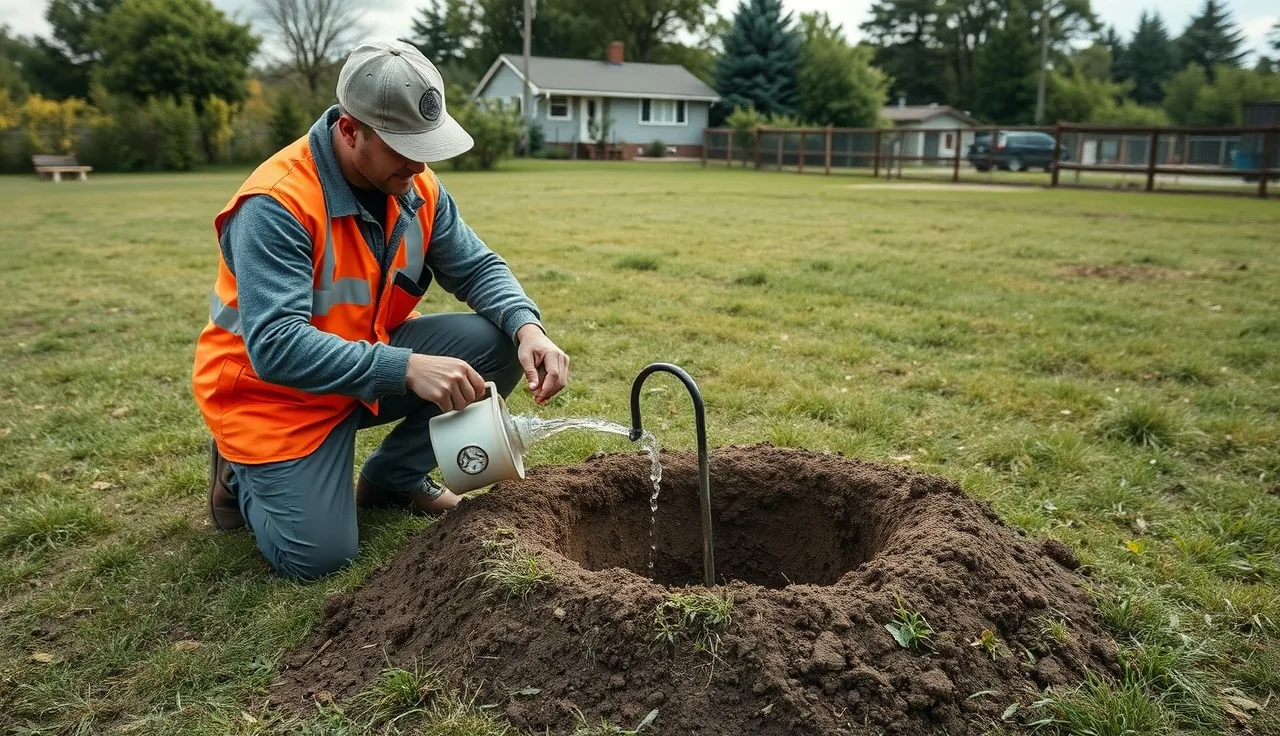
You dig test holes, soak the soil, then time how fast the water drops. The exact steps change state to state, but the shape of the job is the same everywhere.
First, a technician digs or bores holes, usually 4 to 12 inches wide and 12 to 36 inches deep depending on local code, in the spots where the drain field might go. Many counties want three to six holes per site. A little gravel goes in the bottom of each hole so silt doesn't seal it up during boring.
Then comes the presoak. Water goes in to raise the level to a fixed point and gets held there, sometimes for 4 hours, sometimes overnight or longer. This is the part that matters most. Soil absorbs water very differently dry versus saturated. A field-moist clay can look fine. Saturate it fully and it won't budge. The EPA recommends presoak periods that copy real seasonal saturation. [3]
Last, the tester fills to a set depth (typically 6 inches above the gravel) and measures how far the level drops over 30 minutes. The final interval sets the official rate. Drop 3 inches in 30 minutes and you've got a 10 MPI rate, which is strong for a conventional system.
Results get logged on a state form and filed with a site plan at the county health department or environmental agency. Most states require the tester to hold a license: a professional engineer (PE), a licensed site evaluator, or a registered sanitarian. Hiring an unlicensed tester is a fast way to get a permit rejection no matter how good the soil is.
What perc test results mean: passing vs. failing rates explained
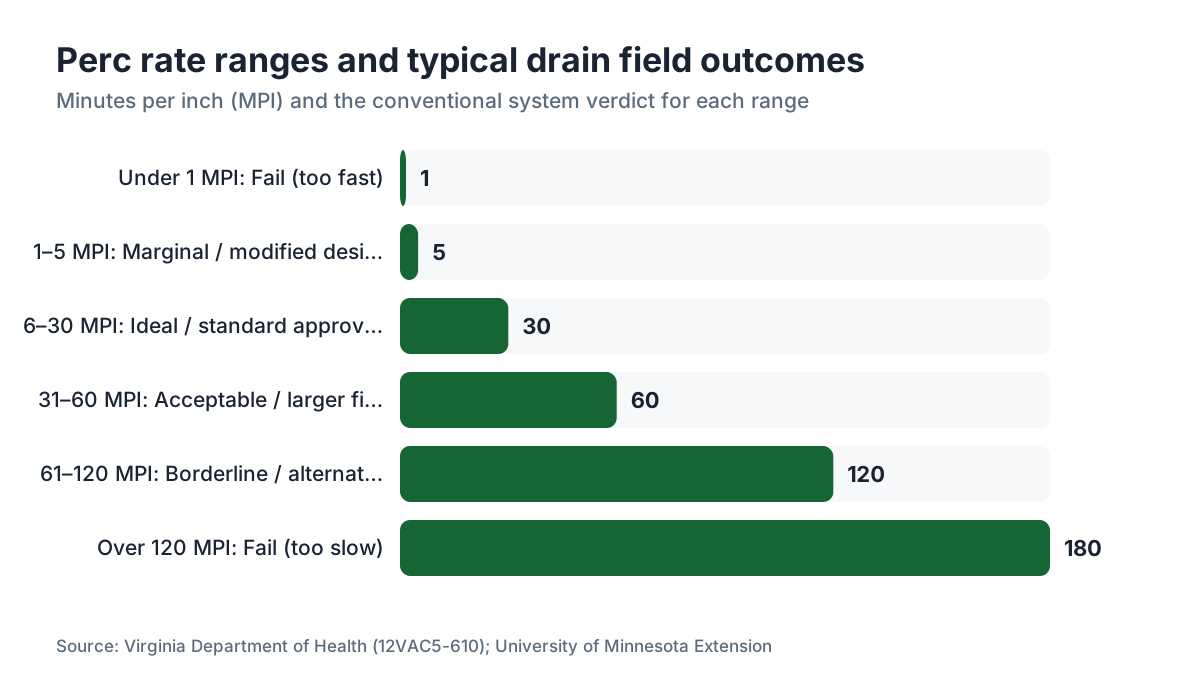
The passing window shifts by state and by system type, but a rough national picture holds for conventional gravity-fed systems.
| Perc Rate (MPI) | Soil Character | Typical Outcome |
|---|---|---|
| Under 1 | Gravel, fractured rock | Fail: too fast, insufficient filtration |
| 1 to 5 | Sandy, coarse | Marginal; may pass in some states with modified design |
| 6 to 30 | Sandy loam, loam | Good: standard trench system usually approved |
| 31 to 60 | Silt loam, fine sandy loam | Acceptable in many states; larger drain field required |
| 61 to 120 | Clay loam | Borderline; alternative systems often needed |
| Over 120 | Heavy clay | Fail in most states for conventional systems |
Passing doesn't mean you can build whatever you want. It means the soil qualifies for at least one system type. A rate of 45 MPI might pass for a mound system in Wisconsin but demand a bigger absorption area than a 15 MPI result would. The rate sets the required square footage of trench bottom directly, through a formula written into your state's code. [4]
Some states dropped timed perc tests in favor of soil morphology evaluation, where a licensed soil scientist reads the soil profile for texture, structure, color mottling (a sign of seasonal water tables), and other redoximorphic features. North Carolina leans primarily on soil evaluation rather than timed perc rates. [5] Plenty of states use both.
A failed perc test is rarely the end. It means a conventional system won't work, but engineered alternatives like mound systems, drip irrigation, aerobic treatment units (ATUs), or constructed wetlands can still open the lot to development. Those cost a lot more, which is exactly why people get so anxious the moment they hear "your perc test failed."
Does a perc test determine the size of your drain field?
Yes. This is the most direct thing the result controls. Once you have a perc rate, your designer uses it to calculate the required trench bottom area in square feet. The formula lives in your state's onsite wastewater code, but the bones are the same nearly everywhere: take the design daily flow (gallons per day, usually set by bedroom count) and divide it by the loading rate your soil's perc rate allows. [4]
Say your perc rate is 20 MPI, your state assigns a loading rate of 0.6 gallons per day per square foot of trench bottom for that rate, and your 3-bedroom house generates about 300 gallons per day. You need 300 divided by 0.6, which is 500 square feet of trench bottom. That converts to a set number of linear feet at your system's trench width.
A slower perc rate means a lower loading rate, which means more square footage for the same daily flow. Heavy clay at 80 MPI might need three times the trench area of a sandy loam at 15 MPI. That extra area costs money in excavation, pipe, and gravel. It also has to physically fit on your lot, which is often the real limit on small parcels.
That's why the perc rate shows up front and center on the septic permit application and on the as-built drawing filed with the county. Any future septic tank inspection or real estate deal should include a look at those records. The original perc rate tells you how much design margin the system has and whether the drain field was built to code for your soil.
What does a perc test determine about system type?
Beyond sizing, the perc rate (paired with groundwater depth and setbacks) decides which system types can even be permitted. This is where the result splits into very different construction jobs and very different price tags.
A conventional gravity system is the cheapest option. It needs soil that percolates inside the state's range plus enough vertical separation between the trench bottom and the seasonal high water table, typically 2 to 4 feet in most states. If your perc rate is fine but your water table sits high, you'll get pushed toward a mound system anyway.
When the perc rate comes back slower than the state's max for conventional systems, you're in alternative territory. Pressure-distribution systems spread effluent more evenly across a bigger area. Mound systems build that area above grade. Drip irrigation doses effluent into shallow soil on a timer, which can work in slow-draining soils that fail a conventional test. Aerobic treatment units treat effluent to a higher standard before it hits the soil, and some states accept that as reason for a smaller or less permeable drain field.
The perc result also shapes septic tank installation planning, because different system types want different tanks. A drip system needs a pump tank. An ATU needs its own aeration chamber. The perc rate is often the first fork in the road that sets the whole design.
Buying land and wondering about the cost to install a septic system? The perc result is the single variable with the widest swing in that estimate. A strong rate in good soil means a simple conventional system. A borderline or failed rate can double or triple the project cost.
Who conducts a perc test, and who has to approve it?
You can't hire just anyone with a shovel. Most states require one of a short list: a licensed professional engineer (PE) with onsite wastewater experience, a registered sanitarian, a licensed soil scientist, or a state-certified site evaluator. Some states still let county health department staff run tests directly, which used to be normal in rural counties. [2]
The approval authority is almost always the county or local health department, or the state environmental agency in smaller states. The tester submits field data, a site map, and the calculated perc rates. A plan reviewer checks whether the results back up the proposed design. Numbers add up and the design meets code, a permit issues. If not, you may be asked to test a different part of the lot, bring in a soil scientist for a supplemental evaluation, or redesign to an alternative system.
Some states let the licensed tester self-certify straightforward results, backed by a spot-check audit. Others require a health department officer physically present during the test. Not sure what your county wants? Call the local environmental health office before you schedule anything. Paying for a test that doesn't meet the procedural rules is money down the drain.
A few states now require soil morphology evaluations alongside or instead of perc tests, reflecting decades of research showing timed perc rates alone can miss features that matter. If your state recently updated its onsite wastewater code, confirm your tester is current with the new requirements.
How much does a perc test cost?
Perc test costs run roughly $250 to $1,000 in most of the country, with the middle landing around $500 to $700 for a standard residential lot. [6] A few real variables move that number.
Hard access, thick brush, or rocky ground adds time and equipment cost. Lots that need a backhoe instead of a hand auger cost more. Sites requiring a 24-hour presoak may need two visits, which tacks on a second mobilization charge. Some testers bundle the perc test with a full site evaluation (perc, soil profile, setbacks, topography sketch). That costs more upfront but gets you further into permitting.
Geography matters a lot. In the rural South and Midwest, where testers are spread thin and drives are long, $700 to $900 is common. In the Mid-Atlantic and Northeast, where lots are smaller and testers are plentiful, $300 to $500 is more typical.
The perc test fee is separate from the county permit fee, which usually runs $100 to $500 depending on the jurisdiction. [7] You pay both.
If you're pricing the cost to put in a septic tank for new construction, the perc test is a small line item in the budget but a high-stakes one. The result can swing the total system cost by $5,000 to $20,000 or more if it bumps you from conventional to alternative territory.
When do you need a perc test (and when can you skip it)?
You need a perc test any time you apply for a new septic permit on a lot without approved soil data on file. That covers new construction on raw land, replacing a failed system where no valid perc data exists, and in some states, major changes like expanding a drain field.
You may be able to skip a fresh test in a few cases. If the lot was tested before and the results are on file with the county, they may still count, as long as nobody graded, filled, or built over the test area. Most counties accept perc data five to ten years old for undisturbed lots, but policies vary. Verify with your local health office before you assume old results still work.
Existing homes with working systems generally don't need perc tests for routine maintenance or minor repairs. Replacing a septic tank while the drain field stays put? No new test needed. Adding bedrooms so the system has to be upgraded? A new evaluation is almost certain.
Real estate deals are a gray area. Sellers aren't universally required to hand over perc results in disclosures, but a buyer who doesn't confirm that a vacant lot has passable soil is taking a real gamble. Smart land contracts make the deal contingent on a passed perc test.
SepticMind's documentation tools let service operators pull prior test data and permit history when scoping a job on an existing property, which cuts the back-and-forth with county offices.
What happens if your land fails a perc test?
A failed perc test feels like a wall. It's usually a detour. Here are the realistic ways forward.
Test a different area. Most lots have soil variability. A hole near a seasonal drainage channel will almost always perform worse than one on a mid-slope with good natural drainage. If your county allows it, hire a soil scientist to walk the property and pick the most promising zones before you dig again. That's money well spent ahead of a second full test.
Consider alternative systems. Mound systems build an elevated drain field from imported sand over the native soil, skipping the slow-draining layer entirely. They handle heavy clay, shallow bedrock, and high water tables. They cost more: a mound typically runs $10,000 to $20,000 above a conventional system in the same county. [8] ATUs and drip irrigation are other engineered routes some states approve for tough soils.
Appeal or request a variance. Some health departments let a design engineer submit an alternative analysis showing a modified system can still meet treatment goals even when standard perc thresholds aren't met. This takes a competent engineer and a willing regulator, but it happens.
And sometimes a lot simply can't support any onsite system. In that case, hooking to municipal sewer (if it's there) or rethinking the land use are the honest outcomes. This is bigger than most people realize. The EPA has estimated that roughly 10 to 20 percent of existing onsite systems are failing or inadequate in some way, [9] and failed perc conditions are a major contributor.
How does a perc test relate to groundwater and environmental protection?
The perc test sits inside a larger framework built to keep pathogens and nutrients out of groundwater. Wastewater leaving a septic tank still carries bacteria, viruses, and nitrogen. The soil between the trench and the water table does the final treatment, and the perc rate is a proxy for how well that soil can do the work. [3]
Very fast soil (low MPI) is a contamination risk more than an engineering problem. Water racing through gravel or fractured rock has almost no contact time with soil particles, so pathogens pass through fast and can reach groundwater or a nearby well within hours. That's why states set a minimum perc rate, more than a maximum.
Very slow soil (high MPI) backs effluent up into the tank and eventually pushes sewage to the surface, a direct public health hazard. Sewage surfacing in a yard creates exposure risk and violates state environmental regulations in every jurisdiction.
Separation distance (usually 2 to 4 feet of unsaturated soil between the trench bottom and the seasonal high water table) works with the perc rate to define where a drain field can go. Both requirements have to be met at once. That's why a soil profile analysis, which shows depth to mottled or gleyed horizons (signs of seasonal saturation), accompanies or supplements the perc test in most modern permitting. [5]
The leach field is where all this filtration happens. Understanding the perc test is the first step in understanding how a drain field works and why it eventually fails.
How long does a perc test take, and how long are results valid?
Field work for a typical residential perc test takes 2 to 4 hours of active work, not counting the presoak. If your state wants a 24-hour presoak, the tester digs holes one day, comes back the next morning for the timed test, and may need a third visit for the soil profile. Plan on 2 to 3 days from first hole to submitted results, longer if the tester is juggling other jobs.
Health department processing adds more. County offices in busy construction seasons can take 2 to 6 weeks to review and return results. Flag a discrepancy or request more information and you add time.
Validity varies by state. Many treat approved perc data as good for the life of the permit, as long as site conditions haven't changed. Others set a five-year expiration. Some require retesting if the permit lapses before construction starts. Check your county's rules before you count on old results.
Season matters for accuracy. Most codes call for testing during the wet season or after enough rain, because soil percolates fastest when dry and slowest when saturated. A test run in a late-summer drought on clay soil can produce an artificially passing rate that fails during a wet spring. Some states specifically require testing in the wettest part of the year, or require seasonal groundwater data from monitoring wells. [2]
What's the difference between a perc test and a full site evaluation?
People say "perc test" to mean any soil evaluation for septic. Technically the perc test is just one piece of a full site evaluation.
A full site evaluation usually includes the timed percolation test, a soil profile examination (texture, structure, depth to restrictive layers, signs of seasonal saturation), topographic measurements (slope, drainage patterns), setback verification (distance to wells, property lines, water features), and sometimes a soil morphology report from a licensed soil scientist.
Many states now require the full package instead of timed perc rates alone, because soil morphology data predicts long-term drain field performance better than a single timed test. The perc rate can wobble with how carefully the tester runs the presoak, soil disturbance during boring, and that day's moisture. Soil mottling patterns represent decades of seasonal water movement, and they're much harder to fake or misread.
Here's the practical takeaway. If you're hiring someone for "a perc test" for a new construction permit, confirm exactly what's in their quote and whether their deliverable meets your county's full submittal requirements. A $250 test that only spits out MPI numbers may not be enough if your county wants a soil profile too.
Operators running new construction across multiple counties find tools like SepticMind handy for tracking which jurisdiction requires which components, cutting the repeated calls to health department offices.
Frequently asked questions
Can I do a perc test myself?
In most states, no. Perc tests for septic permitting have to be conducted or certified by a licensed professional: a PE, registered sanitarian, licensed soil scientist, or state-certified site evaluator. Some counties still let applicants dig test holes while a health department officer observes and records results. Check with your local environmental health office before hiring anyone, and verify their license type meets your county's requirements.
What is a good perc test result?
For a conventional gravity-fed drain field, most engineers consider 6 to 30 minutes per inch (MPI) ideal. That range drains fast enough to handle normal daily flow without backing up, but slowly enough to filter pathogens before effluent reaches groundwater. Rates from 30 to 60 MPI pass in many states but need a bigger drain field. Below 1 or above 60 to 120 MPI typically means a failed test.
How long does a perc test take?
Field work takes 2 to 4 hours, but most states require a presoak of 4 to 24 hours before the timed test begins, so the full process usually spans 2 days. Add 2 to 6 weeks for the health department to review and approve submitted results. Busy construction seasons push that review timeline out further.
What happens if my land fails a perc test?
A failed perc test disqualifies a conventional drain field but doesn't necessarily stop all development. Options include testing a different area of the lot, designing an engineered alternative (mound, drip irrigation, aerobic treatment unit), or requesting a variance with supporting engineering analysis. Some lots genuinely can't support any onsite system, in which case municipal sewer connection or a change in land use is the honest conclusion.
Does a perc test expire?
It depends on the state and county. Many jurisdictions treat approved perc results as valid for the life of the associated permit, as long as site conditions haven't changed. Others set a five-year expiration. If a permit lapses before construction starts, retesting is often required. Always confirm with your local health department before relying on old test data for a permit application.
How much does a perc test cost?
Most residential perc tests run $250 to $1,000, with the national average around $500 to $700. Cost varies with lot access, how many test holes are required, whether a 24-hour presoak is mandated, and local market rates. The perc test fee is separate from the county permit fee, which typically adds another $100 to $500. Bundled site evaluations that include a soil profile cost more but often produce a complete permit submittal.
Can a perc test be done in winter?
It depends on the state and ground conditions. Some states require testing during or after the wet season to capture the slowest, most conservative drainage conditions. Frozen ground is a practical barrier to digging test holes and running a meaningful presoak. Many jurisdictions allow winter testing if the ground isn't frozen and the soil can be properly saturated. Check your state's onsite wastewater code for seasonal restrictions.
Is a perc test required to sell land?
Not universally, but most buyers of undeveloped rural land with no sewer access insist on one before closing, and many contracts make the deal contingent on a passed perc test. Sellers aren't required to disclose old or failed perc results in every state, but failing to disclose a known failed test can create legal liability. Buyers should request county records or commission a new test before purchasing vacant land intended for residential development.
What's the difference between a perc test and a soil evaluation?
A perc test is specifically the timed measurement of how fast water drops in a test hole, expressed in minutes per inch. A full soil evaluation adds a profile analysis: soil texture, structure, mottling (evidence of seasonal water tables), and depth to restrictive layers. Many states now require both. The soil evaluation often predicts long-term drain field performance better because it captures seasonal conditions a single timed test might miss.
Does a perc test determine where the drain field goes?
Partly. The test identifies which areas of a lot have soil capable of supporting a drain field, and results from different locations can rule areas in or out. The final location also depends on required setbacks from wells, property lines, and water features, plus slope, available area, and any easements. The perc results feed into the overall site plan rather than dictating the exact spot on their own.
Can a perc test show if an existing drain field is failing?
Not directly. A perc test measures native soil capacity before a system is built. Once a drain field is running and possibly clogged with biomat, a new perc test in the same spot would produce artificially slow results that reflect the clogging, not the original soil. Diagnosing a failing drain field involves watching for surfacing, tank backup, and sometimes drain field probing. A new perc test evaluates a replacement area, not the existing field.
How many test holes are needed for a perc test?
Typically three to six holes per site, though state codes vary. Multiple holes are required because soil is not uniform, and averaging several results is more reliable than one measurement. Some states allow fewer holes for small lots with very uniform soil. The holes usually get placed throughout the proposed drain field area, with extra holes in reserve areas if the primary location doesn't work out.
Does a perc test account for the water table?
The perc test itself measures surface-to-midlayer drainage rates and does not directly measure groundwater depth. Groundwater depth is assessed separately through soil profile examination (looking for mottled or gleyed horizons) or monitoring wells. Both the perc rate and the separation distance to the seasonal high water table must meet code for a permit to issue. A passing perc rate does not automatically mean the lot passes every site requirement.
Sources
- EPA SepticSmart: Types of Septic Systems: Drain field filters wastewater through the soil; perc rate determines whether that filtering is feasible on a given site.
- Virginia Department of Health, Sewage Handling and Disposal Regulations (12VAC5-610): Virginia requires perc rates of 1 to 60 MPI for conventional trench systems and mandates that licensed evaluators conduct testing.
- EPA SepticSmart Program: How Your Septic System Works: EPA describes the drain field as where wastewater is filtered through the soil, and recommends presoak periods that mimic seasonal saturation.
- University of Minnesota Extension (Onsite Sewage Treatment Program): Perc rate is used with design daily flow to calculate required drain field trench bottom area in square feet, using state loading rate tables.
- North Carolina State University, College of Agriculture and Life Sciences: North Carolina relies primarily on soil morphology evaluation rather than timed perc rates for onsite wastewater permitting.
- Angi: Perc Test Cost Guide: Perc test costs range from approximately $250 to $1,000 nationally, with typical residential tests averaging $500 to $700.
- EPA: Septic Systems (Onsite/Decentralized Systems): County septic permit fees typically range from $100 to $500 depending on jurisdiction.
- University of Minnesota Extension (Onsite Sewage Treatment Program): Mound systems typically cost $10,000 to $20,000 more than conventional gravity systems in comparable counties.
- EPA: Septic Systems (Onsite/Decentralized Systems): EPA estimates that roughly 10 to 20 percent of existing onsite systems are failing or inadequate in some respect.
- Penn State Extension: Many states set acceptable perc rate ranges for conventional systems and require soil profile examination alongside timed perc tests.
- EPA: Septic Systems (Onsite/Decentralized Systems): Engineered alternatives including mound, drip irrigation, and aerobic treatment units may be approved for soils that fail conventional perc thresholds.
Last updated 2026-07-09