Septic tank dimensions: sizes, shapes, and how to pick the right one
By the SepticMind Editorial Team
TL;DR
- Most residential septic tanks hold 1,000 to 1,500 gallons.
- A 1,000-gallon tank measures about 8.5 feet long, 5.5 feet wide, and 5.5 feet tall.
- Minimum size is set by bedroom count, not how many people actually live there.
- Two-compartment tanks are now required in most states.
- Concrete, fiberglass, and polyethylene tanks carry slightly different footprints for the same gallon rating.
What are standard septic tank dimensions?
A standard 1,000-gallon septic tank, the minimum most states allow for a single-family home, runs roughly 96 to 102 inches long, 60 to 68 inches wide, and 60 to 72 inches deep. Call it 8 to 8.5 feet long and about 5 to 5.5 feet wide and tall. Those numbers shift by a few inches depending on whether the tank is concrete, fiberglass, or polyethylene, and whether it has a single chamber or two. That variation matters the day you dig the hole.
A 1,500-gallon tank, the size most commonly installed for three- and four-bedroom homes today, runs closer to 10 to 12 feet long, 6 to 7 feet wide, and 5.5 to 6 feet deep. No manufacturer publishes a single universal standard. The table below reflects the typical ranges you'll see from the major precast and polyethylene producers across the U.S. [1]
| Tank size (gallons) | Typical length | Typical width | Typical depth | Common application |
|---|---|---|---|---|
| 500 | 5.5 ft | 4.5 ft | 4.5 ft | Vacation cabins, very small structures |
| 750 | 6.5 ft | 5 ft | 5 ft | 1-bedroom homes, some states allow |
| 1,000 | 8.5 ft | 5.5 ft | 5.5 ft | 1 to 2 bedroom homes, most state minimum |
| 1,250 | 10 ft | 5.5 ft | 5.75 ft | 3-bedroom homes in several states |
| 1,500 | 10 to 12 ft | 6 to 7 ft | 5.5 to 6 ft | 3 to 4 bedroom homes, common new install |
| 2,000 | 13 ft | 7 ft | 6 ft | 4 to 5 bedroom homes, small commercial |
| 2,500 | 14 ft | 7.5 ft | 6.5 ft | Large homes, small commercial |
These are outside dimensions. Usable liquid capacity always runs a few inches less, because the tank needs headspace above the liquid line and a baffle at both the inlet and outlet ends. The actual liquid depth in a 1,000-gallon concrete tank is typically around 4.5 feet.
How does tank shape affect its dimensions?
Shape changes the footprint even when the gallon capacity is identical. Most residential tanks are horizontal cylinders or rectangular boxes. Precast concrete tanks are almost always rectangular, which makes them predictable to excavate for. Fiberglass tanks are usually cylindrical or have rounded ends, giving them a slightly smaller diameter but sometimes a longer body for the same volume. Polyethylene tanks vary the most. Some makers build them low and wide to fit under driveways with minimal cover.
Vertical tanks exist too. A vertical 500-gallon poly tank might be only 4 feet across but stand 6.5 feet tall, which helps on tight urban lots where horizontal space is scarce. The tradeoff is more excavation depth, and depth gets expensive in rock.
Low-profile tanks are worth a closer look. If your house has a shallow foundation or the water table sits high, you might need a tank that sits only 18 to 24 inches below grade instead of the usual 24 to 36 inches. Low-profile designs spread wider to hit the same volume with less depth, so a 1,000-gallon low-profile tank might run 10 feet long and 7 feet wide instead of the typical 8.5 by 5.5. That moves the outlet end, which changes your leach field layout. Sort that out before you pour the inlet pipe.
What size septic tank do you need by number of bedrooms?
States set the minimum tank size by bedroom count, not by how many people actually live there. Bedrooms are a reasonable stand-in for peak daily sewage flow, and they're easy to verify without metering anyone's water. The EPA's SepticSmart program bases sizing on expected daily wastewater flow, usually figured at 75 to 100 gallons per person per day, with enough tank to hold two to three days of detention time [2].
Here's how that maps to bedrooms in most states. Verify your own state code before you buy anything.
| Bedrooms | Typical minimum tank size | Example state that requires it |
|---|---|---|
| 1 to 2 | 1,000 gallons | Florida, Texas, Virginia |
| 3 | 1,000 to 1,250 gallons | Varies widely |
| 4 | 1,250 to 1,500 gallons | Most states |
| 5 | 1,500 to 2,000 gallons | Most states |
| 6+ | 2,000+ gallons | Most states |
Virginia's Sewage Handling and Disposal Regulations require a 1,000-gallon tank for homes up to three bedrooms and a 1,250-gallon tank for four bedrooms, adding 250 gallons per bedroom beyond that [3]. Florida requires a 1,050-gallon minimum for any new system, no matter the bedroom count [4]. Texas (30 TAC Chapter 285) starts at 750 gallons for a one-bedroom and scales up from there [5].
Here's what I'd actually do. If you're building new and the code allows 1,000 gallons for a three-bedroom house, go to 1,500 anyway. The price gap between those two tanks usually runs $200 to $600, and you buy longer stretches between septic tank pumping visits. Add a bedroom later, or run a home business that dumps more water down the drain, and you won't be scrambling. Tank size barely moves the total project cost. Our breakdown of the cost to put in a septic tank has the full picture.
How do concrete, fiberglass, and plastic tank dimensions compare?
For the same gallon rating, the three materials carry very different wall thicknesses, and that thickness eats ground space without adding a drop of capacity.
Concrete walls run 3.5 to 5 inches thick depending on the design load (traffic versus non-traffic cover) and the mix [8]. A 1,000-gallon concrete tank measures roughly 4 to 6 inches larger in each direction than the interior liquid space. Concrete is heavy, typically 8,000 to 13,000 pounds for a 1,000-gallon tank, so you need a crane or a large excavator to set it [8].
Fiberglass walls are 0.25 to 0.5 inches thick, so the outside dimensions sit very close to the interior. That keeps fiberglass tanks light, 800 to 1,200 pounds for 1,000 gallons, and easy to handle where access is tight. The catch: they can float if the water table rises before backfill, so crews fill them with water first.
Polyethylene tanks land between the two on wall thickness, usually 0.4 to 0.75 inches, with walls that flex under soil pressure. They're the lightest option, often under 500 pounds for a 1,000-gallon tank. That flexibility works against them in some soils. Heavy clay or rocky backfill can distort the shape over time.
For the excavation crew, the number that matters is the tank's outside footprint plus 12 to 18 inches on each side for working room and bedding material. A 1,000-gallon concrete tank at 8.5 by 5.5 feet needs a hole of roughly 10.5 by 7.5 feet, minimum.
How deep does a septic tank need to be buried?
Depth splits into two questions: how far the top of the tank sits below the surface (cover depth), and how far the bottom of the tank sits in the ground (total excavation depth). Both matter, for different reasons.
Cover depth, the soil over the lid, runs 6 inches minimum in warm climates and 12 to 36 inches in cold climates where frost is a concern [2]. In Minnesota and other northern states, tanks often sit 3 to 4 feet down to keep effluent from freezing. That pushes total excavation depth for a 1,500-gallon concrete tank in Minnesota to 9 or 10 feet below grade.
In Florida or Texas, where freeze depth is zero and soils are often sandy or high in groundwater, minimum cover might be 6 inches and total excavation only 6 to 7 feet for the same tank. Florida also requires the bottom of the tank to sit at least 12 inches above the seasonal high water table [4].
The inlet pipe always enters the tank higher than the outlet leaves it. That difference, called the drop, is typically 1 to 2 inches across the length of the tank. The small slope keeps wastewater moving without churning up settled solids. The inlet and outlet inverts (the bottom inside edge of the pipe where it meets the tank) sit 6 to 12 inches below the tank's maximum liquid level, depending on the baffle design.
Your tank lid has to be reachable for pumping. That means no patio and no structure on top of it. Many homeowners add riser extensions, usually 6 to 12 inches in diameter and 6 to 24 inches tall, to bring the access lid to grade. Risers add a few inches to the above-grade profile and save you the cost and the torn-up lawn every time the tank needs service.
What is the difference between a one-compartment and two-compartment tank?
Most states now require two-compartment tanks for every new installation, and there's a solid reason for it. A two-compartment tank divides the interior with a concrete or fiberglass baffle wall, usually set about a third of the way from the inlet end. Sewage enters the first compartment, solids settle and scum floats, and only partly clarified effluent passes through the divider into the second compartment for more settling before it exits to the drain field.
The EPA's Onsite Wastewater Treatment Systems Manual describes two-compartment tanks as producing effluent with lower suspended solids, which extends the life of the leach field by slowing the biomat buildup that eventually clogs drain field soil [7]. That's a real benefit, not marketing copy.
A two-compartment tank is not larger than a single-compartment tank of the same total rating. The internal divider takes up almost no space. A 1,500-gallon two-compartment precast tank might measure 10 feet 8 inches long, 5 feet 10 inches wide, and 5 feet 10 inches deep, essentially the same footprint as the single-compartment version.
Some larger properties run two separate tanks in series instead of one divided tank. This shows up on systems serving more than four or five bedrooms, where a single big tank gets hard to haul and set. Two 1,000-gallon tanks deliver more easily than one 2,000-gallon tank on many rural roads. Do it this way and the connecting pipe still needs that 1 to 2 inch drop, and both tanks need accessible lids.
How do tank dimensions affect the drain field design?
The tank is only stage one. The outlet end of the tank sets where the drain field starts, and the elevation of that outlet controls how deep the distribution pipes can run. Set the outlet low relative to grade and the trenches end up deep, which cuts down the aerobic soil sitting above them. That top 18 to 24 inches of soil does the real treatment work in a conventional leach field.
A taller tank isn't automatically better. A deeper tank drops the outlet further below grade, which can force the distribution box and field lines into soil that's wetter or drains worse. This is exactly why a site's perc test results and soil profile should drive tank placement, not what's convenient for the excavator.
Dimensions also decide the setback math. Most state codes want the tank at least 5 to 10 feet from property lines, 5 to 10 feet from the house foundation, 50 to 100 feet from wells, and set distances from streams, wetlands, and easements. These setbacks measure from the outside wall of the tank, not its center, so a bigger tank chews into your available clearance on every side. On a small lot, jumping from 1,000 to 1,500 gallons (roughly 18 to 24 inches more length) can shove the outlet end past a setback line.
Planning a new system or a replacement? Our overview of septic tank installation shows how these pieces line up on a site plan.
Can you measure your existing septic tank's size without digging?
Yes, with a little detective work. Start with your county health department records. Any permitted septic system has an as-built drawing on file showing tank location, size, and distances to the house and property lines. Most counties post these online now. Call the county environmental health office if the web portal comes up empty.
If records are missing or the system predates permit rules, a probe rod (a thin steel rod with depth markings) can find the tank lid once you know the rough location. Open the lid and measure the interior directly: length times width times depth in feet, times 7.48, gives you gallons. Round to the nearest standard size.
Quick shorthand. If your probe hits concrete at 18 to 30 inches below grade and the lid is about 24 inches across, you almost certainly have a concrete tank installed before 1990, and 1,000 gallons was the standard through most of that era. Systems installed after 1990 in most states moved to 1,250 or 1,500 gallons as minimums.
A septic tank inspection by a licensed inspector locates, measures, and checks the condition of the tank in one visit. If you don't already know the tank's condition, that's a better use of money than just finding out the size.
What happens if your septic tank is too small for your household?
An undersized tank doesn't hold waste long enough to treat it. Proper treatment needs solids to settle for roughly 24 to 48 hours before effluent leaves the tank. When flow outruns the tank's design capacity, retention time drops and half-settled waste rides out into the drain field. Biomat builds up faster, field lines clog, and you end up with effluent surfacing in the yard or sewage backing up into the house.
The warning signs come sooner than most people expect. A tank sized for a one-bedroom cabin, then pressed into service for a full-time four-person household, can show field stress in two or three years. A properly sized system runs 20 to 30 years before it needs that kind of attention.
Two fixes exist. Replace the tank, which is a serious excavation job. Or add a second tank in series ahead of the existing one, which is often cheaper and less disruptive. Either way, if the field already took damage, you may need septic system repair work beyond the tank itself.
The EPA's SepticSmart guidance says a properly designed, installed, and maintained septic system can last 25 to 30 years, but that number assumes correct sizing from day one [2]. Undersizing is one of the fastest ways to cut it in half.
Operators tracking dozens of properties with mixed tank sizes and pump schedules can use SepticMind to map tank capacity against actual household size, which flags the systems getting overworked before the failure shows up on site.
How much does tank size affect pumping frequency?
Directly. The EPA and University of Minnesota Extension both show that pump frequency turns on three things: household size (people, not bedrooms), tank volume, and how hard you work to keep fats, oils, and non-organic junk out of the drain [2][6].
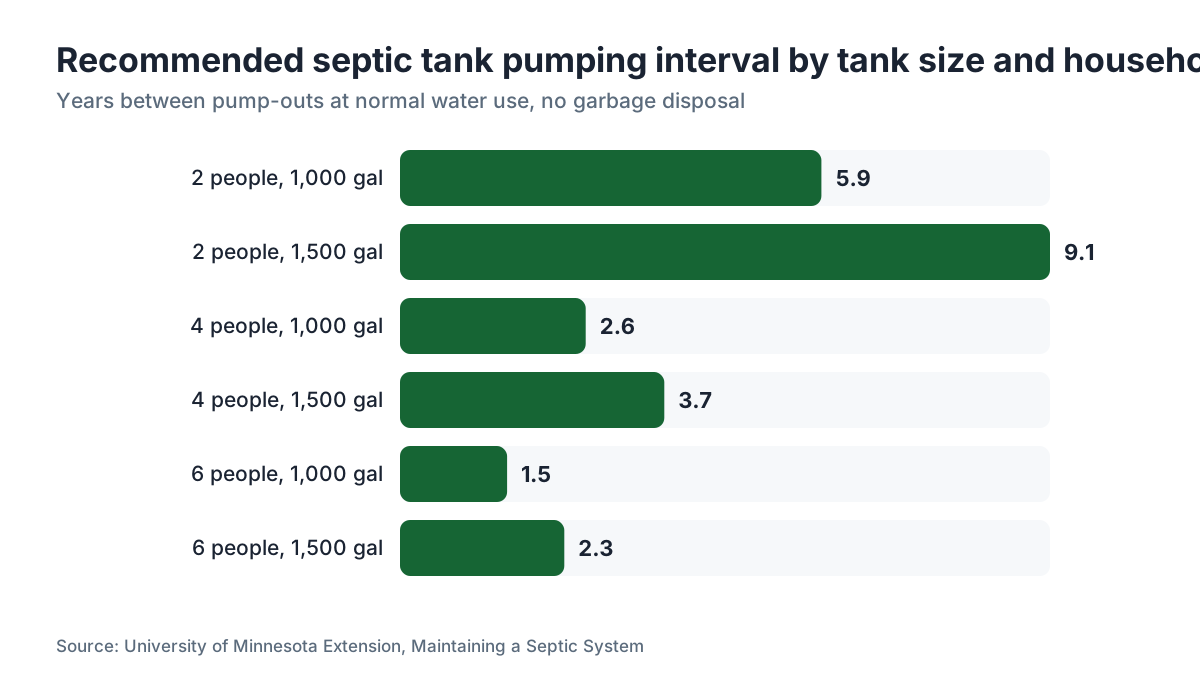
The University of Minnesota Extension's pumping table, the one the industry cites most, shows a four-person household with a 1,000-gallon tank should pump every 2.6 years, while the same household with a 1,500-gallon tank stretches to 3.7 years [6]. At $300 to $600 per pump-out in most markets, that gap adds up over the life of a system.
| Household size (people) | 1,000-gal tank: pump every | 1,500-gal tank: pump every |
|---|---|---|
| 1 | 12.4 years | 18.9 years |
| 2 | 5.9 years | 9.1 years |
| 3 | 3.7 years | 5.9 years |
| 4 | 2.6 years | 3.7 years |
| 6 | 1.5 years | 2.3 years |
Source: University of Minnesota Extension, Maintaining a Septic System [6]
Those intervals assume no garbage disposal. A disposal dumps a lot of organic load into the tank and typically cuts the recommended interval by 30 to 50 percent, no matter the tank size [10]. Run one, pump more often. Our how often to pump septic tank guide walks through the whole calculation.
Every dollar you put into a bigger tank at installation comes back as fewer septic tank pump out visits and a drain field that lasts longer.
What are the rules for septic tank dimensions in new construction?
New construction is where dimensions get locked in for good, so it pays to know what actually governs the spec.
Federal law doesn't directly regulate residential septic tank size. The EPA offers design guidance through SepticSmart and the Onsite Wastewater Treatment Systems Manual, but enforcement sits with states [2]. Every state hands this down to counties, and in some cases to municipalities, so the local health department rules are the ones that decide what you can install.
The state codes cited most in industry literature include a few worth naming. Florida's Chapter 64E-6, Florida Administrative Code, sets the 1,050-gallon minimum and requires two compartments for all new tanks [4]. Texas 30 TAC Chapter 285, run by TCEQ, ties minimum size to daily design flow at 75 gallons per bedroom per day [5]. California's Title 22 and local county ordinances vary enough that a system approved in one county may not clear the next county's rules [9].
For new construction, the sequence goes like this: perc test and soil evaluation, site plan showing tank location with setbacks, permit application with tank specs, inspection at installation before backfill, and final health department sign-off. The permit process will catch a tank that's undersized or badly placed. The real risk is that you spec the minimum when you should have spec'd more.
One more thing worth knowing. Some jurisdictions require engineered plans sealed by a licensed professional engineer for systems above a certain size, typically 1,500 gallons or any commercial application. Check before you design.
Are there special dimension requirements for commercial septic tanks?
Yes, and the sizing math works differently. Commercial systems size by daily flow rate, not bedroom count. State codes typically run off fixture unit counts, employee count, gallons per seat (restaurants), or gallons per bed (campgrounds and hotels) to calculate design daily flow.
The EPA Onsite Wastewater Treatment Systems Manual gives commercial flow estimates: restaurants generate roughly 35 to 50 gallons per seat per day, office buildings about 15 to 20 gallons per employee per day, and campgrounds around 50 gallons per site per day [7]. A 20-seat restaurant at 40 gallons per seat runs 800 gallons per day of design flow, which usually calls for a tank sized at 1.5 times daily flow, so 1,200 gallons minimum. Many engineers would spec 1,500 to 2,000.
Commercial concrete tanks climb to 15,000 or 20,000 gallons. At that size, dimensions become a transport and access problem. A 10,000-gallon precast tank might measure 20 feet long, 8 feet wide, and 8 feet tall, and weigh over 40,000 pounds. It arrives in sections and gets assembled in the excavation.
For any commercial job, the health department will almost always require a licensed engineer to design the system. The tank dimensions land on the engineered drawings, and that's where the real numbers live.
Frequently asked questions
What is the most common septic tank size for a 3-bedroom house?
A 1,000 to 1,500-gallon tank is the common range for a three-bedroom home. Many states set 1,000 gallons as the minimum for three bedrooms, but a 1,250 or 1,500-gallon tank is the better long-term call. It buys longer stretches between pump-outs and takes stress off the drain field if more than two or three people live there.
How wide is a standard 1,000-gallon septic tank?
A standard 1,000-gallon concrete septic tank is typically 60 to 68 inches wide (5 to 5.7 feet). Fiberglass and polyethylene tanks of the same capacity tend to run slightly narrower, sometimes 54 to 60 inches, because their thinner walls give more interior space per outside inch. Exact width varies by manufacturer, so check the product spec sheet before planning your excavation.
How long is a 1,500-gallon septic tank?
A 1,500-gallon septic tank is typically 10 to 12 feet long. Concrete tanks tend toward the shorter end because the rectangular shape packs volume efficiently, while cylindrical fiberglass tanks sometimes run slightly longer for the same volume. Low-profile versions can reach 13 feet because they trade height for shallowness. Always verify against the manufacturer spec sheet before you excavate.
How deep underground does a septic tank sit?
The lid typically sits 6 to 24 inches below the surface in warm climates and up to 36 inches in cold climates to stay under frost depth. Total excavation depth for a 1,500-gallon concrete tank commonly reaches 7 to 9 feet. In northern states like Minnesota, tanks may need to sit 9 to 10 feet deep. Local health department rules and frost depth maps set the requirement.
What is the minimum septic tank size allowed?
Most states set 1,000 gallons as the minimum for a single-family home, though a few allow 750 gallons for one-bedroom dwellings (Texas, for one). Florida's minimum is 1,050 gallons for any new installation. Some rural counties with older codes still permit 500-gallon tanks for cabins or seasonal structures. Check your county health department rules, because state code sometimes sets a floor that the county raises.
How do I find out what size septic tank I already have?
Start with your county health department's online records or call them directly. Most permitted systems have an as-built drawing on file. If records are missing, a licensed inspector can locate and measure the tank. As a rough guide: a home built before 1985 almost certainly has a 1,000-gallon tank. Homes built 1990 to 2000 often have 1,000 to 1,250 gallons. Post-2000 construction typically has 1,250 to 1,500 gallons.
Does septic tank size affect how often I need to pump?
Yes, a lot. A four-person household with a 1,000-gallon tank needs pumping roughly every 2.6 years. The same household with a 1,500-gallon tank can go about 3.7 years, per University of Minnesota Extension research. The larger tank gives solids more room to accumulate without crowding the liquid zone. Garbage disposal use cuts these intervals by 30 to 50 percent regardless of tank size.
What is the difference between tank capacity in gallons and actual working volume?
Nominal capacity is the total interior volume. Working volume, the liquid space that treats waste, runs less because the tank reserves 12 to 18 inches of headspace above the liquid line for gases and scum, and the baffles and divider take up more. A 1,000-gallon tank typically holds about 850 to 900 gallons of true liquid. This matters for detention time, which should be at least 24 hours at design daily flow.
Can I install a larger septic tank than the code requires?
In nearly all jurisdictions, yes. State and local codes set minimums, not maximums. Going larger is almost always allowed and usually smart if your lot has room and your budget allows. The one situation where oversizing causes trouble is a very low-water-use household where solids don't accumulate fast enough to keep normal anaerobic digestion going. For a full-time residence, that's rarely a concern.
How much space do I need around a septic tank for installation?
Plan for the tank's outside dimensions plus 12 to 18 inches on all sides for bedding material and crew access. A 1,000-gallon concrete tank measuring 8.5 by 5.5 feet needs a hole of roughly 10.5 by 7.5 feet at minimum. Add setback clearances from the house foundation (typically 5 feet minimum), property lines (typically 5 to 10 feet), and any wells or water bodies (50 to 100 feet or more).
Are two-compartment septic tanks required?
Most states now require two-compartment tanks for all new residential installations. The second compartment adds settling before effluent reaches the drain field, dropping suspended solids and extending drain field life. The EPA's Onsite Wastewater Treatment Systems Manual treats two-compartment tanks as the standard design. If your existing tank is single-compartment, you don't have to replace it unless it fails, but new systems should use two compartments.
How do septic tank dimensions differ for fiberglass vs. concrete?
Fiberglass walls are much thinner (0.25 to 0.5 inches versus 3.5 to 5 inches for concrete), so the outside dimensions sit very close to the interior. A fiberglass 1,000-gallon tank might measure 95 inches long and 58 inches wide outside, while a concrete tank of the same nominal capacity runs 102 by 68 inches. Fiberglass tanks are also far lighter, which eases installation but demands anchoring if the water table is high.
What septic tank size do I need for a 5-bedroom house?
Most states require 1,500 to 2,000 gallons for a five-bedroom home. Virginia, for example, requires 1,500 gallons for a five-bedroom house under its sewage regulations. If you have a large family or plan to run a garbage disposal, going to 2,000 gallons is worth the modest extra cost. The tank price difference usually runs $300 to $800, and the payback in fewer pump-outs and drain field protection is real.
Can septic tank dimensions affect my home's resale value or inspection outcome?
Yes. A tank undersized against the home's bedroom count is a red flag in a real estate inspection and may require replacement before closing in some states. An older single-compartment 750-gallon tank in a three-bedroom home being sold in Florida or Virginia, for example, could require upgrading. Buyers' inspectors routinely check tank size against bedroom count. See our septic tank inspection guide for what inspectors actually look at.
Sources
- Infiltrator Water Technologies, Tank Specifications: Typical outside dimensions for polyethylene septic tanks by gallon rating
- U.S. EPA, SepticSmart Program and Onsite Wastewater Treatment Systems Manual: Recommended sizing at 75-100 gallons per person per day; two-compartment tanks recommended; properly designed systems last 25-30 years
- Virginia Department of Health, Sewage Handling and Disposal Regulations (12VAC5-610): Virginia requires 1,000-gallon tank for up to 3 bedrooms, 1,250 gallons for 4 bedrooms, 250 gallons per additional bedroom
- Florida Department of Health, Chapter 64E-6 Florida Administrative Code: Florida requires a 1,050-gallon minimum for all new septic installations and two-compartment design; tank bottom must be 12 inches above seasonal high water table
- Texas Commission on Environmental Quality, 30 TAC Chapter 285: Texas sizes minimum tank capacity at 75 gallons per bedroom per day design flow; 750-gallon minimum for one-bedroom
- University of Minnesota Extension, Maintaining a Septic System: Four-person household with 1,000-gallon tank should pump every 2.6 years; with 1,500-gallon tank every 3.7 years
- U.S. EPA, Onsite Wastewater Treatment Systems Manual (EPA/625/R-00/008): Two-compartment tanks produce effluent with lower suspended solids, extending drain field life; commercial flow estimates for restaurants and offices
- National Precast Concrete Association, Septic Tank Standards: Precast concrete tank wall thickness runs 3.5 to 5 inches; typical weight for 1,000-gallon tank is 8,000 to 13,000 pounds
- California State Water Resources Control Board, Onsite Wastewater Treatment Systems Policy: California Title 22 and county ordinances govern septic tank sizing; requirements vary by county
- U.S. EPA, SepticSmart: Protect Your Investment: Garbage disposal use significantly increases solid load and reduces recommended pumping intervals
Last updated 2026-07-09