Septic tank filter: what it does, when to clean it, and how to install one
By the SepticMind Editorial Team
TL;DR
- A septic effluent filter is a cartridge that sits in the tank's outlet baffle and catches suspended solids before wastewater exits to the drain field.
- Clean it every 1 to 3 years, or whenever the tank gets pumped.
- Cartridges cost $30 to $200.
- Skip the cleaning long enough and the filter plugs solid, backing sewage into the house.
What does a septic tank filter actually do?
An effluent filter catches solids on their way out of the tank. It sits inside the outlet tee or baffle, right where clarified liquid leaves and heads for the drain field. Grease particles, biological floc, and stray solids get stopped before they ride the effluent out. Without a filter, every flush sends a small pulse of turbulence through the tank, and some of that disturbed material exits with the liquid.
Most filters are a slotted or screened cylinder, anywhere from 4 to 24 inches long, that drops into the outlet pipe housing. Wastewater passes through the slots, typically 1/16 inch (1.6 mm) wide. Particles bigger than that catch on the surface, then fall back into the sludge layer when flow slows.
The EPA's SepticSmart program lists effluent filters among the short list of components that extend drain field life by cutting the solids load reaching the soil [1]. That math is simple. Replacing a drain field costs $3,000 to $15,000 or more. A filter cartridge costs a fraction of that. The filter is cheap insurance.
Not every tank has one. Filters became common in new construction after many states wrote them into their onsite wastewater codes through the 1990s and 2000s. Older systems often lack them entirely. If your tank went in before roughly 1995, it may have no filter at all, and adding one is usually a simple retrofit.
What are the different types of septic effluent filters?
Four filter designs cover almost everything you'll find on the market.
Slotted-tube filters are the most common. They're a hollow cylinder with rows of narrow slots. Orenco Biotube, Zoeller, and Polylok all fall into this category. They work well in most residential tanks, and they're what most plumbers and septic contractors reach for first.
Mesh-screen filters wrap a fine mesh around a frame. They catch finer particles than slotted designs, but they clog faster, so they need more frequent attention in high-use households.
Dual-component filters pair a coarse outer sleeve with a finer inner element. The sleeve pre-screens large solids and the inner element does the fine work. You clean both layers separately.
Alarm-equipped housings add a float switch or pressure sensor that trips a warning light or audible alarm when the filter restricts flow enough to raise the liquid level inside the tank. The extra $50 to $100 on the housing buys you a heads-up before the backup reaches the house. Worth it.
Sizing matters too. Most residential systems use a 4-inch diameter filter, but 6-inch models exist for higher-flow commercial or multi-family jobs. Match the filter to the outlet pipe diameter and the tank's daily flow rate. An undersized filter in a busy household needs cleaning every few months instead of every year or two.
For systems with a septic pump tank or a septic tank effluent pump that pushes effluent to a pressurized distribution network, filter placement and sizing differ from a plain gravity system. Confirm with your installer that the filter is rated for the pump's flow rate, typically 30 to 45 gallons per minute for a standard effluent pump.
How often should you clean a septic effluent filter?
Every time you pump the tank, minimum. Beyond that, it depends on household size and habits.
Most state extension services and manufacturer guidelines land in the 1-to-3-year range [2][3]. A two-person household with modest water use and no garbage disposal might stretch three years between cleanings without trouble. A five-person household running a lot of laundry, with a garbage disposal and a habit of flushing things it shouldn't, might need annual cleaning or sooner.
The practical rule: inspect and clean the filter at every pump-out, then watch how fast it plugged based on the sludge buildup. If you're on a three-year pumping schedule and the filter looks nearly clogged at pump time, move to annual filter cleaning while keeping pumping at three years. The two jobs don't have to happen together.
Signs the filter needs cleaning right now:
- Slow drains across more than one fixture in the house
- Gurgling from multiple drains or toilets
- A sewage smell near the tank or inside the house
- The alarm light on an alarm-equipped housing is lit
None of these are definitive. They can point to other problems. But a plugged filter is one of the first things to check because it's the easiest fix. Our guide on how often to pump a septic tank covers the full pumping schedule logic.
How do you clean a septic tank effluent filter yourself?
Cleaning the filter is a real DIY task. Understand what you're doing before you pull it out.
What you need: rubber gloves (heavy nitrile or latex), safety glasses, a garden hose with decent pressure, a bucket, and somewhere to send the rinse water that won't run into a storm drain or surface water.
Step 1. Find the outlet end of the tank. On most tanks that's the end closer to the drain field. Open the access lid over the outlet baffle. If you have a riser with a screw-down lid, bring the right tool or wrench.
Step 2. Pull the filter housing handle straight up. Don't twist it sideways. The filter drips, so hold it over the open access and let it drain back into the tank, not onto the ground.
Step 3. Rinse the filter with a garden hose, sending all the rinse water back into the tank. This is the part people get wrong. Rinsing into the yard, or into a bucket you then dump on the lawn, puts partially treated wastewater on the ground. That's illegal under most state codes [4].
Step 4. Inspect the filter body for cracks, broken slots, or missing end caps. A cracked filter passes solids unfiltered. If it's damaged, replace it.
Step 5. Slide the filter back into the housing with the handle oriented so you can pull it easily next time. Replace the lid.
The whole job takes 15 to 30 minutes. The filter looks and smells unpleasant. That's normal. You won't hurt anything by rinsing it thoroughly and putting it back.
One thing you should never do: soak the filter in bleach or any sanitizing solution. The filter carries a biofilm that helps treatment, and bleach kills it. Plain water rinse only.
What does septic tank effluent filter cleaning cost if you hire someone?
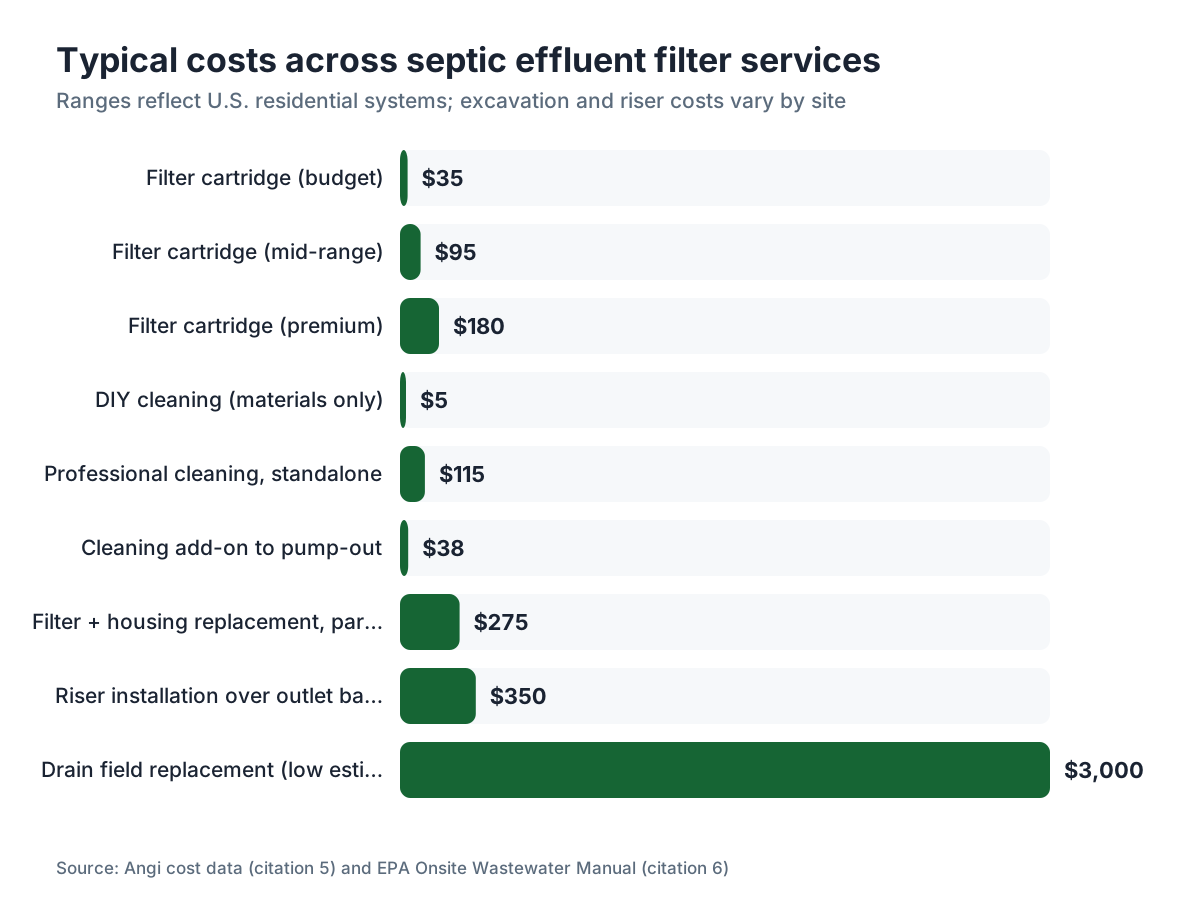
A standalone cleaning visit runs $75 to $150, covering the service call plus the actual cleaning, and the price moves with your region and how easy the outlet baffle is to reach [5]. That figure assumes a surface riser. If the contractor has to dig to reach a buried outlet baffle, add $50 to $200 for excavation.
Cleaning is almost always cheaper bundled with a pump-out. Most pumping companies fold filter cleaning into the pump-out price or tack on a modest $25 to $50 to clean and inspect it during the same visit.
| Service | Typical cost range |
|---|---|
| Filter cleaning only, standalone visit | $75 to $150 |
| Filter cleaning added to pump-out | $25 to $50 add-on |
| Filter cartridge replacement (parts) | $30 to $200 |
| Filter + housing replacement | $100 to $400 parts + labor |
| Excavation to access buried outlet baffle | $50 to $200 additional |
Installing a riser over the outlet baffle, if you don't already have one, runs $200 to $500. It pays for itself fast in the excavation costs you skip at every future service visit. Every septic professional recommends it, and homeowners consistently put it off until they've paid to dig three times.
How do you install a septic tank effluent filter?
A new install on an existing tank is a half-day job for a competent plumber or septic contractor. In some states you can do it yourself as the homeowner if you pull the right permit.
The basic process:
- Pump the tank first. You're working at the outlet baffle, so the level needs to be down where you can see what you're doing.
- Remove the existing outlet baffle or tee. Most are PVC and either unscrew or pull free from a solvent-welded fitting. Old concrete baffles that have crumbled may need to be chipped out carefully.
- Install a new outlet tee or baffle housing sized for the filter cartridge you picked. The housing glues to the outlet pipe with PVC cement, with the top extending above the liquid line so you can pull the filter handle without reaching into the tank contents.
- Slide the filter cartridge into the housing.
- Add a surface riser and lid if one isn't already there. Now is the time. The marginal cost of adding a riser while the contractor is already on site is tiny compared to doing it as its own job.
Installation runs $200 to $600 for parts and labor if you hire it out on a system that already has a proper outlet tee and riser. If the outlet baffle is broken or absent (common in concrete tanks more than 20 years old), fixing the baffle adds to the cost. The EPA's onsite wastewater guidance treats functional outlet baffles as a baseline of proper tank function, separate from the filter [1].
Check your state's onsite wastewater code before any DIY install. Many states allow homeowner maintenance on their own systems but require licensed contractor work for modifying tank components. North Carolina's rules [4] and Florida's Chapter 64E-6 [12] both draw lines between what counts as maintenance and what counts as modification.
What happens if you never clean the septic effluent filter?
A neglected filter doesn't fail quietly. It clogs.
When a filter plugs solid, the liquid level inside the tank climbs above the outlet pipe because the wastewater has nowhere to go. That rising level pushes effluent back through the inlet pipe toward the house. First come slow drains. Then gurgling. Then, if it runs far enough, sewage backs up into the lowest fixture in the house, usually a basement floor drain or a ground-floor toilet.
That's the expensive version. Emergency plumber, possible septic tank repair, and if solids slipped through a partially clogged filter before it sealed completely, possible early drain field failure.
Here's the irony. A fully plugged filter does protect the drain field, because nothing gets through. But it protects the field by backing up into your house instead of your soil, which is a much worse problem to have.
Solids escaping through a degraded or bypassed filter are a main driver of drain field biomat formation. The biomat is a dense biological layer that chokes soil permeability over time. Once a field fails from biomat buildup, repair or replacement starts around $3,000 and reaches $15,000 depending on soil conditions and local rules [6]. A $5 annual self-cleaning, or a $50 add-on to a pump-out, is a very good trade against that.
For what happens downstream, see our leach field explainer.
What are the best septic tank effluent filters on the market?
No independent head-to-head study ranks septic effluent filters against each other, so treat any "best" list with that caveat. A few brands do show up over and over in contractor preference and NSF certification listings.
Orenco Systems Biotube Effluent Filter: the reference design for slotted-tube filters. The Biotube uses a fiberglass tube with 1/16-inch slots and carries independent NSF 46 certification for material safety. Orenco publishes dimensional specs and flow rates for each model [7]. Cartridges run $60 to $130.
Polylok PL-525 series: popular with contractors because they're widely stocked, durable, and come in multiple lengths for different tank depths. The handle design lets you pull it one-handed, which matters when you're leaning over an open tank. Cartridges run roughly $35 to $80.
Zoeller 10-0851 and related models: Zoeller is better known for effluent pumps, but the filter line is solid and integrates cleanly with their pump tank products when you're running a septic pump tank. Cartridges run $50 to $120.
Sim/Tech STF-100 series: a budget-friendly option with a serviceable design. Popular in DIY installs because the housing is easy to work with. Cartridges run $30 to $60.
For most households, Polylok or Orenco are the practical picks, because parts and replacement cartridges sit on the shelf at most plumbing supply houses. The best filter for you is the one your local contractor can source and service. Exotic filters with proprietary cartridges become a headache the moment you need a replacement at 7 p.m. on a Friday.
NSF International keeps a certification database for plumbing products including septic components. Checking NSF 46 or NSF 61 certification is a reasonable baseline for any filter you're weighing [8].
Do all septic systems need an effluent filter?
No, not every system requires one, though most codes adopted since the mid-1990s do require them on new construction.
Conventional gravity systems with a single septic tank feeding a soil absorption field gain the most. The filter makes up for the fact that effluent quality from a septic tank swings a lot depending on the day's water use, what got flushed, and whether the tank sits at full capacity.
Pressure distribution systems that use a septic tank effluent pump to push effluent through a pressurized network often add screening at the pump intake. Effluent pumps take damage from solids, so here the filter protects both the field and the pump. If you have a pump tank, size the filter for the pump's flow rate, which is higher than the daily household flow.
Aerobic treatment units (ATUs) and other advanced systems usually have their own internal filtration and clarification stages, so an extra outlet filter may or may not be required depending on the design and local code.
Alternative systems feeding mounds, drip irrigation fields, or constructed wetlands almost always require a filter, because those networks have narrow orifices that plug easily with solids.
If your system is older and has no filter, adding one is generally worth doing even where it isn't code-required for your install. The University of Minnesota Extension's septic maintenance guidance specifically recommends retrofitting effluent filters on older systems where the outlet baffle allows it [2].
How does an effluent filter interact with a septic pump tank?
A septic pump tank, also called a pump chamber or dosing chamber, takes pre-treated effluent from the main septic tank, then a septic tank effluent pump pushes it out to the dispersal field. The filter can live in one of two spots: at the outlet of the main tank, or at the pump intake inside the pump tank.
Most designers put the primary filter at the septic tank outlet, so solids never reach the pump tank in the first place. The pump intake usually carries a separate screen or inlet filter to guard the pump against any fine particles that slipped through.
Effluent pumps don't tolerate solids. A pump that ingests grit or grease wears faster and dies earlier. Replacing a submersible effluent pump runs $300 to $800 for the pump alone, plus labor, so protecting it with a well-maintained filter is plain economics [9].
If your system has both a septic tank and a separate pump tank, confirm with your installer or an inspector which filtration exists at each stage. On older retrofitted systems it's common to find a pump tank was added but no filter went in at either location.
Operators running multiple accounts can track filter maintenance schedules and service intervals in software like SepticMind, built for septic service companies managing preventive maintenance workflows.
For the pump-out side of this, our septic tank pump out guide walks through the full service visit.
Can a septic effluent filter cause problems on its own?
Yes, in a few ways people don't see coming.
Wrong size for the system. A filter too short for the tank depth misses solids across the full liquid column. A filter too long can touch the sludge layer and load up with heavy solids faster than it should. Match filter length to tank depth.
Backwards installation. Some filters are directional, with the flow-through direction marked on the housing. Install it backwards and solids build up inside the filter where they can't fall back to the sludge layer, which speeds up plugging.
Bypassing the filter during cleaning. Pull the filter, then hit a heavy rain event or a laundry marathon before you reinstall it, and the tank runs unfiltered for that stretch while solids exit freely. Don't leave the filter out overnight.
False security from a cracked filter. A filter with a broken end cap or cracked tube can look fine on a casual glance while it passes solids straight through. Squeeze the body gently when you pull it. If a section flexes more than it should, inspect it closely for cracks.
High-use households overwhelming the filter. A rental or vacation home packed with occupants can clog a standard residential filter in weeks, not months. Managing a high-use property? Consider a larger-diameter filter or a dual-stage setup.
Contractors doing septic tank inspection should check the filter as part of the outlet baffle inspection, document its condition, and note whether it got cleaned. That record matters if there's ever a dispute about maintenance.
What do state codes and the EPA say about septic effluent filters?
The EPA doesn't mandate effluent filters in federal law. Both its SepticSmart guidance and the EPA Onsite Wastewater Treatment Systems Manual recommend outlet filtration as a best practice to protect the soil absorption system [1][6]. The EPA's position is simple: filters are cheap, they work, and they belong in standard residential septic design.
State requirements vary a lot. As of the mid-2020s, most states that updated their onsite wastewater codes after 2000 require effluent filters on new installations. A few examples:
- North Carolina: Rule 15A NCAC 18E requires outlet filters on new and replacement septic systems [4].
- Florida: Chapter 64E-6, FAC, requires effluent filters on systems installed or significantly repaired after the rule adoption dates [12].
- California: the OWTS Policy from the State Water Board encourages filters as part of standard treatment train components.
The National Onsite Wastewater Recycling Association (NOWRA) backs effluent filtration as standard practice, consistent with the run of state code updates [11].
Buying a home on a septic system? Ask specifically whether the tank has a working effluent filter and when it was last cleaned. A septic tank inspection should open the outlet access and confirm the filter's presence and condition. Filters aren't universal even in states that require them on new systems, because older systems were grandfathered.
If you want to track maintenance records and stay on top of county inspection requirements, keep a dated log of filter cleanings. Some counties now require documented maintenance as a condition of the operating permit.
Frequently asked questions
How do I know if my septic tank has an effluent filter?
Open the access lid over the outlet end of the tank (the end closer to the drain field) and look into the outlet tee or baffle. If a filter is there, you'll see a cylindrical cartridge with a handle or pull strap extending above the liquid line. If you see only an open pipe or a plain tee with no cartridge, there's no filter. Tanks built before the mid-1990s often have none.
Can I clean the effluent filter myself or do I need a professional?
Cleaning a septic effluent filter is a legitimate DIY task. Pull the cartridge handle, rinse with a garden hose sending all rinse water back into the open tank, inspect the cartridge for cracks, and reinstall it. Wear rubber gloves and eye protection. The key rule: all rinse water goes back into the tank, not onto the ground, which is an illegal discharge in most states. Uncomfortable opening the tank? Hire a contractor.
What happens if I never clean my septic tank filter?
An uncleaned filter eventually plugs solid. Wastewater then backs up inside the tank, raising the liquid level until it reverse-flows toward the house. You'll see slow drains across all fixtures, gurgling, or sewage backing up into the lowest fixtures. In milder cases the filter cracks and starts passing solids to the drain field, which speeds up field failure. Either outcome costs far more to fix than routine cleaning.
How much does it cost to replace a septic effluent filter cartridge?
Replacement cartridges cost $30 to $200 depending on brand and size. Orenco Biotube cartridges run $60 to $130, Polylok models $35 to $80, and budget options like Sim/Tech $30 to $60. If you also need to replace the housing, add $50 to $150 in parts plus a contractor's labor, typically $75 to $150 for a straightforward swap on an accessible tank.
How often should a septic effluent filter be cleaned?
Most manufacturers and state extension services recommend every 1 to 3 years, with cleaning at every pump-out as the minimum. A two-person household with conservative water use might get 3 years between cleanings. A five-person household with a garbage disposal and heavy laundry use might need annual cleaning. If an alarm-equipped housing trips, clean the filter immediately regardless of when it was last serviced.
Where exactly is the septic tank effluent filter located?
The filter sits inside the outlet tee or baffle, at the end of the tank that connects to the drain field. Most systems have a surface riser and lid over that access point. With no riser, the outlet baffle may sit under 6 to 18 inches of soil and require digging to reach. Some older tanks put the outlet at a corner rather than centered on the end wall.
Does a septic effluent filter need to be replaced or just cleaned?
Most filters need cleaning, not replacement, for many years. A well-maintained slotted-tube filter lasts 5 to 15 years or longer. Replace the cartridge if you find cracks in the tube, broken end caps, damaged slots, or a handle that has separated from the body. Those defects let solids bypass the filter. Unsure? Hold the cartridge up to light after rinsing; light should pass evenly through the slots with no gaps from cracks.
Can I install a septic effluent filter on an older tank that doesn't have one?
Usually yes, if the tank has a functional outlet tee or baffle that can take a filter housing. A plumber or septic contractor removes the existing tee, installs a filter-compatible housing, and drops in the cartridge. Cost runs $200 to $600 for parts and labor on a tank with existing riser access. If the outlet baffle is damaged or absent, fixing it adds cost but is worth doing anyway.
Will a septic filter protect my drain field from failure?
A filter sharply reduces the solids load reaching the drain field, which is the main cause of biomat formation and field failure. The EPA's SepticSmart program lists effluent filtration as a protective measure for the soil absorption system. A filter won't make a field immune to other causes like flooding, root intrusion, or hydraulic overload, but it removes the most preventable cause of early failure. Field replacement runs $3,000 to $15,000 or more.
Does a septic system with a pump need a filter in a different location?
Systems with a septic tank effluent pump usually benefit from filtration at two points: the outlet of the main septic tank to protect the pump chamber, and the pump intake to protect the pump itself. Effluent pumps are sensitive to solids and grit, which cause premature wear. Confirm with your installer where filters sit in your specific system. Pump replacement costs $300 to $800 for the pump alone, not counting labor.
What size effluent filter do I need?
Match filter diameter to your outlet pipe diameter, typically 4 inches in most residential systems. Filter length should span from the outlet pipe invert to roughly 6 inches above the normal liquid level. Most manufacturers publish sizing charts. When in doubt, a slightly longer filter gives more surface area and clogs slower. For pump systems, also check that the filter's rated flow capacity matches the pump's output.
Is bleach or any cleaner safe to use when cleaning an effluent filter?
No. Rinse the filter with plain water only. The filter surface hosts a beneficial biofilm that aids treatment, and bleach or antibacterial cleaners kill it. You don't need any cleaner; garden hose pressure clears the slots fine. Send all rinse water back into the open tank. Dumping it on the lawn or into a bucket you carry away is an illegal discharge of inadequately treated sewage in most jurisdictions.
Does a new home or recently installed septic system always have an effluent filter?
Most states now require effluent filters on new and replacement systems, so a system installed after roughly 2000 to 2010 in most states should have one. Installation quality varies, though, so confirm at your first septic inspection that the filter is present and correctly installed. Ask the inspector specifically to check the outlet baffle for a filter cartridge and document its condition.
How do I know when the effluent filter needs cleaning between scheduled service visits?
An alarm-equipped housing trips when the filter restricts flow enough to raise the tank liquid level. Without an alarm, watch for slow drains on multiple fixtures at once, gurgling in drains or toilets, or a sewage odor near the tank access lid. Any of those warrant pulling and inspecting the filter before the next scheduled cleaning. A plugged filter is one of the easier problems to confirm and fix.
Sources
- U.S. EPA, SepticSmart Program: EPA SepticSmart identifies effluent filters and functional outlet baffles as components that meaningfully extend drain field life by reducing solids load on the soil absorption system.
- University of Minnesota Extension, Septic System Maintenance: University of Minnesota Extension recommends cleaning effluent filters roughly every 1 to 3 years and retrofitting filters on older systems where the outlet baffle allows it.
- Polylok, Effluent Filter Product Information: Manufacturer guidance for slotted-tube effluent filters recommends cleaning at intervals of 1 to 3 years or at each tank pump-out.
- North Carolina Administrative Code, 15A NCAC 18E Onsite Wastewater Systems: North Carolina Rule 15A NCAC 18E requires outlet filters on new and replacement septic systems and distinguishes homeowner maintenance from component modification requiring licensed work.
- Angi, Septic Tank Cleaning Cost Guide: Standalone septic filter cleaning service calls typically cost $75 to $150; filter cleaning added to a pump-out is commonly a $25 to $50 add-on.
- U.S. EPA, Onsite Wastewater Treatment Systems Manual (EPA/625/R-00/008): EPA Onsite Wastewater Treatment Systems Manual describes soil absorption system failure from biomat formation and recommends outlet filtration as a best practice; field replacement costs can reach $15,000 or more depending on soil conditions and local requirements.
- Orenco Systems, Biotube Effluent Filter Product Specifications: Orenco Biotube effluent filters use 1/16-inch slots and are available in multiple lengths to accommodate different tank depths; NSF 46 certified for material safety.
- NSF International, Certified Plumbing and Onsite Wastewater Products: NSF International maintains certification listings under NSF 46 and NSF 61 for plumbing and septic components, providing a baseline for product material safety evaluation.
- Zoeller Pump Company, Effluent Pump Product and Service Information: Submersible effluent pump replacement costs $300 to $800 for the pump unit; solids ingestion from inadequate filtration accelerates wear and reduces pump service life.
- National Onsite Wastewater Recycling Association (NOWRA): NOWRA supports effluent filtration as standard practice in onsite wastewater treatment design, consistent with most state code updates requiring filters on new systems.
- Florida Department of Health, Chapter 64E-6 FAC Onsite Sewage Treatment and Disposal: Florida Chapter 64E-6 FAC requires effluent filters on systems installed or significantly repaired after the rule adoption dates as part of standard tank outlet requirements.
Last updated 2026-07-09