Septic tank inspectors: what they do, what they cost, and how to find one
By the SepticMind Editorial Team
TL;DR
- A septic tank inspector checks the condition of your tank, baffles, lids, and drain field.
- A basic visual inspection costs $100 to $300.
- A full Title 5-style inspection with pumping runs $300 to $900.
- Get one before buying a home on septic, after any alarm or backup, and every 1 to 3 years for maintenance.
- Licensing rules vary by state.
What does a septic tank inspector actually do?
A septic inspector checks every accessible part of your onsite wastewater system and tells you whether it works, what's wearing out, and what's about to fail. Simple to say. The job covers a lot of ground.
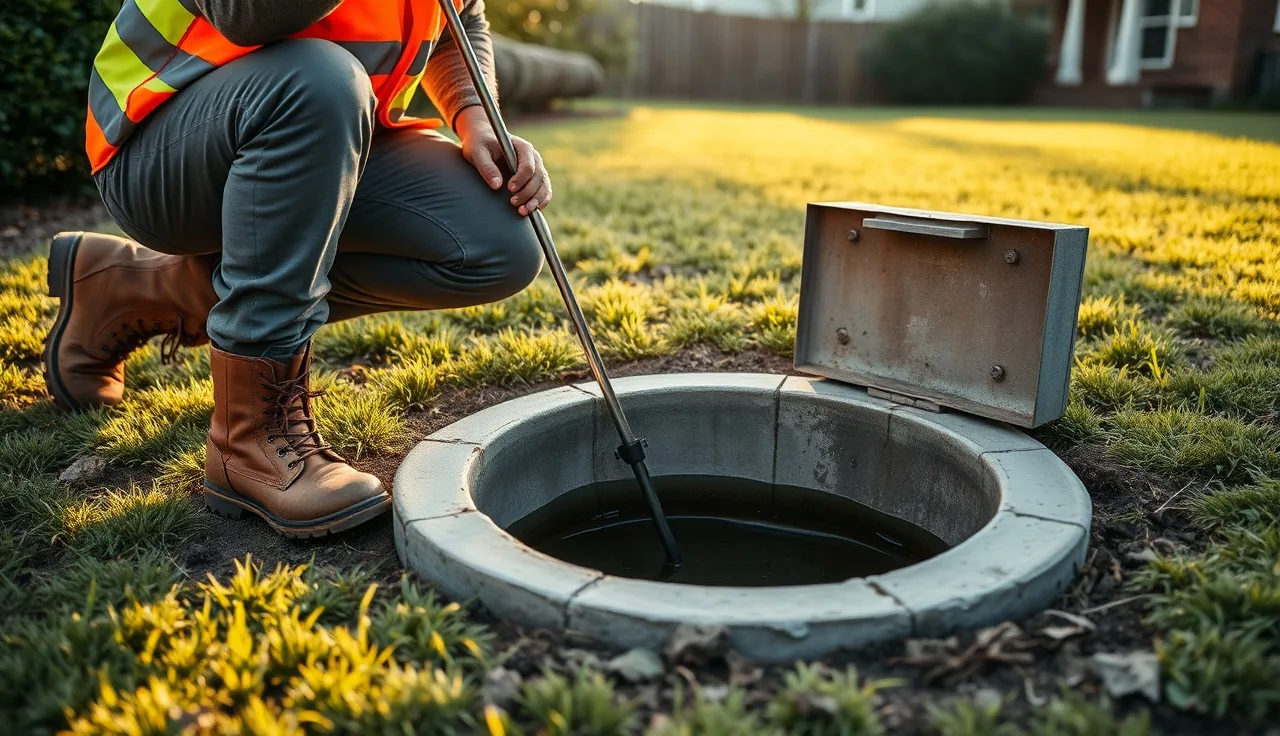
On a typical visit, the inspector locates the tank (sometimes with a probe or a locating device if the lid isn't marked), uncovers the access lids, and measures the scum and sludge layers inside. The EPA's SepticSmart program says tanks should be pumped when the top scum layer sits within 6 inches of the outlet baffle or the bottom sludge layer sits within 12 inches of the outlet [1]. An inspector checks exactly those numbers.
Past the tank, the inspector looks at the inlet and outlet baffles, the tank walls and lid for cracks, the distribution box if one exists, and the condition of the drain field. They check for saturated soil, surface breakout (sewage showing up on the ground), and proper drainage. Many inspectors also run a dye or hydraulic load test, pushing water through the system to see how the field handles a real load.
The report you get should document every measurement, every observation, and a clear pass/fail or condition rating. A good inspector doesn't just hand you a checklist. They explain what they found in plain language and tell you what happens next if something is wrong. If the tank needs pumping before the inspection can be done right, a qualified inspector says so upfront instead of guessing at sludge depths through a clogged access port. You can read more about what that pumping involves at septic tank pumping.
What are the different types of septic inspections?
Inspections are not all the same, and the difference matters a lot when you're buying a house or chasing a problem.
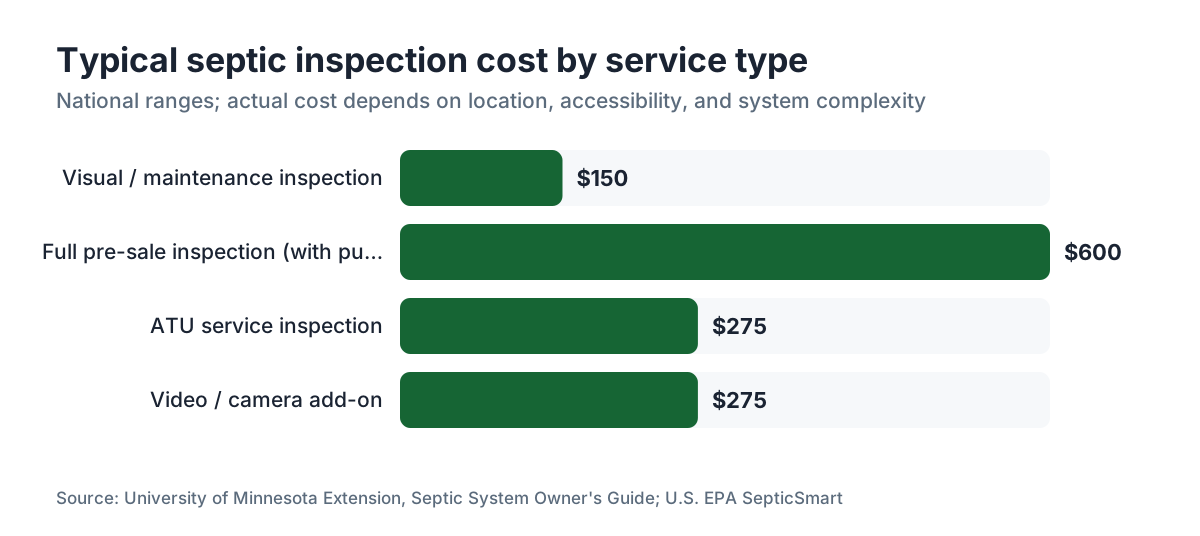
Visual or maintenance inspection. This is the baseline. The inspector opens the tank, measures scum and sludge, checks visible parts, and looks at the drain field from the surface. No pumping required, though it's often recommended. Cost usually runs $100 to $200. Good for routine annual or biannual checkups.
Full or Title 5-style inspection. Massachusetts wrote its inspection standard into Title 5 of the State Environmental Code (310 CMR 15.000), which requires a licensed inspector, pumping the tank, and a hydraulic load test before any property transfer [2]. Many other states copied the approach for their own pre-sale rules. These inspections cost $300 to $900, mostly because they include pumping (see septic tank pump out for what that involves).
Aerobic treatment unit (ATU) inspection. Aerobic systems have a separate air pump, spray heads, and chlorine or UV disinfection that all need their own evaluation. ATU inspections take more work than a standard gravity-fed tank inspection and usually require a service contract, often mandated by state health departments.
Camera or video inspection. Some inspectors run a camera through the effluent pipe or distribution lines to find cracks, root intrusion, or collapsed sections you can't see any other way. This is usually an add-on, not a standalone service, and it costs $150 to $400 more.
| Inspection type | What's included | Typical cost range |
|---|---|---|
| Visual / maintenance | Lid access, layer measurement, field observation | $100 to $200 |
| Full pre-sale (Title 5-style) | Pumping + hydraulic load test + full report | $300 to $900 |
| ATU service inspection | Mechanical, electrical, and disinfection check | $150 to $400 |
| Video / camera add-on | Pipe interior camera inspection | $150 to $400 extra |
The range is real. I've seen inspections in rural areas run as low as $75, and inspections in high-cost metro markets hit $1,000 once pumping, a camera, and a rush fee all stack up. The honest answer: call at least two licensed inspectors near you before you assume you know the price.
How much does a septic inspection cost?
A standard septic inspection without pumping runs roughly $100 to $300 nationally. Add pumping and you're typically at $300 to $600. A full pre-sale inspection with pumping, a hydraulic load test, and a written report can reach $600 to $900 in most markets [3].
Several things push the price up. If the tank lids are buried and need excavation by hand or machine, inspectors usually charge extra, sometimes $50 to $150 depending on depth. A camera inspection of the lines adds another $150 to $400. Emergency or same-day scheduling can add 25 to 50 percent to the base price. Location matters more than most homeowners expect. Inspections in parts of New England or California routinely cost twice what the same service runs in the rural Southeast.
A septic tank riser installed over the access port kills the excavation charge on every future inspection, which is why inspectors push them as a one-time investment.
If you're a buyer using the inspection to negotiate or to decide whether to walk, the math is easy. A $400 inspection that catches a failing drain field saves you from a $10,000 to $30,000 septic system repair you'd own the moment you close. That's probably the best $400 you spend in the whole deal.
Some states run assistance programs for low-income homeowners facing septic repairs found during inspection. The EPA's SepticSmart initiative links to state programs, and USDA Rural Development offers grants and loans through its Section 504 program for qualifying households [4].
When should you get a septic inspection?
Four situations clearly call for an inspection. Everything else is judgment.
First, before buying any home on a septic system. This is not optional. A standard home inspection does not cover the septic system well enough, and many general inspectors will tell you that flat out. You need a dedicated septic inspection, ideally with the tank pumped so the inspector can see the full interior.
Second, after any sign of trouble: slow drains throughout the house (more than one fixture), gurgling in the pipes, sewage odors inside or near the yard, or wet soggy patches over the drain field. Those symptoms don't always mean catastrophic failure, but they always mean an inspection is cheaper than waiting.
Third, on a regular maintenance schedule. The EPA recommends inspecting septic systems every 1 to 3 years [1]. The real interval depends on household size and tank capacity. A 1,000-gallon tank serving four people needs more attention than a 1,500-gallon tank serving two. See how often to pump septic tank for the pumping-interval specifics, since pumping and inspection often happen together.
Fourth, after any major event: a heavy vehicle parked over the tank or field, big construction or grading near the system, or a flood that may have driven soil into the tank. These can cause damage you'll never see from the surface.
One thing worth saying clearly: don't skip the inspection because the system seems fine and you just had it pumped. Pumping and inspecting are related but different. A pump truck operator is not doing a formal inspection unless that's spelled out in the service agreement.
What credentials and licenses should a septic inspector have?
Licensing for septic inspectors varies by state, which is both the honest answer and the annoying one. There is no single national license for septic inspectors in the United States.
Most states license inspectors under one of three frameworks: as a subset of the wastewater/onsite installer license, as a separate inspector or evaluator credential, or under a general environmental health technician program. Some states require a licensed engineer or sanitarian to sign off on pre-sale reports. A few states have no specific inspector license at all, which creates real quality swings in the market.
The National Association of Wastewater Technicians (NAWT) runs a certified inspector program with a written exam and continuing education requirements [5]. The National Onsite Wastewater Recycling Association (NOWRA) maintains an Onsite System Professional (OSP) certification that many states recognize as meeting or beating their licensing threshold [6]. When you're sizing up inspectors, look for one of these national credentials plus your state-specific license.
For pre-sale work, your state's department of environmental quality, department of health, or equivalent agency keeps the list of licensed inspectors and the exact requirements for a report to count at a property transfer. In Massachusetts, the inspector must be a licensed System Inspector under the Title 5 program, and the commonwealth keeps a searchable database [2]. Your state likely has a similar resource.
A few red flags when hiring: an inspector who won't give a license number on request, someone who offers to skip the pump-out to save you money on a full inspection, or a company that's also trying to sell you a new system the same day. That last one isn't disqualifying, but know the conflict is there.
How do you find a qualified septic tank inspector near you?
Start with your state agency. Most state environmental or health departments keep a public list of licensed inspectors searchable by county or zip code. That list is the best place to start because it's current and it carries the licensing requirement behind it.
Second source: your county health department. Many counties regulate onsite systems on their own (or jointly with the state), and the county sanitarian can usually point you to approved inspectors even if they can't name a favorite.
Third option: NAWT and NOWRA both keep member directories you can search by location [5][6]. These aren't complete (not every good inspector is a member), but they're a decent filter for finding someone with formal training.
Ask neighbors, especially in rural subdivisions or older developments where most homes are on septic. Local knowledge about who does thorough work and who rushes through in 20 minutes is genuinely useful. Real estate agents who work septic-heavy markets often know who does rigorous work versus who hands out passes to close deals fast, and a good buyer's agent should tell you which is which.
When you call, ask these questions: What does the inspection include? Do you pump as part of the process or is that separate? What license do you hold and what's the number? What does the written report look like, and can I see a sample? How long have you been inspecting in this specific area and soil type?
That last question matters more than it sounds. An inspector who knows local soil, typical system ages, and common failure modes in your county will catch things someone unfamiliar with the area misses.
What do septic inspectors look for in the drain field?
The drain field is where most serious septic failures actually happen, and it's the hardest part of the system to judge without some expertise.
An inspector evaluating a drain field looks for surface saturation or breakout: soggy ground, unusually bright green grass, or in the worst cases visible sewage above the soil. These signs mean the field can't absorb effluent as fast as the household makes it. Lush grass over the field in dry weather is normal and healthy. Standing water over the field in dry weather is not.
The hydraulic load test, where the inspector pushes a large volume of water through the system and watches the field respond, is the most reliable way to check current function under realistic conditions. A field that looks fine at rest but breaks out under load is already failing, even if it's not obvious day to day.
The inspector also checks the distribution box (D-box) if the system has one. A D-box that's settled or tilted sends all the effluent to one section of the field and starves the rest, which speeds up failure in the overloaded section. Caught early, that's a fixable problem.
Soil percolation is the underlying physics: the soil has to absorb liquid faster than the household delivers it. The soil type, the age of the biomat (the biological layer that forms at the soil-pipe interface), and the depth to seasonal high groundwater all shape this. An experienced inspector notes all three. If the field is at or near the end of its life, they should say so directly so you can plan for eventual septic drain field repair or replacement instead of getting hit with an emergency.
Septic drain fields typically last 20 to 30 years with proper maintenance, and some in ideal soil conditions last 40 years or more [3]. An inspector can't give you a precise remaining lifespan, but they can give you a condition category (good, fair, marginal, or failing) that lets you make informed decisions.
What do inspectors check inside the septic tank itself?
Inside the tank, the inspector is measuring, observing, and probing. Here's specifically what they look at.
Scum and sludge layers. The scum layer floats on top, the sludge layer settles at the bottom, and the clear zone in between is where effluent flows out to the field. The inspector uses a sludge judge or similar tool to measure the exact thickness of each layer. When the combined sludge and scum creep toward the outlet, effluent quality drops and solids start passing to the field.
Inlet and outlet baffles. These tees or baffles keep solids in the tank instead of letting them flow to the drain field. Plastic baffles in newer tanks hold up well. Concrete baffles in older tanks corrode from hydrogen sulfide gas over time. A missing or corroded outlet baffle is one of the most common findings on older systems, and one of the most consequential: without it, solids move freely to the field.
Tank walls, base, and lid. Concrete tanks crack from ground movement, tree roots, or plain age. Any crack that reaches the outside of the tank is a concern for groundwater contamination. Lid condition matters too. A deteriorating concrete lid is a safety hazard, more than a maintenance item. Inspectors note lid condition in every report.
Liquid level. In a tank running normally, the liquid should sit at the outlet invert (the pipe outlet level). Above the outlet means the field isn't draining. Below it means there may be a leak in the tank.
Odors and gas. Inspectors note unusual odors that hint at problems beyond normal decomposition, and some use gas detection equipment in enclosed tank compartments. This is a safety matter for the inspector too, since hydrogen sulfide in confined spaces is a real occupational hazard.
What happens if an inspector finds a problem?
The outcome depends entirely on what's found and how bad it is. A clear pass, where all components work and the tank sits within normal sludge and scum ranges, gets you a written report you file away and revisit in one to three years.
A conditional pass (the language varies by state) usually means something needs attention but doesn't count as immediate failure. A deteriorating outlet baffle that can still be replaced cheaply, or a D-box that needs leveling, or a tank that needs pumping, would typically generate a conditional result with a list of required repairs and a follow-up timeline.
A fail means the system has failed or is close to it. In a real estate transaction, that's a big negotiating event. The buyer can ask the seller to repair the system, cut the purchase price, or in some jurisdictions the sale simply can't close until the system passes. Some states give sellers 90 days to correct failed systems found at the point of sale before the property can transfer [2].
For repairs, a septic tank repair limited to replacing a baffle or leveling a D-box might run a few hundred dollars. A drain field replacement is a different order of magnitude, usually $3,000 to $15,000 depending on system size, site conditions, and local permitting. A full new system can run $15,000 to $50,000 or more on difficult sites; for comparison benchmarks see cost to install septic system.
If you run a septic service business and track inspection outcomes, repair recommendations, and follow-up scheduling across a customer base, SepticMind's operations platform is built to manage that workflow. The inspection report itself is what drives everything else, no matter how you manage it.
Do you need a septic inspection before selling a home?
In many states, yes, a septic inspection is legally required before a home on a private septic system can change hands. The specific requirement, who must do it, and what the report must contain vary a lot.
Massachusetts Title 5 is the most cited example. It requires a licensed System Inspector to inspect the system within two years before any transfer of title (or six months for systems serving 2,000 gallons per day or more) [2]. Florida requires sellers to disclose the type and age of the septic system, and some counties require inspection. Virginia requires an inspection report for systems in certain age categories before sale [10]. New Jersey requires a "real estate transfer inspection" in most counties.
California has no statewide pre-sale inspection mandate, but individual counties (especially in sensitive watershed areas) do. Oregon's OAR 340-071 governs onsite systems, and many counties require inspection at point of sale.
Even where it isn't legally required, any real estate agent worth using will recommend it, and any lender using FHA or USDA financing often requires it. For FHA loans, HUD guidelines require the appraiser to note if the septic system appears to be within 50 feet of a well, and failing systems can block financing entirely [8].
If you're a seller and you know your system is old or has had issues, getting an inspection before you list (rather than letting the buyer order one) gives you time to fix problems on your own schedule and with your chosen contractor. Surprises at closing are expensive, both in money and in deals that fall apart.
How is a septic inspection different from routine pumping?
Pumping removes accumulated solids from the tank. Inspection judges whether the system is structurally sound and actually working. Related, but distinct.
A pump truck operator focuses on getting the tank empty. Many good operators flag obvious problems, but a pump-out is not a formal inspection unless that's what you contracted and the operator holds the right inspector credential in your state.
Best practice is to combine both: pump the tank first so the inspector can see the walls, base, and baffles clearly without sludge in the way, then run the inspection. Many inspection companies bundle pumping into the full inspection package. If you're doing them separately, schedule pumping through septic tank cleaning first and make sure your inspector knows the tank was recently pumped.
Routine pumping on the right schedule, typically every 3 to 5 years for a household of four with a 1,000-gallon tank, extends system life by keeping solids from migrating to the drain field [1]. But it doesn't replace the inspection that confirms the physical parts are intact and the field still absorbs properly.
SepticMind's scheduling tools help service operators keep both pumping and inspection appointments coordinated across a customer base, which matters because the two services do the most good when they happen together instead of years apart by accident.
How do you prepare for a septic inspection?
A little prep makes the inspection faster, more accurate, and cheaper.
Dig out your system records before the inspector arrives. If you have the original permit, the as-built drawing (the diagram showing tank and field locations), and any prior inspection or pumping records, hand them over. The inspector spends less time probing for the tank and more time evaluating what's actually there. County health departments often have as-built records on file if you don't have your own.
Mark the approximate tank location if you know it. Without risers, the inspector may need to probe or use a locating device, which takes time. If lids need digging out, that's extra time and sometimes extra cost, as noted above. This is the real-world argument for septic tank riser installation if your lids are buried.
Keep the area accessible. Move vehicles, playground equipment, or anything else parked over the tank or field. Inspectors can't safely work under or around heavy objects.
Don't pump the tank the day before the inspection unless the inspector tells you to. A tank that was just pumped and hasn't refilled gives inaccurate sludge and scum readings. Ideally the pump-out happens as part of the inspection, not on its own right before.
Note any recent symptoms and tell the inspector directly: slow drains, odors, gurgling, anything odd. An inspector who knows where to look does a better job than one working blind.
Frequently asked questions
How long does a septic tank inspection take?
A basic visual inspection typically takes 45 minutes to 1.5 hours. A full pre-sale inspection that includes pumping the tank, running a hydraulic load test, and generating a written report usually takes 2 to 4 hours depending on system size, accessibility, and whether the lids need to be excavated. Larger or more complex systems with multiple tanks or aerobic treatment units take longer.
Can a home inspector inspect a septic system?
A general home inspector can note obvious surface signs of septic problems like wet spots over the drain field or slow drains, but cannot perform a formal septic inspection in most states. A septic inspection requires a licensed septic or onsite system inspector. If you're buying a home, hire both: a home inspector for the structure and a licensed septic inspector for the wastewater system.
How often should a septic system be professionally inspected?
The EPA recommends inspecting septic systems every 1 to 3 years. The right interval for your system depends on household size, tank capacity, and system type. A household of four using a 1,000-gallon tank should inspect more frequently (every 1 to 2 years) than two people in the same house. Aerobic treatment units often require annual inspection as a condition of the operating permit.
What does a septic inspection report include?
A proper inspection report documents the tank location and capacity, scum and sludge measurements, condition of baffles, lids, and tank walls, drain field observations, any hydraulic load test results, and a clear pass, conditional, or fail rating. It should list any required repairs with a recommended timeline. Pre-sale inspection reports often follow a state-mandated format.
Is a septic inspection required when buying a house?
It depends on the state. Massachusetts requires a Title 5 inspection before any property transfer. Several other states and many counties have similar requirements. Even where not legally mandated, FHA and USDA lenders often require it, and any buyer's agent in a septic-heavy market should strongly recommend it. Buying without one is a significant financial risk.
Who is qualified to inspect a septic system?
In most states, you need a licensed septic inspector, licensed onsite system installer, or licensed sanitarian. Some states require a professional engineer to certify pre-sale reports. National credentials from NAWT or NOWRA indicate additional training and testing. Always verify the inspector's license number with your state agency before hiring.
What causes a septic system to fail inspection?
Common causes include a saturated drain field that shows breakout or fails the hydraulic load test, missing or corroded outlet baffles that allow solids into the field, cracked tank walls, sewage surfacing above ground, or liquid levels above the outlet indicating the field isn't draining. Some states also fail systems where the setback from a well or water body is insufficient.
Can I inspect my own septic tank?
You can do informal maintenance checks, measuring sludge depth with a sludge judge and looking at the field surface, but this does not substitute for a professional inspection for any legal or real estate purpose. More importantly, opening a septic tank without proper safety equipment is dangerous due to confined space hazards and hydrogen sulfide gas. Professional inspectors have the training and equipment to work safely.
How much does a septic inspection cost without pumping?
A visual inspection without pumping typically costs $100 to $200 in most markets. Some inspectors charge as little as $75 in rural areas; high-cost metro markets can reach $300 for a basic inspection. Adding pumping typically brings the total to $300 to $600. Always confirm exactly what's included before you book, since pricing terminology varies widely by company.
What's the difference between a septic inspection and a perc test?
A septic inspection evaluates an existing system's current condition and function. A percolation (perc) test measures how fast water drains through undisturbed native soil, and is done before a new system is designed and installed on a property. If you're building on a lot or replacing a failed system, you may need a perc test to determine what type of system the soil can support.
What happens after a septic system fails inspection at a home sale?
Outcome depends on state law and the purchase contract. Most states give sellers a defined window (often 90 to 180 days) to repair the system before the sale can close. Buyers can also negotiate a price reduction, require the seller to place repair funds in escrow at closing, or in some cases walk away from the deal. A failing system is a negotiating event, not necessarily a deal-killer.
How do I find a licensed septic inspector in my state?
Start with your state's department of environmental quality or department of health; most maintain a searchable database of licensed inspectors by county. NAWT and NOWRA both have member directories searchable by location. Your county health department can also provide a referral. Always verify the license number directly with the state before hiring anyone.
Sources
- U.S. EPA, SepticSmart: Homeowner's Guide to Septic Systems: EPA recommends inspecting septic systems every 1 to 3 years and states tanks should be pumped when the scum layer is within 6 inches or sludge within 12 inches of the outlet baffle.
- Massachusetts DEP, Title 5 of the State Environmental Code (310 CMR 15.000): Massachusetts Title 5 requires a licensed System Inspector to inspect the septic system within two years before any transfer of title, and gives sellers 90 days to correct failed systems.
- University of Minnesota Extension, Septic System Owner's Guide: Septic drain fields typically last 20 to 30 years with proper maintenance, and pre-sale inspection cost ranges commonly reach $600 to $900 in higher-cost markets.
- USDA Rural Development, Section 504 Home Repair Program: USDA Rural Development offers Section 504 grants and loans for low-income homeowners needing home repairs including septic system repairs.
- National Association of Wastewater Technicians (NAWT), Inspector Certification Program: NAWT offers a certified inspector program with a written exam and continuing education requirements; their member directory is searchable by location.
- National Onsite Wastewater Recycling Association (NOWRA), Professional Certification: NOWRA's Onsite System Professional (OSP) certification is recognized in many states as meeting or exceeding their licensing threshold for septic inspectors.
- U.S. EPA, Septic Systems: Overview: About one in five U.S. homes relies on a septic system or other onsite wastewater treatment system.
- HUD, FHA Single Family Housing Policy Handbook (Handbook 4000.1): FHA guidelines require the appraiser to note if a septic system appears within 50 feet of a well, and failing systems can block FHA financing.
- Virginia DEQ, Septic System Regulations and Homeowner Information: Virginia requires an inspection report for septic systems in certain age categories before property sale.
Last updated 2026-07-09