Septic tank inspection price: what to expect in 2025
By the SepticMind Editorial Team
TL;DR
- A routine septic tank inspection costs $100, $300 for a basic visual check and $300, $600 for a full operational inspection with pumping.
- A real estate inspection with camera work runs $400, $925.
- Price varies by inspection type, tank size, access difficulty, and region.
- Most homeowners need one every 1 to 3 years, or before buying or selling a home.
What does a septic tank inspection cost?
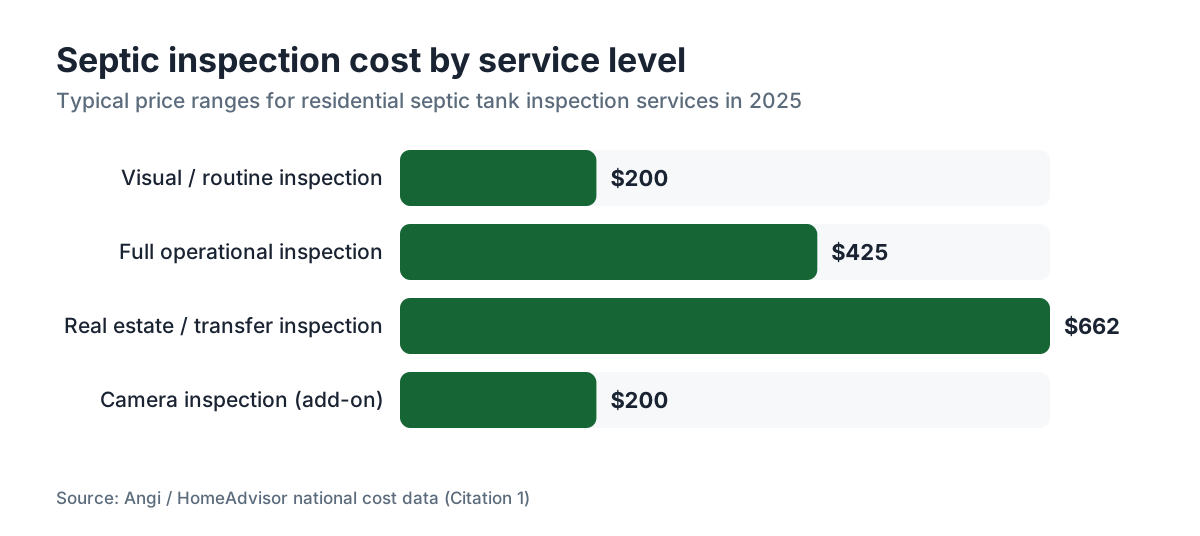
Septic inspections fall into three price tiers nationwide. A basic visual or routine maintenance inspection runs $100, $300. A full operational inspection, which includes checking the tank, inlet and outlet baffles, water levels, and often pumping the tank so the inspector can see the bottom, runs $300, $600. A full real estate inspection with dye testing or camera work on the drain field runs $400, $925.
Those ranges come from national contractor surveys and cost aggregators. Actual prices in rural areas and the Southeast tend to sit at the low end, while New England, California, and the Pacific Northwest push toward the top [1].
The number that shows up on your invoice depends on a handful of things: what type of inspection you're getting, whether pumping is bundled in, how hard it is to find and uncover your lids, and what your county requires for a real estate transfer. More on each of those below.
What are the different types of septic inspections and what do they cost?
There isn't one standard product called "a septic inspection." There are at least four distinct service levels, and confusing them is how homeowners end up surprised by a bill or, worse, surprised by a failed system.
Level 1 (visual/routine): $100, $300
A technician locates the access lids, pulls them, and visually checks the scum and sludge layers, the inlet baffle, and the outlet tee or baffle. No pumping, no camera. Fine for a routine maintenance check when you already know your system's history.
Level 2 (operational inspection): $250, $600
This is what most certified inspectors mean when they say "full inspection." The inspector runs water through the system, checks flow rates, inspects baffles and effluent filters, probes sludge depth with a Sludge Judge or similar tool, and looks at the distribution box if accessible. Many operators bundle pumping here because the tank needs to be empty to inspect the walls, floor, and inlet pipe properly. If pumping is bundled, expect the higher end of that range. Standalone septic tank pumping adds $275, $550 on its own [2].
Level 3 (real estate/transfer inspection): $400, $925
Required by many lenders and strongly recommended by buyers' agents. Includes everything in Level 2 plus a hydraulic load test (running a set volume of water to see how the system responds), dye testing, and often a camera inspection of the outlet pipe leading to the leach field. Some states require a licensed inspector or engineer to sign off. This is where price variation is widest because scope varies most.
Camera/video inspection add-on: $100, $300 extra
If the inspector runs a camera through the outlet pipe or into the distribution box lines to check for root intrusion, pipe collapse, or backflow, that typically adds $100, $300 on top of the base inspection fee [1].
| Inspection Type | Typical Price Range | Pumping Included? |
|---|---|---|
| Visual / routine | $100, $300 | No |
| Full operational | $250, $600 | Sometimes |
| Real estate / transfer | $400, $925 | Usually |
| Camera add-on (standalone) | $100, $300 | No |
What factors make a septic inspection cost more or less?
Location is the biggest single variable. Labor markets differ dramatically. A basic inspection in rural Tennessee might be $125; the same service in Marin County, California, runs $350 before any add-ons.
Tank size matters less than you'd think for the inspection fee itself, but it matters a lot if pumping is included. A 1,500-gallon tank costs more to pump than a 750-gallon tank, so bundled-pumping quotes will reflect size [2].
Access is where hidden costs appear. If your lids are buried under 18 inches of soil, someone has to dig. Hand digging runs $50, $150; a locating service with a probe or radio tracer adds another $50, $100. If your county requires risers to be installed at time of service, that's $200, $600 extra depending on the number of lids.
System type moves the price too. A conventional gravity-fed system draining to a standard field is the easiest and cheapest to inspect. An alternative system, such as a mound system, drip irrigation system, aerobic treatment unit (ATU), or chamber system, has more components, requires checking added equipment like pumps and timers, and takes longer. Expect to add $75, $200 for alternative systems.
Inspector credentials affect price as well. A general pumper doing a visual costs less than a licensed onsite wastewater professional or a registered sanitarian. For a real estate transaction, many lenders require a licensed inspector, so you may not have a choice [3].
Does a septic inspection include pumping?
Sometimes, and the answer matters a lot for your budget.
For a routine visual inspection, pumping is almost never included. For a full operational or real estate inspection, about half of contractors bundle pumping into the base price, while the other half quote it separately. Always ask before booking.
The reason inspectors often want the tank pumped first is practical: you can't see hairline cracks, inlet baffle condition, or bottom sediment through 1,000 gallons of effluent. Some inspectors will do a Level 2 inspection without pumping by probing sludge and scum depths, but if those depths are borderline, they'll recommend pumping before they'll sign anything anyway.
If pumping is not included and you need it, budget $275, $550 for a standard residential tank. See the full breakdown on septic tank pump out costs. Getting inspection and septic tank cleaning done in the same visit by the same truck usually saves $50, $100 versus two separate trips.
How much does a septic inspection cost for a home purchase?
This is the scenario where price matters most and skipping it is the most expensive mistake a buyer can make.
For a real estate transaction, budget $400, $925 all-in including pumping. Some areas of New England and the Mid-Atlantic add state-mandated fees on top, so check your state's department of environmental services or local health department website for required inspection protocols [4].
The EPA's SepticSmart program notes that "a properly designed, installed, and maintained septic system can last for decades," and a failing system can require a full replacement costing $5,000, $25,000 or more [5]. Paying $600 for a thorough pre-purchase inspection to uncover a failing system is one of the clearest return-on-investment calls in home buying.
Who pays is negotiable. In most markets, the buyer orders and pays for the inspection. In some states (Massachusetts Title 5 is the most cited example), the seller is legally required to have the system inspected and certified before a transfer, and that cost falls on the seller [6]. The Massachusetts Title 5 inspection costs $400, $800 depending on tank size and whether pumping and repair are needed.
If a system fails inspection, you can negotiate a price reduction, require the seller to repair or replace it before closing, or walk away. That bargaining position is worth far more than the inspection fee.
How often do you need a septic inspection, and does frequency affect your total annual cost?
The EPA recommends having your septic system inspected by a professional every 1 to 3 years, with pumping every 3 to 5 years for a typical household [5]. Your county or state may have its own schedule, and alternative systems with mechanical components usually require annual inspections because those systems have pumps and timers that need maintenance.
Run the math. If you're on a 3-year inspection cycle and paying $200 per routine inspection, that's about $67 per year. Add pumping every 3 to 5 years at $350 average and your total annual cost for keeping the system certified and maintained runs roughly $135, $180 per year. That's a lot cheaper than ignoring it and facing a $3,000, $15,000 septic system repair bill.
For how to plan your pumping schedule around inspections, the guide on how often to pump septic tank walks through the household size and tank size math in detail.
Operators managing inspection scheduling across many properties often use software to track these intervals automatically. SepticMind is one platform built for that job, letting service companies set recurring inspection reminders and document results without manual spreadsheets.
What does a septic inspector actually check?
A good inspector follows a documented protocol. Here's what a proper operational inspection covers:
Tank condition. Inlet and outlet baffles or tees, walls and base for cracks or structural damage, scum layer thickness (should be less than 6 inches), sludge layer depth (should be less than one-third of tank capacity), and the effluent filter if one is installed.
Distribution. Flow from the outlet to the distribution box and from the distribution box to the drain field laterals, checking for even distribution and no backflow.
Drain field. Surface inspection for wet spots, odors, or die-off of vegetation in a pattern that suggests effluent surfacing. For a full real estate inspection, this includes hydraulic loading and sometimes a camera or dye test through the outlet pipe.
Risers and lids. Condition of access covers and risers, since damaged or missing lids are a safety hazard and a code violation in most states.
System components. For alternative systems: pump operation, timer settings, float switch condition, ATU aeration equipment, and alarm function.
The National Onsite Wastewater Recycling Association (NOWRA) publishes inspection standards that most certified inspectors follow as a baseline [7]. If your inspector's checklist doesn't cover at least the tank and drain field items above, ask why.
Are there any extra fees to watch out for on a septic inspection bill?
A few line items show up on invoices that homeowners don't always anticipate.
Lid locating fee. If the inspector has to probe or use a locator device to find buried lids, this is often $50, $100 extra.
Excavation of buried lids. Manual digging of one lid runs $50, $150. If you have a two-compartment tank, that's potentially two lids. This alone can double the cost of a cheap inspection.
Riser installation. Many counties now require risers to be installed at time of service if they aren't already there. This is actually a good thing because it cuts future access costs, but the upfront hit is $200, $600 per lid depending on lid size and riser height needed.
Report or certification fee. For real estate transactions or alternative system permits, some inspectors charge $50, $150 extra to prepare and file a written report. Ask if this is included.
Travel/mobilization. In rural areas with long drive times, some inspectors charge a trip fee of $50, $100. This is common and reasonable; just know to ask.
Hydraulic load test water. For transfer inspections, the inspector may use 100 to 150 gallons of water to test the system. If the property is vacant with no water service, the inspector may charge for bringing water. Rare, but it happens.
Is a DIY septic inspection possible, and is it worth it?
You can do a basic visual check yourself, and the EPA's SepticSmart resources walk through what homeowners can watch for: slow drains, gurgling sounds, wet spots over the drain field, and sewage odors inside or outside [5]. Those are signs something is wrong, not a substitute for a professional inspection.
Actually opening the lids, probing sludge depth, and reading baffle condition is within a capable homeowner's reach if you've done it before and know what you're looking at. The Sludge Judge (a clear plastic tube used to pull a sample from the tank) costs about $30 and lets you measure sludge depth yourself. The EPA's rule of thumb: when sludge reaches the bottom of the outlet baffle (typically one-third of tank depth), it's time to pump [5].
What a DIY check cannot do: certify condition for a real estate transfer, assess drain field performance under load, find hairline cracks or structural problems in the tank, or meet any county inspection requirement. For anything beyond your own peace of mind between professional visits, hire a licensed inspector. The $150, $250 for a professional check is not a place to cut corners when the alternative repair bill starts at $3,000 for a septic tank repair.
How do you find a qualified septic inspector and avoid overpaying?
Start with your state's licensing database. Most states require septic inspectors to hold a license through the department of environmental quality, the department of health, or a similar agency. Searching "[your state] licensed septic inspector" or checking your state agency's contractor lookup tool filters out unqualified operators immediately [4].
NOWRA and the National Association of Wastewater Technicians (NAWT) both maintain member directories of trained professionals [7][8]. Not every good inspector belongs to a national association, but membership signals they've completed at least some standardized training.
For pricing, get three quotes. Be specific when you call: tell them your tank size if you know it, whether the lids are accessible, what type of system you have, and whether this is for maintenance or a real estate transfer. Vague quotes produce useless comparisons.
Red flags: an inspector who quotes over the phone without asking any of those questions, quotes dramatically below the market range (could mean a visual-only check sold as a full inspection), or can't tell you what their inspection covers in writing.
Timing matters too. Spring and early summer are the busiest seasons for septic inspections. If you can schedule in late fall or winter, you'll often get faster availability and occasionally a slightly lower price.
What happens if a septic inspection uncovers problems?
The inspection report will typically rate findings as pass, conditional pass, or fail, though exact language varies by state and inspector.
Minor issues, like a cracked lid, a missing effluent filter, or a baffle that needs replacing, run $50, $300 to fix and don't threaten the system's function. A failing outlet baffle is a $150, $400 repair. These don't usually blow up a real estate deal.
Mid-level problems, like a damaged distribution box, root intrusion into lateral lines, or a pump failure on an alternative system, run $500, $3,000 and may require a follow-up inspection after repair. See the full scope on septic tank repair costs.
System-level failures, such as a collapsed drain field, a cracked tank that's leaching untreated effluent, or a tank so structurally compromised it can't be safely pumped, trigger full replacement conversations. A new conventional system runs $5,000, $15,000; alternative systems in difficult soils can run $20,000, $50,000 [9]. See the full guide on cost to install septic system and cost to put in a septic tank for what replacement actually involves.
If a system fails during a real estate inspection, the buyer has real bargaining power. Sellers who have already disclosed a known problem and didn't fix it face liability exposure in most states, so failing inspections often result in significant price concessions or seller-funded repairs.
Does homeowners insurance or a home warranty cover septic inspections?
Standard homeowners insurance does not cover septic inspection costs. It also doesn't cover routine maintenance or wear-and-tear failures, which is how most drain field problems get classified. Sudden and accidental damage (say, a tree falls on your tank lid) might be covered, but that's the exception.
Home warranties are inconsistent. Some plans include septic coverage with a cap of $500, $1,500 per claim; others explicitly exclude septic systems or cover only the pump, not the tank or field. Read the contract. If you're buying a home and the seller is offering a home warranty, ask specifically whether the septic system is covered and what the claim limit is.
HSA (now Cinch) and American Home Shield are two of the larger warranty providers; both offer septic add-ons at an extra $50, $100 per year on top of the base warranty premium. Whether that's worth it depends on the age and condition of your system.
The honest answer: a septic inspection is a maintenance cost you budget for, not an insurance claim you file. Treat it like an HVAC tune-up. It's predictable, periodic, and far cheaper than ignoring the system until something breaks.
Frequently asked questions
How much does a basic septic inspection cost?
A basic visual septic inspection runs $100, $300. This covers lid access, a visual check of scum and sludge layers, baffle condition, and a general look at the system without pumping. It's fine for routine maintenance when you already know your system's history, but it won't satisfy a lender or a state real estate transfer requirement.
How much does a septic inspection cost when buying a house?
For a real estate purchase, budget $400, $925 all-in including pumping. Some states like Massachusetts require a Title 5 inspection, which the seller typically pays for. This level of inspection includes tank pumping, hydraulic loading, baffle checks, and often drain field assessment. It's one of the most valuable inspections in a home purchase because failed systems cost $5,000, $25,000 to replace.
Is septic inspection included in a home inspection?
No. A standard home inspection covers the structure and mechanical systems of the house. Septic is almost always a separate, specialist inspection ordered and priced on its own. Some home inspection companies offer a septic add-on, but it's usually a basic visual check, not a full operational inspection. For a real estate transaction, always order a dedicated septic inspection from a licensed septic professional.
How long does a septic inspection take?
A basic visual inspection takes 30 to 60 minutes. A full operational inspection with pumping takes 2 to 4 hours depending on tank size, access difficulty, and whether the drain field needs assessment. Real estate inspections with hydraulic loading and camera work can take 3 to 5 hours. Schedule for a half-day if you want to be present for a full inspection.
Who pays for a septic inspection when selling a home?
In most states it's negotiable, and buyers commonly pay. However, some states require seller-paid inspections before transfer. Massachusetts Title 5 is the best-known example, requiring the seller to have the system inspected and certified. Always check your state's onsite wastewater regulations and your purchase contract, since this can be a $400, $800 seller obligation.
How often should a septic system be inspected?
The EPA recommends a professional inspection every 1 to 3 years for conventional systems, with pumping every 3 to 5 years. Alternative systems with mechanical components like pumps and aerators typically require annual inspections because those parts wear out on a shorter cycle. Your county health department may set a mandatory inspection schedule, particularly if you're in a sensitive watershed area.
Can a septic inspection fail?
Yes. Common failure reasons include inadequate tank capacity, failing or saturated drain fields, damaged or missing baffles, evidence of sewage surfacing, structural cracks in the tank, and pump failures in alternative systems. A failed inspection doesn't necessarily mean immediate replacement; some issues are repairable. But a full system failure means replacement, which runs $5,000, $25,000 for a conventional system.
What's the difference between a septic inspection and septic pumping?
Pumping removes the accumulated solids and liquids from the tank. Inspection evaluates the condition and function of the entire system, including the tank, baffles, distribution, and drain field. They're often done together because an empty tank is easier to inspect, but they're distinct services. Pumping alone costs $275, $550; an inspection without pumping starts around $100. Many operators discount when you book both.
Do I need a septic inspection before installing a new system?
If you're replacing an existing system, your county will require a site evaluation and soil percolation test before issuing a permit, not a standard inspection of the old system. That site evaluation runs $300, $600 and is performed by a licensed engineer or soil scientist. It determines what type of replacement system your lot can support. The old system may be evaluated as part of that process.
Are there hidden costs in a septic inspection quote?
The most common surprises are lid locating ($50, $100), hand-excavation of buried lids ($50, $150 per lid), riser installation if the county requires it ($200, $600), and a written report or certification fee ($50, $150) for real estate transactions. Ask for an itemized quote and specifically ask what happens if the lids are buried and whether pumping is included before you book.
What credentials should a septic inspector have?
Requirements vary by state, but look for a license from your state's environmental or health agency for onsite wastewater system inspection. National credentials like NAWT Certified Inspector or NOWRA Certified Inspector signal added training. For a real estate transaction, your lender may require a licensed professional engineer or registered sanitarian. Always verify license status through your state's online lookup tool.
Can a septic inspection detect drain field problems?
A surface inspection can identify signs of drain field failure like wet spots, surfacing effluent, and vegetation die-off patterns. A hydraulic load test, included in real estate-level inspections, puts the system under load to see how it responds. Camera inspection of outlet pipes can find root intrusion or collapse. But a definitive diagnosis of a failing drain field sometimes requires excavation of a lateral trench.
How much does a septic inspection cost for an alternative system?
Alternative systems like mound systems, aerobic treatment units (ATUs), drip irrigation systems, or chamber systems cost $75, $200 more to inspect than conventional systems because they have added mechanical components. Annual inspections are typically required for ATUs. Budget $350, $800 for a full inspection of an alternative system, and expect a detailed report on pump operation, timer settings, and aeration equipment.
Sources
- HomeAdvisor / Angi, Septic Inspection Cost Guide: National price ranges for septic inspection types: visual $100, $300, operational $250, $600, real estate transfer $400, $925, camera add-on $100, $300
- HomeAdvisor / Angi, Septic Tank Pumping Cost Guide: Standalone septic tank pumping costs $275, $550 for a standard residential tank
- National Association of Wastewater Technicians (NAWT): Inspector credentials and licensing requirements vary by state; certified inspectors command higher fees than general pumpers
- EPA, OnSite Sewage (Septic) Systems by State: State agencies regulate onsite wastewater inspection licensing and may require state-mandated inspection protocols for real estate transfers
- Massachusetts Department of Environmental Protection, Title 5 Inspection Program: Massachusetts Title 5 requires seller-paid inspection before real estate transfer; inspection costs $400, $800 depending on tank size and conditions
- National Onsite Wastewater Recycling Association (NOWRA): NOWRA publishes inspection standards and maintains a member directory of trained onsite wastewater professionals
- National Association of Wastewater Technicians (NAWT), Certified Inspector Program: NAWT offers a certified inspector credential and maintains a directory of qualified septic inspection professionals
- EPA, How to Care for Your Septic System: Septic system replacement costs $5,000, $25,000 or more depending on system type and site conditions; maintaining the system is far less expensive than replacing it
- CDC, Onsite Wastewater Treatment Systems (Septic Systems): Over 21 million homes in the US rely on septic systems; failing systems can contaminate groundwater and surface water
Last updated 2026-07-09