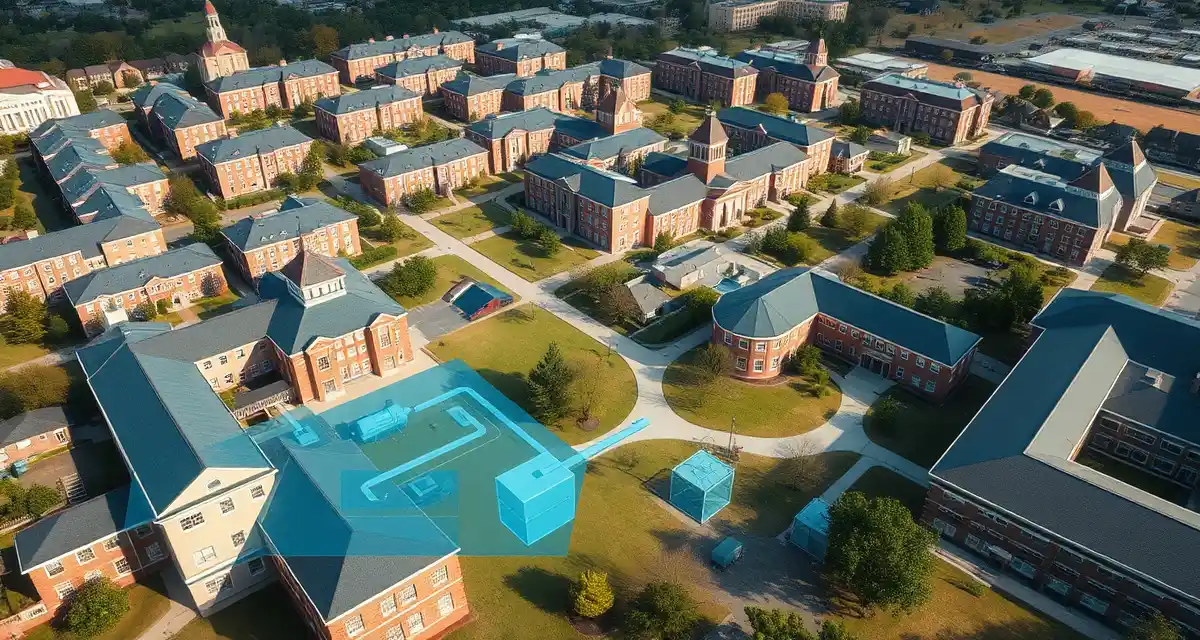
Septic Service for University and College Campuses
By the SepticMind Editorial Team
A septic failure during finals week at a university creates an immediate health and operational crisis affecting students at their highest-stress academic moment, and university campus septic systems experience extreme occupancy swings between academic semesters that no generic commercial service schedule accounts for. Managing university and college campus septic accounts requires understanding how the academic calendar drives both load variation and service timing.
TL;DR
- Universities facilities have distinct wastewater loading patterns that affect septic system sizing, service frequency, and permit requirements.
- Commercial and institutional properties like universities typically require more frequent pumping than residential systems due to higher daily usage.
- Some universities operations generate waste streams (grease, chemicals, or high-volume flow) that require pre-treatment before reaching the septic system.
- Service contracts for universities provide predictable recurring revenue and are easier to manage with a platform that tracks commercial account schedules.
- Health department inspections for universities properties may require septic system condition documentation as part of facility licensing.
- Septic companies specializing in universities service build referral networks with property managers, architects, and health inspectors in that niche.
SepticMind's university account type tracks academic calendar occupancy patterns in service scheduling, ensuring campus facilities are serviced around the academic year rather than on fixed calendar dates that ignore when students are actually on campus.
The Academic Calendar Load Pattern
University campuses have an occupancy pattern unlike any other commercial account type:
Full academic session (September-December, January-May): Campus operates near maximum occupancy. Residence halls are full, academic buildings see peak daily use, dining facilities serve thousands of meals per day.
Summer sessions: Reduced but significant occupancy. Summer programs, research operations, and campus housing for summer students and conference guests maintain partial load.
Winter break: Near-zero occupancy for 2-6 weeks. Residence halls are vacated; minimal staff maintains the campus. The septic systems have their only true recovery period.
Spring break: One-week low-occupancy period during the academic year that provides a minor recovery window.
This pattern creates high loading for 9-10 months with brief recovery periods. Unlike seasonal facilities that go fully dormant, university septic systems rarely see truly low loading -- even during breaks, some on-campus housing, research facilities, and essential operations continue.
Types of University Facilities With Private Septic
University campuses with private septic typically have it in areas where municipal sewer isn't available:
Athletic complex facilities: Campus athletic complexes often sit on the edges of campus where infrastructure development came later. Locker rooms, training facilities, and field house buildings may rely on private septic.
Research and agricultural facilities: Universities with agricultural programs, research farms, or field research stations have specialized facilities well beyond municipal sewer reach.
Historic campus buildings: Older campus buildings on historic core areas sometimes predate the campus sewer extension and were served by individual or small cluster septic systems.
Campus edge housing: Residential facilities built as the campus expanded outward may be on private septic if sewer extension wasn't economically justified.
Conference and retreat facilities: Universities with conference centers, retreat facilities, or faculty housing communities often have these on private septic systems at locations away from the main campus core.
Each of these facility types has a different load profile and service requirement. Managing them under one university account with separate facility records keeps the compliance history organized.
Service Scheduling Around the Academic Calendar
The optimal service scheduling for university accounts centers on the academic calendar's transition points:
Pre-fall semester service: Facilities used primarily during the academic year should be serviced in August before fall semester begins. This pre-fall pump-out provides maximum capacity buffer for the high-load fall semester.
Winter break service: The winter break (typically mid-December through early January) is the best time for service that might disrupt building use during operation. Extended dormancy allows any repairs to be completed without student access impacts.
Pre-spring semester service: For facilities that saw heavy fall use and will see another heavy spring semester, a service between winter break and spring semester start addresses the accumulated fall-semester load before a second high-load period begins.
Post-spring service: After the spring semester ends (May) and before summer programs pick up, a post-spring service documents condition and provides capacity for summer use.
This four-event calendar -- pre-fall, winter break, pre-spring, and post-spring -- is a reasonable starting framework for high-use university facilities, with the understanding that actual service events can be consolidated based on observed fill rates.
Residence Hall Septic: High-Load Management
Residence halls with private septic present the highest load intensity of any university facility type:
Continuous daily use: Unlike academic buildings that empty in the evening, residence halls have students using facilities through the night. There's no meaningful daily recovery period.
High per-capita use: College students in residence halls use more water and generate more wastewater per capita than households. Communal living with limited personal space concentrates use in shared bathrooms.
Kitchen and laundry: Residence halls with shared kitchens and laundry rooms add gray water loading beyond restroom use.
Event loading: Residence hall common areas during study periods, social events, and resident meetings generate use spikes beyond normal daily patterns.
A residence hall with 200 students on private septic is a high-commercial load that needs service frequency closer to a commercial account than a residential calculation would suggest.
Healthcare and Research Facility Considerations
University health centers and research facilities may have specialized wastewater considerations:
Student health center: Clinical wastewater from a health center may contain pharmaceutical residues and other medical waste considerations similar to small medical facilities. The service approach for university health centers should reflect healthcare facility considerations.
Research laboratory wastewater: Research labs using chemical reagents, biological materials, or radioactive materials have strict regulations about what can enter any drain system. The septic system serving a research building should not receive regulated research wastewater without proper pretreatment.
Agricultural research facilities: University farms and agricultural research stations generate agricultural wastewater that may require specific management depending on the research activities.
For the septic service relationship, identify what building types are connected to each system you're servicing and verify whether any specialized wastewater management is in place.
Working With University Facilities Departments
University facilities departments are professional property managers with well-organized procurement and compliance processes. A few practices make these relationships work well:
Align with procurement cycles: Universities operate on fiscal year budgets and procurement policies. Annual service contracts fit their budget planning better than ad-hoc service. Approach the conversation as a contract proposal rather than individual service calls.
Provide formal documentation: University facilities departments keep organized maintenance records. Your service reports need to be in formats that fit into their systems -- consistent, dated, and signed by a licensed technician.
Understand their compliance framework: Universities have environmental health and safety offices that set internal standards for facility maintenance. Understanding what those standards require for septic system management helps you position your services as meeting their compliance framework.
The septic service for schools guide covers the educational institution client relationship model. The healthcare facility service guide covers health center and medical facility considerations that apply on university campuses.
Get Started with SepticMind
Managing service contracts for universities properties is easier with a platform built for the septic trade. SepticMind tracks commercial service schedules, documents every inspection visit, and keeps your compliance records organized by property. See how it handles your commercial account portfolio.
Frequently Asked Questions
What service schedule is appropriate for university campus buildings with private septic?
University facilities with high academic-year occupancy should plan for pre-fall service in August before the semester begins, potential mid-year service during winter break if fall-semester loading was heavy, and post-spring service in May to document condition and provide buffer for summer programs. Residence halls with continuous high-occupancy use may need service twice per academic year at minimum -- before fall semester and at winter break. Academic buildings, athletic facilities, and research buildings with more predictable hours can often manage with annual or biennial service depending on their load intensity. Track actual fill levels at each service to calibrate intervals to observed filling rates rather than default assumptions.
How should septic service adapt to university academic calendar occupancy changes?
Service scheduling should follow transition points in the academic calendar rather than fixed calendar dates. Pre-semester service before high-occupancy periods, break-period service during low-occupancy windows, and post-semester service after high-load periods are more aligned with actual demand than monthly or quarterly calendar scheduling. When the university changes its academic calendar -- adding a summer semester, changing break lengths, or opening new facilities -- update the service schedule to reflect the changed occupancy pattern. SepticMind's university account type stores the academic calendar for each campus facility and triggers service reminders based on semester start dates rather than fixed calendar intervals.
Does SepticMind support academic calendar-based septic scheduling for campus accounts?
Yes. SepticMind's university account type maintains the academic calendar for each campus, including semester start and end dates, break periods, and summer programming schedules. Service reminders for each facility are generated based on the calendar transition points most relevant to that facility's load pattern -- pre-fall service reminders in July for high-occupancy academic-year facilities, winter break service windows for facilities that see heavy academic-year use, and so on. Multiple campus facilities are tracked under one university account with individual records for each building, allowing the facilities director to see all facilities' service status in one view. Compliance documentation for each facility is maintained separately and can be generated for individual buildings or the entire campus portfolio.
How often should a septic system serving a universities property be inspected?
Septic systems at universities properties should be inspected at least annually and pumped more frequently than residential systems, since commercial-scale daily water usage accelerates sludge and grease accumulation. The exact frequency depends on the specific activities at the facility, peak occupancy, any food service or chemical use on-site, and local regulatory requirements. A service provider familiar with universities operations can recommend an appropriate inspection and pumping schedule based on the system's actual usage profile.
What septic system issues are most common at universities properties?
The most common septic problems at universities properties are rapid sludge accumulation from high occupancy, grease trap failure if food service is involved, hydraulic overloading during peak-use periods, and non-biodegradable waste disposal from cleaning or maintenance activities. Regular inspection and a service contract with clear maintenance intervals are the most effective ways to catch these problems before they cause system failure or regulatory violations.
Try These Free Tools
Sources
- National Onsite Wastewater Recycling Association (NOWRA)
- US EPA Office of Wastewater Management
- NSF International
- Water Environment Federation
- National Environmental Services Center (NESC)