Effluent filter cleaning: how to do it right and how often
By the SepticMind Editorial Team
TL;DR
- Clean your effluent filter every 1 to 3 years, or at every scheduled pump-out.
- The job takes 15 to 30 minutes: pull the cartridge, rinse solids back into the tank with a hose, reinstall.
- Skip it and sewage backs into the house or solids clog the drain field.
- DIY cost is close to zero.
- A pro charges $50 to $150, or nothing if it's bundled with a pump-out.
What is an effluent filter and what does it actually do?
An effluent filter (sometimes called an outlet baffle filter) sits in the outlet tee of your septic tank, right before liquid waste leaves for the drain field. It catches suspended solids that slip past the tank's settling process, so those solids never reach and clog your leach field.
Without a filter, fine particles of grease, hair, and partially digested waste ride out with the effluent every time a large water surge stirs the tank. Drain field soil is not built to handle that load. Once pipes or soil pores clog with solids, the damage is almost always permanent, and a full drain field replacement can run $5,000 to $25,000 depending on your region [1].
Most filters sold today are slotted plastic cartridges. Brand names you'll see in the field include Zabel, Orenco, Bio-Microbics BioBarrier, and Polylok. Slot sizes range from 1/16 inch (1.6 mm) for aggressive filtration to 3/16 inch (4.8 mm) for lighter duty [7]. Florida's onsite treatment rules, like most state codes adopted after 2000, require an approved filter on any new or repermitted system [2].
Older homes may not have one at all. If your tank went in before the mid-1990s and nobody has ever mentioned a filter during a pump-out, pull the outlet lid and look. Adding one later is a simple retrofit that costs $30 to $80 for the cartridge.
How often should you clean an effluent filter?
Clean the filter at every routine pump-out, whichever comes first with any visible clogging. The EPA SepticSmart program ties filter service to routine pump-out intervals, which for most households means every 3 to 5 years [3]. Manufacturers and state extension programs push that to every 1 to 2 years for households with heavy use, garbage disposals, or more than four people [6].
The honest answer: clean it whenever it's visibly clogged or at every pump-out, whichever comes first. Some filters clog in 18 months in a busy household. Others go three years with almost no buildup.
A few things speed up clogging:
- Garbage disposal use. Food solids raise the suspended particle load fast.
- Large households. More flushes mean more solids stirred up per day.
- Grease down kitchen drains. Grease coats the slots and is harder to rinse off than grit.
- High water table periods. In wet seasons, groundwater intrusion can push slugs of unprocessed waste toward the outlet.
- Recent high-volume water events (a burst pipe, a marathon laundry day, a house full of guests).
For operators running routes in high-density service areas like Polk County, FL, or anywhere in central Florida's clay-heavy soils, a clogged filter is one of the more common service calls [6]. Setting a cleaning interval in your scheduling software takes about two minutes and heads off most of those emergency callbacks. SepticMind's scheduling tools let operators attach filter service intervals to individual customer records so nothing slips through.
If your system has an alarm float that trips at a high-water level, a clogged filter is often what sets it off. That's the filter doing its job: slowing discharge to protect the field, and telling you it needs attention at the same time.
What are the signs that your effluent filter needs cleaning?
The clearest sign is a high-water alarm, if your system has one. A clogged filter chokes outflow, liquid backs up in the tank, and the float trips. No alarm? Watch for these instead:
- Slow drains throughout the house, especially after normal daily use rather than after one big flush.
- Gurgling from toilets or drains when other fixtures run.
- Sewage odors near the tank lids or inside the house through floor drains.
- Standing water or unusually green grass over the septic tank itself (not the drain field), which can mean a backed-up tank weeping from the lid seams.
None of these symptoms point only at the filter. A full tank, a broken outlet baffle, or a failing drain field can produce the exact same signs. But cleaning the filter is the cheapest first check, so do it before anything else. If a clean filter doesn't fix slow drains within 24 hours, move to a septic tank inspection to rule out deeper problems.
How do you clean an effluent filter step by step?
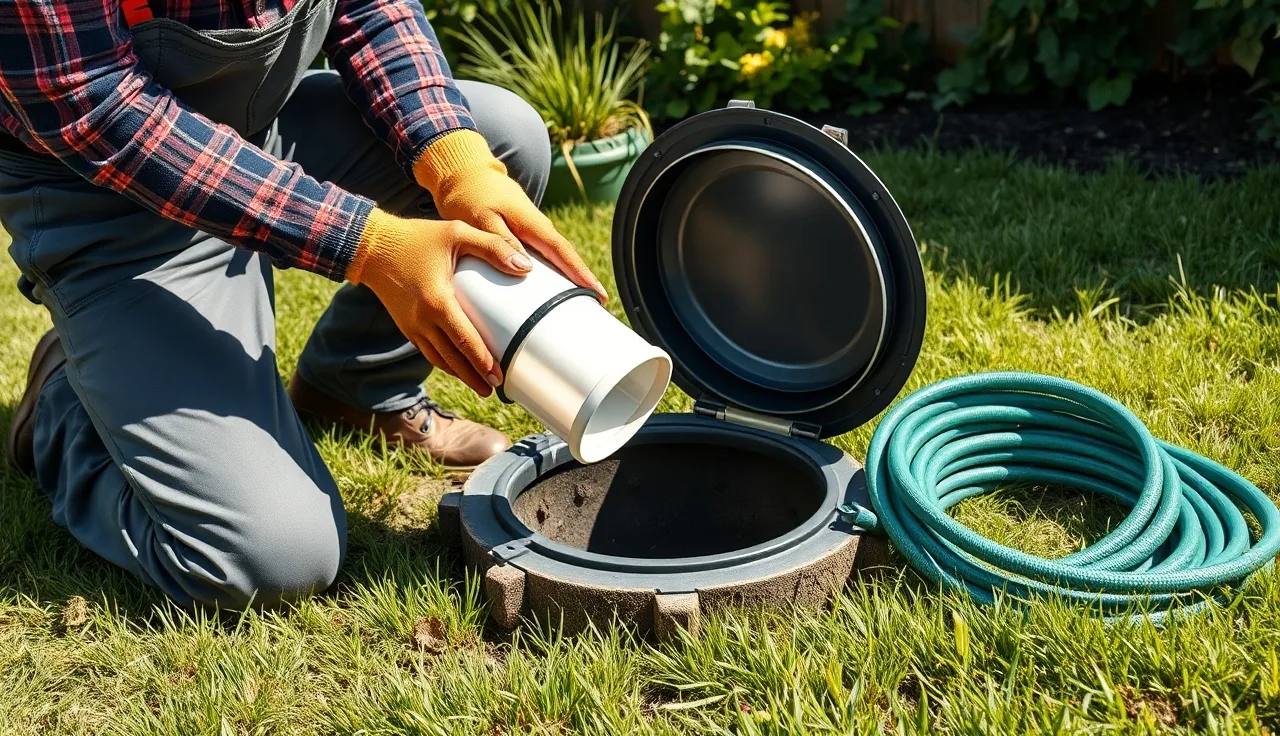
This is a DIY-friendly job. You need rubber gloves, safety glasses, a garden hose with reasonable pressure, and a bucket or tarp for the cartridge. A face mask helps. Raw septic effluent carries pathogens and hydrogen sulfide gas, so work in open air.
Step 1: Find the outlet baffle lid. Your tank usually has two lids. The inlet side is nearest the house. The outlet side faces the drain field. The filter lives on the outlet side. Not sure which is which? Open a lid and look for a plastic standpipe. The filter body is hard to miss once you're staring at it.
Step 2: Pull the cartridge. Most cartridges lift straight out by a handle or loop. Some have a quarter-turn lock. Lift slowly. The cartridge drips heavily, so have the bucket ready.
Step 3: Rinse solids back into the tank, not onto the ground. This is the rule most homeowners get wrong. Hold the cartridge over the open tank and rinse it with the hose. The solids fall back in, where bacteria keep processing them. Rinsing onto the lawn puts pathogens on the surface and may violate your local health code [7].
Step 4: Inspect the cartridge while it's out. Look for cracked plastic, missing end caps, or warped slots. A damaged cartridge stops filtering properly. Replacement cartridges cost $30 to $80 depending on brand and size [10].
Step 5: Reinstall and replace the lid. Seat the cartridge fully so the end caps seal against the tee housing. Put the lid back and mark your calendar for the next cleaning.
The whole job is 15 to 30 minutes. Doing it as an add-on to a scheduled septic tank pump out is ideal, because the tank is already open and the pumper can rinse the cartridge before refill.
Can you clean an effluent filter yourself or do you need a pro?
You can clean it yourself. No license is required for a homeowner to service their own filter in most states, including Florida [2]. The task is simple, the tools sit in your garage, and the only real risk is forgetting to rinse into the tank instead of onto the ground.
A few situations do call for a licensed operator:
- You've never located your tank lids and have no system diagram. Digging blind can crack the tank or the inlet/outlet pipes.
- The system has an alarm or a pump chamber. Multi-compartment systems can hide filters in odd places.
- The cartridge is cracked or missing, which means the system may have run unprotected for a while. A pro can size up the drain field while they're there.
- You're in a county that requires a licensed contractor for any septic service. This is uncommon, but worth a call to your county health department.
For homeowners in Mulberry, FL, and the broader Polk County, FL, area, the Florida Department of Health in Polk County administers the state's onsite sewage program [8]. You can confirm local requirements through the Florida DOH onsite sewage office [2]. Effluent filter cleaning in Mulberry, FL, falls under the same statewide rules as the rest of the state: homeowners may service their own systems, and routine maintenance needs no permit.
Hire a pro and most pumping companies fold filter cleaning into a standard septic tank pumping visit at no charge, or for a modest $25 to $75. Ask when you book.
What does effluent filter cleaning cost?
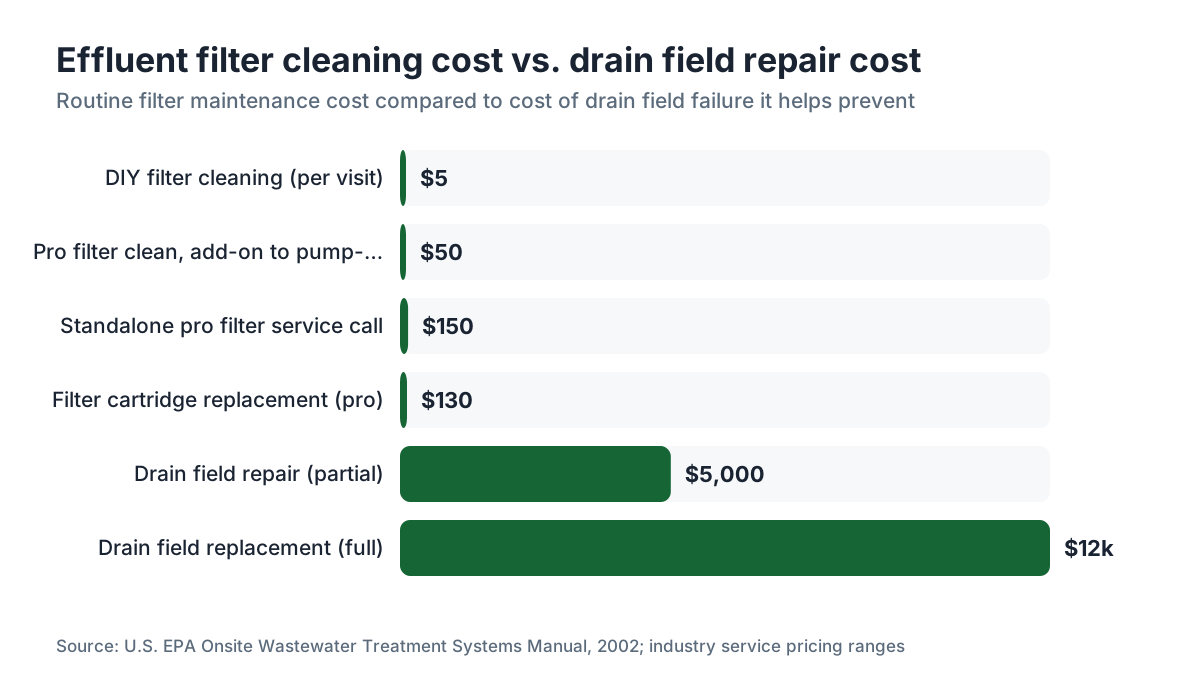
Cost turns almost entirely on whether you do it yourself or bundle it with a service call. DIY is a few dollars for gloves. A standalone pro visit runs $100 to $200.
| Scenario | Typical cost | Notes |
|---|---|---|
| DIY cleaning, existing filter | $0 to $10 | Just gloves and a hose |
| Pro cleaning, add-on to pump-out | $0 to $75 | Many pumpers include it free |
| Standalone pro service call | $100 to $200 | Travel plus labor, no pumping |
| Filter cartridge replacement (DIY) | $30 to $80 | Zabel, Orenco, Polylok brands |
| Filter cartridge replacement (pro-installed) | $80 to $175 | Parts plus labor |
Those are national ranges. In Polk County, FL, service costs tend to land toward the lower end, because plenty of licensed septic contractors compete for the work. Pricing varies by company, so call two or three operators and ask flat out whether filter cleaning is included in the pump-out price.
The cost of skipping it is the number that matters. Drain field replacement in Florida averages $4,000 to $12,000 for a standard system, and a lot more for advanced treatment units or large lots [1]. A $50 cleaning every couple of years is an easy trade.
For operators: if you're not charging separately for filter cleaning and replacement, you're leaving money on the table and skipping a service customers genuinely need. Track filter condition at every visit and flag cartridges due for replacement. It's one of the plainest ways route management tools lift per-customer revenue without adding complexity.
What happens if you never clean the effluent filter?
Short version: the filter clogs solid, outflow stops, the tank backs up, and sewage comes back into the house. That's the good outcome, because at least you know something's wrong.
The worse one is a partly clogged filter that still passes some flow, then bypasses entirely under pressure during a surge and shoves a slug of raw solids into the drain field. Drain field soil that takes on raw solids grows a biomat, a dense biological layer that slowly seals the soil pores. The EPA identifies drain field failure as the primary reason for septic system replacement, and solids loading from a failed or absent filter is one of the leading causes [3].
Florida guidance makes the link plain. UF IFAS Extension calls regular effluent filter cleaning one of the cheapest steps a homeowner can take to protect the drain field [6]. That's not marketing copy. It's standard advice from engineers who've watched thousands of systems fail.
Plenty of homeowners figure that if the system seems fine, nothing needs attention. Septic systems fool you that way. A drain field can degrade silently for years before any surface symptom shows. By the time the ground over the field goes soggy or you smell sewage outdoors, the soil damage is usually well along. Regular filter cleaning is cheap insurance against that slow failure.
Are there different types of effluent filters and does the cleaning method change?
Yes, filter designs differ in a few real ways, but the core cleaning process is the same for all of them: pull, rinse over the tank, reinstall.
Slotted cartridge filters (Zabel A100, Polylok PL-525, Orenco FT series) are the most common. They're cylindrical plastic with horizontal slots. Pull out, rinse over the tank, reinstall. You'll find these on about 90% of residential systems [7].
Screen filters wrap a mesh screen around a frame instead of using slotted plastic. They filter finer particles and clog faster. Some need a gentle brush scrub on top of rinsing to clear biofilm from the mesh. Check the manufacturer's instructions. Aggressive pressure washing can deform fine mesh.
Filters with built-in alarm floats (some Orenco models) carry an internal float that trips an alarm before full clogging. When you clean these, make sure the float moves freely after reinstall and the alarm wire isn't pinched by the lid [9].
Gravity-fed versus pump-system filters. Most residential systems are gravity-fed, with the filter in the outlet tee of a passive tank. Some systems use a pump chamber downstream, which may hold extra screening components. Clean the primary tank's outlet filter on the same schedule either way.
If your system uses a proprietary treatment unit (Norweco, Advantex, Bio-Microbics), read the manufacturer's operations and maintenance manual for filter-specific guidance. Some advanced units run multiple filter stages on different service intervals.
How does effluent filter cleaning fit into overall septic maintenance?
Septic maintenance is a short list: pump the tank on schedule, keep the drain field free of compaction and roots, keep harsh chemicals out, and keep the filter clean. That's it.
Filter cleaning and tank pumping go hand in hand, because the easiest time to clean the filter is while the tank is being pumped. The lid is open, the pumper is on site, and rinsing the cartridge over an open tank is trivial. On a 3-year pump-out schedule, line up filter cleaning with every pump-out. Large household or a garbage disposal? Clean the filter every 18 months even if the tank isn't being pumped [6].
The how often to pump septic tank question and the filter question share an answer: it depends on household size, tank volume, and usage. The EPA's 2002 Onsite Wastewater Treatment Systems Manual gives a table of pumping frequencies by household size and tank volume [5]. Filter cleaning should track those same intervals.
For septic tank cleaning and septic tank emptying visits that open the full tank, operators should make filter inspection a standard checklist item, not an optional extra. Documenting filter condition at each visit builds a service record that's genuinely useful to the homeowner and protects the operator if a field failure gets alleged later.
SepticMind's operator platform includes customizable service checklists where filter condition, slot size, and cartridge brand get logged per visit, so that data follows the customer record instead of living on a paper ticket that gets lost.
Thinking about the bigger picture? A septic tank inspection every few years catches outlet baffle decay, tank cracks, and inlet problems that a cleaning visit alone won't reveal.
What do Florida and Polk County rules say about effluent filter requirements?
Florida Statutes Chapter 381 and Florida Administrative Code Rule 64E-6 govern onsite sewage treatment and disposal systems statewide [2]. Under Rule 64E-6, an approved effluent filter is required on any new system permitted after the rule's adoption and on any system undergoing substantial repair or modification.
Polk County administers these rules through the Florida Department of Health in Polk County's Environmental Health division [8]. There's no separate Polk County effluent filter ordinance. The statewide FAC 64E-6 standards apply uniformly.
For existing systems built before the filter requirement, there's no retroactive mandate to add one in most cases, but the state program strongly recommends it. If your system gets inspected during a real estate transaction and the inspector notes no filter, buyers and lenders often require installation before closing.
Cleaning your own filter on your own property needs no license in Florida. Hiring someone to do it may require a licensed septic contractor depending on the scope. The Florida Department of Health maintains a contractor lookup tool [2].
For effluent filter cleaning in Mulberry, FL, specifically, Mulberry sits inside Polk County's jurisdiction, so the Florida DOH Polk County office at (863) 519-8300 can confirm whether any local variance applies to your property [8]. In practice, routine filter maintenance follows the same statewide rules across all of Polk County.
What should you never do when cleaning an effluent filter?
A handful of common mistakes cause real damage. Skip all of them.
Never rinse the cartridge onto the ground. Raw septic effluent carries fecal coliform bacteria, E. coli, and other pathogens. Rinsing onto the lawn contaminates the surface, can reach groundwater, and may break your local health code. Always rinse over or into the open tank [7].
Never use bleach or disinfectants on the filter. The goal is to knock off physical solids, not sterilize the cartridge. Bleach rinsed into the tank kills the beneficial bacteria that run the whole system. Plain water does the job.
Never use a pressure washer at high pressure. A strong garden hose is fine. A 3,000 PSI washer can deform a plastic cartridge's slots, widening them and defeating the point of the filter.
Never reinstall a cracked cartridge. A cracked end cap lets the filter get bypassed entirely. If it's damaged, replace it [10].
Never ignore the lid seal. Septic tank lids should fit snugly. If the lid was cracked or didn't seat right before you opened it, flag it for repair. A loose or cracked lid is a safety hazard and lets rainwater in, which dilutes the tank and overloads the field.
Never skip documentation. Write down the date, what you found, and what you did. A phone photo of the filter with a quick note is enough. If you ever sell the house or file a warranty claim, that record earns its keep.
Frequently asked questions
How often should an effluent filter be cleaned?
Clean it at every pump-out, which for most households is every 1 to 3 years. Heavy-use households with garbage disposals or more than four people should inspect it annually. If your system has a high-water alarm and it trips between scheduled pump-outs, the filter is the first thing to check. The EPA SepticSmart program ties filter service to routine pump-out intervals as the baseline.
Can I clean my effluent filter myself?
Yes. Most homeowners can do it with rubber gloves, safety glasses, and a garden hose. Pull the cartridge from the outlet tee, rinse solids back into the open tank (not onto the ground), inspect for cracks, and reinstall. No license is required for homeowners servicing their own systems in Florida or most other states. If you're unsure where the filter is or your tank has multiple compartments, call a licensed operator.
What happens if I don't clean my effluent filter?
A fully clogged filter backs sewage up into the house. A partly clogged one can force solids past it into the drain field during surge events, causing biomat buildup and permanent soil damage. Drain field replacement costs $4,000 to $25,000 depending on system size and location. The EPA identifies solids loading from poor filter maintenance as one of the leading causes of premature drain field failure.
How much does it cost to have a professional clean an effluent filter?
Most pumping companies include filter cleaning in a standard pump-out at no extra charge, or for $25 to $75 added to the bill. A standalone service call just for filter cleaning runs $100 to $200 including travel and labor. Cartridge replacement, if needed, adds $30 to $80 for parts. In competitive markets like Polk County, FL, prices tend toward the lower end of those ranges.
Where is the effluent filter located in my septic tank?
It sits in the outlet tee of your septic tank, on the side closest to your drain field (the far side from the house). Open the outlet-side lid and look for a cylindrical plastic cartridge with a handle or loop sticking up from the tee pipe. If you see only a concrete or PVC tee with no cartridge, your system either predates the filter requirement or the filter was removed and never replaced.
Do I need a permit to clean my effluent filter in Florida?
No permit is required for routine cleaning of an existing effluent filter on your own property in Florida. Florida Administrative Code Rule 64E-6 governs onsite septic systems statewide, and routine homeowner maintenance doesn't trigger a permit. If you're adding a filter to a system that didn't have one, check with your county health department; that may count as a repair requiring a licensed contractor and permit.
How long does it take to clean an effluent filter?
The physical cleaning takes 15 to 30 minutes for a homeowner working solo. Most of that time is locating and opening the lid. The rinse itself is 5 to 10 minutes. Bundled with a professional pump-out, the pumper usually does it in under 10 minutes while the tank is already open. Add time if the cartridge needs replacement.
Can a clogged effluent filter cause slow drains in the house?
Yes. A heavily clogged filter chokes outflow from the tank, the liquid level rises, and eventually the system backs up enough that drains throughout the house slow or stop. Gurgling and sewage odors often come with it. But slow drains have several possible causes, including a full tank, a broken baffle, or a drain field problem, so if cleaning the filter doesn't fix it within a day, schedule a full inspection.
What type of effluent filter do I have and does it matter for cleaning?
Most residential systems use slotted plastic cartridges from brands like Zabel, Polylok, or Orenco. The cleaning process is the same for all of them: pull, rinse over the tank, reinstall. Screen-style filters may need a gentle brush scrub on top of rinsing. Check your filter for a brand marking and pull up the manufacturer's sheet if you're unsure. Slot size (typically 1/16 to 3/16 inch) affects how often it clogs, not how you clean it.
Is there an effluent filter requirement in Polk County, FL?
Yes. Florida Administrative Code Rule 64E-6 requires an approved effluent filter on any new or substantially repaired onsite system statewide, including all of Polk County. The Florida Department of Health in Polk County administers the program locally. Older systems installed before the rule's adoption may not have a filter, but adding one is strongly recommended and is sometimes required as a condition of a real estate sale or repair permit.
Should I clean the effluent filter before or after the tank is pumped?
After the tank is pumped is ideal, but most operators rinse the filter over the open tank before pumping so the solids fall back in and get removed during the pump-out. Either order works. The one rule that doesn't bend: always rinse solids back into the tank, not onto the ground. If you're doing a standalone filter clean without a pump-out, rinse into the tank and the bacteria will process the debris.
How do I know if my effluent filter needs to be replaced rather than just cleaned?
Inspect the cartridge while it's out. Look for cracked plastic, missing or deformed end caps, broken slot walls, or visible holes. Any of those means the filter is letting particles through unfiltered and needs replacement. Also replace it if the slots are visibly warped from a previous over-pressure rinse. Replacement cartridges run $30 to $80, a cheap repair against what a compromised filter costs in drain field damage.
Can an effluent filter help extend the life of my drain field?
Yes, and that's its main purpose. The drain field's soil accepts liquid effluent and treats it through natural filtration and biological processes. Solids that reach the field pile up in a layer called biomat, which slowly clogs soil pores and eventually kills the field's permeability. A clean effluent filter is the last line of defense between the tank and the field. UF IFAS Extension calls regular filter cleaning one of the cheapest ways to extend drain field life.
What cleaning products should I use on an effluent filter?
Plain water from a garden hose is all you need and all you should use. No bleach, no disinfectants, no enzyme cleaners, no degreasers. The goal is physical removal of solids, not chemical treatment. Any disinfectant that drips into the tank kills the bacterial colonies that break down waste, setting back the tank's biological performance for weeks.
Sources
- U.S. EPA, Onsite Wastewater Treatment Systems Manual (2002): Drain field failure is the primary reason for septic system replacement; solids loading is a leading cause of premature field failure.
- Florida Department of Health, Onsite Sewage Program (FAC Rule 64E-6): Florida Administrative Code Rule 64E-6 requires an approved effluent filter on new and substantially repaired onsite systems; homeowners may perform routine maintenance on their own systems without a license.
- U.S. EPA, SepticSmart Program: EPA SepticSmart recommends inspecting and servicing the effluent filter at every routine pump-out, typically every 3 to 5 years, and identifies drain field failure as the primary reason for system replacement.
- U.S. EPA, Onsite Wastewater Treatment Systems Manual, Table 4-2 (2002): EPA Manual Table 4-2 provides recommended pumping frequencies by household size and tank volume.
- University of Florida IFAS Extension, Septic Systems and Their Maintenance: UF IFAS Extension guidance on septic system maintenance in Florida, including filter cleaning recommendations for central Florida clay soils and heavy-use households.
- National Environmental Services Center (NESC), Effluent Filters: What They Are and Why You Need Them: NESC describes effluent filter slot sizes (1/16 to 3/16 inch), brands, and the importance of rinsing solids back into the tank rather than onto the ground.
- Polk County, FL / Florida DOH in Polk County, Environmental Health: Florida DOH Polk County administers FAC Rule 64E-6 for Mulberry FL and all of Polk County; no separate local effluent filter ordinance exists beyond the statewide rule.
- Orenco Systems, Effluent Filter Installation and Maintenance Manual: Orenco manufacturer guidance on FT-series filter cleaning intervals and inspection of alarm floats built into filter assemblies.
- Zabel Environmental Technology, A100 Effluent Filter Product Information: Zabel A100 cartridge specifications including slot size range and replacement criteria for cracked end caps or deformed slots.
Last updated 2026-07-09