Cost of a new drain field: what homeowners actually pay
By the SepticMind Editorial Team
TL;DR
- A new drain field (leach field) usually costs $3,000 to $20,000, and most homeowners land between $5,000 and $12,000.
- Conventional gravity trenches sit at the cheap end.
- Mound and drip systems push toward $20,000.
- Soil type, lot size, permit fees, and whether the tank also needs work drive the price more than anything else.
What does a new drain field cost on average?
Most homeowners pay $5,000 to $12,000 for a new drain field. The full range runs wider. A simple gravity system on sandy rural soil can come in near $3,000, and an engineered mound or drip field on a tight, wet lot regularly hits $15,000 to $20,000 or more. [1]
Those numbers cover the field alone. If the septic tank also needs work, add $1,500 to $5,000. Permits, inspections, and soil testing add another $500 to $2,000 in most states. Add all of that up before your first contractor quote lands, or the bid will look smaller than the real project.
One useful benchmark comes from the EPA's SepticSmart program, which puts a conventional new system (tank plus leach field) at roughly $3,000 to $7,000 in a favorable location [1]. Replacement almost always costs more than a fresh build. You're paying to abandon the failed field, work around site access, and squeeze the new field into whatever land you have left.
Here's the honest caveat. Nobody has good national data on drain field replacement specifically. The ranges above come from state onsite wastewater program disclosures, contractor surveys, and extension service publications. Your state's health or environmental agency sometimes publishes average installed costs inside its financial assistance documents, and those are the most reliable local numbers you'll find.
What factors drive the cost of a new drain field up or down?
Soil is the single biggest variable. A perc test (percolation test) measures how fast water moves through your ground. Sandy, well-draining soil gets you a compact, cheap trench. Clay or seasonally saturated soil forces a mound, a drip system, or an aerobic treatment unit ahead of the field, and each of those adds thousands. Some lots fail perc outright and need engineered alternatives north of $30,000. [2]
Lot size and open area matter almost as much. Plenty of land away from wells, property lines, and structures gives the installer room to work. A tight lot may force a smaller, pricier system or a health department variance. Setbacks vary by state but commonly run 50 to 100 feet from a drinking water well, 10 feet from property lines, and 25 feet from a structure. [3]
System size follows bedroom count in most state codes, since bedrooms stand in for daily flow. A three-bedroom home usually needs a field sized for 300 to 450 gallons per day. A five-bedroom home might need 600 to 750 gallons per day. More capacity means more trench, more pipe, more gravel or chamber media, and more labor.
Water table and bedrock depth drive excavation cost. Hit rock or groundwater at four feet and the job gets expensive fast. Blasting or hauling fill to build a mound adds $2,000 to $8,000 over the base price.
Labor rates swing hard by region. Rural Midwest contractors often quote $40 to $70 per linear foot of trench. Contractors near metro California, New England, or the Pacific Northwest may charge $80 to $120 or more per foot. [4]
| Cost Factor | Lower Cost Scenario | Higher Cost Scenario |
|---|---|---|
| Soil type | Sandy, fast-draining | Clay, high water table |
| Lot conditions | Open rural land | Tight urban lot, slopes |
| System type | Gravity trench | Mound or drip system |
| Home size | 2-3 bedrooms | 5+ bedrooms |
| Region | Rural Midwest/South | Pacific NW, New England |
| Permits & testing | Simple county process | Multiple agency reviews |
| Estimated total | $3,000, $6,000 | $12,000, $25,000+ |
How much does each type of drain field system cost?
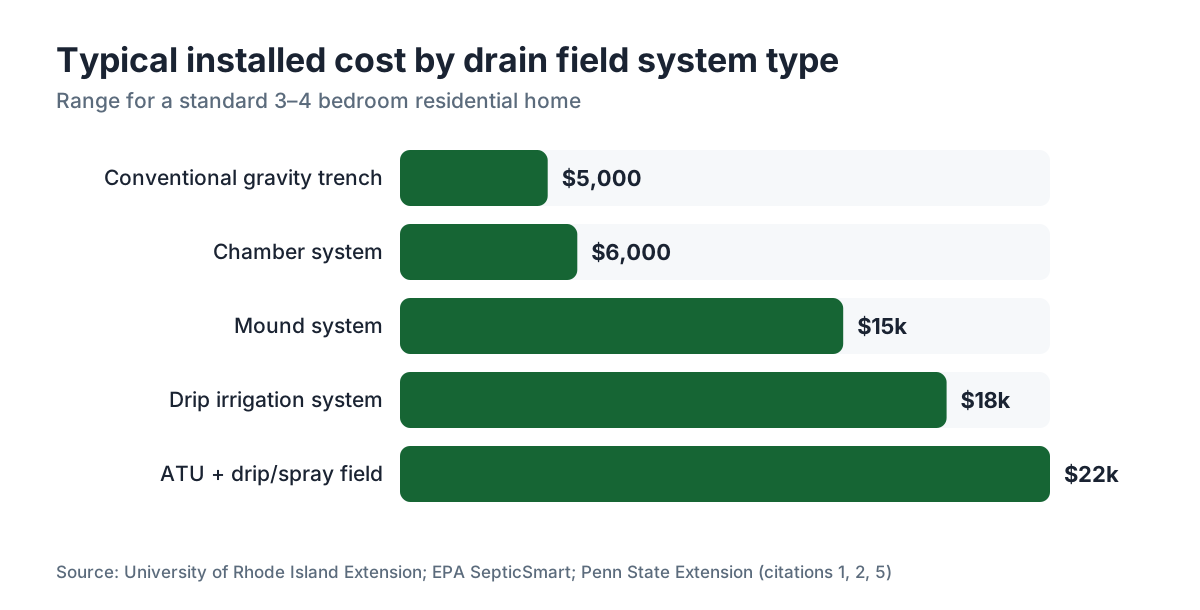
Conventional gravity trench systems are the baseline. Perforated PVC pipe runs in gravel-filled trenches, and wastewater moves from the tank by gravity. Installed cost usually runs $3,000 to $7,000 for a standard three-bedroom home with good soil. Lowest upfront price, simplest maintenance.
Chamber systems (Infiltrator is a common brand) swap gravel for plastic arch chambers. They often need less excavation, which can trim labor time and material hauling. Expect $4,000 to $8,000 depending on size.
Mound systems come in when the natural soil is too poor or the seasonal high water table sits too close to the surface. A mound is a built-up bed of sand fill above the original grade, with the field buried inside it. It adds a pump chamber, a dosing pump, and a lot more material. Total installed cost usually runs $10,000 to $20,000. [5]
Drip irrigation systems push treated effluent through small-diameter tubing just below the surface. They need an aerobic treatment unit or a filtration step first, plus ongoing filter cleaning and emitter checks. Install cost runs $12,000 to $25,000. They work on lots where nothing else does. [5]
Aerobic treatment units (ATUs) paired with a small drip or spray field are sometimes the only permitted option on a difficult lot. The ATU alone costs $5,000 to $15,000, and the field adds more on top. Annual service contracts run $300 to $600 because the operating permit requires periodic inspections.
Can you save money running a leach field with chambers instead of gravel? Sometimes. The savings come mostly from less material hauling, which matters most on hard-access sites. Get bids for both and let your site conditions decide.
What does a drain field installation include, and what costs extra?
A standard replacement bid should include excavation and removal of the failed field material, supply and installation of distribution pipes or chambers, backfill, rough grading, and final grading of the disturbed area. Most contractors fold the county or state permit into the base price, though in some states you pull the permit yourself.
Things that show up as extras on the final invoice:
Soil testing and perc tests: $300 to $1,500 depending on how many test pits the health department wants. You usually need this before the permit issues, not after.
Pump installation: if the new field sits uphill from the tank or needs a dosing schedule, you need a pump chamber and pump. Add $1,200 to $3,500.
Septic tank inspection or pumping: most contractors and health departments want the tank confirmed sound before they sign off on a new field. A septic tank pump out runs $300 to $600. Tank repair is separate. See septic tank repair.
Restoration: concrete, decking, fencing, or landscaping over the old field is almost never included. Budget $500 to $3,000 if you want the yard looking decent again.
Engineering: some states require a licensed engineer to design systems on difficult lots. Engineering fees run $500 to $2,500.
How much does hydro jetting a drain field cost, and is it worth it?
Hydro jetting a drain field (also called jetting the laterals) costs roughly $500 to $2,500 depending on the number of lines and the contractor. High-pressure water runs through the perforated pipes to break up blockages and flush debris back toward the tank.
Here's my honest take. Jetting is worth a shot when the field has been neglected but isn't biomat-failed or structurally collapsed. If the trouble is root intrusion or solids packed in the distribution pipes, jetting sometimes restores partial function. If the soil around the trenches is sealed with biomat (that black, greasy layer of anaerobic bacteria that clogs the soil pores), jetting the pipes does nothing. The problem isn't in the pipe. It's in the soil interface.
Some contractors sell jetting as a first step to buy field life. Fine, if the assessment is honest. I'd be skeptical of any company quoting $1,500 in jetting as a guaranteed fix without diagnosing the failure type first. Wet soil at the surface, sewage odors, and slow drains all at once usually mean biomat failure, and jetting won't touch that.
If jetting works, you've bought some years. If it doesn't, that money comes straight out of the replacement budget. Get a clear scope in writing for what happens when jetting fails to restore function before you pay a dime.
Can you restore a failed drain field instead of replacing it?
Sometimes, yes. The two main non-replacement routes are aeration and shock treatments.
Aerobic restoration forces air into the failed trenches to break down the biomat biologically. Companies that do this (it goes by several trade names) typically charge $1,500 to $4,000 and claim restoration in 70 to 90 percent of appropriate cases. Independent research is thin. The closest peer-reviewed work comes from small land-grant university studies, none of which I'd call conclusive, though the underlying biology of aerobic biomat breakdown is sound.
Chemical shock treatments (hydrogen peroxide, bacterial additives, enzyme products) have mixed evidence. The EPA notes that many septic additives are ineffective and some may harm the system. [6] If a contractor leads with an additive as the main fix, that's a red flag.
The honest answer: a field over 20 to 25 years old showing widespread failure is probably a lost cause, and restoration just delays the replacement by a year or two. A younger field (under 15 years) with localized or usage-driven failure is worth trying before you commit to a full replacement.
Regular septic tank pumping is the single best thing you can do to stretch drain field life. Solids that don't get pumped eventually spill into the field and clog it. The EPA recommends pumping every three to five years for most households. [1]
What permits and inspections are required for a new drain field?
Every state requires a permit for drain field installation, and most counties add their own. Requirements vary a lot. In some rural counties it's an application, a soil test, and one inspection at install. In states with strong water quality rules (Oregon, Washington, and North Carolina among them), you may need an engineered design, pre-construction approval, a mid-installation inspection, and a final as-built drawing before the permit closes. [3]
Permit fees themselves usually run $150 to $750. The bigger cost is the soil testing and site evaluation the permit requires. Some states require a licensed soil scientist or engineer, more than the contractor, to certify the site evaluation.
North Carolina's On-Site Water Protection program, for example, publishes its permitting requirements and typical timelines online. Most state health departments have similar resources. Look for your state's department of environmental quality, department of health, or department of natural resources. The onsite wastewater or septic section holds the authoritative rules for your jurisdiction. [3]
One thing worth knowing: you generally cannot legally install a drain field without a permit, and doing so risks fines and mandatory removal. More practically, an unpermitted system becomes a serious headache when you sell the house. Real estate deals increasingly require a septic tank inspection that checks for permit records.
Are there financial assistance programs to help pay for a new drain field?
Yes, and they're underused. Several federal and state programs offer grants or low-interest loans for onsite wastewater repair and replacement.
The USDA Rural Development program offers Section 504 Home Repair loans and grants for low-income homeowners in rural areas. Septic replacement qualifies. Grants go to homeowners 62 and older who can't repay a loan. [7]
The EPA's Clean Water State Revolving Fund (CWSRF) is a federal capitalization grant program states use to fund water quality projects, including onsite wastewater. Many states have built specific septic loan programs on top of CWSRF money. Interest rates often sit below market, and some programs target low-to-moderate income households. [8]
Counties in states with sharp water quality concerns (Chesapeake Bay watershed counties in Virginia, Maryland, and Pennsylvania, for example) sometimes run grant programs for septic upgrades near sensitive waters. These can cover 50 to 100 percent of replacement cost in some cases. [9]
The fastest way to find your state's programs is to search "[your state] onsite wastewater financial assistance" and click the .gov results. Your county extension office is a good first call too. They often know about money that isn't widely advertised.
If you run a service business and track customer jobs with assistance applications across your territory, tools like SepticMind keep loan program status organized alongside inspection records and job scheduling.
How long does a new drain field last, and how do you protect the investment?
A well-installed, well-maintained drain field should last 20 to 30 years. Some go longer. Overloaded, neglected, or poorly-sited fields can fail in under 10.
The biggest predictor of field life is how well you maintain the tank. Skip the pumping and solids carry into the distribution pipes and clog the soil interface. Know how often to pump your septic tank: the EPA guideline is every three to five years, though the right interval depends on household size and tank capacity. [1]
Other things that shorten field life:
High water use. Garbage disposals add a heavy solids load. Running several laundry loads in one day can hydraulically overload the field before it recovers. Spread water-heavy chores across the week.
Chemicals. Bleach, paint, solvents, and antibacterial products in bulk kill the bacteria that run your system. Normal household amounts are fine. Dumping a gallon of bleach down the drain is not.
Physical damage. Don't drive over the field. Don't plant trees or deep-rooted shrubs on it. Grass is fine, and actually good. [1]
Surface water. Roof drains, sump pumps, and yard drainage should run away from the field, not across it. Flooding the field with clean water burns through its hydraulic capacity as fast as wastewater does.
Doing a full system replacement? See cost to install a septic system for how the total project splits across tank and field.
How do you get an accurate quote for a new drain field?
Get at least three bids, and make sure every bid covers the same scope. Sounds obvious. It's still easy to line up a quote that includes permits and soil testing against one that doesn't, and the cheaper-looking bid turns out costlier once the extras land.
Ask each contractor to spell out:
- What system type they're proposing and why
- Whether the bid includes permit fees, soil testing, and the final inspection
- What happens if they hit rock or high water and have to redesign midway
- The warranty on labor and materials
- Whether they carry liability insurance and hold a current contractor license
For a septic system repair or replacement, your state's environmental or health agency website usually has a searchable list of licensed installers. Using a licensed contractor matters for your permit, your warranty, and your liability.
A licensed installer with a good reputation will sometimes tell you straight that your lot supports only one system type, or that the cheapest bid you got is underbidding a job headed for complications. That kind of straight talk is worth money.
SepticMind's operator tools help contractors build itemized quotes, track job status through permitting, and keep soil test results attached to the job file. If your contractor uses it, you'll get a more organized bid package with the documentation attached.
What are the signs your drain field is failing?
Catching failure early sometimes means the difference between a $1,500 aeration treatment and a $12,000 replacement. Here's what to watch.
Sewage odors inside the house or over the yard. A rotten-egg or sewage smell near the field means effluent is surfacing instead of soaking through the soil.
Wet, spongy, or unusually lush grass over the field. Sewage is fertilizing and saturating the ground. That's the biomat at work.
Slow drains across the whole house. Not one slow fixture (that's usually a pipe clog), but every fixture draining slowly at once. That often points to a backed-up field.
Sewage backing up into the lowest drains in the house. This is the last warning before a genuinely unpleasant situation.
See any of these and call a licensed septic professional. Before they push replacement, ask them to check whether the tank just needs pumping (a full tank mimics field failure) and whether the distribution box shows a localized problem. A septic tank cleaning or septic tank emptying should happen before you diagnose the field.
The EPA's SepticSmart program states: "A properly designed, installed, and maintained septic system can provide long-term, effective treatment of household wastewater." [1] The operating word is maintained. Most premature failures are preventable.
Frequently asked questions
How much does a new drain field cost for a 3-bedroom house?
For a three-bedroom home on soil that passes a standard perc test, a conventional gravity drain field typically runs $4,000 to $8,000 installed, permit included. Mound or drip systems on the same house can reach $12,000 to $18,000. Tank pumping and inspection, if done at the same time, add $300 to $600. Regional labor rates and local permit fees move the number in either direction.
Can a drain field be repaired instead of replaced?
Sometimes. Hydro jetting costs $500 to $2,500 and can clear blockages in the distribution pipes. Aerobic restoration treatments ($1,500 to $4,000) sometimes reverse biomat failure. Neither works on a field with saturated, compacted, or structurally failed soil. Fields over 20 to 25 years old with widespread failure are usually better candidates for replacement than repair.
How long does it take to install a new drain field?
The physical install usually takes one to three days for a conventional system. The wait is everything before that: perc testing, permit review, and scheduling. In many counties the permit-to-installation timeline runs two to six weeks. States with rigorous review (engineered design, multi-agency approval) can take two to four months. Plan around that, especially if your current field is failing.
Does homeowners insurance cover drain field replacement?
Standard homeowners policies almost never cover drain field replacement from normal wear, age, or gradual failure. Some cover sudden and accidental damage, but biomat failure and soil saturation don't qualify. A few insurers sell septic endorsements or riders as add-ons. Read your policy and call your agent before you assume coverage exists. Don't treat insurance as your financial plan for this.
What is the cheapest type of drain field to install?
A conventional gravity trench system with perforated pipe and gravel is the cheapest option, typically $3,000 to $7,000 for a standard home. Chamber systems (plastic arch chambers in place of gravel) land at a similar price and sometimes cost slightly less thanks to reduced material hauling. Both need good native soil. If your soil fails the perc test, you're into mound or drip territory and the cheap options are off the table.
How much does a mound septic system cost?
A mound system for a typical three-to-four-bedroom home runs $10,000 to $20,000 installed, with complex installs going higher. The added cost comes from engineered fill sand, a dosing pump and pump chamber, and more labor. Mounds are required where the water table or bedrock sits too close to the surface for a conventional trench. Annual maintenance costs more too, since the pump needs periodic inspection.
Do I need a new septic tank when I replace the drain field?
Not necessarily. The tank and the field are separate components. If your tank is structurally sound and the right size for your household, you can replace the field and keep the tank. Your installer should inspect and pump the tank during the project. If the tank is cracked, undersized, or more than 30 to 40 years old, replacing both at once can save a second mobilization cost later.
How much does a perc test cost before installing a new drain field?
A percolation test (perc test) typically costs $300 to $1,500 depending on how many test pits your county requires and whether a licensed soil scientist or engineer must run it rather than a contractor. Some states bundle the perc test into the permit fee. Get clarity on who performs the test and who pays before you sign anything with a contractor.
Can I install a drain field myself to save money?
In most states, no. Drain field installation requires a permit, and permits require a licensed installer. Doing it yourself is illegal in most jurisdictions and voids any future permit record. An unpermitted system is a liability at resale and can trigger fines or forced removal. A few very rural counties with minimal oversight are exceptions, but they're getting rarer as state water quality rules tighten.
How much does hydro jetting a septic drain field cost?
Hydro jetting the lateral lines in a drain field runs $500 to $2,500 for most residential systems. It's worth trying when the failure looks like pipe blockage or root intrusion rather than soil biomat failure. If the contractor can't tell you the failure type before recommending jetting, ask for a camera inspection or a distribution box check first. Jetting doesn't fix soil-level failure.
What are the signs that a drain field needs to be replaced?
The main signs are sewage odors in the yard or house, wet or spongy ground over the field, unusually green and lush grass over the field lines, all house drains running slow at once, and sewage backing up into the lowest fixtures. Before assuming replacement, have the tank pumped and inspected, and have a pro check the distribution box. Some failures that look like the field are actually tank problems.
Are there grants or loans to help pay for a new drain field?
Yes. The USDA Section 504 Home Repair program offers loans and grants for low-income rural homeowners, and septic replacement qualifies. Many states run septic loan programs funded through the EPA's Clean Water State Revolving Fund, often below market rate. Some counties near sensitive waterways offer outright grants. Search your state's environmental or health department website for onsite wastewater financial assistance programs.
How do I find a licensed drain field installer near me?
Your state's department of environmental quality, department of health, or equivalent agency keeps a list of licensed onsite wastewater contractors. Search the agency site for 'septic installer license lookup' or 'onsite wastewater contractor search.' Your county health department is another good call. Always verify the license is current, check for complaints with your state contractor licensing board, and get at least three bids.
Sources
- EPA SepticSmart program, homeowner guidance: EPA recommends pumping septic tanks every three to five years; properly maintained systems provide long-term effective treatment; conventional systems average $3,000, $7,000 new installed
- Penn State Extension, onsite septic and soil evaluation resources: Soil percolation rate and water table depth determine what system type is required; clay-heavy or high-water-table lots require mound or alternative systems
- North Carolina Department of Environmental Quality, onsite wastewater and water protection: State permit requirements, setback standards, and inspection requirements for drain field installation
- University of Minnesota Extension, septic system resources: Regional labor rates and system type cost ranges for drain field installation in the upper Midwest
- University of Rhode Island Cooperative Extension, onsite wastewater and alternative systems: Mound systems cost $10,000, $20,000 and drip systems $12,000, $25,000 for residential installations
- EPA, How to Care for Your Septic System: EPA notes that many septic additives are ineffective and some may harm the system or contaminate groundwater
- USDA Rural Development, Single Family Housing Repair Loans and Grants (Section 504): USDA Section 504 program provides loans and grants to low-income rural homeowners for septic system replacement
- EPA, Clean Water State Revolving Fund: CWSRF funds state septic loan programs with below-market interest rates for onsite wastewater system repair and replacement
- Virginia Department of Health, onsite sewage and water services: State setback requirements, permit processes, and approved system types for drain field installation in Virginia; watershed grant programs near sensitive waters
- Oregon Department of Environmental Quality, onsite wastewater management program: Oregon permitting requirements including engineered design and multi-inspection process for drain field replacement
Last updated 2026-07-09