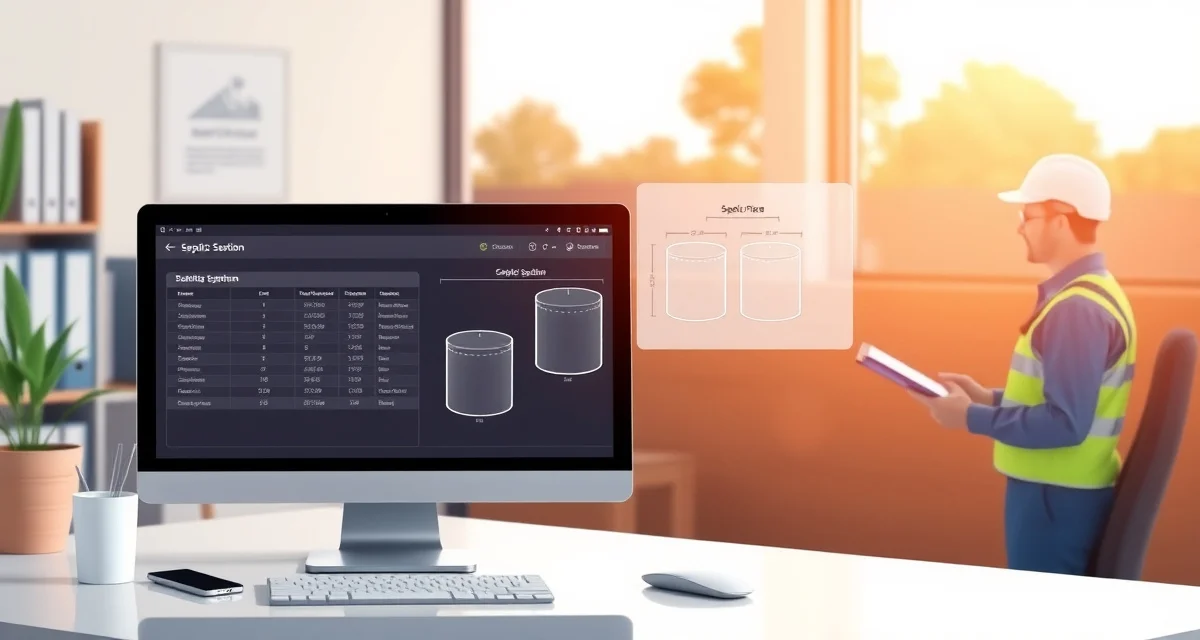
Septic Tank Size Database: How SepticMind Knows Your Customer's Tank
By the SepticMind Editorial Team
Here's a scenario that plays out every day in septic companies that don't have a tank data system. The dispatcher books a pump job. The tech drives 40 minutes to the address. The tank turns out to be a 1,500-gallon concrete unit, and the truck sent has capacity for a standard 1,000-gallon job but is already half-loaded from the morning. The tech pumps what they can, has to make a second trip for the rest, and the afternoon schedule collapses.
TL;DR
- Tank size is the primary determinant of pumping interval; a 1,000-gallon tank serving a family of four needs pumping roughly every 2.6 years.
- Most states set minimum tank sizes at 1,000 gallons for a single-family home with up to 3 bedrooms.
- Tank size records maintained by county health departments are often the only reliable source for properties built before the 1990s.
- Knowing tank size from a database lookup before arrival allows accurate job duration estimates and pump volume forecasting.
- Two-compartment tanks appear as a single tank size in records but provide better effluent quality at the same total volume.
- Commercial property tank sizing is based on estimated daily flow calculations, not bedroom count, requiring different documentation than residential systems.
This happens in 31% of jobs when tank data isn't shared at dispatch. It's not a people problem. It's an information problem.
SepticMind's address-linked tank database solves this by auto-populating tank size, material, age, and location when a job is created. The dispatcher sees the specs before booking. The tech sees them before leaving. The right truck for the job is matched at dispatch, not discovered on arrival.
What Tank Data the System Stores
The SepticMind tank database is tied to property addresses. Each property record can store:
Tank size and capacity
The total liquid capacity of the tank in gallons. For properties with multiple tanks, each tank is recorded separately with its own capacity. This is the dispatch-critical number that determines which truck to send and how to plan the day.
Tank material
Concrete, fiberglass, or polyethylene tanks have different service considerations. Concrete tanks may have deteriorating baffles or cracked lids. Fiberglass tanks can shift or float in high water table conditions. Polyethylene tanks are lightweight and often easier to access but may have different pump-out rates. Knowing the material before the visit lets the tech prepare for what they might find.
Tank age and installation date
Age matters for inspection decisions and for flagging systems that may be approaching end of service life. A 1980 concrete tank behaves differently from a 2015 fiberglass unit. When this information is in the record, techs can make informed notes during service and flag aging concerns appropriately.
Tank location on property
The GPS-pinned location of the tank on the property eliminates the time spent probing an unfamiliar yard. For rural properties with large lots, this can save 20 to 30 minutes per job. On subsequent visits, the tech pulls up the location pin and goes directly to the access point.
Additional system components
Number of compartments, distribution box location, pump chamber if present, drainfield location and type, and access lid dimensions. The more complete this record, the more prepared the technician is for every aspect of the job.
Where the Data Comes From
The obvious question when you see "tank database" is: how does the system know the tank size for a property you've never serviced?
The answer has a few layers.
Your own service history
Every time your technicians complete a job and document tank details, that information is stored in the property record. After the first service visit to any address, the tank data is in the system for all future visits.
Customer-provided information
When a new customer calls to schedule service, they often know basic details about their system, including approximate tank size. That information is entered when the customer record is created.
Property and permit records
Permit records from county health departments frequently include system specifications including tank size. In some cases, SepticMind can integrate with available county or state permit databases to pre-populate installation specifications.
Technician updates from the field
When a tech discovers that the tank size in the record is wrong, or finds a tank that wasn't in the record, they update it from the mobile app. The correction is immediately visible to dispatch for all future jobs at that address.
The database builds itself over time as your service history grows. For existing customers you've served for years, the tank data is likely already complete. New addresses fill in as service is completed.
Why This Matters at Dispatch
Dispatching without tank size data leads to three predictable problems: wrong equipment, underestimated job time, and rework. All three cost money.
Wrong equipment: Sending a half-full truck to a large commercial tank, or sending your largest truck to a small residential job while a better-matched truck sits at the shop. Both scenarios waste capacity.
Underestimated job time: Booking jobs based on a generic "pump-out = 45 minutes" assumption doesn't hold when tank sizes vary from 500 gallons to 3,000 gallons. The routing plan built around standard job times collapses when real job durations are different.
Rework: When a tech can't complete the job because of a wrong equipment match, someone has to return. The return visit is often billed at a loss or not billed at all, and it disrupts the next day's schedule.
Tank specs auto-populate from address lookup when the job is created in SepticMind. The dispatcher knows what they're sending a truck to before committing the appointment.
SepticMind's customer management software stores the complete property record including all tank and system data as part of the customer account.
Updating Tank Records From the Field
Field techs are the primary source of accurate tank data. They're on the property. They can see the tank, measure the capacity, document the material, and pin the exact location.
SepticMind's mobile app includes fields for updating all tank specifications during a service visit. When a tech discovers that the 1,000-gallon tank in the record is actually a 1,500-gallon tank, they update it before leaving the site. The corrected information is immediately available for the next job at that address.
This creates a feedback loop that improves data quality over time. The more jobs your technicians complete with the mobile app open and records updated, the more accurate and complete the tank database becomes.
Tank Data and Inspection Documentation
For inspection jobs, tank specifications are more than dispatch logistics. They're part of the required inspection documentation.
A septic inspection report needs to document the tank capacity, material, apparent condition, and component status. When that information pre-populates from the address database, the inspector isn't transcribing it from a data plate or guessing based on visual assessment. They verify the pre-populated data and note any discrepancies, which is itself a useful inspection finding.
Digital inspection forms pull the pre-populated tank data into the inspection record as a starting point, with fields for the inspector to confirm or correct based on what they observe on site.
How Multiple Tanks Are Handled
Commercial properties, older residential systems with dual tanks, and some alternative system configurations have more than one tank. SepticMind's property record supports multiple tank entries for a single address.
Each tank is listed separately with its own capacity, material, location pin, and service history. When a job is created, dispatch can see all tanks at the property and plan the service accordingly, including whether multiple trucks or multiple visits are needed.
Helping Homeowners Find Their Tanks
A useful side effect of the tank location database is the ability to help homeowners locate tanks they've lost track of. This is more common than you'd think, especially on properties where the tank was installed by a previous owner or where landscaping has changed since installation.
When a new customer calls because they can't find their tank, the ability to check whether a prior service company's records are in the database, or to schedule a locate visit and then document the location for all future visits, adds value to the customer relationship and eliminates the repeated tank-finding problem on future calls.
How to find your septic tank provides guidance your customers can use to understand the process.
Get Started with SepticMind
SepticMind is designed around the actual workflows of septic service companies, from county permit tracking to automated maintenance reminders. Whether you are managing a single truck or a multi-county fleet, the platform scales with your operation. See how it works for your business.
Frequently Asked Questions
How does SepticMind know the tank size for a new customer address?
For properties your company has previously serviced, tank data is stored from prior service visits. For new customers, tank size is entered when the customer record is created (often provided by the customer during booking), or populated from available county permit records if accessible. Technicians confirm and update tank details during the first service visit, building accurate records for all future appointments.
What tank information is stored in SepticMind for each property?
SepticMind stores tank capacity in gallons, material (concrete, fiberglass, polyethylene), installation date or estimated age, GPS-pinned location on the property, access lid dimensions, number of compartments, pump chamber details if applicable, and distribution box location. Service history for each tank is also stored and accessible from the property record.
Can technicians update tank records from the field after a service visit?
Yes. SepticMind's mobile app includes fields for updating all tank specifications during or immediately after a service visit. Changes made from the field are reflected in the property record immediately and are available to dispatch for all subsequent jobs at that address. This keeps the database accurate as technicians discover discrepancies between the record and the actual system.
How does tank size affect the service interval calculation for a specific household?
Tank size and household size together determine the pumping interval using established accumulation rate data. A 1,000-gallon tank serving a family of four needs pumping approximately every 2.6 years. The same household on a 1,500-gallon tank can extend that interval to roughly 4.2 years. A service company that captures tank size for every customer account can calculate personalized service intervals rather than using a default 3-year interval for everyone, which produces more accurate maintenance recommendations and more satisfied customers.
What is the most reliable source for finding tank size records for an older property?
County health departments are the most authoritative source for installation permit records, which typically include tank size specifications. For properties built after the early 1990s, digital records are often accessible online or by request. For older properties, paper records may require an in-person request at the county office. If county records are unavailable, a septic professional can estimate tank capacity by measuring the interior dimensions during a pump-out visit. Service companies that capture and store tank size from every service visit build a database that eliminates future research for returning customers.
Try These Free Tools
Sources
- National Onsite Wastewater Recycling Association (NOWRA)
- US EPA Office of Wastewater Management
- NSF International
- Water Environment Federation
- National Environmental Services Center (NESC)