How to choose a septic tank pumping company (and not get ripped off)
By the SepticMind Editorial Team
TL;DR
- A reputable septic tank pumping company pumps all solids from your tank, inspects baffles and the outlet, and provides a written service record.
- Expect to pay $250 to $600 for a typical 1,000 to 1,500-gallon residential tank.
- Most households need pumping every 3 to 5 years.
- Vet any company by checking state licensing, insurance, and whether they pull a legal waste manifest.
What does a septic tank pumping company actually do?
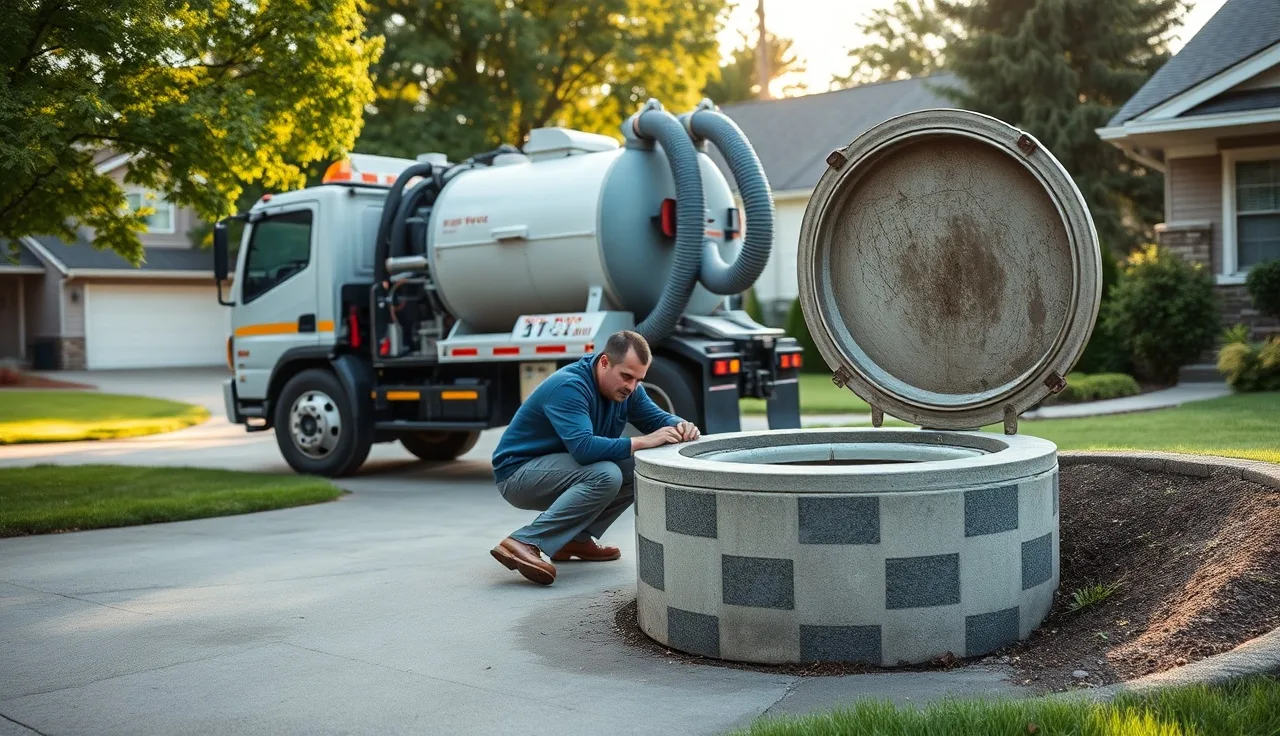
A pumping company drives a vacuum truck to your property, uncovers the tank lids, drops a hose in, and vacuums out everything inside: the sludge settled on the bottom, the scum floating on top, and the liquid effluent in between. The job takes 30 to 60 minutes on a standard residential tank [1].
Emptying the tank is only half the work. A technician doing it right inspects the inlet and outlet baffles while the tank is open, looks for cracks in the walls, checks whether the effluent filter is clogged, and notes the sludge-to-scum ratio so you have a real number to schedule the next visit against. The EPA's SepticSmart program describes a complete service visit as including both pumping and a visual inspection of accessible components [1].
Once the waste is out, the truck hauls it to a licensed septage receiving facility, usually a municipal wastewater plant permitted to accept it. Your technician should hand you a waste manifest or service record showing the volume removed and where it went. In most states that paperwork is legally required, not a courtesy.
Here's what a company should never do: pump only the liquid and leave the sludge behind, skip the inspection, or dump the waste in a field or creek. Any of those is a reason to walk.
How much does septic tank pumping cost?
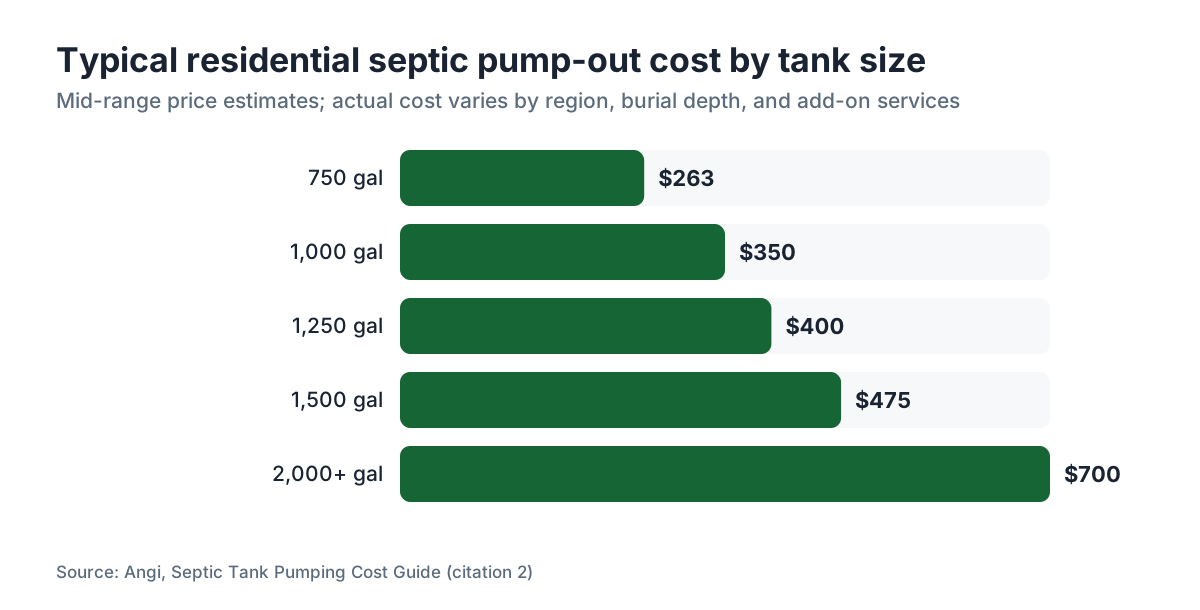
The honest range for a standard residential pump-out is $250 to $600 in most U.S. markets, with the national average around $400 to $500 for a 1,000 to 1,500-gallon tank [2]. Tank size, burial depth, access, and your local market move the number.
| Tank size (gallons) | Typical cost range |
|---|---|
| 750 | $175, $350 |
| 1,000 | $250, $450 |
| 1,250 | $300, $500 |
| 1,500 | $350, $600 |
| 2,000+ | $500, $900+ |
Extra charges show up on plenty of invoices: uncovering buried lids ($50 to $150 per lid), effluent filter cleaning ($25 to $75), locating a tank with no records ($75 to $200), and emergency or weekend service (often 1.5x to 2x the standard rate). Ask about all of them before you book.
In markets like septic tank pumping in Tampa and the broader Florida Gulf Coast, prices run a little below the national midpoint because sandy soils mean shallower tanks and quicker access. Don't count on big savings if your tank hasn't been touched in a decade and is packed with sludge.
Get three quotes before you hire. It costs you an hour. A $150 spread on identical service for the same tank is common. The cheapest quote is sometimes a fine deal and sometimes a signal that the company skips the inspection or cuts corners on disposal paperwork.
How often should you pump your septic tank?
The EPA recommends pumping every 3 to 5 years for most households [1]. The real interval turns on four things: tank size, how many people live there, how much wastewater you generate daily, and how fast solids build up (a garbage disposal speeds that up a lot).
The pumping frequency table from West Virginia University's National Environmental Services Center makes it concrete. A 1,000-gallon tank serving two people needs pumping roughly every 5.9 years. The same tank serving six people needs it every 1.5 years [8]. See how often to pump septic tank for the full breakdown by household size.
A good pumping company tells you, based on the sludge depth they measured today, when to schedule the next visit. If they can't give you that answer, they didn't measure.
One thing the industry agrees on: don't stretch past 5 years no matter how few people live in the house. Once sludge builds past a certain point, it starts escaping into the drain field, and a clogged leach field costs $5,000 to $20,000 to repair or replace. Regular pumping is about the cheapest insurance you can buy for your property.
How do you find and vet a reputable pumping company?
Start with your state's environmental or health agency website. Most states keep a public database of licensed liquid waste haulers or septage management contractors. In Florida, septic tank contractors must hold a Septic Tank Contractor license issued by the Department of Health under Chapter 489, Part III, Florida Statutes [3]. Hiring an unlicensed operator puts you on the hook legally and financially if something goes wrong.
What to check before you book:
- State license number (ask for it, then verify it in the state database).
- Proof of liability insurance and, for crews entering confined spaces, workers' comp coverage.
- Whether they use a waste manifest and can name the facility they haul to.
- How long they've worked locally. Ten years of Google reviews is easier to read than three.
- Whether the quote is all-in or open to surprise add-ons for lid access and the like.
Online reviews help, but they only go so far. A company can hold 4.8 stars and still skip the inspection every time. Ask one pointed question on the phone: "Do your techs inspect the baffles during a pump-out, and do you leave a written service record?" The answer tells you more than the star rating does.
Word of mouth from neighbors on the same kind of system is still one of the most reliable signals you'll get. Local Facebook groups and Nextdoor threads surface the same patterns over and over: which companies show up on time, and which ones invoice for work they never did.
What should the service visit look like from start to finish?
Knowing the normal sequence is how you catch a bad one. Here's what a proper visit looks like.
The tech arrives, asks where the tank is or pulls it from prior records, and locates the lids. Those sit 6 to 18 inches below grade on older systems and at or near grade on newer ones with risers. They uncover both the inlet and outlet compartments, which means more than one lid.
The hose goes in and pumping starts. While the tank drains, a good tech uses a rod to break up the sludge layer and make sure the truck is pulling solids, more than liquid. Fully emptying a standard tank takes 20 to 45 minutes of active pumping.
With the tank empty, they inspect: inlet baffle intact, outlet baffle or T-pipe intact, no cracks in the walls, no root intrusion, no sign of backflow from the drain field. If there's an effluent filter on the outlet, they clean it. Some companies photograph the open tank for the service record. Nice touch when they do.
They re-cover the tank and backfill any hole. You get a written receipt or digital record with the date, estimated gallons removed, the disposal facility, and any observations or recommendations.
If the tech is back in the truck and gone in under 20 minutes, ask what they found during the inspection. Nobody finishes a real pump-out and inspection in 15 minutes.
What are the signs your septic tank needs pumping now?
Most tanks stay quiet until something's already going wrong. The warning signs worth acting on the same day:
Slow drains across the house (more than one fixture, since a single slow drain is usually a line clog) point to a full tank or a blocked outlet. Gurgling from toilets or drains after a flush says the same thing.
Wet, spongy ground over the drain field, or a bright green patch of grass above it, means liquid is surfacing. That's a drain field problem, often set off by a tank that's been pushing solids into the field. See leach field for what happens next.
Sewage odors inside the house or near the tank. A brief odor outside right after pumping is normal. A persistent one is not.
Sewage backing up into the lowest fixtures, usually a ground-floor toilet or tub drain, means the system is full or blocked. Call a company today.
Just bought a home and don't know the pump-out history? Schedule one. A septic tank inspection at purchase should have flagged the tank's condition, but if it didn't, get a pump-out and a baseline measurement inside the first year.
What's the difference between pumping, cleaning, and emptying?
Homeowners and companies swap these terms around, which breeds confusion. Here's what each one means in practice.
Septic tank pumping is the standard service: vacuum the contents out, haul them away. Most companies use this term for their routine work.
Septic tank cleaning sometimes means a more thorough job, including rinsing the walls with a portion of the effluent (called back-washing or rinse-back) to knock loose sludge caked on the interior. Worth doing every other pump-out, or any time the tank has gone years without attention. Not every company folds it into the standard price.
Septic tank emptying and septic tank pump out mean the same thing as pumping. The word choice is mostly regional.
What none of these cover: repairs to baffles, risers, effluent filters, or the distribution box. If the tech finds a broken baffle or a cracked tank during the pump-out, that's a separate septic tank repair job. Some pumping companies do both; others refer it out. Ask before you book whether they can handle minor repairs on the spot, so you're not paying for a second trip.
How do pumping companies dispose of septage legally?
Federal law under 40 CFR Part 503 sets the standards for how septage (the material pumped from septic tanks) gets treated and disposed of [4]. The legal routes: land application to permitted agricultural sites, treatment at a licensed septage receiving facility, or co-treatment at a municipal wastewater plant that accepts it.
In practice, most residential pumpers haul to a municipal plant. The state environmental agency licenses both the hauler and the receiving facility. Your service manifest should name the disposal site.
Why should you care? If a company dumps septage illegally, some states can hold you liable as the waste generator, and the fallout can contaminate nearby wells and waterways. A few minutes of verification now saves that headache.
Ask the company straight: "Where do you haul the waste?" A legitimate one answers without a pause. Vague or evasive answers about disposal are a hard stop.
Should you use septic additives or treatments between pump-outs?
This question comes up constantly, so I'll be blunt. The EPA states there is "little scientific evidence that biological additives... improve the performance of a well-maintained septic system" [9]. The National Onsite Wastewater Recycling Association takes the same line [10].
The bacteria that break down waste in a healthy tank come from the waste itself. Enzyme or bacterial products don't remove the need to pump, and some chemical additives (especially solvents sold to "unclog" a system) can kill the biology in the tank and wreck the drain field.
Money spent on monthly additive products is, in my view, mostly wasted. Put it toward pumping on schedule instead. A system recovering from an antibiotic overload (a household on heavy antibiotics for weeks) or a long vacancy can sometimes benefit from a biological restarter, though even there the evidence is thin.
If a pumping company tries to sell you an additive subscription as part of the package, that's a profit center for them, not a service to you.
How do septic tank pumping companies operate differently across regions?
Licensing, inspection rules, pumping intervals, and pricing swing hard from state to state and sometimes county to county. Florida requires both a Septic Tank Contractor license and registration of the vacuum truck as a sanitary transport vehicle under Department of Health rules [3]. California hands most septic regulation to county environmental health departments, so requirements shift by county. Texas regulates septic maintenance contractors through the Texas Commission on Environmental Quality [5].
Some regions run mandatory pump-out or inspection programs tied to property sales or a fixed calendar. King County, Washington requires an inspection and pump-out before a property sale [6]. Parts of New England have adopted similar rules to protect groundwater.
In high water table markets (coastal Florida, parts of the Gulf Coast, much of the Northeast), tanks can float out of the ground if they're pumped when the water table is at the surface. Experienced local operators check conditions before they pump. That's local knowledge a national chain doesn't always carry.
If you run a fleet of service calls across several markets, tracking scheduling and compliance across those different rule sets gets genuinely messy. SepticMind's operator tools are built around that regulatory variation, handling service records and manifest tracking by jurisdiction.
The practical takeaway: verify that any company you're weighing is licensed in your state, not in a neighboring one.
What does a pumping company cost versus what does a failed system cost?
Run this comparison once and the math sticks for good.
A pump-out every 3 to 5 years at $350 to $500 a visit works out to $70 to $165 per year in maintenance.
A drain field replacement, the most common result of a neglected system that pushes solids into the field, costs $5,000 to $20,000 depending on soil type, system size, and whether a new site is even available [7]. A full system replacement with a new tank runs $15,000 to $50,000 in many markets. See cost to install septic system and cost to put in a septic tank for current installation ranges.
A septic system repair for a partial failure, like one dead distribution line or a cracked baffle, runs $500 to $4,000.
Annualized pumping costs 1% to 3% of what a drain field replacement costs. There's no scenario where skipping pump-outs saves money over 20 years. None.
The only real question is whether you pump on a schedule or wait for trouble. Waiting costs more almost every time, because the trouble usually shows up after the damage has already started.
What questions should you ask before hiring a pumping company?
Here's the shortlist I'd run before booking anyone:
Are you licensed in this state, and what's your license number? (Verify it before they arrive.)
Do you carry general liability and workers' compensation insurance?
Does your standard pump-out include a baffle inspection, and do you leave a written service record?
Where do you dispose of the waste, and can you show me the facility's permit?
Is the quote all-in, or are there common add-ons like lid access fees?
Can you handle minor repairs (broken baffles, effluent filter replacement) on the same visit, or do you refer those out?
How do you handle scheduling and reminders for the next pump-out? A company that tracks your history and reaches out is easier to deal with than one you have to remember to call.
For operators running multiple service routes, SepticMind's scheduling and manifest tracking tools handle exactly this workflow, keeping service history and state-required documentation in one place.
A company that answers all seven cleanly and doesn't hedge on the license and disposal questions is one worth hiring.
Frequently asked questions
How long does a septic tank pump-out take?
Most residential pump-outs take 30 to 60 minutes from truck arrival to departure, including the inspection. A very full 1,500-gallon tank might run closer to 90 minutes. If a technician is done in under 20 minutes, ask specifically what they observed during the inspection, because a complete job isn't physically possible in that time.
Can I pump my septic tank myself?
No, not practically. Vacuuming and hauling septage requires a licensed vacuum truck, and septage disposal is regulated under federal and state law. Homeowners aren't legally permitted to haul and dispose of their own septage in any U.S. state. You can locate and uncover the lids yourself before the truck arrives to save on excavation fees, but the pumping itself needs a licensed contractor.
What happens if I never pump my septic tank?
Sludge and scum build until they overflow the outlet baffle and enter the drain field. Solids clog the soil pores in the leach field, so effluent can't percolate. Then sewage backs up into the house or surfaces in the yard. Drain field replacement costs $5,000 to $20,000. There's no way to un-clog a biomat-choked field without mechanical intervention or full replacement.
How do I find my septic tank before the pump-out crew arrives?
Check your county health or environmental agency for the original system permit, which usually includes a site plan with the tank location. Failing that, follow the sewer line out from the house (typically 10 to 20 feet from the foundation), probe with a metal rod at 6-inch depth increments, or look for a slightly depressed or raised patch of soil. Older tanks may have no surface markers at all.
Does homeowners insurance cover septic pumping or repair?
Standard homeowners policies don't cover routine pumping; it's considered maintenance. Some policies cover sudden and accidental sewage backup damage to the home's interior, but not repairs to the septic system itself. A few insurers offer septic system endorsements or riders. Read your policy's exclusions carefully; most homeowners are surprised to find their system isn't covered.
Is it okay to pump a septic tank in winter?
Yes, winter pumping is fine in most climates. Frozen ground makes lid access harder, and in extreme cold some truck equipment needs extra warm-up time, but the pumping itself isn't affected. In very northern climates some companies add a winter surcharge. Waiting until spring to address a full tank risks a backup during the thaw, when water tables rise and systems are already stressed.
What is a septic tank effluent filter and should the pumping company clean it?
An effluent filter (also called a baffle filter) sits in the tank's outlet and catches solids before they reach the drain field. Most systems installed after the mid-1990s have one. A clogged filter causes the same symptoms as a full tank: slow drains and backups. The pumping technician should clean or replace it during every pump-out. If they don't mention it, ask.
How do I know if a pumping company is licensed in my state?
Search your state environmental or health agency website for a contractor license lookup tool. In Florida, the Department of Health's license verification portal lets you check a Septic Tank Contractor license by name or number. In Texas, the TCEQ maintains an On-Site Sewage Facility installer and maintainer database. Most states have equivalent public lookup tools. Verify before the truck arrives, not after.
What is a waste manifest and why does it matter?
A waste manifest (sometimes called a septage hauling log) records the volume pumped, the origin address, the hauler's license number, and the receiving disposal facility. Federal regulations under 40 CFR Part 503 require tracking of septage disposal, and most states require the hauler to keep these records for inspection. Your copy protects you if a question ever comes up about illegal disposal linked to your property.
Can a pumping company tell me if my drain field is failing?
A pumping technician can spot certain warning signs during a pump-out: sewage backing up from the outlet side of the tank (a saturated or clogged field), unusually high liquid levels even with normal sludge, and green grass or wet soil above the field. They can flag those observations, but a definitive drain field assessment usually needs a separate inspection, often with dye testing or soil probing.
How should a pumping company handle a tank that's been neglected for 10+ years?
A badly neglected tank often needs multiple passes with the vacuum hose plus back-washing (spraying effluent back in to loosen hardened sludge) to fully empty. Some companies charge more for that, which is fair. More importantly, a long-neglected tank almost certainly has sludge in the drain field by now. The technician should note the baffle condition and recommend a drain field inspection if there are signs of field loading.
What's the difference between a septic pumping company and a septic inspection company?
A pumping company's main job is emptying the tank. An inspection company (or a certified inspector) evaluates system performance, checks all accessible components, may run dye testing, and produces a formal report, often for a real estate deal. Some companies do both. A pump-out includes a basic visual inspection, but it doesn't replace a full system inspection when one's required for a home sale or when you suspect a failure.
Are there any red flags that a pumping company is operating illegally?
Yes. Can't produce a license number on request, won't say where they haul the waste, no written service record after the job, a price far below market (a sign they're skipping disposal costs), and a truck with no company name or DOT number. Septage dumped in a field, ditch, or woods is a federal and state violation. If you witness it, contact your state environmental agency.
Does pumping frequency change if I have a garbage disposal?
Yes, a lot. Garbage disposal use roughly doubles the rate of solid buildup in the tank. The EPA and most state extension programs advise against using a disposal with a septic system, or recommend pumping every 1 to 2 years if you use one regularly. If you have a disposal and have been pumping on a 5-year schedule, cut that interval in half and check the sludge depth at the next visit.
Sources
- U.S. EPA, SepticSmart Program, Homeowner's Guide to Septic Systems: EPA recommends pumping every 3 to 5 years, states that additives lack scientific evidence of benefit, and describes a complete service visit as including pumping plus visual inspection of accessible components.
- Angi (formerly Angie's List), Septic Tank Pumping Cost Guide: National average cost for residential septic tank pumping is approximately $400 to $500, with a range of $250 to $600 for standard 1,000 to 1,500-gallon tanks.
- Florida Department of Health, Onsite Sewage Programs, Chapter 489 Part III Florida Statutes: Florida requires Septic Tank Contractor licensure under Chapter 489 Part III for anyone pumping or maintaining septic systems; vacuum trucks must be registered as sanitary transport vehicles.
- U.S. EPA, Biosolids Laws and Regulations, 40 CFR Part 503: Federal law under 40 CFR Part 503 sets standards for treatment and disposal of septage, including land application, permitted facilities, and co-treatment at municipal wastewater plants.
- Texas Commission on Environmental Quality, On-Site Sewage Facilities: Texas regulates septic maintenance contractors through the TCEQ, which maintains a public database of licensed On-Site Sewage Facility installers and maintainers.
- National Environmental Services Center (NESC), West Virginia University, Septic System Pumping Frequency Table: A 1,000-gallon tank serving two people needs pumping every approximately 5.9 years; the same tank serving six people needs pumping every approximately 1.5 years.
- U.S. EPA, How to Care for Your Septic System: EPA states there is little scientific evidence that biological additives improve the performance of a well-maintained septic system.
- National Onsite Wastewater Recycling Association (NOWRA), Resources: NOWRA recommends against reliance on septic additives and emphasizes routine pumping and inspection as the basis of system maintenance.
Last updated 2026-07-09