Hardware and electronic components inside a septic system
By the SepticMind Editorial Team
TL;DR
- Modern septic systems run on a small set of electronic hardware: float switches, effluent pumps, control panels, high-water alarms, timers, and in advanced systems, aerators, UV disinfection units, and telemetry modules.
- When any of these fail, sewage backs up or discharges untreated.
- Knowing what each part does helps you catch failures early and talk to a technician without getting oversold.
Why do septic systems need electronics at all?
A gravity-fed septic tank with a conventional drain field has almost no electronics. Wastewater flows downhill from the house, separates in the tank, and trickles through gravel and soil under its own weight. That kind of system runs for decades with zero electricity.
Everything changes the moment you add a pump. A mound system, a drip-irrigation field, an aerobic treatment unit (ATU), or any component that sits uphill from the tank or needs timed doses forces you into electrical territory. The EPA estimates that about 20 percent of the roughly 21 million on-site septic systems in the United States are now advanced or alternative designs that depend on electrical parts to work at all [1]. As lots shrink and buildable soils get worse, that share keeps climbing.
Even a basic pump-to-drain-field setup needs a float switch, a pump, and an alarm. ATUs pile on more: blowers, timers, chlorinators or UV lamps, and sometimes cellular telemetry. Learn the hardware stack from simplest to most complex and you can inspect it yourself, talk straight with a service tech, and budget for repairs before a failure leaves you with a yard full of sewage.
What are the main electronic components in a septic system?
Here's a layered breakdown, from the parts found in nearly every pumped system to the ones you only see in advanced treatment units.
Float switches
The float switch is the most common electronic part in any pumped septic system. It's a buoyant plastic or foam ball tethered to a cable inside the tank or pump chamber. As liquid rises, the float tilts and closes (or opens) a circuit. Most systems run two or three floats: one to start the pump, one to stop it, and a third set higher to trip the high-water alarm. Float switches cost $15 to $60 each at supply houses. The labor to replace one inside a wet chamber usually runs $75 to $200 depending on access [2].
Effluent pumps
The effluent pump sits in the pump chamber (a separate compartment in the tank, or a standalone chamber) and moves clarified wastewater to the drain field or treatment unit. Most residential effluent pumps are submersible, rated between 0.5 and 1.0 horsepower, and draw 5 to 10 amps at 120V or 240V. You'll see Zoeller, Liberty, and Goulds in the field constantly. A pump motor typically lasts 7 to 15 years. Replacement, parts and labor, generally runs $400 to $1,200 [2].
Grinder pumps
A grinder pump is the heavy-duty cousin, used in low-pressure sewer systems or when solids have to travel a long distance or uphill. It adds a cutting mechanism ahead of the impeller to macerate solids. These draw more current (often 240V, 10 to 20 amps) and cost $800 to $2,500 to replace.
High-water alarms
A high-water alarm is a float switch wired to a buzzer and a warning light, usually mounted on the outside of the house or on the control panel. EPA's SepticSmart program tells homeowners to respond to a septic alarm right away instead of silencing it and hoping [3]. Most alarms run on 120V, have a test button, and include a silence switch so you can mute the buzzer while the light stays on.
Control panels
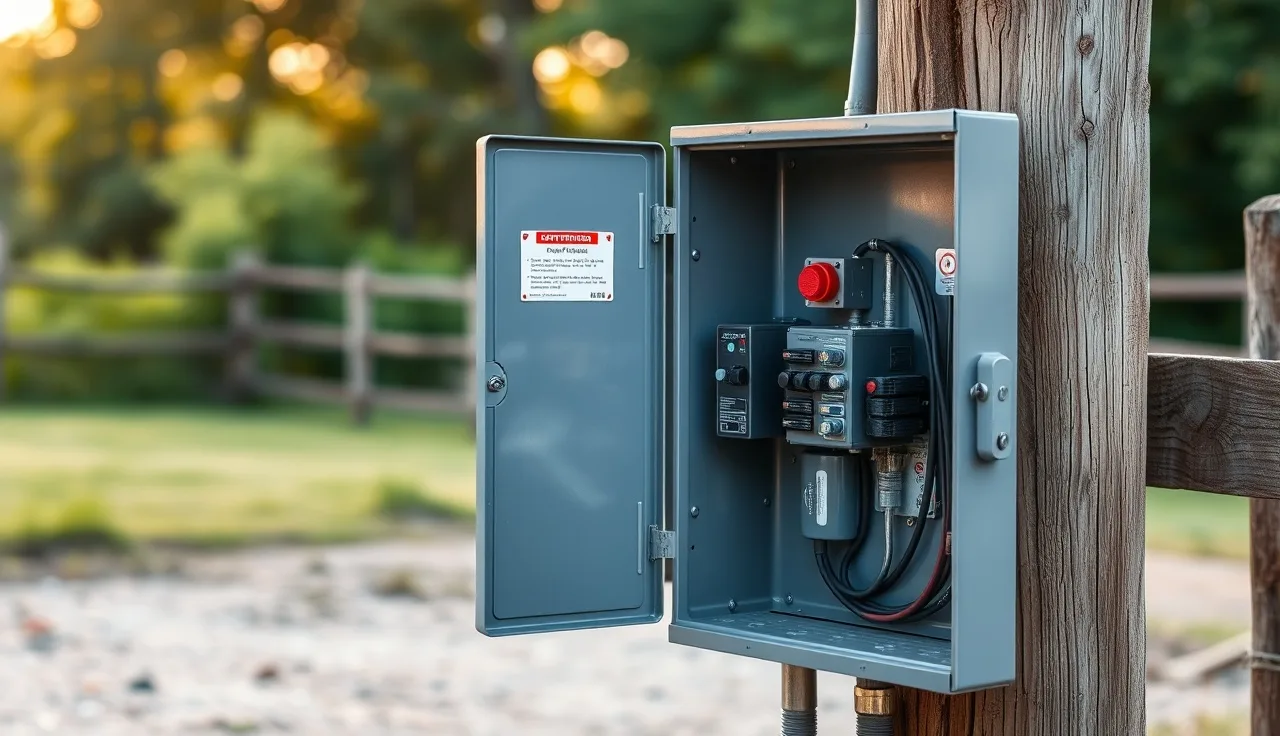
The control panel is the brain of the electrical system. It holds the circuit breaker or fuse for the pump, the timer or demand-dose controller, alarm relays, indicator lights, and sometimes a GFCI breaker. Panels range from a weatherproof box with one breaker and an alarm relay (about $150 to $400 installed) to microprocessor units with LCD displays, data logging, and remote monitoring ($600 to $2,500 and up). Mount the panel on an exterior wall or a post near the tank, never inside the house where fumes could collect.
Timers and demand-dose controllers
Drain fields work better when effluent arrives in small timed doses instead of one big slug after every flush. A timer-based dose controller runs the pump for a set interval (say, 10 minutes) at scheduled times (say, every two hours). A demand-dose controller watches the float and doses only when the chamber fills to a set level. Both cut hydraulic loading on the soil and stretch field life. Programmable timers built for septic use cost $80 to $300 as a component, plus installation.
Aerators and blowers (ATUs)
Aerobic treatment units use an air blower or compressor to inject oxygen into the treatment chamber, feeding aerobic bacteria that chew through waste far faster than anaerobic bacteria alone. The blower runs continuously or cycles on a timer. Blowers are the most frequently replaced part in ATUs, with a service life of 3 to 8 years and a replacement cost of $200 to $600 for the motor and impeller assembly [4].
Chlorinators and UV disinfection units
Many ATUs need a disinfection step before effluent reaches the drain field or surface. Chlorination uses a tablet chlorinator, a small tank of calcium hypochlorite tablets that effluent passes through. UV systems use a low-pressure mercury lamp to kill pathogens with radiation instead of chemistry. UV lamps need replacement every 9 to 12 months; ballasts last longer. Some state codes, including Texas OSSF rules under 30 TAC Chapter 285, require disinfection for ATUs that surface-discharge [5].
Soil moisture sensors and pressure transducers
Higher-end drip-irrigation systems sometimes add soil moisture sensors in the drain field, adjusting dose timing based on actual soil saturation instead of a fixed clock. Pressure transducers watch line pressure to catch clogged emitters. These are niche parts, but they're showing up more in water-scarce western states.
How does a septic control panel work?
Think of the control panel as a junction box with a brain bolted on. At its core it takes incoming power from your home's main panel, protects the pump circuit with a dedicated breaker (usually 15 to 20 amps for a residential effluent pump), and routes the float switch signals to either the pump relay or the alarm relay.
When the pump float tilts up, it signals the pump relay, which closes the circuit and starts the motor. When the lower float tilts back down, the relay opens and the pump stops. If liquid climbs past the alarm float, the alarm relay powers the buzzer and warning light. The silence button breaks the buzzer circuit but leaves the light on, so you know the problem is still live.
In timer-equipped panels, a DIN-rail timer or a programmable logic relay sits in the pump circuit. The timer runs the pump on a schedule and the float acts as an override or interlock instead of controlling the pump directly. Some advanced panels log dose counts and pump run-time to a memory chip or send data by cellular modem. SepticMind integrates with panel telemetry modules so operators can track pump cycles and alarm events across many customer sites without sending a truck.
Panel wiring follows the National Electrical Code (NEC), with Article 682 covering electrical installations around standing water and wet conditions [6]. Local inspectors usually want a GFCI breaker on the pump circuit and a weather-resistant (NEMA 3R or 4X) enclosure. If your panel has no GFCI protection, fix that regardless of the panel's age.
What is a float switch and how do you test one?
A float switch is a mercury tilt switch (older units) or a stainless ball-bearing tilt switch (newer units) inside a sealed plastic housing, wired to two leads. Held horizontal, the switch is open. When the float hangs straight down or tilts past a threshold, the switch closes. Some are wired normally-open (NO) and some normally-closed (NC), so match the replacement to the original wiring.
You can test a float without pulling it from the tank. Set a multimeter to continuity or resistance, kill the power, and clip the probes to the two switch wires at the control panel. With the float hanging down, you'll read either continuity or no continuity, depending on the switch type. Lift the float past its pivot point and the reading should flip. Same reading in both positions means the switch is dead.
For pump floats, many techs run a bucket test: disconnect the switch leads at the panel, bridge them with a jumper to force the pump on, and confirm the pump runs. If it runs with the jumper but not with the float leads, the float is bad. If it won't run even with the jumper, the pump or its wiring is the problem.
Floats are cheap enough that most techs swap all three at once when one fails, especially past the five-year mark. Two extra floats at $40 in parts beats a return trip.
How long do septic system electronic components last?
Service life swings hard based on how corrosive the tank environment is and how often the system gets maintained. The table below gives realistic ranges from manufacturer specs and commonly cited field experience [2][4].
| Component | Typical service life | Replacement cost (parts + labor) |
|---|---|---|
| Float switch | 5 to 10 years | $100 to $300 |
| Effluent pump | 7 to 15 years | $400 to $1,200 |
| Grinder pump | 7 to 12 years | $800 to $2,500 |
| Control panel (basic) | 10 to 20 years | $300 to $700 |
| Control panel (advanced) | 8 to 15 years | $700 to $2,500 |
| ATU blower | 3 to 8 years | $200 to $600 |
| UV lamp | 1 year (bulb only) | $50 to $150 |
| UV ballast | 5 to 10 years | $150 to $400 |
| Chlorinator housing | 10 to 20 years | $100 to $300 |
| Pressure transducer | 5 to 10 years | $100 to $350 |
The single biggest thing shortening component life is hydrogen sulfide gas, which corrodes electrical contacts fast. Panels mounted directly over a tank riser take the worst of it. Given the choice, put the panel on the house wall or a post a few feet back from the tank lid.
What does a high-water alarm mean and what should you do?
A high-water alarm means liquid in your pump chamber or tank has risen above the alarm float, which sits above the normal operating range. The pump should have run and dropped the level. The fact that it hasn't points to a failed pump, a stuck pump float, a pump circuit that lost power, or incoming flow briefly overwhelming the system's capacity.
EPA's SepticSmart guidance is blunt about it: respond to the alarm immediately, cut your water use, and call your septic professional instead of just silencing the buzzer [3]. That's the right move. Don't flush more than you absolutely have to. A pump chamber that overflows pushes partially treated effluent into the drain field, which can clog the field and cost thousands to rehab.
First thing to check yourself: has the control panel tripped a breaker? Reset it once. If it trips again right away, you likely have a wiring fault or a seized pump motor pulling locked-rotor current. Stop resetting and call a technician. If the breaker holds, go to the panel and hit the manual pump override (if there is one) to force the pump on. Listen at the tank. If you hear the pump run and the alarm clears, the pump float is probably stuck. If you hear nothing, the pump has likely failed.
Need to get the tank pumped as an emergency stopgap while you wait for a tech? See our guide on septic tank pump out. Pumping the tank buys time. It doesn't fix the electrical problem underneath.
How do septic system timers and dose controllers work?
Conventional systems run the pump whenever the chamber fills to the activation float, then dose the whole accumulated volume to the field at once. For a lot of older drain fields in good soil, that's fine.
Timers and dose controllers spread that same daily volume across several smaller doses. A typical setup doses for 10 minutes every two hours, with the float as a backup override. Why it matters: saturated soil can't accept effluent. Give the soil time to drain and recover between doses and you head off surface breakout and early field failure.
University of Minnesota Extension work on mound systems found that timed dosing extends the aerobic treatment zone in the soil compared to surge dosing [7]. Population-level failure-rate data is hard to pin down, because long-term field studies take decades to run.
Most timers sold for septic use are standard DIN-rail 24-hour or 7-day programmable relays, the same kind used in HVAC and irrigation. What matters is that they're rated for the pump's inrush current (pumps draw 3 to 6 times their running current on startup). A timer rated only for resistive loads burns its contacts fast. Look for a relay rated at least 20 amps for pump service, or run a separate contactor downstream of a lighter-duty timer.
What electronics do aerobic treatment units (ATUs) add?
Aerobic treatment units are their own category. In a conventional septic tank, anaerobic bacteria do the work without oxygen. An ATU pumps air, continuously or in cycles, to build an aerobic environment that produces cleaner effluent. EPA's technology fact sheet on aerobic treatment units reports 85 to 95 percent reduction in biochemical oxygen demand (BOD) compared to conventional septic tanks [8].
The electronics in an ATU usually include:
- Air blower or compressor, running on 120V or 240V, cycling on a timer or running continuously.
- A blower control timer, often a simple interval timer or a programmable relay.
- A blower-failure sensor, either a current-sensing relay that catches the blower motor dropping its draw, or a differential pressure switch that catches loss of air flow.
- A pump to move aerated effluent to the disinfection stage (separate from the final effluent pump).
- Disinfection hardware: a UV lamp with its ballast and a flow sensor, or a chlorinator with a level sensor for tablet monitoring.
- The alarm panel, usually more complex than a plain high-water buzzer, with separate indicators for blower failure, high water, and disinfection failure.
Some state health departments make ATU owners keep a service contract with a licensed ATU servicer. Texas requires a two-year maintenance contract for all new ATU installations under 30 TAC Chapter 285 [5]. That contract usually covers quarterly inspections of every part on this list.
Thinking about an ATU? The electronics service is a real line item in the total cost of ownership. Our breakdown of the cost to install septic system covers that in detail.
Can you add remote monitoring or telemetry to a septic system?
Yes, and it keeps getting easier. Remote monitoring modules tap into the existing alarm relay in the control panel and send an alert by cellular or WiFi when the alarm trips. Fancier units log pump run-time, count dose events, and report tank level through an ultrasonic or pressure transducer sensor.
For homeowners, the point is peace of mind while you travel. A cellular alarm notifier that texts you when the high-water alarm fires costs $100 to $300 for the hardware plus a cellular plan, usually $5 to $15 a month.
For service operators, fleet-wide telemetry rewrites the maintenance model. Instead of waiting for a customer to call about a sewage smell, the operator sees a pump run-time anomaly (the pump running longer than usual, a sign the drain field is backing up) and books a visit before it fails. Platforms like SepticMind pair that telemetry with service scheduling, customer records, and compliance tracking so operators can run dozens of ATU accounts without missing inspection deadlines.
One practical warning: cellular signal at a buried tank is often lousy. Most telemetry modules go in the above-ground control panel, not the tank. The antenna usually sits on the panel lid or runs to a nearby eave.
What electrical code requirements apply to septic system wiring?
Septic electrical work falls under the National Electrical Code. Article 682 (Natural and Artificially Made Bodies of Water) applies to submersible pumps in wet environments, and Article 547 (agricultural buildings) is what some regulators apply to rural septic installations [6]. On top of the NEC, most states have their own onsite wastewater codes with electrical rules.
The requirements that hold across most jurisdictions:
- A dedicated circuit from the main panel to the septic control panel, sized for the pump's full-load amperage plus at least 25 percent headroom.
- GFCI protection on the pump circuit. Required in many states, good practice everywhere.
- A disconnect at the control panel so a technician can kill power to the pump without walking back to the main panel.
- NEMA 3R minimum (rain-tight), or NEMA 4X (watertight) for outdoor panels.
- All conduit and fittings rated for wet locations.
- Burial depth for underground wiring: the NEC calls for 24 inches for direct-buried conductors, less if the wire runs in conduit [6].
EPA's SepticSmart program tells homeowners to have their systems, electrical parts included, inspected every one to three years depending on system type [3]. Many state codes make regular inspections mandatory for ATUs. Keeping your septic tank inspection records current is a good habit either way.
Buying a home on septic? Ask straight out whether the panel has GFCI protection and when the pump was last replaced. Both are negotiating points if the answer isn't good.
How much do septic electronic component repairs cost?
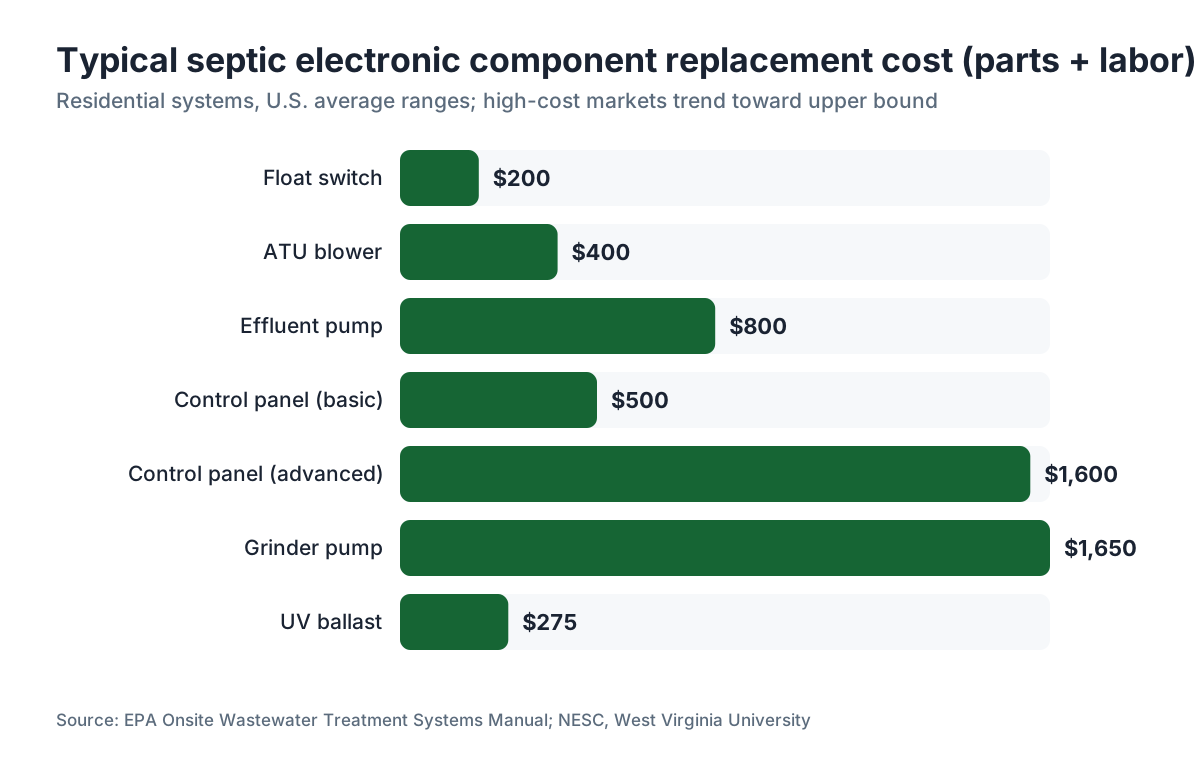
The range is wide because labor dominates, and rates run from roughly $75 an hour in rural areas to $175 an hour in high-cost metro markets. The table earlier in this article gives part-plus-labor ranges. Here's the context behind those numbers.
A float switch replacement sounds cheap, and the part is. But getting to it means locating the tank riser, confirming the lid is reachable, and working in a wet, confined space. If the riser is buried under a foot of soil and the lid is concrete, the labor cost climbs before the tech ever touches the float.
Pump replacement is the most common big repair. The pump itself, for a residential effluent job, runs $150 to $500 depending on horsepower and brand. A contractor marks that up, so expect $300 to $800 in parts on the invoice, plus 1 to 3 hours of labor. Emergency calls (the alarm went off at 10 PM on a Friday) add a premium of $100 to $300 in most markets.
Control panel replacement is worth two quotes. A basic single-pump alarm panel is a commodity item. Some supply houses sell them assembled and pre-wired for $200 to $400, and an electrician or septic tech swaps a panel in two to four hours. If a contractor quotes you $2,500 for a basic panel, that number deserves scrutiny.
For broader cost context, our guide on septic system repair breaks down what drives prices across different failure types.
How do you troubleshoot a septic pump that won't run?
Start at the power source, not the pump. A methodical approach saves time and keeps you from pulling a pump you didn't need to.
Step 1: Check the breaker in the main panel and the breaker or fuse in the septic control panel. Reset once if tripped.
Step 2: With power on, check for voltage at the pump terminals in the control panel using a multimeter. You should read line voltage (120V or 240V depending on your pump). If there's nothing, the problem is upstream: a tripped GFCI, a bad relay, or a wiring fault.
Step 3: If voltage is present at the pump terminals, bridge the pump float leads to force the pump on. If the pump runs, the float switch has failed.
Step 4: If voltage is present but the pump won't run even with the float leads bridged, the motor is likely dead or the pump is seized. Megger testing (insulation resistance testing) of the motor windings confirms a motor failure before you pull anything.
Step 5: Pull the pump only after you've confirmed motor or impeller failure. Pumps are heavy and the chamber is hazardous (hydrogen sulfide gas, pathogen risk). If you're not a trained technician, stop at step 4 and call a pro. Never enter a tank or chamber without proper confined-space equipment [9].
Regular maintenance, including the septic tank pumping schedule for your system size, takes load off the pump and stretches its life. A pump running constantly because the tank never gets pumped fails years early.
Frequently asked questions
What type of pump is used in most residential septic systems?
Most residential septic systems use a submersible effluent pump rated 0.5 to 1.0 horsepower, running on 120V or 240V single-phase power. These move clarified liquid (not raw sewage) from the pump chamber to the drain field. Grinder pumps are used when solids have to be macerated for transport, typically in low-pressure sewer connections or when pumping long distances uphill.
How often should septic system electronic components be inspected?
EPA's SepticSmart program recommends inspecting all system components, electrical parts included, every one to three years. ATUs under service contracts are typically inspected quarterly. At minimum, test your high-water alarm annually with the test button on the panel, and listen for unusual pump noises during routine visits. Catching a failing float switch early costs a fraction of what a pump chamber overflow or drain field repair runs.
Can I replace a septic float switch myself?
Replacing the wires and float housing inside the tank means working near raw sewage and hydrogen sulfide gas, which is dangerous without training and PPE. That said, many float switches terminate at a junction box at grade level, and replacing the wires above ground is straightforward if you're comfortable with basic electrical work and you cut power to the circuit first. When in doubt, call a licensed septic or electrical contractor.
Why does my septic alarm keep going off after a storm?
Heavy rain saturates the soil around the drain field, cutting its ability to accept effluent. At the same time, groundwater can seep into older tank lids and risers, raising the liquid level artificially. Both push the level above the alarm float. The alarm is doing its job. Reduce indoor water use until the soil drains. If storm alarms become a pattern, have a technician check for tank lid infiltration and drain field condition.
What is the difference between a pump float and an alarm float?
A pump float controls when the effluent pump turns on and off; it sits lower in the chamber at the normal operating range. An alarm float sits higher, above the pump-off level. If liquid reaches the alarm float, it means the pump failed to remove water as expected. The two floats wire to separate relays in the control panel: one to the pump motor circuit, one to the alarm buzzer and light.
How do I know if my septic blower has failed on an ATU?
Most ATU control panels have a blower-failure indicator light. If that light is on, or the alarm sounds and the high-water light is off, suspect the blower. Confirm by listening at the blower housing for motor noise and checking for air flow at the diffuser inside the tank (visible through the access lid). A failed blower lets the tank go anaerobic within days, sharply degrading effluent quality.
Does a septic system need a dedicated electrical circuit?
Yes. Pump motors draw high starting (inrush) current, up to six times their running amperage, and sharing a circuit with household loads causes nuisance tripping and voltage sag. Most codes and all good practice require a dedicated circuit from the main panel, protected with a breaker sized at 125 percent of the pump's full-load amperage, with GFCI protection at the septic panel.
What does NEMA 4X mean on a septic control panel?
NEMA 4X is an enclosure rating: the box is watertight, dust-tight, and corrosion-resistant (the X means stainless steel or fiberglass construction). Outdoor septic panels need at least NEMA 3R (rain-tight). NEMA 4X is better near tanks because hydrogen sulfide and moisture chew through standard steel enclosures. It costs more upfront and saves on panel replacements down the road.
Can a septic pump run continuously and is that a problem?
A pump running continuously means the system is taking more flow than it's designed for, the pump float is stuck in the on position, or the pump chamber is taking on groundwater infiltration. Continuous operation overheats the motor and burns it out early. It also floods the drain field. If you notice the pump running non-stop (you can hear it, or the indicator light stays on), treat it as urgent.
Are UV disinfection units better than chlorine tablet systems for septic ATUs?
UV disinfection needs no chemical handling, makes no disinfection byproducts, and performs consistently when the lamp is clean and within its service life (usually one year). Chlorine tablets are cheaper upfront but need regular replenishment and put chlorinated compounds in the effluent. Some state codes specify which method is acceptable for surface-discharge systems. Check your local regulations before choosing.
How deep should the electrical conduit be buried going to the septic pump?
The National Electrical Code requires direct-buried conductors at least 24 inches deep when running to equipment in wet or submerged locations. Conductors in rigid metal or intermediate metal conduit can go shallower, and PVC conduit has its own allowance. Local amendments may be stricter. Have a licensed electrician confirm the burial method meets both the NEC and your local inspector's requirements before you backfill.
What happens if you ignore a septic high-water alarm?
Ignore it and effluent keeps rising in the pump chamber until it overflows through the tank outlet or backs up into the house. Untreated effluent saturates the drain field and can permanently clog the soil pores. Field restoration or replacement runs $5,000 to $20,000 or more depending on system type and soil conditions, far more than the pump repair that would have fixed the original problem.
Do gravity septic systems have any electronics?
Conventional gravity systems with no pump have essentially no required electronics. The one common addition is a passive filter alarm at the outlet baffle, a simple float that alarms if the effluent filter clogs and the tank backs up. Some owners add tank-level sensors for monitoring, but they're optional. With no pump, your attention shifts entirely to pumping schedule and drain field condition, not electrical parts.
How do I find the control panel for my septic system?
Most control panels sit on the exterior wall of the house nearest the tank, or on a treated-wood post or conduit stake between the house and tank. They look like a weatherproof electrical box, often gray or beige, with a warning light behind a small window. Can't find it? Trace the electrical conduit from the main panel's dedicated breaker (often labeled septic or pump) through the wall and outside.
Sources
- EPA, Septic Systems Overview: Approximately 20 percent of U.S. homes use on-site wastewater treatment; roughly 21 million septic systems are in operation across the country.
- EPA, Onsite Wastewater Treatment Systems Manual (EPA/625/R-00/008): Effluent pump service life, replacement costs, and float switch component pricing ranges for residential septic applications.
- EPA SepticSmart, Homeowner Tips: EPA SepticSmart recommends responding to a septic alarm immediately, reducing water use, and contacting a septic professional rather than silencing the alarm; inspect all system components every one to three years depending on system type.
- National Environmental Services Center (NESC), West Virginia University, On-Site Wastewater Technical Resources: ATU blower service life of 3 to 8 years and typical replacement cost ranges for residential aerobic treatment unit components.
- Texas Commission on Environmental Quality, 30 TAC Chapter 285, On-Site Sewage Facilities: Texas requires disinfection for ATUs that surface-discharge under 30 TAC Chapter 285 and mandates a two-year maintenance contract for new ATU installations.
- National Fire Protection Association, NFPA 70 (National Electrical Code), Articles 547 and 682: NEC Article 682 governs electrical installations in wet environments including submersible pumps; burial depth for direct-buried conductors is 24 inches.
- University of Minnesota Extension, Septic System Owner's Guide: Timed dosing of drain fields extends the aerobic treatment zone in soil and reduces hydraulic loading compared to single-surge dosing.
- EPA, Wastewater Technology Fact Sheet: Aerobic Treatment Units (EPA 832-F-00-031): Aerobic treatment units achieve 85 to 95 percent reduction in biochemical oxygen demand compared to conventional septic tanks.
- Occupational Safety and Health Administration (OSHA), Hydrogen Sulfide Hazards: Hydrogen sulfide gas is present in septic tanks and pump chambers; confined-space entry requires proper equipment and training.
- CDC, Septic Systems and Private Wells: Untreated or partially treated septic effluent carries pathogens that pose a health risk during service and confined-space work.
Last updated 2026-07-09